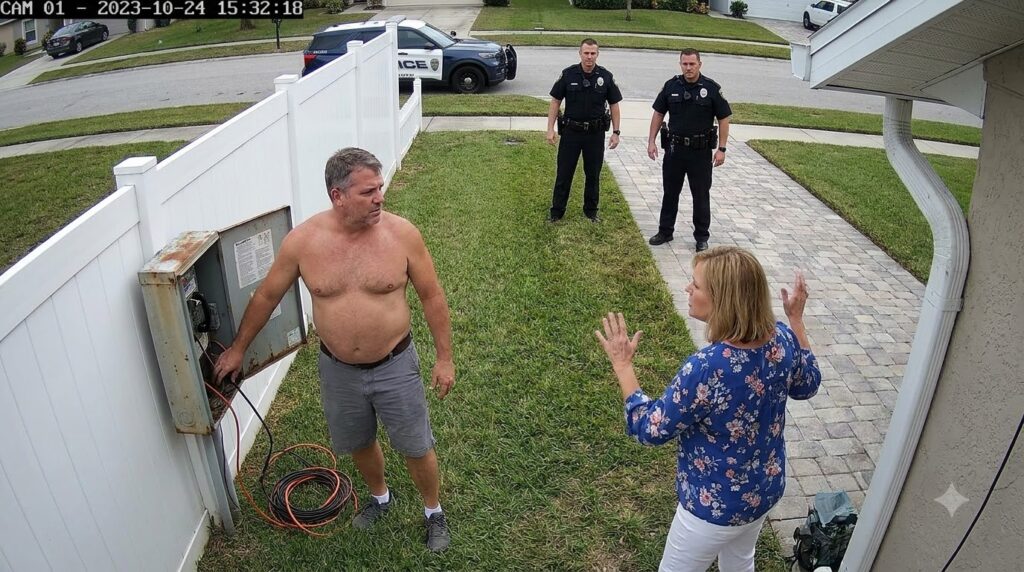
CHAPTER 3: The Man Who Knew the House
The man appeared around the corner of Daniel’s brick garage carrying a hard-sided data reader. He wore a plain gray windbreaker without a municipal insignia, company patch, or visible identification.
His arrival was so calm and deliberate that Daniel immediately wondered how long he had been nearby.
“Let go of her, Mr. Miller,” the stranger said.
Daniel realized that he was still gripping the woman’s collar. In the confusion, he had closed the distance between them and restrained her against the siding, trying to keep her away from the exposed equipment.
He released her and stepped back.
“Who are you?”
The newcomer looked at the discarded cutters in the flowerbed, then at the open utility housing. An amber light pulsed on the device in his hand.
“You’re damaging company hardware,” he said.
“Your employee was cutting my electrical line. She refused to identify herself, and now something underneath my house is vibrating.”
The man glanced at the woman, who had moved away from the wall.
“This is private property,” Daniel continued. “I have a deed. I pay taxes. You don’t get to show up and claim the ground belongs to you.”
“Property rights assume the land beneath your foundation belongs to the surface deed,” the man replied. “Section twelve of the 1994 municipal infrastructure amendment grants right-of-way privileges to any pre-existing subsurface digital artery.”
Daniel recognized the same explanation the woman had given him. Hearing it repeated did not make it more convincing.
“You keep talking about an amendment. Then show me the records.”
The man did not offer a document. He lifted the data reader slightly, allowing its amber indicator to illuminate the open utility housing.
“Your house sits over the primary trunk connecting an old military-industrial relay to the downtown grid. We’re reclaiming our node.”
“Then why was I never informed? Why is there no company identification? Why did your worker cut a live cable?”
The man’s expression remained neutral.
Daniel felt the situation slipping away from ordinary rules. The stranger spoke as though a claim of technical authority should end the conversation. Yet neither man nor woman had provided a verifiable work order, and the second junction box still bore an unfamiliar corporate serial number.
The underground vibration grew stronger.
Daniel stepped toward the woman again, intending to keep her away from the cutters until the police arrived. She moved at the same moment. Her boot caught behind his ankle, and she twisted sharply, using his forward momentum against him.
Daniel lost his balance.
He struck the concrete walkway on his shoulder, the impact driving the air from his lungs. Pain spread down his arm. By the time he managed to roll onto one elbow, the woman had already moved beyond his reach.
She did not run. She retreated toward the man with the data reader, maintaining the same controlled composure she had shown from the beginning.
“You’re too late, Resident,” she said. “The loop has already authenticated.”
Daniel pushed himself upright, fighting through the pain.
“What loop?”
“Check your perimeter.”
He looked toward the street. His phone lay on the concrete, its screen cracked. The call had been interrupted, and he could no longer hear the dispatcher.
Then the man pressed a sequence of keys on his device.
A metallic clack sounded from inside the foundation wall.
Daniel turned toward the utility box. White vapor began hissing from the seams of the secondary housing and from a narrow gap in the siding. It spread along the wall, carrying a sharp smell of cold nitrogen and burned oil.
“What did you just do?” Daniel demanded.
The man closed his fingers around the device.
The sound of a police siren rose in the distance.
Relief came so quickly that Daniel almost laughed. Whatever authority these people claimed, they would now have to explain themselves to someone outside their organization. He could show the officers the damaged cable, the unauthorized junction box, and the unfamiliar corporate label.
The siren grew louder as a patrol car turned onto Elmwood Terrace. Red and blue lights swept across the maple trees and washed over the front of Daniel’s house.
But something else happened.
The facade of the house flickered.
It lasted only a moment, yet Daniel saw the siding, windows, and front entrance distort as though the image of his home had briefly lost its signal. The man looked down at the data reader.
Its display showed one word in bright green letters.
ISOLATED.
He snapped the case shut.
“Let’s see what the county officers say when they run your address,” he told Daniel. “You’ll find out your house was officially condemned and demolished twenty years ago.”
Daniel stared at him.
The police car was approaching the driveway. The man and the woman stood only a short distance away, and neither seemed concerned about the approaching officers.
Daniel had spent seven years living at this address. He had repaired the house, maintained the property, and paid the taxes. The suggestion that it had been demolished before he supposedly moved in was impossible.
He looked toward the utility housing again.
The vapor was thinning, but the vibration continued beneath the concrete.
The patrol car came to a stop.
Daniel turned toward the officer’s approaching headlights, convinced that the evidence would settle the dispute. He had no idea that the most disturbing part of the confrontation was about to begin—not with another threat, but with a government record that denied the existence of the home he had lived in for seven years.