
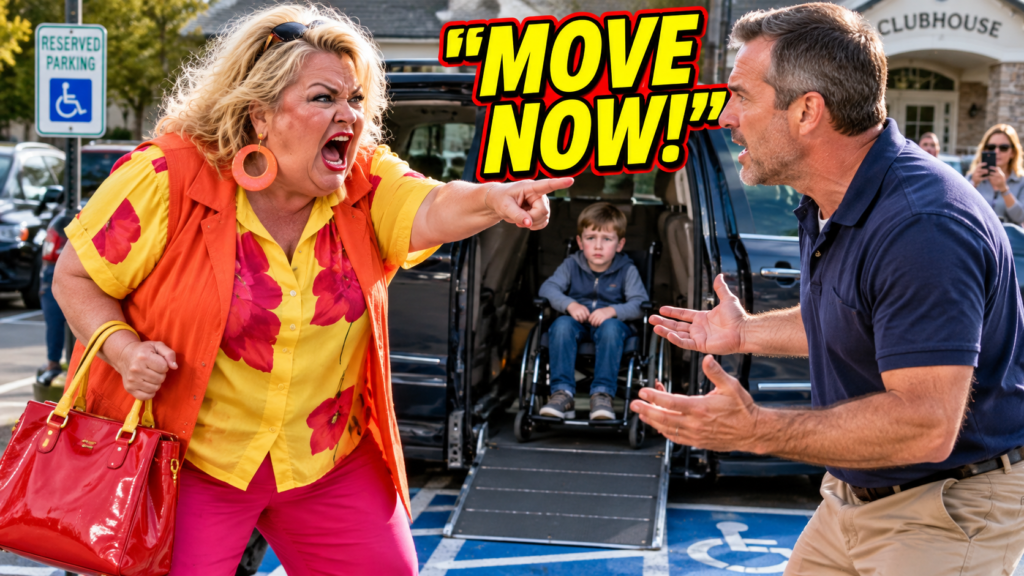
Chapter 6: What the Camera Really Proved
The final HOA meeting was held on a warm Thursday evening.
This time, nearly thirty residents attended.
Daniel sat beside Melissa.
Noah stayed home with his grandmother.
Karen sat across the room.
She looked smaller somehow.
Not physically.
Just less certain.
Harold opened the meeting by stating the purpose.
“This is not a trial of anyone’s character. We’re reviewing conduct and determining what changes are needed.”
That sentence immediately lowered the temperature in the room.
The board presented the parking footage.
Then the phone recording.
Then the previous complaints.
Finally, the board addressed the note.
It had not been written by Karen.
That mattered.
Harold made that clear.
“We cannot turn one person’s misconduct into permission for another person’s misconduct.”
Daniel looked around the room.
Several residents lowered their eyes.
The board’s decision was straightforward.
Karen was formally warned for obstructing accessible parking access and ordered to complete the HOA’s accessibility policy review.
The community would also install clearer pavement markings and signage.
But the board went further.
Residents would receive a written reminder that accessible parking spaces and access aisles were not favors granted by individual residents.
They were there for people who needed them.
Daniel listened quietly.
Then Harold asked if anyone wanted to speak.
Karen stood.
For a moment, Daniel expected another accusation.
Instead, she said something he hadn’t expected.
“I was wrong.”
The room became silent.
Karen looked at Daniel.
“I thought he was taking more than he needed.”
Daniel didn’t respond.
She continued.
“I was so focused on proving that I was right that I never stopped to look at what the space was actually for.”
Her voice cracked slightly.
“I shouldn’t have spoken about your son that way.”
Daniel looked down.
He had imagined many endings to the dispute.
This wasn’t one of them.
Karen sat down.
Daniel stood.
He didn’t want an apology turned into another public argument.
“I don’t need everyone here to agree with me,” he said. “I just want Noah to be able to get out of the car without feeling like he’s causing trouble.”
No one applauded.
There was no dramatic celebration.
Instead, something quieter happened.
Ruth, the older woman who had previously been involved in a parking dispute with Karen, walked to the microphone.
“I’ve needed accessible parking for years,” she said. “And sometimes I’ve moved along because I didn’t want to make a scene.”
She looked at the board.
“Maybe we should stop asking people who need the space to be the ones who accommodate everyone else.”
That sentence stayed with Daniel.
Because it wasn’t really about parking.
It was about dignity.
People often surrendered small pieces of their dignity because fighting for them felt exhausting.
Daniel had nearly done the same.
The meeting ended without shouting.
Outside, Karen waited near the entrance.
When Daniel walked past, she said quietly:
“I’m sorry.”
Daniel stopped.
He didn’t pretend everything was fixed.
But he nodded.
“Thank you.”
Then he continued toward his car.
For the first time in weeks, he felt the tension leaving his shoulders.
The parking lot looked exactly the same.
But something had changed.
The access aisle was clearly marked.
The signs were visible.
And nobody was standing in the middle of it.








