
Chapter 4: A Pattern Nobody Had Seen
The board did not punish Karen that night.
Instead, Harold postponed the decision and asked Linda to review the previous complaints.
That decision irritated Karen.
She wanted an immediate ruling.
Daniel wanted the matter finished.
But the old records changed the nature of the problem.
This wasn’t necessarily a single bad afternoon.
There was a pattern.
Over the next two days, Linda contacted residents named in the old reports.
One was Frank Holloway.
Another was an elderly woman named Ruth.
The third was a retired couple, George and Elaine Miller.
None wanted a confrontation.
They simply provided statements.
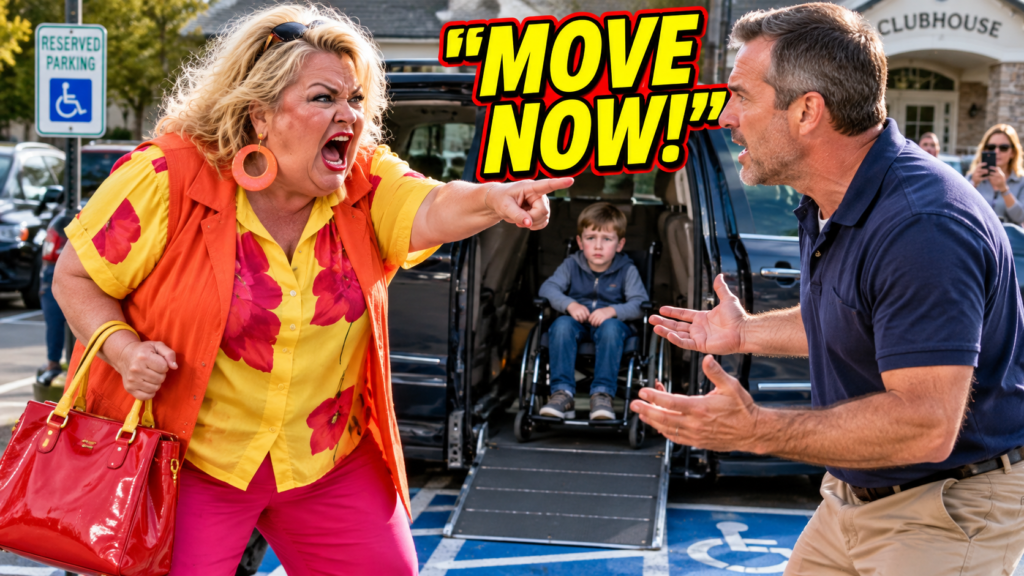
Karen had previously argued with Ruth over a marked accessible space near the pool.
She had complained that George’s temporary disability placard was “probably unnecessary.”
And she had once insisted that Elaine move her vehicle because Karen’s friend was “saving” the same parking area.
None of the incidents had become formal disputes.
People had simply moved on.
Older residents often did that.
They had spent enough of their lives learning that some arguments were not worth the energy.
But Daniel began wondering whether that habit had allowed the problem to continue.
The following Saturday, the HOA board held a private review.
Karen attended.
Daniel attended.
So did Linda.
This time, Karen brought her own evidence.
A stack of printed emails.
She claimed several residents had complained about Daniel’s “aggressive personality.”
Harold reviewed them.
Most were vague.
One said Daniel had “looked angry.”
Another said he had “spoken firmly.”
A third contained no complaint at all.
It was simply an email Karen had sent to a neighbor describing Daniel as difficult.
Daniel said nothing.
He knew what was happening.
Karen was trying to create enough noise that the actual event would disappear inside it.
Then Harold asked a simple question.
“Karen, who were you saving the parking space for?”
Karen hesitated.
“My friend.”
“What is your friend’s name?”
Another hesitation.
“She doesn’t live here.”
Harold looked down.
“Was she coming to the clubhouse?”
“Yes.”
“When?”
Karen couldn’t answer.
Daniel watched her carefully.
Her confidence was fading.
Then Linda placed one final document on the table.
It was a parking-lot access report from the security system.
It showed Karen had occupied or blocked the access aisle several times over the previous six months.
Not every time was a violation.
But the dates lined up with several resident complaints.
Karen stared at the document.
“You’ve been monitoring me?”
Linda shook her head.
“No. The camera records the parking lot.”
That distinction mattered.
Nobody had been hunting for Karen.
The evidence had simply existed.
Harold leaned back.
“This board has to deal with documented conduct, not personalities.”
Daniel appreciated that.
For the first time, he felt the situation moving away from personal revenge and toward something useful.
But then Karen looked at him.
Her expression had changed.
The anger was still there.
But beneath it was fear.
She whispered something that Daniel almost didn’t hear.
“They’re going to take away my parking privileges.”
Daniel didn’t answer.
He had no desire to see her humiliated.
He wanted something simpler.
He wanted Noah to be able to leave the car without having to ask permission from anyone.
The board announced that a formal accessibility review would be held the following week.
Until then, the disputed parking area would be monitored.
Karen left without another word.
Daniel thought the worst was over.
That evening, he discovered a handwritten note under his windshield wiper.
It contained only six words:
You should have left when I told you.








