
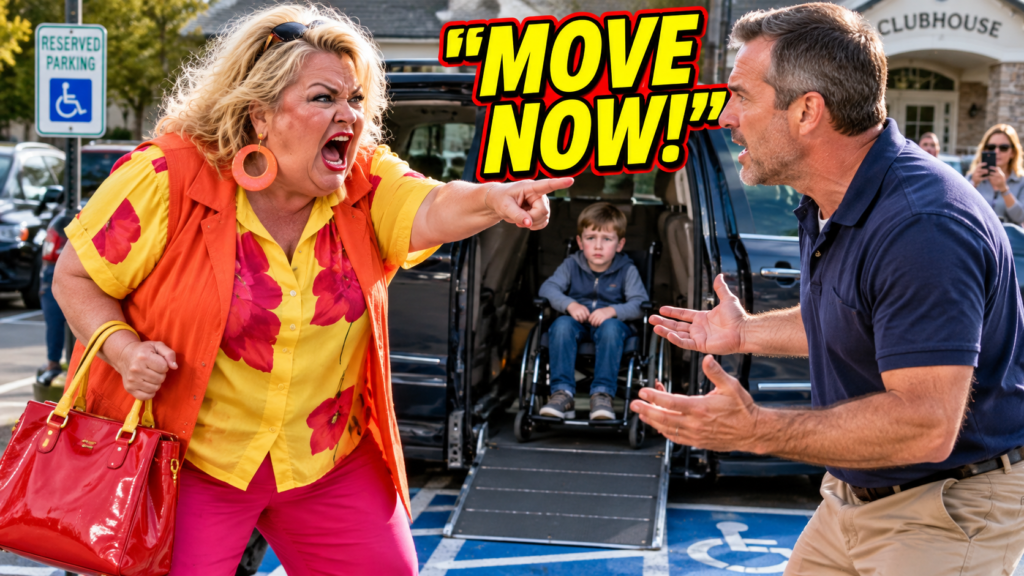
Chapter 1: “Stop! This Spot Is Taken!”
“STOP! You are NOT putting that wheelchair down here!”
Daniel Carter froze with one hand on the rear passenger door of his SUV.
The wheelchair ramp had barely begun to unfold when Karen stepped directly into the striped access aisle and slammed her enormous red handbag against the side of his vehicle.
For a second, Daniel simply stared at her.
Behind him, the automatic lift clicked and stopped.
Inside the SUV, his nine-year-old son, Noah, watched through the window.
Daniel took a breath.
“Move,” he said. “That space is for my child to get out safely.”
Karen spread both arms across the access aisle.
“I said move the car! You don’t get to claim this entire space just because you brought a wheelchair.”
Daniel looked down at the blue accessibility symbol painted on the pavement.
Then he looked at the wide striped area beside it.
“This isn’t a parking space,” he said. “It’s the access aisle. The ramp needs it.”
Karen rolled her eyes.
“I’ve lived here longer than you.”
That sentence might have ended the argument if Daniel had been the kind of man who enjoyed confrontation.
He wasn’t.
For most of his adult life, Daniel had learned to choose patience over pride. After his wife died three years earlier, he had learned something even harder: sometimes keeping the peace meant swallowing anger for the sake of his child.
But today, patience had a limit.
Behind them, another SUV rolled into the lane and stopped.
A horn sounded.
Karen didn’t move.
A second car arrived.
Soon, a small line began forming behind Daniel.
“You’re blocking everybody,” Daniel said.
“Maybe they should learn to wait.”
Noah lowered his eyes.
Daniel noticed.
That was when his voice changed.
“You’re making my son wait because you refuse to move five feet.”
Karen gave a short, sarcastic laugh.
“Maybe your son should learn that other people matter too.”
A resident nearby lifted a phone.
Karen immediately pointed at him.
“Put that phone away! You’re twisting everything I said!”
Daniel glanced at the phone, then back at Karen.
“Good,” he said quietly. “Let them see where you’re standing.”
Karen’s face tightened.
Then she pointed toward Noah.
“Having a wheelchair doesn’t make your family more entitled to this space than everyone else!”
The words hung in the air.
Daniel didn’t answer.
Instead, he closed the SUV door gently.
He walked around to the driver’s side.
Karen smiled, believing she had won.
But Daniel wasn’t leaving.
He was pulling out his phone.
He opened the HOA resident app and took a photograph of Karen standing in the access aisle.
Then he photographed the parking sign.
Then the position of his SUV.
Karen’s smile disappeared.
“What are you doing?”
“Documenting it.”
“You can’t photograph me!”
Daniel looked at her calmly.
“I just did.”
Before Karen could answer, the clubhouse’s front doors opened.
An older man named Frank Holloway stepped outside.
He had been on the HOA board for nearly fifteen years.
He looked at the line of cars.
Then at Karen.
Then at the wheelchair ramp.
His expression changed.
“Karen,” he said, “why are you standing there?”
Karen turned toward him.
“I was protecting a parking spot.”
Frank looked at the blue symbol on the pavement.
“No,” he said. “You were blocking the access aisle.”
Karen’s face flushed.
And Daniel noticed something else.
Above the clubhouse entrance was a small black security camera pointed directly toward the parking lot.
For the first time, Karen stopped talking.
Daniel followed his gaze.
“So,” he said, “maybe we should see what that camera recorded.”
Karen’s hand tightened around her red handbag.
The argument was no longer about a parking space.
It was about what the camera had seen.
And Daniel had no idea yet just how much it had captured.








