The Edge of the Lot: A Narrative of Gritty Suburban Endurance and Rusted Truth
CHAPTER 1: THE DRIVEWAY SEAM
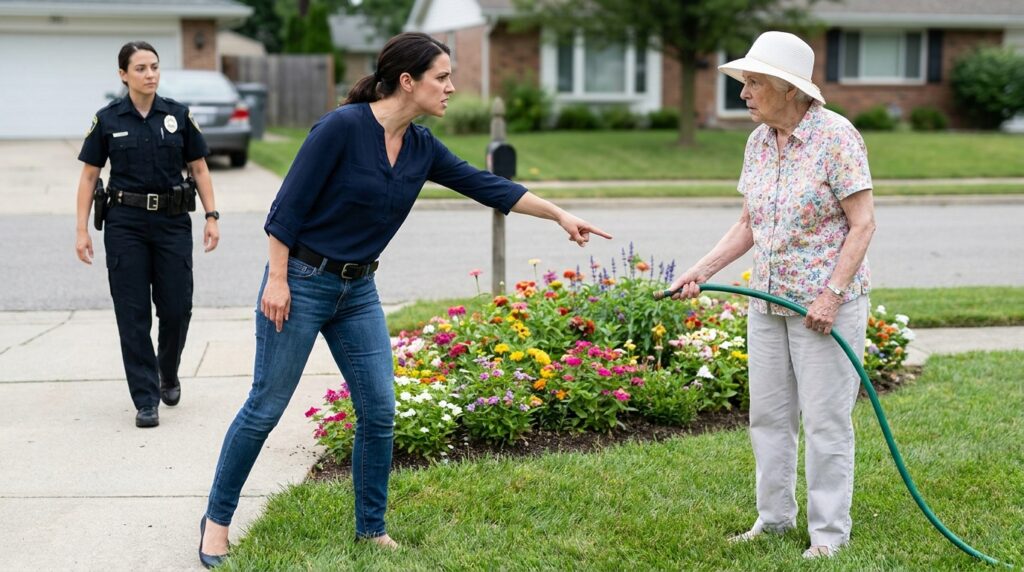
The heat rose from the asphalt in desaturated waves, blurring the sharp, uniform lines of the opposite roofs. Eleanor Vance kept her fingers closed tightly around the brass nozzle of the green rubber hose. The rubber was old, its surface webbed with fine, sun-baked cracks that left a faint gray residue on her palms. She didn’t turn the spigot. Water was expensive this month, and every gallon had to be calculated against the weight of the heat. Under the wide brim of her white sunhat, the air smelled of dry iron, scorched grass, and the bitter dust Amanda’s tires had kicked up when she took the corner too fast.
“Look at the map, Eleanor. Just look at it.” Amanda Cross didn’t look at the sky or the street; her eyes were locked on the small, square patch of perennial phlox that separate the two driveways. She stood three inches deep into the turf, her black leather belt creaking slightly as she shifted her weight. Her index finger was extended, rigid and pale against the dull navy of her blouse, pointing down at the roots. “The easement isn’t a suggestion. This is municipal property value we’re talking about. My appraiser comes out on Friday, and I won’t have a half-dead jungle dragging down the block’s baseline.”
Eleanor didn’t lift her head enough to give Amanda her eyes. She focused instead on the hem of Amanda’s jeans, where the denim met the dry blades of fescue. The fescue had been planted by Thomas thirty-five years ago, a drought-resistant strain that grew thick and stubborn, resisting the sterile clover mixes the newer couples brought in on flatbed trucks. Her late husband’s hands seemed to linger in the uneven grading of the soil beneath her shoes. She felt very small in her floral blouse, her ribs aching with the physical exertion of simply remaining upright against the volume of Amanda’s voice.
“I am just watering my flowers, Amanda,” Eleanor said. Her voice lacked the sharp resonance of the younger woman’s; it was dry, sparse, like the rattle of seed pods in autumn. She didn’t offer an excuse. She didn’t mention the thirty-two years she had weeded this specific lane before Amanda’s down payment was even a line in a banking ledger.
“You’re encroaching,” Amanda snapped, her posture leaning forward, crowding the space between them until the shadow of her shoulder fell across Eleanor’s boots. “The neighborhood circle doesn’t tolerate historical immunity anymore. We have standards. If you can’t maintain the line, the city will clear it for you.”
Across the street, a garage door rumbled upward with a mechanical groan, a neighbor pausing with a plastic gas can in hand to watch the perimeter line. The sudden hush of the block was heavy, the kind of stillness that precedes a sudden shift in the wind. Eleanor’s knuckles turned white against the brass coupling. The weight of the house behind her—the leaking flashing near the chimney, the creaking floorboards, the empty kitchen—felt like a physical load pressing her into the dirt. She couldn’t step back. To step back was to cede the first inch of a fifty-year perimeter.
The heavy, rhythmic clink of a utility belt broke the silence before the engine even cut out. A dark blue municipal cruiser pulled flush against the concrete curb, its tires scuffing the gutter. Officer Reynolds stepped onto the grass, her uniform crisp, her boots breaking the dry stalks of weeds with a deliberate, even stride that went straight for the center of the seam.
Reynolds didn’t look at the flowers. She looked at Amanda’s finger, then at Eleanor’s small, braced frame. “Ma’am,” the officer said, her voice dropping into the space like an iron gate. “Take one step back and tell me what happened.”
Amanda’s hand remained frozen in the air for one microsecond, her index finger pointing directly into Eleanor’s chest. Written on the inside of Amanda’s wrist, half-hidden by her watch strap, was a faint, blue-inked number—not a phone number, but a series of county coordinates that Eleanor had never seen before.

CHAPTER 2: THE LINE IN THE DUST
“I said step back, ma’am.” Officer Reynolds did not unholster her weapon, but her right hand rested firmly against the heavy nylon edge of her utility belt, right above the matte-black casing of her pepper spray. The heavy metal links of her gear rattled with a dull, industrial click as her weight shifted.
Amanda’s chest heaved under the navy cotton of her blouse. For a second, her jaw stayed locked, her eyes darting from Reynolds’ silver badge to the small, sunhat-shaded face of Eleanor. The entitlement that had driven her across the asphalt was still vibrating through her limbs, but the presence of the blue uniform was a physical wall. She pulled her foot back across the seam of the driveway, her heel scraping against the brittle fescue with a dry, ripping sound.
“She’s over the easement,” Amanda said, her pitch rising, though she kept her volume tight under the officer’s steady gaze. She held her wrist up, almost unconsciously, exposing the blue-inked coordinates scrawled across her skin. “I have the plat maps from the neighborhood association ledger. The city guidelines state that any non-conforming perennial structure within thirty-six inches of the municipal curb is subject to immediate removal. I am within my rights to issue a civil notification.”
Eleanor let out a slow, shallow breath, her thumbs rubbing the cracked rubber of the hose. The heat seemed to press heavier now that the shouting had stopped, thick with the smell of exhaust and unwatered earth. “The ledger from the association isn’t the town ledger, Amanda,” Eleanor said softly. Her voice didn’t shake, but it carried the brittle, papery texture of someone who hadn’t spoken more than ten words a day since winter. “Thomas built these stone borders with the town surveyor standing right where that cruiser is parked. In 1976.”
“1976 doesn’t govern this block anymore,” Amanda spat, her eyes flashing with a cold, financial calculus. “The infrastructure bond was restructured in nineteen-ninety-two. Your old papers are dead weight, Eleanor.”
“That’s enough,” Officer Reynolds cut in. She stepped fully into the gap, her boots grinding a fallen twig into the dry dirt at the edge of the flower bed. The movement was practiced, tactical, breaking the visual line between the two women. She turned her torso sixty degrees, shielding Eleanor with her left shoulder while face-to-face with Amanda. “Ms. Cross, is it? Did you call this in as a disorderly neighbor dispute?”
“I called because she is refusing to comply with a property line audit,” Amanda said, her hand dropping to her side, though her fingers remained clenched into a rigid fist. “She’s maintaining an attractive nuisance. These beds collect runoff, they breed mosquitoes, and they block the line of sight for the corner lot. My appraiser is coming on Friday. If this isn’t resolved, it goes to the county compliance board.”
Reynolds pulled a small, ruggedized digital tablet from her side pocket. The screen caught the glare of the July sun, reflecting a harsh, white square against her uniform. Her thumb clicked through three screens with a dull, plastic snap. “The dispatch got a call about a verbal altercation at an easement line. No active property destruction, no physical trespass reported before I arrived. What I see right now is you standing on grass that isn’t on your deed, shouting at a resident who is standing on hers.”
“The easement gives the public—”
“The easement gives the city utility access, not you a platform to scream at seventy-eight-year-olds,” Reynolds said. Her tone was completely flat, drained of any neighborly courtesy, operating entirely on the dry mechanics of municipal code. She looked down at Amanda’s wrist, her eyes lingering on the scrawled numbers for a fraction of a second. “What are those coordinates?”
Amanda pulled her sleeve down with a quick, defensive jerk of her arm. The fabric of her navy shirt rasped against her skin. “Nothing. Just notes from the developer’s archive. For my fence line.”
Eleanor felt a cold prickle of instinct beneath the heat of her sunhat. The numbers hadn’t looked like standard GPS coordinates; they were formatted with the old Roman numeral prefixes the county used back when the valley was nothing but orchard lots and gravel pits. Thomas had those same sequences written in the margins of the original deed hidden in the iron lockbox under her bed.
“Ma’am,” Reynolds said, turning her attention fully back to Amanda, her posture unyielding. “You’re going to walk back across the street to your property. If I have to come back out here today for another boundary dispute before the county surveyor files an official request, I’m citing you for disturbing the peace. Do you understand me?”
Amanda’s face went white at the margins of her nose, her mouth thinning into a hard, bloodless line. She looked past Reynolds’ shoulder, her eyes drilling into Eleanor with a promises-made intensity that made the older woman’s chest tighten. “This isn’t finished,” Amanda whispered, her voice carrying just enough weight to clear the space between them. “The board meets tomorrow night, Eleanor. Your husband isn’t here to sign the waivers this time.”
She turned on her heel, her boots striking the hot asphalt with a sharp, rhythmic cadence as she marched back toward her two-story, gray-sided home. The front door shut behind her with a heavy, pressurized thud that rattled the decorative glass panes in her entry frame.
The street fell back into its mid-afternoon stupor. Across the lane, the neighbor with the gas can slowly lowered it, stepping back into the shadow of his garage as if the show had ended.
Officer Reynolds let out a short sigh, the tension leaving her shoulders in a sudden, downward drop. She turned to Eleanor, her eyes sweeping over the fragile, upright frame under the sunhat, the faded floral print of the blouse, and the heavy loop of the dry garden hose.
“She’s been pushing this for three weeks, hasn’t she?” Reynolds asked, her voice dropping its official shield, revealing a tired, low-register local accent.
“Ever since the sign went up down the road,” Eleanor said, her hands finally relaxing their grip on the hose nozzle. The brass was hot from the sun, leaving a dark, metallic tang in the air between them. “The new development. They’re trying to widen the access lane at the end of the block to bring the cement trucks through.”
Reynolds looked down at her tablet, then back at the phlox. “She’s working for them, Eleanor. Or her husband is. That’s why those coordinates are on her arm. They aren’t checking your flower beds for weeds. They’re looking for the old iron pin from the seventy-six boundary survey.”
Eleanor felt the ground beneath her boots seem to shift, the deep, historical stability of her fifty years on this lot suddenly feeling as thin as the dry topsoil. “The pin is under the stone wall,” she said, her voice dropping into a guarded whisper. “Thomas drove it four feet down into the limestone bedrock.”
“Keep your doors locked tonight,” Reynolds said, her hand returning to her utility belt as she turned back toward her cruiser. “If anyone comes onto this lawn with a spade or a transit before the official county office opens on Monday, you call me directly. Don’t go out there to talk to them.”
The officer climbed into the air-conditioned cabin of the car, the door closing with a solid, professional click. As the cruiser pulled away, its tires humming against the hot tar, Eleanor stood alone at the seam of the driveway. The sun was beginning its long, slow descent, casting long, skeletal shadows from the perennial stalks across the parched grass.
She looked down at the phlox. At the base of the thickest root cluster, right where Amanda’s boot had pressed into the turf, the soil had been disturbed. Not by a footstep. A small, clean plug of dirt had been extracted, leaving a hole the exact diameter of a core-sampling tube.
CHAPTER 3: THE COLD IRON STAKES
The pre-dawn air didn’t bring relief; it merely turned the suburban dust into a cold, gritty grease that coated the skin. Eleanor Vance stepped off her back porch before the streetlights had completely timed out. Her boots, an old pair of Thomas’s leather work shoes with soles worn flat as river stones, crunched through the stiff, parched grass. She carried her weight carefully, her joints protesting the damp chill that rose from the concrete foundation of the old greenhouse.
The greenhouse was a skeletal structure of corroded galvanized pipe and salvaged window frames, built in the winter of 1981. The glass was milky with age, scored by decades of hard water and scratching willow branches. Inside, the shelves held rows of cracked terracotta pots and plastic seedling trays, all empty now except for the dry husks of last year’s geraniums. It was her sanctuary, but more importantly, it was the western anchor of her property.
As she rounded the rusted corner frame where the gutter pipe had long since split down its seam, she stopped. The white sunhat was gone, replaced by a wool cardigan pinned tightly at her throat, her eyes narrowing in the grey twilight.
Three stakes of rough-hewn pine had been driven into the narrow dirt path between the greenhouse foundation and the chain-link fence that marked the neighborhood boundary. They weren’t the professional, neon-orange polymer markers used by the city crews. These were thick, jagged wedges of utilitarian wood, split by hand, each topped with a square of faded blue ribbon tied in a double knot. The stake closest to the greenhouse had been driven deep, splintering the aged cedar header board Thomas had laid down to keep the weeds from encroaching on the glass.
Eleanor approached the first stake, her breath pluming softly in the cold air. She knelt, a slow, clicking sequence of movements that required her to rest one hand heavily against the damp, cold concrete of the foundation. The smell of iron filings and wet, rotting loam filled her nose. She reached out and touched the pine. The wood was fresh, the sap still sticky enough to catch the grit of the topsoil, but the blue ribbon was old—weathered and frayed at the edges, as if it had spent months sitting in the bed of a truck or the bottom of a tool chest.
She pulled at the stake. It didn’t budge. Whoever had set it had used a heavy sledge, driving it down past the loose topsoil into the hard-packed clay layer below.
“They don’t look official, do they?”
The voice came from the darkness beyond the chain-link fence. Eleanor didn’t jump; her heart simply gave a dull, heavy thud against her ribs. She straightened up slowly, using the galvanized frame of the greenhouse to hoist her weight.
Mr. Henderson, who lived in the single-story ranch house behind her lot, was standing by his clothesline. He was an older man, seventy-two, his face a map of grey stubble and deep-set lines from a lifetime at the rail yard. He wore a stained flannel shirt, a steaming ceramic mug balanced between his rough fingers. He didn’t look at Eleanor; he looked down at the stakes.
“Saw two men out here around three this morning,” Henderson said, his voice a low rumble that barely carried over the distant drone of the interstate. “Had those little headlamps on. Didn’t use a truck—came through the access lane from the new development lot. I thought they were city workers until I saw them carrying the sledge wrapped in a burlap sack to keep the noise down.”
Eleanor rubbed her thumb against her palm, transferring the sticky pine sap to her skin. “Did they look at the greenhouse, Arthur?”
“They took measurements from the corner anchor,” Henderson replied, taking a slow sip from his mug. The steam rose and vanished against the grey sky. “Had a long steel tape. One of them was reading off numbers from a sheet of blue paper. The other one kept looking toward Amanda’s house. Then they drove the wood.”
He stepped closer to the fence, the wire groaning softly as he leaned his forearms against the top rail. “They left something behind, Eleanor. When they hurried back toward the cul-de-sac, one of them dropped a ledger sleeve near my hydrangeas. I picked it up before the dew ruined it.”
He reached into his deep flannel pocket and pulled out a long, legal-sized plastic sleeve, folded into thirds. He pushed it through a gap in the chain-link fabric where the wire had unraveled from the tension post.
Eleanor took the plastic. The surface was cold and slick, coated in a fine layer of condensation. Inside was a single sheet of heavy-bond paper, its edges slightly yellowed. At the top, stamped in a faded purple ink that predated digital records, were the words: Amended Easement Waiver – Vance Lot 14.
Her eyes scanned the typed lines, the text produced by an old manual typewriter where the letter ‘e’ sat slightly above the baseline. Her gaze dropped to the bottom of the page. There, written in a shaky, blue-ink hand that she would recognize anywhere, was a signature: Thomas E. Vance. The date beside it was August 14, 1994.
A cold hand seemed to close around Eleanor’s throat. Thomas had been meticulous about their land. He had spent months fighting the county in the seventies to secure every fractional inch of their deed. The idea that he would sign an amendment twenty years later, ceding three feet of the western boundary to an unnamed developer, was a contradiction that cracked the very foundation of her memory.
“That’s not his pen,” Eleanor murmured, her voice losing its dry pragmatism for a fleeting second, replaced by the raw edge of an old wound.
“I didn’t think so either,” Henderson said, his eyes scanning the shadow of Amanda’s roofline across the street. “But that paper looks like it came straight out of the old registry vault in town. The watermark is right there in the grain. If they bring that to the board meeting tonight, Eleanor, the city attorney isn’t going to look at your flower beds. They’re going to look at that name.”
Eleanor folded the plastic sleeve and tucked it deep inside her cardigan pocket, the heavy cardstock pressing against her ribs like a hidden blade. She looked back down at the pine stake splintering her husband’s cedar borders. Her active mind began to calculate the distance, the time, and the physical cost of what was coming. She didn’t have her husband’s strength, but she had his tools.
She walked back to the greenhouse door, her flat-soled boots leaving uneven tracks in the frost. Inside, hanging from a rusted nail driven into the main timber, was his old five-pound digging iron. The metal was pitted, coated in a layer of red rust that flaked off in her hands as she lifted it. It was heavy, too heavy for her wrists, but she gripped the cold iron shaft with both hands and dragged it out into the grey morning light.
CHAPTER 4: THE DIGITAL NOTICE
The five-pound digging iron made a thin, metallic ring when it struck the frost-hardened clay. Eleanor Vance leaned her chest against the top of the rusted bar, her shoulders burning from the sheer effort of lifting it three times. The pine stake hadn’t budged more than a quarter-inch. Her breath came in short, ragged puffs that dissolved instantly into the grey morning air. Her palms, coated in the sticky residue of the pine sap, burned against the pitted metal. She was seventy-eight, and the physics of the earth did not make exceptions for long histories or quiet grief.
Before she could lift the bar a fourth time, a high-pitched, electronic chime cut through the silence from inside her cardigan pocket.
It was the mobile phone her daughter had forced her to buy after Thomas passed—an inexpensive, plastic-cased device that Eleanor rarely used. She dropped the digging iron against the concrete foundation with a dull clatter and pulled the phone out. The screen was blindingly bright in the dim dawn light, reflecting off her old sunhat as she angled the device.
A message from the local municipal board administrative app filled the display. It was a formal notification header, but the digital seal at the top—the standard eagle-and-scales emblem of the county—looked oddly distorted, its margins pixelated as if it had been scanned from an older print copy and compressed.
The text read:
NOTICE OF INTENT TO COMPLY: PROPERTY LANE ACCESS RECONSTRUCTION.
Pursuant to the Amended Easement Agreement of August 1994 (Vance Lot 14), an administrative review has finalized the right-of-way expansion for the western perimeter line. Failure to remove non-conforming plant structures and traditional garden borders within twenty-four hours will result in municipal clearing at the owner’s expense. A physical hardcopy ledger confirmation has been logged by Representative Cross.
Eleanor’s thumb hovered over the glass. Representative Cross. Amanda wasn’t just a loud voice across the driveway; she had positioned herself inside the administrative machinery of the district. The forged waiver Arthur Henderson had found by the hydrangeas wasn’t a threat for the future—it was already traveling through the county’s automated system, converting a lie into legal momentum before the brick-and-mortar archives even opened on Monday morning.
She walked back toward the kitchen door, her steps heavier now, the weight of the plastic phone in her hand feeling like a stone. The house was cold inside. She hadn’t turned the baseboard heaters on yet, saving the electricity for the deep winter months. She sat at the laminate kitchen table, smoothing the folded plastic sleeve Arthur had handed her across the cracked surface.
The watermark in the paper—a faint grid of diamond shapes—caught the low light coming through the small window above the sink. She remembered that watermark. It was from the old legal pads Thomas used when he ran the local hardware store on Main Street before the big box retailers built their concrete warehouses near the highway. It wasn’t county vault stock. It was local retail stock from thirty years ago.
“You didn’t sign this, Thomas,” she whispered into the empty kitchen. The silence of the house didn’t answer, but the specific layout of the room did. Every drawer pull, every square of linoleum, every copper pipe under the sink had been maintained by a man who never signed a document without keeping three photocopies in the iron box beneath the bed.
She didn’t open the box yet. Her energy was finite, and she had to use it like kerosene in a storm. If Amanda had already filed the digital notification, the town board meeting at seven-thirty tonight was the absolute deadline before the code enforcement trucks arrived with their chains and diesel blades.
She went to the phone book—the real one, with the frayed paper spine that sat behind the flour canister—and dialed the number for the municipal office. The line clicked twice before an automated voice informed her that administrative hours would not begin until nine.
Through the window, she watched Amanda’s house. The grey siding looked dark under the heavy cloud cover. A white utility van, completely unmarked, pulled into Amanda’s driveway, its brakes squealing softly on the cold asphalt. A man in a high-visibility vest got out, carrying a yellow tripod and a digital transit line scanner. He didn’t look at Eleanor’s house. He set the tripod right at the seam of the concrete, his body language brisk, efficient, and entirely authorized.
Eleanor stood up from the table, her wool cardigan falling open. She didn’t put on her sunhat this time; she reached for her old canvas coat, the one with the deep pockets meant for heavy tools. Her active mind was no longer waiting for law enforcement or municipal courtesy. The blue numbers on Amanda’s wrist, the core-sample hole in her phlox bed, and the distorted digital seal on her phone were all pieces of a single mechanical trap. If she stayed on her porch, the trap would close.
She walked out to the driveway just as the surveyor leveled his digital lens toward her greenhouse.
“You’re on the wrong side of the pin, young man,” Eleanor said, her voice thin but carrying flatly across the asphalt.
The surveyor didn’t lower his machine. He adjusted a dial on the side, his fingers gloved in black neoprene. “Just checking the coordinates provided by the association, ma’am. I don’t set the line. I just read what the data says.”
“The data is forty years late,” Eleanor said, her boots stopping right at the edge of the phlox bed, her hand resting inside her coat pocket where the forged waiver sat. “Tell Amanda her paper is thirty years old, and my husband bought his stationery from his own store.”
The man didn’t reply, but his hand hesitated on the tripod adjustment. Inside Amanda’s front window, the blinds shifted an inch, a pale face appearing behind the glass before the slats snapped shut again.
CHAPTER 5: THE VAULT AND THE LEDGER
The air inside the county recorder’s basement was cold, smelling of stale paper, wet starch, and eighty years of floor wax. Eleanor Vance let the heavy canvas coat drop open at her sides, her fingers tracing the stiff, gritty edges of the paper stacks arrayed across the grey laminate table. Her muscles ached with a deep, throbbing weariness from the three-mile bus ride into town, but her mind remained clear, calculating the shrinking margin of time before the evening’s town board hearing.
Before her lay the heavy, canvas-bound ledger for Sector 4, its brass binding screws coated in a dull, greenish crust of oxidation. It was the physical record of her life’s perimeter—the ink-and-paper bones of the suburban block where she had buried a husband and raised three children.
“The digital records only go back to nineteen-eighty-eight, honey,” the clerk had told her half an hour ago, her voice indifferent as she pointed to a flickering terminal with a cracked plastic bezel. “If you want the seventy-six plat map, you have to find it yourself in the stacks. We don’t pull those big books anymore.”
Eleanor flipped the thick, yellowed pages with her bare thumbs. The texture of the paper was rough, catching on the deep lines of her weathered hands. Each sheet turned with a heavy, dust-laden snap that echoed softly through the empty basement vault. She wasn’t searching for a sentiment; she was searching for the specific physical coordinates Thomas had preserved.
She pulled her old canvas wallet from her pocket and unrolled a stack of five decades of property tax receipts, their edges crisp and charred-looking from years of heat inside the iron box under her bed. She matched the numbers.
Parcel 404-12-09. Lot 14. Vance.
Her finger tracked down the ledger column where the original 1976 survey should have been logged. The entry was written in a clerk’s tight, copperplate script, the black ink faded to a dry, sepia brown.
August 4, 1976: Boundary line established via bedrock marker pin 04-B. Four feet sub-surface. North forty-two degrees east.
Eleanor paused. Her eyes drifted to the margin. A faint, red-ink notation had been scratched beside the entry—a single letter ‘E’ followed by a six-digit string that didn’t match her receipts. She pulled out the plastic-sleeved document Arthur Henderson had found by the hydrangeas—the forged waiver bearing Thomas’s name from 1994. She laid it flat against the old ledger page.
The watermark matched the local hardware pads, just as she had noted that morning. But as she compared the signature on the waiver to Thomas’s actual handwriting on her old receipts, a different discrepancy caught her attention. It wasn’t the signature that was wrong; the signature was a perfect, precise photocopy of his hand from his 1992 property tax exemption form. The actual fraud lay in the parcel identification number listed on the waiver. The document claimed to alter the easement of Lot 14, but the metes-and-bounds description attached to it listed the coordinates for the adjacent property—the land Amanda’s modern two-story home now occupied.
A cold, rhythmic click sounded from the stairwell behind her. Eleanor did not turn around immediately. She carefully closed the heavy ledger book, the canvas cover thudding against the laminate table, and slid her receipts back into her deep coat pocket.
Amanda Cross stood at the end of the aisle of steel shelving, her navy blouse neat, her black leather belt buckled tightly. She held a sleek digital tablet under her arm, the green power indicator casting a tiny, rhythmic pulse of light across her pale chin.
“You should be at home resting, Eleanor,” Amanda said, her voice dropping into the quiet space of the archive room with a hard, transactional weight. “The city buses aren’t reliable at this hour, and the stairs down here are steep.”
“The stairs are fine, Amanda,” Eleanor said, her voice remaining low and level. She leaned her hands against the edge of the table, using the wood to stabilize the tremor in her knees. “And the book is very clear.”
Amanda walked forward, her boots clicking against the grey linoleum until she stood on the opposite side of the table. She didn’t look at the ledger; she looked at the canvas coat Eleanor wore. “The book is a museum piece. The district director already signed off on the digital utility notification this morning. The trucks are scheduled for dawn. They have an administrative mandate to clear the thirty-six-inch right-of-way for the construction conduit.”
“The conduit doesn’t touch my lot,” Eleanor said, reaching into her pocket and touching the edge of the yellowed paper receipts. “Your waiver has Thomas’s signature from ninety-two, but the coordinates aren’t for my flower beds. They’re for your driveway. Your house is built two feet over the nineteen-seventy-six line, Amanda. That’s why you need the pin gone.”
Amanda’s face didn’t change color this time. Her expression remained fixed—a mask of modern, professional utility that had no room for the sentiment of old gardens or dead husbands. “The board doesn’t read paper logs from seventy-six, Eleanor. They read the digital ledger. And on the digital map, your greenhouse is a non-conforming encroachment. If the pin is found under your stone wall, it changes the entire tax assessment for four houses on our side of the street. Nobody is going to let one old woman’s flowers tank the equity of the whole block.”
She leaned down, her fingers pressing into the grey laminate table until the joints turned white. “We have the votes for the zoning override tonight. The paper you’re holding doesn’t exist in the system.”
“Then I’ll make them open the drawer,” Eleanor said simply.
She picked up her canvas wallet and walked past Amanda, her sleeve brushing against the younger woman’s navy blouse. The smell of Amanda’s expensive perfume was sharp and chemical against the ancient dust of the archive room. Eleanor didn’t look back as she reached the bottom of the concrete stairs. She felt the heavy folded document in her pocket—the false waiver that Amanda had filed—and knew the victory she had found in the book was a trap. Amanda knew she had found it. And Amanda had the digital keys to the town hall.
CHAPTER 6: THE DRIVEWAY NEGOTIATION
The rain had come and gone in twenty minutes, leaving nothing but a greasy sheen on the concrete driveway and the suffocating scent of wet, baked mud. Eleanor Vance stood at the exact seam where her pitted asphalt met Amanda’s smooth, slate-grey stamped concrete. Her legs felt hollow from the long journey back from the courthouse, the damp cold from the pavement creeping straight through the worn soles of Thomas’s old leather work shoes.
The headlights of a passing delivery truck swept across the front yard, illuminating Amanda. She stood on her own side of the line, her arms crossed tightly over her navy blouse, a heavy manila folder tucked into her elbow. Her dark hair was slicked back, damp from the recent downpour, giving her features a sharp, predatory symmetry in the failing light.
“The bus ride back must have taken you an hour,” Amanda said. Her tone had lost its high-volume aggression from the morning, replaced by a low, transactional hum that sounded like a motor idling in a closed garage. “You shouldn’t have gone down to the archives, Eleanor. It’s a waste of the little energy you have left.”
Eleanor didn’t adjust her canvas coat, though the wet fabric was heavy against her thin shoulders. She looked at the manila folder in Amanda’s grip. “I saw the signature page, Amanda. I saw what you tried to attach to my lot number.”
Amanda took a half-step forward, her boot resting on the absolute edge of the concrete seam, but she didn’t cross it. The lesson Officer Reynolds had delivered earlier was still written in the tight, defensive hold of her shoulders. “It doesn’t matter what you saw in a paper ledger that haven’t been indexed since the Carter administration. The digital board meeting starts in forty minutes. The zoning variance for the utility conduit has already been loaded onto the screen. It is an automated file progression.”
She paused, the rhythmic hum of her tablet clicking inside her folder. She opened the manila cover just enough to reveal a pale blue sheet of paper—not an enforcement notice, but a bank draft with a perforated edge.
“This is a structural accommodation offer,” Amanda said, her voice dropping another register as she held the paper within Eleanor’s line of sight. “Ten thousand dollars. Paid by the development group’s civil infrastructure fund. It’s listed as an voluntary boundary stabilization grant. You sign the digital waiver on my tablet right now, we withdraw the code violation for the perennial beds, and the city crews will move your greenhouse three feet to the east at no cost to you. They’ll even put a new fiberglass roof on it.”
Eleanor looked down at the bank draft. The amount was exactly what it would cost to repair the chimney flashing and replace the baseboard heaters before the November frosts hit the valley. It was a functional out—a clean, logical exit from a war she was physically too old to fight.
“You’re offering to pay me with the developer’s money because you know what happens if the county surveyor actually drives an iron pin into the ground,” Eleanor said. Her voice was thin, but it held the dry, abrasive weight of a rusted file. “If they find the seventy-six pin under my stone wall, they find out your entire detached garage is sitting twenty-four inches on the wrong side of the deed. You don’t care about the utility conduit, Amanda. You care about your equity.”
Amanda’s mouth thinned until her lips vanished into a pale line. The performative neighborhood courtesy evaporated from her eyes, leaving the cold, naked panic of a suburban homeowner who had extended her credit to the absolute limit. “If my foundation is compromised, the title insurance company pulls the line for the whole block. Every house on this side of the lane goes into administrative probate. Do you think the neighbors are going to thank you for that, Eleanor? Do you think your dead husband’s memory is going to keep the roof over your head when this whole street treats you like a virus?”
“Thomas didn’t build things to be moved by a bank draft,” Eleanor said.
She stepped back from the concrete seam, her boots sinking into the wet turf of her flower bed. As she did, her heel struck something hard and metallic buried beneath the mulch at the base of the phlox. A dull, iron-on-iron clink sounded through the quiet yard.
Amanda’s eyes dropped instantly to Eleanor’s feet. For a fraction of a second, an expression of raw, tactical calculations crossed her face. She looked at her watch, then back at the hidden object in the soil.
“The meeting is at seven-thirty,” Amanda said, her voice flattening into a final warning as she closed the manila folder with a sharp, paper snap. “When the digital vote goes through, the city won’t offer you a dollar. They’ll bring the skid-steers at dawn, and they’ll clear everything from the curb to the fence line based on the nineteen-ninety-two digital overlay. You have forty minutes to realize that nobody is coming to save this grass.”
She turned and walked briskly up her steps, the black leather belt creaking with her pace. The heavy front door shut behind her, the lock clicking home with a sound like a small caliber rifle clearing its chamber.
Eleanor remained in the dark yard. The streetlights flickered on, casting a jaundiced, yellow glow across the wet perennials. She knelt down in the dirt, her canvas coat soaking up the cold moisture from the lawn as she brushed away the wet mulch with her bare fingers.
Her nails caught on a heavy, ancient piece of iron. It wasn’t the surveyor’s pin. It was an old, industrial-grade steel padlock, completely frozen with red rust, hanging loosely from a buried galvanized irrigation box that had been sealed shut before the subdivision was even named. The lock was solid, its keyway packed with dried clay, but stamped into the corroded face of the metal were four digits that didn’t match any year she had lived here: 1971.
The code on her phone chimed again in her pocket—a second automated warning from the municipal app, the countdown clock on the zoning override ticking down to thirty-five minutes. Her актив structural status was fractured. She had the truth from the archives, but the physical ground beneath her feet was already being re-mapped by a machine she couldn’t see.
CHAPTER 7: THE NIGHT SURVAY
The roar of a diesel engine shattered the neighborhood silence twenty minutes before the town board meeting concluded. Twin beams of high-intensity white light cut through the dark, rainy mist, painting the front of Eleanor’s house in a flat, clinical glare. Eleanor Vance didn’t wait to check her phone. She pulled the canvas coat tight around her chest, grabbed her late husband’s five-pound digging iron from the porch, and stepped out onto the slick, wet grass.
A compact yellow excavator sat idling at the curb, its iron tracks dripping with black mud from the development lot down the road. Two men in unmarked neon vests were already at the edge of the phlox bed, their steel shovels biting into the sod with a rhythmic, tearing crunch. Beside them stood the surveyor from that morning, holding a heavy steel clipboard with an official city survey mandate taped to the front.
“Stop right there,” Eleanor said, her voice small against the rumble of the diesel exhaust but carrying the rigid weight of an unyielding barrier. Her fingers were locked around the pitted iron handle of the digging bar.
The surveyor didn’t look up from his clipboard. “We have an emergency administrative clearance order, ma’am. The neighborhood association representative logged an active encroachment obstructing the municipal right-of-way. We’re here to locate the corner marker and clear the thirty-six-inch line before the morning asphalt crews arrive.”
“Amanda Cross doesn’t have the authority to clear this lawn at night,” Eleanor said, her boots skidding slightly on the slick clay as she stepped between the shovels and the root clusters of her phlox. “The official ledger in the county archive says the bedrock marker is four feet down. If you dig here without the county recorder’s warrant, you’re trespassing on Lot Fourteen.”
“The digital system says otherwise,” a sharp voice cut through the glare.
Amanda marched down her driveway concrete, her tablet held high like a weapon, its screen displaying a blinking green confirmation box. Her face was flushed, her teeth flashing under the diesel work lights. “The board just approved the expedited utility variance, Eleanor. The digital overlay is locked. Your paper books are officially dead. Move back, or the operator will have the police remove you for obstructing city infrastructure.”
The first worker lunged with his spade, his boot driving the steel blade directly into the heart of the perennial bed, severing the thick root systems Thomas had planted decades ago. The wet earth gave way with a sickening, wet pop.
Eleanor didn’t yell. She lifted the heavy iron digging bar with both arms, using the residual momentum of her anger to drop the pointed wedge end directly onto the throat of the worker’s shovel. The impact of iron against steel cracked through the dark lane like a pistol shot, vibrating through her arthritic wrists and sending a shockwave of pain straight up her spine. The worker stumbled back, his hands stinging from the resonance.
“Get off my property,” Eleanor whispered, her breathing ragged, her heart hammering against her ribs like a trapped bird.
“Keep digging,” Amanda barked, her arm extended as she pointed a rigid, accusatory finger over Eleanor’s head. “She can’t hold that bar for more than two minutes. Clear the stones around the wall. Find the pin!”
The second man stepped around Eleanor, his shovel scraping against the limestone borders Thomas had hauled piece by piece from the valley quarry. The heavy stones groaned as the steel pried them loose from their thirty-year beds, exposing the pale, worm-traveled dirt beneath.
Eleanor lunged forward to plant the digging iron again, but her foot caught on the rusted steel padlock she had unearthed earlier. The wet mud slid beneath her flat-soled leather work shoes. She went down hard, her knee striking the broken cedar header board with a dull, sickening impact that knocked the breath completely from her lungs. The iron bar slipped from her grip, clattering uselessly against the concrete driveway seam.
From the dirt, her face inches from the torn roots of her perennials, she watched the excavator’s hydraulic arm rise, its steel bucket silhouetted against the bright work lights. Amanda stood above her at the edge of the stamped concrete, her expression completely empty of empathy, her phone already dialing the local dispatch line to report a non-compliant resident.
The system had failed her. The archives were closed, her body was broken, and the digital ledger had wiped her sixty years of labor from the map with a single electronic click. She lay in the cold mud, her hands covered in gray grit, watching the steel teeth of the bucket drop toward her husband’s stone wall.
CHAPTER 8: THE STRIKING OF THE PIN
The cold mud tasted of zinc and rotted mulch. Eleanor Vance did not stay down. The diesel fumes from the idling excavator rolled over her in a greasy wave, but her fingers, stiffened by seventy-eight winters, clamped around the wet shaft of the dropped digging iron. She pushed her weight upward. Her knees ground against the broken fragments of the cedar border, every vertebrae in her spine registering the impact like an overloaded spring.
“Hold the bucket,” the surveyor yelled, his voice cutting through the mechanical rattle. He was kneeling three feet away, his black neoprene gloves tearing frantically at the deep clay exposed by the shovel blades. “The line-scanner is catching something dense under the base layer. Stop the drop!”
The excavator’s hydraulic arm hissed, frozen mid-descent, its blunt steel teeth hanging five inches above Eleanor’s sunhat.
Amanda stood under the brilliant glare of the halogen work lights, her jaw set into a rigid angle. Her black leather belt creaked as she leaned over the concrete seam, her finger trembling against the glass edge of her tablet. “It’s a boulder. I told you, there’s nothing on the old plat maps but un-indexed stone. Tell the operator to clear it. The digital override is already active.”
“It’s not stone,” the surveyor muttered. He pulled a heavy steel wire brush from his tool belt and began scraping at a dark, vertical mass embedded deep within the exposed limestone ledge.
The sound was a dry, screaming hiss—metal on oxidized metal. The rain-soaked grit vanished under the friction, revealing a thick, squared cylinder of solid iron driven straight into the bedrock. It was coated in a dense, dark crust of orange corrosion, but the shape was unmistakable. It was the original seventy-six marker pin, anchored with poured lead four feet beneath the topsoil.
“Look at the benchmark stamp,” the surveyor said, his voice dropping into a flat, professional register that completely stripped Amanda of her administrative leverage. He pointed a thin flashlight beam down into the pit. “It’s a Tier One county monument mark. Cross-referenced under volume four, page twelve. It’s got the original Roman numeral prefix.”
Eleanor leaned heavily on her digging bar, her breath a jagged whistle in her throat. She wiped the gray mud from her chin with the sleeve of her canvas coat. “Read the coordinate line, young man,” she said, her voice dropping like a heavy iron weight onto the pavement. “Read where the true bearing runs.”
The surveyor set his digital transit directly onto the rusted head of the iron pin. A thin, ruby-red laser line shot across the dark yard, slicing through the wet mist with absolute geometric precision. It didn’t track along the edge of the phlox bed. It didn’t follow the thirty-six-inch right-of-way Amanda’s tablet had generated.
The red beam cut directly across the stamped concrete of Amanda’s driveway, traveling past the property line seam, and struck the corner foundation of her detached double-car garage twenty-four inches deep into the structure.
The block went completely silent, save for the low, rhythmic throb of the excavator’s diesel pump.
Amanda’s hand dropped to her side, the tablet screen flickering green against her mud-spattered jeans. The performative mask of community order didn’t just crack; it dissolved into the cold, gray reality of a massive title insurance defect. If the pin stayed where it was, her home was structurally non-compliant, her property lines were fraudulent, and her mortgage equity was a toxic asset.
“The nineteen-ninety-two digital ledger…” Amanda whispered, her eyes tracking the red laser line where it burned against her foundation stone. “The association director told me the archive was updated.”
“The archive had an indexing error from the county migration,” Eleanor said, her voice steadying as she planted the digging iron into the soil beside the true pin. She felt Thomas’s presence not as a ghost, but as the enduring mathematics of the land he had protected. “Your house was built on a clerical mistake, Amanda. My husband knew the line. He kept the paper copies because he knew people like you would eventually come with a digital map to steal what you didn’t have the calluses to build.”
A white municipal police cruiser pulled slowly to the curb, its tires rolling over the wet leaves in the gutter with a heavy, wet hiss. Officer Reynolds stepped out into the glare of the work lights, her standard dark uniform dark with rain, her hand resting naturally against her utility belt. She took in the scene in a single, professional sweep—the excavator, the dug-out trench, the red laser line striking the garage wall, and Eleanor standing upright with her iron bar.
“I thought I told you to keep this gear off the grass until Monday, Ms. Cross,” Reynolds said, her voice flat and entirely unyielding as she stepped onto the turf between them.
Amanda didn’t look at the officer. She looked down at the rusted iron pin, her chest heaving as she slowly took a step backward, ceding the literal and metaphorical perimeter she had tried to erase. “I’ll step back now,” she muttered, her voice breaking as she turned toward her own dark house.
The surveyor began packing his tripods into the unmarked van, his movements quick and silent under the officer’s gaze. The excavator operator reversed his tracks, the heavy iron links clanking with a metallic, defeated roar as the machine backed down the street into the dark.
Eleanor Vance stood alone at the edge of her garden, the rain falling softly across her face, washing the gray clay from her fingers. The phlox beds were torn, the limestone borders were displaced, but the boundary line remained driven deep into the stone of the earth, untouchable and secure.
CHAPTER 9: THE ADMINISTRATIVE RETURN
The morning sun didn’t warm the block; it merely lit the gray water standing in the ruts the excavator had left behind. Eleanor Vance sat at her laminate kitchen table, her wrists wrapped in tight compression bandages to dull the deep, throbbing ache left by the digging iron. In front of her sat a mug of black tea, the steam rising softly to condense against the low brim of her white sunhat, which she had placed on the table like a shield.
A firm, double-rap on the back door pane broke the silence.
Officer Reynolds stood on the porch, her dark uniform jacket dark with the morning mist. When Eleanor opened the door, the officer didn’t step inside. She reached into her leather clipboard case and pulled out a heavy, linen-bound envelope. The paper was dry and stiff, bearing a raised gold seal from the State Department of Transportation Infrastructure Archive.
“This came through the central dispatch courier at dawn, Eleanor,” Reynolds said, her voice low and stripped of its usual shift-work fatigue. “The county recorder didn’t just fix the indexing error after we flagged the pin last night. They pulled the full transaction history for Sector Four. You need to see who authorized the digital migration back in ninety-two.”
Eleanor took the envelope. out. The heavy paper rasped against her bandaged palms. She drew out a single, wide ledger sheet—a digital printout of a historical database change log.
October 12, 1992: Entry 09-B altered. Description: Right-of-way easement widened by thirty-six inches. Authorized by: Vance-Cross Development Holdings Corp.
“Amanda’s family didn’t just move here three years ago,” Eleanor murmured, her finger tracing the printed name.
“Her grandfather owned the gravel pits that became the new subdivision,” Reynolds said, looking across the driveway seam where Amanda’s garage sat under the cold shadow of the gray siding. “The clerical error wasn’t an accident from a computer system. They intentionally shifted the line on the digital maps thirty-four years ago to clear the access lane for the future commercial highway link. Amanda wasn’t trying to save her equity, Eleanor. She was trying to finish the layout before the state audit caught the overlap.”
Through the kitchen window, the sound of a heavy diesel engine brake echoed from the end of the block. A black sedan with tinted windows pulled flush against the concrete curb, blocking the path to Eleanor’s greenhouse. A man in a tailored charcoal suit stepped onto the wet grass, holding a leather-bound folder. He didn’t look at Amanda’s house. He walked straight toward the stone wall Thomas had built, his eyes locked on the rusted iron pin still exposed in the mud.
The active frontline had shifted. The neighborhood dispute was dead, replaced by the weight of the infrastructure engine that had been waiting for three decades to claim the lot.
CHAPTER 10: THE PROBATE SHADOW
“The bank executed the default clause at midnight, Mrs. Vance, which means Amanda Cross no longer holds the title or the authority to negotiate this seam,” the man in the charcoal suit said. His leather folder was unclasped, the crisp sheets of high-grade corporate bond paper rustling softly against the cold wind. He didn’t step on the mud; his polished calfskin shoes remained firmly on the cracked apron of the driveway curb. “My name is Miller. I represent Vance-Cross Development Holdings. The state utility expansion corridor is already bonded. We are exercising the grandfathered corporate easement recorded in October of nineteen-ninety-two.”
Eleanor Vance stood three inches from him, her canvas coat zipped to her throat, her bandaged hands resting flat across the cold, rusted T-handle of her digging iron. Her joints burned with a dry, deep ache that made every breath a calculated effort. “That ninety-two filing is fraud, Mr. Miller. My husband’s signature wasn’t on the original ledger sheet in the archive basement.”
Miller didn’t blink. His expression had the smooth, desaturated permanence of a concrete retaining wall. “The physical ledger sheet has a manual notation, Mrs. Vance. But the digital record has been the active regulatory baseline for over thirty years. In the eyes of the state infrastructure board, the digital file is the property line. A court injunction to challenge a thirty-year-old data migration will cost ninety thousand dollars in statutory filing fees alone. Your house will be condemned for municipal right-of-way clearance long before a judge looks at your husband’s paper receipts.”
He pulled a heavy, silver-plated pen from his breast pocket and held it out, the metal catching the flat, gray glare of the morning sky. “We are prepared to assume the existing probate debt on Amanda’s lot and clear your outstanding municipal tax liens. One hundred and twenty thousand dollars, moved into a blind escrow account today. All we require is your signature on a clean civil boundary release.”
Behind him, a second flatbed truck rumbled to a halt at the curb, its heavy steel ramps dropping onto the asphalt with a deafening, metallic clang. Two men in unmarked gray canvas jumpsuits began unhooking the heavy chains from a pneumatic jackhammer unit. They weren’t waiting for the town board; they were operating on a private corporate timeline that moved faster than the local police could process.
Officer Reynolds stepped forward, her hand dropping onto the hard polymer grip of her utility belt. “Mr. Miller, I told the previous crew that no heavy machinery operates on this lawn without a county sheriff’s warrant. The seventy-six pin is a marked historical benchmark.”
“This isn’t a zoning dispute anymore, Officer,” Miller said, not even turning his head to look at her badge. He pointed a leather-gloved finger toward the foundation of the old greenhouse behind Eleanor’s house. “The infrastructure bond gives us automatic structural access to any subterranean utility line within Sector Four. We aren’t digging for the pin. We’re clearing the path for the high-pressure drainage bypass. If you interfere with an active state infrastructure grant, your department will be liable for the daily delay penalties. That’s twelve thousand dollars every eight hours.”
Reynolds paused, her jaw tightening as she looked down at the digital tablet in her hand. The state database was already updating, a flashing red warning label appearing over Eleanor’s lot number: STATE INFRASTRUCTURE EXEMPTION ACTIVE.
Eleanor looked from the heavy jackhammer unit to the skeletal galvanized frame of her greenhouse. Her active mind didn’t panic; it calculated the friction of the machine. They were rushing. They weren’t trying to clear a path for a pipeline that wouldn’t be laid for months; they were trying to destroy something beneath her soil before her legal documents could be verified by a real magistrate.
“The greenhouse isn’t sitting on a drainage path, Mr. Miller,” Eleanor said, her voice thin but possessing the hard, scraping resonance of dry stone.
“The digital survey says it is,” Miller replied, his silver pen remaining extended in the cold air between them like a needle.
Eleanor didn’t look at the pen. She turned her back on him, her flat-soled leather work shoes sinking deep into the wet, torn turf as she walked toward the greenhouse foundation. Every step was a heavy labor, the pain in her knees radiating up to her ribs. She reached the rusted iron padlock she had dug up the previous evening—the one stamped 1971 that sat on top of the buried galvanized irrigation box.
She knelt in the gray mud, her fingers clawing at the thick, cold clay packed inside the lock’s ancient keyway. She didn’t have the key, but she had Thomas’s five-pound digging bar. She dragged the iron rod over, jammed the wedge-shaped point directly into the corroded shackle of the lock, and threw the entire weight of her small frame against the bar.
The rusted metal gave way with a sharp, dry snap that echoed like a breaking bone through the yard. The lid of the galvanized box creaked open, the iron hinges groaning as sixty years of sediment spilled down into a dark, cavernous void below.
A heavy, rushing draft of cold, stagnant air blasted upward into Eleanor’s face, smelling of old iron, damp concrete, and the deep, chemical sulfur of the town’s ancient subterranean overflow system.
Inside the box, resting on a small concrete ledge right above the dark, rushing water of an old municipal drainage brickwork artery, was a vintage copper vault key. It was wrapped in a greasy oilcloth, a heavy lead tag wired to the ring. Stamped into the lead were the words: MUNICIPAL SEWER 1971 – MAIN ARTERY ACCESS EXTENSION. PRIVATE PROPERTY MAINTENANCE RIGHTS RETAINED BY T. VANCE.
The drainage system wasn’t a modern state utility right-of-way. It was a traditional municipal utility piece built by the town fifty-five years ago, and Thomas had locked the main structural valve inside his own lot line before the state development corporation had even drafted their corporate charter. If the developer’s jackhammers struck this limestone ledge without using this specific copper key to bleed the pressure valve, the sudden release of subterranean water would collapse the structural foundation of every modern house on Amanda’s side of the street.
“You can’t dig here, Mr. Miller,” Eleanor said, standing up slowly and holding the cold copper key out in her mud-stained bandage. Her eyes were sharp beneath the brim of her hat. “If you crack the limestone without the private key to the main artery valve, your infrastructure line will be forty feet underwater before your men can reach the curb.”
Miller’s smooth face finally twitched, his eyes locking onto the lead tag in her hand with a sudden, freezing recognition of an absolute physical checkmate.
CHAPTER 11: THE DRAINAGE HORIZON
Miller’s hand stayed frozen in the air, his fingers still curved around the silver pen. The metal looked fragile, almost absurd against the backdrop of the yellow excavator and the split limestone trench. He stared down into the darkness of the galvanized irrigation box, his breathing shallow, the smooth charcoal fabric of his suit jacket tightening across his shoulder blades as he leaned forward. The cold, sulfated air rushing up from the brickwork vault ruffled the edge of his combed hair, stripping away the polished immunity of his corporate title.
“A nineteen-seventy-one municipal bypass,” Miller said. His voice didn’t carry its previous administrative weight; it was low, dry, catching on the gritty mist that hung over the lawn. He didn’t look at Eleanor. He looked at the heavy lead tag wired to the copper key, his internal calculus recalculating the structural risk in real time. “The district infrastructure map doesn’t show an active easement line beneath the primary limestone shelf.”
“Because it isn’t an easement for the town,” Eleanor said. Her fingers, wrapped in the tight white compression bandages, closed firmly around the cold ring of the copper key. She stood flat-footed in the wet clay, using the long iron shaft of Thomas’s digging bar to anchor her small frame against the wind. “The town paid my husband to construct the overflow tunnel when the old gravel pits flooded the valley road in seventy-one. He didn’t cede the title. He built a private retention lock. If your jacks break the bedrock without bleeding the hydrostatic head from this valve, the backup will blow the sewer mains out through every floor drain on the eastern half of the block.”
The two men in the gray canvas jumpsuits stopped unhooking the heavy chains from the pneumatic jackhammer unit. One of them, an older worker with grease-stained knuckles and a faded union cap, looked down into the open trench, then back at Miller.
“She’s right, Mr. Miller,” the worker said, his boots scraping against the steel bed of the flatbed truck as he stepped down. “Look at the brickwork down there. That’s old-style municipal masonry—double-course red commons. If there’s a locked head-gate under that greenhouse foundation and we strike the limestone blindly, the back-pressure will liquefy the sub-grade fescue in thirty seconds. We’ll drop the neighbor’s garage right into the hole.”
Amanda Cross’s front door didn’t open, but the white blinds in her large picture window remained open an inch. In the dim reflection of the diesel work lights, her face was a pale, stationary smudge behind the glass—a silent witness to the exact moment her family’s thirty-year digital deception ran headfirst into the rusted iron realities of the earth.
Miller took a slow step backward, his polished calfskin shoe sliding off the wet concrete apron of the driveway and sinking into the gray mud. The grit ruined the leather, but he didn’t look down. He turned toward the surveyor, who was already turning off the red laser transit line. The ruby beam vanished from Amanda’s garage wall, leaving only the dull, natural daylight to illuminate the two-foot structural encroachment.
“Is the state automated file progression clear on this anomaly?” Miller asked, his voice flat, his focus narrowing onto the steel clipboard.
The surveyor didn’t look up from his screen. His fingers moved with a rapid, nervous cadence across the glass. “The database has a blind spot, sir. The ninety-two digital migration overrode all surface lot lines, but it didn’t catalog the subterranean retention deeds from the old county sewer district. The code is clean, but the physical physics don’t match the overlay. If we dig, we violate the state municipal utility safety act. The liability falls entirely on the holding corporation.”
The engine of the compact yellow excavator dropped its RPMs with a low, choking gurgle as the operator pulled the throttle back. The heavy iron tracks sat stationary in the mud, the diesel exhaust pluming into the gray sky like a funeral shroud for the development project’s morning mandate.
Officer Reynolds moved into the center of the driveway seam, her dark municipal uniform distinct against the yellow steel of the machinery. She pulled her leather-bound report folder from her side pocket and uncapped her pen—not a silver corporate stylus, but a thick, utilitarian plastic ballpoint.
“Mr. Miller,” Reynolds said, her voice dropping into the quiet of the block with the finality of a court order. “You’re going to order your men to load that pneumatic jack back onto the flatbed. If those engines are still idling on this lot in five minutes, I’m issuing a corporate citation for unauthorized hazardous excavation under municipal code four-two-zero. And I’m going to personally deliver a hardcopy copy of this nineteen-seventy-one lead tag to the county magistrate’s office before noon.”
Miller looked at Eleanor one final time. His eyes lingered on the wide white sunhat, the faded canvas coat, and the old green rubber garden hose that still lay looped along the lawn edge—the simple, stubborn anchors of a fifty-year perimeter. He didn’t offer a hand. He didn’t make a final speech about property values or the inevitable expansion of the valley highway. He simply closed his leather folder with a sharp, dry snap that sounded like the closing of an account.
“Clear the lane,” Miller told the crew, his voice dropping into the low register of a tactical retreat. “Move the flatbeds back to the cul-de-sac. We’re pausing the right-of-way construction until the legal division reviews the seventy-one archive ledger.”
He turned and walked toward the black sedan, his mud-caked shoes leaving dark, uneven prints across the gray stamped concrete of Amanda’s driveway. The car door closed with a heavy, pressurized thud, and the vehicle pulled away from the curb, its tires humming smoothly against the wet tar as it vanished into the morning mist.
The workers moved in silence, their heavy steel chains rattling as they hoisted the jackhammer back onto the truck bed. The ramps rose with a mechanical whine, locking into place with a pair of sharp, iron-on-iron clicks. Within three minutes, the diesel roar had retreated down the road, leaving the suburban street to its natural, quiet stupor.
Eleanor Vance remained standing at the edge of the trench. Her shoulders let down two inches, the heavy canvas coat suddenly feeling lighter against her ribs. She looked down at the copper key in her hand, the cold metal grease smudging the white cotton of her bandages. She didn’t drop it back into the box. She slid it deep into her pocket, right beside her husband’s old property tax receipts.
“You need help filling that dirt back in, Eleanor?” Arthur Henderson asked, walking over from the chain-link fence by his clothesline. He carried a heavy iron garden spade over his shoulder, his weathered face showing a grim, pragmatic satisfaction.
“The phlox needs to be reset before the sun gets too high, Arthur,” Eleanor said, her voice dry but carrying the steady, unbreakable rhythm of a long life’s work. “The roots are tough, but they don’t like the cold air.”
She knelt once more in the wet gray earth, her bare fingers reaching out to touch the torn fescue. Under the soil, the rusted iron pin remained driven four feet down into the solid limestone bedrock—unseen, un-indexed by the digital world, but holding the entire weight of her home against the horizon.