
The Weight of the Curb: Where Private Property Lines Fracture and Power Folds on Rusted Asphalt
CHAPTER 1: THE RECKONING ON RUSTED CURBS
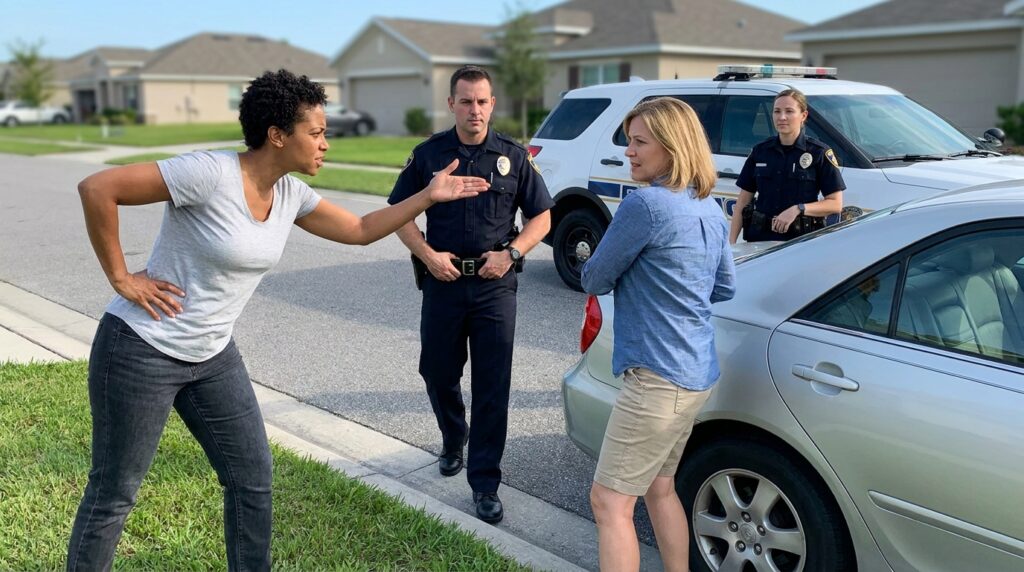
The sharp hand sweep cut through the heavy afternoon heat, stopping exactly three inches from the blue cotton fabric of the shirt. It was a practiced gesture of territorial authority, a short-radius blade of fingers slicing through the dead air between the silver sedan’s passenger door and the lip of the concrete curb.
“Don’t judge me like you know my life,” the voice was dry, hardened by months of calculated grievance, coming from a face framed by dark curly hair that didn’t move in the stagnant breeze. The neighbor leaned forward from the waist, her flats dug into the crabgrass at the property boundary, her weight tilted like a small, stubborn structure trying to claim the asphalt beneath it.
The keys were cold where they bit into the palm of the homeowner’s right hand. A heavy, brass ring with four flat edges, pressed tight until the skin turned white. She didn’t drop her gaze. Her shoulders were pulled backward against the warm, sun-baked metal of the sedan’s window pillar, the heat of the silver paint transferring through her shirt like the dull warmth of a radiator. She could smell the dry topsoil, the faint tang of exhaust from a distant lawnmower, and the sharp, vinegar-like scent of the weed killer her neighbor had sprayed along the line earlier that morning.
“I’m on my own property,” the homeowner said, her voice dropping into a register that felt thick and unyielding in her chest. “And I am done moving my car for you.”
The neighbor’s hand snapped back to her hip, her fingers curling over the faded hem of her t-shirt. She took a single, half-inch step closer, her silhouette blocking the glare of the sun off the car’s roofline. The shadow fell directly across the homeowner’s sandals. It was a routine they had rehearsed through seven weeks of anonymous notes, tipped trash bins, and the constant, silent surveillance from behind closed blinds across the asphalt lane. Every day was an exercise in measuring inches—the distance between a bumper and a mailbox, the exact point where the manicured Bermuda grass gave way to the patch of dandelion-choked weeds near the street drain.
Then the heavy, mechanical click of a door latch broke the rhythm.
From thirty yards down the road, the white marked municipal patrol SUV sat idling, its presence unannounced by sirens but heavy enough to change the air. The tires had rolled silently over the oil-stained pavement, stopping just behind the sedan’s rear bumper. The engine emitted a rhythmic, low-frequency thrum that vibrated through the soles of the homeowner’s sandals.
The primary officer stepped into the space. He didn’t rush. His boots made a distinct, gritty crunch against the loose gravel scattered along the asphalt edge. He was tall, his black uniform crisp despite the humidity, the leather of his duty belt creaking slightly as he settled his weight onto both heels directly between the two women. His dark hair was cut short, his face a neutral sheet of administrative indifference. Behind him, near the front fender of the cruiser, the secondary officer stood with her hands resting lightly at the top of her belt, her eyes scanning the rooflines of the surrounding houses.
The primary officer raised a single, flat palm low between them, a physical gate cutting the remaining distance in half.
“Both of you step back and calm down now,” he said. The tone wasn’t heroic; it was the flat, transactional voice of a man who spent his afternoons sorting through the small, bitter territorialities of county plats. He turned his head toward the neighbor, his eyes dropping to her boots, which were still planted firmly on the disputed strip of grass. “Stay right here while we sort this out.”
The neighbor shifted her weight, her mouth opening to release a rapid, well-rehearsed paragraph of municipal code violations, but her eyes flicked for a fraction of a second toward the silver sedan’s front tire. There, just behind the black rubber, a small, rusted iron rod protruded three inches from the dirt—a surveyor’s stake that hadn’t been cleared since 1994, its tip freshly exposed where someone had recently dug away the sod.

CHAPTER 2: THE SURVEYORS SHADOW
“Driver’s license and registration,” the primary officer said. His voice had the dry, abrasive quality of ungreased machinery, cutting clean through the neighbor’s rising intake of breath. He didn’t look at the neighbor; his eyes remained fixed on the homeowner, watching the precise movement of her fingers as they uncurled from the brass key ring.
The neighborhood felt compressed, the air between the houses thickening under the weight of the afternoon sun. Across the black asphalt lane, the vertical vinyl blinds of number forty-two twitched, a three-inch gap revealing the pale silhouette of a forehead pressed against the glass. The secondary officer noticed it instantly. She shifted her boots, the stiff leather of her holster squeaking against the fabric of her trousers, her shadow stretching long and dark across the sun-baked weeds at the pavement’s edge.
The homeowner reached through the open driver-side window of the silver sedan. The interior of the car was an oven, releasing a draft of trapped heat that smelled of old upholstery and parched foam. Her fingertips brushed the glove box latch—pitted plastic, rough against her skin. She pulled the vehicle registration from the visor, the paper stiff and yellowed at the margins by years of southern exposure. When she pulled her arm back out, her knuckles scraped the oxidized chrome trim of the door frame, leaving a faint gray smudge of zinc oxide across her skin.
“She’s over the line, Officer,” the neighbor broke in, her flats scraping against the gravel as she tried to re-anchor her posture. Her hands were still clamped onto her hips, her light gray t-shirt bunching at the shoulders. “The subdivision covenant is explicit about curbside obstruction. I have the standard county variance paperwork right here.”
She held a black vinyl binder tight against her ribs. Tucked into the clear plastic front sleeve was a folded document, its edges softened and grayed by moisture. Through the crinkled plastic, the homeowner caught the edge of something unexpected—not a standard photocopy of a neighborhood association charter, but a dense, technical grid sheet lined with faded yellow highlighter marks. The lines didn’t look like property lots; they were wide, parallel corridors that sliced through the existing boundaries of the block like a highway template.
The primary officer took the homeowner’s paper without looking at it, his thumb catching the edge as he tilted his head toward the neighbor. “Ma’am, I told you to step back. I’m not asking you again.”
The neighbor’s mouth snapped shut, the dark curls around her temples damp with sweat. She didn’t retreat more than three inches, her heels sinking slightly into the soft, unwatered dirt where she had recently kicked topsoil over the rusted iron surveyor stake.
The homeowner stood her ground by the sedan’s front fender, her palm resting on the hood. The silver metal was hot enough to sting, the vibration of the idling patrol unit thirty feet behind them humming through the chassis. “The car hasn’t moved since Thursday,” the homeowner said, her tone flat, drained of the anxiety that had kept her awake through the previous three nights of anonymous notes. “The parking permit is logged with the township. It’s taped to the lower left corner of the windshield.”
The primary officer took two steps toward the front of the sedan. His heavy utility belt clicked and clattered with every stride, the handcuffs in their case thumping against his hip. He leaned over the hood, his boots straddling the very line where the grass met the asphalt. His eyes moved from the white parking decal behind the glass down to the small patch of disturbed earth near the tire.
“This stake,” the officer said, pointing a finger toward the rusted iron rod protruding from the dirt. “Who uncovered this?”
A sudden silence settled over the curb. The neighbor’s fingers tightened against the vinyl binder, the plastic crackling sharply in the quiet. “The county came out three weeks ago,” she said quickly, her voice rising an octave, the words tumbling out with an artificial precision that sounded like a read script. “They were verifying the stormwater easement. It’s a matter of public record. The whole grid is out of compliance.”
The homeowner watched the neighbor’s knuckles. They were white against the black cover of the binder. Underneath the neighbor’s frantic certainty, there was something else—a slight, rhythmic tremor in her forearm, the physical strain of someone holding a heavy weight with brittle bones. The homeowner looked down at the yellowed grid sheet through the plastic sleeve again. One of those highlighted corridors didn’t just cross her yard; it ran directly through the neighbor’s front porch, a thick marker indicating a complete structural deletion.
“The county didn’t send anyone,” the homeowner said softly, her eyes tracking the tremor up to the neighbor’s tense jaw. “I checked the municipal portal last night. There hasn’t been a variance request filed on this block since 2018.”
The primary officer didn’t look up from the stake. He reached down, his leather-gloved hand brushing aside a clod of dry clay to expose the square, stamped head of the iron pin. The metal was heavily pitted, flaking off in dark red scales onto the green grass. He pulled a small steel scribe from his shirt pocket and scraped the top of the metal, revealing a clean, bright glint of underlying steel beneath thirty years of rust.
“This wasn’t uncovered by an engine or a rainstorm,” the officer muttered, his gaze tracking a straight line from the iron pin back toward the neighbor’s driveway, where a small, orange hand trowel sat half-hidden behind a plastic trash bin. “Someone’s been digging here within the last twenty-four hours.”
The secondary officer stepped forward from the cruiser, her hand leaving her belt as she closed the distance to the lawn edge. “Sir,” she said, her voice dropping into a low, professional murmur. “We have a secondary unit checking the digital log now. The resident at forty-one just uploaded a video clip to the county dispatch queue.”
The neighbor didn’t move, but her posture seemed to shrink, the rigid lines of her shoulders rounding as the shadow of the secondary officer fell over her binder.
CHAPTER 3: THE PARCHMENT BLOCKADE
The neighbor didn’t wait for the secondary officer to finish her report. She snapped the black vinyl binder open, the plastic rings popping with a sharp, metallic sound that mimicked a small branch breaking underfoot. Her fingers, covered in a fine layer of gray limestone dust from the disturbed sod, pulled out a thick, multi-page document printed on heavy-grain, cream-colored legal paper. The margins were clean, almost too clean, but the text was a dense thicket of old-fashioned, serif fonts.
“This is the 1982 charter,” the neighbor said, thrusting the pages toward the primary officer’s chest line. Her voice had regained a brittle momentum, the flat, dry tone of a person trying to force a physical obstacle between herself and an incoming truth. “Look at section four, paragraph B. The curbside setbacks are absolute. Any non-registered domestic transport left stationary for more than forty-eight hours forfeits its spatial clearance. I am well within my rights to demand removal.”
The primary officer took the document by the top edge, his leather glove leaving a dull grease mark against the crisp paper. He didn’t read it immediately. Instead, his thumb rubbed the surface of the sheet, testing its thickness, feeling the unusual weight of a stock that didn’t match the cheap, lightweight wood-pulp paper standard for local county clerk printouts. He tilted it toward the light, squinting at the faint watermark running vertically through the fiber—an intricate insignia of a defunct title company that had folded during the housing crash two decades ago.
The homeowner didn’t lean in to look. She stayed anchored against the silver sedan, her fingers brushing the rusted handle of the rear door, where the metal felt cold and pitted under her skin. She had spent hours digging through the public county registries on her tablet, tracing the legal history of this entire block back to the original land grants. She knew every true line, every true variance. This piece of paper the neighbor was brandishing was a phantom, an obsolete artifact or a direct fabrication designed to simulate the heavy gravity of institutional law.
“That charter was superseded during the 1996 township reorganization,” the homeowner said, her tone steady, holding its ground like the iron pin buried near her front tire. “The current codes are digital. They’re hosted on the municipal server, and they don’t include spatial forfeitures for vehicles with active residential decals.”
The neighbor’s arm remained extended, her elbow locked, her knuckles tight. “The digital transition was never fully ratified by the district board. This paper holds the foundational easement lock. If you park here, you are trespassing on a common-area buffer zone that feeds directly into my parcel’s layout.”
The primary officer finally lowered the pages, his face remaining a blank mask of bureaucratic endurance. He looked from the heavy paper back down to the orange hand trowel sitting by the neighbor’s trash bins. The orange paint on the small tool was flaking off in distinct, bright curls, identical to the microscopic orange flakes scattered in the dry clay around the freshly exposed iron surveyor stake.
“Ma’am,” the officer said, his attention turning entirely to the neighbor, his voice dropping into that low, flat register used to de-escalate territorial disputes before they turned into physical incidents. “This document doesn’t have a valid county recorder stamp for this decade. It looks like an old title policy layout from an inactive file.”
“It’s the original deed logic,” the neighbor insisted, her forward lean increasing by a fraction of an inch, her flats grinding into the loose asphalt grit at the curb’s edge. Her face was flushed now, a dark crimson patch rising from the collar of her t-shirt up into her cheeks. “The entire drainage system relies on this specific line remaining clear of non-municipal weight. If her car sits here, the subsoil compacts. It compromises my foundation.”
The homeowner took a step forward, breaking her contact with the sedan. The movement was deliberate, her sandals coming down firmly on the dry grass of her lawn. “The drainage culvert runs eight feet beneath the opposite side of the asphalt lane,” she said, looking directly at the neighbor’s locked binder. “Your foundation isn’t being compromised by a parked sedan. But that yellow grid sheet in your pouch says your porch is sitting right inside the city’s pending six-foot expansion zone.”
The neighbor froze, the document trembling slightly in the officer’s hand. Her eyes darted from the homeowner’s face down to the clear plastic sleeve of her binder, where the corner of the water-damaged yellow layout was still visible. For the first time since the patrol unit had stopped, her aggressive posture showed a structural crack—a quick, involuntary swallow that tightened the tendons in her throat.
Behind them, the secondary officer tapped her earpiece, the small blue light flashing against the dark hair tied behind her head. “Sir,” she called out to the primary officer, her gaze fixed on the digital screen of her handheld tablet. “The dispatch link is confirmed. We just got the direct video feed from the doorbell across the yard. It’s not just a parking dispute anymore. We have visual confirmation of active line tampering from three o’clock this morning.”
The primary officer didn’t return the heavy paper to the neighbor. He folded it once, slowly, the thick grain resisting the pressure of his palm, and tucked it into his side pocket. He looked at the neighbor, then at the orange trowel behind her. “Let’s take a walk over to your porch, ma’am,” he said, stepping into her exit path. “We need to look at what you’ve been pulling out of that dirt.”
CHAPTER 4: THE DIGITAL EYE
The coarse glass grain of the phone screen was cold under the homeowner’s thumb. She swiped twice, her skin catching slightly on a hairline fracture running across the display, before tapping the encrypted icon for her porch security rig. The screen pulsed, casting a pale gray reflection against the blue cotton sleeve of her shirt as the local storage drive sorted through eight hours of raw, uncompressed nighttime data.
“Right here, Officer,” the homeowner said. Her voice remained clipped, steady, stripped of the fatigue that had spent weeks burrowing into her posture. She held the device flat, resting it near the edge of the silver sedan’s roof so the primary officer could see the unedited frame.
The neighbor made a sudden, frantic movement to her left, her flats slipping on a patch of loose limestone gravel. She reached out, her fingers catching the black vinyl binder tightly against her ribs as if trying to shield the water-damaged yellow layout from view. Her arm shook, the muscles in her jaw tightening until the skin over her cheekbones looked thin and brittle. “That footage is unverified,” she snapped, her voice rising into an unnatural, defensive pitch. “It’s a private recording covering a public right-of-way. It’s entirely inadmissible under township privacy ordinances.”
The primary officer didn’t answer her. He leaned his torso over the hot silver roof of the car, his heavy utility belt clattering softly against the metal trim as he focused on the moving pixels. His breathing was slow, deep, smelling faintly of black coffee and stale car interior. Behind them, the secondary officer moved into a hard blocking position at the foot of the neighbor’s driveway, her hand resting flat on her duty belt, her shadow anchoring the physical lane between the property lines.
On the small screen, the desaturated infrared timeline jumped to 03:14 AM. The wide-angle lens captured the street in shades of metallic gray and chalky white. The stillness of the suburban block was broken by a single, solid silhouette emerging from the shadow of the neighbor’s hedge line. The figure was short, wide-shouldered, carrying a long-handled tool that glinted under the distant streetlamp.
The homeowner watched the primary officer’s eyes track the digital movement. The video showed the figure kneeling directly at the edge of the concrete curb, using an orange hand trowel to systematically scrape away the topsoil, digging down six inches until the flat head of the iron surveyor pin emerged from the red clay. The figure then produced a small, laminated card—the exact yellow grid sheet currently tucked inside the neighbor’s plastic pouch—and held it against the stake, checking a series of measurements with a metal rule.
“That’s a civil surveyor layout,” the homeowner muttered, her voice remaining low, tracking the tremor in the neighbor’s hands. “She wasn’t checking for standard parking violations. She was matching the physical iron pins against the district’s expansion template.”
The neighbor’s flats ground into the pavement as she tried to shift her stance, but the secondary officer’s presence at her flank remained unyielding. “The city plans to take six feet of this block,” the neighbor whispered, the aggressive mask finally fracturing into something raw and desperate. “The public utility easement is expanding. If they verify the pins at their current marker, my porch is gone. The structural setback becomes non-compliant. I had to establish the adverse line before the official county crew logs the final data next week.”
The primary officer stood up straight, his face an unreadable block of administrative stone. He reached into his pocket and pulled out the thick, cream-colored document he had confiscated a moment before, turning the pages over to reveal a hidden, unstamped addendum tucked into the back flap. It was a private structural report, printed on heavy grain but completely devoid of any official municipal registration numbers.
“This layout doesn’t belong to the city,” the officer said, his thumb tapping the edge of the hidden addendum. “This is a private filing from a commercial mortgage firm. Ma’am, you aren’t trying to stop a city easement. You’re trying to move the physical boundary line to clear a private refinancing audit.”
The homeowner took a slow, deep breath, her palm tightening over the keys in her hand. The real-time cause-and-effect was locking into place behind her eyes. The anonymous notes, the constant harassment about her car, the deliberate digging at midnight—it wasn’t a standard neighborhood grievance about parking. It was a calculated, frantic attempt to seize six inches of the legal lot line before an outside bank discovered that the neighbor’s property was structurally out of bounds.
The neighbor didn’t run. She stood frozen on the concrete, her flats buried in the weeds, her eyes fixed on the primary officer’s hand as he pulled a black ink pen from his breast pocket. The secondary officer stepped down from the driveway line, her boots crunching rhythmically against the grit as she prepared to open the official state incident file.
CHAPTER 5: THE UNCOVERED PIN
“Let’s look at the dirt,” the primary officer said. His tone remained clinically detached, a cold weight dropping into the space between them. He turned on his heel, his heavy black leather boots grinding a trail of white limestone grit against the sun-baked asphalt as he walked toward the neighbor’s driveway entrance.
The neighbor moved with him, her flats slapping unevenly against the pavement. The rigid posture she had maintained throughout the afternoon had developed a heavy lean, her shoulders rounding as she clutched the black vinyl binder to her chest. “There’s no cause to examine my private storage area, Officer,” she said, her voice hitching, losing its sharp, institutional rhythm. “The property issue is entirely out here at the curb. Whatever my private contractor left by the trash receptacles is irrelevant to this resident’s parking violation.”
The homeowner didn’t stay behind by the silver sedan. Her hand left the warm door handle, her keys making a soft metallic click as she slipped the ring over her index finger. She walked a parallel line along her own grass edge, her sandals pressing into the dry Bermuda turf. The heat coming off the lawns felt thicker here, smelling of scorched thatch and the metallic tang of old water pipes buried shallowly beneath the topsoil.
At the side of the neighbor’s driveway, three large plastic trash bins sat clustered against a weathered wooden fence line. Behind the center container, partially hidden by a pile of loose yard clippings, the orange hand trowel lay flat. The flaking orange paint on its handle caught the direct glare of the sun. Beside it, a shallow patch of red clay had been freshly scooped out, exposing not a standard county pipe, but a square, industrial-grade iron pin that had been entirely severed from its underground anchor.
The primary officer stopped, his shadow falling over the hole. He knelt down, the leather of his duty belt grooving into his hip as he leaned forward to inspect the damage. He reached out with his gloved right hand and lifted a heavy, solid object that had been stowed beneath the lip of the plastic bin—a six-inch block of concrete with an old steel rod rusted into its center core.
“This is an official benchmark marker,” the officer muttered, his voice dropping into a harsh, pragmatic register. He turned the block over, scraping a layer of dried mud with his thumb to reveal a stamped brass cap with a district serial number. “You didn’t just dig around the stake at the curb, ma’am. You physically pulled the primary subdivision anchor out of the ground.”
The homeowner stood at the lawn boundary, her arms crossed against her blue shirt. The weight of the deception was unraveling with every clod of earth the officer turned over. “She needed the physical line to look malleable,” the homeowner said, her gaze fixed on the neighbor’s pale face. “If the primary benchmark marker is missing, the surveyor crew coming next week has to reconstruct the entire lot line from old deed data—the exact 1982 documents she’s been holding in that binder.”
The neighbor’s hand dropped from her binder, the plastic cover crackling as her grip failed. She looked at the severed concrete block in the officer’s hand, her lips tightening into a thin line that began to twitch at the corners. “The bank wouldn’t clear the bridge loan without a certified title clearance,” she whispered, her eyes darting toward the curtained windows of the houses across the street. “They said my driveway footprint encroached on the township common space by four inches. If the loan didn’t process by Friday, the listing went into automatic default. I just needed to buy thirty days to adjust the layout.”
The primary officer stood up slowly, the iron-and-concrete marker remaining balanced in his palm like a piece of structural evidence. He didn’t look at her with anger; his face held only the cold, unyielding calculation of a state official documenter. “Moving or damaging an official district survey marker isn’t an association variance issue, ma’am,” he said, shifting his weight onto both heels. “It’s a state-level property alteration violation.”
Behind them, the secondary officer’s tablet chimed twice—a short, high-frequency alert that cut through the stagnant afternoon air. She looked up from the screen, her expression hardening as she caught the primary officer’s eye. “Sir,” she said, her voice dropping into a flat, professional warning. “The county registrar just pushed the full file through. The loan default notice isn’t pending. The municipal tax lien was finalized at noon yesterday. This property isn’t under review for a refinance—it’s already under an active county seizure warrant.”
The neighbor didn’t answer. She took a single step backward, her flats catching on the edge of her own concrete driveway as the decoy explanation she had built around the city’s expansion completely shattered, leaving her standing exposed against the rusted surfaces of her own home.
CHAPTER 6: THE PAPER RAILS
“Check the tax ID on that 1982 addendum,” the secondary officer said. Her finger tapped the screen of her portable tablet, the blue luminescence casting a pale sheen over her dark hair. Her voice had the mechanical rhythm of a court reporter, flat and cold in the dry afternoon heat. “The county registrar didn’t just log a lien, sir. The judicial certificate was detached three weeks ago. The parcel under forty-four isn’t an active residential deed anymore—it’s listed as a seized asset under structural quarantine.”
The primary officer didn’t return the heavy, cream-colored document to the neighbor’s hands. He let his thumb slide over the bottom edge of the sheet, where a jagged, perforated margin indicated that a smaller piece of paper—likely a formal state notice—had been torn away with systematic haste. He looked down at the neighbor’s driveway edge, where three bundles of dry, parched turf grass sat on a wooden pallet near the trash receptacles. Beneath the corner of the lowest bundle, the tip of a bright red, stamped steel placard was visible, buried face-down in the loose red clay.
The homeowner took two steps closer to the fence line, her sandals grinding into the limestone grit that had settled along the concrete seam. The hot metallic breeze coming off the asphalt lane smelled of sun-baked zinc primer and the stagnant, iron-rich water pooling inside the street drain. “She wasn’t trying to save her porch from a city expansion,” the homeowner said, her eyes tracking the precise line of the neighbor’s trembling arm. “She was trying to merge the curbside lot numbers before the county surveyor mapped the block for the liquidation auction. If she could prove an active, multi-year encroachment onto my parcel, the title company would have to hold the foreclosure execution under a boundary dispute clause.”
The neighbor didn’t move. Her flats remained sunk into the loose topsoil, her fingers locked around the empty black binder as if its plastic spine were the only rigid thing left on the street. Her face had drained of its aggressive color, leaving a mottled, gray complexion that made her look years older under the harsh glare of the southern sun. “The notice was filed without a physical audit,” she whispered, her words dropping with a brittle, dry cadence. “The board didn’t calculate the common-area buffer. They just looked at the old plat maps from the eighties. If I could get the surveyor to log the silver sedan as an permanent obstruction on the easement, the whole file would drop back into the litigation queue.”
The primary officer leaned down, his heavy leather utility belt creaking as he used his gloved hand to slide the bundles of dead turf off the pallet. He pulled the red steel placard out from the dirt, his fingers scraping away a thick crust of dried mud to reveal the bold, black lettering of a municipal sheriff’s seizure order. The metal was stamped with yesterday’s date, the edges still sharp enough to cut through the thin layer of topsoil clinging to its face.
“This was posted on your front door at eight-fifteen yesterday morning,” the officer said, his gaze fixed entirely on the neighbor’s face. He didn’t drop his arm; he held the heavy steel notice between them like a barrier. “You didn’t call us out here because of a parking violation, ma’am. You called us because you needed an official police report documenting an unyielding civil dispute at the exact hour the county inspector arrived to verify the lot clearance.”
The neighbor’s posture folded inward, her shoulders rounding as she let the empty binder slip from her fingers. It hit the concrete driveway with a flat, hollow slap, the clear plastic sleeves crinkling under the weight of the fall. She didn’t look down at it. Her eyes stayed locked on the primary officer’s ink pen, which was now moving rapidly across the grid sheet of his pocket notebook, tracking the specific codes for public records obstruction and state marker destruction.
The homeowner stepped back toward the passenger side of her silver sedan, her fingers closing tightly around the cold brass key ring in her pocket. The entire infrastructure of the block felt different now—no longer a simple collection of tidy lawns and uniform siding, but a fragile system of legal boundaries and hidden financial fractures that could be unraveled by six inches of shifted dirt. Her vehicle wasn’t an obstacle; it had been used as a pawn in a frantic, subterranean gamble to stall an institutional machine that had already closed its gates.
Behind them, the secondary officer moved toward the patrol SUV, her boots crunching a steady, rhythmic pattern against the parched pavement as she picked up the radio mic to summon the district supervisor. The house at number forty-two remained completely silent, the three-inch gap in the vinyl blinds now dark and empty, its audience withdrawn as the real authority on the block finalized its records.
CHAPTER 7: THE CLOSING PLATS
“Sign the lower field,” the primary officer said. His words were flat, hard blocks dropping into the stifling heat between the neighbor’s concrete porch steps and the edge of the parched lawn. He held out the steel clipboard, its lower edge pitted with gray zinc oxidation, his thumb holding down a carbon-layered pink triplicate form that rustled and snapped in the hot draft coming off the street.
The neighbor didn’t reach for the pen. Her fingers remained bunched into the loose fabric of her gray t-shirt, her knuckles white and covered in a fine skin of gray clay from where she had been clawing at the sod hours earlier. Her gaze remained pinned to the red steel seizure notice resting face-up on the wooden pallet. “The assessment is out of order,” she whispered, her chest hitching with a short, shallow rhythm that didn’t match the aggressive cadence she had used at the curb. “The district surveyor didn’t file the final plat adjustment. If the citation goes into the public record before the mortgage company closes their audit, the title lock is permanent. I won’t have a legal entrance left to list.”
The homeowner stood five feet back on the dividing seam of the two lawns. The coarse grass beneath her sandals felt dry, brittle like dried straw, snapping under her weight with a small, sharp crunch that sounded loud in the heavy silence of the block. She watched the neighbor’s face—the complete deflation of her manufactured authority, the lines around her mouth tightening as the weight of the civil citation began to settle over her property.
“The title lock was already permanent,” the homeowner said, her voice low and even, matching the steady thrum of the idling patrol unit behind them. “The mortgage firm didn’t pull their audit because of my sedan. They pulled it because they found the duplicate application you filed with the county clerk using a falsified lot registration number from 1982. You were trying to override the state’s lien data with an obsolete description.”
The neighbor’s eyes flicked to the homeowner, a sudden, sharp needle of desperation surfacing through her exhaustion. “The lot was sub-divided incorrectly thirty years ago,” she said, her voice rising into a thin, raw register that cracked in the dry air. “Your garage sits six inches into the original common-use lane. If the county executed the tax seizure on the true plat line, they would have taken my western fence with it. I had to create an active litigation dispute to freeze the asset release.”
The primary officer didn’t look up from the form. He tapped the steel clip of the board with his pen tip, the metallic click clean and decisive. “The county doesn’t freeze asset releases for residential parking complaints, ma’am,” he said, his tone remaining empty of sympathy, a purely bureaucratic instrument tracking the physical realities of the scene. “Moving a municipal boundary pin to manufacture an adverse possession claim against your neighbor is a third-class records violation. The state surveyor’s office has already logged the coordinate drift from your porch camera feed.”
The neighbor slowly reached out her hand, her arm stiff, her fingers shaking as they closed over the cheap black plastic barrel of the officer’s pen. She didn’t read the lines. She dragged the point across the pink carbon paper, leaving a short, jagged signature that tore through the top layer of the form, exposing the oily black ink beneath.
Behind them, the secondary officer stepped down from the driveway curb, her tablet screen darkening as she slid it into her nylon belt pouch. “The supervisor unit is clearing the dispatch line now, sir,” she reported to the primary officer. “The county code team has been notified to set the orange boundary flags along the true plat marker first thing tomorrow morning. The vehicle at forty-one is cleared of all obstruction reports.”
The neighbor dropped the pen. It dangled from its small silver chain, clicking against the metal frame of the clipboard as she turned away without another word. Her flats dragged across the pitted concrete of her porch step, her body leaning heavily against the rusted iron screen door handle as she pulled herself inside the dark, unlit interior of her kitchen, leaving the screen door to slam shut with a dull, hollow rattle.
The homeowner walked back toward the silver sedan, her fingers loosening their grip on the brass key ring in her pocket. The heat coming off the car’s hood was beginning to drop as the sun dipped behind the uniform rooflines of the subdivision, leaving the metal looking dark, desaturated under the graying sky. The curb line was exactly where it had been four hours ago—pitted, cracked, lined with loose gravel and parched weeds—but the invisible lines governing the asphalt had settled back into their stone-cold beds, unyielding and permanent.
CHAPTER 8: THE FIXED LINES
“Next time you call us out here for a legal parking space, you’ll be the one getting a citation,” the primary officer said, his voice flat, carrying the dry authority of an administrative decision as it echoed down the concrete path toward the empty kitchen doorway. The house at number forty-four remained completely dark, the rusted iron screen door handle holding its silent position against the frame.
The officer turned his back to the house, his heavy duty belt shifting with a short clatter of polymer cases and steel ring snaps as he stepped down onto the asphalt lane. He walked back toward the white patrol SUV, his boots crunching methodically through the dry limestone gravel scattered along the lawn boundary. He didn’t offer a nod or an explanatory summary to the homeowner; he simply reached into his breast pocket, drew out his notebook, and clicked the black ink pen shut with a clean, decisive mechanical snap.
The homeowner stayed anchored by the passenger fender of the silver sedan, her fingers finally relaxing their grip on the flat, brass key ring inside her khaki shorts pocket. The skin of her palm was white where the edges had bit deep, the small red mark fading slowly in the cooling air. She took a slow, deep breath, smelling the sharp, chemical residue of the engine exhaust mixing with the scent of sun-baked Bermuda turf.
The entire neighborhood felt unusually still, the desaturated gray light of dusk settling over the uniform rows of vinyl siding and matching garage doors. Across the street, the three-inch gap in the blinds of number forty-two had disappeared completely, the slats flattened down to seal the interior from the view of the empty street. The secondary officer was already inside the cruiser, the blue light on her wireless headset blinking once against the dark side glass before the engine surged, its exhaust releasing a brief puff of gray carbon vapor as the unit pulled slowly away from the curb.
The homeowner looked down at the edge of her front tire. The small, rusted iron rod protruded three inches from the dry dirt—a straight, unyielding point of reference that no longer felt like a hazard or a mistake. A foot away, a deep, circular impression remained in the parched turf where the original benchmark marker had been dragged out of its bed, the black earth inside it dry and beginning to flake into dust.
“Next week, the county flags go up,” she murmured to herself, her voice dropping into the quiet space beneath the car’s idling engine.
She reached down, her knuckles brushing the rough rubber of the front tire as she verified the clearance. The silver sedan sat perfectly level against the concrete lip, its white residential parking decal gleaming behind the glass like a permanent title seal. The neighbor’s frantic, subterranean gamble had run its course against the stone-cold geometry of the township plats, and the result was written in the quiet, unbothered layout of the block.
The homeowner stood up, slid her hand over the hot silver roof of the car one last time, and turned toward her porch steps. The metal under her fingers was losing its stored heat, matching the desaturated gray stone of the foundation as the evening darkness finally locked the lines of the subdivision into place.







