The 1981 Ghost File: A Veteran’s Grit and the Downfall of a Corrupt System
CHAPTER 1: THE DISPENSATION OF ZEROES
The linoleum floor had been scrubbed until the grey marrow of the stone showed through the wax, smelling of ammonia and wet dust. Under the steady, sixty-cycle hum of the overhead tubes, forty people sat with their thumbs hooked into the loops of their bags, watching the red digital elements of the wall clock tick toward four.
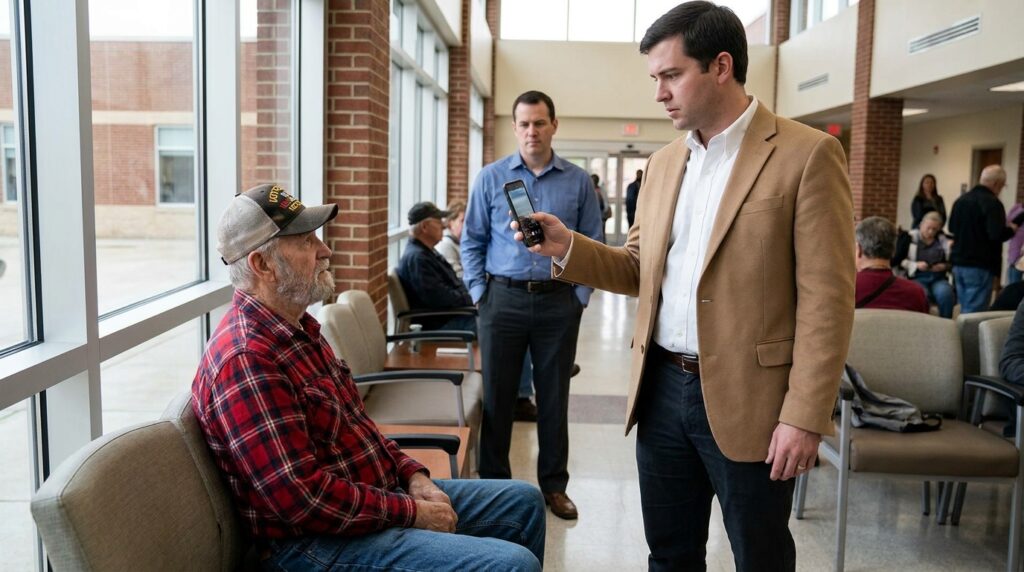
Arthur did not look at the clock. He looked at the edge of the young man’s tan sleeve, where the stitching had begun to unravel near the button—three loops of synthetic thread pulling loose from a machine-sewn cuff.
“The notice went out three weeks ago, Mr. Vance,” the auditor said. His voice wasn’t loud, but it had the clear, carrying ring of a man who spent his mornings practicing presentations in empty conference rooms. He stayed low, his torso tilted forward at a forty-five-degree angle, using his height to block Arthur’s line of sight to the security gate. “We’ve run the audits across the entire third-quarter ledger. The system doesn’t make exceptions for missing signatures. If the primary service file isn’t updated by the close of the business day, the medical voucher defaults to zero. It’s a automated purge.”
Arthur kept his palms flat against the knees of his jeans. The denim was stiff, washed three times in well water that carried the iron-heavy rust of the county line. He didn’t shift his hips. When you sat on institutional plastic long enough, your bones learned to find the single dead spot where the metal screws didn’t pinch the meat of the thigh.
“The signature is on the original contract,” Arthur said. His voice was lower than the ventilation hum, a gravelly vibration that stayed inside the space between their faces. “Nineteen-eighty-one. Fort Benning. It’s in the dry storage down in the annex.”
The auditor let out a short, dry puff of air through his nose—the small, controlled laugh of a person who had already explained the same rule six times before lunch. He tapped the glass of the smartphone held between his fingers. The screen was a grid of blue lines and gray boxes, columns of text so small they looked like rows of dead ants.
“The annex doesn’t exist anymore, sir. Everything is cloud-migrated. If it’s not in the portal, it’s not on the budget.” He stepped closer, his polished shoe coming down an inch from Arthur’s scuffed leather toe. The shadow of his blazer fell across Arthur’s lap, turning the red plaid of his flannel shirt the color of dried liver. “I’ve got five hundred files to clear before the weekend. Sign the waiver. You can re-apply in November when the system resets.”
Behind them, a man in a blue work shirt shifted on his bench, the plastic creaking like dry timber. A woman cleared her throat, a sharp, wet sound that died instantly against the acoustic tiles. Everyone was listening. In places like this, an argument was the only thing that broke the weight of the hours.
Arthur looked down at his own right thumb. The nail was split down the center, a white ridge that had grown that way since a piece of a hydraulic housing had let go under a five-ton truck in the mud outside of Da Nang. He pressed his finger against the ridge until the skin turned pale.
“I’ve handled harder days than this, son,” Arthur said, his eyes rising slowly to meet the investigator’s gaze. The gray in his beard didn’t move. “You won’t shake me today.”
The auditor’s jaw tightened, the skin along his cheek turning a faint, blotchy pink. He didn’t back off. Instead, he reached into his breast pocket and drew out a heavy black pen, dropping it onto Arthur’s knee with a sharp, plastic click. “The queue moves in two minutes. Decide.”
The screen in the young man’s hand didn’t flicker, but a tiny, white dot began to pulse in the upper left corner of the grid—a silent, rapid signal that had nothing to do with the county database.

CHAPTER 2: OVER THE YELLOW LINE
“The clock doesn’t care about eighty-one, Mr. Vance,” the auditor said. His fingers didn’t leave the black plastic pen resting on Arthur’s knee. He leaned further into the old man’s space, his tan blazer stretching tight across his shoulder blades until the fabric groaned. “The terminal closes out the queue at sixteen-hundred. If that waiver isn’t scanned, your medical allowance returns to the general county pool. I’m trying to help you clear the line, but you have to cooperate.”
Arthur looked at the pen. It was a cheap, disposable thing with a bitten cap and blue ink visible through the translucent barrel. A tool for signing away rights on grey paper. He didn’t pick it up. Instead, he lifted his hand from his jeans, his thumb trailing over the split ridge of his nail, and let his fingers rest flat on the cold laminate armrest of his chair.
“You’re standing over the yellow line, son,” Arthur said. His voice was a low, steady rumble, like a gravel truck idling on a steep grade. He didn’t look up into the auditor’s eyes yet; he kept his focus on the small plastic badge pinned to the young man’s lapel—M. Miller, Compliance Investigator. “The county code says the public must remain behind the yellow line unless called forward by name. You didn’t call my name. You walked back here to look for me.”
Miller’s face hardened. The pink blotches along his jaw deepened into a dull, angry red, the color of clay after a heavy rain. He stepped half an inch closer, his leather-soled shoe grinding a grain of salt into the grey linoleum floor. The smell of his mints was gone now, replaced by the sour tang of nervous sweat that clung to the synthetic weave of his shirt.
“I don’t need to call your name to do my job,” Miller muttered. His voice dropped an octave, trying to keep the conversation from spilling over into the next row of benches. He tapped the glass of his terminal again, his finger striking the screen with a sharp, greasy slap. “Your file is a ghost, Vance. It’s sitting in a restricted holding index that’s screwing up my section metrics. I’ve got three supervisors tracking my clear-rate today. I’m not losing my quarterly bonus because an old man wants to fight over a forty-year-old signature.”
Arthur let the silence grow between them. It was a heavy, tactical silence, the kind he used to keep when the radio went dead in the tree line and the only sound was the drip of water off a grease-coated canopy. He watched the white dot pulsing in the corner of Miller’s screen. It wasn’t a standard battery indicator or an app refresh signal. It was an active sync command, flashing three times fast, then holding a long, steady beat. A data hook.
Behind Miller, the security gate buzzed—a dry, mechanical rattle that sounded like a cicada dying in the grass. The clerk at window four turned her head, her heavy plastic earrings clicking against her collarbone as she stared toward Arthur’s corner. She didn’t return to her terminal. She kept her hands frozen above her keyboard, her eyes wide under the green glare of her desktop lamp.
“Look at your screen, Miller,” Arthur said softly.
“I’m looking at your waiver, Vance. And I’m looking at—”
The device vibrated. It wasn’t the soft, polite chime of a text message; it was a deep, continuous hum that shook the young man’s hand until the plastic casing rattled against his ring. The blue grid vanished from the display. In its place, a solid block of amber text began to cascade down the screen, characters wiping from left to right so fast they blurred into a single yellow smear.
Miller frowned, his thumb hooking into his sleeve as he lifted the device closer to his face. His knuckles were white against the leather casing. He swiped down once, then twice, his thumb leaving broad, wet streaks of oil across the glass. “The system is looping. It’s an administrative lock.”
“That’s not a loop,” Arthur said. He finally raised his eyes, his gaze locking onto Miller’s face with the flat, unblinking weight of iron plates. “That’s a query flag. Someone just noticed you’re pulling water out of a dry well.”
A low mutter rippled through the row of vinyl chairs behind them. The man in the blue shirt stood up, his work boots thudding against the floor as he angled his head to see over Miller’s shoulder. Two benches down, an older woman pulled her canvas bag closer to her chest, her eyes darting toward the heavy glass doors of the entrance where a lone security guard was slowly rising from his stool.
Miller didn’t look back at the crowd. His eyes were fixed on the bottom of the screen, where a single line of text had stopped scrolling. The letters were black against the amber background, solid and blocky, spelling out a sequence that didn’t belong on a county ledger.
SECURITY OVERRIDE CODE: SIGNALS-4-ALPHA.
A sharp, metallic pop echoed from the back office behind the security glass. The automated ticket dispenser on the wall groaned, its internal rollers spinning wildly for three seconds before spitting out a long, blank tongue of white paper that coiled onto the floor. The red digital clock didn’t click to sixteen-hundred. It frozen at fifteen-fifty-nine, its elements flickering rapidly like a dying fire.
Miller’s fingers loosened. The black pen rolled off Arthur’s knee, landing on the grey floor with a hollow bounce.
CHAPTER 3: THE RAISING OF VOICES
The terminal didn’t strike sixteen-hundred. The digital numbers remained pinned at fifteen-fifty-nine, the red LED bars vibrating with a dull, frantic pulse that made the dust motes look like static sparks dancing in front of the lens.
Arthur watched the auditor’s fingers. They were no longer tapping the glass; they were hooked rigid into the leather edges of the terminal casing, trying to stabilize a hand that had begun to shake with the dry, rapid rhythm of an engine running out of lubricant. The amber glare from the screen caught the sweat gathering under Miller’s jawline, highlighting the sharp twitch of a tendon near his ear.
“It’s a network-level freeze,” Miller said. He didn’t speak to Arthur; he spoke down into the glass, his voice rising in pitch until it cracked against the silent row of plastic benches behind them. He pulled his torso back out of Arthur’s personal space, but his heels didn’t shift from the yellow line. “The entire regional database just disconnected from the local terminal. This isn’t an internal loop.”
“I told you,” Arthur said, his hand remaining heavy and flat against the iron-stained denim of his knee. “You’re digging in wet ground, son. The deeper you go, the more things cave in.”
Miller looked up, his teeth clicking together as he forced his shoulders back into a rigid, defensive square. He looked toward window four, then over his shoulder at the security desk by the double glass doors. The guard was standing now, his belt groaning under the weight of his radio and his plastic handcuffs as he took three measured steps onto the linoleum. The small room had grown narrow, the smell of wet wool coats and stale chemical floor cleaner thickening into a cold grease that stuck to the back of the throat.
“You’re trying to disrupt a county audit, Mr. Vance,” Miller shouted. He didn’t use his controlled corporate tone anymore. He threw his words across the wide grey gap of the waiting room, deliberately targeting the bystanders who sat with their bags clutched against their knees. “The compliance office has full legal authority to verify legacy vouchers. If your paperwork is out of compliance, it’s a misdemeanor under code forty-two. You don’t get to freeze our terminals because you don’t want to sign the disclosure.”
The man in the blue shirt stood up fully now, his thick leather gloves clutched in his right hand like a club. He didn’t look at Miller; he looked down at Arthur’s blue cap, his eyes tracing the faded gold thread of the lettered rim. “The old man hasn’t touched your machine, kid. He’s just sitting there.”
“He’s refusing to comply with a standard reconciliation,” Miller said, his boots clicking twice against the salt-streaked floor as he turned his back to Arthur to face the benches. His tan blazer swung loose, revealing the silver clip of a pager and a secondary database key dangling from his belt loop. “The county is losing sixty thousand dollars a month on unverified medical accounts in this district alone. We are clearing the dead weight from the ledger. If he doesn’t sign, he’s obstructing public administration.”
Arthur didn’t rise. He kept his spine straight against the rigid plastic backing of his chair, calculating the geometry of the room. The distance from his boots to the security rope was four paces. The distance from Miller’s outstretched terminal to the hard edge of the laminate table was two. He could feel the familiar, cool pressure behind his temples—the old command math that had nothing to do with county regulations or administrative fines.
He reached down and picked up the black pen that Miller had dropped. The plastic was cheap, cold, and slightly greasy from the auditor’s fingers. Arthur turned it over once between his fingers, his thumb feeling the small, circular dent in his nail.
“You’re talking about sixty thousand dollars like it’s a big number, Miller,” Arthur said. His gravelly voice was low, but it cleared the room like a dry wind over a range. The auditor froze, his shoulder blades tightening through the fabric of his jacket. “That’s two months of diesel for the regional drainage pumps. Or it’s five seats on the municipal water board. Why don’t you check where that ledger actually routes when the signature isn’t there?”
Miller turned around slowly. His eyes were wide, the pupils shrunk down to small black points under the harsh overhead tubes. “The ledger routes to the general fund, Vance. It’s an automated transfer.”
“It routes to an escrow box in the second-tier database,” Arthur said, his fingers tightening around the cheap plastic pen until the translucent barrel began to bend. “It’s been routing there since ninety-six. Every time an account defaults from an old unit file, the balance doesn’t go back to the state. It goes into the discretionary maintenance budget for the third district supervisors. Your clear-rate isn’t an audit, son. It’s a harvesting operation.”
The clerk at window four let out a sharp, indrawn breath that died behind her teeth. She pulled her hands completely off the desk, her fingers curling into her palms as she looked down at the amber screen of her own terminal. The display wasn’t running the county log anymore. It was mirroring Miller’s screen, the same amber letters scrolling in a continuous, rapid cascade that cast a yellow shadow across her face.
The security guard stopped five feet from the yellow line, his hand resting on the leather flap of his holster. He didn’t look at Arthur. He looked at Miller’s terminal, where the white dot had turned a solid, burning red.
CHAPTER 4: THE MEASURED LINE OF DEFENSE
The security guard didn’t pull his piece, but his hand stayed anchored to the leather retention strap of his holster, his boots widening into a short, defensive stance on the grease-stained stone. The smell of copper dust grew stronger under the low ceiling, bleeding from the vents as the main distribution frame in the wall began to draw more current to handle the forced system link.
Miller didn’t answer Arthur’s charge. He couldn’t. His fingers had clamped around the edge of his terminal casing so hard the plastic was bending away from the glass, revealing a tiny green strip of the internal circuit board. The solid red dot in the corner of his screen had begun to pulse in pairs—two short beats, then a long, cold pause—matching the emergency data-harvest logs that only ran when a regional database was being scraped from the top down.
“You don’t know the route codes for the district funds, Vance,” Miller whispered. His voice had lost its carrying tone, dropping down into a dry, defensive hiss that barely reached over the yellow line. He looked down at the bent plastic pen in Arthur’s hand, then at the thick, calloused thumb pressed against the split nail. “Those are closed-ledger indexes. They don’t exist on public portals.”
“They exist if you’re the one who verified the terminal drops forty years ago,” Arthur said, his voice remaining flat, heavy, and perfectly level. He didn’t lift his arm from the laminate seat rest. He just pointed the cheap black tip of the pen toward the bottom row of amber text flashing across the screen. “Read the secondary header, Miller. It’s not checking my name anymore. It’s checking yours.”
The investigator’s eyes dropped to the glass. The sequence SIGNALS-4-ALPHA had vanished, replaced by an eight-digit terminal ID and a single, flashing red compliance flag that bore the stamp of the state auditor’s executive security branch. Beneath it, a secondary prompt was already compiling his personal identity credentials—his network login, his section clearance code, and his employee identification number—stripping them out of the device’s internal memory cache like dry wheat before a flail.
Behind the security glass, window four went completely dark. The green glow of the desktop lamp died with a short, metallic pop, leaving the clerk sitting in the shadow of the partition wall. She didn’t call for the guard. She stood up from her rolling chair, her skirt rustling against the metal trash bin as she backed toward the rear exit door without looking at Miller.
“The terminal is reporting an unauthorized ledger query,” Miller said, his teeth catching his lower lip as his hand began to wobble. He tried to drop his hand to his belt to pull the database key, but his fingers slipped off the small steel ring. “It’s registering an institutional data breach under my credential profile. I didn’t initiate a supervisor override.”
“The system initiated it when you crossed the yellow line into a restricted veteran index,” Arthur said. He turned the pen once between his fingers, his thumb tracing the white ridge of his nail with a slow, deliberate circle. “You thought you were clearing out an old man who couldn’t read a ledger. You didn’t check who put the lock on the index before the cloud migration ever started.”
The man in the blue shirt stepped closer to the barrier rope, his heavy boots giving off a sharp, rhythmic creak that drew the security guard’s head around. “Is there a problem with the gentleman’s account, investigator? Because from where we’re sitting, it looks like your machine is the thing that’s out of compliance.”
Miller didn’t look at the crowd. The pink blotches along his cheek had turned gray, the color of old cement under a winter rain. He lowered his hand from the device, his arm hanging loose and heavy against his side as the screen began to dump his complete activity log into the state compliance network. The amber text was rolling faster now, a yellow smear that cast a greasy sheen across his manicured beard and his white collar.
The security guard took one pace backward, his hand loosening from the holster flap as he checked the flashing red element on the wall clock. The time was still stuck at fifteen-fifty-nine, but the low-frequency vibration in the floor had stopped. The room had become perfectly quiet except for the continuous, deep hum of the investigator’s device as it completed the federal security intercept.
Miller’s posture broke. His shoulders dropped three inches, his sharp tan blazer bunching around his neck until he looked small, thin, and hollowed out under the harsh glare of the tubes. He slowly turned the terminal around, his fingers sliding along the plastic edge until the screen faced Arthur, the glass held out like a piece of cold iron between them.
“It’s a complete credential lock,” Miller said, his voice dropping into a tight, dry plea that didn’t leave the perimeter of the vinyl chair. “It’s flagging every file I touched this morning for a manual forensic review. Intercept the flag, Mr. Vance. You have the command override code.”
Arthur looked at the offered device, his gray beard completely still as he let the silence run for five full beats.
CHAPTER 5: THE SHATTERING OF THE SHIELD
Arthur did not reach for the extended glass panel. He let Miller’s arm hang there in the empty air between them, the terminal’s amber backlight casting horizontal lines of sharp orange across the investigator’s white shirt like bars on a cage. A drop of sweat fell from the point of Miller’s trimmed beard, hitting the edge of the screen with a faint, wet tap that seemed to echo through the silence of the waiting area.
“The script doesn’t stop from the outside, son,” Arthur said. He kept his hands dropped flat against his thighs, his calloused thumbs aligned with the hard seam of his jeans. “Once the state auditor’s flag drops down onto an active terminal, it means the gate is locked from both sides. You’re the one holding the latch.”
Miller’s thumb twitched against the plastic border of his casing. The display was no longer running his local clear-rate log; it was dumping blocks of red hexadecimal strings, each sequence wiping out an entire tier of regional data with a dry, mechanical sizzle from the terminal’s internal speaker. The top line of the header remained fixed, spelling out his complete compliance profile next to a cold, automated declaration: FEDERAL INTEGRITY ENFORCEMENT—CRITICAL ADMINISTRATIVE BREACH.
“I didn’t open a restricted box,” Miller said, his teeth clicking against each other as his voice dropped into an erratic, hollow rattle. He didn’t look at the crowd of bystanders who had shifted closer to the security rope. He kept his eyes pinned to the gold thread along the edge of Arthur’s faded cap. “The regional director gave me the compliance index code. It was on the weekly ledger update. He said it was an unassigned legacy pool.”
“He told you what you needed to hear to make you run the plow,” Arthur said softly. He turned his wrist slightly, the cheap black pen he’d taken from his knee pointing directly at a small, triangular symbol flashing beneath the red security flag. “That’s a joint-command intercept mark. It’s been sitting on that ledger since the county lines were re-mapped in ninety-two. The regional board didn’t unassign it. They just hid it behind the medical voucher system so they could draw the interest off the reserve pool without triggering a state disclosure.”
Miller’s hand shook so violently the terminal slipped an inch through his palms, the hard corner scraping against the metal armrest of Arthur’s chair with a dry, grinding screech. He caught it against his stomach, his sharp tan blazer wrinkling as he leaned his torso over the glass like a man protecting a wound. “If the integrity flag clears to the central office, my credential profile is permanently locked. Every file I handled in the third district gets routed for a forensic review. They’ll pull the audit trace back through the last three fiscal years.”
“They’ll look at everything you touched,” Arthur agreed. His gray beard didn’t shift. His voice had the flat, unyielding weight of an iron stake driven into dry earth. “They’ll see where the money went when the older applicants didn’t sign the disclosure waivers. They’ll look at the municipal water board accounts, and they’ll look at the regional drainage pump contracts. They’ll find the entire secondary ledger you’ve been cleaning for the district supervisors.”
Behind them, the security guard took another step back, his heavy black boots squeaking against the linoleum as his radio began to emit a steady, high-pitched data hiss. A metallic voice broke through the static, truncated and distorted by the network block inside the building: “Terminal three status… alert… integrity failure at portal four… hold all field personnel…”
The guard didn’t answer his lapel mic. He looked at the window where the clerk had left her station, then down at his own small digital monitor on his belt. The screen had gone dark, replaced by the same amber block that was currently burning through Miller’s slate.
The man in the blue shirt let out a low, dry chuckle from the first row of benches. He didn’t move away from the security rope. “Looks like the kid found out who owns the well. Maybe you should’ve checked the name on the cap before you started talking about code forty-two, Miller.”
Miller didn’t turn to face the room. His face had gone completely grey, the color of dry alkaline powder. He looked at Arthur, his chest heaving under the synthetic weave of his white shirt as he realized the decoy secret he’d been using to protect his career—the small-scale county fraud he’d been hiding behind—was being systematically crushed by a massive, automated system he couldn’t see.
“Help me stop the trace,” Miller whispered. His voice was raw, stripped of every ounce of bureaucratic authority. He dropped his knees slightly, his height lowering until he was eye-level with the seated veteran, his hands offering the vibrating screen once more like an old bucket filled with hot coals. “You have the override line, Mr. Vance. Just give me the old unit identifier. It will stall the flag until the regional director can pull the terminal off the grid.”
Arthur looked at the screen, his gaze tracing the red hexadecimal strings as they hit the end of his own secure file index. The absolute truth of his old work—the network he’d built to monitor these very boxes forty years ago—remained perfectly hidden behind the amber wall, locked away from the small investigator’s sight.
“The regional director isn’t coming to pull your terminal, son,” Arthur said. He leaned his back against the vinyl seat, his shoulders square and solid against the plastic. “He’s currently deleting his own login keys from the supervisor loop. You’re the only name on the header today.”
The terminal gave off a final, short beep, and the screen turned completely black except for a single line of grey text that settled across the center of the glass: TERMINAL DECOMMISSIONED BY EXECUTIVE AUTHORITY.
CHAPTER 6: THE EXTENDED HAND OF REVERSAL
The black glass of the slate reflected the overhead tubes as twin grease-smeared tracks. Miller’s thumbs stayed clamped to the edges of the plastic shell, his knuckles grey against the tan fabric of his cuffs. The deep hum that had been vibrating through his sleeve died out with a low, metallic click from the internal board, leaving only the sound of a heavy diesel truck down-shifting two blocks away on the state highway.
“Fine,” Miller muttered. His voice was a flat, dry scrape that barely reached past the yellow line. He didn’t lift his face to look at Arthur or the row of benches behind them; his head stayed bent over the dead device as if he were trying to read his own reflection in the dark. “Fine, let’s settle this respectfully and move forward.”
He didn’t pull the device back to his chest. He kept his arms extended, his elbows locked as he slid the black rectangle across the grey laminate armrest of Arthur’s chair. His manicured beard was trembling slightly at the edges, the hair coarse and stiff with wet salt. He held the dead weight of his career out between his hands, offering the physical proof of his own failure to the old man he’d tried to force out of the room ten minutes ago.
“You’re still holding the line, son,” Arthur said. He didn’t pick up the slate. He reached out with his right hand, his calloused fingers wrapping around the cheap plastic barrel of the pen Miller had left on his knee. He didn’t drop it into his pocket; he just laid it lengthwise across the dark glass of the dead terminal, the translucent casing clicking against the reflection of the overhead lights. “A handoff doesn’t change the ledger. If your profile is locked at the central frame, it stays locked until a supervisor pulls the hardware key from the back room.”
“The supervisor won’t touch the key,” Miller said. His tone was tight, transactional, and fast—the voice of an insurance salesman calculating a loss on a wet porch. He looked up then, his pupils large and watery under the green reflection of the dead window lamps. “The regional office has an automated backup route for district code forty-two. If a terminal drops out under an integrity flag, the mainframe isolates the sector within ninety seconds. My name is on the local session log, Mr. Vance. It’s the only name that’s active on this side of the gate.”
Arthur looked down at his own right shoe, where the scuffed leather was white with salt from the driveway puddle outside. He could feel the cold draft from the floor vents hitting his ankles, bringing the smell of damp oil and rusted iron pipe from the crawlspace beneath the floorboards. The county had built this annex over an old maintenance yard, and the earth underneath still held the grease of fifty years of road graders and stone crushers.
“They built the system to isolate the branch so the leak wouldn’t show on the main state ledger,” Arthur said, his gravelly voice dropping down into a level vibration that stayed between them. “Every time an old voucher is closed out by hand, the transfer file gets a temporary index mark. If the integrity check flags the index, the sector gets wiped to protect the board. You aren’t the first clerk they’ve left behind the glass with a dead terminal, Miller.”
Behind them, the security guard’s boots shifted against the linoleum with a long, wet creak. He didn’t use his radio anymore. He’d pulled his heavy black leather gloves out from his belt, his fingers working into the stiff hide with slow, deliberate tugs as he watched the back exit door behind window four. The glass pane was still dark, but a low-frequency click—three quick beats—echoed from the internal locking mechanism inside the partition wall.
The man in the blue shirt stood up fully from his bench, his heavy flannel jacket swinging loose as he leaned both hips against the steel barrier rope. “He asked you a question, kid. Is the gentleman’s voucher clear or not? We’ve been sitting here since two o’clock, and some of us have trucks running in the lot.”
Miller didn’t turn his head toward the crowd. His shoulders were hunched tight under his tan jacket, his collar bunching up against his ears until he looked thirty pounds lighter than he had when he walked over the yellow line. He kept his arms extended, the dead black slate resting on his palms like an old plate.
“All right,” Miller whispered, his eyes dropping back down to the plastic pen Arthur had laid across the glass. “All right, let’s keep this civil. Just give me the old branch routing code from eighty-one. The database index will hold the session open if there’s a matching prior system record.”
Arthur let the pen sit on the glass. He didn’t move his hand to touch the slate, his thumb tracing the white, split ridge of his own nail with a slow, flat pressure. He knew exactly what was behind the grey amber text that had flashed before the screen went dark—the ultimate reality of the joint-command signal array he’d wired into these very walls before Miller’s office was even mapped. It wasn’t an administrative code. It was a live trigger, and it was currently counting down the seconds until the state line went dead.
“ThePrior system record is closed, son,” Arthur said softly.
CHAPTER 7: THE RISING MUTTER
The click inside the partition wall repeated twice—sharp, dry, mechanical sounds like an empty firing pin striking an old chamber. A low, grey vibration seemed to travel out from behind the service counters, rattling the metal frame of the change tray at window four before dying into the floorboards.
Miller didn’t draw his arms back. He stayed locked in his slight lean over the yellow line, the weight of the dead slate pressing into his palms until his thumbs turned a pale, waxy white under the fluorescent glare. The plastic pen Arthur had laid across the dark glass remained perfectly level, its translucent blue barrel split by a long reflection of the flickering ceiling tube.
“The trace doesn’t clear if the database stays cold, Mr. Vance,” Miller whispered. His voice was no longer a structured compliance tool; it had shrunk to a dry, rattling wheeze that barely traveled across the armrest. His eyes stayed glued to the small, circular scar on Arthur’s thumb. “The district network is on a ninety-second cycle. If the central frame doesn’t see a valid credential update before the clock resets, it flags the entire sector terminal for manual recovery. They’ll clear the whole house.”
“They’ll clear what they can see,” Arthur said. He didn’t shift his hips on the stiff plastic of his chair. He kept his heels dug flat into the salt-rimed grey linoleum, his gaze lifting past Miller’s shoulder to trace the line of benches behind him. “But they won’t find the source code in the district portal, son. They’ll just find the scraps you left behind the counter.”
Behind Miller’s back, the row of vinyl seats began to stir with a heavy, restless motion. The man in the blue shirt took his hands off the steel barrier rope and stepped across the gap, his heavy work boots striking the stone with an unhurried, rhythmic thud that made the security guard turn his chin. Two benches down, the woman with the canvas bag rose halfway from her seat, her fingers hooking into the worn strap as she pointed a thin, silver smartphone toward the investigator’s hunched shoulders.
“He told you no, kid,” the man in the blue shirt said. His voice was thick with the flat, heavy cadence of the county line, loud enough to strike the drywall ceiling and drop back down over the partitions. “We’ve been sitting under these lights for two hours listening to you talk about code forty-two and ledger discrepancies. Now your machine goes black, and you’re trying to squeeze an old man for an override. Put the slate down and open the gate.”
A sharp murmur ran through the rest of the line—the low, dangerous sound of twenty people who had spent their afternoon tracking a blinking red clock while their engines idle-burned four-dollar diesel in the muddy lot outside. A second phone rose near the back row, its glass lens catching the glare of window four’s dead desktop lamp.
“He’s obstructing an active inquiry,” Miller said, his head jerking back toward the crowd for the first time, though his feet didn’t move an inch from the yellow marker. His face was dry and gray, the skin around his manicured beard looking thin and tight like wet paper stretched over a frame. “The terminal lock is a security protocol. If you cross the barrier line, the guard has the authority to—”
“The guard is checking his own terminal, Miller,” Arthur said softly.
The room went dead silent again. The security guard had stepped back to his small iron desk near the double entrance doors, his leather gloves still gripped in his right hand as he used his left thumb to strike the keys of his base radio. The grey screen on his wall unit wasn’t showing the county security feed anymore. It was running a solid block of amber diagnostic rows, the characters wiping from left to right with the same rapid, automated rhythm that had burned through Miller’s slate three minutes prior.
The guard didn’t look at the crowd. He pulled his lapel mic free from his shoulder strap and spoke into the mesh, his voice flat and perfectly level: “Base, this is unit two. The main entry gate just took an external data lock. The magnetic latches aren’t responding to the local override key. Advise if there’s a district drill in progress.”
The radio didn’t spit back a voice. It gave off a high, continuous data squeal—the cold, dry hiss of a communication line that had been severed from the top down by an automated defense intercept.
Miller’s shoulders sank another inch, his sharp tan jacket wrinkling across his back as he looked back down at the dead glass in his hands. The small white dot that had been pulsing in pairs was gone. The screen was cold, dark, and hollow, holding nothing but the grease-streaked image of his own wide eyes and the faded gold lettering of Arthur’s cap.
The low-frequency click behind the wall stopped. A secondary buzzer sounded from the deep hallway beyond the counters—a single, long mechanical tone that indicated the regional authority had bypassed the district terminal entirely.
Arthur reached out and took the plastic pen back from the dead glass, his fingers wrapping around the barrel with an unhurried, heavy precision that made Miller step back half a pace. The veteran didn’t look at the dead slate or the trembling hand that held it. He looked toward the heavy iron doors of the back office as the latch began to move from the inside.
CHAPTER 8: THE OVERRIDING AUTHORITY
The heavy iron door latch behind the partitioned safety glass lifted with a single, brutal clunk that vibrated through the metal frame and died out against the stone footing.
Arthur stayed still, his spine pressed into the vinyl seat backing, his thumbs resting over the split ridge of his nail. He didn’t turn his neck. He watched Miller’s face change as the gray shadow of the hallway lengthened across the counter, the young man’s knees giving a small, soft click as his heels finally slipped backward over the yellow line. The dead slate remained tucked against Miller’s chest, a smooth shield of useless glass that reflected nothing but the dark corners of the ceiling.
A man in a charcoal wool overcoat stepped through the open security frame, his leather gloves tucked neatly under his arm. He didn’t have a county badge on his lapel; he had an administrative ID on a short steel chain that swung flat against his vest with every step. His hair was cropped close, the gray at his temples cut sharp down to the skin, matching the hard, unhurried precision of his stride across the grey linoleum floor.
“The session is closed, Miller,” the director said. His voice was completely devoid of the auditor’s rehearsed corporate ring; it had the cold, dry thinness of grease paper. He didn’t look at the junior investigator. He kept his eyes fixed entirely on Arthur’s blue cap, his leather shoes coming to a smooth halt two inches from the yellow marker. “Hand the device to the guard. Your terminal credentials have been flagged for an immediate security hold.”
Miller’s fingers didn’t move from the plastic casing. He stood frozen, his breath coming in short, shallow puffs through his nose that smelled faintly of salt and cold winter air. “The… the index, sir. It locked down the whole sector. I was just running the third-quarter reconciliation loop under code forty-two.”
“You were digging where the ground was marked, son,” the director said softly, his chin tilting down just enough to show the dark red seal of the executive audit branch on his lanyard. “The third district pool isn’t on your ledger sheet. It hasn’t been on your ledger sheet since ninety-six. You were told to clear the public queue, not to run queries on restricted infrastructure.”
He turned his shoulder slightly, cutting Miller out of the spatial geometry of the corner entirely. He looked down at Arthur, his arms dropping down to his sides as his posture shifted into a brief, unhurried straightening—the subtle, generational muscle memory of a man who had stood in formations before the county built its first terminal drop.
“Master Sergeant Vance,” the director said, his voice dropping into the low, gravelly lower register that stayed within the gray space between them. “The regional office took the automated line intercept thirty seconds ago. Your file has been returned to the closed archive. The medical voucher will clear to your local branch by sixteen-hundred.”
Arthur lifted his head slowly, his eyes locking onto the director’s face with the flat, unblinking weight of two iron plates. He didn’t offer a salute; he didn’t rise from his vinyl chair. He just reached down and took the cheap plastic pen off the armrest, his thumb tracing the white ridge of his nail one final time before dropping the barrel into the top pocket of his red plaid shirt.
“The line was wired to hold, Henderson,” Arthur said. His voice was a quiet rumble that carried further than the ventilation hum, clearing the row of benches with the weight of forty years of buried limestone. “It was wired to hold when the first switches were dropped in the ground. You shouldn’t have let the kids play with the dials.”
The director didn’t answer the charge. He gave a single, thin nod, his hand extending toward the dark corridor behind the security partition. “The private desk is open in the back, sir. We’ve got the old paper registry pulled from the dry storage. It won’t need to go through the network frame again.”
Behind them, the waiting room observers remained perfectly silent, their phones lowered halfway to their laps as they watched the disgraced investigator step back toward the guard’s desk. The man in the blue shirt didn’t cross the rope; he just stood with his heavy gloves clutched in his hand, his eyes tracking Miller’s trembling shoulders as two county security officers stepped through the front glass doors to take the dead slate from his fingers.
Arthur rose from the vinyl chair. His knees gave a short, dry pop as his weight settled into the scuffed leather of his boots, his frame solid and unhurried as he adjusted the brim of his blue cap. He didn’t look back at the room or the blinking red element on the wall clock as it finally clicked forward to sixteen-hundred, the system lock releasing with a long, mechanical hum from the main frame in the floorboards. He walked over the yellow line, his stride level and heavy against the grey stone, leaving the broken ledger behind him in the cold, unvented dust.