The Weight of Salt and Iron on a Weathered Table

CHAPTER 1: THE COLD ANCHOR

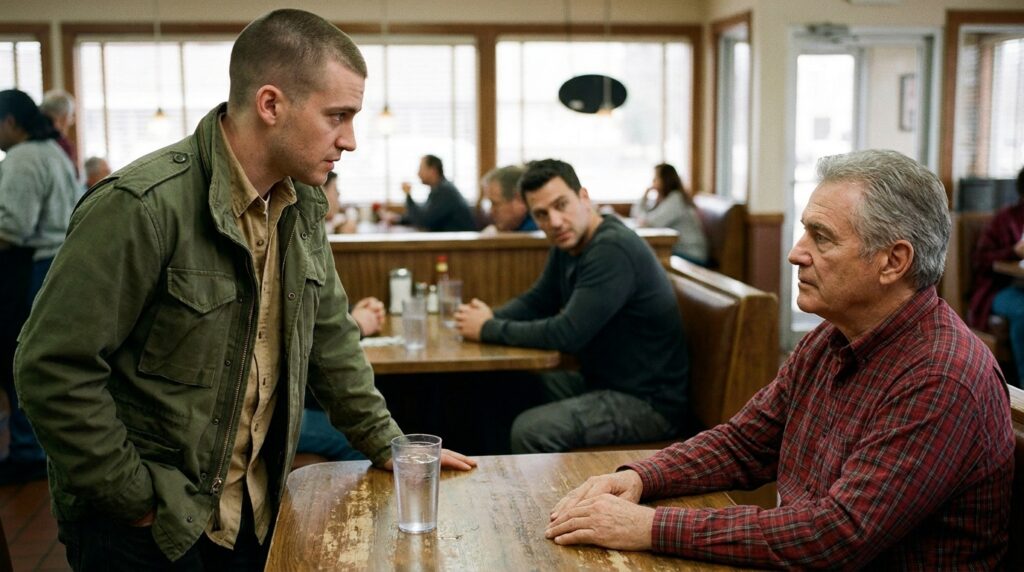
“Look at me, I’m talking to you, answer me now,” the kid said, his palms flat against the grease-filmed oak of the booth.

Thomas did not look up immediately. He kept his eyes on the white porcelain mug between his hands. The coffee had gone lukewarm, a thin skin of condensation forming along the inner rim where the heat met the damp morning air of the county line. The diner smelled of scorched lard, old Formica, and the faint, sweet rot of wet tobacco coming from the vest pocket of the man three booths over. It was an old smell. A heavy one.

The kid’s hands were clean. Too clean for the olive field jacket he wore, which still carried the sharp, machine-pressed creases of a distribution warehouse. He was thick in the shoulders, his jaw line hard from youth rather than labor, his short buzz cut catching the yellow glare of the unbranded fluorescent tube flickering directly overhead. He leaned forward until the nylon of his jacket hissed against the edge of the wooden table, cutting off the grey light coming through the front window.

Thomas let his left hand slide down from the mug. He laid it flat on the wood. His skin was the color of river clay, mapped with purple veins that twined around a heavy silver ring. The metal was dull, scratched by decades of gravel and salt, its central crest worn down to a smooth, unreadable nodule. He didn’t ball his fingers into a fist. He simply pressed down, feeling the grit of spilled sugar beneath his palm, using it to anchor the slow, rhythmic thump of his heart.

Behind the kid, near the cash register where the plastic mint bowls sat, a man in a dark canvas coat paused with his hand inside his pocket. A Background Observer. The man didn’t move toward the door. He didn’t reach for his phone. He simply stood there, his reflection caught in the scratched chrome of the pie case, watching the space between the kid’s shoulder blades and the old man’s chin. The clatter of silverware from the kitchen had dropped an octave, replaced by the low, greasy hiss of the flat-top grill.

“I know what’s in the brown folder, old man,” the kid muttered, his voice dropping into a register meant only for the two of them, though the silence in the room made it carry like grease on water. “My crew is locked out of the north ridge because you’re holding the clearance logs. You think because you sat in an office forty years ago, the county can’t touch you?”

Thomas watched a small flake of dried mud detach itself from the kid’s cuff and tumble onto the table. It rolled twice, then stopped against the base of the salt shaker.

The weight of the folder was heavy against his thigh, wedged securely between his hip and the patched vinyl of the bench. The leather was split along the spine, held together by three wraps of black electrical tape that had turned sticky in the July heat. The kid thought it was about an easement. He thought it was about a gate key and a boundary line drawn by a drunk surveyor in 1984.

The kid’s breath smelled of wintergreen mints and dry panic. He leaned an inch closer, his knuckles turning the color of lard as he put his weight into the table. “You don’t exit this booth until I get the signature.”

Thomas looked up then. His eyes were the faded grey of rain-soaked slate, surrounded by yellowed whites that hadn’t seen a full night’s sleep since the winter the river froze through. He let the silence stretch between them until the kid’s jaw muscle gave a small, involuntary twitch.

“Calm down,” Thomas said. His voice didn’t rise above the hum of the kitchen compressor, but it had the thick, iron resonance of a closing bunker door. “And step back.”

The kid’s fingers stiffened against the wood, his eyes widening slightly as his gaze caught the small, white scar running vertically through Thomas’s left eyebrow—a mark that didn’t belong to a clerk.


CHAPTER 2: THE FRICTION OF THE REAR GUARD

The kid didn’t drop his hands from the table. Instead, the wood groaned under his shifting weight as he canted his head, his chin jerking back half an inch. The warning had landed like an ungreased iron bolt sliding home in a dry receiver—low, raspy, and solid enough to vibrate through the Formica.

“Step back?” The kid’s laugh was thin, raspy from dry air and tobacco. He didn’t move an inch. “You’ve got a lot of nerve for an old man who doesn’t even own the gravel his truck’s rotting on. That land belongs to the state utility consortium as of midnight yesterday. Your fence is six feet over the line, and that leather wallet next to your hip contains the signed survey exemptions from forty-four years ago. I’m not some local deputy you can spook with that tone, old man. My outfit has a warrant for structural inspection, and we’re taking the ridge by noon.”

Thomas didn’t blink. He watched a faint smudge of pale white grease on the kid’s sleeve—not tractor oil, not grease from the diner kitchen. It was the zinc-based sealant used on military-grade storage lids, the kind that didn’t wash out of synthetic fibers without a kerosene rinse. The kid’s company wasn’t drilling for gas. They weren’t setting telephone poles either.

“The ridge is federal reserve until the county receives the formal deed,” Thomas said. His voice remained in that dead, level space, the cadence of a man who had spent three decades counting supply crates under artillery light. “The county hasn’t seen the papers because there aren’t any papers to show, son.”

“We don’t need your county clerk,” the kid hissed, his knuckles tightening again, his breath leaving a small circle of fog on the dark wood between them. “We’ve got the state clearance. The easement is ours. Now hand over the folder or I’m calling the marshal down from the interstate.”

Behind the young contractor, the Background Observer finally shifted. His boots—heavy, oil-tanned leather with thick Vibram soles that left gray scuffs on the diner’s linoleum—made a dry, rhythmic scraping sound against the floorboards. He didn’t approach the table. He moved toward the counter, his hip brushing against the chrome stools, his eyes locked on the reflection of the kid’s back in the dark glass of the coffee pots. He reached up, his thumb and forefinger lightly testing the weight of a brass key ring hanging from his belt loop.

The kitchen door swung open once, letting out a sharp blast of burnt onion and the harsh, metallic rattle of a dishwasher basket hitting an iron sink. No one spoke. The two truck drivers in the corner booth had stopped looking at their road maps; one of them had his fork held halfway to his mouth, the yolk of his egg dripping yellow onto his paper napkin. The silence in the diner wasn’t the silence of respect; it was the heavy, sulfur-sour quiet that settles over a dry field before the first strike of heat lightning hits the wire fence.

Thomas looked down at his own hand again. The silver ring felt heavy, a cold band of iron against his skin that seemed to draw the remaining warmth out of his fingers. He could feel the thin edge of the document folder pressing through his trousers, the corner of the stiff, linen-backed paper inside cutting slightly into his hip. The kid thought he was holding a property line. He thought he was protecting a few acres of scrub pine and gray shale from a state highway expansion. He had no idea what happened to the soil under those pines when the trucks came through in the dark during the autumn of ’82.

“The marshal knows where the township line ends,” Thomas said softly. He didn’t move his hand from the table, but he let his fingers uncurl, his palm rising just enough for the kid to see the old, white scar tissue thick across the base of his thumb—the kind left by the hot breach of an unvented recoilless rifle. “And he knows who dug the drainage ditches on that ridge before your father was old enough to carry a pocketknife.”

The kid’s mouth opened to reply, his chest expanding as he took in a breath to launch another threat, but his eyes wandered down to Thomas’s hand. He saw the ring. He saw the worn, flat spot where the eagle’s talons had once been engraved into the silver, now nothing more than three parallel gouges in the metal. The kid’s shoulder blades locked. His posture didn’t soften, but the forward lean stopped, his weight shifting back onto his heels as he noticed the small, brass survey pin tucked into the corner of Thomas’s shirt pocket—the old, five-digit serial stamp that hadn’t been issued since the Department of Defense cleared the ordnance depot at the river mouth.

“You’re Miller,” the kid said, his voice losing its edge, dropping into a flat, dry register. “The supply chief from the third division.”

“I’m the man sitting in this booth,” Thomas replied. He reached out with his left hand, his thumb catching the edge of his lukewarm coffee cup, his fingernail clicking twice against the thick porcelain. “And your coat is dirty, son. Zinc grease doesn’t belong on a highway job.”

The kid took half a step back, his boots squeaking against the salt-crusted floor. He didn’t look at the Background Observer, but his hand moved toward his pocket, his fingers twitching against the heavy nylon flap of his jacket as the front door of the diner rattled against its iron latch.

CHAPTER 3: THE DECONSTRUCTION OF AUTHORITY

The name didn’t clear the room; it weighted it. The kid’s fingers slid an inch across the varnished grain, leaving pale streaks in the dust before his joints locked up entirely. His breath came shorter now, rattling against the low pane of the diner window where the first yellow rays of the high-country sun were beginning to bake the dirt into the glass.

“Miller died in ninety-two,” the kid said. His tone lacked its previous weight, though he kept his boots planted, trying to match the old man’s vertical posture through pure skeletal strain. “The records from the third logistics detachment were scrubbed after the reservoir easement was turned over to the county water board. You’re holding a dead man’s identity if you’re claiming that name, old man. And my outfit has the corporate lean to back our entry up. We don’t need to check old graves to drop our drills into the north slope.”

Thomas watched the kid’s knuckles turn from grey to white. The corporate lean. It was the term they used when the land acquisition firms bought up delinquent tax debt from the township to avoid state environmental disclosure laws. If the kid’s firm had the lean, they had the right to run heavy machinery right up to the boundary wire—but they didn’t have the key to the iron lockbox on the ridge pump station. They didn’t have the coordinates for the subsurface shafts either.

“The third logistics didn’t leave graves on the slope,” Thomas said, his fingers remaining perfectly flat against the table. “They left trenches. If your superiors told you the records were scrubbed, they lied to save the cost of a three-mile containment fence. You tell your manager that the five-digit registry is still active at the regional registry, and the gate stays chained until I see a federal environmental stamp on your work order.”

The Background Observer had stopped using his brass key ring. He stood three paces from the booth now, his dark canvas coat unbuttoned just enough to reveal a standard-issue leather belt with a heavy, double-pronged steel buckle. His face remained in the shadow of the low fluorescent fixture, but his chin was tilted down, his attention entirely focused on the leather folder tucked behind Thomas’s hip. He wasn’t tracking the conversation for the sake of the land; he was counting the inches between the old man’s elbow and the edge of the vinyl bench.

Across the room, the driver who had been holding his fork let it drop. The tines clicked against the heavy ceramic plate with a sharp, clear ring that seemed to snap the kid’s focus back into line. He looked over his shoulder once, his jaw tightening as he saw the two older men in the corner booth watching his posture. The small-town diner etiquette was simple: you could argue over a fence line or an unpaid bill until the morning fry-cook cleared the grease traps, but you didn’t corner an elder in a public booth without drawing the room’s collective eye.

“The work order is internal,” the kid muttered, his voice tightening as he leaned down again, trying to reclaim the physical leverage he had surrendered when Thomas spoke. “We’re not clearing brush, Miller. We’re running a seismic core probe through the old limestone culverts to check the bedrock consistency for the pipeline corridor. If you don’t give us the access codes from that file by noon, the county sheriff is going to be the one pulling you out of this booth, not me. This whole county runs on the tax revenue from that corridor, and an old soldier with an unverified pension isn’t going to stall a state project.”

Thomas felt the cold iron of his silver ring pressing into the soft skin of his palm. He knew the limestone culverts. He had overseen the concrete pours himself during the rainy season of ’81, when the trucks came up from the railhead with no markings on their sides and their tailgates draped in wet canvas. The county thought the pipeline was going to carry natural gas from the northern fields. They thought the old logistics depot was nothing more than an abandoned fuel terminal with a few rusty storage tanks buried beneath the scrub pine.

“The limestone under that ridge isn’t bedrock,” Thomas said, his slate-grey eyes catching the flicker of the overhead light as he tilted his chin upward. “It’s a honeycomb of old drainage channels. If you drop a pneumatic drill into those culverts without the engineering maps from eighty-two, you won’t find rock, son. You’ll find out exactly why the state utility consortium waited forty years to touch that land.”

The kid’s hand twitched toward his chest pocket, his fingers brushing against a blue-capped plastic pen before he caught himself. He didn’t have a corporate lean; he had an assignment. His olive field jacket carried the smell of fresh diesel and damp silt—the kind of mud that gathered around the drainage grates at the base of the ridge where the overflow ditches emptied into the county creek. He had already been up there. He had already found the iron gate, and he had found the old brass survey pin that matched the one tucked into Thomas’s shirt pocket.

“The maps are in the folder,” the kid said, his eyes dropping to the taped edge of the leather folder where it showed through the gap in the vinyl booth. “You’ve been keeping them out of the public archive for twelve years. That’s why the easement is tied up. That’s why our title company couldn’t clear the deed last month. You’re not protecting the environment, old man—you’re holding a grudge against the outfit that retired you.”

Thomas let his left hand slide backward, his knuckles brushing against the heavy leather of the folder. He could feel the dry, brittle texture of the older document sleeves inside—the thick, cotton-weave paper that carried the ink stamps of a department that had changed its name three times since the Cold War ended. The kid thought it was about an old soldier’s bitterness. He thought it was about a missing signature on a deed map. He had no idea that the white grease on his cuff was the only thing keeping his lungs from burning before the sun went down.

“A grudge takes energy,” Thomas murmured, his eyes shifting past the kid’s shoulder to the front door where the iron latch began to vibrate against its strike plate. “I’m just an old man trying to finish my breakfast before the coffee goes completely cold.”

The door didn’t open immediately, but the glass pane rattled as a shadow cut off the morning light from the parking lot outside.

CHAPTER 4: THE THRESHOLD OF RESISTANCE

The door latch gave a final, rusted click before the frame gave way. The cold air from the valley floor rolled in across the threshold, cutting through the heavy smell of lard and hot grease like an iron wedge. The shadow that entered didn’t scramble for a table. It moved with the slow, deliberate stride of a man who spent his mornings checking the depth of creek beds and the thickness of boundary wire.

“You’re leaning too hard on that wood, son,” Thomas said, his voice dropping into that quiet, gravelly frequency that made the water glass on the table tremble against its rim. “And you’re standing on ground that doesn’t recognize your boots yet.”

The kid didn’t step back, but his shoulders gave a sharp, involuntary jerk. His fingers, still pressed flat against the scarred oak, left white patches on the grain where his blood had ceased to circulate. His face had gone the color of skimmed milk under the yellow flicker of the ceiling fixture. He was looking at Thomas, but his attention was split by the heavy tread behind him—the dull, regular thud of government-issue rubber soles meeting old linoleum.

“The survey is clear,” the kid muttered, his tone dropping until it was nearly lost in the low, mechanical rattle of the pie case. “We don’t need a township permit for a subsurface probe. The state consortium has a blanket exemption for the reservoir drainage corridor. If we don’t clear the access lines by noon, the regional office is going to drop a non-compliance lien on every parcel from here to the bridge.”

Thomas let his palm rise from the wood. The silver ring caught a momentary glint of cold grey light from the window, its worn crest showing three faint, parallel lines where the old unit engraving had been filed down to a dull plate. Beneath his hand, the blue ink stamp on the corner of the leather folder had begun to bleed through the grease-stained paper—a distinct, five-digit alphanumeric sequence that began with the letters ORD. The kid thought it was a tract code. He thought it was a legal reference for a land easement dispute that could be settled with a court order and a standard wire cutter.

“The state consortium doesn’t own the culverts under the north slope,” Thomas said softly. He didn’t reach for the folder, but his index finger traced the sticky wrap of electrical tape along its spine. “They own the pipe that runs through them. The concrete around that pipe belongs to the engineers who poured it when the county line was still a gravel road. If your manager tells you different, you ask him why the drainage ditch at the base of the ridge has a steel grate three inches thick and a padlock from the Department of Defense.”

The Background Observer had stopped checking his keys. He stood entirely still now, his dark canvas coat hanging straight down, his hands resting loose at his sides just below the level of his belt. He wasn’t watching the kid anymore. His eyes were locked on the small, white scar running through Thomas’s left eyebrow—the specific trajectory mark left by an unvented breach block during a training run at the old depot forty winters ago. He knew what the folder contained. He knew exactly what kind of paper stayed white after forty years in a damp basement.

The kid’s chest rose and fell in short, irregular hitches. He took a single step to the side, his boot heel scraping against the salt-crusted floor with a sharp, dry rasp that made the truck drivers in the corner booth look up from their maps. His hand remained near his pocket, his thumb catching on the heavy nylon seam of his olive field jacket where the pale smudge of zinc grease had begun to dry into a hard, white crust.

“We found the secondary shaft,” the kid said, his voice tightening until it had the thin, brittle ring of cold tin. “The one with the brass seal near the old pump house. The title company said it was an abandoned limestone storage vault from the old quarry crew. We’ve already got the pneumatic compressor on the flatbed at the gate. If we don’t have the clearance sequence by the time the crew chief finishes the daily log, we’re cutting the chain.”

Thomas looked past the kid’s shoulder to the front glass. The sun was fully over the ridge now, throwing long, desaturated streaks of yellow across the gravel lot outside, highlighting the rusted fenders of his old pickup and the sharp, clean lines of the contractor’s white utility truck parked directly behind it. The mud on the utility truck’s wheel wells was grey—not the red clay of the valley floor, but the alkaline silt that gathered only where the deep drainage channels broke through the limestone.

“The brass seal wasn’t put there by a quarry crew,” Thomas said, his grey eyes settling back onto the kid’s face with the weight of an unmovable object. “It was put there to keep the water out of the lower gallery. You drop a pneumatic bit into that limestone, son, and you won’t find a storage vault. You’ll find out exactly why the third logistics detachment didn’t leave a salvage list when they pulled the trucks out of the county in October of eighty-two.”

The kid’s mouth opened to reply, a sharp, angry syllable forming behind his teeth, but the sound died before it reached the air. The heavy latch on the inner kitchen door gave a sharp, metallic click as the cook stepped out with a fresh pot of coffee, his boots squeaking against the slick floorboards. The room had changed its tone; the low, regular hum of the breakfast rush had been completely replaced by the heavy, dry stillness that settles over a trench before the first shell leaves the tube.

Thomas let his fingers rest flat on the taped edge of the folder. He could feel the dry crackle of the inner map sheets—the heavy, cloth-backed vellum that carried the red-ink boundaries of a zone that had never been marked on any county road map. The kid was still looking for a land line. He was still waiting for an old man to give up a signature so he could clear his work order and collect his weekly check from the acquisition firm.

“You tell your chief that the gate has two locks,” Thomas murmured, his fingernail clicking once against the thick porcelain of his lukewarm cup. “And the second one doesn’t take a key.”

The door behind the kid didn’t close, but the man in the dark canvas coat took his first step forward, his boot sole making a slow, grinding sound against the sand on the linoleum.

CHAPTER 5: THE CORROSION OF LAW

The grinding step of the man in the dark canvas coat stopped three inches short of the kid’s elbow. He didn’t look at the kid. Instead, he pulled a heavy, square leather wallet from his interior pocket and dropped it onto the wood. The leather was grayed at the corners, the grain rubbed smooth by thirty years of utility belts, but the small brass star pinned to the interior flap still carried the dark green patina of old river humidity.

“The second lock doesn’t take a key because the state police welded the housing shut in eighty-four, son,” the man said. His voice was dry, the gravelly drawl of a retired county investigator whose ears had been ruined by open-cab tractors. “And the county sheriff doesn’t sign off on utility overrides unless the state surveyor signs the environmental variance first. I’ve been sitting in my car listening to the low-band frequency for twenty minutes. Your crew chief didn’t log a pipeline transit with the district dispatcher. He logged an emergency bypass.”

The kid didn’t turn his head, but his jaw gave a hard, visible click. The strategic confidence he had worn like a second skin when he entered the diner was flaking away, leaving only the raw friction of a subordinate who had been handed a bad map and a short deadline. “Vance,” he muttered, his eyes tracking the dark corrosion around the rivets of the retired trooper’s badge. “This isn’t your division anymore. The regional board passed the infrastructure emergency bill on Tuesday. Local jurisdiction was suspended along the ridge corridor.”

Thomas looked at the badge, then back at the kid’s cuff. The white zinc grease was dry now, a chalky residue that left faint white smudges on the dark varnish of the booth. The setback didn’t come from the kid’s words; it came from the low, rhythmic vibration that began to thrum through the soles of Thomas’s boots. It wasn’t the kitchen compressor. It was the deep, sub-surface thud of a six-inch rotary drill hitting the upper limestone cap two miles north. They hadn’t waited for the folder. The confrontation in the diner wasn’t a negotiation—it was a containment action meant to keep Thomas away from the ridge while the heavy equipment broke the seal.

“They’re already past the baseline,” Thomas said, his voice dropping into a flat, iron registry that made the retired trooper look down. “They didn’t want the access codes to clear the title, Vance. They wanted to see if the pressure gauges on the lower culverts were still recording.”

The kid took a full step back now, his boots grinding the salt into the linoleum with an aggressive rasp. He reached into his field jacket, his fingers wrapping around a heavy, silver-cased radio that carried the dark green military-spec stencil of a tactical relay. “The title fraud was just the filing mechanism,” he said, his youth disappearing behind the cold, transactional clarity of a corporate operator who knew his leverage had just been crushed but his objective was already moving. “We don’t need your signature, Miller. The drill went through the upper concrete shelf five minutes ago. If that folder has the drainage cross-sections, you’d better pray our bit doesn’t hit the secondary intake.”

The diner had gone completely cold. The cook remained by the pie case, the coffee pot held at a stiff angle, his eyes locked on the old trooper’s badge. The two truck drivers in the corner were already sliding their maps into their pockets, their faces hardening into the neutral, unreadable masks of local men who knew when a state line dispute was turning into something that would ruin the autumn well water.

Thomas felt a cold weight settle behind his ribs—the familiar, metallic taste of tactical failure. He had spent twelve years keeping the leather folder buried under the spare tire of his truck, believing the county’s bureaucratic inertia would protect the ridge more effectively than a wire fence. He had assumed the acquisition firm was running a standard land-grab fraud to inflate the utility board’s stock. He had calculated his resistance based on the logic of property lines and tax leans.

He had been entirely wrong. The corporate easement wasn’t a decoy to steal the timber; it was a legal shield designed to cover a catastrophic corporate salvage operation.

“Vance,” Thomas said, his fingers tightening against the stickiness of the electrical tape on the folder’s spine until the wood beneath his palm felt like frozen iron. “Get your vehicle. The lower drainage system isn’t connected to the creek. It empties into the limestone aquifer under the township school.”

The retired trooper didn’t ask for clarification. He picked up his square leather wallet, his thumb tracing the green corrosion on the brass star once before he jammed it into his canvas pocket. His face had gone from the weathered red of an old farmer to a dull, flat grey that matched the morning mist outside. “The wind is coming from the north,” Vance muttered, his boots already turning toward the glass door. “The old radio tower on the hill still has the Civil Defense horn on the roof. I can trip the relay if the pressure line drops.”

The kid didn’t follow him. He stood between Thomas and the door, his silver radio humming with a low, white-noise static that sounded like dry sand shifting across a concrete floor. A voice broke through the speaker—thin, metallic, and frantic with the high-country accent of a drilling foreman who had just hit something that wasn’t limestone.

“We’re through the vault wall,” the speaker rattled, the distortion tearing at the small speaker grid. “But the pressure isn’t dropping. It’s climbing. There’s an unmapped header pipe down here, and the mud is coming up white. It looks like zinc tallow, Chief. It’s eating the seals on the return line.”

Thomas didn’t rise from the booth. He opened the taped spine of the folder, his weathered thumb sliding past the old land deeds until it caught the yellowed edge of an engineering blueprint marked with three diagonal red stripes. The paper was crisp, the sulfur smell of old drafting ink rising from the folds like ghost smoke from a dead engine. He didn’t show the kid the map. He simply looked at the lowest line of the cross-section—the one marked with the old five-digit ordnance stamp that matched the pin in his pocket.

“You told your crew to use a diamond bit,” Thomas said to the kid, his voice so quiet it was nearly lost beneath the static of the radio. “You thought you were drilling into a storage vault for old infrastructure records. You didn’t check the weight of the concrete because you thought the county built it.”

The kid didn’t answer. He held the radio to his ear, his short buzz cut glistening with a sudden sheen of cold sweat as the distant thudding from the north ridge stopped entirely, replaced by a low, hollow whistle that vibrated through the diner’s water pipes.

CHAPTER 6: THE RUPTURE OF THE DECOY

“Tell them to clear the pad,” the radio squealed again, the signal breaking into a jagged hiss of white noise that sounded like dry sand blown against sheet iron. “The return valve is locked up tight. It’s not water, Chief. It’s coming out grey, and it smells like a battery fire. We’ve got two men down on the staging deck who can’t catch their—”

The radio went dead with a sharp, high-frequency pop that left the diner completely silent. The kid didn’t lower the hand holding the silver casing. His arm remained fixed at a rigid right angle, his athletic frame frozen between the wooden edge of the booth and the cold light of the door pane. His fingers were slick with the sudden grease of panic, leaving shiny grey streaks on the tactical finish of the handset.

Thomas didn’t wait for the younger man to drop his arm. He stood up from the vinyl bench, his old knee joints giving a dry, rhythmic pop that seemed to match the low-frequency vibration of the iron water pipes beneath the floorboards. The worn leather folder was tucked beneath his left arm, his heavy silver ring pressing hard against the cracked binding where the black electrical tape had begun to split.

“The title wasn’t theirs to buy, son,” Thomas said, his slate-grey eyes catching the kid’s gaze and locking it into place. “The land board didn’t hide those records to cheat your acquisition firm out of a right-of-way. They hid them because the concrete under that ridge was never designed to be drilled. The third logistics detachment didn’t leave fuel lines up there—they buried sixty tons of unexploded white-phosphorus mortar shells from the sixty-two depot closure.”

The kid’s mouth worked silently for a second, his short buzz cut catching the yellow grease-film reflection from the ceiling fixture. The corporate justification he had carried into the diner—the legal logic of easements, property liens, and county infrastructure development—had shattered down the middle, leaving nothing but the raw, chemical reality of the grey mud drying on his cuff. “The engineers… they checked the core samples from eighty-four,” he whispered.

“They checked the samples the company gave them,” Thomas said, his voice dropping into that thick, iron cadence that belonged to the motor-pool yard, not a retirement bureau. “They didn’t check the lower drainage channel because I had the only copy of the cross-section log buried under three hundred pounds of steel scrap in my barn. Your company didn’t want the access codes to clear the title—they wanted the five-digit ordnance stamp so they could verify the salvage value of the storage hulls before the county park bill passed.”

Behind them, the cook let the coffee pot hit the counter with a loud, hollow clatter that made the two truck drivers slide out of their booths in one simultaneous movement. They didn’t ask for their bills. They moved toward the back exit, their heavy boots making a fast, double-time scrape against the floorboards as the scent of scorched matches and sour metal began to drift through the front air vents. The small-town etiquette had dissolved; the public witness layer was no longer watching a status flip—they were fleeing a perimeter.

Thomas reached out, his weathered right hand catching the kid’s olive field jacket by the stiff nylon collar. He didn’t use a combative grip; he used the short, high-leverage anchor of an experienced sergeant resetting a green private at the firing line. The physics of the movement were clean—a simple weight shift that dragged the younger contractor two inches forward until his chest hit the edge of the shared wooden table.

“You’ve got three minutes before the pressure reaches the lower aquifer,” Thomas muttered, his face so close the kid could smell the cold coffee on his breath. “The secondary intake has a manual sluice gate behind the pump house. If your flatbed is blocking the road, your crew is going to drown in zinc tallow before the state troopers can set a roadblocks.”

The kid didn’t struggle against the grip. His eyes were wide, the pupils dilated until the grey of his irises was nothing more than a thin ring around the dark center. The silver radio in his hand began to click rhythmically—the automatic beacon of a tactical unit that had lost its base station. “The keys… the keys are in the truck,” he stammered.

“Then move your feet,” Thomas said, releasing the nylon with a short forward shove that sent the younger man stumbling toward the door latch.

Thomas turned back to the booth, his hand dropping onto the white porcelain cup one last time. He didn’t drink. He simply picked up the small brass survey pin from his shirt pocket and laid it flat on the grease-filmed oak, right next to the white mud flake that had fallen from the kid’s sleeve. The pin’s serial stamp—the unreadable code that had kept the north ridge locked for forty years—showed clear under the morning light. The decoy secret of the property dispute was gone, paid for by the sudden, hollow whistle from the ridge that was now growing louder with every breath he took.

He didn’t look back at the pie case or the watchful observer who had vanished out the side door. He gripped the leather folder against his ribs and followed the kid out into the dusty, sulfur-heavy glare of the parking lot.

CHAPTER 7: THE FINAL DEPLOYMENT

The sun didn’t warm the gravel lot; it bleached it.

The heat coming off the manifold of Thomas’s old truck smelled of baked grease and scorched gaskets, a dry, metallic breath that met him the moment his boots cleared the diner’s wooden threshold. Ahead of him, the kid was already running, his athletic frame silhouetted against the blinding, desaturated white of the low-country sky. The kid’s olive field jacket swung loose, the dry zinc grease on his sleeve flaking off in tiny, white specks that were instantly scattered by the north wind.

Thomas didn’t run. He adjusted the weight of the leather folder beneath his left arm, his fingers digging into the sticky black electrical tape along the binding. His breath came slow, a rhythmic draft that tasted of iron filings and the sour lard from his breakfast. Every stride across the loose limestone stones was a conscious calculation of skeletal leverage—the steady placement of his heels, the flex of his scarred knee, the unyielding posture of a man who had spent his youth clearing supply yards while the world burned around the perimeter.

Behind them, the low, hollow whistle from the ridge shifted. It was no longer a sound; it was a physical pressure that vibrated through the steel panels of the parked vehicles, a rhythmic, mechanical rattle that signaled the failure of the primary concrete vault two miles north. The contractor’s utility truck was running, its diesel engine coughing a thick, grey smoke that settled over the dry ditch weeds.

Thomas reached the driver’s side of his own truck. He didn’t climb in. He reached through the open window, his weathered hand wrapping around the pitted iron shaft of the spare tire iron he kept bolted to the floorboards. The silver ring on his finger clicked against the tool’s unpainted weld, the sound thin and clear against the rising groan from the hillside.

“Get in the truck, son,” Thomas said. His voice didn’t rise to match the wind, but it carried across the gravel with the heavy, unmovable density of an anchor chain falling into mud.

The kid stopped at the bumper of his utility vehicle, his silver radio pressed so hard against his ear that the plastic casing left a red dent in his skin. His eyes were wide, the pupils completely swallowed by black as the speaker emitted a final, high-pitched screech that died into a wet, bubbling gurgle. “The crew… they’re not answering,” the kid whispered, his hand shaking until the radio slipped from his grip, bouncing once off the rusted fender before hitting the dirt. “The pressure valve… it’s completely pinned.”

“The valve isn’t pinned,” Thomas said, his slate-grey eyes settling on the white smoke beginning to vent from the deep drainage culvert at the edge of the lot. “The header pipe has already parted. The mud you’re smelling isn’t lime. It’s the old tallow compound we used to seal the mortar crates when the repository was shuttered.”

He didn’t wait for the younger man to recover his footing. Thomas stepped into the path of the utility truck, his left hand lifting the manual blueprint sheet out of the folder, letting the wind catch the brittle, cotton-weave paper until the red-ink lines of the lower gallery showed clear against the glare. The triple red-stripe mark—the forgotten ordnance boundary—was fully exposed now. It wasn’t an archive file anymore; it was the active layout of a disaster that had been waiting forty years for a diamond-tipped drill bit to break its seal.

The corporate logic that had brought the kid into the corner booth—the legal maneuvering, the tax leans, the infrastructure revenue projections that had seemed so concrete an hour ago—had evaporated, leaving only the cold physics of two miles of unvented concrete culverts filling with pressurized chemical slime. The kid was no longer an antagonist; he was simply a green private who had dropped his piece in the dirt during his first live-fire run.

“The manual gate is three hundred yards past the boundary wire,” Thomas muttered, his right hand locking around the kid’s arm with the iron restraint of an old command figure. “The override lever has an unindexed iron lock that doesn’t belong to the county. You’re going to help me throw that bar before the backup pressure splits the lower culvert wall under the school yard.”

The kid didn’t speak. He allowed himself to be hauled into the cab of Thomas’s truck, his boots dragging through the loose limestone until his knees hit the rusted floorboards. The engine caught with a harsh, heavy roar—the ungreased clatter of old pistons working against time, against the grey silt rolling down the creek bed, against the ultimate truth that had finally broken through the table and into the morning air.

Thomas shifted the lever into gear. He didn’t look back at the diner windows where the last observer had vanished into the grey morning light. He pressed his heel into the floor, his silver ring cold against the wheel as the old truck surged forward into the dust, driving straight toward the ridge where the white grease was already clearing the line.

Similar Posts

Leave a Reply

Your email address will not be published. Required fields are marked *