The Measured Weight of an Unbroken Gaze and the Sharp Cost of Cold Retribution
CHAPTER 1: THE RECKONING OF SILENCE
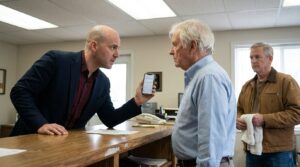
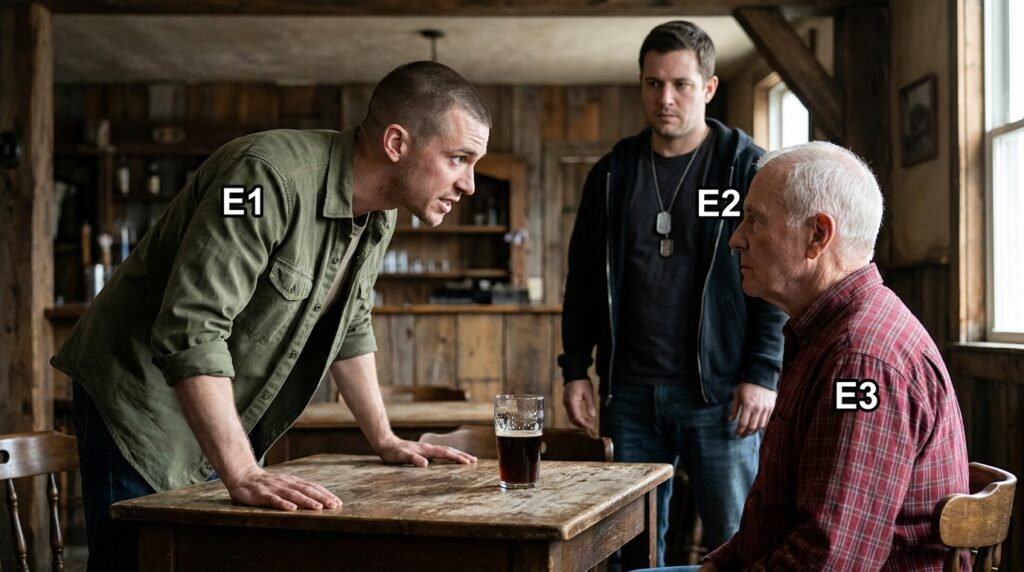
“You keep acting like that, but nobody here believes you anymore,” the kid says, his knuckles going white against the grain of the scarred oak table.
He is twenty-eight, maybe less. He has the freshly scrubbed look of a junior specialist who still thinks the uniform is a shield instead of a target. His shoulders are thrown forward, his lean frame leaning deep across the center line, trying to cast a shadow over my glass. On his utility shirt, the fabric is stiff, smelling of commercial laundry starch and unearned certainty. Behind him, the thicker one with the trimmed beard stands like a sandbag, arms crossed over a dark hoodie, his dog tags making a tiny, metallic click every time his chest rises.
I do not move my hands from the wood. They rest flat, palms down, the calluses around my knuckles catching on the rough, uneven splinters of the tavern table. The amber light from the hanging Edison bulb above us catches the edge of my silver signet ring, its crest worn down to a smooth, unreadable blur by forty years of friction.
“I’m still waiting for a real answer,” the kid presses, his voice dropping an octave to carry across the low hum of the ceiling fan. He thinks he’s commanding the room. He thinks the five regulars sitting at the counter—the ones who have stopped watching the television to look at us—are his audience. “Don’t look away now.”
I don’t. My eyes are locked onto the bridge of his nose, right between his eyebrows, where a small twitching muscle betrays the fact that he is working too hard to maintain his snarl. In the field, a man who leans that far forward is already off-balance; a quick upward snap to the throat would put him on his back before his companion could clear his elbows from his pockets. But this isn’t the tree line outside Hue, and the manila folder sitting under my left elbow contains three decades of administrative legacy that cannot be dirtied by a boy’s ignorance.
The wooden beer glass sits precisely between us, cold and stationary. A ring of condensation has formed around its base, soaking into the dry wood of the table. The room has gone perfectly quiet now. The bartender has stopped wiping the copper draft taps, his rag hanging limp from his fingers.
The kid believes he is protecting something sacred. I can see it in the rigid line of his jaw—he thinks I am a ghost story told by civilians to buy free drafts. He wants a ledger. He wants names, dates, and operational codes that were burned in an incinerator at Fort Meade before his mother was old enough to drive.
“That’s exactly what everyone expected you to say,” he sneers, though I haven’t given him a single syllable. He starts to straighten up, his shoulders shifting back as if he’s won a small perimeter action by default. His companion moves an inch to the left, his boot heel scraping against the linoleum floor.
The silence between us stretches, thick and heavy with the smell of stale rye and dry earth. I let him take his breath. I let him think the space belongs to him. Then, I lean back just an inch, my spine finding the solid, unyielding back of the wooden chair.
“I’m finished arguing with you,” I say. My voice doesn’t rise above the sound of the air conditioning unit rattling in the window behind me, but it hits the table with the dead weight of an iron latch falling into place.
The kid’s mouth opens slightly, his eyes narrowing as the lack of resistance catches him completely exposed. Before he can find his footing, the heavy brass latch on the tavern’s front door gives a sharp, metallic crack, and the cold evening air cuts straight through the amber warmth of the room.

CHAPTER 2: THE ANCHOR IN THE SHADOWS
The brass latch didn’t just rattle; it cracked against the strike plate like a primer cap igniting in an empty chamber. The draft that followed it was thin and carried the distinct, sharp scent of aviation fuel and wet asphalt from the tarmac three miles north.
The kid—E1—didn’t spin around immediately. His discipline was just good enough to keep his eyes on me for one more second, searching for the reaction he hadn’t earned. His shoulders remained locked, the olive utility fabric bunched up at his shoulder blades like a tight harness. But his companion, the sturdier one in the dark hoodie, shifted his weight instantly. The small brass dog tags hanging against his chest gave a faint, rhythmic rattle as he cleared his hands from his front pocket, his eyes darting toward the threshold where the shadows from the entryway met the amber spill of the tavern.
“You think that’s an end to it?” the kid muttered, his voice dropping below the register of the wind coming through the door. He didn’t look back at the entrance yet, but his hands left the wood of the table, his fingers curling into tight, hollow fists at his sides. “A name on a piece of paper don’t clear the field. Not after what happened at the ridge.”
I didn’t answer him. I reached down with my right hand, my fingers wrapping around the cold, grooved base of the octagonal wooden beer glass. It was heavy, a solid chunk of milled oak that had been stained so dark it looked like cast iron under the low bulb. As I lifted it an inch to clear the condensation ring, my thumb brushed against a small, rough indentation on the underside—a crude, five-digit serial stamp that the tavern owner thought was a manufacturer’s mark. It wasn’t. It was an old logistical routing code from the 501st Ordnance Depot, a detail I’d noted thirty years ago when this place was still an unmapped briefing hut.
The kid’s eyes tracked the movement of the glass, his gaze sharp and calculating, trying to read a tell in the steady positioning of my wrist. He was looking for fear, or perhaps the sudden bravado of an old man who thinks he’s about to be rescued by a civilian crowd. He didn’t see either. He only saw the slow, deliberate physics of a hand that had held heavier tools than an administrative file.
“The ridge was six months ago, Specialist,” I said, my voice flat, hitting the narrow space between us before the sound of boots on the linoleum could drown it out. “And your commander didn’t leave his perimeter because of a bad map. He left it because he didn’t know how to read the silence before the mortar track opened up.”
The kid stiffened, his face draining of the ruddy color the beer had given it. The mention of the ridge was a live wire; it was the decoy secret his entire unit had been hiding behind to explain away their recent administrative suspension. He thought he was here to expose a fraud, but the manila folder resting under my left elbow didn’t contain my old discharge records. It contained the raw, unredacted after-action logs of his own squad’s failure—a file currently marked for a formal Article 15 review that his colonel had been trying to intercept all week.
Behind him, the sturdier companion finally took a step back, his boots making a dry, sticky sound against the floor as the figure from the doorway stepped fully into the light.
The air in the room didn’t just cool; it seemed to thin out. The regulars at the counter didn’t turn back to the television. The bartender stayed perfectly still, the white rag in his hand frozen halfway down the copper draft line. Every eye in the place was fixed on the shape now standing by the coat rack—a high-ranking silhouette whose utility cap sat perfectly level, the silver insignia at the center catching the direct gleam of the Edison bulb like a small, polished tooth.
The kid didn’t turn around until the heavy heel-iron of the newcomer’s boots struck the transition strip between the entryway rug and the main room. It was a precise, double-beat stride that anyone who had spent more than six weeks in basic training could identify without looking up.
“Specialist Miller,” the voice came from the shadow behind them. It wasn’t loud, but it had the hollow, resonant weight of an empty oil drum being struck with a wrench. It was an voice that had spent twenty years overriding the roar of diesel generators and low-flying rotors. “Identify your current detail.”
The kid’s posture didn’t just change; it disintegrated and reformed in a micro-second. The aggressive forward lean vanished, his spine snapping straight with a sudden, rigid jerk that looked almost painful. His arms went flush against his dark trousers, his fingers flattening out along the seams as he tried to clear the space he had just been crowding. Beside him, the companion in the hoodie went equally stiff, his chin lifting until his throat was exposed to the light.
“Sir,” the kid barked, his eyes staring straight ahead at the wood paneling of the back wall, completely bypassing my face now. “Assisting with local logistical transport from the airfield, sir.”
The officer stepped out of the gloom. The uniform was immaculate, the camouflage pattern sharp and dark, free of the grease stains that covered the kid’s utility shirt. On his collar, the silver eagle of a full colonel gleamed under the amber light. He didn’t look at the kid. He didn’t look at the companion. His eyes were fixed entirely on the corner of the heavy oak table where my manila folder sat, its edges slightly frayed under the weight of my forearm.
I didn’t rise. I kept my seat, my hand still resting against the cold grain of the table, my fingers maintaining their light grip on the base of the wooden glass. The colonel took three more measured steps until he was standing directly at the flank of the table, his shadow completely cutting off the kid’s light.
“You’re three miles outside your sector, Specialist,” the colonel said, his gaze never shifting from my face. The skin around his eyes was lined with the gray fatigue of a man who hadn’t slept since the operational review began on Tuesday. “And you’re occupying a space that doesn’t belong to your unit.”
The kid didn’t answer. His jaw was locked so tight the muscle beneath his ear looked like an iron wire. He could feel the shift in the room’s atmospheric pressure, the sudden, total collapse of his leverage. He still thought this was about the ridge. He still thought the folder contained the evidence that would break his career. He didn’t know that the real threat wasn’t the paper in the file, but the old man who had sat in the dark thirty years ago and decided how many men his unit would be allowed to lose before the command structure was dismantled from the top down.
“Leave the room,” the colonel murmured, his voice dropping into a register that was almost gentle, though the edge beneath it remained razor-sharp. “Both of you. Now.”
The kid hesitated for a fraction of a second—a tiny, imperceptible hitch in his breathing that only someone who had spent decades watching men break under pressure would notice. Then, he turned on his heel, his boots clicking in a tight, mechanical arc as he and his companion moved toward the exit without a single backward glance.
The heavy door closed behind them, the latch clicking home with that same dead iron weight. The colonel remained standing by the table, his cap cast in shadow, his eyes fixed on mine as the silence of the tavern closed back in around us.
“You should have stayed in Virginia, sir,” the colonel said quietly, his hand coming down to rest on the back of the empty chair across from me.
CHAPTER 3: THE STRATEGIC PARALLEL
“Virginia is humid this time of year, Colonel,” I said, my voice remaining level as the door’s latch settled into its final, metallic rest. “The air here has more grit. It reminds a man of what he’s actually working with.”
Colonel Vance did not pull out the chair. He kept his gloved hand resting flat on the cold, varnished oak of its backrest, his fingers curling slightly over the top rail. He was assessing the geometry of the table, his tactical eyes registering the exact distance between my left hand and the manila folder. Under the harsh illumination of the hanging bulb, the silver eagles on his shoulders cast narrow, blade-like shadows down his sleeves. He had the rigid posture of a man who spent his life projecting authority to hide the fraying edges of his command.
“You haven’t changed the signature blocks on your internal correspondence since ninety-four,” Vance murmured, his gaze dropping to the corner of the folder where a heavy steel split-pin bound the thick stack of papers together. “The administrative clerks at the division desk didn’t recognize the routing stamps when the courier dropped this off. But I did. There are only two people left in the logistics command who use a three-letter prefix for a standard field reprimand.”
I turned the wooden beer glass precisely ninety degrees to the left, watching the condensation slide down the dark, octagonal grooves. “Then you already know why I didn’t send it through the encrypted terminal. Digital lines leave an echo. Paper only burns.”
Vance’s jaw tightened. He finally pulled the chair back, the wooden legs making a short, sharp shriek against the floorboards before he dropped his weight into the seat. He didn’t lean forward the way the specialist had; he sat perfectly erect, arms resting along the armrests, minimizing his physical profile while trying to maximize his psychological leverage. He was a veteran of the bureaucracy, an adversary who understood that an unwritten threat was far more dangerous than a raised voice.
“Miller is a good soldier,” Vance said, his eyes drilling into mine. “He’s young, he’s aggressive, and he’s fiercely protective of his unit’s legacy. He thinks you’re a fraud because your name isn’t on the public rosters for the ninety-two campaign. He doesn’t know how the black-box budget handled personnel assignments back then.”
“He doesn’t know because he hasn’t been taught how to look past the ink,” I replied, my hand remaining motionless beside the folder. “He thinks the uniform makes him an arbiter of truth. That’s a training failure, Colonel. Your training failure.”
Vance pulled a small, silver pen from his upper pocket, the click of its spring-loaded mechanism echoing sharply in the quiet tavern. He tapped the blunt end against the oak table, a rhythmic, maddening cadence that matched the slow rotation of the ceiling fan above us. “If that file leaves this room, the entire structural integrity of the Third Battalion collapses before the fiscal review on Friday. You’re holding an administrative execution order for my executive officer. The ridge wasn’t a tactical failure; it was a supply-line bottleneck. The reprimand is a decoy to shield the political appointments at the department level.”
There it was. The decoy secret, dropped onto the wood like a spent casing. Vance believed the file was purely an institutional cudgel meant to dismantle his command structure for a budgetary infraction at the ridge. He thought he had diagnosed the boundary of my operational intent. His entire counter-strategy was built on the assumption that I was here to clean up an administrative mess for the oversight committee in Virginia.
I let him harbor that conviction. I reached down, my thumb catching the edge of the manila folder and flipping the cover back just enough to expose the first page.
Under the dim amber glow, a peculiar ink stamp was visible on the lower margin of the internal backing sheet—a double-bordered oval emblem featuring a stylized transit grid, stamped twice in fading purple ink. It sat directly beneath the standard classification markings, its sharp edges slightly blurred by the cheap fiber of the paper. Vance’s eyes darted down to it, his pen freezing mid-tap. He recognized the stamp as an antique operational clearance marker, but his mind immediately categorized it as an old administrative artifact from the depot’s founding days. He didn’t see the structural blueprint hidden within the grid lines. He didn’t realize that the oval wasn’t a security clearance at all; it was an architectural validation stamp from the original, unlisted office that had designed the very communication protocols his battalion used to coordinate their movements.
“Your executive officer signed the fuel manifests three weeks before the first mortar track was delivered to the ridge,” I said, my voice dropping into a cold, transactional rhythm. “He knew the weight limits on the northern access road wouldn’t support the weight of the armored trailers. He chose to look at the promotion schedule instead of the topography.”
“The department ordered those movements,” Vance countered, his voice rising slightly before he checked himself, his eyes flicking toward the bartender who was now systematically cleaning the far end of the counter with exaggerated focus. “If you break my XO, the command structure splits down the middle. The young men like Miller—the ones who actually have to carry the rifles—will lose the only leadership they trust. Is that what your legacy looks like, sir? Ruining a frontline unit to settle a thirty-year-old bureaucratic ledger?”
“True discipline isn’t maintained by hiding the rot behind the ranks, Colonel,” I said, my fingers pressing lightly against the purple ink stamp on the paper, feeling the slight indentation where the metal die had bitten into the wood pulp. “It’s maintained by ensuring the foundation can bear the weight of the mistakes.”
Vance stood up slowly, the silver pen vanishing back into his pocket with a smooth, practiced motion. He adjusted his utility cap, his fingers setting the brim exactly parallel to his brow line. The shadow returned to his face, hiding the deep, dark pockets of exhaustion under his eyes.
“The review board convenes at nine tomorrow morning,” Vance said, his voice dropping into a flat, formal pronouncement. “If that folder isn’t on the desk by eight, the military police will execute an administrative recovery warrant for state property. I can’t protect you from that, sir. Not even with your retirement rank.”
He turned and walked toward the door, his boots striking the floor with that same mechanical, double-beat cadence. As his hand reached for the brass latch, he paused, his profile silhouetted against the dark glass of the window.
“The world changed after you left the basement in Virginia,” he said without looking back. “We don’t live in the silence anymore.”
The door clicked shut, the cold air rushing in once more to swirl the dust motes around the amber bulb. I sat alone at the table, my hand moving from the paper back to the cold grain of the wooden glass. The colonel had his strategy mapped out, but he was still playing on a board I had drawn before his first promotion.
CHAPTER 4: THE LIQUIDATION OF LEVERAGE
The silence Vance left behind didn’t last five minutes.
It began as a low, structural vibration in the soles of my boots—the deep, synchronized thrum of heavy-duty diesel engines idling in the gravel lot outside. Then the light changed. The dull amber glow of the hanging Edison bulbs was instantly annihilated by sharp, blinding shafts of white halogen searchlights that cut through the frosted tavern windows, sweeping across the room like blades. The scarred oak tables and old leather booths were suddenly sliced into stark, shifting geometric fragments of brilliant white and pitch black.
The regulars at the bar didn’t just quiet down; they froze. The bartender dropped his glass-wiping rag entirely, his hands slowly rising to press flat against the copper bar rail as the distinctive, high-pressure hiss of air brakes settled right outside the threshold. This wasn’t a routine patrol check. This was a multi-vehicle tactical box-in.
The front door didn’t click open this time. It was hit with a calculated, mechanical force that drove the brass latch straight into the drywall behind it.
Three men in charcoal-gray tactical vests cleared the frame in a standard low-profile stack, their movements precise, rapid, and completely fluid. The high-gloss white lettering of the Military Police insignia across their chests gleamed under the strobing blue and red light bars reflecting off the parking lot ice. Their weapons weren’t holstered; they were carried at a strict, low-ready presentation, muzzle vectors sweeping the corners of the room before locking down the exits.
“Secure the perimeter counter,” the lead element barked, his voice muffled by the rigid throat-mic buckled around his neck. “Nobody touches a terminal. Nobody moves their hands from the surface.”
Behind the stacked fire-team stepped a figure whose presence immediately altered the remaining atmospheric pressure in the room. He didn’t wear the standard field utilities Vance had sported. He wore the crisp, razor-creased service dress of a General officer, the heavy black wool overcoat pinned with the two silver stars of a Major General. It was Garret, the active installation commander. His face was a hard mask of grey stone, his eyes small and dead behind wire-rimmed spectacles that caught the strobing emergency lights like spinning coins.
He didn’t look at the bartender. He didn’t acknowledge the regulars. His boots struck the floorboards with a heavy, unyielding cadence that stopped exactly two paces from the edge of my heavy oak table. The three tactical operators formed a rigid semi-circle behind him, their shadows lengthening across the wood until they completely swallowed my glass.
“You’ve been a difficult man to locate, sir,” Garret said. His voice was thin, dry, and entirely devoid of the institutional deference Vance had shown. He didn’t reach for a chair. He stood over me, his hands leather-gloved and clasped tightly behind the small of his back.
I didn’t lift my palms from the table. I kept them flat against the wood, my index finger resting less than an inch from the manila folder. “The map hasn’t changed in forty years, General. If you had trouble finding the coordinate, you should have checked the baseline routing logs.”
Garret’s eyes flicked down to the folder, then back to my face. A sharp, unpleasant smile touched the corner of his mouth. “The baseline logs are currently being archived. Along with every scrap of paper you brought out of the Virginia repository.”
He signaled with a slight nod of his chin. The lead tactical operator stepped forward, reaching into his vest to pull out a single sheet of heavy, cream-colored bond paper. It wasn’t a standard administrative summons. Across the top header, a thick, crimson ink stamp read: Title 10 Emergency Seizure — Sovereign Exclusion Domain.
The operator laid the sheet flat on the wood, directly over the beer glass’s condensation ring.
“Vance is a provincial bureaucrat,” Garret said, his voice dropping into a hard, rhythmic drone that signaled an absolute end to negotiation. “He thinks in terms of local reprimands and squad-level suspensions at the ridge. He came here trying to salvage an executive officer’s career because he thinks that’s the extent of the damage. He doesn’t see the architecture.”
My eyes tracked the red stamp on the paper. The code sequence listed beneath the Title 10 citation wasn’t a logistical case number for a supply-line failure. It was an active federal blackout directive—an intervention order that completely bypassed the standard regional courts-martial and regulatory review boards I had calculated into my strategy. The local administrative leverage I held—the fuel manifests, the XO’s signed directives, the structural proof of the Third Battalion’s negligence—was instantly rendered useless. The system wasn’t entering a legal dispute; it was executing a total administrative liquidation.
“The folder stays with my detachment,” Garret murmured, his gloved hand finally coming down onto the center of the manila cover, his fingers pinning the cardboard to the table with a heavy, crushing pressure. “The review board at nine tomorrow morning has been canceled by direct command of the department. There is no ledger to fill out, old man. There is no audience left to watch you turn the keys.”
I looked at his gloved fingers, then up at the sharp, glinting edges of his spectacles. The calculation had failed. The operational parameters I had relied on for the past three decades had been overwritten by a younger, more ruthless iteration of the hierarchy—one that didn’t care about institutional rules or legal consistency. They were simply going to take the paper, seal the room, and erase the boundary entirely.
“You think you’ve contained the sequence because you brought twelve rifles and a red stamp, General?” I asked, my internal monologue frantically scanning the room’s physical geometry, searching for a secondary line of calculation that didn’t exist. For the first time since ninety-two, the space wasn’t responding to my movements.
“I know I’ve contained it,” Garret replied, his face remaining entirely static as the operator behind him stepped closer, his hand moving toward the heavy nylon strap of his weapon casing. “Because the man who taught me how to isolate a perimeter used to sit in your exact chair. Collect the file.”
The operator’s fingers closed around the edge of the manila folder, the heavy paper creaking as it was lifted from beneath my arm, leaving nothing but the cold, empty grain of the oak table between us.
CHAPTER 5: THE CORE REVERSAL
The empty spot on the table was colder than the wood around it.
The manila folder was gone, vanished into the crisp nylon seal of the operator’s document pack, but the world didn’t stop spinning on its axis. General Garret didn’t look down at the bare, scarred oak. He kept his wire-rimmed spectacles locked on my face, the red strobe from the parking lot slicing horizontally across his lenses like a thin line of blood. The tactical detachment was already falling back into a defensive egress formation, their heavy leather soles pivoting on the floorboards with a synchronized, mechanical scrape.
“You built a solid perimeter, old man,” Garret said, his voice dropping into that flat, clipped cadence used by managers who have successfully audited an unlisted line item. “But a perimeter only works if the terrain stays static. You’re still calculating your options based on the ninety-two regulatory framework. The department moved past that architecture before the ink dried on your retirement citation.”
I looked down at the table surface. The cream-colored bond sheet containing the Title 10 seizure warrant remained behind, pinned down by the heavy octagonal beer glass. But beneath the base of that glass, right where the condensation had pooled into the grain, lay something the operator’s fingers had missed in their efficiency—the steel split-pin clasp. It had snapped free from the cardboard folder during the forceful pull, its dual prongs flattened out against the dark varnish like a tiny, silver trapdoor that had just been tripped.
“You should have looked at the clasp, Garret,” I said, my voice cutting cleanly through the rhythmic hum of the tactical vehicles outside.
The General’s left eyebrow twitched, a minuscule hitch in his expression that lasted less than a millisecond. He didn’t order his men to stop, but his boots didn’t take the next step toward the door either. “The clasp is inventory scrap, sir. The data is in the folder. The field logs from the ridge are already entering the incinerator loop at the base headquarters.”
“The field logs from the ridge were the decoy, you fool,” I replied, my right hand slowly moving across the table, my index finger pinning the broken piece of steel to the wood. “Vance thought the folder was an execution order for his career. You thought it was a political liability for the oversight committee. Both of you spent the evening chasing a paper trail because you’ve been trained to follow the ink.”
The room went perfectly quiet again. The three tactical operators in the entryway stack didn’t lower their muzzles, but their postures stiffened, their ears straining against the low hiss of their internal throat-mics. The bartender had vanished beneath the lip of the copper counter entirely, seeking the only cover the structural wood could provide.
I slid the silver split-pin across the varnished oak until it rested directly over the crimson ink of the emergency seizure warrant. Under the raw glare of the halogen searchlight, the inner side of the metal prong showed a micro-engraved, five-digit logistical stamp—501-A. It wasn’t an administrative serial number. It was the original designators code for the black-budget infrastructure that had established the local base’s communication routing array forty years ago.
“The oval stamp on the backing sheet wasn’t an administrative marker from the depot,” I murmured, my gaze remaining locked on the bridge of Garret’s nose. “It was the structural architecture validation. The file didn’t just contain reports on a supply bottleneck at the ridge. It contained the complete, unredacted logic loop for the automated division command network. The network you used to coordinate this tactical box-in tonight.”
Garret’s face didn’t just pale; the muscle beneath his left ear locked up like an over-tensioned cable. He took a single, aggressive step forward, his leather gloves striking the table with a dull, hollow thud that vibrated through the oak. He finally realized the scope of his miscalculation. He had stolen a container of paper, but by bringing his active, network-linked command unit within three miles of this specific coordinates booth, he had brought his entire active infrastructure directly into the target profile.
“The Third Battalion doesn’t operate on an unlisted network,” Garret hissed, his voice losing its dry, administrative drone, replaced by the jagged edge of an officer who has just realized his forward command post is completely exposed. “The encryption architecture is secure.”
“The encryption architecture is yours,” I said, a cold, sharp smile finally touching the corners of my mouth as the tiny silver signet ring on my finger caught the strobe light. “The baseline logic is mine. I didn’t stay in Virginia to archive the past, General. I stayed to ensure that when the younger generation started using my tools to cover their rot, I could turn the power off from the basement.”
A high-pitched, metallic whine suddenly tore through the tactical operators’ headsets, followed instantly by the sharp, electric pop of an unshielded circuit blowing in the lead vehicle outside. The white halogen searchlights cutting through the windows flickered twice, then died, plunging the tavern back into the dim, cold amber of the failing Edison bulbs as the deep thrum of the diesel engines choked out into absolute silence.
Garret stared at me through the gloom, his wire-rimmed spectacles reflecting nothing but the darkness closing in around his perimeter. The decoy layer had shattered, and the ultimate truth was finally turning its teeth toward the room.
CHAPTER 6: THE SILENCE OF THE ARCHITECT
“The line is dead, Garret,” I said, my voice dropping into the frozen hollow left by the power grid’s sudden collapse.
The General did not pull his hand back from the table. His fingers remained splayed against the varnished oak, but the leather of his glove was trembling—a high-frequency vibration born of sheer, systemic shock. Through the frosted glass of the window, the red and blue emergency light bars did not strobe anymore; they had frozen into solid, static bars of dead violet that stained the parking lot ice. Inside the headsets of the tactical operators, the metallic whine had dissolved into a flat, empty hiss that sounded like sand falling onto glass.
Time did not move at its regular pace. In the dim, amber twilight of the failing Edison filaments, every movement was elongated, stripped of its velocity by the absolute gravity of the reversal. The lead operator took one slow, staggering step backward, his hand fumbling with the dead control box at his hip, his fingers tracking the useless plastic ridges with the clumsy panic of a man who had suddenly lost his sight.
“This is an unlisted installation,” Garret whispered. The administrative drone was entirely gone, replaced by the dry, rasping breath of an officer whose entire tactical interface had been reduced to cold silicon and scrap metal in less than five seconds. “The routing relays are decoupled from the public net. You can’t execute an override from a civilian booth without an active terminal link.”
I lifted my right hand from the oak, my fingers leaving five pale, clear ovals in the thin layer of dust beside the Title 10 seizure warrant. The silver signet ring didn’t flash; it held a dull, steady gleam that matched the exact hue of the steel split-pin resting between us.
“I didn’t need a terminal link, General,” I said, my voice dropping beneath the low, rhythmic rattle of the window pane as the cold wind outside began to rise. “The routing relays aren’t decoupled. They were built on top of the original five-digit framework I stamped into the bedrock of this county forty years ago. Every encrypted trunk line your battalion laid down this morning is just another branch growing out of the trunk I planted.”
The operators didn’t look at Garret for orders anymore. They looked at the dead indicators on their vests, then back at the solid, unmoving frame of the table. The institutional shield that had protected their arrogance since they left the airfield had been peeled away, leaving nothing but the raw, unyielding physics of a room they no longer controlled.
Garret slowly straightened his spine, his knuckles lifting from the wood with a faint, sticky pull. His wire-rimmed spectacles were entirely dark now, reflecting only the hollow silhouette of the dead searchlights outside. The power dynamic hadn’t just shifted; it had imploded into the floorboards. He had entered the tavern with twelve rifles and a red stamp to seal a political liability, only to discover that his entire division command structure was currently hanging from a single thread that ran beneath my left boot.
“Stand down, son,” I said, the title hitting his silver stars with the cold, unyielding weight of an iron latch dropping into a groove. “You’re speaking to the man who wrote the tactical doctrine you failed to follow this morning. The review board at nine tomorrow isn’t canceled. It’s just under new management.”
The General’s mouth opened slightly, his jaw freezing mid-motion as the true scope of the Layer 2 reality settled into his calculation. He wasn’t dealing with a retired civilian spinning old stories for a free draft; he was sitting across from the ghost author of his entire operational reality. The manila folder he had stolen was an empty hull—a piece of administrative bait designed to draw his active-duty command structure within range of the baseline kill-switch.
Behind him, the entryway door gave a soft, slow creak as the wind pushed it open an inch, letting a thin line of freezing air slide across the linoleum floor. The absolute silence of the small-town veteran space closed back around us, heavy with the smell of stale rye, cold earth, and the distinct, bitter tang of static ozone from the blown tactical circuits.
“What do you want?” Garret asked, his voice barely rising above the whistle of the draft.
I reached out, my fingers wrapping around the cold, grooved base of the octagonal wooden glass, setting it precisely over the crimson ink of his useless seizure warrant.
“I want you to walk out of my perimeter,” I said quietly, my eyes locking onto the center of his forehead with an unbroken, final gaze that left no room for negotiation. “And when you report to the desk tomorrow morning, you tell the department that the silence is still working.”
He didn’t answer. He turned on his heel, his movements slow, heavy, and completely stripped of the mechanical cadence that had brought him through the door. The tactical stack followed him out into the dark, their boots dragging against the wood as they retreated into the dead, unlit night.
True strength didn’t need to bark to prove it had teeth. It just had to wait for the room to go cold.