The Weight of Concrete and the Narrow Boundaries of a Checked Kingdom

CHAPTER 1: THE FAULT LINE

The grease on the handle of the adjustable wrench was old, thick, and smelled faintly of scorched iron. It took three hard wipes with an oil-stained rag to clear the threads, but Miller didn’t look down at his hands. He kept his eyes on the gray water pulsing through the hairline fractures of the shared driveway. Every five minutes, another delivery truck rumbled past the lower curb of the development, and the vibration sent a tiny, muddy geyser up through the split concrete. The water was gray, heavy with silt from the upper slope, and it was draining directly against the foundation sill of his basement.

He could hear the rhythmic clink of the rusted iron latch on the neighbor’s side gate. It was a dry, metallic sound that had drifted across the narrow strip between the two houses for eighteen months.

Miller knelt, his knees pressing into the damp gravel edge where the lawn met the masonry. The light jacket he wore was stiff from salt air and old workdays, the fabric scratching against his collar as he leaned forward to inspect the latest shift in the soil. There was a fresh two-inch depression near the utility box. The earth was falling through its own bottom, sucked down into some hollow pocket Miller hadn’t permitted.

A shadow broke the flat glare of the overcast sky. It didn’t approach with a casual stride; it arrived with the heavy, uncalibrated weight of someone who spent his mornings watching windows.

“We aren’t digging today, Miller.”

The voice was thin but pushed forward with a rehearsed density. Aaron stood three inches past the rusted gate latch, his t-shirt dark with sweat at the shoulder blades, his fingers already hooked into the pocket of his jeans as if checking for a knife he didn’t own. He didn’t look at the pooling water or the yellow surveyor string coiled on top of the gray plastic work crate. He looked only at the space between Miller’s boots and the edge of the slab.

Miller didn’t stand up immediately. He let the wrench settle into the palm of his hand, feeling the chill of the tool match the temperature of his skin. He counted three distinct vibrations from the main road before he shifted his weight, his dark pants catching a smear of wet clay as he rose to his full height. His shoulders stayed square, his posture holding the blunt, guarded stillness of an old timber post.

“The grade is dropping,” Miller said. His voice was flat, stripped of the rising cadence that usually invited an argument. “The runoff from your gutter line is washing out the sub-base under the walk.”

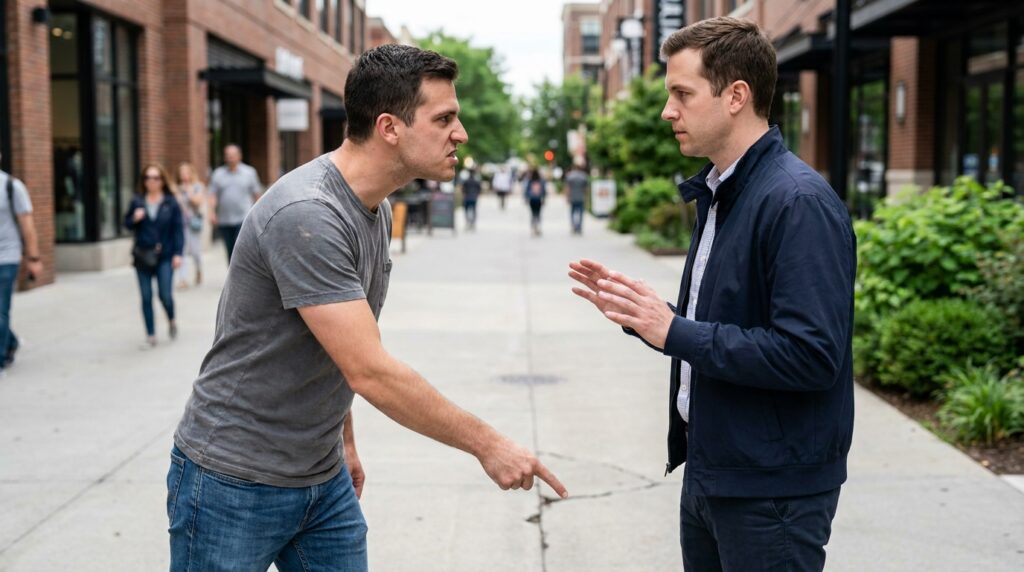
“My gutters have been there since ninety-six,” Aaron said, taking a half-pace forward. His jaw was already tight, the skin around his eyes twitching with the specific, fragile heat of an authority faker who had spent the night reading county code line items on a phone screen. He pointed a single, calloused finger down at the exact point where the concrete split into three distinct paths. “The line is the seam, Miller. You don’t lay concrete on this side of the flag, and you don’t touch the drainage. You don’t just step into my space like that, you don’t get it.”

Miller looked at the finger. The tip of Aaron’s boot was less than four inches from the newly driven brass survey pin—a pin that Aaron hadn’t noticed because he was looking too hard at Miller’s eyes. In the reflection of the smart-home camera mounted under Miller’s eaves, both men looked like small, dark shapes locked inside a narrow gray corridor.

Miller kept his hands level with his chest, fingers loose, palms half-turned inward in a gesture that looked like a retreat but kept his balance perfectly centered over his heels. “I’m not taking anything from you, Aaron,” he said, the words quiet against the sudden rattle of the iron gate latch. “I’m just trying to help.”

Aaron’s chin dipped, his teeth visible behind a dry, split lip. “Then stop acting like you know everything.” He reached out, his hand swinging low toward the yellow string on the crate, his knuckles brushing the edge of an old, tarnished brass key sticking out of the protagonist’s pocket—an object Aaron had never seen before, but one that matched the ancient stamp on the county water valve buried four feet beneath their boots.


CHAPTER 2: THE CURB OVERRUN

“Keep your fingers off the brass, Aaron.”

Miller’s words didn’t carry weight because they were loud; they carried weight because they didn’t move. The tarnish on the old key pressed into the meat of his thumb through the worn denim of his pocket, a cold, distinct ridge against his skin. Aaron’s hand remained suspended an inch away, his knuckles white, the dry wind from the street whipping a spray of yellow limestone dust right across the space between their chests. Aaron didn’t pull back. He simply tilted his chin up, his gaze sliding from Miller’s eyes down to the bright orange survey flags driven into the gravel.

“You think a piece of wire and some paint makes this yours?” Aaron asked. His voice had dropped into a rough, scratchy register, the tone of a man who spent too many hours counting the tires on every vehicle that pulled into the cul-de-sac. “The township records don’t say anything about a re-survey on this block. My uncle built that patio deck in ninety-eight, and he didn’t ask for a brass pin to tell him where the soil stops.”

“Your uncle didn’t clear the easement with the water authority either,” Miller said. He stepped back—not away from Aaron, but out of the narrow track of the walkway, redirecting his momentum toward the edge of the street where a low, heavy rumble was beginning to shake the storm grate.

The sound grew thicker, a mechanical thrum that vibrated through the soles of Miller’s work boots long before the shape cleared the corner. A dual-axle flatbed truck, its yellow cab splattered with dried river mud, slowed to a crawl at the mouth of the lane. On the back, three pallets of interlocking hydraulic gravel sat strapped under heavy nylon webbing, their weight causing the truck’s rear leaf springs to groan with every dip in the asphalt. The driver, a stocky man wearing a high-visibility vest that had faded to a dusty yellow, rolled down his window and looked at the curb.

He couldn’t pull in.

Aaron’s three-quarter-ton flatbed trailer was parked parallel to the curb lane, its rusted iron hitch extended six inches past the legal parking line, the heavy jack-foot sunk deep into a soft patch of municipal tar. The trailer was empty except for a pile of broken concrete blocks and three lengths of corroded iron pipe, but it took up twenty feet of the only clear access route to Miller’s driveway.

The driver leaned out, his forearm resting on the dirty door panel. “Hey, chief. I can’t drop these pallets here if that rig stays locked to the curb. My crane arms won’t clear those overhanging telephone wires with the trailer in the way.”

Miller walked down the slope of his lawn, his boots crunching against the dry clover. He didn’t look back to see if Aaron was following, but the rhythmic, metallic scrape of the side gate latch told him the neighbor was already moving down the parallel concrete path, keeping pace behind the hedge line like a dog tracking a fence.

“The trailer moves,” Miller said to the driver, his hand coming down onto the cold, oxidized steel rail of Aaron’s rig. The rust was rough under his palm, flaking off in dry, red scales that left an orange smudge across his fingers. “Give it five minutes.”

“It doesn’t move an inch,” Aaron shouted from behind the privet hedge. He broke through the gap in the branches, his casual t-shirt catching on a twig that snapped with a sharp, dry report. He didn’t look at the truck driver; he went straight for the trailer hitch, planting his boots right where the asphalt met the concrete curb strip. “That trailer is registered, it’s tagged, and it’s on my side of the drainage seam. You want your gravel, Miller? Tell him to dump it in the middle of the street and haul it up yourself with a wheelbarrow.”

The delivery driver looked between the two men, his engine idling with a wet, rhythmic cough that sent puffs of black diesel smoke into the low overcast sky. “Look, guys, I’ve got four more drops before three o’clock. I don’t care who owns the asphalt, but my slip says ‘curbside delivery.’ If I can’t drop the jacks, I’m taking the load back to the yard and charging the account for a dry run.”

Miller didn’t raise his voice. He looked at the trailer’s rusted hitch, then down at the wet spot forming beneath the frame. The street had been dry for three hours, but a steady, grey trickle of water was weeping out from underneath the trailer’s left tire, bubbling out from a tiny crack in the municipal blacktop. It wasn’t storm runoff. It smelled faintly of iron and subterranean rust—the exact signature of the water currently undermining his own foundation sill.

He reached into his pocket, his fingers sliding past the old brass key until they touched the hard plastic corner of his phone. He didn’t look at the screen as he pulled it out. He simply pointed the lens toward the base of the trailer hitch, where the water was beginning to cut a miniature channel through the road salt.

“You’ve got an active leak coming from the service side of your property line, Aaron,” Miller said, his voice flat, his gaze locked on the small pool gathering around the neighbor’s boots. “The township code says any obstruction over a municipal water line during an unverified discharge carries a four-hundred-dollar daily assessment if the utility crew can’t clear the access cap.”

Aaron froze, his hand still clamped onto the iron crank of the trailer jack. His jaw worked silently for three seconds, his eyes darting toward the security camera hum under Miller’s eaves, then down at the gray folder resting on the work crate fifty feet away. The heat in his face had turned a deep, mottled red, but he didn’t drop his hand. He knew the utility cap was exactly three feet behind his trailer’s rear axle—buried under six inches of the broken concrete blocks he had dumped there last Tuesday.

“You don’t know what’s under this road, Miller,” Aaron muttered, his voice dropping into a tight, transactional hiss that the delivery driver couldn’t catch over the thrum of the diesel engine. “You think you’re fixing a lawn, but you’re digging into things that have been settled since before your house was framed.”

Miller didn’t answer. He simply watched the water line rise against the rubber of Aaron’s boots, waiting for the first sign of the county surveyor’s vehicle to round the lower corner of the development.

CHAPTER 3: THE IMPRINT OF THE STAKE

The white county truck didn’t clear the corner softly. It bounced over the asphalt apron of the cul-de-sac, its rear utility racks clattering with the heavy, rhythmic iron chime of iron T-bars and zinc-coated tripods. When the brakes caught, the front bumper dipped within an inch of Aaron’s rusted flatbed trailer hitch, forcing the grey water pooling around the tires to splash up against the white-painted quarter panels.

A man in a thick canvas jacket climbed down from the cab. He didn’t lock his door; he left the diesel engine chugging, a wet, mechanical vibration that matched the pulse of the water still bubbling from the split in the blacktop. He carried a heavy leather map case under his arm, its strap reinforced with unpolished brass rivets that had turned green around the edges.

“Miller?” the surveyor asked, squinting through the light, salt-heavy drizzle. He had the dry, leathery skin of someone who had spent thirty years tracing old colonial deeds through the overgrowth of the county line.

Miller took his hand off the cold steel rail of Aaron’s trailer. He nodded once, shifting his weight to the ball of his right foot, keeping himself positioned directly between the surveyor and the gray plastic work crate holding the unsealed deed folder. “The brass pins are in,” Miller said. “But we have an access problem on the municipal side.”

“I see it,” the surveyor muttered. He walked toward the rear axle of the trailer, his heavy boots leaving deep, dark imprints in the wet silt washing down the slope. He stopped exactly where the grey trickle emerged from beneath the tires, his gaze sliding down to the pile of broken concrete blocks Aaron had dumped over the utility cap. He dropped a heavy steel measuring tape onto the pavement with a sharp, metallic clack. “This is the entry sleeve for the district water main. Who authorized the aggregate dump on top of the inspection valve?”

“Nobody authorized anything,” Aaron snapped, stepping out from the hedge line. His t-shirt was thoroughly soaked now, clinging to his ribs, but his jaw remained locked in that same aggressive forward lean. He pointed his finger directly at the surveyor’s leather case. “The main line runs six feet to the north, under Miller’s gravel strip. My uncle watched the county lay the lateral in seventy-two. You’re reading the wrong grid lines.”

The surveyor didn’t look up from his tape. He knelt in the mud, his canvas coat scraping against the rusted frame of the trailer as he reached beneath the axle. His fingers came back slick with a thick, orange slime—iron bacteria from a pipe that had been leaking far longer than three days. He wiped his hand on a clean rag, then unbuckled the leather case, pulling out a heavy, blue-printed linen sheet that had been varnished against the weather.

“Your uncle didn’t have to sign the industrial easement bonds in eighty-four, neighbor,” the surveyor said, his voice flat, dry, and unyielding. He laid the map flat across the top of Miller’s plastic crate, right next to the yellow surveyor string. “The lateral shifts forty degrees at the property seam. It goes right through this concrete walkway. And according to the township deed revision, anything within four feet of this pin is an open utility lane.”

Miller walked closer, his boots steady against the concrete. He didn’t look at Aaron’s face; he looked at the blue linen print. His eye caught a specific, handwritten annotation from 1954, scrawled in faded red ink near the margin of the plot. There was a small symbol—a crossed key—drawn right over the intersection of their property lines. He felt the cold shape of the old brass key in his pocket, its weight suddenly feeling three times heavier against his hip.

“Look here,” Miller said, his finger coming down on the map just short of the red ink marker. “The main valve isn’t just a shut-off. There’s an unmapped connection point listed under the old district code.”

Aaron stepped forward, his body crowding the space between Miller and the surveyor. He didn’t look at the map; he used his shoulder to block Miller’s line of sight, his face less than six inches from Miller’s jacket collar. “You don’t touch that folder, Miller. You don’t have the authorization to review the township utility deeds. That’s private infrastructure until the county serves an enforcement notice.”

The delivery driver from the gravel truck let out a short, sharp blast on his air horn, the sound shattering the quiet of the residential lane. Several porch watchers three houses down shifted their positions, their silhouettes dark against the screen doors as they watched the three men cluster around the work crate.

“I don’t need an enforcement notice to clear an obstruction during an active discharge, son,” the surveyor said. He reached into the back of his truck and pulled out a four-foot iron pry-bar, its tip sharpened to a blunt chisel edge. He drove the iron tool into the pile of concrete blocks under Aaron’s trailer, the impact sending a shower of gray stone dust over Aaron’s boots. “We’re pulling this rig out of the lane right now. If the hitch snaps, it’s a municipal liability waiver.”

Aaron didn’t back up. He reached out and grabbed the shaft of the surveyor’s iron bar, his knuckles turning dark red against the rusted metal. “You touch this trailer, and I’m calling the district supervisor. I know exactly who signed your field warrant.”

Miller watched the water bubbling faster now from the split pavement, the grey silt turning into a thick, dark slurry that was beginning to undermine the very spot where Aaron was standing. He didn’t intervene; he simply turned his head toward his own roofline, where the small blue light of the security camera continued its silent, rhythmic blink, capturing every inch of the contact.

CHAPTER 4: THE PAVEMENT LINE

The rusted metal of the surveyor’s iron bar screeched as Aaron’s weight slammed into the shaft. The vibration traveled up the iron tool, throwing a spray of wet, orange-tinted silt across Miller’s work boots. For a micro-second, the only sound in the narrow space between the two houses was the ragged, localized rasp of Aaron’s breathing and the low, heavy idle of the county diesel truck behind them.

Aaron didn’t release his grip. He lurched half a pace forward, his shoulders bunching beneath his damp t-shirt as he jammed his own boots directly into the wet gravel seam. He was leaning into Miller’s personal space now, his chest a mere few inches from Miller’s jacket zipper, his entire posture twisted into an aggressive, unyielding block over the orange survey marker flag.

“You don’t just step into my space like that, you don’t get it,” Aaron spat. His jaw was a hard, tight knot, his eyes wide and bloodshot from the cold drizzle. He lifted a single, mud-streaked hand and jabbed a finger sharply down at the cracked concrete between their feet, pinning his claim to the pavement like an iron stake. “This is old ground, Miller. My family laid this driveway before your deed was even printed at the county house. You don’t bring town trucks onto my side of the line.”

Miller stood his ground squarely. His heels remained planted on his own undisputed slab, his square shoulders forming an immovable barrier against Aaron’s forward lean. He didn’t drop his stance, nor did he ball his hands into fists. Instead, he kept his hands raised chest-level, fingers loose and slightly curved inward in a calm, controlled, defensive posture that offered no target for escalation while keeping his balance perfectly centered over his boots.

“I’m not taking anything from you, Aaron,” Miller said, his voice flat, steady, and unhurried against the dry rattle of the neighbor’s side gate latch. “I’m just trying to help.”

Aaron’s chin dipped forward, his teeth grinding together until a thin line of white foam appeared at the corner of his split lip. He looked down at the brass surveyor pin, then back up at Miller’s steady, unblinking eyes, his voice dropping into a tight, frustrated hiss. “Then stop acting like you know everything.”

The words had barely left Aaron’s mouth when a sharp, hollow crack echoed from underneath the rear axle of the flatbed trailer.

The weight of the unmapped water main pressure, combined with the heavy iron bar driven into the concrete blocks, had finally sheared the sub-surface clay. The grey slurry beneath the trailer erupted in a sudden, violent surge, bubbling up through the broken asphalt like oil. The water didn’t drain away toward the street; it rushed directly into the narrow trench the surveyor had cleared, exposing the top of a corroded six-inch iron line that ran parallel to the boundary.

But it wasn’t a standard utility line. Spliced into the side of the main county valve was a rough, unauthorized copper sleeve—a buried bypass pipe that was illegally anchored with heavy steel bands, extending directly from the water main toward the foundation wall of Aaron’s basement.

The surveyor let go of the pry-bar, his canvas coat slick with the gray mud slurry. He wiped his face with the back of his hand, his eyes wide as he looked at the exposed connection. “What the hell is that?”

Miller didn’t answer right away. He let his gaze track the path of the illegal copper splice. The pipe didn’t just cross under the walkway; it was drawing continuous, unmetered pressure directly from the township side of the line. The old brass key in Miller’s pocket seemed to hum against his thigh, the handwritten red cross-key icon from the 1954 blueprint suddenly snapping into sharp, terrifying focus. This wasn’t a standard neighborhood drainage issue. This was a deliberate, subterranean overreach that had been hidden under the concrete for decades.

Aaron backed up half a step, his boots slipping on the slick, silt-covered blacktop. The deep red flush in his face vanished instantly, leaving his skin a pale, pasty grey under the flat light of the overcast sky. He looked at the bubbling water, then at the surveyor’s leather map case, his hands dropping to his sides as his aggressive posture completely deflated.

“That’s… that was there when we bought the property,” Aaron muttered, his voice cracking as his eyes darted toward the blue light of the security camera humming beneath Miller’s eaves. “That’s an old agricultural line. It’s grandfathered in under the original development charter.”

“The county doesn’t grandfather unmetered main splices, son,” the surveyor said, his voice dropping into a cold, transactional register as he pulled out a heavy field notepad. “That’s a tier-one infrastructure breach. The fine alone starts at five grand, before they calculate the back-usage bills.”

Miller turned his head slightly, his eyes locking onto the small screen of his phone as a fresh notification blinked. The camera had recorded the entire incident—every gesture, every accusation, and the exact moment the illegal line was exposed in front of the surveyor and the distant porch watchers. But as Miller looked closer at the exposed iron main in the mud, he noticed something else: the massive county pipe wasn’t just sitting near the boundary line. It was situated entirely inside the legal footprint of his own deeded soil, which meant the entire corner of Aaron’s garage was sitting on ground it had no right to occupy. The paradigm was shifting again, and the true depth of the historical grid error was about to surface.

CHAPTER 5: THE SEAM REVERSAL

The exposed copper sleeve was still hissing under the grey slurry, bleeding a bright, unnatural turquoise oxidation into the dark clay. Miller didn’t look back at Aaron, whose boots were now thoroughly anchored in the shifting muck. Instead, Miller reached out and pulled the unsealed township deed folder toward himself across the top of the work crate. The cold steel corners of the metal clip bit into his thumb, a small pocket of sand grinding between the paper and his skin.

“The main line doesn’t just run parallel,” Miller said. His voice stayed level, cut thin by the damp cold of the afternoon wind. “Look at the offset on the footing marker.”

The surveyor stepped around Aaron’s frozen form, his heavy canvas coat sweeping over the yellow surveyor string. He held a secondary zinc-coated plumb bob over the exposed edge of the water main, his eyes dropping to the handwritten red annotations on the 1954 plat map. The metal weight swung in a slow, precise arc over the water-filled ditch, its tip pointing exactly two inches inside the concrete foundation block of Aaron’s detached garage wall.

“The grid anchor is dead,” the surveyor muttered. He reached down and ran his fingers across the wet limestone base of the wall, where a fresh hairline split was beginning to propagate upward into the mortar. “This isn’t a simple lateral drift. The entire 1950s municipal tract was laid out from the wrong baseline monument. Every structure on this western boundary lane is shifted forty-eight inches to the east.”

Miller did the calculation without speaking. He didn’t look up to check the smart-home camera light under his eaves, but he knew the lens was logging the specific, silent geometry of the reveal. A forty-eight-inch shift didn’t mean Aaron had simply encroached on a shared walkway strip. It meant the entire structural footprint of Aaron’s master bedroom and the load-bearing masonry wall of his garage sat squarely on Miller’s deeded, tax-assessed property.

Aaron took a step backward, his hand finally releasing the iron crank of his trailer jack with a dry, hollow clack. The unearned confidence that had held his shoulders square for months seemed to leak out into the grey puddle beneath his heels. He looked down at his own water-logged t-shirt, then out toward the lower road where the delivery truck driver was still waiting, his engine idling with that same thick, rhythmic diesel thrum.

“The house has been standing for thirty years,” Aaron said, his voice dropping into a dry, defensive rasp that carried no weight against the wind. “The township approved the structural framing in ninety-four. You can’t retroactively invalidate a foundation sill because of an unmapped municipal error.”

“The township approved a framing plan based on a false affidavit, son,” the surveyor said, his pencil scratching a jagged black line across his field pad. He didn’t look at Aaron; his eyes were fixed on the exposed main valve. “When a tier-one infrastructure breach exposes a structural encroachment on a verified main line easement, the title insurance company doesn’t arbitrate. They clear the line. Every foot of this concrete wall has to come down before the utility crew can drop the emergency sleeve.”

The delivery truck driver opened his cab door, the metal hinge groaning as he stepped onto the running board. He looked at the three men clustered around the work crate, then down at the water line that had now risen past the lip of the municipal storm grate. “Hey! Am I dropping this hydraulic gravel or what? The yard just called—they’re shutting down the crane bay at four.”

Miller didn’t answer the driver immediately. He walked to the edge of the walkway slab, his boots tracing the cold, wet seam where the concrete met the foundation wall. He reached into his pocket and pulled out the old brass key, his thumb finding the deep, specific notch that matched the internal pins of the buried main valve cap. He didn’t offer the tool to the surveyor, nor did he use it to unlock the casing. He simply held it where the pale daylight could catch the green tarnish on the shaft.

Aaron watched the key. His jaw worked silently, his lips moving in a small, subvocal twitch that suggested a response he couldn’t bring himself to vocalize in front of the porch watchers three houses down. The crowd of neighbors had grown larger now; two more screen doors had clicked open along the cul-de-sac, their dark shapes watching the power dynamic between the two properties dissolve into the mud.

“The camera caught every single inch of your line, Aaron,” Miller said, his voice flat, dropping the words into the space between them like a row of driven pins. “The overreach isn’t just under the pavement anymore.”

Aaron didn’t swing his arm, and he didn’t point his finger down at the concrete. He simply looked at the gray folder resting on the crate, his body posture completely broken as the first heavy droplets of the afternoon downpour began to crater the gray slurry at his feet. The decoy secret of the buried water main bypass had collapsed, but the true weight of the structural error was now locked between them, unyielding and permanent.

CHAPTER 6: THE SETTLED LINE

The afternoon rain didn’t fall in a light drizzle anymore; it hit the concrete in thick, heavy drops that immediately dissolved the grey slurry into dark ribbons across the driveway seam. The blue varnished paper of the 1954 blueprint began to ripple under the wet weight, the handwritten red cross-key ink running slightly at the edges, staining the paper like an old rust leak.

Miller did not move his hand from the work crate. He felt the specific, cold grain of the wet plastic box under his palm, his work shirt clinging to his shoulder blades as the water soaked through his casual jacket. Across the narrow channel of mud, Aaron stood entirely frozen. The rain was streaming down the neighbor’s face, dripping from his tight, unmoving jaw directly onto his soaked t-shirt, but his eyes never left the exposed foundation blocks where the copper bypass bypass was still hissing beneath the silt.

The silence that followed the surveyor’s declaration was thick, heavy, and absolute. It was the specific silence of a block that had suddenly lost its internal logic. The porch watchers three houses down didn’t speak; they simply stood under their dark awning, their shoulders hunched against the damp wind, their faces turned toward the white county truck like statues driven into the soil.

“We need the trailer cleared now,” the surveyor said. His voice was flat, carrying the mechanical finality of an official ledger entry. He didn’t lift his head from his pad as he wrote, his pencil lead snapping once under the wet friction before he cleared the point with a calloused thumb. “If the crew has to bring a line-cutter to drop the lateral sleeve, any structure within the forty-eight-inch encroachment zone is considered an immediate hazard to the primary utility main.”

Aaron’s boots slipped once in the slick clay as he backed his weight completely across the concrete seam. The forward lean that had defined his posture since the first morning he walked the fence line had vanished, replaced by the hollow, slack-shouldered posture of a man who had suddenly realized the ground beneath his bedroom floor wasn’t his to defend. He didn’t pull his phone from his pocket, and he didn’t call the district supervisor. His hand hung loose near his jeans pocket, fingers twitching in a faint, useless rhythm against the fabric.

“The garage wall carries the beam for the loft,” Aaron said. His voice was barely loud enough to clear the thrum of the idling diesel truck behind him. It was a thin, dry sound, stripped of the rehearsed density that had pushed Miller into the personal space-block an hour ago. “If you excavate the main valve four feet to the west, the foundation footing won’t hold the weight of the masonry blocks.”

“Then the loft comes down,” Miller said.

He didn’t say it to wound. The words were simply a continuation of the same hard, pragmatic calculations he had applied to the hairline cracks in his basement wall for the past eighteen months. He reached down and slid the tarnished brass key back into his pocket, the cold metal settling against his hip with a faint, final clink that sounded like an iron latch closing for the last time.

The delivery truck driver didn’t wait for Aaron to answer. He slammed his cab door shut, the heavy iron hinge making a blunt, structural sound that rattled the safety racks on his flatbed. He threw the transmission into reverse, the dual axles groaning as he backed the heavy load of hydraulic gravel out of the cul-de-sac lane, leaving a deep set of tire tracks in the wet mud at the curb. He wasn’t going to drop the pallets, and he wasn’t going to wait for the county crew to clear the access cap. He was heading back to the yard, his job completed by the simple reality of an unyielding boundary.

The surveyor stepped back toward his truck, buckling the leather map case with a wet snap. “The utility enforcement notice will be served at the municipal office by five, Miller,” he said, climbing into the cab without looking back at the property line. “Keep your cameras clear. The district crew will need the video logs to verify the discharge timeline before they drop the excavation shield.”

The white truck shifted into low gear, its tires churning the gray concrete slurry as it pulled away from the curb, leaving the narrow lane completely empty under the downpour.

Miller stood alone on his side of the brass survey pin. He didn’t look at Aaron, who was already retreating toward his side gate, his wet boots dragging heavily through the gravel hedge gap without making a sound. The iron latch on Aaron’s gate didn’t clink when it shut; it was too heavy with water, the rusted mechanisms gummed up by the silt washing down from the upper slope.

Miller knelt one last time, his hand coming down on the top of the work crate to close the gray folder. The paper inside was wet, but the legal seal was still visible—an unyielding stamp of black ink that had outlived three generations of owners and would outlive the concrete wall currently splitting the yard. He picked up the crate and walked back toward his porch, his shoulders square, his stride steady and unhurried as the first true streams of clean, unblocked rainwater began to flow straight down the newly cleared easement lane toward the municipal drain, completely clear of his foundation.

Similar Posts

Leave a Reply

Your email address will not be published. Required fields are marked *