
The Measured Distance of a Shadowed Line Across Rusted Iron

CHAPTER 1: THE FRICTION OF THE MATS

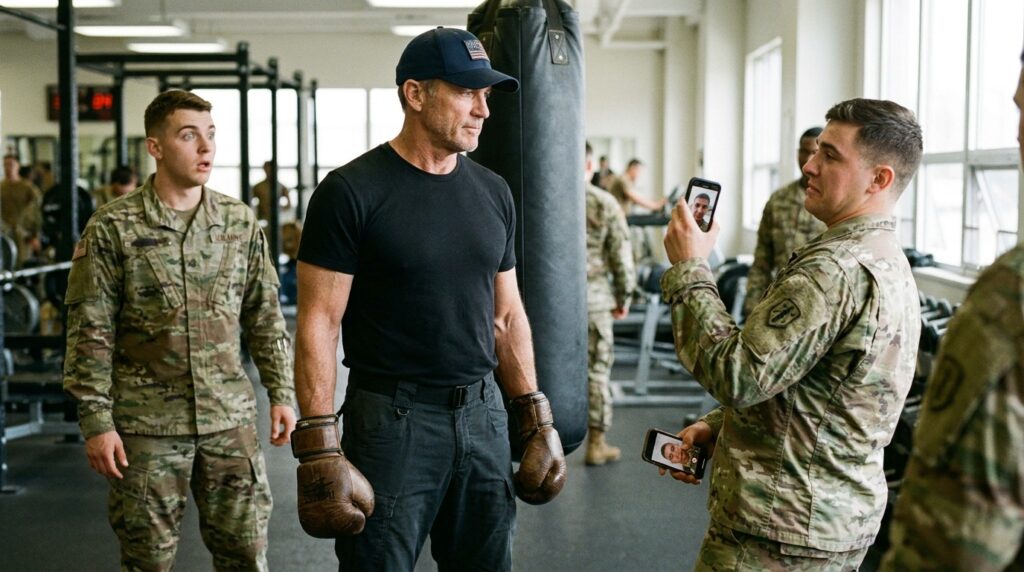
The air in the training bay tasted of iron filing dust and old sweat, but the recruit’s teeth were what clicked loudest when he closed the distance. It was a young sound—unworn, sharp, and entirely too close to the shoulder.

Miller did not shift his boots. He kept his heels planted on the split seam of the rubberized matting, where the grey foam beneath had begun to rot from twenty years of coastal humidity. Through the thin canvas of his worn boxing gloves, the leather of the heavy bag felt cold, almost greasy with the condensation that rolled off the corrugated zinc ceiling panels. Three feet away, the boy’s camouflage trousers were unblemished, the fabric stiff enough to rustle whenever he shifted his weight from hip to hip.

“Let’s see if that old patch on your jacket actually means anything today, or if it’s just history,” the boy said. His voice didn’t carry across the entire room, but it didn’t need to. The space between them was small enough that Miller could see the small, jagged pale scar just under the boy’s ear—the mark of a modern tactical helmet strap worn too tight during a high-speed drop.

The rest of the bay had gone thick. To the left, the second recruit had stopped mid-stride, his fingers still hooked into the adjustment buckle of his vest. The hum of the industrial floor fans didn’t cool the air; it only pushed the smell of wet hemp ropes and stale copper across the floor. Miller let his breath drop into his lower ribs, keeping it rhythmic, the exhalations brief and silent through his nose. He knew the calculation the boy was making. The boy looked at the grey stubble along Miller’s jawline, the slight hitch in his left shoulder where an old operational fracture had healed thick, and he saw a ledger that had already been settled.

Miller looked back and saw only momentum without a brake.

The boy stepped deeper into the circle, his chest rising as he gathered the weight of his youth into his heels. He was trying to crowd the old man against the iron frame of the bag station, using his bulk to force a step backward. A step backward on this floor meant giving up the lane, and once the lane was gone, the training cycle belonged to the recruits.

Miller adjusted the faded navy cap over his brow, his thumb catching on a loose thread at the brim. His gloves came up—not into a high, modern guard, but lower, near the ribs, palms turned slightly inward. The grey athletic tape around his right wrist hissed as it dragged against his t-shirt. He didn’t look at the boy’s eyes; he watched the small V where the collarbones met the throat, waiting for the split-second tightening of the tendon that always preceded a heavy rush.

“You wanted proof,” Miller said, his voice flat, stripped of the rank he no longer wore on his chest. “Now watch carefully and remember this.”

The boy didn’t wait for the end of the sentence. He moved with the sudden, violent weight of an ungreased spring, his shoulder dipping to take the line. But the air in the gym didn’t belong to him yet.

An operational discrepancy caught Miller’s eye just as the boy lunged forward—a small, brass casing from a morning drill lay wedged directly beneath the boy’s retreating heel, a fraction of an inch from changing his entire balance.


CHAPTER 2: THE ROTATION OF THE AXIS

The brass casing beneath the recruit’s left heel flattened into the split seam of the rubber matting with a sharp, metallic ping that was instantly swallowed by the roar of the ventilation fans. The boy’s ankle rolled inward by less than three degrees, but in the closed geography of the pocket, three degrees was an eternity. His center of gravity, which had been driving in a straight line through Miller’s chest, dipped toward the damp floor.

Miller didn’t retreat. Retracting a foot on this oil-slicked rubber meant inviting the boy’s bulk to collapse over him like a falling bulkhead. Instead, he let his hips pivot inside his dark tactical pants, his weight shifting onto his trailing right heel where the tread of his old boots had long since worn smooth. The friction was a dry, scraping heat that traveled up his shin. He allowed his left glove—the one stiffened with grey adhesive tape around the wrist—to drop into the hollow space just beneath the boy’s lead elbow.

It wasn’t a strike. It was an interception of mass.

The boy’s camouflage jacket, heavy with the starch of unwashed factory finishes, hissed as it scraped against Miller’s black t-shirt. The smell of the raw cotton was thick, mixed with the sudden, metallic tang of the boy’s breath as his lungs contracted from the unexpected change in trajectory. Miller felt the vibration through his own spine—the dull, grinding reminder of the third lumbar vertebra that had been crushed in a sub-zero riverbed twelve years ago. The pain was old, dry, and familiar, like the rust on the chain links holding the heavy bags behind them. He locked his core, suppressing the spasm before it could reach his shoulders, and let his right glove rotate upward along a tight, short arc.

The boy’s chin was precisely where the muscle memory said it would be.

Miller stopped the strike an inch short of the jawline, his knuckles merely grazing the short, stiff stubble of the recruit’s high-and-tight haircut. He didn’t need the impact; he needed the leverage. His thumb hook caught the soft tissue directly under the boy’s jaw, utilizing the momentum of the recruit’s own forward rush to tilt his head back toward the corrugated ceiling. The boy’s eyes, which had been narrowed into a calculated glare of youthful dominance, widened until the whites showed completely around the dark iris.

To the left, the observing recruit didn’t move. The adjustment buckle on his vest clicked once against his chest as his entire frame went rigid, his breath caught in his throat like water in a narrow pipe. The rhythmic, hollow thumping of the other training bags down the line seemed to fade into a distant, metallic rattle.

Miller’s left leg snapped round. It was a low, short-axis kick that traveled no higher than the boy’s shin—a blunt, heavy placement of his boot heel against the thick tendon just above the recruit’s combat boot. There was no theatrical flash, no cinematic snap of broken bone. It was simply the application of weight against an unstable pillar. The leather of Miller’s boot met the stiff nylon of the camouflage trousers with a dull, heavy thud that vibrated through the floorboards beneath the mats.

The boy’s forward drive ceased instantly. The kinematic chain broke at the knee. His frame didn’t fly backward; it dropped vertically, his knees striking the rubber seam with a wet, heavy impact that jarred the dust loose from the iron frame of the punching bag station above them.

Miller didn’t follow him down. He didn’t step over him like a conqueror in an arena. He simply drew his right glove back to his ribs, his chest rising and falling in the same unhurried cadence he had kept since entering the bay. His fingers inside the canvas gloves were warm, the sweat starting to pool in the palms, but his grip remained loose. He looked down at the pale scar beneath the boy’s ear, noticing for the first time that the tissue was fresh—too fresh for a standard pipeline injury. It had the precise, neat margins of a surgical excision, the kind performed at the tier-one hospital in Bethesda, not a field clinic.

The boy stayed on his knees, his hands pressed flat against the grey foam of the mats to stabilize his chest. His breath came in jagged, whistling gasps that rattled through his teeth, his face flushed dark with the humiliation of a target that had vanished before it could be hit. The sweat was already breaking through the short hairs at his temples, dripping down to the salt-crusted collar of his uniform.

“Technique doesn’t age,” Miller said, his voice dropping into the quiet gravel of a man who had spent decades speaking beneath the roar of twin-prop engines. “People just forget to respect it.”

The boy didn’t look up immediately. His fingers twitched against the rubber, his knuckles whitening as he tried to find the leverage to reset his frame. He was evaluating the risk of a second rush, his internal calculations spinning against the reality of the floor he was currently holding with his knees. But his eyes remained fixed on the small patch of grey tape wrapped around Miller’s left wrist—the silver-grey adhesive was lifting at the corner, revealing a dark, initials-stamped serial number on the leather beneath that didn’t belong to standard base inventory.

The industrial fans continued to slice through the heavy air, throwing long, regular shadows across the three men. The silence between them had become a physical thing, a wall of cold iron that the younger cohort down the line was beginning to notice. Two more pairs of boots stopped their drills, their shadows lengthening across the wet concrete floor as they turned toward the heavy bag station.

Miller reached down, his taped glove catching the top loop of the heavy bag’s chain to stop its slight, rhythmic sway. The iron links were cold, the grease on them black and thick enough to stain the canvas. He didn’t look at the boy’s face; he looked toward the small, reinforced observation window set into the reinforced concrete wall forty feet away, where the reflection of the overhead fluorescent tubes obscured whatever was moving behind the glass.

CHAPTER 3: THE LINE OF TRANSMISSION

The dark glass of the observation window remained opaque, but the tiny, regular flicker of an indicator light on an encryption hub inside the wall died precisely as Miller’s gloved fingers stopped the chain’s vibration. The sudden absence of that electronic hum left only the heavy, low-frequency thrum of the floor fans.

Miller looked down at his right glove. The leather across the knuckles had cracked into a web of pale, dry fissures, exposing the grey canvas backing beneath. He didn’t unlace them. He didn’t give the boy on the floor the benefit of seeing a bare hand shift or a knuckle rub against a sore joint.

“Get up,” Miller said. He didn’t raise his voice; he let the weight of it drop straight down through the damp air, heavy as an anchor chain settling into salt mud.

The boy didn’t move immediately. His palms were still flat against the rubber mat, his fingers curled into the rotted edge where the grey foam bled its dry, chemical dust onto the concrete. A thin thread of dark saliva hung from his lower lip, swinging slightly with the movement of his lungs before it snapped against the matting. His chest was still hitched, the modern camouflage pattern of his blouse jumping with every short, shallow intake of air.

The second recruit—the one whose vest buckle had clicked against his chest—took a single half-step forward. The rubber soles of his modern issue boots made a dry, sharp skitch against the concrete floor. It was a conditional movement, an instinctive reaction to the sight of an officer or an instructor holding a line too long.

Miller’s gaze shifted to him before the heel could fully settle. “Did I tell you to alter your interval?”

The second recruit froze, his chin tilting up by an inch, his eyes locked on the front seam of Miller’s faded navy cap. His jaw muscles clenched, the skin tightening over his cheekbones until the pale, uniform scars from his own survival phase showed like white salt lines. “No, sir.”

“Then reset it.”

The boy shifted backward, his heels hitting the boundary line of the next drilling lane with a precision that had been beaten into him over eighteen months of advanced training. He didn’t look back down at his teammate on the mats. In this pipeline, an unseated man was a hazard until he cleared the floor under his own power.

The fallen recruit finally untwisted his legs. He didn’t use his hands to push off; he swung his hips with a violent, awkward jerk that spoke of a lower back already locked with spasm—a carbon-copy reflection of the exact injury Miller carried in his own third lumbar. The boy stood up, his knees making a dry, cracking sound that seemed too loud for an empty bay. His face had gone from dark flush to an uneven, pasty grey, the sweat on his forehead picking up the fine grey dust from the floor.

He was looking at Miller’s left wrist now, his eyes tracking the silver corner of the lifting tape. The initials stamped into the leather beneath—J.M. 04-B—didn’t exist in the current logistics registry for the Special Warfare Center. They belonged to a detachment that had been officially stricken from the budget parameters during the first winter of the dry border incursions.

“Your left hand is heavy, sir,” the boy said. His voice was lower now, stripped of the brittle edge he’d brought into the pocket three minutes ago. He was trying to find a professional footing, a way to reframe his collapse as an instructional assessment. “The modern manual says the lead should stay high to mask the pivot. You didn’t mask it.”

“The manual assumes your heel is clear,” Miller said, his gloved hand sliding down the canvas of the heavy bag until his thumb rested against the fat seam at the bottom. The smell of the old stuffing—dried corn hulls and chopped rag—was sour with age. “You were standing on your own weight before you even initiated the drop. If I hadn’t caught your chin, that casing would have put your forehead into the iron bracket.”

He let his eyes drop back to the fresh surgical scar under the boy’s ear. Up close, the pink, raised ridge didn’t look like a standard laceration. The stitch-marks were microscopic, spaced with the specific, mechanical regularity of an automated closing tool used only in high-tier neurological reconstructions.

“Who cleared your line for this block?” Miller asked.

The recruit’s shoulder blades tightened beneath his camouflage blouse. He didn’t look at the observation window, but his chin drifted by less than a millimeter toward the reinforced door at the back of the gym floor—the one that led to the administrative annex where the operational logs were kept behind cipher locks. “The command master chief signed the sheet, sir. Standard fitness-for-duty validation after the second deployment.”

“Your charts aren’t standard,” Miller said. He stepped out of the pocket, his smooth-soled boots sliding across the rubber with a quiet, regular scraping that sounded like a shovel hitting dry earth. He passed within six inches of the boy’s shoulder, not waiting for a salute or an acknowledgment. “Your left foot is dragging by two ounces because the nerve behind that scar hasn’t settled into the sheath yet. They’re rushing your rotation.”

He didn’t look back to see if they were following. He walked toward the grey metal locker at the edge of the training floor where his water flask sat on top of an unpainted pine bench. The concrete beneath the bench was damp, stained dark by decades of salt fog drifting through the high, unsealed louvers of the gym’s eastern wall.

Behind him, the boy hadn’t reset his stance. He remained beside the heavy bag, his head tilted slightly down as if he were still calculating the precise microsecond his balance had vanished into the matting.

An iron latch clicked at the back of the bay. The heavy, reinforced door to the administrative annex swung inward by six inches, the old rubber gasket along its edge dragging against the concrete with a wet, heavy hiss. A man in clean, unissued khaki utility uniform stood in the shadow of the frame, his face hidden by the angle of the overhead fluorescent tubes, but his right hand was visible—his thumb was hooked into a heavy brass belt buckle that bore the distinct, three-pronged crest of a command officer who hadn’t seen a blue-water deck in ten years.

Miller didn’t lift his flask. He stopped three feet from the bench, his taped wrist resting against his hip as he watched the shadow in the doorway expand across the damp floor toward his boots.

CHAPTER 4: THE MEASURED POCKET

“You’re still stepping left to shield the lower lumbar, Miller. A sharp eye picks that up from the gantry before you even drop your chin.”

The man in the khaki utility uniform stepped fully out of the doorway’s grease-stained shadow, his starched collar sharp against the salt-bleached concrete wall. It was Vance. The brass trident on his belt buckle didn’t have the dull patina of a working diver’s gear; it had been buffed until the ridges were smooth, a desk-man’s ornament that had spent a decade scraping against the mahogany edge of briefing tables.

Miller didn’t take his gloves off. The leather inside was hot, slick with his own sweat, but he kept his fingers curled tightly into the canvas palms. He reached down with his right hand, his thumb catching the dented steel lip of his water flask on the pine bench. The cold metal left a wet semicircle across his taped wrist.

“The boy was light on his heels,” Miller said. His voice was a dry rattle that barely lifted above the dull hum of the industrial floor fans. “He would have broken his own ankle on the seam if I hadn’t taken the lane.”

“The boy is twenty-three, and his reaction times are six percent higher than the baseline for the third-tier deployment group,” Vance said. He stopped four feet away, precisely at the edge of the rubber matting where the raw concrete began. His leather low-quarters were clean, free of the grey foam dust that covered Miller’s boots. He didn’t look at the recruits down the line, but his hand remained flat against his utility pocket, where the stiff white corner of an official medical reassessment log peeked through the buttonhole. “We didn’t bring you out of the retirement cadre to redesign the close-quarters curriculum, Miller. We brought you here to certify the readiness logs.”

“The readiness logs are fiction if the legs don’t hold,” Miller said. He unscrewed the flask lid with a single twist of his palm, the dry threads of the cap grating with a tiny, metallic shriek. He took a short sip, letting the lukewarm water clear the taste of the iron filing dust from his throat. He kept his eyes on Vance’s collar—not on the silver oak leaves of his rank, but on the small, grease-darkened smudge just below the lapel seam. It was hydraulic fluid, the specific low-viscosity grade used in the seal assemblies of hyperbaric insertion locks.

Vance didn’t look back at the glass window of the observation room, but his shadow on the concrete floor drifted by two inches to the right, narrowing the lane between Miller and the exit. “The command has parameters, Miller. The deployment schedules for the second quarter are already locked into the administrative annex. If a man has a signature on his fitness-for-duty sheet, he belongs in the rotation.”

“The boy has an automated closing wire behind his ear,” Miller said. He set the flask down on the pine bench with a dull, heavy clink that traveled through the wood. “The skin hasn’t even turned white yet. He’s carrying four pounds of fluid in his left calf because the neural pathway is firing thirty milliseconds behind his hip. You didn’t run a standard audit on him.”

Vance’s jaw muscles tightened, the skin along his throat turning the same dull, pasty grey as the rotted matting beneath the punching bags. He didn’t answer immediately. He reached into his utility pocket, his fingers drawing out a small, steel-rimmed magnifying lens—the kind used by field armorers to check the sear engagement on a worn firing pin. He held it between his thumb and forefinger, the glass catching the green glare of the overhead fluorescent tubes.

“The pipeline isn’t a museum, Miller,” Vance said, his voice dropping into a flat, transactional cadence that didn’t carry past the heavy bag station. “We don’t keep people around just because their names are stamped into the leather of the old gear. If a tool doesn’t meet the mechanical tolerance for the next cycle, we clear the bench.”

Miller looked down at his own left wrist, where the grey tape was peeling further back from the J.M. 04-B stamp. The physical secret was sitting right there on the leather, but Vance’s eyes weren’t tracking the serial number. They were watching the subtle, involuntary twitch in Miller’s left thumb—the small, rhythmic tremor that always came whenever his lower back sustained more than three minutes of sustained torque on the rubber floor.

“You didn’t come down here for the recruits, Vance,” Miller said.

“I came down to see if the machine still runs when you put weight on it,” Vance said. He turned his head slightly, his gaze finally tracking the long, regular shadows of the younger soldiers who had stopped their drills down the line. They were standing in their lanes, their camouflage blouses dark with sweat, their eyes locked on the old man and the officer who had divided the floor between them. “The command master chief wants the signature on the readiness sheet by sixteen hundred. If the signature isn’t there, the entire cohort stays on the base for another ninety days.”

He stepped backward into the shadow of the administrative doorway, his leather shoes making no sound against the clean concrete. He didn’t shut the door. He left it open by six inches, the wet hiss of the administrative air conditioning unit seeping into the hot, salt-crusted air of the gym floor like oil pouring into a well.

Miller didn’t move toward the door. He reached down, his taped fingers wrapping around the leather laces of his left glove to check the knot. The canvas was fraying at the eyelet, a small thread of white nylon coming loose under the strain of his grip. When he looked back up at the observation window, the green indicator light on the wall inside had turned red, blinking twice in a short, regular sequence that meant the line was still open, and someone was still counting the seconds between the strikes.

CHAPTER 5: THE GRAIN OF THE FRICTION

The iron frame of the bench didn’t yield when Miller leaned his thigh against it to brace his lower lumbar. The cold from the unpainted metal cut straight through his dark tactical trousers, a sharp, local point of contact that ground directly into the scarred nerve tissue above his hip.

The door to the administrative annex remained cracked by six inches, the wet, chemical smell of its recycled air cooling the edge of the gym floor like rain hitting hot scrap iron. From down the line, the regular, rhythmic thumping of the heavy bags didn’t restart. The recruits remained fixed in their lanes, their sweat-darkened camouflage blouses looking gray under the high fluorescent tubes. They were waiting for an order that had been delayed in transit.

Miller unlaced his right glove first. He didn’t use his teeth; he caught the loose, nylon thread at the eyelet with his left thumb hook and pulled until the salt-crusted leather parted with a short, dry hiss. When he slid his hand out, the skin of his palm was white, puckered from four hours of contained moisture, the raw smell of old canvas and iron oxide filling the space between his chest and the bench.

He didn’t touch the water flask again. He walked past the unseated recruit, who was still standing beside the punching bag with his head down, his fingers tracing the flat indentation where his boot had struck the matting. The boy didn’t look up when Miller’s shadow crossed his boots.

The corridor behind the administrative door was narrow, the walls covered in a thick layer of industrial enamel paint that had bubbled from the humidity of the coastal salt marsh outside. The floor here wasn’t rubber; it was raw terrazzo tile, cracked into grey, irregular segments that rattled whenever the compressor for the hyperbaric lock cycled in the sub-basement.

Miller’s boots made a distinct, dragging sound against the stone—the old, two-ounce discrepancy in his stride sounding like a loose iron tire on a cart. He reached the master chief’s administrative office at the end of the hall before the air conditioning unit could cycle down.

The door wasn’t locked. The electronic bolt had been held open by a flat piece of lead wire wedged into the latch assembly—the standard field trick used by teams running quick rotations between the armory and the transport trucks. Inside, the desk was cleared of everything except an unpainted aluminum logistics case and the triple-carbon readiness logs Vance had been carrying.

Miller reached for the logs with his bare hand. His skin left a faint, greasy smudge against the top sheet, where the name Miller, J. had been stamped in violet ink beside the validation block.

The sheet didn’t contain the standard training evaluation code. It had been routed through the third-tier logistics center under an Operational Status Audit tag—the specific designation used to clear old inventory before a facility was turned over to the naval base authority. But beneath the violet ink, hidden by the cross-hatching of the command seal, was a second signature line that had been filled out with a heavy grease pencil.

The handwriting belonged to Hauer.

Miller’s thumb came down on the carbon paper, the texture of the dry sheet feeling thin, almost brittle under his callous. Hauer’s stroke hadn’t changed since the winter they spent at the refueling terminal in Kittery—the bottom loop of the H was always dragged low, a signature cut short by a broken wrist that had never been reset by a military surgeon.

The physical secret on the paper was clear: the cohort wasn’t being held for ninety days because of a training deficit. The readiness sheets were already marked as Deficient in the master registry. The entire hand-to-hand module had been constructed as a physical stress-test for one man—not the young recruit with the surgical scar behind his ear, but the instructor holding the pen.

The old spinal injury in Miller’s lower back throbbed twice, a cold, sickening ache that traveled down his left thigh like water finding a crack in a concrete foundation. He had been cleared for this cycle under a false authorization code. If his thumb hadn’t stopped the recruit’s drive at the punching bag, the boy’s mass would have struck the exact structural weak point in Miller’s third lumbar, validating the medical retirement log that was already sitting in Vance’s utility pocket.

The industrial floor fans in the gym outside seemed to drop an octave as the primary power circuit shifted to the sub-basement generators. The red indicator light on the encryption hub in the wall behind the desk didn’t blink; it went black, the small glass lens reflecting nothing but Miller’s own weathered face and the blue-grey curve of his navy cap.

A step sounded in the terrazzo corridor behind him. It wasn’t the clean, silent pace of Vance’s low-quarters. It was a heavy, flat-footed stride that traveled with the clicking of an unhooked safety lanyard against an unarmored thigh.

Miller didn’t turn toward the doorway. He folded the top sheet of the triple-carbon log into a tight, hard square, the dry paper creaking under the pressure of his calloused thumb until the corner tore slightly along the violet ink line. He tucked it into the waistband of his tactical pants, beneath the grey adhesive tape that was still lifting from his left wrist.

“You always did spend too much time looking at the signatures, John.”

The man standing in the frame was broader than Vance, his khaki utility shirt unbuttoned at the throat to reveal a grey tangle of hair that rose up toward a thick, purple ridge along his collarbone. He held an unpainted steel clipboard against his hip, his fingernails split and black with the grease of low-pressure diesel injectors.

CHAPTER 6: THE GRAIN OF THE TREAD

“The ink stays wet for three days in this damp, John. You shouldn’t have thumbed the carbon line.”

Hauer didn’t shift his bulk from the center of the terrazzo frame. His right hand remained flat against the unpainted steel clipboard, his crooked wrist jutting out at an awkward, hard angle where the bone had fused into a thick knob of calcium thirty winters ago. The smell of low-pressure diesel oil from his utility trousers was heavier than the air conditioning’s recycled frost, settling over the desk like grease over an engine block.

Miller let his bare right hand stay flat against the aluminum logistics case. The metal was cold enough to sweat beneath his fingers, leaving five distinct, oval patches of moisture on the matte finish. “The boy’s leg is short by two ounces, Hauer. You knew the nerve wouldn’t hold if he took a direct line against a heavy bag.”

“The boy isn’t the problem,” Hauer said. He didn’t drop the clipboard. He used the flat edge of the steel plate to tap the doorframe, a dull, rhythmic clink that sounded like an ungreased valve clicking in a cylinder head. “The boy is just mass. You’re the one who keeps tracking the interval. Vance has the retirement log sitting in his pocket with three separate signature blocks already cleared by the division office. If you hadn’t caught that lunge, the medical board would have had its folder settled before the sun went behind the marsh.”

The third lumbar vertebra in Miller’s back spasmed once—a sharp, electric pinch that traveled down his left thigh to the heel of his boot. He kept his hips locked against the iron edge of the desk, his weight distributed evenly across the rotted rubber soles to hide the tremor. “You signed the lower authorization block, Hauer. That grease pencil line belongs to the old detachment code. We haven’t used those numbers since the winter we cleared the docks at Kittery.”

Hauer’s grey eyes didn’t narrow; they stayed wide, filmed with the yellowed, salt-crusted tint of a man who had spent forty years looking into the glare of fuel-oil fires. His jaw shifted, the scar across his collarbone tightening until the purple ridge went pale under the office’s green fluorescent tubes. “The numbers are still valid in the master registry at Coronado if you know which file clerk is holding the ledger. I put the code down because it was the only way to get your name off the retirement pool roster before Vance’s people could lock the drawer.”

“You put my name on a deficit log,” Miller said. His voice stayed level, a flat gravel-scrape that didn’t lift above the low vibration of the sub-basement generators. He reached down, his thumb catching the square of folded carbon paper he had tucked into his tactical waistband. The dry sheets crackled like dead leaves under his palm. “You set the module up so the young intake would push the boundary. If I had been ten milliseconds slower on the pivot, that boy’s shoulder would have taken my hip off the pins.”

“If you were ten milliseconds slower, you wouldn’t belong on this floor anyway,” Hauer said. He took a single, short step into the room, his flat-foot stride making a dry, scraping skitch against the cracked terrazzo tile. He set the steel clipboard down on top of the aluminum logistics case, directly over the oval smudges Miller’s fingers had left behind. “Vance isn’t here for an audit, John. He doesn’t give a damn about the readiness logs or the second-quarter deployment schedules. He’s here because the procurement branch is clearing the old warehouse files, and your name is the only one left on the inventory list that doesn’t have a final disposition code next to it.”

Miller looked at the clipboard. The top sheet wasn’t a standard readiness registry; it was a single, one-page manifest printed on heavy, wax-coated paper that didn’t take ink—the kind used for off-books cargo transfers through unlisted ports of entry. The heading at the top had been blacked out with a heavy marker, but the font underneath was the old, narrow type used by the logistics division before the automation systems were updated in ninety-eight.

The physical secret of the decoy was coming loose at the corners, but the deeper truth stayed behind the iron curtain of Hauer’s flat gaze.

“The signature isn’t the ledger, John,” Hauer said, his voice dropping until it was just a low hiss beneath the rattle of the ceiling vents. “Vance thinks he’s clearing a liability off the books. He thinks if he pushes your lumbar hard enough on this matting, you’ll take the pension and go sit on a porch in Virginia. But he doesn’t know about the second ledger. He doesn’t know who’s holding the pen behind that observation glass.”

Miller’s hand went back to his left wrist, where the grey adhesive tape had peeled away entirely now, leaving the J.M. 04-B stamp bare against the salt-bleached skin. The leather beneath the tape was stiff, notched with four small, regular cuts where an old armorer had removed the original inventory rivets.

“The line is still open,” Miller said, his eyes drifting toward the tiny, dark lens of the audio pickup set into the corner of the office ceiling junction.

“The line is always open when you’re dealing with Vance,” Hauer said. He reached into his utility shirt, his rough, split fingers drawing out an unpainted brass key that had no serial number stamped into its bow—the old style of armory key that could drop the deadbolt on every storage locker from here to the fuel piers. He laid it on top of the wax-coated manifest, the heavy metal making a sharp, final clack against the steel clipboard. “The administrative annex has twenty-two minutes before the evening shift cycles the encryption keys. If you’re going to change the entry on that carbon sheet, you do it before the master chief clears the desk.”

He turned back toward the terrazzo corridor, his heavy, flat-footed stride already moving away before Miller could take his fingers off the water flask. The door didn’t shut behind him; it remained open by six inches, the dry, salt-crusted air of the training bay outside drifting back into the office to mix with the cold grease of the desk.

Miller didn’t take the brass key. He stood beside the unpainted aluminum case, his eyes fixed on the small, purple smudge of Hauer’s grease pencil signature, watching the ink contract as the humidity from the marsh began to settle into the paper.

CHAPTER 7: THE SHADOWED BALANCE

The unpainted brass key lay flat against the wax-coated manifest, its raw edges catching the sharp, green glare of the fluorescent tubes until the metal looked grey as zinc. It didn’t possess a registration notch. Its surface was scored with thin, longitudinal lines from a manual file—the coarse, jagged teeth marks of a workshop modification meant to bypass the master cylinder pins in the administrative lockers.

Miller didn’t pick up the key. He reached down with his bare right hand, his fingers spreading across the rough pine edge of the desk to anchor his weight.

The third lumbar vertebra didn’t spike with pain this time; it went entirely cold, a dead, stone-like block that seemed to sink through his tactical trousers toward the concrete foundation. The silence coming from the open doorway was total now. The sub-basement generators had settled into a low, harmonic drone that vibrated the glass inkwell on the ledger desk, making the violet ink ripple in small, concentric rings that never hit the lip.

He looked up at the reinforced observation window across the hall. The reflection of the overhead fluorescent panels didn’t shift, but the heavy iron frame of the balcony door directly above the gym floor gave a single, muffled clack as the hydraulic seal was released from the inside.

A figure stood on the metal gantry, his boots making a dull, ringing sound against the rusted steel mesh as he walked to the railing. It wasn’t Vance. The silhouette was taller, the shoulders curved slightly forward beneath a standard-issue green flight jacket that lacked any rank insignia or name tapes. The fabric at the elbows was worn down to the white weave, frayed from decades of leaning over the chart tables of littoral combat ships.

It was Henderson.

The old commander didn’t call down to the floor. He kept his hands tucked into the deep pockets of his jacket, his gaze tracking the line of the heavy punching bags until it settled on the unseated recruit, who was finally pulling his gear out of the training lane. Up close, from forty feet below, Henderson’s face looked like a block of salt-cured wood—the lines around his eyes split and deep from the glare of northern oceans, his jawline motionless beneath a thin layer of grey stubble.

Miller took the square of folded carbon paper from his waistband. His fingers moved slowly, the puckered, white skin of his palm catching on the dry edges of the sheet until it opened with a loud, paper-crisp snap that echoed down the narrow terrazzo corridor. He didn’t use Hauer’s brass key to unlock the storage cases. He didn’t need to change the registry entry.

The decoy secret—the file Vance had carried to prove Miller was a medical liability—was nothing but wastepaper. The violet ink signature from the division office hadn’t been stamped to force a retirement; it had been logged to provide an administrative blind. If a man was officially marked as broken on the base ledger, his name disappeared from the electronic satellite tracking system used by the regional command structure.

The true ledger was the wax-coated sheet on Hauer’s clipboard. It was a mobilization order for an unlisted vessel currently sitting three miles outside the salt marsh at the ammunition pier—a run that required an operator whose spinal column was already dead enough to pass a mechanical sensor scan at the border checkpoint. Henderson hadn’t been trying to clear an old liability off the books. He had been trying to build a wall of paper around the only man left who could pull the trigger without leaving an electronic footprint in the defense network.

“The shift is cycling, John.”

Vance’s voice came from the foot of the gantry stairs, but it lacked the sharp, administrative edge it had carried twenty minutes ago. He was standing near the rubber mats, his low-quarters covered in the thin grey foam dust from the recruit’s fall. He looked up at Henderson, then back at Miller’s bare hands, his fingers twitching against the side of his utility trousers where the medical reassessment folder had been tucked away. He had realized, too late, that he was the only person in the bay who had been reading the public version of the log.

Miller walked out of the office, his smooth-soled boots making that regular, dragging skitch against the concrete floor until he reached the heavy bag station. The smell of the raw cotton and the salt fog drifting through the high louvers was stronger here, cold enough to make his sweat-damp t-shirt stick to the skin between his shoulder blades.

He stood beside the bag, his bare right hand catching the iron chain link to stop its final, microscopic sway. The metal was grease-black, cold enough to leave a dark ring across his calloused palm. He didn’t look up at the gantry railing again. He looked down at the younger recruits, who were now standing in a tight, silent semi-circle near the gear lockers, their modern camouflage uniforms looking too bright against the rotted grey foam underfoot.

“Pack your kits,” Miller said. His voice didn’t rise, but it had the specific, iron weight of a command that had already been settled before the ink was dry on the carbon paper. “The lane is closed for the day.”

The arrogant recruit didn’t look at his teammate. He picked up his training gloves from the matting, his fingers slightly unsteady as he stuffed them into his canvas bag. He didn’t offer a salute, but his shoulders remained dropped, his frame curved in a submissive line that acknowledged the distance between his youth and the man holding the chain.

Above them, the green indicator light inside the observation glass didn’t turn back to red. It died completely, the darkness behind the panes swallowing the silhouette of the green flight jacket until there was nothing left but the reflection of the fluorescent tubes, burning white and steady across the rusted iron rafters of the bay.

Miller reached down, his bare hand wrapping around the handle of his steel water flask. The metal was cold, but the weight of it was solid in his grip—the only thing on the floor that hadn’t changed its classification when the sun went behind the marsh.

Similar Posts

Leave a Reply

Your email address will not be published. Required fields are marked *






