
The Measured Line: A Novel of Friction, Iron, and the Weight of Quiet Labor
CHAPTER 1: THE GRAVEL PATH
The sun over Fort Walker did not warm the sand; it merely dried it until the grit rose up in fine, pale sheets around the soles of combat boots. Aaron Vance turned the weathered silver ring on his left finger, feeling the smoothed-out ridges of a crest that had long since lost its sharp definition against the skin. From the shade of the staging awning, the incoming Ranger candidates looked like a single, block-printed mass of fresh OCP camouflage, their skin taut and free of the specific gray hollows left by multiple long-deployment cycles. They moved with the loud, heavy-heeled speed of men who believed the training ground was a stage meant to be conquered rather than an anchor that could break them.
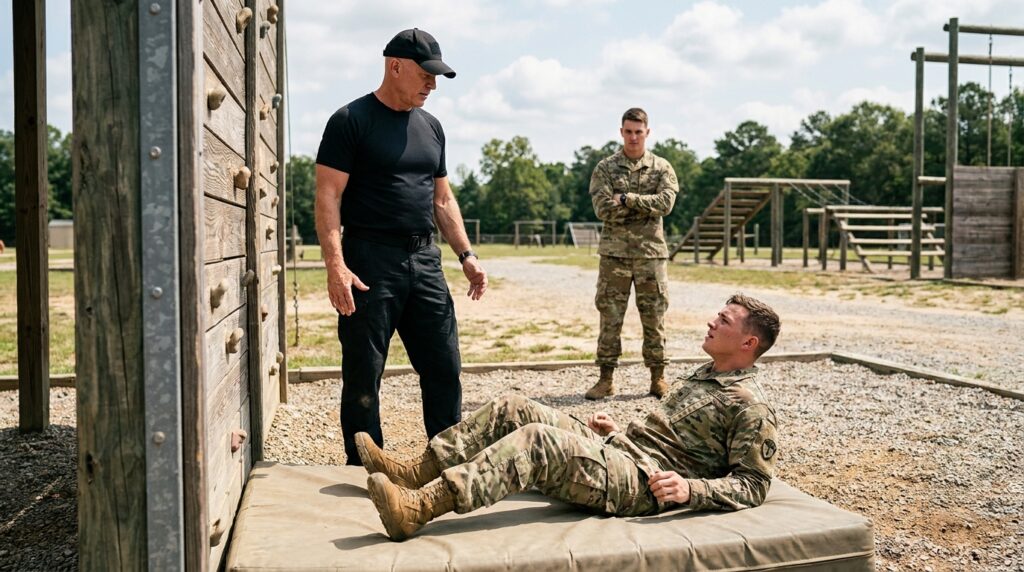
Vance pulled the brim of his unbadged black cap down against the glare, his eyes tracking the subtle tilt of Specialist Kincaid’s shoulders. The young soldier was leaning against the timber frame of the high climbing wall, his jaw moving rhythmically over a piece of commercial tobacco, his eyes fixed anywhere but on the civilian contractor holding the clipboard.
“The technical specs for the grip transitions are on page four of your readiness brief,” Vance said. His voice lacked the gravel-shouting cadence of the active-duty drill instructors; it was flat, level, and dry as the brush clearing behind the range lanes. “If you don’t anchor the secondary line before the weight transfer, you’re throwing three inches of hip clearance into the drop. That’s three inches of dead space where the vest catches on the sill during an ingress.”
A low snicker rippled through the front tier of the formation. Kincaid didn’t clear his throat, but he spat into the dry weeds near the edge of the rubber safety mat, the dark stain spreading instantly across the parched earth. “With all due respect, sir, some of us are built for the modern line, and some of us are built for the classroom. Step aside.”
The silence that followed was not the clean, respectful quiet of an assembled unit; it was the heavy, testing stillness of a squad waiting to see where the balance of status would tip. Private First Class Miller shifted his weight, his fingers twitching near his cargo pocket where his phone lay hidden, his posture egging the younger specialist forward.
Vance looked down at his own hands. They were wide, the knuckles thickened by decades of heavy weapon recoil and cold metal contact, the skin around the thumbs stained with old carbon grease that never quite washed out. He didn’t drop the clipboard. He didn’t raise his chin. He simply measured the distance between Kincaid’s boots and the lip of the impact area—four feet of loose gravel, followed by a hard transition into the thick, synthetic black rubber that smelled faintly of sulfur under the midday heat.
“Your weight is forward, Specialist,” Vance said softly, his thumbs settling against the top edge of the paper specs. “Fix your base.”
Kincaid didn’t fix it. Instead, he took two long, heavy steps out of the formation line, his boots crunching loud against the stones until he was inside the three-foot perimeter where the air stayed hot between them. He was a full two inches taller than Vance, his shoulders broader from modern gym regimens, his breath smelling of wintergreen and adrenaline. He extended a hand toward the faded black fabric of Vance’s tactical shirt, his fingers curving into a hard, performative grip meant to shove the old man back onto the heels of his boots.
Vance didn’t look at the hand. He looked at the slight, telltale twitch in Kincaid’s left hip that always preceded a heavy push.

CHAPTER 2: THE ANCHOR LINE
The knuckles of Specialist Kincaid’s right hand came forward in a flat, heavy line, the fabric of his camouflage sleeve snapping like a wet towel against the humid Virginia air. Aaron Vance didn’t shift his heels. To the thirty younger men watching from the perimeter of the gravel pit, the old man appeared frozen—a static target pinned against the sun-baked timbers of the climbing wall.
But Vance’s world had already slowed to the predictable physics of mass and friction. He felt the dry heat radiating off the rubber safety mat beneath his boots, felt the weight of the stopwatch iron clipping against his sternum, and noted the exact trajectory of Kincaid’s center of gravity. The young soldier was leaning too far into his strike, trusting his youth and his cross-trained mass to carry through the older man’s perimeter. It was the common error of the uninitiated: believing that aggression could compensate for a broken base.
Vance’s left hand rose three inches. It was a short, untelegraphed movement that didn’t clear the shoulder. His calloused thumb caught the inside of Kincaid’s wrist right at the soft junction where the tendon met the bone. He didn’t push back; he didn’t try to match the active-duty soldier’s brute strength. Instead, Vance rotated his own hips backward by two degrees, sinking his weight into his right heel and allowing Kincaid’s forward momentum to overextend.
The redirection was instantaneous. Vance applied a downward pressure on the lever of Kincaid’s forearm while using his right palm to check the specialist’s advancing shoulder. The young man’s boots lost their purchasing on the loose gravel. With a dull, hollow thud that vibrated through the boards of the climbing wall, Kincaid hit the synthetic rubber safety mat flat on his back, the air escaping his lungs in a sharp, wet gasp.
The surrounding pit went dead. The small, private smirks on the faces of the trainees along the line evaporated, their postures freezing into rigid, awkward columns of green and brown fabric. Private First Class Miller dropped his hand from his cargo pocket, his fingers going stiff against his seam. The regular hum of the base—the distant, rhythmic thudding of heavy machine-gun fire from Range 4 and the drone of a fuel truck on the perimeter road—seemed to recede behind the sudden wall of absolute stillness.
Vance settled back into his upright stance. His hands stayed open, palms slightly turned inward, his fingers relaxed. He didn’t look down at Kincaid with anger; his face remained as flat and unreadable as the gray sky over the treeline. The sun caught the edge of his smoothed silver ring as he reached down to adjust the brim of his black cap.
“Your left heel was off the deck before you initiated contact,” Vance said, his voice dropping into the quiet space between them without a single tremor of exertion. “You gave away your leverage for an extra inch of reach. In a five-second pocket, that inch belongs to the man who keeps his footing.”
Kincaid lay on the rubber mat for three seconds, his jaw clenched so tight the muscle beneath his ear throbbed against the dust. His OCP uniform was coated in a fine layer of gray polymer residue from the matting. His chest rose and fell in ragged, shallow jerks as his nervous system tried to process how sixty pounds of dynamic force had been neutralized without a struggle. His eyes, tracking upward toward Vance, were wide with a volatile mixture of humiliation and tactical shock.
Vance didn’t offer a hand to help him up. To do so would be an act of performative ego, a violation of the professional distance he required to keep the training line functional. He simply stepped back two paces, clearing the impact zone and leaving the space open for the specialist to recover his posture or break entirely.
Behind the formation, the dry grass rustled as a pair of heavy, standard-issue low-quarters ground into the stones. The trainees shifted their eyes toward the administrative lane, their shoulders squaring instinctively as Command Sergeant Major Marcus Thorne stepped through the gap in the wire. Thorne’s uniform was immaculate, the star and wreath on his chest catching the high noon glare like polished iron, his face set in the hard, dark lines of a man who had spent thirty years watching soldiers fail the standard.
Thorne didn’t look at Kincaid, who was now scrambling to his knees, his hands digging into the grit as he tried to find his footing. The Command Sergeant Major stopped exactly one pace from Vance, his eyes fixed forward, his chin tucked into his collar. He didn’t salute—regulations forbade it on a live tactical floor—but his entire posture carried the unmistakable weight of senior institutional deference.
“Master Sergeant,” Thorne said, his voice cutting through the thick heat like a cold blade. “The division commander wanted to ensure your equipment specs were meeting the current transition parameters. I see the candidates are already familiarizing themselves with the baseline.”
Vance nodded once, his thumb sliding over the top edge of his clipboard, checking the corners of the papers. “The specialist was just verifying his center of gravity, Sergeant Major. We were about to reset the clock for the group ingress.”
Thorne finally turned his eyes down to Kincaid, who was now standing at an awkward, dust-covered attention, his chest still heaving. “Specialist Kincaid,” Thorne said, the drop in his tone low enough to make the trainees along the line shift their eyes back to the front. “If you ever put your hands on the man who wrote the close-quarters integration manual for the third special forces group again, I will personally ensure your remaining time in this regiment is spent inventorying cold-weather gear in Alaska. Do you follow my trajectory?”
“Sir, yes, sir,” Kincaid managed, his voice tight, the arrogance completely drained from his face, leaving only the pale skin around his nose.
“Get back in the block,” Thorne commanded. He didn’t wait for the movement. He turned back to Vance, his eyes dropping for a fraction of a second to the administrative crate sitting near the bench—where a gray, unbadged folder was peeking out from beneath the standard field manuals. “We have an update on the facility allocations, Aaron. When the line finishes this run, we need to speak in the office.”
Vance watched Thorne turn and walk back toward the command tent, his boots tracking straight lines through the loose sand. He felt the cold iron of the ring against his skin again. The decoy was already moving into place, but the weight of the actual line was still theirs to carry.
Vance lifted his whistle. “First stick. On the box. Three seconds to target.”
CHAPTER 3: THE TIMED DRILL
“Reset the clock,” Vance said, his left index finger pinning the split-second split trigger on the metal casing of the timer. He did not look at the squad as they scrambled back into their four-man cells, their boots creating a dry, collective hiss across the limestone dust. “You spent four extra seconds calculating your entry because you were looking at the mat instead of the corner. The corner doesn’t move. The mat doesn’t shoot back. Again.”
The noon heat had begun to cook the pine sap out of the timber uprights supporting the climbing wall. It rose in thin, oily ribbons, distorting the sharp geometric edges of the secondary tower fifty yards down the range lane. Vance kept his palm flat over the unbadged clipboard, feeling the corrugated iron bench beneath it vibrate slightly each time a heavy logistics truck shifted gears on the access loop behind the wire.
Specialist Kincaid was back in the stack, his position fixed as the number three man in the primary element. The dust on his camouflage trousers had turned a dull, streaked charcoal where it had mixed with the sweat on his knees. His shoulders were completely square now, his chin pinned low into the protective ballistic collar of his vest, his eyes locked entirely on the unpainted wood of the target frame. The performative swagger had been hammered out of his stance, replaced by the rigid, mechanical tension of a soldier who had suddenly realized the ground beneath his boots was monitored by someone who could see the microscopic flaws in his skeletal alignment.
“Go,” Vance said. He did not shout the command. He released it like an exhaust valve.
The four men cleared the threshold with a heavy, rhythmic sequence of impacts—three quick steps, a sliding pivot, and the metallic slap of a defensive shield clearing the frame. Vance’s eyes didn’t follow the muzzle directions; they tracked the heels. He watched the subtle weight shifts, the small, desperate adjustments the ankles made when the balance point drifted more than an inch away from the spine.
“Two hundredths slow on the second transition, Miller,” Vance noted, his pencil scratching a small, precise diagonal mark across the grid lines of the log sheet. “You’re letting your vest ride up against your throat because your strap tension is loose on the left. Fix it before the third run.”
He stood by the iron bench for twenty minutes, his boots motionless on the gravel, a quiet hum of mechanical assessment running through his mind while the candidates pushed their bodies against the clock. Every movement they made was paid for in friction—the rubber of their soles grinding against the limestone, the nylon webbing sawing against their collarbones, the hot metal of their weapon receivers clattering against the plastic buckles of their slings. To the squad, it was a test of raw physical endurance. To Vance, it was an exercise in removing the unnecessary mass from a machine that had to function in the dark.
When the final stick cleared the lane, their chests heaving under the stiff weight of their body armor, Vance capped his pen. He didn’t offer a summary of their performance. He didn’t tell them they had improved. He simply turned his back to the sun-bleached timbers and walked toward the administrative crate sitting at the end of the staging bench.
His fingers reached past the standard field manuals, his knuckles brushing the rough, unvarnished edge of the plastic container until they found the corner of the unbadged gray folder Thorne had looked at earlier. The cardboard was old, the edges slightly frayed and soft from humidity, but it lacked the standard Department of the Army tracking bar codes that marked every other piece of paper on the installation.
He pulled it out by an inch. The top sheet inside was a standard three-part carbon form, but the text printed across the header wasn’t a training schedule. It was a programmatic deletion order, stamped with the red ink of the Defense Logistics Agency’s budgetary review board, listing his own contract code under the heading: Phased Discontinuance of Non-Essential Civilian Instructional Services.
Vance didn’t change his breathing. He pushed the folder back into the dark gap between the manuals, his thumb lingering for a second on the rough plastic tab of the crate. A man who had spent thirty years watching the borders of the state move didn’t panic when a piece of paper told him he was no longer necessary. He simply calculated the cost of the next step.
He looked back toward the training lane. Kincaid was standing near the water Lister bag, his head down, his hands resting flat against his hips while Miller poured a stream of clear, lukewarm water over the back of the specialist’s neck. The water ran down the camouflage fabric, turning the green and brown patterns into a dark, uniform sodden black. Kincaid looked up as Vance’s shadow crossed the gravel line, his jaw tightening slightly, but he didn’t break his stance. He remained completely motionless, waiting for the older man to pass.
“Get your gear cleared from the platform,” Vance said to the squad as he walked past the water station toward the command shack. “The Sergeant Major wants the lane clear by thirteen hundred. We’re moving to the interior floor for the logistics breakdown.”
He didn’t wait for their response. He ground his boots into the gravel path leading toward the green-painted plywood door of the office, the sound of the trainees’ quiet, rhythmic movement behind him fading into the general roar of the base’s diesel generators. The air inside the office corridor was thick with the smell of scorched electronic components and old floor wax, a stagnant heat that stayed trapped behind the reinforced windows.
Thorne was waiting at the end of the desk, his active-duty cap sitting flat on the green blotter, his large hands holding a pair of unsealed orders that looked exactly like the sheets hidden in the administrative crate outside.
“They’re pulling the funding for the regional active-duty integration cycles, Aaron,” Thorne said without looking up from the text. He rubbed his thumb over the black ink of the signature block. “Effective at the end of the current micro-cycle. They’re saying the modern line doesn’t require contract oversight from the retired roster anymore.”
Vance stopped two paces from the desk, his hands dropping naturally to his sides, his eyes tracking the slight, mechanical twitch in Thorne’s jaw. “The squad isn’t done with the corner transitions, Marcus. If they go back to the division with that left-side drift, someone’s going to lose an edge during the winter deployment.”
“It’s already signed,” Thorne said, finally lifting his eyes. His gaze was steady, but there was a hard, guarded flatness behind it—the specific look a commander gives when he is executing a directive he hasn’t been cleared to explain. “The papers are in the crate. You’ve got four hours to finalize the log sheets before the transport arrives to clear the floor.”
Vance reached out and turned his silver ring around his finger, the metal cold against his skin despite the stale heat of the room. The trap was moving fast, but he could still feel the real weight of the line waiting behind the wall.
CHAPTER 4: THE BREACH
“Step back, Specialist,” Vance said. He did not pull his shoulders back or change the drop of his thumbs against the aluminum clipboard. The air between them had grown tight, smelling of the sun-baked zinc coating on the chain-link perimeter fence and the sharp, chemical heat of Kincaid’s sweat.
Kincaid didn’t drop his chin. The dust from the safety mat was still caked into the seams of his primary shoulder tabs, but his posture had hardened again, driven by the quiet, watching presence of the three other fire teams lined up along the gravel rim. He took an additional half-step forward, his boot grinding a limestone pebble into white paste against the edge of the rubber impact zone. His chest rig, heavy with three inert training magazines, brushed the lower border of Vance’s unbadged black shirt.
“The Sergeant Major isn’t out here right now, sir,” Kincaid said, his voice dropping below the volume of the distant range clear-signals. His right hand was hovering two inches above his side belt line, his fingers curved into a loose, twitching arc. “And the word down from the company office says your contract doesn’t run past the fifteen-hundred hours logistics check. We don’t need a civilian holding a stopwatch to tell us how to clear a frame when our deployment orders are already stamped.”
Vance watched a single drop of sweat trace a dark line through the dust on Kincaid’s temple. He didn’t look back toward the command shack where Thorne was working through the carbon logs. The world had narrowed to the three feet of space between his heels and the young soldier’s boots—a simple equation of mass, friction, and the mechanical limits of an unweighted spine.
“Your contract doesn’t concern the line, Specialist,” Vance said. His voice was level, almost gentle, the cadence he used when correcting a loose sling or a dragging heel before a night run. “The line only cares about leverage. Right now, your heels are two inches inside your shoulder pocket. If I take your wrist, you have no platform to anchor against the drop.”
A quiet, dry rustle passed through the trainees behind Kincaid. Miller shifted his feet, his hand dropping down to his cargo pocket as if looking for something to steady his own weight against the heat. None of them spoke. They were active-duty Rangers, conditioned to the strict hierarchies of the regiment, but they were also young men who lived by the primitive logic of physical dominance. They wanted to see if the old man’s redirection in the previous drill was a fluke of momentum or a permanent architecture of control.
Kincaid’s jaw muscle jumped. He reached out with his left hand, his fingers spreading into a wide, heavy clamp meant to trap Vance’s right collarbone and force him back against the heavy timber uprights of the climbing wall. It was a street-level movement, raw and uncoordinated, but it carried the full weight of a two-hundred-pound athlete who had spent his youth moving heavy iron in a gym.
Vance didn’t move his head. He didn’t drop the clipboard.
His left elbow rose four inches, his forearm pivoting along an internal axis that had been wired into his marrow before Kincaid’s birth. The edge of his wrist caught the inside of Kincaid’s advancing forearm at a precise forty-five-degree angle, deflecting the hand upward and away from his shoulder line. At the same instant, Vance stepped his right boot back three inches, his sole finding a pocket of packed clay between the loose gravel stones.
The contact was dry and loud—the sound of dense bone striking dense bone through layers of hot cotton fabric. Kincaid’s momentum carried him forward into the empty space Vance had just vacated. His shoulder dipped, his center of gravity shifting over his forward toes until his spine lacked the vertical structure to support his gear.
Vance’s right hand didn’t strike. He simply placed his open palm against the center of Kincaid’s ballistic vest, his thumb locking against the iron zipper pull of the main plate carrier. With a short, concentrated push that used the leverage of his anchored back leg, he directed Kincaid’s remaining forward weight down toward the mat.
The specialist didn’t fall flat this time. He caught himself on one knee, his boot dragging a deep furrow through the limestone dust before his palm hit the synthetic rubber. The impact rattled the inert magazines in his pouches, a sharp, metallic clatter that broke the silence of the staging lane. He stayed there for two seconds, his breath coming in short, wet gasps, his face turning a deep, dark red under the brim of his camouflage cap.
“That’s twice you’ve given away your base for a short reach,” Vance said softly. He turned his silver ring around his finger once, the metal cold against his skin despite the glare of the noon sun. “If you don’t fix the left strap on your rig, the next transition will pull you three inches off the sight line. Clean your uniform and get back in the stack.”
Vance turned his back to the specialist, his eyes tracking the administrative crate sitting at the end of the staging bench. The unbadged gray folder was still peeking out from beneath the field manuals, its frayed edges soft from the rising humidity. He could feel the eyes of the entire fire team on his shoulder blades—a heavy, silent pressure that had nothing to do with the budget cancellation orders sitting on Thorne’s desk. They were looking at his hands now, tracking the way he held the clipboard, looking for the secret that allowed a gray-haired contractor to dictate terms to the active-duty line.
He ground his boots into the gravel, his gaze fixed on the green plywood door of the command shack. The first layer of the trap was already open, but the real line was still moving in the dark behind it.
CHAPTER 5: THE COLD RUN
The sound of Specialist Kincaid’s breath catching in his throat stayed trapped between the gravel floor and the high timber beams of the tower. It was a wet, rattling noise, the sound of a baseline engine losing its compression under a sudden load. Aaron Vance stepped out of the active lane, his boot heels leaving short, shallow half-moons in the white limestone dust.
He didn’t check the stopwatch. The numbers on the small digital display were irrelevant when the structural mechanics of the squad had collapsed before the third marker. He walked toward the iron-braced administrative crate resting at the end of the staging bench, his hand sliding across the coarse grain of the wood until his fingers grazed the corner of the gray folder.
The thirty trainees along the line didn’t move. Their green and brown camouflage patterns seemed to dissolve into the desaturated gray of the treated timber wall behind them. They stood with their weight thrown onto their heels, their shoulders rigid beneath the stiff nylon webbing of their plate carriers, their eyes tracking Vance’s knuckles with the quiet, intense focus of men watching an unexploded shell on a live deck. Private First Class Miller lowered his head an inch, his jaw tightening until the muscle beneath his cheek bone went white under the noon glare.
Vance pulled the folder completely clear of the crate. The red ink of the Defense Logistics Agency stamp was dry, but the edges of the top form lacked the micro-perforations that always marked a standard regional draw-down notice. There was no routing number in the upper right margin. There was only a three-digit functional identifier: T3-A.
He turned the page. Below the cancellation notice lay a secondary sheet of heavy, unlined rag paper, crisp and smelling faintly of industrial ink. It wasn’t an inventory log. It was a roster of names—sixteen active-duty operators, all from tier-one elements, currently listed as detached on training leave from their primary commands. At the very bottom of the columns, printed in the clean, block typography of a terminal printout, was Kincaid’s service identification code, marked with an open bracket that had no closing date.
Vance closed the cardboard folder with a short, deliberate snap of his wrist. The sound was flat, like a pistol primer failing to ignite in a closed pit.
“Vance,” a voice called from the shadow of the command shack.
Command Sergeant Major Thorne was standing in the doorway, his large frame silhouetted against the dim, yellow light of the interior corridor. He wasn’t holding his administrative cap. His sleeves were rolled up past his forearms, exposing the thick, graying hair and the old shrapnel scars that marked his skin like rusted iron wire. He didn’t look at Kincaid, who was now standing three paces from the mat, his uniform covered in gray dust, his head fixed straight ahead.
“Leave the log sheets on the bench,” Thorne said. His tone carried the dead, uninflected weight of a senior clerk finalizing a terminal manifest. “The truck from the transport pool just cleared the main gate. They’re running thirty minutes ahead of the schedule.”
Vance didn’t answer immediately. He turned the silver ring around his left finger, feeling the smooth, worn metal click against his knuckle. He looked back at Kincaid, noting the way the young soldier’s fingers were locked against his trousers, the knuckles white, the pulse in his neck jumping in three-second intervals. The arrogance had been drained from the specialist’s face, but behind the humiliation, there was a sharp, calculating intelligence that Vance had seen in a hundred rooms before the line moved. Kincaid wasn’t looking at a civilian contractor anymore. He was looking at a barrier he hadn’t been trained to bypass.
“The second element hasn’t cleared the blind corner on the lower run, Sergeant Major,” Vance said, his voice dropping into the quiet space between the benches. “If they don’t tighten the transition before the transport arrives, they’re going to drift on the entry.”
“The entry is cancelled,” Thorne replied. He stepped out onto the gravel path, his low-quarters grinding into the limestone until he stood within two feet of Vance’s shoulder. He reached down and took the gray folder directly out of Vance’s hand, his fingers pinning the cardboard against his thigh. “The line belongs to the division now, Aaron. Get your personal gear out of the locker. We’re locking the floor at thirteen hundred.”
A sudden, sharp vibration shook the ground—the deep, rhythmic thrumming of a twin-axle logistics transport shifting down as it negotiated the gravel turn behind the security wire. The dust rose up through the chain-link mesh, coating the parched leaves of the scrub oaks in a fresh layer of pale gray silt.
Vance stood motionless under the midday glare. The decoy secret was in his hands—the budget cut, the cancellation, the bureaucratic end of a graying career. It was a clean story, a logical explanation that the trainees along the line could understand and carry back to their barracks. But as the truck’s engine died in the compound, leaving only the sound of hot iron cooling in the wind, Vance looked at the unbadged folder in Thorne’s grip and realized the final truth was still buried deep below the gravel.
“Miller,” Vance called out, his voice sharp enough to make the private’s shoulders snap straight. “Take the first stick and load the training blocks into the transport. Use the rear straps.”
He didn’t wait to see them move. He turned toward the dark interior of the command shack, his boots tracking the pale limestone dust onto the clean, black linoleum of the floor.
CHAPTER 6: THE COMMAND SHACK
“Close the door, Aaron,” Thorne said. He didn’t drop the gray cardboard folder onto the green blotter. He held it down against the desk with his thick forearm, his thumb resting over the red ink signature block as if the ink were still wet enough to smear under the pressure of his skin.
The interior of the command shack stayed quiet, save for the low, uneven rattling of an old window unit vibrating against its rusted casing. The air smelled of old paper, vinegar-based floor cleaner, and the specific ozone musk of field radios left running on a high-voltage loop. Vance let his hands settle at his sides. He watched the white limestone dust drop from the cuffs of his tactical pants, leaving tiny, pale lines across the dark linoleum floor. Outside the reinforced window, the heavy dual-axle logistics truck was still idling by the loading bay, its exhaust pipe coughing steady gray plumes into the midday heat.
“The boys from the transport pool aren’t here for the training blocks, are they?” Vance asked. His voice was too quiet for the small room, flat and dry, lacking the pitch of a man who needed an answer to clear his conscious mind.
Thorne turned his face toward the window, his jaw tightening until the muscle below his ear twitched against the crisp collar of his utility uniform. He didn’t answer by the book. Instead, he lifted his arm, reached into his lower breast pocket, and pulled out a small, unsealed manila envelope that lacked the standard Department of Defense routing stamps. He didn’t place it in Vance’s hand. He laid it flat on top of the gray folder, exactly over the three-digit identifier: T3-A.
“The cancellation order is real enough for the regional office,” Thorne said, his tone dropping an octave until it matched the vibration of the wall unit. “The funding lines are cleared out. If anyone from the division board calls down here looking for your consulting logs, they’re going to find a dead record dated three weeks ago. As far as the bureau is concerned, you’ve been off the installation since the spring cycle ended.”
Vance stepped closer to the edge of the desk, his boots silent against the linoleum. He reached out with his left hand, his thumb sliding over the rough cardboard surface of the envelope until he felt the silhouette of a hard, square object sealed within the heavy paper. He didn’t tear the seal. He didn’t need to see the cold gray metal of the non-barcoded identity chip or the tactical override credentials to know what kind of line was being laid across his deck.
“Kincaid knew,” Vance said. It wasn’t a question. He turned the silver ring around his finger, feeling the small, smoothed ridges of his old unit crest catch the edge of his knuckle. “He wasn’t trying to mark his territory for the squad. He was checking the response time on an unknown platform.”
Thorne finally looked up, his eyes two dark, guarded slits behind his graying lashes. “The Specialist has three tours with the reconnaissance element in North Africa. He isn’t a candidate, Aaron. He’s the point man for the inbound task force. They needed to see if the man who designed the third-group close-quarters curriculum could still run a defensive pivot without telegraphing the weight transfer.”
A sudden, sharp metallic crash echoed from the loading bay outside—the sound of an iron tailgate dropping against the bumper of the transport truck, followed by the heavy, rhythmic thrum of active-duty boots hitting the gravel yard. The trainees weren’t loading the wooden training blocks. They were unloading heavy, unpainted transit cases—the kind that carried pressurized hydraulic tools and live-ammo containers rather than chalk rounds and rubber shields.
Vance looked through the grimy glass of the office window. Specialist Kincaid was standing by the truck bed, his uniform still caked in the gray dust of the mat, but his hands were already busy clearing the safety pins from a heavy-caliber storage locker. He didn’t look back toward the command shack. He moved with the cold, deliberate economy of a man who had already cleared his baseline and was now tracking a target that lay far beyond the perimeter wire of Fort Walker.
The trap had closed, but it hadn’t broken the way Vance had calculated on the staging bench. The budget cut was the shield; the cancellation was the narrative designed to clear the room before the real work began. He felt the cold iron of the ring press into his skin as he looked down at the unsealed envelope on the desk. The decoy secret had been shattered by the sound of the live freight hitting the deck, leaving him standing on a line that was no longer civilian, no longer retired, and completely uncoupled from the safety of the institution.
“The commander needs your answer before the gate is locked at fourteen hundred,” Thorne said, his hand sliding off the folder, leaving the envelope open between them. “The transport doesn’t go back to the pool, Aaron. It goes to the coast.”
Vance reached down, his calloused fingers catching the edge of the manila paper. The room stayed hot, the smell of scorched wire rising from the radio bay behind the desk as the afternoon sun hit its peak.
CHAPTER 7: THE BREAKING WEIGHT
The manila envelope tore along its glued seam with a short, fibrous hiss that was swallowed entirely by the deep growl of the transport truck. Aaron Vance slid the small, square token into his palm. It was thick, machined from unanodized titanium, lacking any serial markings or standard institutional engravings—just a dull gray wafer with a single, inset black-silicon magnetic array. It felt cold against the skin of his thumb, colder than the weathered silver ring resting against his knuckle.
He stepped out of the office threshold and back into the midday glare of the staging compound. The air had turned thick with the heavy odor of combusting low-grade diesel and the sharp, copper-and-solvent tang of fresh packing grease being stripped from operational hardware.
The three fire teams were no longer standing in a loose instructional formation. They moved around the flatbed with the quiet, non-verbal synchronization of a deployment-locked element. Private First Class Miller was leaning into the bed of the transport, his arms wrapped around an olive-drab transit container, his face glistening with gray lanes of sweat that had cut through the limestone dust on his cheeks. He didn’t look at Vance as the contractor reached the edge of the platform; his attention was pinned to the heavy iron handles of the military lockers.
“Vance,” a voice grated from the left flank.
Specialist Kincaid was standing beside the main hydraulic rack, his unbadged black tactical vest pulled tight against his frame, the straps adjusted down to the millimeter. He was holding a short, gray-parkerized carbine frame, checking the bolt seat with a flat, mechanical click of his thumb. The marks from his fall beneath the climbing wall were still visible as a pale, smeared stain across his shoulder tabs, but his eyes had completely settled into a hard, professional coldness. The performance was gone. The true baseline of the machine was exposed.
“The manifest has three open slots for the support element, sir,” Kincaid said, his voice flat, dropping the casual insubordination from before as if it had been nothing more than an assigned code. He didn’t look up from the chamber of his weapon. “The Sergeant Major said you still keep your field rig in the corner locker of the maintenance bay. We clear the gate in seven minutes, and the perimeter wires are already detached from the main grid.”
Vance stopped by the iron wheel of the flatbed’s secondary hitch, his fingers resting on the oxidized metal surface. He looked past the truck toward the climbing wall, where the empty safety mats sat beneath the timber frame like large, square scars on the parched Virginia soil. The decoy of his termination had worked cleanly; the young Rangers in the barracks would talk about the old civilian who got pushed out by the regional budget boards, a standard institutional retirement story. But the real line had nothing to do with retirement. It was a mobilization disguised as a erasure.
“You’re missing the alignment pin on your primary optic, Specialist,” Vance said softly, his voice cutting under the rumble of the engine without an ounce of force. “If you take that frame onto a wet deck, the vibration from the rotor is going to drift your hold two inches to the left before you find your baseline. Fix it.”
Kincaid’s fingers went entirely still against the receiver. He slowly lowered the weapon by an inch, his eyes locking onto Vance’s face with a heavy, unblinking focus. There was no mockery left in his jaw, only the deep, dangerous recognition of an asset who realized he was still being parsed by a master craftsman.
“The coast transport doesn’t wait for technical adjustments, sir,” Kincaid replied, his tone transactional, probing. “We run with the gear we have on the deck.”
“Then you’ll run with a broken lead,” Vance said. He turned the silver ring around his finger once, the metal catching the noon sun like a small, blunt shield.
Before Kincaid could reset his grip on the weapon, the main gate’s pneumatic lock fired with a loud, high-pressure exhaust blast that shook the dry brush along the chain-link boundary. A second logistics truck, unpainted and covered in thick, dark mud from the low country coastal routes, backed through the wire with its lights blacked out. The rear canvas flap was thrown back, revealing three figures dressed in plain, unbadged gray flight suits, their helmets resting on the steel floor beside an open crate of live-coded communication nodes.
Vance watched Thorne walk past the flatbed, his hand already pinning the gray cardboard folder inside his uniform jacket. The entire staging area was changing its shape in real-time, the institutional skin of Fort Walker peeling back to reveal the dark, operational core that lay beneath the budget paperwork. Vance looked down at the titanium square in his hand, then out toward the marsh lanes that led toward the Atlantic. The narrative was moving out of the classroom, and every step taken from this micro-second forward would be paid for in the raw physics of survival.
“Vance,” Thorne called out from the back of the second vehicle, his arm outstretched toward the dark interior. “The clock is done.”
Vance didn’t look back at the timbers of his old instructional deck. He ground his boot into the gravel, his fingers closing tight over the metal token as he took his first step toward the idling line.
CHAPTER 8: THE BLACK GATE
The steel latch of the mud-streaked transport dropped into its housing with a short, metallic ring that put an end to the classroom. Aaron Vance pulled his hand back from the frame, his fingers tracing the cold, unanodized edge of the titanium wafer hidden inside his palm. The dark interior of the truck smelled of wet canvas, chlorinated storage liners, and the dense, oily film of mineral preservative coating the communications consoles.
He didn’t take the bench seat nearest the cabin. He remained standing by the rear portal, his boots finding a natural anchor against the iron ribs of the floorboard as the vehicle shifted into low gear, the transmission whining under the massive drag of its covert freight. Outside the opening, the pine towers and the timber climbing wall of Fort Walker began to recede behind a thick curtain of gray dust kicked up by the heavy mud tires. The illusion of his termination was complete; the regional logs would show an empty desk, a retired man erased by budget cuts, a clean bureaucratic departure. But the floor beneath his boots was vibrating with the heavy, rhythmic drone of a machine that was moving toward a live boundary.
Specialist Kincaid sat across the narrow bay, his hands resting flat against the upper handguards of his short-barreled carbine. The gray dust from his fall during the drill was still visible along the thick seams of his vest, but his eyes were fixed on the small titanium token Vance held. The performative rebellion had been stripped completely from his frame, leaving behind the precise, cold calculation of an asset who had successfully identified his platform.
“The secondary frequency is locked into the internal loop, sir,” Kincaid said. His voice was level, matching the low drone of the tires against the wet asphalt as the vehicle cleared the base perimeter and turned toward the coast. He didn’t look at Thorne, who was already adjusting the dial on the secure data unit behind the partition. “The assessment team has cleared the deck at the maritime junction. They’re waiting on your signature to verify the technical layout for the ingress.”
Vance reached up and adjusted the brim of his unbadged black cap, pulling the shadow low over his forehead. He turned the silver ring around his left finger, feeling the smooth, worn surface of the unit crest press hard against the skin. For months, he had treated the training floor as a chore—a quiet way to let his joints settle and his hair turn gray while the institution moved past his generation. But looking at the clean, unprinted typography of the tracking sheet Thorne had left on the crate, he understood that the silence hadn’t been an end. It had been a quarantine.
“The layout doesn’t require a signature, Specialist,” Vance said softly, his voice cutting cleanly through the rattle of the steel wall paneling. “It requires a proper pivot. If your team continues to drag the left heel during the transition, the threshold is going to catch your plate carrier before you clear the frame. We’ll spend the first hour on the boat resetting your base.”
Kincaid looked down at his weapon, his index finger tracing the short, blunt curve of the trigger guard. A faint, hard smile touched the corner of his mouth before his jaw tightened back into a disciplined line. “The boat has a steel deck, sir. It doesn’t give as much as the mat.”
“The asphalt outside won’t give at all,” Vance replied.
The vehicle took a sharp, heavy tilt to the right, the sound of the tires changing from the smooth hum of state highways to the rough, irregular splashing of wet sand and coastal gravel. The air coming through the ventilation slits lost the dry, pine-scented heat of the inland base, turning cold and heavy with the thick smell of salt marsh, decomposing cordgrass, and the wet sulfur of the low-country inlets. Behind the command partition, the secure data terminal gave three short, high-pitched chirps—the tracking confirmation signal showing that their administrative codes had been completely purged from the active defense networks.
Vance watched the light fade from the rear opening as the canvas flap was drawn shut by Private First Class Miller, who was now standing watch by the latch line. The world was narrowing down to the iron floor, the cold titanium square, and the small, dark circle of men who had been pulled out of the light to hold the border. The line hadn’t broken; it had simply gone underground, where the paperwork couldn’t follow.
“Aaron,” Thorne said through the small sliding portal from the cab, his hand holding a fresh set of black-bound manifests that bore no department seals. “We’re five minutes out from the slip. Put your cap in the locker.”
Vance didn’t move his hand immediately. He felt the cold iron of the ring catch the light one last time before he reached into his pocket and let the titanium token slide home into the dark.







