
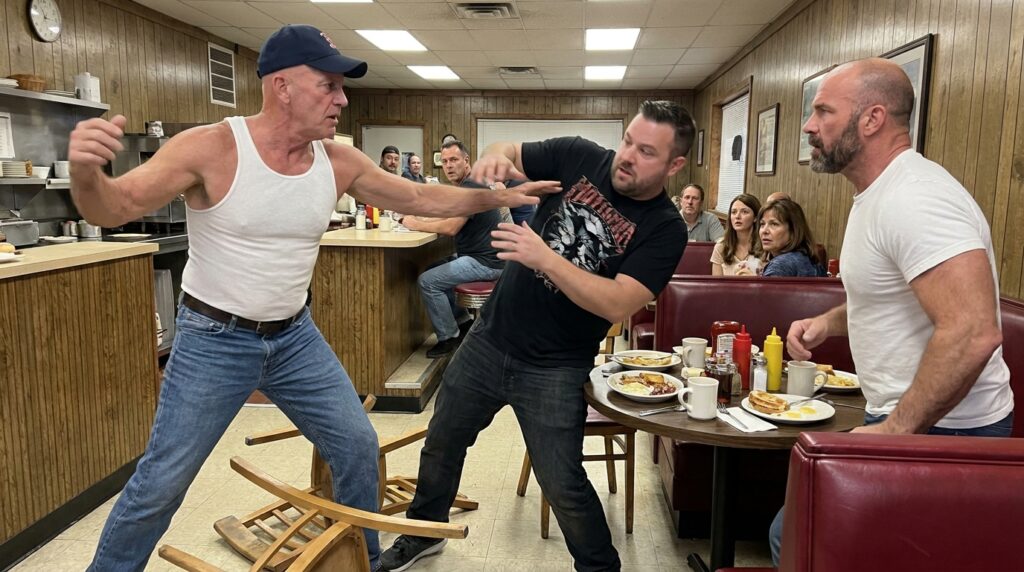
The Bitter Salt of the Borderline: A Novel of Longed-For Anonymity and the Inevitable Weight of Sovereign Defense
CHAPTER 1: THE FRICTION OF THE ENTRY
The smell of burnt coffee and low-sulfur diesel always clung to the corners of Route 9’s terminal diner, a heavy film that stayed behind long after the morning haulers had rolled out toward the interstate. At sixty-two, the hum of the old commercial refrigerator unit behind the counter felt less like background noise and more like a companionable ache, a steady vibration that matched the permanent stiffness in his lower lumbar. He didn’t look up when the heavy glass door rattled against its aluminum frame. He didn’t need to. The hinges had a distinct, high-pitched screech when opened with too much speed, a sharp tearing sound that usually belonged to men who hadn’t worked a full shift yet but already wanted a fight.
His fingers remained flat against the cool, pitted surface of a silver ring that held a single brass key. He didn’t turn it. He didn’t adjust the faded navy service cap pulled low enough to cast his eyes into a gray shadow. He simply watched the small pool of melted ice water at the bottom of his heavy ceramic mug tilt three degrees to the left as two pair of heavy, steel-toed work boots scuffed across the gray linoleum.
They were loud. Not the loud of men who worked the lime quarries up north—those men carried a quiet, exhausted mass that took up space without trying—but the loud of people who needed the room to know they possessed options. The younger one, short-coupled and thick through the chest in a black graphic t-shirt that smelled of stale laundry detergent and tobacco, stopped three inches from the edge of the round table. His accomplice, older by five years with a patchy beard and a white shirt already damp at the armpits, stayed a half-step back, his eyes moving across the other booths, measuring the reaction of the four regulars who sat frozen over their eggs.
“You’re sitting in our seats, old man,” the stocky one said. His voice had the dry, raspy edge of someone who spent too much time shouting over small-engine machinery. He didn’t wait for an answer. He leaned forward, planting one large, calloused palm flat on the table, right next to the silver key ring. The wood-grained laminate groaned slightly under his weight. “Me and my boy here usually take this corner on Tuesdays. You looks like you’re about done anyway.”
From beneath the stiff brim of his cap, the Veteran observed the alignment of the young man’s knuckles. The skin over the joints was red, scarred from old slips against engine blocks, but the balance was wrong. The Aggressor was leaning entirely on his right hip, his left heel slightly off the floor—an unstable posture chosen for cinematic effect rather than sustainable leverage. In the small-town county system, this was how authority was negotiated: through three inches of uninvited proximity and the assumption that age made a man pliable, like old leather left out in the rain.
“The booth behind you is empty,” the Veteran said. The words came out sparse, dried out by years of desert dirt and institutional silence. He didn’t move his hand from the key. His shoulder blades remained settled firmly against the vinyl padding of his seat, his center of gravity low and immovable. “The coffee’s the same over there.”
“We don’t want the booth behind us,” the Aggressor countered, his face darkening as he pulled his shoulder back, his chest expanding under the thin cotton of his shirt. He took the final three inches of space, his hip pressing against the edge of the table lane, his breath smelling faintly of sour wintergreen. “We want this one. And I’m not asking a second time.”
Across the aisle, a fork clinked sharply against a plate, then stopped entirely. The silence that followed was heavy, desaturated, and smelling of old iron.

CHAPTER 2: THE WEAR AND TEAR OF THE LINE
“I don’t think you heard me, old-timer,” the stocky one said. His boots didn’t shift, but his weight drifted forward, his shadow swallowing the remaining three inches of salt-shaker light between them. The black graphic cotton of his shirt was thin, stretched taut across a pair of heavy, unrefined shoulders that had spent more time digging fence posts than learning how to carry an argument. “This isn’t a conversation. You’re moving.”
The Veteran didn’t adjust his navy cap. Through the small, dust-filmed gap of his peripheral vision, he caught the dull reflection of the diner’s stainless-steel counter trim—pitted, scratched by decades of industrial cleaning rags, and rusting where the zinc plating had worn away near the grease trap. The room had dropped its noise the way an old air-brake system drops pressure: all at once, leaving only the low, wet rattle of the refrigeration coils.
“The booth’s empty behind you,” the Veteran repeated. His voice remained level, a flat stone skipped across frozen mud. He kept his index finger resting heavily on the cool brass edge of the key ring. Beneath the metal, he could feel the faint, rhythmic vibration of the fryer units down the line. It was a mechanical reality he understood. Action had a cost. Momentum had a weight. If a machine wasn’t oiled, it sheared its own gears. If a man didn’t know where his boundaries ended, he usually found out by hitting something harder than himself.
The accomplice with the patchy beard shifted his feet, his soles making a dry, scratching sound against the worn linoleum. He wasn’t looking at the Veteran’s face; he was looking at the table. Specifically, his eyes were locked on the small, grease-stained roll of heavy blueprint paper sticking out of his own partner’s rear pocket—the edge of the blue-ink grid lines barely visible beneath a layer of gray field dust. It was a minor detail, a surveyor’s habit, but the paper was high-grade, waterproof polymer, the kind used by state highway crews or utility conglomerates when they were clearing a path through land people didn’t want to leave.
“He’s not moving, Luke,” the accomplice muttered, his hand twitching toward the pocket of his canvas vest. His tone lacked the raw, uncalculated malice of the younger one. It was the voice of a man who worked for an hourly wage and didn’t want a deputy showing up before the midday shift started. “Leave it. We got work down by the creek anyway.”
“He’s moving,” Luke said. The stocky man didn’t look back at his partner. His jaw had hardened into a block of muscle, his skin flushing an angry, sun-baked red beneath the dirt. He wanted the room to see the compliance. He needed the counter clerk—a thirty-year-old woman named Clara whose fingers had frozen over the coffee pot handle—to know that the younger, heavier men dictated the layout of the space. “He’s moving or I’m putting his breakfast in his lap.”
The Veteran took a slow, deliberate breath through his nose. The air tasted of old lard and the sharp, chemical tang of the floor sealant they used on weekends. He could see the structural flaws in Luke’s setup clearly now. The younger man’s center of mass was too far forward, his head extended past his lead knee. He was counting entirely on the psychological weight of his age and his bulk to do the work for him. It was a common error among those who had only ever fought people who were afraid of being hurt.
“You should listen to your friend,” the Veteran said softly. He didn’t lift his hand from the key, but his boots—old, well-greased leather with the steel toes worn down to the dull gray alloy—shifted two inches beneath the table, locking his heels into the structural crossbar of the booth’s iron frame. “He looks like he knows how much a replacement windshield costs.”
The comment didn’t hit Luke’s ears like an insult; it hit him like an obstruction. For a second, the stocky man’s eyes flicked down to the faded blue cap, searching for the tremor or the quick, nervous blink that usually signaled an older regular was ready to yield. He found nothing but the shadow of the brim and the absolute stillness of the Veteran’s shoulders.
The silence in the diner thickened until it felt structural, a heavy, unyielding layer of gray air that held every booth in place. Clara still hadn’t lowered the glass carafe. The old trucker in the corner booth had closed his notebook, his thumb hooked into his suspenders, his eyes measuring the distance between Luke’s broad back and the heavy fire extinguisher mounted near the kitchen doors. Everyone knew the rule along Route 9: you didn’t get involved in county disputes unless the blood started hitting the food, but you didn’t look away either. Public shame was the only currency that counted when the law was twenty minutes away on the state highway.
Luke’s hand came off the table. It didn’t drop back to his side. Instead, his fingers curled into a loose, heavy fist that hovered two inches above the Formica, his knuckles white where the old tool scars ran deep into the skin. “You got a lot of mouth for an old man who lives out of a rusted-out trailer by the marsh.”
“I have the table,” the Veteran said. His finger remained on the brass key, the metal now warm from his own skin. “And I’m still using it.”
The younger man didn’t give a warning signal. He didn’t need to. The sudden, violent contraction of his right shoulder was enough. He lunged forward, his hip slamming into the corner of the wood-grained laminate, his left hand reaching out to grab the collar of the Veteran’s tank top, his boots scuffing hard as he tried to drive his weight into the lane and force the older man back into the corner of the booth.
CHAPTER 3: THE COLLAPSE OF THE LANE
The cotton of the thin black t-shirt bunched as Luke’s lead shoulder dropped, his fingers wide and hooked like a set of ungreased excavation teeth aiming for the Veteran’s throat. It was a movement born of small-town certainty—the conviction that mass alone could dictate the geometry of a room.
The Veteran didn’t pull back into the vinyl padding of the booth. To retreat was to yield the floorboards, and once a man’s heels cleared his baseline, the physics of defense dissolved into a scramble. Instead, his left boot anchored into the iron crossbar beneath the table, the old leather groaning against the weld. He rose a fraction of an inch—not an upward jump, but a forward, level surge that met the Aggressor’s momentum at its narrowest point of transit.
His right hand came off the brass key ring with zero waste, his palm flat and hardened by decades of heavy equipment repair. He didn’t swing for the jaw. A fist was a fragile tool against a thick skull; it broke knuckles and wasted energy. Instead, he drove both heels flat into the gray linoleum, locking his core as he planted his hands directly into the center of Luke’s chest.
The impact was dry, a sharp thud that carried the iron-heavy tang of two solid masses colliding over stale coffee. The force transfer went straight through the stocky man’s center of gravity, arresting his forward lunge instantly. Luke’s boots lost their purchasing on the slick, grease-filmed floor. His knees buckled outward as the momentum he had manufactured was sent directly backward through his own hips.
The stocky man recoiled, his arms flailing to catch the edge of the adjoining table lane. His weight struck a heavy oak dining chair—an old piece of local furniture with rusted iron brackets beneath the seat. The wood didn’t give way with a clean snap; it disintegrated with a low, splitting roar, the legs splintering against the floorboards and scattering dark debris into the aisle. Ceramic plates rattled across the laminate surface, a lone coffee mug sliding three feet before shattering against the zinc baseboard of the counter.
“Luke!” the accomplice barked, his voice losing its flat contractor’s drone and spiking into a sharp, nervous register. His hand, which had been resting near his canvas vest, twitched violently as he took two rapid steps backward toward the diner’s aluminum threshold.
The room remained locked in its gray, desaturated stillness, but the air had changed. The old trucker in the corner booth slowly lowered his fork, his eyes tracking the splintered oak beneath Luke’s thighs. Clara hadn’t dropped the glass pot, but her knuckles were white against the plastic handle, her breath coming in shallow, rhythmic gasps that rattled the dry paper invoices tucked into her apron string.
The Veteran took one single, aggressive step forward out of the booth, his boots grinding a fragment of ceramic plate into a fine white powder against the linoleum. He didn’t drop his hands into a guard. He kept them low, near his hips, his thumbs hooked loosely into the waistband of his jeans, his broad shoulders squared against the entire width of the table lane. He had re-established the boundary line; the space between his lead boot and the shattered chair was now an absolute vacuum that belonged to his utility record.
“Get up,” the Veteran said. The words didn’t carry the heat of an angry man. They had the cold, heavy weight of an operational manual—a set of instructions delivered to a machine that had failed its inspection.
Luke was on his side, his hands flat against the grit of the floorboards as he tried to clear his head from the impact. The black shirt was torn at the shoulder, revealing a pale, thick patch of skin covered in a grey field smudge. As he rolled, his heavy leather tool belt twisted around his waist, exposing the underside of the main holster loop. Stenciled into the unpolished leather was a clean, military-grade identification number: US-ENG-774-V. It wasn’t the marking of a local road crew; it was a standardized federal utility sequence, the kind stamped onto gear issued to civil engineering units operating under government defense contracts.
The Veteran’s eyes fixed on the stencil for less than a second, his mind instantly registering the crisp, unfaded ink of the stamp. This wasn’t local muscle clearing a personal grudge. The weight of that number belonged to an infrastructure firm he had spent twelve years dodging—a corporate entity that specialized in reclaiming rural right-of-ways before the state highway extensions were even drafted.
The accomplice noticed the direction of the Veteran’s gaze. His patchy beard twitched as he lunged forward, not to strike, but to grab Luke by the strap of his canvas vest, dragging the heavier man toward his feet with an awkward, frantic heave that sent another splinter of the oak chair scraping across the floorboards.
“Come on, Luke,” the accomplice muttered, his eyes darting from the stenciled belt back to the grey shadow beneath the Veteran’s navy cap. “We’re outside our sector. Let it go.”
But Luke’s fingers were already curling into the grit, his mouth twisting into a red, sun-baked snarl as he found his footing among the broken wood. He hadn’t read the identification code; he had only felt the iron density of the old man’s hands, and his pride was currently bleeding into the linoleum.
CHAPTER 4: THE UNYIELDING FOREARM
“Get your hands off me, Vance,” Luke hissed. He wrenched his arm out of his accomplice’s grasp, his heavy work boots dragging a jagged arc through the oak splinters on the floor. His eyes were wide, bloodshot at the corners from the sudden spike of adrenaline and the sharp, hot sting of dust in his throat. He looked at the other booths, searching for something to stabilize his pride, but he found only the hollow glare of old men who had seen real winters. “The old bastard got lucky. That’s all it was.”
The Veteran didn’t answer with a threat. He simply re-entered his baseline stance, his feet wide, his left shoulder dropped three degrees lower than his right to shelter his liver. His skin felt cool under the grease-heavy draught from the kitchen doors. This was the mechanical drift of the conflict: once an amateur lost his footing, his subsequent movements were driven by panic rather than leverage.
“Luke, don’t do it,” Vance said, his boots clicking in a rapid, defensive rhythm toward the cash register. “Look at his hands. Just look at his damn hands.”
But Luke was already in motion. He didn’t execute a measured advance; he threw his entire bulk into a desperate, flat-footed charge across the table lane. He dropped his head, his chin tucked behind his collarbone, his heavy arms swinging upward in an uncoordinated attempt to gather the Veteran’s torso and drive him against the sharp, zinc-plated trim of the counter. It was a maneuver that worked in the gravel lots behind the bars, where men were too drunk to read the trajectory of a shoulder.
The Veteran timed the transit by the scrape of Luke’s heel studs against the pine planks. He didn’t drop his weight backward to cushion the impact. Instead, he executed a clean, three-inch pivot on his left toe, clearing his right hip from the center line just as the stocky man entered the vacuum of his space.
The motion was economical, stripped of any cinematic flourish. As Luke’s bulk surged past his chest, the Veteran brought his right arm up, his elbow bent tight, his forearm forming a solid, iron-heavy lever of unyielding bone and muscle. He didn’t strike downward; he simply drove the flat of that lever forward into the junction where Luke’s collarbone met his throat.
The contact was absolute. The energy of Luke’s own momentum was redirected back through his cervical spine with a blunt, bone-dry crack. The physics of the interception were relentless—the stocky man’s head stopped instantly while his lower half continued to travel forward, causing his heels to clear the floorboards entirely. His body rotated three degrees in the air before gravity claimed the mass, sending him crashing sideways into the empty space beneath the menu board.
A loose brass padlock rolled out from his unfastened tool loop, its casing embossed with a small, clean insignia—the triple-arrow seal of the Federal Land Reclamation Bureau. It bounced twice on the linoleum, a bright, metallic clink that died instantly against the grease trap.
The Veteran stood over the space, his breath coming in a single, unhurried measure through his nose. His forearm was red where it had taken the skin off Luke’s neck, the small hairs singed by the friction of the canvas shirt. He didn’t look down at the padlock immediately, but his mind had already processed the seal. The Reclamation Bureau didn’t clear right-of-ways for county pipelines. They cleared boundaries for high-security installation corridors, the kind that required a clean title and the total absence of civilian structures within three miles of the perimeter.
“You’re done, son,” the Veteran said. His voice didn’t have the raspy heat of the local workers. It was the flat, rhythmic tone of a range officer checking a clear chamber. “Your balance is gone. If you try to stand up before that ear stops ringing, you’re going to put your teeth through the floor.”
Luke didn’t answer. He was on his chest, his fingers twitching against the gray grit of the baseboard, his breath coming in wet, shallow wheezes that left a faint circle of condensation on the worn wood. The anger had left his eyes, replaced by the dull, uncomprehending stare of a steer that had taken a bolt between the ears.
Vance had completely backed into the aluminum frame of the exit door, his hands raised to the level of his chin, the fingers shaking against the glass pane. His face had gone the color of skimmed milk, his gaze locked on the small brass padlock that lay between the Veteran’s boots. He knew the designation of that lock. He knew exactly what kind of signature was required to clip it to a field case.
“We’re leaving,” Vance said, his voice dropping into an urgent, dry whisper that barely reached the counter clerk. He reached down, his fingers hooking into the collar of Luke’s torn t-shirt, dragging his partner’s heavy shoulders toward the threshold with a frantic, uncoordinated heave. “We’re leaving right now.”
The Veteran didn’t move to block the door. He simply watched the grease-stained polymer blueprint roll slide further out of Luke’s pocket as the man was hauled through the exit, its blue grid lines catching the hard morning sun from the gravel lot.
CHAPTER 5: THE SURRENDER AT THE THRESHOLD
The double-paned glass door rattled against its frame, the dry hiss of the diner’s air conditioning cut short by the blinding, white-hot glare of the noon sun. Vance was moving backward, his fingers hooked into the damp canvas armpits of Luke’s vest, dragging the stocky man’s dead weight across the concrete sill. Luke’s boots made a thick, heavy scraping sound over the metal threshold, leaving a twin trail of black rubber marks that smelled instantly of high-friction heat.
The Veteran didn’t stay behind the counter lane. He followed them—not with the hurried stride of a hunter, but with the steady, mechanical pacing of an inspector tracking a faulty cable. His boots hit the sun-baked gravel with a dry crunch that caused Vance to freeze, his hand slipping from Luke’s shoulder as he dropped back against the rusted fender of an unwashed Ford F-250.
“Don’t come any closer,” Vance said. The words were flat, stripped of the contractor’s bravado that had filled the booth five minutes ago. He pressed his palms against the blistering metal of the truck’s truck bed, his heels digging into the loose limestone chips until he hit the solid base of the tire iron. “We’re leaving. I told you, we’re leaving.”
Luke was on one knee now, his head hanging low between his shoulders, a thick bead of dark saliva stringing down from his lip into the white dust. His fingers clutched at the gravel, his chest heaving under the torn cotton of his black shirt as he tried to process the total failure of his balance. The brass padlock he had dropped inside lay three feet behind them, but the stenciled marking on his tool belt was fully exposed to the midday glare: US-ENG-774-V.
The Veteran stopped at the edge of the asphalt apron, where the shade of the diner’s corrugated awning died against the heat of the road. His face remained obscured beneath the navy service cap, but his thumbs were still hooked firmly into the waistband of his jeans. His eyes weren’t fixed on Luke’s face; they were locked onto the cab of the truck, where a small, battery-operated field scanner was humming on the dashboard, its green indicator light flashing in sequence with the high-frequency vibration of an unaligned flywheel.
“You dropped your lock,” the Veteran said. His voice was a low, industrial rasp that carried across the quiet lot. “And you left your alignment keys on my table.”
Vance didn’t reach for his pockets. He raised his hands until his thumbs were level with his collarbone, the palms open and coated in a white film of limestone dust. It was the absolute posture of a sub-contractor who had realized the liability had exceeded the value of the bond. “The keys don’t matter. The lock belongs to the company. Keep it. Just let me get him into the cab before someone calls the county marshal.”
“The marshal won’t come out this far for a broken chair,” the Veteran said, his boots shifting an inch into the stones, the iron-toed soles making a dull, heavy clink against an old muffler bolt buried in the dirt. He took a single, deliberate step past the baseline of the shade, the direct heat of the sun hitting his leathered arms. “But the firm might. If they think you lost the ledger.”
The accomplice’s jaw went slack, his eyes flicking toward the glove box before he could catch the movement. The reaction was small, a mere twitch of the neck muscles, but it was enough for a man who had spent thirty years watching engineers hide asset lists from local tribal boards. The blueprint roll was still hanging from Luke’s rear pocket, but the outer layer had unraveled slightly in the dust, revealing a bright red-ink rectangular stamp across the corner: EXEMPT – RECORD SEC-12.
It wasn’t a state transit code. It was the legal tag used by private acquisition consortiums when they were working under a federal nondisclosure rider to clear family homesteads before the public notice was filed at the courthouse.
“We don’t have a ledger,” Vance muttered, but his boots were sliding sideways, his shoulder pressing into the truck’s door handle as he tried to shield the cab from view. “We’re just doing the line checks for the culvert. That’s all the supervisor gave us.”
“The supervisor doesn’t issue federal padlocks to utility crews,” the Veteran said. He reached down, his heavily calloused fingers grabbing the unraveled edge of the polymer blueprint roll from Luke’s pocket. He didn’t jerk it; he pulled it with a smooth, continuous force that brought the stocky man’s torso flat against the gravel with a low moan.
The sheet unrolled between them, a heavy, waterproof grid of blue-ink lines that mapped out the old creek bed behind the marsh. But it didn’t show the water line. It showed a series of three intersecting survey hubs, each marked with a small brass survey monument symbol, and all three were located precisely inside the western fence line of the Veteran’s three-acre parcel.
The names on the title column at the bottom weren’t local names. The primary claimant was listed as Vanguard Development Infrastructure, with an unlisted field office number based out of Fort Meade.
A sudden, high-pitched mechanical whine cut through the heat—the dashboard scanner in the truck had changed frequencies, its green light turning a solid, unblinking crimson as it began to download a remote telemetry log from a satellite link. Vance reached into the cab through the open window, his knuckles striking the frame as he frantically punched the kill switch on the unit, but the screen had already displayed four lines of fresh, incoming text: ALERT – AREA MON-02 COMPROMISED. DEFENSIVE RETALIATION CONFIRMED.
The Veteran looked from the screen back to the red-ink stamp on the map, his fingers tightening against the tough polymer until the material creaked. The trap wasn’t coming from the highway; it was already sitting in his regular booth, and he had just given them the physical performance they needed to log the profile.
CHAPTER 6: THE HARDENING OF THE SILENCE
“That wasn’t no county crew, Silas,” the old trucker said. His voice came out small, dry, scraping through the stillness of the diner like a rusty nail across a zinc bucket. His fork remained abandoned on the paper placemat, his eyes fixed on the door where the F-250’s tires were still flinging gravel against the base of the outdoor propane tank.
The Veteran stepped back over the threshold, his boots dragging the heat of the noon sun into the cooler, grease-weighted air of the dining room. He didn’t drop the polymer blueprint roll. He kept his large, calloused fingers clamped tightly around its unraveled edge, the heavy sheet creaking against his thigh as he walked back toward his booth. The brass padlock he had retrieved from the stones clinked softly inside his front pocket, a heavy, mechanical rhythmic counterweight to his stride.
“Clara,” Silas said. He didn’t look at the clerk. He stopped beside the shattered remains of the oak dining chair, his toe nudging a splintered leg until it lay flush against the base of the counter. “Get your book out.”
Clara didn’t reach for the ticket pad right away. Her hands were still wrapped around the black plastic handle of the coffee pot, her breath hitting the glass rim in small, shallow puffs that faded almost instantly. When she finally moved, the motion was stiff, her apron strings snapping against the counter trim as she pulled a worn leather-bound ledger from beneath the old mechanical cash register. The ledger was ancient, its edges frayed down to the gray thread, smelling of forty years of tobacco smoke and spilled grease.
“They’ve been logging the line since April,” she whispered. Her eyes darted from Silas’s navy cap down to the red-ink stamp visible on the unrolled section of the map: EXEMPT – RECORD SEC-12. “Two men from the state land office came through first, looking at the old survey monument beneath the pantry floor boards. They said the county line had drifted three feet east after the ’93 flood.”
Silas settled his bulk into the booth, the vinyl seat groaning under his weight with a familiar, low rattle. He laid the blueprint flat on the wood-grained laminate, using his heavy ceramic mug to pin the top edge down against the vibration of the refrigerator coils. The red rectangular stamp sat directly over the section of the grid that marked his own property line—the three acres of marsh and gravel where his trailer had sat undisturbed for twelve years.
“The line didn’t drift,” Silas said. His voice was a flat, industrial monotone, stripped of any local inflection. He traced the blue-ink line with his thumb, his thick nail tracing the path of the old creek bed until it reached the three intersecting survey hubs. “The state didn’t send them. This is an acquisition layout. Look at the grid orientation. It’s balanced on the military datum line, not the county road system.”
The old trucker rose from his booth, his suspenders pulling taut over his flannel shirt as he scuffed across the gray linoleum to stand a three-foot distance from the table. He leaned his head down, his weathered face tightening as he studied the stenciled initials at the bottom of the claimant column. “Vanguard Development. That’s the outfit that cleared out the old fuel depot down by the rail spur last winter. They don’t build roads, Silas. They build fences.”
“They build corridors,” Silas corrected softly. He reached into his pocket and pulled out the brass padlock, setting it down on the table with a heavy, metallic thud that caused the salt shakers to jump. The triple-arrow seal of the Federal Land Reclamation Bureau caught the yellow light from the window, its brass surface dull and pitted from exposure to moisture. “They bait the owner until he hits someone. Once there’s an assault charge on the local record, the federal rider allows them to execute an immediate title reclamation under the public safety provision. It keeps the acquisition out of the district court.”
The room went entirely cold then, the remaining regulars looking down at their plates as the structural logic of the confrontation settled into the wood. The fight hadn’t been an argument over a booth. Luke hadn’t been an entitled bully looking for an easy mark; he had been an employee executing a specific, calculated provocation designed to generate a defensive reaction on camera. The dashboard scanner in the truck hadn’t been downloading mapping data—it had been logging the physical force transfer of Silas’s forearm check to verify the capability index.
Clara turned a page in her ledger, her finger stopping beside a handwritten notation dated three weeks prior. “The supervisor came in alone last Tuesday, Silas. He didn’t buy nothing. He just sat in your booth for an hour, scraping the grease off the floor bolt with a pocket knife. He said he was looking for the original section marker from the ’50s.”
Silas didn’t look up, but his hand closed around the silver ring holding his brass key. He knew what lay beneath the diner’s foundation. The original section marker wasn’t a standard iron pipe; it was a heavy brass disk stamped by the Army Corps of Engineers before the highway was built—the master anchor point that locked the titles for every acre between the marsh and the state line. If that monument was altered or cleared from the record, his trailer wasn’t just on disputed ground; his entire property line would legally cease to exist.
“They’re coming back,” the old trucker said, his hand twitching toward the door as the low, rhythmic thrum of a heavy diesel engine began to vibrate through the gravel lot outside. It wasn’t the F-250 this time. The sound was deeper, slower, carrying the distinct, unaligned clatter of a heavy utility transport vehicle rolling in from the state highway.
Silas didn’t move from his seat. He turned the brass key over in his palm, his skin feeling the cool, unyielding weight of the iron as the reflection of a second, larger shadow began to stretch across the diner’s glass threshold.
CHAPTER 7: THE SETTLING OF THE SHADOW
The glass panes of the diner’s front facade didn’t just rattle; they vibrated at a frequency that sent a steady, fine mist of dried window putty flaking down onto the linoleum sill. The deep, rhythmic thrum of the approaching diesel engine entered the room through the floor joists, traveling up the iron frame of the booth and into the base of Silas’s heavy ceramic mug. The small pool of cold coffee inside the cup rippled in concentric, high-friction circles that matched the exact stroke of an unaligned eight-cylinder utility transport flywheel.
Silas didn’t stand up. He kept his heels locked firmly into the iron crossbar beneath the wood-grained laminate, his broad, tank-top-clad shoulders square against the table lane. Through the salt-pitted glass of the front entry, the white glare of the noon sun was suddenly blocked out by the massive, matte-gray grill of a three-ton field logistics unit. It came to a halt exactly six inches from the concrete apron, its exhaust stack burping a thick, low-sulfur cloud that smelled of hot lubricating oil and scorched iron.
The driver’s side door swung open against its ungreased limiter with a dry, metallic screech that silenced the remaining refrigeration coils inside the diner. A lone man stepped down into the gravel—not a young field hand like Luke or a panicked sub-contractor like Vance, but a fifty-year-old operational manager wearing a crisp, starch-stiff khaki field uniform that bore no local county patches. His boots were clean, black leather with vulcanized soles that left no marks on the limestone chips as he stepped over the threshold and into the dim, grease-weighted air.
“The road’s closed for three miles north, Clara,” the manager said. He didn’t look at the booth where Silas sat pinned by the counter light. He walked directly to the register lane, his hand dropping a heavy leather document pouch onto the Formica surface with a blunt, dead thud that caused the old receipt spindle to jump. “State transit order came through twenty minutes ago. You’ve got until five o’clock to clear the inventory before the security gate locks the right-of-way.”
Clara didn’t touch the pouch. Her fingers remained frozen around the handle of the empty glass carafe, her apron string twitching against the zinc trim of the register base. “The marshal hasn’t signed no transit order, Mr. Henderson. The county commissioners told us the bridge works were pushed to August.”
“The commissioners don’t have jurisdiction over a defense corridor link,” Henderson said. His voice was a thin, level rasp that carried no heat, only the absolute indifference of a corporate ledger. He finally turned his head, his eyes moving past the splintered pieces of the oak chair until they locked onto the faded navy service cap shadowing Silas’s face. “And neither does anyone else living on unrecorded marsh tracts.”
Silas picked up the brass padlock from the laminate table. The metal felt heavy, holding the dull, cold density of government-issued hardware that had survived three deployments in the salt flats. He rolled it once in his calloused palm, the triple-arrow seal of the Land Reclamation Bureau catching the glare of the utility truck’s hazard lights outside.
“The tract isn’t unrecorded,” Silas said. The words came out slow, dried out by decades of range discipline. He didn’t look up from the brass lock. “The master monument is still registered under the ’54 Army Corps survey. It’s sitting exactly three feet beneath the pantry floorboards behind your register, Henderson. Right where your boys were trying to scratch it out last Tuesday.”
The operational manager didn’t blink. He took two steps forward into the table lane, his fingers hooking into the webbed utility belt that held his digital transceiver. The unit was humming, its crimson indicator light flashing in identical sequence with the dashboard scanner in the truck outside. “The ’54 survey was voided when the defense infrastructure bill passed in October, Silas. The corporate title was filed under a blanket reclamation rider. The second your name hits the state assault log for what you did to my field hands out in that lot, the title executes automatically. You don’t have a fence line anymore.”
Silas let out a low, steady breath through his nose. He could hear the structural ticking of the hot diesel manifold outside, the expansion of the iron parts under the direct noon heat. He knew the parameters of the game now. The provocation hadn’t been an error; it was the final required variable in an acquisition equation that had been running since the rail spur was cleared. If he stood up and used his hands a third time, the camera on the truck’s chassis would register the transaction, and the federal marshal would have no choice but to sign the immediate eviction warrant under the public safety mandate.
“I didn’t hit him,” Silas said softly. He laid the brass padlock back down on the blueprint, his thumb resting flat against the red-ink rectangular stamp that read EXEMPT. He looked past Henderson’s shoulder, out through the glass door where the clean chrome survey markers on the gray transport truck were reflecting the blinding white glare of the road. “I just didn’t move. There’s a difference in the code.”
Henderson’s hand went completely still on his transceiver. For the first time since he had crossed the threshold, his eyes flicked down to the silver ring holding the single brass key on the table. He knew the weight of that key. It didn’t belong to a padlock or a trailer door; it belonged to the heavy iron casing that sealed the master section monument beneath the floorboards—the one link the acquisition team needed to destroy before the five o’clock title confirmation rolled through from Fort Meade.
The silence in the diner hardened into something solid, a heavy, unyielding layer of gray air that held every booth in its grip. The old trucker didn’t move his hand from his suspenders. Clara didn’t lower the empty pot. They all watched the two men across the wood-grained laminate, knowing that the boundary hadn’t just been drawn in the dirt outside; it was being held by three inches of unyielding brass and the quiet, immovable mass of an older regular who refused to yield his lane.
“Five o’clock, Silas,” Henderson said, his voice dropping into a cold whisper that barely cut the hum of the truck. He turned on his heel, his vulcanized soles making no sound against the grit as he walked back toward the glass entry. “After that, the machinery doesn’t look for flags.”
Silas didn’t answer. He simply reached out and picked up his heavy mug, his fingers feeling the cool water at the bottom as the heavy gray truck threw its transmission into reverse, flinging a fresh spray of sharp limestone chips against the rusted base of the diner’s outer line.
CHAPTER 8: THE SECURING OF THE DITCH
The wind coming off the salt flats didn’t blow the fog; it dragged it, a heavy, grease-colored curtain that smelled of low-tide rot and unrefined fuel oil. Silas stood at the edge of his gravel driveway, his boots sinking two inches into the soft, uncompacted silt where his ditch line met the state right-of-way. In his left hand, he held a rusted iron t-post driver—thirty pounds of weighted steel casing that carried the sharp, zinc-heavy odor of old garage oil.
He didn’t need a flashlight to see where the boundary had been breached.
Every twelve feet along the eastern slope of his culvert, a clean, white-painted pine stake had been driven into the sod. They weren’t standard wooden markers from the county yard; these were topped with small, cylindrical caps of high-impact orange polymer, each one holding a tiny, unblinking infrared diode that cast a faint, blood-red ring onto the wet weeds below. To anyone driving Route 9 at forty miles an hour, they looked like simple utility flags. To Silas, who had spent three winters setting up tactical perimeter lines outside of Ansbach, they were telemetry reference anchors—spatial guides for automated grading machinery designed to operate without headlights.
He approached the first marker, his breath forming a brief, gray cloud beneath the brim of his navy service cap. He didn’t bend his knees from the waist; he dropped his weight straight down into his heels, his calloused fingers wrapping around the smooth pine shaft. The wood was fresh, the sap still sticky where the industrial blade had planed the corners, completely unweathered by the marsh air.
With a single, downward contraction of his shoulder blades, he wrenched the stake from the silt. The suction broke with a low, wet pop that died instantly against the heavy hum of the marsh reeds. He didn’t snap the wood. He used his thumb to pry the orange cap off the top, exposing the three-volt lithium cell and the serialized circuit board inside. Stamped directly into the green fiberglass of the module was the same corporate identification marker he had seen on Luke’s tool belt inside the diner: VDI-SYS-B.
They weren’t waiting for five o’clock tomorrow. They were already mapping the grading paths tonight, using the fog to mask the deployment of the telemetry array.
“Silas,” a voice called from the gravel lane behind him. It was a dry, breathless whisper that carried the distinct rattle of a loose exhaust hanger.
Silas didn’t spin on his heel. He dropped the disabled module into his jeans pocket, his right hand settling back into its loose, low-slung rest near his belt line before he turned his face toward the road. Clara’s old Dodge Dart was idling at the mouth of his gate, its headlights turned off, the engine missing on the third cylinder with a wet, unaligned clatter that shook the rusted quarter panels.
She scrambled out of the driver’s seat, her canvas coat open and flapping against her knees, her white apron still tucked beneath her waistband. In her arms, she held a heavy, grease-spattered accounting file—not the ledger from the counter, but a flat, steel-bound corporate record box with a combination dial that had been forced open with a cold chisel.
“Henderson’s crew didn’t go back to the highway,” she said, her boots crunching frantically through the loose limestone chips until she stood within the three-foot perimeter of Silas’s space. Her face was gray in the fog, her eyes wide, reflecting the faint red glow of the remaining markers down the ditch line. “They set up a mobile operations trailer behind the lime quarry. I watched them through the kitchen window. They brought a county records clerk out from town in a private sedan.”
Silas looked down at the steel box in her arms. The paint was chipping around the hinges, revealing the dull gray primer beneath, and the top was stenciled with the words: PROPERTY REGISTER – DISTRICT 4 – 1954.
“Where did you get that, Clara?” Silas asked. His voice remained level, a flat stone dropped into cold mud, but his fingers tightened against the iron t-post driver he still held in his left hand.
“It was behind the dry-storage partition,” she said, her breath coming in shallow, ragged gaps that smelled faintly of stale diner coffee. “The supervisor wasn’t looking for a section marker last week. He was looking for the wall space where my father had bolted this box to the iron studs in ’72. Silas… I looked at the land index inside before I cut the ignition. Your military record isn’t attached to your deed anymore. They’ve updated the file. It says you were discharged under a Section 8 in seventy-eight—pre-arranged mental instability.”
The Veteran stood completely still in the gray dark, the mist settling into the weave of his white tank top like fine salt. The structural logic of the trap was now completely exposed. A Section 8 classification didn’t just void his civil service preference; under the state’s updated infrastructure reclamation act, it legally categorized him as an incompetent occupant on a strategic land parcel, allowing the private consortium to execute an immediate title override without ever presenting a case to a local jury.
Across the marsh, three hundred yards away through the reeds, a pair of heavy halogen floodlights suddenly cut through the fog, their white beams sweeping across his western fence line with the cold, deliberate sweep of an extraction detail.
CHAPTER 9: THE FALSIFIED DISCHARGE
The door to the county records annex didn’t give way with a clean latch snap; it cleared the strike plate with a dry, iron-heavy grind that left a smudge of rusted scale across the sleeve of Silas’s tank top. The air inside the basement vault was colder than the marsh fog, smelling of forty years of dissolving binding glue, damp pulp, and the distinct, oily tang of a transformer unit that had been left humming under load since the late shift walked out.
Silas didn’t switch on the overhead tubes. The twin halogen beams from the Vanguard logistics truck were already cutting through the ground-level transom windows, throwing a series of long, desaturated bars of white light across the rows of metal filing cabinets.
“The server racks are in the back corner,” Clara whispered. Her boots scuffed softly against the gray concrete as she set the forced-open steel register box down on a rusted drafting table. Her fingers were still red from the cold drive, shaking as she pointed toward the small green indicator lights pulsing behind a heavy wire mesh partition. “The clerk they brought in from the town office… he wasn’t updating local deed histories. He was running an extraction protocol directly from the state microfiche bank.”
Silas approached the metal cage, his boots leaving a faint trail of wet limestone dust on the floor boards. His index finger tracked the seam of the partition until he hit the padlock loop. It was a standard brass tumbler, old but oiled, bearing the clean stamping of the county highway department. He didn’t pull a tool from his pocket. He simply wrapped his calloused hand around the casing, his knuckles lock-braced against the frame, and applied a steady, low-leverage torque until the old screws inside the cedar door frame sheared with a sound like dry bone snapping.
He pulled the wire gate open, the hinges screaming once before settling into the dark.
Behind the mesh sat three gray terminal housing blocks, their cooling fans throwing a steady stream of hot, dry air against his shins. Attached to the rear backing plates of the primary unit were two pristine, chrome security seals—their barcodes crisp and bearing the registration tag of Vanguard Strategic Assets. The local land recorder hadn’t just allowed an update; the entire county data line had been partitioned, the physical hardware bypassed by an integrated corporate routing switch that took its commands directly from the mobile operational trailer down by the lime quarry.
“Open the fiche index, Clara,” Silas said. His voice was a flat, unhurried rasp that barely carried over the hum of the cooling units. He didn’t adjust his navy cap. His eyes were fixed on the glowing monitor screen, where a series of command lines were scrolling in real time, deleting archival sub-directories dated between 1974 and 1979.
Clara pulled the heavy metal drawer marked MILITARY ACTIONS – UNCLASSIFIED, the steel rollers rattling against the tracks like a dry chain over a sprocket. She flipped through the gray cardboard dividers until her thumb hit the tab marked S-442. She pulled a single, yellowed celluloid card from the sleeve and dropped it onto the light-table glass.
“Look at the entry date, Silas,” she said, her voice dropping into a tight, dry register that rattled the paper receipts in her coat pocket. “The original microfiche has been cleared with an emulsion solvent. There’s a fresh overlay strip glued straight onto the master acetate.”
Silas leaned over the glass, the cool white light from the box casting the grid lines of his own record across the deep lines of his face. The name was his—Silas Vance, Master Sergeant, US Army Civil Engineering Corp. But the code block at the bottom of the form had been rewritten with a fine, mechanical precision that didn’t match the heavy typewriter ink of the original document. The entry read: DISCHARGE CODE: SM-8-INCOMPETENT. ADMINISTRATIVE EXEMPTION FILED UNDER RECLAMATION RIDER 12-B.
It wasn’t just a falsified medical filing. The date of the overlay strip was stamped June 23, 2026—less than twelve hours old, logged into the system at the exact moment Luke had initiated the lunge across the diner table lane.
The trap had a second bottom. The corporation hadn’t rewritten his discharge to take his trailer; they had used his original 1954 title registry to track down every remaining legacy land grant along the valley corridor. Below his file, listed under the same administrative exemption rider, were fourteen other names—every single retired service member living within five miles of the defense pipeline lane, all of them reclassified as legal dependents under the state public safety mandate within the last forty-eight hours.
A sudden, sharp metallic crack echoed from the ground-level transom window above their heads. A lone stone had skipped across the iron grating of the window well, followed by the heavy, deliberate crunch of vulcanized rubber soles coming to a halt on the loose gravel lot outside.
Silas didn’t jump. He kept his hand resting flat against the glass of the light table, his finger pressing down until the celluloid card clicked against the frame. Through the narrow gap of the window slot, he could see the matte-gray front bumper of Henderson’s utility transport idling forty inches from the building’s main foundation line, its cooling fans cutting in with a low, wet roar that shook the vault’s concrete joists.
“They’re not here to clear the files, Silas,” Clara whispered, her boots sliding two inches back into the cage shadow as the headlights turned the basement air into a blinding white glare. “They’re here to seal the room.”
Silas picked up the yellowed record card, his thick thumb snapping the acetate cleanly across the code block before dropping the pieces into his shirt pocket. He didn’t look back at the server racks. He turned toward the stairs, his boots finding the first iron riser with an unhurried, mechanical weight that belonged to a man who had already calculated the distance to the next boundary line.
CHAPTER 10: THE LOGBOOK IN THE LATHS
The iron stair riser groaned, a flake of rusted scale clicking against Silas’s boot heel as he forced the heavy fire door back into its jamb. He didn’t look at the high-beam glare cutting through the transom behind them. He grabbed Clara by the stiff canvas elbow of her coat, steering her straight through the narrow pass between the kitchen’s ungreased dish racks and into the windowless vacuum of the diner’s dry-storage annex.
The air here was dead, trapping the dry, choking heat of fifty summers of baking asphalt roofs and the low, organic rot of stored flour sacks.
“The wall isn’t standard studding, Silas,” Clara said, her breath catching in her throat as she hit the edge of an unpainted pine shelving tier. She dropped the forced steel register box onto a pile of collapsed potato burlap, her fingers frantic as she tapped the tongue-and-groove cedar wainscoting behind the salt tins. “My father didn’t just bolt the box here in ’72. When the state surveyors came through after the first highway assessment, he spent three nights with a hand-saw, cutting straight into the main structural load-bearing laths behind the pantry line.”
Silas pulled his faded navy service cap lower, the gray shadow of the brim shielding his eyes from the dust shifting down from the ceiling joists. He didn’t use a pry-bar. He planted his left heel flat against the floorboards—right over the spot where the original 1954 brass survey monument lay sealed under three inches of iron-strapped fir—and drove the flat edge of his iron t-post driver straight into the seam where the cedar met the corner molding.
The wood didn’t yield with a clean, modern snap; it split with a low, agonizing groan, the dry tongue-and-groove fiber tearing away in jagged, resinous strips that smelled instantly of sun-baked pine sawdust and oxidized iron.
Behind the exterior cedar laths, tucked into the dead space between two rough-sawn oak studs, sat a flat, hand-forged structural iron bracket. It was held in place by four heavy square-headed lag bolts, their heads coated in a thick, black layer of ancient axle grease to prevent the damp marsh air from scaling the threads. Wrapped inside an oil-treated canvas tarp beneath the iron strap was a single, long-form field ledger—its binding thick, cord-stitched leather that had turned the color of dried liver after fifty years in the dark.
“Is that it?” Clara whispered, her boots sliding through the cedar splinters as the ground beneath them shuddered again. The low, unaligned clatter of the heavy utility transport outside had dropped into a deep, high-torque idle, the sound traveling up the foundation piers until the metal shelves began to ring like loose guitar wires.
Silas reached into the cavity, his calloused fingers stripping away the greasy canvas wrap. He didn’t pull the book out with a jerk; he checked the structural brackets first, his thumb identifying a small, rectangular lead seal clamped across the binding cord. The seal bore the stamped registry of the US Army Corps of Engineers – District 9 – 1954.
He cracked the lead clamp with the edge of his thumbnail, opening the first thick rag-paper page under the dim, indirect light of the kitchen pass-through. The entries weren’t written in the standardized corporate ink of Vanguard Development. They were handwritten in a tight, precise draftsman’s script, every page logging the absolute baseline coordinates for the entire valley floorboards, cross-referenced against the permanent geographic bedrock markers up at the lime quarry.
But it was the final appendix page that broke the decoy secret.
The ledger didn’t just hold land descriptions. Pasted onto the interior rear cover was a copy of the original 1954 federal land patent, signed under the homestead provision for civil engineering veterans who had cleared the delta marsh channels after the war. Tucked into the flap beneath the deed was a modern, laser-printed administrative summary sheet bearing the header of Vanguard Strategic Assets, dated two weeks prior.
The sheet contained a complete operational list of the fourteen veteran properties along Route 9, but under Silas’s name, the box marked DISPOSAL METHOD had been updated with a single, handwritten pencil annotation: Bait Luke. Log dynamic physical capability profile. File incompetence override under Section 8 baseline prior to 1700 survey window.
The systematic falsification wasn’t a county bureaucratic error or a simple corporate land grab. The company had spent three months monitoring his daily movements, tracking the exact density of his balance and the mechanical economy of his movements inside this diner, all to establish a pre-calculated physical profile that could be used to classify his defensive muscle memory as an unprovoked, non-civilian hazard to the highway project.
A sudden, sharp shattering of structural glass echoed from the front dining room. Henderson’s utility transport had shifted its weight, the heavy steel winch assembly on its front bumper creeping past the six-inch clearance margin and pressing directly into the aluminum framework of the diner’s main entrance door.
Silas closed the leather ledger with a dry thud that sent a puff of grey dust into his face. He didn’t look down at the torn cedar laths. He tucked the heavy book firmly beneath his left arm, his right hand settling back into its loose, centered rest near his waistband as the first sound of splintering oak booths began to tear through the front room.
“Silas,” Clara said, her voice dropping into an absolute, paralyzed quiet as the shadow of the truck’s hydraulic lifting arm expanded across the kitchen ceiling. “They’re clearing the floor.”
Silas turned his boots toward the pass-through lane, his heels grinding the fresh pine sawdust into the floorboards with the unhurried, mechanical weight of a operative who had finally located the anchor.
CHAPTER 11: THE FINAL MEASURE
The aluminum framework of the diner’s entryway tore with a dry, high-pitched scream, the zinc-plated rivets shearing out of the header block like programmatic fasteners under load. A single, heavy plate of safety glass didn’t shatter; it dissolved under the flat, dead compression of the gray utility transport’s winch blade, dropping three hundred pounds of square-edged green crystal straight into the front booth aisle.
Silas stepped out from the kitchen pass-through, the cord-stitched leather ledger locked beneath his left armpit, his hand resting unhurriedly against his hip. The smell of cold grease was gone, replaced instantly by the raw, industrial wash of unscrubbed diesel exhaust and the heat of an eight-cylinder block running at full compression six feet from the counter stools.
Henderson stood just inside the ruined threshold, his boots planted in the crystal pile, his hand resting flat against the grip of his transceiver. Behind him in the white noon glare, the three-ton logistics vehicle was idling, its hydraulic stabilizer arms lowered until the steel pads had ground two inches deep into the asphalt apron.
“You’re thirty minutes past the marker, Silas,” Henderson said. He didn’t check his watch. He pointed a single, dirt-filmed finger toward the dry-storage door where the torn cedar laths were still weeping pine sawdust into the floorboards. “The regional link is live on the Fort Meade switch. The title executed at seventeen hundred. You’re an occupant on a federal corridor.”
“The title didn’t execute,” Silas said. His voice came out small, flat, a dry iron block dropped into the gravel. He didn’t pull his hand from his waist. He simply turned his shoulder three degrees to the left, allowing the yellow counter light to illuminate the hand-forged lead seal hanging from the ledger’s binding cord. “Your field office ran the extraction protocol against the microfiche records bank, but they didn’t clear the master logbook. The patent isn’t administrative, Henderson. It’s an original Corps assignment linked to the section monument beneath these floorboards.”
The operational manager’s jaw tightened, the skin over his cheekbones turning a dry, clay gray under his sun-baked uniform cap. His fingers twitched against the transceiver button, but he didn’t key the link. “An unindexed book doesn’t hold weight against a live state transit order. The grading blade is coming through that wall in ten minutes, whether your name is in that paper or not.”
“It’s not an unindexed book,” Silas said. He took one step forward, his boot sole grinding a crystal of safety glass into fine white salt against the floor boards. He reached into his tank-top pocket and pulled out the yellowed pieces of the celluloid microfiche card he had snapped in the county basement, dropping them onto the Formica surface of the nearest table lane, right next to the brass padlock. “The index number is matching the Corps stamp on the ledger frame. If your blade touches the foundation piers before a district judge signs the specific validation warrant, your firm loses the defense bond for the entire sector.”
Henderson looked from the celluloid pieces back to the broad, unmoving mass of Silas’s shoulders. The absolute stillness of the old man’s posture was a mechanical reality he couldn’t bypass with mass; it was the composure of a drill instructor who knew the exact yield point of every material in the room. The camera mounted on the truck’s chassis was still rotating, its green lens tracking the transaction, but the data line wasn’t logging a dynamic physical assault profile anymore—it was recording a verified federal title exception, logged in real-time before the local witnesses.
Across the aisle, the old trucker slowly stood up from his booth, his thumb still hooked into his suspenders, his eyes tracking the red-ink stamp visible through the canvas wrap of the book. “He’s got you on the baseline, Henderson. The county marshal’s car just cleared the rail spur down by the marsh line. I heard his radio frequency cut in when your transport killed the local server racks.”
The operational manager didn’t execute a counter-move. He took a single, slow step backward into the crystal pile, his boots making a heavy, crunching sound that died against the deep idling rumble of the diesel block outside. His hand dropped away from his utility belt, the fingers shaking slightly as he pulled his shoulder back out of the diner’s ruined frame.
“We’ll hold the sector at the ditch line,” Henderson whispered, his face darkening until it matched the desaturated color of the road asphalt. “But the trailer’s coming down anyway, Silas. The corridor doesn’t look for flags after the first freeze.”
“I’ll be at the gate,” Silas said. His finger remained resting flat against the cool brass edge of the key ring on his belt, his center of gravity unmovable as the massive gray utility truck threw its transmission into reverse, its tires flinging a final, dry spray of limestone grit across the shattered threshold.
The room returned to its gray stillness, the vibration in the joists dying down until only the steady, wet rattle of the refrigeration coils remained to fill the space. Silas didn’t adjust his navy cap. He tucked the leather book tighter beneath his arm and turned his boots toward his regular booth, his heels scuffing through the white salt of the glass as the noon shadow finally began to settle over the valley.







