
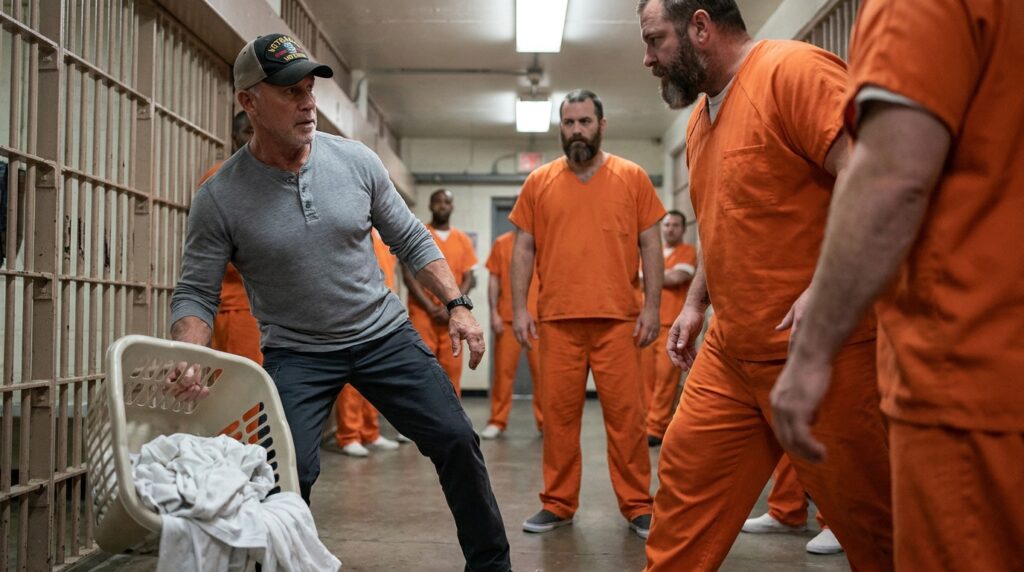
The Iron Perimeter: A Novel of Institutional Survival, Faded Tattoos, and the Unyielding Weight of Discipline
CHAPTER 1: THE COLD IRON RUN
The scuffed linoleum of the intake office smelled of chemical floor stripper and stale tobacco, an institutional odor Frank had smelled in forty different variations from Fort Bragg to the federal line. He didn’t look at the kid behind the laminated desk. The clerk couldn’t have been more than twenty-four, his green uniform shirt crisp and unearned, his fingers moving with a light, hollow rhythm over a mechanical keyboard. On the corner of the desk lay Frank’s old service folder, its corners soft and grayed from decades of handling, looking small beside the facility’s glossy privatization brochures.
“The computer says your clearance is utility contract only, McAllister,” the guard muttered, not looking up. He adjusted a black plastic name tag that read Miller. “That means you don’t carry a baton, you don’t carry gas, and you don’t lock down cells. You’re just inventory management for the tier linens. Frankly, at your age, most guys take the terminal gate position where there’s a chair.”
Frank didn’t shift his weight. His boots, heavy-soled and polished to a dull, pragmatic sheen, remained anchored exactly two inches behind the red intake line painted on the floor. He adjusted the brim of his faded veteran cap, the dark fabric stiff against his thumb. Underneath the gray cotton sleeve of his shirt, the faded anchor tattoo on his forearm felt tight against his skin, a dry reminder of a time when authority was measured by the depth of a man’s voice rather than a entry bar-code.
“The linen count is twenty-two bags short on Tier 3,” Frank said. His voice was flat, desaturated of color, like a stone pulled from a dry creek bed. “I don’t need a chair to count canvas, Miller. I need the turnstile unlocked.”
The young guard let out a dry, nasal breath—the sound of small-time authority encountering a border it couldn’t quite map. He punched a green button beneath the desk rim. The heavy steel gate behind Frank gave a sharp, metallic clack, the sound of iron pins releasing from greasy sockets. “It’s your funeral, Mac. Tier 3 has been sour since the midnight shift change. Don’t say the state didn’t warn you.”
Frank didn’t thank him. He grabbed the iron handle of the three-wheeled utility cart, the cold iron biting into his calloused palm with familiar friction. As he pushed the rattling frame through the threshold, the air changed instantly, turning thick with the smell of institutional laundry starch, boiled cabbage, and the low, damp vibration of four hundred men locked behind rusted mesh.
He moved down the central corridor, his eyes tracking the floor joints. Every three feet, a expansion gap had rusted out, leaving sharp lips of concrete that caught the small wheels of the cart. A lesser man would have rushed, tried to get the shift over before the heat in the block peaked at noon. But Frank kept his pace metronomic, each step identical to the last. He noticed a small grease smudge on the third cell bar of the intake cage—fresh oil, the kind used for lubricating heavy locks, or perhaps for cleaning something that didn’t belong in a cell. He didn’t stop to examine it, but the discrepancy logged itself behind his eyes, a tiny crack in the perimeter.
Ahead, the passage narrowed into the throat of Tier 3. The light there was different—a desaturated, yellow-gray wash from overhead fixtures that hummed with a persistent sixty-cycle vibration. And there, leaning against the iron utility locker at the end of the run, was a silhouette that broke the clean vertical lines of the bars.

CHAPTER 2: THE TERRITORIAL LINE
“You took a wrong turn at the turnstile, old man,” Big Vance said.
His voice didn’t carry the high, jagged pitch of an angry inmate looking for a quick tier brawl. It was a low, resonant drone that seemed to vibrate directly out of the rusted steel deck plates of Tier 3. He hadn’t shifted his position against the utility locker. His massive, hairless head was cocked slightly to the left, catching the desaturated yellow-gray wash of the overhead tubes. The bright orange prison cotton of his uniform was stretched taut across a pair of shoulders that effectively narrowed the central lane to a single foot of clearance.
Frank kept his hands clamped on the cold iron handle of the laundry cart. He didn’t tighten his grip—tightening your grip meant you were preparing for a strike, and men like Vance read white knuckles the way a tracker read broken twigs. He let the cart roll forward another three inches until the front caster dropped into one of the scuffed concrete expansion gaps with a dull, heavy thud.
“The manifest says the utility locker needs a physical count,” Frank said. His tongue felt dry, tasting of the recycled air and the faint undercurrent of scorched copper from the facility’s ventilation system. “Step back from the latch, Vance.”
To the left and right, the rhythmic metallic clicking of dominoes against steel tables in the dayroom suddenly died. The silence that followed wasn’t empty; it was a heavy, collective exhalation as thirty men in matching orange uniforms slowly turned their heads toward the utility run. They didn’t crowd the bars yet. They stayed back in the shadows of their cells, arms folded, their boots shifting with a dry, scratching friction on the concrete. The inmate support layer was setting the perimeter. They knew the rules of the block better than the rookie guards in the control bubble: when a testing sequence began, you gave the participants room to determine the gravity of the line.
Vance didn’t move. A faint smile twitched the corner of his heavy, bearded jawline. He reached down with his right hand, his thick fingers tracing the rusted edge of the utility locker’s padlock staple. Frank’s eyes didn’t follow the hand; he kept his focus locked strictly on Vance’s collarbone, watching for the subtle drop of the shoulder that preceded a forward lunge. But as his gaze crossed the lock itself, he noticed the same detail he’d seen at the intake cage—a thin, translucent bead of fresh machine oil glistening along the hinge pin. It was too clean for a block that hadn’t seen maintenance funding in three fiscal quarters.
“Locker’s empty, Mac,” Vance murmured, his chest expanding as he took a slow, deliberate breath. He stepped off the locker frame, his massive boots planting themselves dead center in Frank’s path. The proximity was close enough for Frank to smell the cheap, alkaline soap from the tier showers and the metallic tang of old sweat. “Everything on this tier goes through me before it goes into a folder. Your young friend Miller at the desk forgot to tell you how the accounting works up here.”
The mention of Miller wasn’t an accident. It was a calculated piece of intellectual leverage, an unspoken confirmation that the rookie guard’s skepticism in the intake office wasn’t just administrative laziness—it was connected. Vance was laying a psychological perimeter, testing whether Frank would lean on institutional authority or clear his own path.
“Miller doesn’t sign my timecard,” Frank said. He took one step forward, his polished boot stopping exactly an inch from Vance’s right toe. He could feel the heat radiating off the larger man’s bulk, a physical wall of muscle and intent. “And he doesn’t count the canvas. I’m going to open the latch now.”
“You aren’t opening anything but a bag of trouble, old man,” Vance whispered, his beard tightening as his jaw set. He didn’t drop his hands into a guard, but his weight shifted backward slightly, centering his mass over his hips. “You think that little cap makes you look like something we haven’t broken before? You’re a ghost in a gray shirt. Go back to the gate while you can still walk through it without a limp.”
Frank didn’t answer. He let his left hand slide off the cart handle, his arm hanging loose at his side, his fingers slightly curled but relaxed. He could feel the weight of every year in his joints—the old fracture in his tibia from a training drop at Fort Bragg, the dull ache in his shoulder from decades of lifting heavy freight. He was outnumbered, unweaponed, and isolated in a corridor where the security cameras had a known blind spot across the utility run. If he backed down now, the cart would be stripped before the noon whistle, and his authority on the tier would be reduced to a running joke among the inmates.
He reached for the locker latch with his right hand, his movement deliberate, offering Vance a clear look at the faded anchor tattoo on his wrist. It was an invitation and a boundary, written in old blue ink against weathered skin. Vance’s eyes tracked the motion, his pupils dilating as his hand rose to intercept Frank’s arm. The entire block seemed to lean inward, the silence on the tier tightening like a rusted cable under a winch.
CHAPTER 3: THE PRESSURIZED SILENCE
The low, industrial hum of Tier 3 shifted long before Big Vance made his second physical adjustment. To an untrained ear, the block always sounded the same—a baseline drone of extraction fans, rusted water lines knocking against reinforced masonry, and the distant, dry rattle of steel bunks. But Frank had spent three years listening to perimeter fences breathe in high-altitude crosswinds; he knew the exact density of a room’s atmosphere when the internal structure began to flex under structural stress.
The yellow-gray wash from the overhead fluorescent fixtures felt heavier now, catching the airborne lint and dry concrete dust that drifted from the utility run. The three-wheeled laundry cart sat dead locked, its rusted frame angled slightly against the masonry joint where the scuffed floor met the steel base plates of the cells. Vance had his left hand braced against the rusted locker jamb, his thumb resting less than an inch from the padlock staple where the fresh, translucent bead of machine oil gleamed. He wasn’t pushing yet. He was simply existing in the space, his broad chest rising and falling with a slow, heavy rhythm that smelled faintly of salt and state-issued starch.
“You’ve got a lot of miles on those boots, McAllister,” Vance said, his voice dropping into a flatter, more transactional tone that didn’t reach the control bubble thirty yards away. His eyes remained fixed on Frank’s collarbone, watching for the minor muscle twitches that betrayed an impending pivot. “But miles don’t buy you any track up here. This locker doesn’t need your fingers inside it.”
Frank left his right arm extended toward the iron latch, his knuckles precisely two inches from the rusted iron tongue. The blue ink of the anchor tattoo on his wrist looked faded under the sodium lighting, the edges of the ink frayed by years of manual labor and salt water. In his peripheral vision, the cell doors on the lower tier remained silent, but the shadows behind the rusted mesh were moving. Heads were low, bodies leaning against the bars to catch the angle of the run. None of them were shouting. The absence of noise on a high-security tier wasn’t a sign of compliance; it was a sign of organization. They were waiting for the friction point to declare its parameters.
“The inventory requires a baseline match,” Frank replied. His internal voice was counting the seconds between the control bubble’s automated sweep cycle. The rotating camera at the far end of the tier gave a rhythmic, pneumatic shhh-clack every eighteen seconds as its internal gears reversed. It had seven seconds left before its lens swung back toward the laundry blind spot. “The manifest was pulled from the main office an hour ago. If the count is short, the tier stays locked during the afternoon yard run.”
Vance’s bearded jaw tightened, the thick muscles along his neck hardening into solid cords under the orange cotton collar of his shirt. He didn’t drop his stance, but his fingers slipped off the locker jamb, his palm hitting the cold iron door with a hollow, metallic thunk that echoed through the concrete throat of the block. “The manifest is a piece of paper, old man. Papers get lost between the desk and the incinerator. Miller knows that. If you were as smart as your file says you are, you’d be down at the gate house smoking a stale cigarette instead of trying to look heavy in a gray shirt.”
The reference to his service record was the second indicator. Frank didn’t have his military history stamped on his civilian badge; his file was supposed to be restricted to the warden’s personnel cabinet in the administrative wing. The fact that a tier boss on a locked block could quote the contents of an off-limits ledger meant the information pipeline wasn’t just leaking—it was being directed. The fresh oil on the lock, Miller’s dismissive warning at the turnstile, and Vance’s spatial lock on the linen supply weren’t separate incidents. They were the mechanical linkages of a larger structural alignment designed to force an error.
Frank didn’t allow his eyes to wander toward the high windows where the dry noon sun hit the perimeter wire outside. He focused entirely on the distance between his lead boot and Vance’s forward heel. The space was forty-two centimeters. If Vance initiated a shoulder check or an intentional crowd, the physics of the concrete floor favored the larger man’s mass unless Frank adjusted his center of gravity before the impact point. He could feel the old, deep ache in his lumbar vertebrae—the physical price of three decades spent under the unyielding weight of combat gear and transport pallets—but his legs remained steady, his weight distributed fifty-fifty across the thick rubber soles of his tactical shoes.
“The lane belongs to the facility, Vance,” Frank said, his voice retaining its flat, measured cadence. He didn’t lift his hands into a defensive guard, but he let his shoulders square slightly, reducing the profile of his chest. “And the locker opens on my shift. Step back from the cart.”
Vance didn’t drop his head or pull his chin in for a charge. Instead, he let his right arm drop down, his fingers curling into a heavy, calloused fist that hung near the seam of his orange pants. The air between them grew thin, carrying the high, metallic vibration of the tier’s industrial fans. From the far end of the run, the pneumatic camera completed its rotation, its glass lens catching the yellow glare of the lights as it locked onto the dead space behind the utility locker. The five-second window was closing, and the silent perimeter of the block seemed to tighten around them like an ungreased winch.
CHAPTER 4: THE SHATTERED AXIS
The mechanical click of the remote camera had barely cleared its housing when Big Vance moved. He didn’t drop his shoulder or raise his arms into a recognizable street-fighting posture. Instead, he simply dropped his mass forward, using the dead weight of his six-foot-four frame to crowd the remainder of the lane. It was a prison yard check, an old tactic designed to split an opponent’s balance over a fixed low obstacle before their muscle memory could account for the transition.
Frank’s lead boot caught the edge of the iron laundry cart as Vance’s chest collided with his left shoulder. The impact carried the heavy, unyielding physics of a moving flatcar. The scuffed concrete floor offered no friction; the layer of chemical floor stripper had left the surface slick, and Frank’s heel sheared across the gray linoleum joint. His fingers stripped away from the cold iron handle of the cart. The heavy canvas basket tipped instantly, its metal base plates screeching against the floor pins as twenty bags of institutional sheets slid out across the concrete lane.
The fall was slow, measured by the internal clock of a man who had dropped through tree lines under a heavy chute. Frank didn’t reach out his hands to break the descent—doing so would risk a fractured radius or an exposed throat. He folded his left elbow inward, tucking his chin tightly against the stiff collar of his gray shirt as his hip took the primary shock of the concrete. The scuffed surface bit into his skin through the dark tactical pants, a sharp, unvarnished heat that radiated into his lower vertebrae.
Vance stood over the scattered pile of white linens immediately, his massive boots pinning one of the stenciled canvas straps beneath his heel. The bright orange cotton of his prison trousers blotted out the desaturated light from the lower cells. He didn’t follow up with a boot to the ribs. He remained stationary, his broad chest rising and falling, a physical monolith establishing a territorial lockout in the blind spot of the tier’s security network.
“You’re in the wrong lane, old man,” Vance said. The words were low, targeted at the floor rather than the tier at large. “And you’re cleaning up my mess next.”
Around the perimeter, the silence deepened until the sixty-cycle vibration of the fluorescent tubes became the only audible layer of the tier. The inmate witness layer shifted closer to the rusted mesh of the cell fronts, their faces entirely unreadable in the yellow wash of the block. They weren’t cheering. In a federal facility, an escalation of this weight was viewed as a transactional shift; they were observing the structural damage to see how much territory would change hands before the afternoon shift change.
Frank lay motionless for two full heartbeats, his face less than three inches from a faded stencil on the spilled canvas that read US-DOC-PROPERTY. He could smell the sour starch of the sheets and the sharp, alkaline odor of the floor wash. His left shoulder throbbed where Vance’s mass had compressed the joint against the iron frame of the cart, but his breathing remained rhythmic, a metronomic four-count sequence that suppressed the adrenaline spike before it could compromise his motor control.
His fingers closed around the coarse, woven edge of the tipped laundry basket. He didn’t look up at Vance’s face. He looked at the larger man’s center of mass—the thick drawstring knot of his orange trousers, the slight tilt of his left hip that indicated his balance was forward, over-extended on the pinned strap. A younger man would have used the floor to launch an upward strike, an emotional response that would invite a counter-grapple from someone with Vance’s physical leverage. Frank didn’t seek a strike. He sought the alignment of his spine.
He pulled his knees toward his chest, his boots finding traction against the small metal lip of the utility locker’s bottom runner. The cold iron gave him a solid anchor point. With a single, explosive extension of his thighs, he drove his hips backward, sliding his torso out from beneath Vance’s immediate shadow and creating three feet of critical clearance along the scuffed concrete lane.
The movement was silent, devoid of the theatrical grunt of an aging worker in distress. As his boots cleared the spilled linen, Frank planted both palms flat against the gray floor plates, using the leverage to swing his torso up into a rigid, vertical axis. He didn’t stand all the way up yet; he remained in a low, deep crouch, his weight centered over his mid-foot, his hands rising instinctively to his chest level with the fingers curled into a loose, deceptive guard.
Vance’s expression didn’t change from its mask of bearded indifference, but his right boot slipped half an inch off the canvas strap as Frank re-established his spatial perimeter. The larger man’s eyes narrowed slightly, tracking the speed of the recovery. It wasn’t the scramble of a civilian civilian contractor who had lost his balance; it was the precise, weight-distributed repositioning of a tactical operator resetting an interior defensive perimeter after a structural breach.
The yellow light flickered once above the utility locker, casting long, fractured shadows across the white sheets that separated the two men. From the far corner of the tier, the automated camera began its slow, pneumatic rotation back toward the lane, its internal gears giving off a dry, high-pitched whistle that signaled the end of the five-second blind spot.
CHAPTER 5: THE GUARDED STANDOFF
“You shift weight fast for a civilian,” Big Vance said.
His shoulder didn’t drop, and his massive fingers remained loose, hanging an inch above the canvas laundry strap pinned under his boot. He didn’t rush into the clearance Frank had opened along the linoleum seam. He simply pivoted on his heel, his center of gravity remaining perfectly centered over his hips. The massive, hairless crown of his head gleamed under the yellow-gray wash of the tubes, casting a sharp, elongated wedge of shadow across the scattered, white institutional linens.
Frank didn’t rise to his full height. He kept his hips low, his boots dug into the small iron lip of the utility locker’s bottom runner to counter the slickness of the floor stripper. His forearms were up, fists unclinched but firm, tracking Vance’s collarbone with a steady, unblinking focus. His left shoulder socket throbbed where the initial impact had jammed the bone against the steel basket frame, a deep, grinding heat that reminded him of the mortar splinter he’d carried out of Mogadishu thirty-odd years ago. He ignored the pulse. In a narrow lane, pain was just noise; it didn’t change the coefficient of friction or the leverage required to stop an engine.
“The camera’s back on the run, Vance,” Frank said. His voice was a flat, unvarnished vibration that barely carried across the three feet of space separating their boots. “Stand down. You’re misreading the room.”
A low chuckle rattled inside Vance’s heavy, bearded jawline. He didn’t look back at the rotating lens whistling at the far end of the tier. “The camera’s got a dirty housing today, old man. Miller forgot to wipe the grease off the glass during the morning inspection. You’re the only one counting seconds on this line.”
The detail was a hard strike. Frank’s gaze narrowed by a fraction of a millimeter. A dirty camera lens meant the control bubble wasn’t seeing a clear perimeter; they were seeing an automated silhouette passing through a pre-set arc. The fresh machine oil on the intake cage lock, the rookie guard’s calculated cynicism, and the tactical blind spot weren’t random institutional failures. They were an invited vacuum. Vance wasn’t just testing a soft target for block status; he was executing a specific, timed contract designed to provoke an explosive physical intervention before the noon whistle could clear the tier.
From the dark cells lining the central corridor, the collective breathing of the witness layer grew shallow. A few younger inmates slid their hands through the rusted mesh, their fingers tapping a light, syncopated rhythm against the iron bars. They were waiting for Frank to break—to throw a desperate punch that would justify Vance using his entire two-hundred-and-fifty-pound mass to systematically dismantle him against the utility locker. If Frank committed to a strike, he was accepting their rules. If he used tactical violence, the report would read like an aging civilian losing control of a detail, providing the administrative justification Miller needed to pull his file from the personnel cabinet.
Frank shifted his lead heel backward by three centimeters, his sole grinding against a stray scrap of coarse, stenciled canvas. He didn’t offer an opening. His guard remained locked on his center of mass, his posture completely absorbing the physical exhaustion of the crouch without allowing his spine to bend.
“I don’t need a clear lens to know your balance is forward,” Frank said, his voice dropping into a colder, more precise cadence. “Go ahead and make your move. I’ve handled far worse than you in tighter spaces than this.”
Vance’s beard twitched as his teeth bared slightly, but his forward boot didn’t leave the floor. His eyes tracked the absolute stillness of Frank’s hands. In the yard, an old man who didn’t shake after hitting the concrete was a different kind of problem; it meant the muscle memory was too deep to be startled out of alignment. The massive inmate remained anchored, his weight testing the line, his massive shoulders blotting out the light from the utility latch as the high-pressure tension of the tier reached its absolute, vibrating limit.
The standoff didn’t break with a blow. Instead, a heavy, electronic rattle groaned through the deck plates from the far end of the run—the sound of the main tier gate pins grinding back into their tracks before the scheduled guard change.
CHAPTER 6: THE SILENT RETREAT
The heavy iron pins of the main gate dropped into their concrete sockets with a sharp, pneumatic slam that rattled the empty laundry baskets on Frank’s cart. The sound traveled down the central corridor of Tier 3 like a physical shockwave, cutting through the sixty-cycle vibration of the fluorescent tubes. Almost instantly, the loose, syncopated rhythm of the inmates’ fingers tapping against the bars died out, replaced by the sharp, measured clack of reinforced heels approaching from the intake desk.
Frank didn’t lower his forearms. His boots remained anchored against the metal runner of the utility locker, his center of gravity held exactly three inches below Vance’s horizontal sightline. He watched the thick muscle along Vance’s collarbone slowly untwist, the forward tilt of the larger man’s left hip shifting back into a passive, resting stance. The kinetic threat didn’t vanish; it simply settled back into the gray fabric of the prison uniform, a heavy mass entering a state of calculated cold storage before the approaching authority could frame the baseline layout.
“We’re short on linen details today, McAllister,” a voice called out from the throat of the run.
It wasn’t Miller. The cadence was older, heavier, carrying the dry rasp of a veteran shift supervisor who had managed the perimeter lines before the state facility had been sold to the private management group. Chief Supervisor Henderson stopped exactly five feet outside the utility blind spot, his dark blue wool shirt crisp despite the damp noon heat of the tier. His right hand rested lightly on his leather utility belt, his thumb hooked over the ring of a brass key block that didn’t match the new digital cards given to the rookie guards. His gray eyes swept the floor, tracking the twenty bags of spilled sheets and the scuffed linoleum where Frank’s heel had sheared through the floor stripper.
Vance didn’t look back at the supervisor. He slowly lifted his right boot off the coarse canvas strap, stepping back into the shadow of Cell 312 with an deliberate lack of urgency. His face remained an unvarnished mask of bearded indifference, but his pupils were still dilated from the pressure of the standoff.
“Just clearing the lane for the contractor, Chief,” Vance murmured, his voice flat, devoid of the high pitch of an inmate caught in an unauthorized escalation. “Old man lost his footing on the slick spots. The utility detail needs better maintenance before someone gets hurt on the run.”
Henderson didn’t draw his baton, and he didn’t reach for the radio on his shoulder. He looked at the fresh bead of machine oil glistening on the locker latch, then at the faded anchor tattoo on Frank’s extended wrist. A rookie like Miller would have started writing disciplinary slips for a yard fight; a man who had spent thirty years watching institutional machinery knew when a layout had been engineered to fail from the top down.
“The lane’s clear enough for a count, Vance,” Henderson said, his voice dropping into a low, desaturated rumble that matched the tone of the concrete walls. “Get back behind the line. Your faction’s due in the mess hall for the noon distribution in four minutes. If I see your shadow on the utility locker when the whistle blows, the entire block loses its yard privilege for forty-eight hours.”
Vance didn’t answer. He offered a slow, microscopic nod toward Frank—an acknowledgment of territory maintained rather than an apology—and stepped backward into the dim interior of his cell. The iron mesh door didn’t slam; it slid closed with a dry, metallic hiss that signaled the temporary end of the active testing sequence.
Frank slowly lowered his hands, his muscles burning as the adrenaline began to drain from his shoulders. He didn’t stretch or rub the joint where the initial shoulder check had compressed the bone against the cart frame. He stood up to his full height, his spine locking into the vertical alignment he had maintained through three decades of service. He reached down and grabbed the iron handle of the overturned basket, his fingers closing over the coarse, woven canvas with an unyielding grip.
“You’re a long way from the gate house, Mac,” Henderson said softly, stepping into the utility run and using his boot to kick a stray sheet away from the expansion gap. He didn’t help Frank lift the heavy canvas. “Miller’s down at the desk logging a equipment delay on your detail. He’s already typed up the report saying your reaction times are a liability for the tier.”
Frank hoisted the tipped basket back onto the cart’s three-wheeled frame, the steel base plates settling back into the grease pins with a dull clack. His face remained clean of emotion, a weathered piece of timber that had stood against harder gales than a junior clerk’s administrative sabotage.
“The report can say what it wants, Henderson,” Frank said, his thumb running over the fresh lock oil on the padlock staple as he secured the cart. “The manifest matches the bags. I’m going to finish the count before the whistle.”
Henderson looked at him for a long, unblinking five seconds, the brass keys on his belt jingling faintly as he shifted his weight. “The warden’s signing the privatization clearance on Friday, Mac. They aren’t looking for men who know how to hold a perimeter. They’re looking for reasons to balance the ledger. Don’t give them a clean sheet to write on.”
The supervisor turned on his heel, his heavy boots clicking down the corridor with a metronomic rhythm that slowly faded into the ambient hum of the cell block. Frank didn’t watch him go. He pulled the utility cart another two feet down the lane, his eyes locked on the double-canvas lining of the bottom shelf where the fabric was slightly thicker, its seam re-stitched with heavy nylon thread that didn’t belong to the facility’s standard issue. The decoy secret Vance had been protecting wasn’t inside the locker; it was riding inside the cart itself.
CHAPTER 7: THE BALANCED LEDGER
The stiff nylon thread gave way with a dry, jagged rip that sounded like cold iron dragging across shale. Frank didn’t use a knife; his thumbnail, hardened by years of handling canvas transport bundles and field gear, forced the double-stitched seam of the utility cart’s bottom lining apart millimeter by millimeter. The desaturated yellow light of the utility corridor caught the white fluff of severed cotton batting as he reached into the dead space between the structural frame plates.
His fingers closed on something cold, flat, and bound in heavy oilskin. It wasn’t the dense, soft shape of smuggled narcotics or the sharp edge of a machined shank. It was a narrow, metal-bound logbook, its leather cover scuffed and grayed at the corners from constant contact with the damp canvas walls of the linen detail.
Frank pulled the ledger out into the light. He didn’t open it immediately. He stood motionless in the narrow corridor, his boots aligned precisely with the gray linoleum expansion joint, his weathered face shadowed by the low brim of his veteran cap. The ambient noise of Tier 3 had changed; the noon whistle had cleared the block, leaving behind a vast, hollow silence that smelled of floor stripper and stale cabbage. The iron cell doors stood open in uniform rows, their heavy mesh frames resembling the ribs of a pick-clean carcass under the flickering fluorescent tubes.
He flipped the first page with a slow, calloused thumb. The entries weren’t written in the crude, jagged hand of a tier boss managing a commissary racket. Every line was rendered in the clean, metronomic print of a high-level administrative clerk. There were dates, badge numbers, and specific retirement codes matching every older officer on the facility payroll, including his own. Next to each name was a dollar amount—a projected valuation of saved pension expenditures under the new private management contract—and a corresponding cross-reference to specific disciplinary files managed by Rookie Guard Miller.
Frank felt a cold, physical stillness settle behind his eyes. The decoy layout—the idea that Vance was using the linen carts to move contraband across the blind spots—was completely dismantled by the ink on the page. Vance wasn’t running an inmate enterprise against the system; he was the system’s operational instrument. The fresh oil on the lock hinges, the orchestrated confrontation in the lane, and Miller’s pre-written report about his failing reaction times weren’t separate tactical movements. They were the mechanical linkages of a deliberate corporate purge masquerading as an inmate security crisis. The warden wasn’t trying to clean up Tier 3; he was staging an artificial breakdown of older personnel to clear the legal ledger before the privatization signatures dried on Friday morning.
“You’ve got a steady hand for an old man,” a voice muttered from the threshold behind him.
Frank didn’t look up from the page. He knew the gait—the heavy, uneven drag of Henderson’s left heel against the concrete. The senior supervisor stopped two feet from the back wheel of the cart, his blue wool shirt looking desaturated and dark in the yellow wash of the corridor lights. The brass key block on his belt gave off a single, hollow click as he shifted his weight.
“You knew the alignment before I signed the intake sheet, Henderson,” Frank said. His voice was a flat, low vibration that didn’t bounce off the masonry. “The whole tier’s an empty perimeter.”
Henderson took a slow, heavy breath, his fingers resting passively near the top of his leather utility holster. “The facility’s already gone, Mac. The state closed the funding loop three months ago. The guys who built the lines—the guys who know how to stand a watch without an electronic bar-code—we’re just expensive ink on a state balance sheet. Miller’s faction gets a bonus for every senior folder they clear before the transition team arrives.”
Frank closed the ledger with a dull, heavy thud that echoed through the empty utility run. He didn’t drop it back into the canvas seam. He tucked the oilskin bundle securely into the inner pocket of his gray shirt, buttoning the stiff cotton flap down over the metal binding until the outline was flat against his ribs. The old anchor tattoo on his wrist looked sharp under the yellow tube light, the blue ink dark against his weathered skin.
“They want to test the perimeter,” Frank said, his eyes finally moving to meet the supervisor’s gray gaze. “Let them test it. But tell Miller I don’t move out of my lane until the shift is completed.”
Henderson looked at him for a long, silent three seconds, his jaw setting as the distant bells of the facility clock began to toll the midday change. “They won’t stop at a shoulder check next time, Mac. Vance has the run of the block until Friday.”
“Discipline doesn’t expire when you change the logo on the gate,” Frank said. He grabbed the iron handle of the three-wheeled cart, his knuckles white against the cold metal as he pushed the rattling frame forward into the central lane.
As the cart passed the threshold of Cell 312, Frank noticed a subtle change in the structure. Three middle-aged inmates who had stayed in the shadows during the standoff were standing exactly six inches behind their red cell lines. They didn’t shout, and they didn’t rattle their cups against the mesh. As Frank moved past them, his gray shirt crisp and his boots hitting the concrete with identical, metronomic precision, the lead inmate slowly lifted his right hand and adjusted the brim of a faded orange cap in a silent, rigid acknowledgment that looked exactly like a military salute. The power dynamic hadn’t just broken; it had realigned itself around the old man’s unyielding axis. Frank didn’t return the gesture, but he kept his head up, his gait steady, and his perimeter locked as he wheeled the cart toward the main gate run.
CHAPTER 8: THE FILES REVERSED
“You’re thirty minutes over your log window, McAllister,” Guard Miller said, his thumb tapping the plastic edge of a black proximity badge against the laminated desk rim. “Hand over the cart keys. The detail is being reassigned to a state transport crew.”
The intake desk was bathed in a sharp, blue-tinted glare from three flat-screen monitors that hummed with a persistent, high-frequency vibration. The air here was colder than the concrete throat of Tier 3, stripped of the organic smells of starch and cabbage, replaced entirely by the dry, recycled output of the administrative wing’s climate control units. On Miller’s secondary screen, a red flashing cursor hung over Frank’s digital personnel profile, the field marked Incident History – Pending Review open and ready for data entry.
Frank didn’t release his grip on the three-wheeled utility cart’s iron handle. He let the frame settle against the front edge of the steel security counter, the cold metal clinking against the laminated wood with a dull, heavy resonance. He reached slowly into the inner pocket of his gray long-sleeve shirt, his fingers passing over the thick canvas stitching until they found the stiff, oilskin corner of the metal-bound logbook hidden against his ribs.
“The linen count is logged and verified,” Frank said. His voice was lower than Miller’s terminal hum, a flat, desaturated sound that seemed to pull the ambient noise out of the small office space. “The manifest matches the bags on the tier. If there’s a delay, you’ll find the bottleneck in your own ledger, Miller.”
The young guard’s fingers froze over the mechanical keyboard. He finally lifted his head, the blue light from the monitors reflecting off his clean-shaven jaw and the rigid, unearned lines of his corporate uniform shirt. He looked at Frank’s faded veteran cap, then down at the scuffed leather shoes that remained anchored exactly two inches behind the red intake line painted on the floor.
“I don’t need to look at my ledger,” Miller whispered, his eyes narrowing as he leaned forward, invading the clearance of the counter space. “The report’s already filed. Incident on Tier 3: contractor negligence leading to a physical disruption with an inmate population leader. That’s an automatic security pull, Mac. By Friday morning, your clearance code won’t even open the employee turnstile.”
Frank didn’t flinch. He didn’t drop into a tactical stance or shift his weight over his hips. Instead, he pulled the metal-bound logbook from his shirt flap and dropped it flat onto the center of the laminated desk, dead center over the plastic keyboard cord. The heavy oilskin cover hit the wood with a solid, unyielding thud that caused Miller’s proximity badge to slide two inches to the left.
“Open page fourteen,” Frank said softly.
Miller didn’t reach for the book immediately. He looked at the faded ink of the anchor tattoo on Frank’s wrist, then at the grayed, scuffed corners of the metal binding. The silence in the intake station grew thick, pressurized by the sudden drop in the young guard’s confident breathing. Outside the glass partition, the distant hum of the facility’s central ventilation system sounded like a dying engine grinding its gears against a rusted housing.
With a slow, slightly uneven movement of his hand, Miller flipped the oilskin cover back. His eyes tracked the clean, metronomic print of the facility’s administrative clerk—the rows of badge numbers, the specific retirement calculation codes, and the precise monetary figures marked next to his own family name. As his gaze crossed the final column where his digital signature password was cross-referenced with a private corporate ledger entry, the color drained from his face, leaving his skin looking as desaturated and gray as the concrete walls behind him.
“This doesn’t leave the block,” Miller muttered, his fingers tightening against the edge of the ledger page until the paper gave off a dry, crinkling hiss. He didn’t look up at Frank’s face; his eyes remained glued to the ink that systematically dismantled his administrative authority. “If the warden sees this out of the canvas lining, the whole tier goes into lockdown before the shift change.”
“The ledger stays right here,” Frank said, his hand descending onto the top of the oilskin cover, his thumb locking the page down against the desk. “And your report changes before the noon whistle clears. Write it up as a routine linen collection, Miller. No disruptions, no delays, and no file adjustments for Tier 3.”
Miller’s jaw worked silently, the thick muscle along his throat twisting as he looked at the flashing red cursor on his screen. For five long heartbeats, the digital clock on the monitor wall was the only active element in the room, its numbers shifting with a cold, plastic click that marked the steady collapse of the young guard’s corporate trap. He reached for the mouse, his hand visibly shaking as he cleared the pending incident field and re-locked Frank’s personnel profile into a green, compliant status.
“The warden’s still signing the privatization contract on Friday, McAllister,” Miller whispered, his voice stripped of its previous institutional arrogance. “You can’t hold a perimeter when they change the entire fence.”
“The fence isn’t my concern,” Frank said, pulling the logbook back into his shirt flap and buttoning the canvas cover down with a precise, unhurried click. “The watch is. Keep the lane clear, Miller.”
He turned on his heel, his polished boots hitting the scuffed linoleum with the same metronomic cadence he had used on the concrete tier, leaving the young guard alone in the blue, humming glare of his failing network.
CHAPTER 9: THE RIOT MANDATE
The central circuit box at the throat of Tier 3 blew its secondary fuse with a sharp, pneumatic hiss that sounded exactly like a ruptured air line on a transport flatcar. Instantly, the desaturated yellow glare of the fluorescent tubes died, plunging the narrow utility run into a thick, grease-scented twilight punctuated only by the amber emergency beacons pulsing at thirty-yard intervals. The sixty-cycle hum of the ventilation fans dropped into a low, dying rattle, allowing the collective noise of four hundred men behind rusted mesh to rise like a sudden tide against the concrete floor plates.
Frank didn’t drop his hands from the utility cart frame. He locked his boots against the slick concrete lip of the drainage run, his ears tracking the distinct, multi-layered clack of manual cell doors releasing their secondary deadbolts. The facility wasn’t experiencing a brownout. It was an administrative dump—a remote lock override executed from the warden’s wing to clear the internal block boundaries before the scheduled afternoon guard rotation could take position.
Through the dim, pulsing amber light, the massive silhouette of Big Vance materialized from the doorway of Cell 312. He wasn’t wearing his standard orange uniform shirt; it was draped over his left forearm like an improvised shield, exposing the thick, dense muscle of his chest and a jagged surgical scar that ran from his collarbone down to the center of his ribs. His hand held an eighteen-inch steel pipe pulled from the rear water assembly of the tier showers, the raw iron edge glistening with a fresh film of the same translucent machine oil Frank had spotted on the intake locker latch.
“The lane’s wide open now, old man,” Vance said. His drone was heavier, stripped of its previous transactional restraint, vibrating out of the iron deck plates with an aggressive, forward momentum. Behind him, the support layer of inmates poured into the central corridor, their boots creating a chaotic, unmetered thunder against the concrete. “Miller’s out of the loop. The warden wants the ledger cleared before the noon whistles can blow, and your name is the only entry left on the line.”
Frank let his hand slide into the flap of his gray shirt, his fingers reassuring himself of the solid, metal-bound weight of the logbook tucked against his ribs. The layout was clear now. The standoff in the utility run hadn’t been a negotiation; it had been the setup for a full-scale maintenance riot designed to consume the remaining veteran personnel before the privatization teams could assume legal liability. The corporate board didn’t just want to fire men like him—they needed a physical catastrophe, an uncontrollable operational failure that would legally justify the immediate termination of all pension-entitled state employees under the emergency contract clause.
He didn’t step back toward the turnstile. He knew the structural limits of the block; the intake gates would have been locked from the outside the micro-second the primary circuit blew, turning Tier 3 into a self-contained vacuum until the tactical squads arrived at the main gate run. If he ran, he was accepting an asymmetric chase down a dead corridor with someone who had forty pounds of mass advantage. If he stood his ground, the narrow clearance between the utility locker and the tipped laundry cart would force Vance to narrow his strike angle, reducing the leverage of the iron pipe.
“The manifest is still on the desk, Vance,” Frank said, his voice flat, retaining its metronomic cadence despite the deafening roar of the inmate perimeter tightening around the lane. He shifted his heels until his weight was distributed fifty-fifty across the thick rubber soles of his tactical shoes. “And the lane is still restricted. Drop the iron.”
Vance let out a low, guttural rasp—the sound of an engine clearing its valves before a heavy pull. He shifted his weight over his forward heel, his massive shoulders blotting out the pulsing amber beacon behind him as he raised the pipe to waist level, his knuckles locking into a tight, white grip that offered zero openings for a quick disarm. From the shadows of the lower cells, thirty men in matching orange trousers formed a dense, silent circle, their arms folded, their eyes tracking the minor muscle adjustments of the veteran as the high-pressure system of the block reached its breaking point.
Frank didn’t draw a weapon, and he didn’t call out for Henderson through the dark. He lowered his hips by two inches, his spine maintaining its perfect vertical alignment as he brought his forearms into a tight, disciplined guard that closed the path to his center of mass. He could feel the old, deep ache in his tibia from the Bragg jump pulsing against the concrete floor, but his hands remained as still as stone, an unyielding perimeter waiting for the first kinetic movement of the riot mandate to declare its trajectory.
CHAPTER 10: THE MIDNIGHT DEFENSE
The cold iron pipe cut through the dim, amber-pulsing dark with a dry, hollow whistle. Big Vance threw the strike with the unvarnished momentum of a man who used a concrete tier as a private range, aiming a horizontal kill-stroke directly at the left temple of Frank’s veteran cap. It was an executioner’s angle, designed to use the full weight of his broad shoulders to crush the defensive perimeter before an older target could pivot away from the utility locker frame.
Frank didn’t duck, and he didn’t lean his torso backward into the narrow blind spot of the tier. He used the small steel lip of the drainage run behind his right heel as a fixed launching block. As the iron pipe cleared the shadow of Cell 312, Frank dropped his center of gravity three inches, shifting his mass onto his lead leg with a tight, sudden rotation of his hips that allowed the pipe to pass exactly two millimeters above his tucked chin. The displaced air smelled sharply of hot rust and the cheap grease coating Vance’s knuckles.
The counter-movement was a matter of basic physics, an old tactical formula drilled into his spine during deep-recon drops when an extra ounce of movement meant a blown perimeter. Frank kept his hands loose, palms open, his forearms acting as an unyielding wedge. Before Vance could reset his hips for a secondary back-swing, Frank stepped directly into the larger man’s shadow, closing the thirty-centimeter gap until his chest pressed against the wet orange cotton of the inmate’s uniform. His left hand locked onto Vance’s right wrist, his calloused thumb driving into the small, soft recess between the radius and the ulnar nerve.
The pipe hit the scuffed concrete floor with a heavy, metallic clank that echoed down the hollow throat of the corridor, the iron ringing like a dull bell through the dark.
Time dilated, slowing to the metronomic rhythm of Frank’s internal four-count breathing. In the amber wash of the emergency lights, every sensory anchor became hyper-magnified: the coarse, fraying stitches of the canvas sheets scattered beneath their boots, the sharp, acidic heat radiating off Vance’s bearded jawline, the damp, slick layer of chemical floor wash that made every foot adjustment a calculated risk against the linoleum. The surrounding circle of orange trousers stayed frozen, their arms folded, their silent witness layer paralyzed by the realization that the old man hadn’t scrambled or thrown a panic strike—he had absorbed the threat and dismantled the lever before the riot mandate could establish its trajectory.
Vance gasped, a sudden, wet rattle inside his neck as his center of gravity tipped backward over the laundry cart frame. He tried to drive his left forehead forward for a headbutt, his heavy teeth bared under his beard. Frank didn’t offer an axis for the collision. He pivoted on his lead heel, using Vance’s own forward momentum to swing the massive body forty-five degrees to the right, driving the inmate’s broad shoulder blades into the heavy iron mesh of the security cabinet with a crushing, structural thump.
The steel bars groaned under the impact, a cloud of dry concrete dust dropping from the ceiling joints like gray snow over Frank’s cap. Frank held him there, his open palm clamped over Vance’s throat, his thumb maintaining the exact necessary pressure against the carotid artery to suppress a secondary surge without rupturing the tissue. His weathered face remained perfectly flat, an unvarnished block of timber untouched by anger or tactical exhaustion.
“The clock is still ticking, Vance,” Frank whispered. His voice was a flat, desaturated drone that stayed beneath the roaring ambient chaos of the tier. “The ledger is in my pocket, and the report is locked on Miller’s desk. You’re fighting for a private board that cleared your faction’s transfer papers three hours ago.”
Vance’s eyes widened, his pupils expanding in the amber light as his breathing became shallow beneath Frank’s hand. The realization hit him not as a blow, but as a cold, structural calculation: the warden’s remote lock override wasn’t an escape route for his faction; it was a total containment protocol. The corporate privatization plan didn’t have room for a tier boss who knew the pipelines; the riot was designed to justify an automatic, high-lethalty sweep by the state tactical units, cleaning the entire human ledger—inmates and senior staff alike—before the private insurance companies signed the deed on Friday.
The heavy steel gate at the far end of the throat gave off a sharp, hydraulic hiss—the sound of the secondary emergency pins releasing as the state response squads finally hit the perimeter line.
Frank released his grip, stepping back two inches behind the red intake line of the lane. He reached down without looking, his fingers closing over the iron handle of his three-wheeled utility cart, pulling the heavy canvas frame back into its strict vertical axis. Vance didn’t reach for the dropped pipe on the floor. He stayed backed against the rusted security bars, his hands hanging loose, his chest rising and falling as the heavy, rhythmic boot falls of the approaching tactical line began to shake the concrete plates of Tier 3. Frank adjusted the low brim of his veteran cap, his posture locked, his perimeter absolute as he prepared to face the final clearance of the run.







