
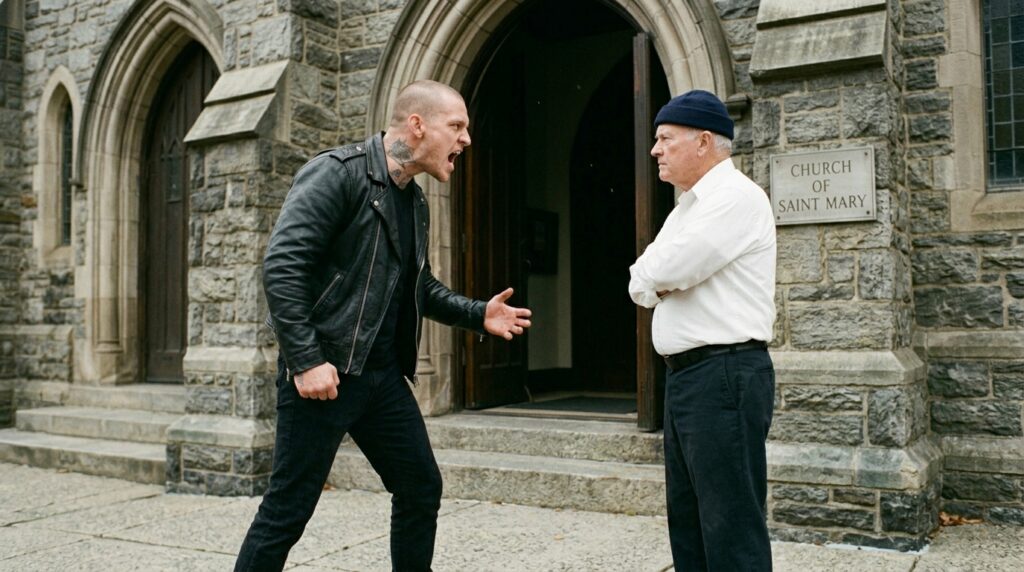
The Iron At The Threshold Where Quiet Men Keep The Gates

CHAPTER 1: THE WEIGHT OF STONE

“You think you can just walk away from this?”

The voice was a jagged rasp, scraping through the humid afternoon air like a rusted blade over concrete. Marcus didn’t wait for an answer. He planted his right boot—heavy, scuffed black leather—directly onto the center stone of the parish threshold. His shoulders squared, the cheap hide of his jacket creaking as he leaned his athletic frame forward, closing the space until the smell of stale tobacco and sour sweat crowded out the scent of old wax and incense drifting from the sanctuary. The dark ink of the tattoos trailing up his throat pulsed against his jaw line.

Thomas did not step back. His feet remained exactly where they had landed three seconds ago, spaced shoulder-width apart on the worn gray granite. Beneath the rim of his navy cap, his white hair caught the dull glare of the overcast sky. He felt the iron stiffness in his left knee, the familiar dull throb of a joint that had carried seventy-nine years of gravity and five decades of manual labor, but his spine remained straight. He kept his hands visible, loose, positioned right at his waist, fingers slightly curled but perfectly still.

“Back off now,” Thomas said. The words came from his chest, low and steady, a flat line of sound that lacked any theatrical heat. “You’re making a serious mistake.”

Marcus let out a short, dry bark of a laugh, his sneer deepening as he looked down at the older man’s crisp white dress shirt. To Marcus, the ironed fabric and the faded silver lettering on the cap were just the ornaments of a relic. He didn’t notice the slight shift in Thomas’s weight, the way the elder’s hips rotated a fraction of an inch to anchor himself against the stone.

“Then make me stop,” Marcus whispered. He lunged. His right hand shot out, fingers hooked like talons, reaching to bunch the collar of Thomas’s shirt and drag him down into the gravel courtyard.

The movement was fast, driven by young muscle, but it was predictable. Thomas didn’t track the hand; he watched Marcus’s center of mass, the telltale dip of the left shoulder that preceded the reach.

Before Marcus’s fingers could close on the fabric, Thomas’s left arm cleared the distance. It wasn’t a punch; it was a brutal, economic wedge. His forearm struck the inside of Marcus’s wrist, deflecting the momentum outward with a sharp smack of bone against leather. In the same micro-second, Thomas stepped inside the strike, his right hand gripping the meat of Marcus’s thumb, twisting it downward against the joint’s natural hinge.

The laws of physics took the young man’s weight and turned it into an anchor. Marcus’s face contorted as his balance vanished, his boots skidding across the grit. Thomas didn’t throw him; he simply guided Marcus’s lunging bulk past his own hip, using a single, tight pivot.

Marcus hit the stone steps hard, the side of his skull bouncing off the low wall with a heavy, hollow thud. His breath left him in a sharp wheeze. He rolled into the dirt at the base of the portal, his jacket scraping against the masonry, his fingers clutching his twisted wrist as he gasped for air.

Thomas stood unmoved at the top of the steps, his chest rising and falling in a rhythmic, unhurried cadence. He didn’t look down at the dirt. Instead, his eyes fixed on a small, heavy iron key that had slipped from Marcus’s open pocket during the fall, glinting against the gray gravel—a key stamped with the official seal of the city’s municipal housing authority.


CHAPTER 2: THE SEAL UPON THE DUST

The scrape of Marcus’s breath in the gravel was the only sound left in the courtyard. The heavy thud of his shoulder hitting the stone steps still hung in the cool air, a sudden, violent punctuation mark that had silenced the murmuring churchgoers. Nobody moved. The parish doors remained pinned open, the interior dark framing a dozen pale faces that had frozen in mid-stride. A woman near the back of the small crowd lowered her phone, her fingers trembling against the glass screen, the screen reflection glinting off the cold gray masonry.

Thomas didn’t let go of his grip until he felt the tension leave Marcus’s forearm—not a surrender, but the hollow deflation of a shock-induced stall. He uncurled his calloused fingers from the young man’s wrist, stepping back one measured pace to re-establish his center of gravity. His arthritic left knee throbbed under the sudden release of pressure, a deep, grinding ache that reminded him exactly how much each movement cost his flesh. He kept his breathing low, pulling air through his nose to muffle the strain in his lungs.

Down in the dirt, Marcus rolled onto his side, his black leather jacket coated in white stone dust. He didn’t rush to get up. He nursed his swollen wrist against his ribs, his shaved head twitching as he looked up through narrowed, red-rimmed eyes. The bravado had vanished from his jaw, replaced by the ugly, raw confusion of a predator that had broken its teeth on an old iron fence.

“You’re going to bleed for that, old man,” Marcus spat, though his voice lacked the heavy cadence from before. It was thin, cracked by the dust and the sudden impact against the wall.

Thomas didn’t answer. He didn’t give Marcus the leverage of an argument. Instead, his gaze remained fixed on the small, heavy iron key lying between Marcus’s boots. The gravel around it was damp with morning dew, the small metal teeth catching the gray light. Thomas reached down with slow, deliberate precision, his large hand moving without a tremor. His fingers closed over the cold iron, the rough texture of the metal scraping his thumb.

As he pulled it up, his thumbnail ran over the small, circular indentation stamped near the ring. It wasn’t a standard manufacturer’s mark. It was a crisp, three-pointed chevron encircling a small tower—the official embossed seal of the city’s municipal housing authority. It was a badge of bureaucratic access, the kind of key given to building inspectors or demolition foremen, not street-level agitators.

“Lose something?”

The new voice came from the foot of the church steps. Officer Vance had stepped through the iron perimeter gate, his heavy utility belt clicking with each slow stride. His dark blue uniform shirt was crisp, but his face carried the tired, desaturated look of a man who had spent twenty years watching the neighborhood rot from the inside out. He looked at Marcus in the dirt, then at the dust on Thomas’s sleeve. He didn’t draw his baton, but his hand rested comfortably on the heavy leather flap of his holster.

Marcus scrambled to his feet, his boots skidding through the loose stones as he retreated toward the sidewalk. He didn’t try to grab the key. He kept his eyes locked on Thomas, his chest heaving under the leather jacket. “He threw me,” Marcus said, pointing his good hand at the veteran, his finger shaking. “The crazy old bastard assaulted me.”

Vance didn’t look at Marcus. He kept his eyes on Thomas, his expression shifting from professional detachment to something heavier—a flicker of recognition that dated back to the old range lanes at the precinct before the retirement boards took over. Vance had seen Thomas handle a service weapon thirty years ago; he knew the shape of a controlled restraint when he saw one.

“Move along, Marcus,” Vance said, his voice flat, drained of any bureaucratic patience. “Before I find a reason to check the outstanding warrants on that van parked across the street.”

Marcus barks a short, ugly curse, his crew shifting uncomfortably behind him near the curb. They looked at each other, then back at Thomas, who still stood unblinking on the threshold, the iron key hidden inside his closed palm. With a final, jagged jerk of his chin, Marcus turned and walked away, his leather jacket swaying as he and his crew dissolved into the midday traffic hum.

The crowd of churchgoers began to thaw, their hushed whispers rising like dry leaves across the pavement. Thomas turned the key over in his pocket, his mind calculating the distance between Marcus’s extortion racket and the city housing office three miles downtown. The key didn’t belong in a street fight. It was a tool for clearing spaces from the inside out.

Thomas looked down at his shoes, noticing a dark smear of grease on the leather that hadn’t been there before—a mark left by the heel of Marcus’s boot during the struggle. He reached into his pocket to ensure his cracked pocket watch was still winding, the rhythmic metallic click reassuring him against the sudden quiet. But as his fingers brushed the iron key again, he realized the stamped seal wasn’t just old; the edges of the metal were fresh, shaved clean by a machine less than a week ago.

CHAPTER 3: THE DEFICIENCY TRAP

The rhythmic, aggressive thwack of steel driving into rotting wood echoed through the side alley of Thomas’s home before he even reached his porch gate. It was a precise, violent sound that didn’t belong in a quiet residential morning. Thomas paused, his fingers tightening against the iron handle of the gate, his thumb resting automatically over the freshly cut municipal key hidden deep within his pocket. His left knee let out a dry, clicking pop as he shifted his stance, the pain a familiar grinding friction that kept him tethered to the dirt.

A man in an orange utility vest stood on Thomas’s bottom step. He held a industrial staple gun against the weathered pine pillar supporting the porch roof. Flattened beneath the steel staples was a thick, high-visibility yellow placard. The man didn’t look up when the iron gate creaked open. He was young, his skin pale and unblemished by actual field labor, his movements carrying the distinct, cold efficiency of a bureaucrat who worked exclusively behind a desk or a shield.

“You’re wasting your staples,” Thomas said. His voice was low, carrying the flat, scraping texture of iron over dry earth. He closed the gate behind him with a controlled click of the latch.

The clerk turned, dropping the staple gun into a plastic tote bag resting by his boots. He adjusted a pair of plastic-rimmed safety glasses that looked completely pristine. “Thomas Vance? You’re the registered occupant. This property has been flagged under an emergency municipal code enforcement order. Structural deficiency. Threat to public safety.”

Thomas climbed the first step, forcing his weight through his right leg to keep his posture perfectly vertical, unyielding. He stopped three feet below the worker, but his height and the straight line of his shoulders eliminated the distance. “I replaced the crossbeams under this porch six months ago. Red oak. Hand-hewn. There isn’t a millimeter of rot in that foundation.”

The young man didn’t flinch, but his fingers twitched against the strap of his bag, a subtle calculation of risk passing through his eyes. He reached into his vest, pulling out a digital tablet with a cracked screen protector. “The report came from the District 4 Housing Office, sir. Signed off by a foreman this morning. It notes foundation settling and unpermitted structural alterations. You have seventy-two hours to secure a licensed corporate engineer’s certification, or the property faces an immediate condemnation notice.”

Thomas’s eyes didn’t look at the tablet. They fixed on the bottom of the yellow placard. Stamped into the thick paper was the exact same three-pointed chevron encircling a small tower that he had found on Marcus’s dropped iron key. The ink was still fresh, slightly smeared at the edges where the staple gun had struck the wood. It was the mark of the municipal housing authority, but the paperwork wasn’t dressed in the standard slow-rolling red tape of city management. This was an ambush wrapped in a filing system.

“Who logged the complaint?” Thomas asked. He kept his hands loose at his sides, his breathing perfectly regulated, a steady intake of the humid air that smelled of old wood dust and iron filings from the nearby rail yard.

“Anonymous community tip,” the clerk replied, his voice transactional, devoid of any personal malice or empathy. He stepped past Thomas, his boot scuffing the edge of the stone stair where a small pile of dry cedar shavings lay from Thomas’s morning maintenance. “The city doesn’t reveal source identities on safety liabilities. Have a good day, sir.”

Thomas didn’t turn to watch the orange vest disappear down the cracked concrete sidewalk. He stood on his porch, the shadow of the roof falling across his worn navy cap. He stepped toward the yellow tag, his rough fingers tracing the edge of the stiff paper. The wood beneath it was solid; when he struck the pillar with the knuckle of his index finger, the sound was dry, dense, and absolute. There was no rot here.

He walked inside the house, the floorboards groaning under his weight with a predictable, familiar friction. The interior smelled of linseed oil and old wool. On the kitchen table, a single copper lamp cast a desaturated circle of yellow light over a map of the neighborhood he had kept since his discharge forty years ago. The parish church sat exactly three blocks north; his house sat on the southern border, right where the old industrial rail lines began to decay into rust and overgrown weeds.

He reached into his pocket and pulled out the key he had taken from the dirt outside the church doors. He laid it flat on the map, right over the intersection of 4th and Elm. The fresh metallic tang of the cut iron hit his nose. Marcus wasn’t just a rogue street thug running a protection racket on small shopkeepers. A low-level enforcer didn’t carry keys to city-locked structures, and a low-level enforcer didn’t have the leverage to manifest an emergency code violation within two hours of a street fight.

Thomas pulled his pocket watch from his vest. He pressed the release, the silver lid clicking open to reveal the cracked glass face. The metallic tick inside was heavy, persistent, a tiny iron pulse counting down the seventy-two hours pinned to his front porch. He didn’t have time for a legal defense; the bureaucratic machinery was moving with the velocity of a closing jaw.

He reached into the kitchen drawer, pulling out a heavy, canvas-wrapped bundle he hadn’t touched since the precinct retirement ceremony. He unrolled the fabric on the table, the scent of gun oil and old leather immediately cutting through the dry air of the kitchen. Inside lay a single brass-handled inspection mirror and a small logbook containing the personal radio frequencies of every active duty cruiser in District 4—Vance’s old network.

His phone on the counter buzzed once, a short, sharp vibration against the laminate wood. It was an unlisted text message from an automated system. No words, just a file attachment showing a scanned property deed boundary map centered directly on the church courtyard, with a thick red line slashing straight through the altar room.

CHAPTER 4: THE DINER CONVERGENCE

The Formica tabletop rattled against its iron base as two hundred pounds of dense muscle dropped into the booth directly across from Thomas. The scent of hot lard and burnt coffee from the diner’s kitchen was instantly overridden by the smell of rain-soaked leather and damp wool. Thomas didn’t jump. He kept his large, weathered hands wrapped around his heavy ceramic mug, the black coffee inside barely rippling as he looked across the grease-stained surface.

It wasn’t Marcus. It was an older man, late fifties, with a face like pitted iron and a thick scar bisecting his left eyebrow. He wore a dark, oil-stained mechanic’s jacket with no name patch, but his posture was strictly military—shoulders set tight, chest pinned forward against the edge of the booth. Behind him, standing near the entry door where the glass was patterned with grease and old condensation, Marcus stood with his arm cradled in a stiff cloth sling, his eyes drilling holes into the back of Thomas’s navy cap.

“You have a heavy hand for an old man,” the man with the scar said. His voice was a flat, low rumble that barely carried past the edge of the table, calculated to stay beneath the rattle of the old refrigerator case humming by the counter.

“The hand was as heavy as the threat required,” Thomas replied. He took a slow, deliberate sip of the bitter coffee, his arthritic knuckles clicking against the ceramic handle. He didn’t look back toward Marcus. He kept his eyes locked on the driver opposite him, analyzing the subtle micro-movements of the man’s jaw and the worn calluses on his index fingers. Range calluses. “Who are you?”

“The guy who pays Marcus to keep this block clear,” the man said. He reached into his coat pocket with his left hand, his movements smooth, completely devoid of street-level hesitation. He dropped a thick, leather-bound notebook onto the Formica. The cover was split along the spine, revealing the gray cardboard beneath, its edges rusted and stained with machine grease. “And the guy who’s telling you that your porch isn’t the only thing that’s going to get flagged by the housing authority if you keep standing on that church step.”

Thomas looked down at the notebook. The corner of a folded document protruded from the ledger pages—a green bank deposit receipt with an official corporate stamp from Vanguard Property Holdings LLC. Written in thick black ink across the top of the ledger page was a list of weekly financial payouts, each line matching a name of a small merchant on 4th Street. Next to Marcus’s name was a dollar figure that didn’t belong to a simple neighborhood protection racket. It was a corporate retention fee.

“You’re running a clearing operation,” Thomas said, his mind assembling the layout of the block, calculating the trajectory of the yellow tags. “Marcus provides the pressure, the city provides the paperwork, and Vanguard buys the carcass.”

The man with the scar smiled, a cold, short movement of his lips that didn’t reach his eyes. “It’s just civic maintenance, Vance. The neighborhood is dead. The rails are iron scrap. The parish is just four stone walls keeping a prime commercial zone from generating tax revenue. Vanguard is funded by people who don’t like empty spaces. They have a legal right to clear the lane.”

“A legal right doesn’t use stolen housing authority keys,” Thomas murmured, his hand dropping into his coat pocket where his fingers brushed against the cool iron teeth of the key he had taken from the dirt. He felt the heavy, metallic ticking of his pocket watch against his ribs, a steady countdown that seemed to narrow the walls of the narrow booth. “And it doesn’t fabricate structural rot on a house that’s stood for eighty years.”

“The city says it’s rotten, so it’s rotten,” the man replied. He leaned closer, his grease-stained collar rubbing against his throat. “Marcus was an amateur. He thought he could rattle your cage because you look like a ghost from the VA hall. I don’t make mistakes like that. I know exactly who you were at the precinct before the pension board cut you loose. But that was thirty years ago, Thomas. Your joints are dry. Your friends are buried or collecting disability. You can’t hold a perimeter by yourself.”

“I’ve held narrower gates,” Thomas said.

He didn’t wait for a counter-argument. Thomas slid his coffee mug to the side with a sharp click of ceramic on laminate. His right hand shot across the table, his fingers latching onto the edge of the leather-bound notebook before the man with the scar could react. The driver’s left hand instantly came down to pin the book, but Thomas didn’t pull back. Instead, he applied a short, downward leverage technique against the driver’s knuckles, his thumb driving into the soft tissue between the bones.

The man’s breath caught in his throat, his shoulders locking as the sudden physical pain paralyzed his arm. He didn’t scream—discipline kept his mouth shut—but his face turned a dark, desaturated gray as his knuckles turned white against the Formica.

Thomas pulled the notebook toward his side of the booth with an economic, sweeping motion, slipping it down into his wide canvas coat pocket before releasing the grip. He slid out of the booth, his left knee screaming under the sudden rotation, but his posture remained upright, rigid as a stone pillar.

Marcus stepped forward from the door, his good hand reaching under his jacket, but the man with the scar raised his left hand, shaking his head once as he massaged his numbed fingers. “Let him go,” the driver rasped, his voice strained by the lingering pain. “He wants the book. Let him read it. It won’t change the timeline.”

Thomas walked past Marcus without breaking his stride, his black boots striking the linoleum floor with a heavy, unhurried rhythm. The diner’s bell chimed over the door as he stepped out into the damp afternoon air, the cold wind immediately biting through his shirt. He pulled the notebook from his pocket as he walked toward the old rail yard lane, his thumb flicking open the first page.

It wasn’t just a corporate ledger. Tucked beneath the first Vanguard receipt was a carbon copy of a confidential city zoning application, dated three days ago. The signatory at the bottom wasn’t a corporate executive from Vanguard. It was the personal ink signature of Councilman Donald Harris—the head of the District 4 public safety committee, the exact man who oversaw Officer Vance’s old precinct.

CHAPTER 5: THE COLD IRON RUN

The rusted iron latch of the line-side equipment shed didn’t drop with a click; it hit the bracket with a flat, industrial slam that vibrated through the floorboards beneath Thomas’s boots. The dim light filtering through the grime-crusted transom window was instantly cut in half. Outside, the rain had turned the gravel slag between the ties into a slick, dark mire, the smell of old creosote and sulfur dioxide rising from the dormant tracks like stagnant pond water.

Thomas didn’t rush the door. He kept his spine straight, his right shoulder resting against the rough-sawn pine frame of an old utility workbench. Inside his heavy coat pocket, his fingers remained steady against the canvas-wrapped inspection log, his pocket watch clicking with a rhythmic, unhurried iron stroke against his ribs. His left knee burned from the three-block march along the switching line, a deep, persistent ache that told him exactly how little leverage he would have if forced into a dead sprint across the yard.

“You should have left the book in the booth, Vance,” a voice called out through the rafters. It came from the shadows behind the dormant diesel generator, dry and flat, carrying the cold authority of a man who didn’t need to shout to be obeyed.

The man with the scar stepped into the narrow corridor between the storage crates. He wasn’t carrying a weapon, but his right hand was dipped into the pocket of his greasy mechanic’s jacket, the fabric pulled taut against a heavy, metallic silhouette. Behind him, two younger men from Marcus’s crew flanked the narrow exit lane, their black leather jackets slick with gray rainwater, their knuckles white against short lengths of iron plumbing pipe.

“The book belongs to the neighborhood,” Thomas said, his voice flat, cutting through the damp chill of the shed like a crosscut saw through dry oak. “And the signature at the bottom of the Vanguard deed belongs to Councilman Harris. He’s using your crew to depress the property values before the municipal safety committee moves on the parish land.”

The driver stepped closer, his boots crunching over iron filings and dry rot wood. The scar over his left eyebrow twitched under the pale yellow light of a single hanging bulb. “You always were a good investigator, Thomas. Too good for a precinct that ran on cash and favors. You think you found the bottom of the hole? You think Harris is just buying a few cheap storefronts for a corporate markup?”

“He’s clearing a path for a logistics terminal,” Thomas muttered, his mind checking the grid, matching the red lines on the text attachment to the old industrial switches outside the door. “The church sits right over the junction lane. If the parish surrenders the title, the city gets the federal infrastructure grant without an environmental delay.”

The man with the scar let out a short, guttural laugh that ended in a dry cough. “Vanguard isn’t a corporation, Vance. It’s a holding container. Harris doesn’t own it. The whole precinct council does. They’ve been buying the debt on these blocks since the old mills shut down thirty years ago. They don’t want the storefronts. They want the eminent domain declaration. If the neighborhood is declared an active safety liability, the city seizes every parcel for ten cents on the dollar.”

Thomas’s hand tightened within his pocket, his thumbnail digging into the fresh metal teeth of the housing authority key. The decoy secret had broken cleanly, but the reality behind it was heavier than a simple corporate payout. It was an institutional maw, a system that used its own code enforcement officers and street thugs to engineer the very decay they claimed to regulate.

“You’re not going to make it back to the parish with that ledger,” the driver said, his shoulder dropping as he braced his weight to close the gap. “Harris already signed the emergency enforcement warrant for your house. The trucks are moving toward Elm Street right now. Give me the book, Thomas. Go sit in your kitchen and let the city write the check.”

“The check is an insult,” Thomas said.

He didn’t wait for the driver to execute his reach. Thomas stepped backward, his heel striking the base of the old utility workbench. With a sharp, explosive lift of his right arm, he drove his palm upward into the bottom of a heavy iron vise bolted to the rotten pine. The rusted wood groaned, then sheared completely through under the levered force, sending eighty pounds of cast iron crashing into the concrete floor directly in front of the driver’s boots.

The concrete cracked with a sharp, gun-like report, spraying gray dust and stone chips into the air. The driver lunged backward to protect his shins, his balance breaking against a pile of old rail ties.

Before Marcus’s crew could clear the dust, Thomas turned toward the rear of the shed. His left leg screamed as he threw his full weight into a short, heavy iron pry-bar resting against the window frame. He drove the steel wedge into the padlock of the narrow tool-escape hatch—a lock stamped with the same municipal serial number he had tracked since the church steps. The rusted shackle gave way with a dry, metallic snap.

Thomas dropped through the low opening into the driving rain, his boots sinking into the wet slag of the yard. The cold wind slammed into his face, carrying the scent of iron rust and wet coal dust. He didn’t look back to see if the leather jackets were through the hatch. He pressed his hand against the ledger in his coat, his eyes fixed on the distant stone tower of the church rising through the desaturated gray dusk. The perimeter was collapsing, and the city wasn’t waiting for the seventy-two hours to expire.

CHAPTER 6: THE EMINENT SHADOW

“Sign the emergency title transfer, Father, or the bulldozers won’t bother waiting for Monday.”

The voice belonged to an assistant city attorney named Miller—a man whose expensive wool overcoat looked entirely out of place against the faded oak paneling of the parish rectory. He stood leaning over the heavy pine table, his hand flat against a thick manila folder. Outside, the downpour lashed against the stained-glass windows, making the lead frames rattle with a low, tinny vibration. The air in the room was dense with the scent of old tallow candles, damp wool, and the bitter trace of burnt kerosene from an old space heater humming in the corner.

Thomas stepped across the threshold, his heavy boots trailing wet slag and mud onto the frayed rug. He didn’t drop his stance. His navy cap was pulled low, water dripping from the brim onto his stiff white collar. His left knee ground with every increment of weight he shifted, a deep, hot ache that ran down into his shin bone. He kept his right hand inside his wide coat pocket, his fingers firmly wrapped around the grease-stained ledger he had taken from the rail yard shed.

“He isn’t signing anything,” Thomas said. The flat line of his voice cut through the bureaucrat’s administrative bluster like an iron wedge.

Miller turned, his mouth tightening into a thin line as he looked at Thomas’s rain-slicked clothes. “Vance. You’re the occupant of the condemned parcel down on Elm. You have no legal standing in this rectory. Officer Vance’s precinct connections ended thirty years ago. If you interfere with a municipal emergency safety decree, I’ll have Vance’s active-duty replacement clear you off the steps.”

“The safety decree is a manufactured lie,” Thomas said, taking two deliberate steps into the room. The pine floorboards groaned under his weight with a dense, predictable friction. He reached into his pocket and dropped the leather-bound notebook flat onto the manila folder. The wet pages peeled open, revealing the green Vanguard property receipts and the handwritten payouts lined up next to Councilman Harris’s signature. “And this ledger details exactly how much Vanguard paid Marcus’s crew to clear the blocks before the city council votes on the eminent domain declaration.”

The parish priest, an elderly man named Father Joseph whose hands shook with a permanent tremor, leaned forward to look at the ledger. His eyes widened as he tracked the dates. “Thomas… these entries match the exact weeks the windows were broken in the chapel. The exact day the delivery van was torched in the alley.”

Miller didn’t reach for the notebook. He didn’t deny the names. He simply squared his shoulders, his jaw resetting into a cold, transactional expression that mirrored the driver from the diner. “It doesn’t matter what Marcus wrote in a pocketbook, Vance. The public safety committee already passed the resolution. The structural code violation on this church is locked into the city record. Under the Emergency Infrastructure Act of 1994, a condemned public safety hazard can be seized under eminent domain without an appeal period if the city council declares a municipal emergency.”

“Harris doesn’t have the authority to declare an emergency by himself,” Thomas muttered, his mind checking the legal perimeter he had studied during his years at the precinct. “He needs a majority signature from the District 4 council board.”

“He has the signatures,” Miller whispered, a faint, ugly smirk touching the corner of his mouth. He drew a second document from his brief-case and laid it next to the ledger. The paper was crisp, stamped at the bottom with a series of blue ink seals—the three-pointed chevron encircling a small tower. “The board signed off on the eminent domain seizure an hour ago. The city council didn’t buy the debt on these properties to flip them to a commercial developer, Thomas. They used Vanguard to depress the value so the city could claim the federal infrastructure grant for the logistics hub under municipal ownership. The entire precinct council is the developer.”

Thomas looked at the signatures. It wasn’t just Harris. Every name on the District 4 public safety board was inked in a row, a solid block of municipal authority that had systematically turned the code enforcement system into a weapon for real estate theft. The decoy secret had shattered completely—Vanguard wasn’t an external enemy trying to buy out the block. The enemy was the city’s own administrative structure, utilizing its local street gang to break the neighborhood’s spine from the inside out while the legal department prepared the shroud.

“You’re too late, old man,” Miller said, leaning back and pulling his leather gloves onto his hands. “The code enforcement trucks are already at the end of Elm Street. If the parish doesn’t sign the voluntary title transfer now, the police department will establish a hard perimeter around the church gates by six o’clock tonight. You’re holding a dead line.”

Thomas reached into his vest pocket, his fingers finding his silver pocket watch. He clicked the lid open, the heavy metallic tick within the casing filling the brief silence between the sheets of rain. He had less than forty minutes before the evening shift at the precinct changed, less than forty minutes before a dozen patrol cars under Harris’s command closed the parish road permanently. He didn’t look at Miller. He looked at Father Joseph, whose frail shoulders had sunk beneath the weight of the legal folder.

“Keep your doors locked, Father,” Thomas said, his voice flat, devoid of fear or hesitation. He picked up the leather notebook and turned toward the rain-slicked threshold. “Nobody signs anything. I’m resetting the perimeter at the gate.”

CHAPTER 7: THE FINAL GATE

“This is a closed perimeter, Vance. Step away from the latch.”

The warning came through a vehicle loudspeaker, distorted by the downpour and the low, heavy idle of three diesel trucks parked across Elm Street. The flashing amber bars on the cabs painted the wet asphalt in rhythmic, desaturated slashes of orange light. Behind the lead truck, a half-dozen figures stood in matching municipal worker coats, their hands resting on industrial pry-bars and hydraulic shears. Beside them, his leather jacket dark with water, Marcus stood next to the man with the scar.

Thomas stood directly inside the iron gates of the parish courtyard, his boots planted on the wet stone where he had broken Marcus’s grip six chapters ago. His white hair was plastered against his forehead, water streaming down the deep creases of his cheeks. His left knee had gone completely cold, a locked, iron weight that refused to register pain anymore—only a absolute stiffness that anchored him to the threshold. He kept his left hand on the cold iron vertical bar of the gate; his right hand held the canvas-wrapped ledger open against his hip.

Behind him, the heavy oak doors of the church creaked open. It wasn’t the police department. It wasn’t an official legal rescue. Father Joseph stepped onto the steps, flanked by twenty residents from the surrounding blocks—the old shopkeepers from 4th Street, the retired rail workers, the people whose names had been meticulously lined up in Marcus’s weekly payout books. They didn’t carry weapons or tools; they simply stood on the stone stairs, their faces pale but steady under the amber glare of the city trucks.

Councilman Harris stepped out from the passenger side of the lead truck. He didn’t wear a uniform; he wore a tailored trench coat that grew dark under the driving rain. He walked up to the iron perimeter fence, his leather shoes splashing through the mud until he stood two feet from Thomas, separated only by the rusted vertical bars.

“You’re holding an illegal assembly on a condemned safety hazard, Thomas,” Harris said, his voice carrying the flat, institutional authority of a man who owned the codes and the courts. “The precinct council has signed the emergency eminent domain warrant. The property belongs to the city logistics authority as of five o’clock. Move the people back, or Vance’s pension won’t be the only thing the board reviews on Monday.”

Thomas didn’t open the latch. He raised his right hand, pressing the grease-stained ledger against the rusted iron bar right at Harris’s eye level. The rain-soaked pages were turning translucent, but the black ink of Harris’s signature remained crisp under the amber strobe light.

“The board won’t be reviewing anything, Donald,” Thomas said. His voice was a low, mechanical growl that stayed beneath the drone of the engines, but it carried the absolute weight of forty years on the street. “The state attorney’s office received a digital copy of this ledger twenty minutes ago. Along with the carbon applications Miller left in the rectory. They didn’t just go to the clerk; they went to the internal investigations bureau at the central precinct.”

Harris didn’t look at the paper. He didn’t flinch. “The internal bureau is run by my committee, Vance. You think you’re the first retired detective to bring a notebook to a captain’s desk? The city needs this terminal. The council signed the papers. A few broken windows on an old parish don’t change the civic necessity.”

“The city council didn’t sign a civic necessity,” Thomas murmured, his hand tightening around the iron bar until his knuckles turned the color of bone. “They signed a private real estate holding that uses their own names on the Vanguard LLC articles of incorporation. You didn’t condemn these houses to build a road, Donald. You condemned them to liquidate the neighborhood’s equity into your own retirement accounts.”

The silence that followed didn’t come from the rain. It came from the sidewalk. Officer Vance had stopped his cruiser fifty feet back, his roof lights silent, his driver-side door pinned open against the wind. He didn’t step out with his baton drawn. He stood behind the frame of the door, his personal radio mic held to his lips, his eyes locked on the councilman. Behind him, two more district cruisers pulled onto the curb, their tires grinding through the gravel slag, their engines dropping into a silent, expectant idle.

The workers in the orange vests began to step back toward the beds of the trucks, their hands dropping away from the pry-bars. They were city employees; they worked for a wage, not a criminal conspiracy, and the sight of three active-duty cruisers blocking their own escape lane was a calculation that didn’t fit their job descriptions.

Marcus looked at the man with the scar, his jaw twitching as he took a step toward the alley, but Vance’s cruiser door finally swung shut. The officer stepped onto the pavement, his leather belt clicking as he walked toward the gate, his hand resting on his sidearm with a slow, deliberate movement that mirrored Thomas’s old tactical rhythm.

“Councilman,” Vance said, his voice flat, cutting through the rain with the standard procedural cadence of an arrest warrant. “We have an order from the county magistrate’s office to hold the execution of the eminent domain decree pending a structural review by an independent state engineer. You and Mr. Miller need to come down to the administrative complex to verify the signatures on the Vanguard filing.”

Harris turned, his face shifting into a pale, desaturated mask under the amber lights. He looked at Vance, then back at Thomas, who still stood unblinking inside the gate, his navy cap channeling the rainwater onto the granite threshold. The system hadn’t broken from the outside; it had jammed because an old operator had jammed his own body into the gears.

“This line doesn’t move, Donald,” Thomas said softly.

He pulled his pocket watch from his vest one final time. He pressed the release, the silver lid clicking open to show the cracked glass face exactly at six o’clock. The metallic tick inside was steady, unhurried, a small iron pulse that had outlasted the mill, the rail yard, and the men who had tried to clear the block.

Thomas turned his back on the street, his boots striking the wet stone steps as he walked toward the parish doors. The churchgoers opened the lane for him, their hands reaching out to touch his rain-soaked sleeve in absolute silence. He didn’t look down at his hands, and he didn’t check the street behind him. The gates were closed, the threshold was intact, and the quiet men were still keeping the walls.

Similar Posts

Leave a Reply

Your email address will not be published. Required fields are marked *





