
The Weight of the Iron Line: A Novel of Modern Tactical Discipline

CHAPTER 1: THE CHURN OF THE LINE

The air inside the mess hall tasted of boiled starch, floor bleach, and the sharp, sour sweat of two hundred men who had spent six hours drilling on dry clay. High overhead, the industrial exhaust fans groaned against the midday heat, shifting the heavy humidity without cooling it. Miller didn’t look at the fans. He kept his eyes locked on the space three inches above the bridge of the old man’s nose, his own jaw set into a hard, rigid line that felt brittle under the glare of the fluorescent tubes.

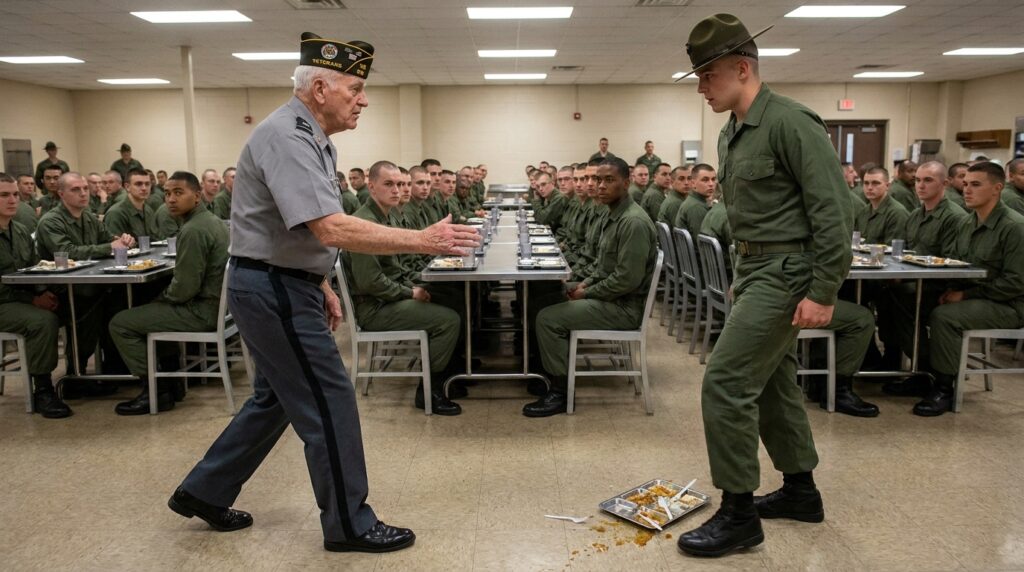
At his feet, the green laminate cafeteria tray lay askew on the red tile floor. A half-eaten block of meatloaf and a puddle of greasy gravy were already congealing against the grout. It was a calculated mess.

“You’re blocking the egress, Instructor,” Miller said. His voice was too loud for the sudden silence that had eaten the room. Behind him, row after row of recruits from Third Platoon sat frozen, forks hovering halfway to their mouths, their eyes darting between the clean, pressed gray wool of the old man’s uniform and the heavy, grease-splattered boots Miller wore.

The Instructor didn’t move. He stood seventy-eight years deep into the earth, his spine an iron rod that looked as though it had been driven into the academy foundations decades ago. The brass crest on his service cap was worn dull at the edges, the eagle’s wings rubbed smooth by forty years of polishing cloths. A thin film of dust from the parade ground settled into the deep, weathered valleys of his cheeks, but his hands—thick-knuckled and stained with the yellow shadow of old motor oil—hung loose and dead still at his sides.

“The tray belongs in the rack, Recruit,” the old man said. The cadence was low, dry as autumn leaves scraping across tarmac. “The protocol isn’t a suggestion. It’s the line.”

“The line is for people who have time to waste on garbage,” Miller muttered. He took a half-step forward, letting his broader shoulders square against the old man’s narrow frame. He was twenty-two, his blood full of the easy strength that comes from running five miles in the morning just to feel the burn. He could see the faint tremor in the Instructor’s left eyelid—the unmistakable, rhythmic twitch of old nerve damage. “Get out of my way, sir.”

Miller didn’t wait for an answer. He leaned his weight into his right heel, intending to brush past the gray shoulder, a heavy, physical dismissal meant to show the whole room that the old guard was nothing but cardboard and memories.

The shift was too fast for the eye to track. There was no lunging preparation, no cinematic wind-up. The air didn’t break; it simply displaced.

The heel of the Instructor’s palm took Miller squarely in the center of his sternum. It wasn’t a punch; it was a solid, percussive thud that drove the oxygen out of Miller’s lungs in a short, ragged whistle. Simultaneously, the old man’s right boot clipped the inside of Miller’s lead ankle with the precise, heavy click of an iron latch slipping into place.

The world tilted. The friction of the floor disappeared. Miller’s weight was turned against him, his momentum converted into a sudden, violent downward arc. His shoulder slammed into the edge of the laminate table with a dull crack, the impact rattling the metal legs against the tile. He hit the floor hard, his campaign hat spinning away into the gravy.

The room stayed dead. Nobody breathed.

Miller lay there for three seconds, his ribs screaming as his lungs fought to expand against the bruise already forming beneath his green shirt. His hand went to his midsection, his fingers trembling against the coarse cloth. When he looked up, the old man hadn’t shifted his feet an inch. He was still holding the lane, his gray uniform unwrinkled, looking down through eyes that were completely empty of anger.

Between them, on the front of the old man’s uniform, the lowest silver button was missing—replaced by a single loop of rough copper wire that held the wool together.

“Don’t ever do that again, kid,” the Instructor said.

CHAPTER 2: THE SOUND OF MOVING IRON

The floor tiles were cold beneath Miller’s palms, a greasy, institutional chill that bit through the grit covering his skin. His breath came in ragged, shallow gasps, each inhale dragging the smell of burnt salisbury steak and industrial floor sealant deep into his bruised lungs. The ringing in his ears was loud, a high, metallic whine that competed with the sudden, unnatural silence of the mess hall.

Above him, the Instructor didn’t move. The old man’s boots—scuffed black leather with salt rings near the welt—remained planted exactly where they had been when Miller’s balance was broken. The single loop of rough copper wire on the Instructor’s lower jacket caught the harsh overhead fluorescent light, a dull orange glint against the faded gray wool. It was a crude repair, out of place on a uniform that was otherwise kept with razor-sharp discipline.

“Get up, Recruit,” the old man said. The voice wasn’t raised. It didn’t need to be. The quiet carried across the rows of laminate tables, cutting through the paralysis of the watching platoon.

Miller swallowed the copper taste of panic. His fingers clawed at the grout lines as he forced his knees under his chest. Every muscle along his ribs protested, a deep, dull ache where the heel of the old man’s palm had met his sternum. He hadn’t just been hit; he had been stopped by a wall of absolute, immovable geometry. He reached out, his hand wrapping around the greasy edge of the table to hoist himself up. His campaign hat lay three feet away, the brim soaking up the dark brown congealing puddle of gravy from the abandoned tray.

Behind the Instructor, the heavy double doors of the mess hall swung open with a sharp, hydraulic hiss. The rhythmic click of polished low-quarters broke the stillness.

Captain Vance stepped into the room, his olive-drab utility uniform immaculate, his starched collar stiff enough to cut glass. His eyes, small and dark like flint, swept the room, instantly registering the overturned tray, the splattered meatloaf, and Miller’s trembling, hatless posture.

“Detail, attention,” Vance barked.

The room erupted into the chaotic, synchronized scrape of two hundred steel-legged chairs clearing the floor. Recruits scrambled into rigid alignments, chins tucked, eyes locked straight ahead into the empty air. Miller forced his heels together, his spine straightening with a jerk that sent a sharp spike of heat through his bruised ribcage. He didn’t dare look at the Instructor, but he could feel the old man’s proximity—a cold, heavy presence that smelled of old wool and gun oil.

Vance walked down the center aisle, his boots striking the tile with deliberate, measured spacing. He stopped two paces from the Instructor, his gaze dropping to the floor, then rising to fix on the veteran’s dull brass cap pin.

“Instructor Vance,” the Captain said, his voice dropping into a tightly controlled lower register. “Is there a breakdown in protocol here?”

The name sent a small, sharp jolt through Miller’s chest. Vance. He hadn’t connected the old man’s last name to the Captain’s before; the academy roster simply listed the senior staff as ‘Instructor Cadre.’ They didn’t look alike—the Captain was lean and wire-drawn, his skin smooth and pale under his cap, while the old man was a block of weathered granite—but the coldness in their eyes was an identical, functional trait.

“The recruit dropped his equipment, Captain,” the Instructor said. He hadn’t turned his head to face the younger officer. His eyes remained fixed on the far wall, tracking nothing. “He was in the process of recovering it.”

“He’s out of uniform,” Captain Vance noted, his eyes shifting to Miller’s gravy-soaked campaign hat on the floor. “And he appears to have forgotten how to clear his lungs.”

“The air in here is heavy today, sir,” Miller said, the words slipping out before his training could check his tongue.

The Captain’s gaze snapped to Miller, freezing him in place. “Did I give you leave to speak, Recruit? You’re Miller, aren’t you? Third Platoon. Your file says you have fast feet. It doesn’t say anything about a loose jaw.” Vance stepped closer, the sharp tang of his expensive aftershave cutting through the smell of cafeteria grease. “Take your hat. Clear this deck. Then report to the administrative annex, Block C. Both of you.”

The Captain didn’t wait for an acknowledgment. He turned on his heel and walked out, the hydraulic doors catching his shadow before closing with another heavy sigh.

The mess hall didn’t return to life. The recruits remained locked at attention, their eyes strained, waiting for the old man’s next move.

The Instructor turned slowly. His joints didn’t make a sound, but his movements had the heavy, unhurried cadence of an old machine that required immense force to start and even more to stop. He looked at Miller, his eyes dropping briefly to the copper wire loop on his own jacket, his thick fingers brushing against it as if checking a latch.

“You heard the Captain, kid,” the old man said quietly. “Pick up your gear.”

Miller bent down, his fingers wet with grease as he retrieved the ruined campaign hat. The wool was heavy, soaked through with the brown sludge of the academy’s lowest-tier meal. His heart was still hammering against his ribs like a trapped bird, but the initial shock was hardening into something else—a sharp, burning curiosity. The old man hadn’t reported the assault. He hadn’t even mentioned the push. He had covered it up with a flat lie about dropped equipment.

As Miller stood up, shaking the excess gravy from the brim, his eyes caught a detail he had missed in the fray. On the underside of the Instructor’s right wrist, visible only when the gray sleeve pulled back against the skin, was a small, blue tattoo—three numbers, nearly faded into the graying hair of his forearm: 402.

It wasn’t a standard unit tattoo. It looked like a brand.

The Instructor turned toward the exit, his boots making a dry, rhythmic sound against the tile as he led the way out of the crowded hall. Miller followed a half-step behind, his boots heavy, his eyes locked onto the old man’s back, knowing that the real weight of the iron line wasn’t on the floor they had just left behind, but in the dark administrative corridors ahead.

CHAPTER 3: THE COLD LIGHT OF CLINIC G

The corridor of Block C smelled of damp concrete and the low, flat hum of oxidized iron radiator pipes that hadn’t been cleared since the previous winter. Flakes of old green primer paint hung from the doorframes like dead skin, curling under the weight of the humidity. Miller kept his boots tracking exactly three feet behind the Instructor’s measured stride. Every time his left foot struck the concrete, his bruised sternum throbbed, a dull reminder of the old man’s palm.

They stopped before a heavy steel door marked Clinic G: Evaluative Services. The Instructor reached out, his thick, scarred fingers turning the tarnished brass handle with a slow, deliberate twist. The door groaned on its hinges, a high-pitched dry scream of metal against metal that set Miller’s teeth on edge.

Inside, the light was even harsher than the mess hall—a stark, desaturated white that exposed the yellowing laminate of the desk and the gray hair of the medical technician sitting behind it. The technician, a tired-looking man named Hauer with a faded blue lanyard around his neck, didn’t look up from his clipboard.

“Stripping down to the waist, Instructor,” Hauer said, his voice flat, exhausted by decades of routine. “Captain’s office called ahead. Urgent post-incident assessment. You know the drill.”

The old man didn’t answer. He raised his hands, unpinning his veteran’s cap with smooth, mechanical efficiency, placing it down on the rusted edge of an instrument cart. Then, his thick fingers moved to the gray wool tunic. One by one, the silver buttons slid through their stiff buttonholes until he reached the bottom. His fingers paused on the loop of rough copper wire. With a small, practiced tug, he unhooked the wire from the lower hem.

As the wool parted, Miller caught his breath, his eyes widening as he stood by the door.

The Instructor’s torso wasn’t just old; it was an archaeological map of violence. The skin was the color of old parchment, stretched tight over a ribcage that looked like a welded cage of iron reinforcement bars. Across his collarbone ran a jagged, silver-white ridge—the unmistakable furrow of a high-velocity fragment wound that had torn through muscle and healed poorly. Below his left rib, a circular, puckered indentation sat like a crater in dry earth. But it was his back that made Miller step closer, forgetting the pain in his own chest.

Two thick, parallel tracks of purple scar tissue ran from his shoulder blades down to his lumbar spine, deep enough that the muscle tissue around them had hardened into dense, protective knots. It looked like he had been caught in a heavy industrial vice, or pinned beneath the iron chassis of a collapsing vehicle.

“Sit,” Hauer said, finally looking up as he reached for a blood pressure cuff. The tech’s eyes caught Miller standing by the door. “Recruit, pick up that intake jacket from the bin. The purple folder on the lower shelf. Don’t just stand there airing your teeth.”

Miller moved his boots across the linoleum, his hand dropping to the lower wire shelf of the desk. He pulled the thick, manila folder toward himself. As he did, his thumb brushed against the top corner of the paper. There, stamped in a faded, dark purple ink that had bled into the cardboard over twenty years, was a symbol: an inverted triangle enclosing three small, perfectly aligned drill holes.

The stamp had no words, no classification markers, and no department name. It looked ancient, an institutional ghost hidden in plain sight. Miller’s thumb lingered on the ink, noting how the texture of the paper beneath the stamp was slightly warped, as if it had been exposed to moisture or chemical wash before being filed away in the damp archives of Block C.

“Pulse is forty-eight,” Hauer muttered, his fingers pressed against the Instructor’s thick wrist, right over the faded 402 tattoo. The tech didn’t sound surprised; he sounded like a mechanic reading the idle speed of an engine that refused to die. “A bit high for you, isn’t it, Vance?”

“The meatloaf was greasy,” the old man said, his chest rising and falling in a slow, unbothered rhythm. He didn’t look at the file in Miller’s hand, but his head turned slightly, his gaze tracking the reflection of the room in the dark, scratched glass of the medicine cabinet.

“Captain Vance wants a full structural clearance,” Hauer said, pulling the velcro cuff from the old man’s arm with a loud, tearing rip. “He asked specifically if the joints are showing signs of structural fatigue. He’s looking for a reason to transition you to an off-site retirement cadre, Vance. You know how the budget works these days. They don’t like paying for iron that doesn’t bend.”

The Instructor stood up, his spine snapping back into its rigid, vertical alignment with a small, audible click from his lower lumbar. He didn’t look like a man who had just been threatened with administrative erasure. He reached for his gray wool tunic, his fingers immediately finding the rough copper wire at the hem, twisting it back into place with a single, unhurried motion that excluded the rest of the room entirely.

“The Captain can look all he wants, Hauer,” the old man said, his voice dropping into that dry, cold register that sounded like iron scraping over gravel. “But he doesn’t own the foundry.”

He turned his head then, his pale gray eyes locking onto Miller’s face, catching the recruit before he could hide the purple stamped folder behind his hip. The silence in the clinic grew heavy, thick with the smell of old iodine and the sharp, chemical reality that whatever line Miller had crossed in the mess hall, it was only the beginning of a very long, very dark road.

“Give the man his folder, kid,” the old man directed quietly. “Then we go see the Captain.”

CHAPTER 4: THE FRICTION OF THE FIRST WATCH

“The boy doesn’t belong on the perimeter line, Vance. He’s a liability with a bruised rib and an unstable center.” Captain Vance didn’t look up from his desk as the heavy steel door of the office ground shut behind them. He was using a dry white stone to dress the edge of a carbon-steel pocket knife, the steady scritch-scritch of metal against abrasive rock filling the narrow room.

“The perimeter is where the grease gets worked out of the joints,” the Instructor replied. His voice was level, matching the rhythmic scrape of the stone. He didn’t ask permission to stand; he simply occupied the center of the office like an anvil that had outlasted three generations of workshop owners.

The Captain paused his hand, the blade catching a dull silver beam from the high, barred window. “This isn’t the old field installation. The administration wants clean records, not broken recruits who look like they were dragged through an ore crusher. If he collapses out on the north ditch, his platoon commander will flag it.”

“He won’t collapse,” the old man said flatly. “He’ll stay upright because the ground out there is too hard to sleep on.”

Miller stood three inches behind the Instructor’s shoulder, his fingers tightly clamped around the stiff fabric of his trousers. The friction between the two older men was almost tactile, like the heat generated when two unlubricated iron gears ground together under a heavy load. The office itself felt like a storage locker for obsolete machinery—the corners were stacked with old wooden ammunition crates, their iron corner brackets pitted with orange rust, and the air smelled faintly of stale graphite and wet wool that had dried too slowly.

Captain Vance set the knife down on a stack of pristine requisition forms. He reached into his lower desk drawer and pulled out a heavy, black steel keyset. The iron ring holding the individual keys together was thick, stamped with a small, etched cross pattern near the weld—a distinctive, hand-turned mark that didn’t match the standard military-issue hardware of the academy. He dropped the keys onto the desk with a heavy, hollow clink.

“Third Watch,” the Captain said, his eyes tracking Miller’s face with a cold, analytical squint. “The old fuel terminal on the north ridge. The padlocks are oxidized, Miller. If you don’t turn the cylinder with enough grease, the pins lock up. If I find the gates open at 0400, your name goes on the transfer list for the logistics detail in the salt flats. Do you copy?”

“Yes, sir,” Miller barked, his throat dry.

“Take him out there, Instructor,” the Captain muttered, shifting his attention back to his stone. “Let him see what happens to iron when it spends twenty years in the dirt.”

The walk to the north ridge was an exercise in mechanical endurance. The academy’s modern concrete corridors gave way to gravel tracks that bit into the soles of Miller’s boots, then to the long, rising slope of the clay flats where the wind blew hard off the scrap-iron yards. The Instructor moved without a flashlight, his gray uniform blending into the twilight until he looked like nothing more than a moving shadow against the dark, iron-rich sand.

When they reached the perimeter fence, the sheer scale of the neglect became clear. The chain-link wire was coated in a thick, powdery skin of brown rust that came off on Miller’s knuckles as he checked the tension. The old fuel terminal sat behind the barrier like a stranded iron leviathan, its massive storage tanks streaked with dark lines of oil and rainwater.

The Instructor stopped before the primary access gate, a heavy iron bar secured by a padlock the size of a man’s fist. He reached into his pocket and pulled out the black steel keyset Captain Vance had provided.

“The key won’t go in if you force it, kid,” the old man said, his breath slow and even despite the steep climb. He didn’t hand the ring over immediately; instead, his thumb rubbed the etched cross pattern on the iron loop. “You have to feel the pins slide. If you push against the spring before the teeth are aligned, you snap the shank. Then you’re stuck on the wrong side of the wire with nothing but a broken piece of metal.”

Miller took the keys, his skin registering the greasy film of graphite lubricant that covered the iron. He stepped up to the lock, his fingers cold against the pitted metal body of the housing. As he slid the key into the keyway, he could feel the resistance—the internal springs were stiff, clogged with years of grit and salt air. He remembered the old man’s words, backing the key out a fraction of a millimeter until he heard a soft, internal click as the tumbler settled.

With a hard twist that sent a sharp pain through his bruised sternum, the padlock snapped open, the iron shackle clearing the chain with a heavy rasp.

“You have a habit of looking at things you don’t understand,” the Instructor said from the darkness behind him. The old man hadn’t moved to help him with the gate, but his eyes were fixed on the way Miller held the keys. “The folder in the clinic. The tattoo on my arm. You’re looking for an angle, aren’t you?”

Miller swung the iron gate open, the hinges screaming for grease. He turned to face the old veteran, the black keyset heavy in his palm. “The Captain looks at you like he’s waiting for something to break, sir. And that folder had a mark on it I haven’t seen on any of the standard academy paperwork.”

The Instructor took a step closer, his face caught in the low, orange glow of the distant perimeter lights. The weathered valleys of his cheeks seemed deeper out here, his white hair cropped close like frost on a stone wall. He reached out and took the keys back from Miller’s hand, his fingers brushing against the recruit’s skin with the rough texture of coarse sandpaper.

“The academy didn’t build these walls, kid,” the old man said, his voice dropping into a rhythmic, gravelly rumble that was nearly swallowed by the wind. “They just built the desks inside them. The people who dug these ditches didn’t leave names behind. They left standards. You keep your eyes on the line tonight, or the cold will get into your knees before the morning watch clears.”

He turned back toward the watch shack, his gray coat billow-flapping against his shins, leaving Miller alone against the rusted wire fence as the first cold drops of night rain began to hiss against the hot iron of the fuel tanks.

CHAPTER 5: THE FILE IN THE VAULT

The iron frame of the file locker didn’t yield easily. It was frozen into its housing by twenty years of damp basement air and calcified rust that had formed along the structural weld points. Miller squeezed his fingers into the narrow gap between the drawer and the casing, his boots slipping against the grimy concrete floor as he leaned his full weight backward. The metal resisted with a low, vibrant hum, a sharp shudder passing through the sheet iron that vibrated up his forearms.

He couldn’t use a crowbar. The sound of shearing metal would bounce through the floorboards straight to the guard post at the end of the lower tunnel. Instead, he reached into his pocket and produced the heavy keyset he had pocketed from Captain Vance’s desk before the third watch split. The ring felt oily, smelling of cold graphite and old oxidation.

He didn’t use the standard key. His eyes tracked the small, etched cross pattern near the weld of the loop. He unhooked the small mechanical pin that held the extra shanks in place, sliding out a long, narrow iron pick with three jagged teeth that had been rounded down by years of intentional friction. It wasn’t standard issue. It was a tool designed to bypass the older tumbler boxes that the academy administration considered long obsolete.

Miller inserted the iron pin into the core of the heavy padlock securing the cabinet. He held his breath, his ear pressed against the cold, flaking paint of the frame.

Click. Scrape. Click.

The internal brass springs resisted, stiffened by salt dust and old grease, but he turned his wrist slowly, mimicking the unhurried geometry he had seen the Instructor use at the fuel gate. The heavy internal bar dropped with a dull, hollow clack that sounded like an iron latch falling into place inside a stone wall.

The drawer slid forward four inches, spilling the smell of old cellulose, damp mold, and dry iron dust into the dark room.

Miller worked fast under the narrow beam of his shielded penlight. His fingers flipped through the gray cardboard guides, their edges frayed into fibrous pulp by time. Most of the labels were stamped with standard logistical codes—quartermaster receipts, coal shipments from the late nineties, vehicle decommissioning logs with pitted staples rusting through the paper.

Then his hand hit a folder that was twice as heavy as the others.

The manila stock had turned the color of dry tobacco leaves. In the upper right corner, the same stamp he had seen in Clinic G was visible under the yellow light: an inverted triangle enclosing three small, hand-punched holes. But unlike the folder in the clinic, this file wasn’t empty.

Miller pulled it from the rack, the old paper cracking like dried mud along the spine.

Inside lay a single unredacted operational brief dated October 14, 2004. The heading across the top read: Project Linebrook: Post-Action Structural Evaluation. The text below was typed on an old mechanical machine, the letter ‘E’ consistently striking higher than the rest of the line.

“Operation collapsed at the secondary breach point due to uncoordinated detonation sequencing. Tactical detachment suffered seventy percent equipment loss and structural exposure. Senior Instructor Vance, acting as field coordinator, failed to verify the load-bearing integrity of the primary exit lane before initiating the extraction protocol.”

Miller’s thumb traced the typed words, his pulse thumping hard against the back of his throat. A black-ops failure. The text described a catastrophic collapse, an operation that had gone completely dark in some forgotten sub-basement across the border. According to the document, the old man wasn’t a living legend preserving an honorable tradition; he was an administrative exile, stripped of his field status and quarantined at this preparatory school to keep his failure from leaking into the modern tactical sectors.

Beside the file, resting in a small hollowed-out compartment within the thick back cover, was a heavy brass-rimmed mechanical chronometer. The crystal face was cracked across the center, a dark line bisecting the brass gears inside. Miller picked it up, noting its unusual weight. When he turned it over, he saw that the official military serial number had been systematically scratched out by a coarse metal file, leaving nothing but silver-gray gouges in the brass casing.

“You’re looking at things that don’t belong on your ledger, Recruit.”

The voice came from the dark gap of the doorway, flat and unhurried, like a stone dropping into a deep well.

Miller froze, his fingers locking around the heavy brass chronometer. He didn’t turn his head immediately; his eyes stayed on the shadow cast across the open drawer by the beam of his penlight. The shadow was immense, its shoulders squared into the iron alignment that only one man at the academy possessed.

The Instructor stepped into the room, his gray wool coat unbuttoned at the top, his cap centered precisely between his ears. He didn’t look angry; his face was the same mask of weathered granite he had worn in the mess hall when he broke Miller’s balance with a single palm strike.

“Instructor,” Miller said, his voice catching slightly on the grit in the air. He held the unredacted folder against his chest, the rough cardboard scraping his fingertips. “This report… it says you broke the line twenty years ago. It says you got your unit trapped.”

The old veteran didn’t look at the file. He walked up to the iron cabinet, his thick-knuckled hand reaching out to touch the cold, rusted edge of the drawer he had spent two decades ignoring. His fingers brushed across the flaking green primer, leaving clean tracks in the gray masonry dust that covered the surface.

“The paper says what the administration needs it to say to keep the building standing, kid,” the old man said softly. He reached out and took the brass chronometer from Miller’s hand, his thumb tracking the file marks across the back of the casing with a slow, mechanical regularity. “A wall doesn’t care which stone takes the weight, as long as the roof doesn’t come down on the people inside.”

He slid the chronometer into his pocket, the brass clinking against the heavy keyset already hidden there. Then he looked down at Miller, his pale gray eyes empty of malice but full of something much heavier—the absolute, pragmatic reality of a man who had traded his identity for a secret that was still bleeding through the floorboards.

“Put the folder back in the track, Miller,” the Instructor directed, his voice dropping into that low, gravelly rumble. “The morning watch starts in twenty minutes, and the clay out on the training ground doesn’t care about history. It only cares about who’s standing when the whistle blows.”

CHAPTER 6: THE BROKEN MIRROR

The heavy brass sleeve of the simulation terminal shivered as Miller cleared the chamber of his training carbine. A plume of white, synthetic propellant smoke hissed from the breech, biting the back of his throat with the sour tang of ozone and spent lead. The underground block was a cavern of rough, water-stained concrete, its high ceilings crisscrossed with rusted iron guide rails that carried the silhouette targets through the gloom. Every round fired down the long lane sent a dull, physical shockwave bouncing off the foundation walls, rattling the copper copper-clad wire leads hanging from the junction boxes.

“Your left elbow is dropping three degrees on the pivot, Recruit,” the old man’s voice rasped out of the dim light behind the firing line.

The Instructor was leaning against a thick structural iron support beam, his hands tucked behind the small of his back. The wet air of the sub-level made his gray wool uniform look darker, almost charcoal, and a light sheen of condensation had settled over the polished leather brim of his cap. He hadn’t touched a weapon all morning, but his pale eyes tracked the movement of Miller’s bolt with the precision of a dial indicator.

“The new tactical manual says a dropped posture reduces the vertical cross-section by fifteen percent, sir,” Miller said, his boots shifting in the damp gravel that filled the brass catchment trench. He slammed a fresh, steel-cased ten-round magazine into the well, the metal-on-metal click loud against the hum of the exhaust fans. “It’s standard modern deployment baseline.”

“The modern manual was written by men who sit in dry rooms with electric pencil sharpeners,” the Instructor said. He took a single step forward, his boots crushing a spent casing into the grit with a dry, metallic crunch. “When the platform shudders under your heels, a low posture doesn’t save your skin. If your bone structure isn’t stacked like a timber frame, the recoil doesn’t go into the ground. It stays in your shoulder. And a bruised shoulder doesn’t hold a steady line on the second watch.”

From the administrative platform thirty feet above the firing lanes, a high-frequency klaxon began to howl—a jagged, two-tone scream that signaled the start of the dynamic stress drill.

The rusted steel target tracks overhead shrieked as the motorized winches took the strain. From the darkness sixty yards down the lane, three heavy iron silhouettes bounced forward, their steel frames wobbling on the guide wires.

Miller snapped the weapon to his cheek, his thumb dropping the safety with a sharp click. He took a breath, letting his weight settle into his heels, trying to apply the modern compression grip his platoon leader had drilled into him. He squeezed the trigger. Three rounds broke from the muzzle in a rapid, hammering stutter that filled the concrete box with deafening roar. The concrete dust sheared off the ceiling tiles, raining down over his shoulders like gray salt.

The first silhouette took two hits in the non-vital outer ring; the third round skipped off the top edge of the iron track with a shower of orange sparks.

“The frame is binding,” Miller muttered, his fingers working the charging handle as the second target swung closer, its metal face tilted forward at an unnatural angle. The winch assembly above it was throwing black grease onto the line, the cable fraying into bright silver needles under the tension.

“Don’t fight the machine, kid,” the old man directed. His voice didn’t rise above the mechanical din, but it cut through the noise like an iron blade through dry paper. “Look at the track. If the winch is pulling left, your target isn’t where the metal sits. It’s where the cable pulls.”

Miller didn’t listen. He forced his body lower, his muscles locking tight as he tried to dominate the weapon’s rise through sheer physical force. He broke two more rounds. The carbine choked—a hard, metallic crunch as an empty steel casing failed to clear the ejection port, jamming the bolt half-forward against the face of a live round.

The target didn’t stop. The iron silhouette hit the terminal bumper at the end of the line with a terrifying, heavy clang that sent a physical vibration through the gravel beneath Miller’s boots. In a real engagement, the line would have been completely overrun.

“Clear the action,” the Instructor said, his tone unchanged.

Miller cursed under his breath, his thumbs raw from the sharp edges of the receiver as he hauled back on the steel bolt handle. It wouldn’t budge. The unburnt propellant gas from the jam was still cooking inside the hot steel chamber, the sour smoke rising into his eyes.

The old man stepped up to the line. His thick, grease-stained fingers reached down into the open port of the receiver. He didn’t use a tool; his thumb caught the lip of the jammed casing with a short, downward flick that utilized the weapon’s own internal leverage against the frozen extractor. With a sharp, metallic ping, the deformed casing flew out of the port, bouncing off the concrete wall before settling into the dirt.

Miller looked down at the cleared chamber, then at the casing that had caused the failure. It wasn’t standard training ammunition. The primer had been struck by a non-standard, heavy iron firing pin that left an unusual, elongated indent—the exact type of heavy modification that wasn’t permitted anywhere within the modern academy logistics system.

“You’re trying to move faster than the iron can cycle, Miller,” the old man said, his thumb brushing a smudge of black carbon from the breech face. He didn’t look at the administrative platform above, where the shadow of an observer was already turning away from the glass. “Speed is nothing but a loose screw if the foundation has play in it. You remember that when we go above deck. The clay up there doesn’t care about your manual. It only cares about who stays upright when the wind takes the building.”

The old man turned and began the long walk back up the concrete incline toward the light, his boots striking the wet stones with that same heavy, unbreakable cadence that made the entire underground facility feel like it was built around him.

CHAPTER 7: THE COMMANDERS SHADOW

The iron reinforcement strips lining the door of the Executive Suite were cold enough to sweat under the morning fog. Miller kept his chin tucked into his stiff collar, his eyes tracking the dull reflection of his mud-flecked boots against the polished dark limestone of the corridor floor. The transition from the concrete grit of the lower training sectors to the administration’s upper deck was always a shock to the system; here, the air didn’t smell of spent lead or damp earth, but of heavy, starch-pressed linen and the dry, ancient heat of copper-coil radiators that rattled inside their mahogany housings.

The Instructor didn’t halt at the threshold. He struck the solid oak panel once with the side of his heavy fist—a sound like an iron mallet hitting wood—and pushed his way into the office before the call came from within.

“You’re tracking gravel onto the rugs, Vance,” a voice said from behind the massive slate-topped desk.

Commander Sterling sat with his hands folded flat over a pristine set of mobilization charts. He was fifty, his hair a slate-gray buzzcut that looked as though it had been filed down rather than clipped, and his uniform was the deep dress green of the Academy High Directorate. On the far corner of his desk, entirely separate from the leather-bound ledgers and the gold inkstands, sat a pair of heavy, blackened iron dress spurs. The wheels of the spurs were locked with old, dried graphite lubricant, their points dulled by decades of hard tarmac wear, completely out of place against the gleaming workspace.

“The clay outside doesn’t clean up easily, Commander,” the Instructor said. He took up his position in the center of the floor, his boots marking the floor with a fine white outline of dried lime dust. His gray coat remained buttoned to the chin, the loop of copper wire at his lower hem catching the sharp glare of the window behind Sterling’s head.

Sterling’s eyes shifted slowly from the Instructor’s face down to Miller, then back up. The gaze was analytical, cold, and entirely devoid of the operational heat that Captain Vance carried. This was the man who kept the budget running; this was the stone that held the roof up.

“Captain Vance filed an incident report regarding the mess hall,” Sterling noted, his fingers tapping a slow, rhythmic cadence against the slate desk. “He claims there’s a loose element in Third Platoon. A recruit who doesn’t understand the internal mechanics of the line. And he suggests the training cadre is showing signs of material degradation.”

“The recruit was tested,” the old man said flatly. “The platform held.”

“The platform is twenty years old, Vance,” Sterling replied, his voice dropping into a quiet, vibrating register that filled the room like the hum of an ungrounded transformer. He reached out, his thumb lightly brushing the rusted wheel of the iron spurs on his desk. “The board doesn’t like looking at structures that require constant maintenance. We have a new shipment of automated simulation assets arriving from the coastal district next month. They don’t require gray wool to guide them, and they don’t leave lime tracks on my floor.”

Miller watched the interaction from his position two paces back. His mind was racing, his thoughts clicking into alignment as he looked from the Commander’s smooth, pale hands to the rusted spurs, and then to the Instructor’s worn cuffs. The file he had seen in the basement—the one detailing the collapse of Project Linebrook—had been signed by a junior coordinator whose name had been chemically erased from the log. But the serial numbers listed for the field equipment matched the old-style designation codes stamped on the very furniture in this room.

“The automated assets don’t know what to do when the grease burns out in the housing, Sterling,” the Instructor said, his tone dropping even lower, until it sounded like a heavy iron door dragging across a stone sill. “They only know how to run until the gear breaks. You can change the manuals every six months, but the weight of the roof doesn’t change.”

Sterling stood up. He was taller than the Instructor, his chest broader under the green wool of his dress tunic, but when he stepped around the corner of the desk, he didn’t crowd the old man. There was a calculation in his movements—a mutual, heavy understanding between two structures that had spent too long resting against one another.

“The manual is changing regardless of the foundation, old friend,” the Commander muttered, his eyes fixing on the single loop of copper wire on the Instructor’s jacket. “Take the boy back to the outer sector. If he’s still on the ledger by the time the evaluation team arrives on Friday, I’ll let Vance handle the administrative clearance myself. And you know how he handles old iron.”

The Instructor reached down, his thick-knuckled fingers picking up his veteran’s cap from the side table with a single, synchronized twist of his wrist. He didn’t offer a salute. He turned his back on the slate desk and walked out, his boots striking the limestone with a heavy, dead thud that echoed down the long, silent corridor.

Miller followed, his chest tight as he glanced back one last time at the desk. The blackened iron spurs were still sitting there under the gray morning light, their rusted gears locked tight, a silent testament to a line that had been drawn long before Miller had ever put on the green uniform.

CHAPTER 8: THE WEIGHT OF SCARS

The wind coming off the north drainage ditch drove a fine, red clay grit through the gaps in the watch shack’s iron window frame. Miller sat on the edge of a bolted-down steel locker, his palms flat against the cold, pitted metal as he watched the Instructor clear the ash from the small belly stove in the corner. Every scrap of the scraper against the iron grate sent a thin, gray cloud of charcoal dust into the small space, where it mingled with the heavy smell of damp wool and sulfur.

“The file in the lower basement said it was your fault, Vance,” Miller said, his voice dry from the dust. He reached into his coat pocket and placed the heavy brass-rimmed chronometer on the table between them, its cracked glass catching the dim orange glow of the stove. “But the dates don’t align. The equipment logs for Project Linebrook were approved by Sterling’s quartermaster pool three months before the extraction collapsed.”

The old man didn’t drop his scraper. He worked the iron rod into the back corners of the ash pan with a slow, heavy rhythm that didn’t falter at the mention of the name.

“The paper is a latch, kid,” the Instructor said without turning around. “Once the hook drops into the eye, it doesn’t matter who forged the bar. The door stays shut.”

“Sterling was the field commander, wasn’t he?” Miller pressed, leaning forward until his boots grated against the sand on the floor. His ribs throbbed beneath his green uniform, a constant reminder of how easily the old man could have broken him if he’d had a mind to. “The report has your signature on the extraction protocol, but the font doesn’t match the machine you used for the cadre records. It matches the mechanical Royal in the Executive Suite.”

The Instructor set the iron scraper down against the stove plate with a sharp, hollow clink. He turned slowly, his spine clicking like an old windlass taking a load. He reached down into his utility kit, his thick fingers moving past the oil bottles and the cleaning patches until they pulled out a small, flat object wrapped in a piece of grease-darkened linen.

He dropped it onto the table next to the broken chronometer.

The linen fell away to reveal a rusted, hand-filed steel template piece. It was shaped exactly like the missing lowest silver button on the old man’s gray wool uniform—a blank disk with two raw, hand-drilled holes through the center, its edges still showing the coarse marks of a metal file. It wasn’t an official issue button. It was a dummy piece, a weight used to keep the alignment of the wool straight when the real mechanism had been stripped away.

“You have a clever tongue, Recruit,” the Instructor said, his pale gray eyes fixing Miller against the locker wall like a pair of iron nails. “But a clever tongue doesn’t change the friction coefficient of a concrete wall. If you open that file in front of the evaluation team on Friday, the roof doesn’t just fall on Sterling. It takes the whole platoon down with it.”

“So you just sit here and let Captain Vance check your joints for rust?” Miller’s jaw tightened, his hand dropping to the edge of the steel template. “You took the blame for an uncoordinated detonation sequence so he could sit behind a slate desk and play with iron spurs?”

“I took the weight because the line needed to hold,” the old man said, his voice dropping into that low, gravelly rumble that was lower than the hum of the north ridge fence. “Sterling knows how to sign a requisition form that keeps two hundred recruits fed every winter. If he goes into the ditch, the academy gets turned over to the logistics division from the coastal district. They don’t know the difference between clay sand and mortar grit, kid. They’ll run you until your lungs fill with water, then they’ll replace you with a steel box that doesn’t require a blanket.”

He stepped closer, his heavy gray uniform coat casting a long shadow across the broken chronometer. He reached down and took the steel template back, his thumb tracking the file marks on its face with that same mechanical regularity Miller had seen in the basement.

“The decoy secret is what keeps you alive tonight, Miller,” the Instructor muttered, his face caught in the narrow red light of the stove door. “The Captain thinks he has me by the throat because of a typed report. Let him think it. If he knows the real truth—the reality under the floorboards—he won’t just file an administrative transfer. He’ll clear the whole deck.”

The wind slammed against the iron roof of the watch shack, a hard, vibrating blow that made the copper wires overhead scream in the dark. The old man turned back to the stove, leaving Miller alone with the weight of the realization that every line he had been taught to follow at the academy was nothing but an iron mask designed to protect a far older, far more dangerous rot.

CHAPTER 9: THE BROKEN SEAL

The iron tooth of the barrier gate sheared off with a dry, screeching crack as the first wave of the evaluation team’s heavy tactical transports ground through the mud. A wall of freezing rainwater slatted against Miller’s face, carrying the sulfurous stench of simulated smoke and wet, rotting clay from the ditch lines. His fingers were raw, his green recruit tunic soaked through until the coarse wool stiffened against his collar like an iron frame.

“Keep your muzzle down in the clay, Miller!” Captain Vance’s voice screamed through the roar of the downpour.

The Captain was stationed fifteen yards down the ridge line inside a sandbagged bunker, his clean green uniform completely ruined by the red muck flying off the spinning tires of the evaluation trucks. High above them on the central observation tower, Commander Sterling’s silhouette remained perfectly rigid behind the glass, his hands folded behind his back, looking down through the storm like an iron monument.

This was the final phase—the multi-tiered tactical evaluation designed to wipe the old cadre off the ledger. The simulated opposition wasn’t using the slow, predictable target tracks of the lower subterranean blocks. They were deploying automated field units, low-slung steel platforms that rolled across the mud on ungreased tracks, their pneumatic wheels throwing up clods of orange sand as they advanced on the perimeter gates.

Miller slammed his weight against the iron support frame of the fallback trench, his boots slipping into the greasy sludge at the bottom of the track. His carbine was heavy, its steel receiver coated in a fine layer of gritty red silt that ground into the bolt slider every time he cycled the action. He aimed at the lead automated platform thirty yards out, his thumb snapping the safety catch down with a rough, heavy click.

He fired four rounds. The mechanical roar of his weapon was flattened by the wind, the muzzle flash illuminating the dark water filling the trench lines. Two rounds struck the front steel shielding of the unit, ricocheting into the gray mist with a thin whistle.

Then his weapon choked.

The bolt assembly jammed halfway back, frozen by a notched brass casing whose rim had been sheared completely off by the extractor claw under the high internal pressure of the mud-fouled chamber. Miller tugged on the charging handle, his knuckles scraping against the rusted edge of the frame, but the metal wouldn’t slide. The unburnt powder slurry inside the breech hissed against the wet steel, releasing a bitter thread of smoke into his eyes.

“Clear the flank, Recruit!” Captain Vance roared from the bunker, his hand sliding down to the leather holster at his hip. “If that platform breaks the line before the assessment team locks the logs, your whole cohort goes into the administrative discard pool!”

Miller didn’t move toward the lane. His eyes locked on the old Instructor, who was standing twenty feet away at the secondary gate, completely exposed to the wind and the automated units. The veteran hadn’t raised a rifle. He was holding a short iron pry-bar he had taken from the watch shack stove, his gray uniform coat flapping violently against his boots, the loop of copper wire at his lower hem glinting under the sweep lights of the observation tower.

The old man wasn’t looking at the advance. He was looking up at the tower—at Sterling.

“He’s not going to clear it,” Miller muttered to himself, his fingers digging into the gritty bolt of his jammed carbine. He recognized the geometry now. The automated units weren’t advancing on an arbitrary path; they were being routed through the exact extraction corridor that had collapsed during Project Linebrook twenty years ago. The old concrete drainage vaults beneath this section of the ridge were hollow, their internal structural reinforcing rods rusted through by decades of salt-water runoff. If the heavy steel platforms concentrated their weight on the secondary gate, the entire shelf would give way, burying the old man and the file archives below in a hundred tons of wet clay.

It was a clean administrative erasure. Sterling wasn’t just replacing old iron; he was burying the evidence of his own black-ops failure under a tactical simulation.

“Miller! Get your boots moving!” Vance screamed, his voice breaking as the lead automated unit slammed into the ungreased chain-link barrier, the steel wire straining until the posts groaned in their concrete sockets.

Miller looked down at his ruined weapon, then at the hand-filed steel template piece he had kept hidden inside his uniform pocket since the watch shack. The shape of the missing button was cold against his palm. If he stayed in the trench and maintained his baseline position as the manual directed, he would pass the evaluation. His record would remain clean, his fast feet noted by the high directorate, and he would be transferred out of the gray dust of Block C before the winter freeze.

But the line wouldn’t hold.

With a short, guttural curse that was swallowed by the roar of the wind, Miller threw his jammed carbine into the mud. He grabbed a heavy iron coupling pin from the grease box behind the frame and forced his knees out of the safety of the trench box, his boots churning through the deep, liquid clay as he charged toward the secondary gate where the old man stood like an anvil against the storm.

“Vance!” Miller shouted through the rain, his fingers locking onto the rusted latch of the barrier wire as the shadow of the lead automated machine closed over the iron line. “The vaults underneath are hollow! The columns are gone!”

The old Instructor didn’t turn his head, but his jaw set into a hard, unbreakable ridge that looked older than the foundation stones of the academy itself, his iron bar rising to meet the weight of the coming steel.

CHAPTER 10: THE MEASURED LINE

The iron support frame of the secondary gate did not buckle inward; it tore downward into the earth with a long, vibrating scream of shearing metal. Miller’s boots lost all traction as the lip of the concrete drainage vault beneath them cracked wide, splitting like dry firewood under the seven-ton weight of the lead automated unit. The red mud turned to an oily slurry, rushing into the dark gap below as the structural reinforcement rods—pitted down to thin, black wire by twenty years of salt runoff—shattered in rapid succession.

Thung. Snap. Thung.

Miller lunged forward, his hands slamming onto the cold, wet zinc coating of the outer gate post. The friction peeled the skin from his palms, leaving gray zinc grit embedded in his raw fingers, but he didn’t let go. His right shoulder jammed hard against the old man’s ribcage as the Instructor drove his iron bar deep into the axle housing of the rolling steel platform.

The machine’s tracks groaned, throwing a cloud of ungreased graphite smoke and hot oil into the rain as it tried to chew through the old man’s leverage. The Instructor’s gray wool tunic was already torn open at the hip, the loop of rough copper wire having snapped under the immense physical strain. The wool parted to reveal the silver-white ridges across his chest, the muscles underneath hardening into dense, trembling blocks of granite as he took the machine’s full momentum through his spine.

“The vault is clearing out, Vance!” Miller shouted, his jaw clamped shut against the spray of muddy sand. “Drop the bar!”

“The line doesn’t drop, kid,” the old man rasped. The cadence was broken, his lungs working like an unlubricated bellows against his bruised chest, but his eyes were fixed on the central tower.

Through the sheet of grey water rolling off the glass of the executive suite sixty yards away, Commander Sterling had not moved. He stood behind his slate-topped desk, his face a pale blur behind the pane, watching the automated platform drag the old guard down into the foundation.

Then, the concrete gave way completely.

A forty-foot section of the ridge lane subsided into the old drainage tunnel with a hollow, concussive boom that shook the sandbags out of Captain Vance’s bunker. The automated unit tipped sideways, its ungreased track assembly screaming as it slid into the hole, dragging the Instructor’s iron bar along with it.

But the old man wasn’t in the trench.

At the exact microsecond the masonry collapsed, his left hand had locked onto the front collar of Miller’s green tunic. With a short, brutal pivot that used the last of his momentum against the failing earth, the veteran had thrown the recruit backward onto the hard clay shelf of the outer perimeter fence. Miller hit the gravel hard, the breath whistling out of his mouth as he rolled into the wire mesh.

When he sat up, wiping the red silt from his eyelids, the rain had begun to thin, rolling off the hills in long, gray curtains.

The automated platform sat dead in the middle of the ditch, its internal electrical leads shorting out against the muddy water with a series of muffled, blue pops. The secondary gate was gone, replaced by a raw, jagged throat of broken aggregate and rusted iron reinforcing wire.

The Instructor stood on the very edge of the lip. His veteran’s cap had been carried away by the wind, exposing his short white hair to the downpour. His gray coat hung loose, the lowest button hole empty, the wool flapping against his shins like a torn flag. His right hand was stained dark with iron rust from the pry-bar, his knuckles bleeding where they had struck the machine’s shield, but his posture was identical to the line he had held in the mess hall on the first afternoon.

From the road behind them, Captain Vance ran forward, his boots slishing through the mud, a squad of third-platoon recruits trailing three paces behind his heels. He stopped at the edge of the subsidence, his eyes darting from the drowned mechanical platform to the old man’s unyielding profile.

“Instructor,” Vance said, his voice dropping its authoritative edge for the first time since the training cycle had initialized. He looked up at the tower, then down at the broken concrete. “The evaluation board… they logged the failure. The automated units are non-functional.”

The old man didn’t answer the Captain. He turned his head slowly, his pale gray eyes tracking down the line of frozen recruits who stood along the wire. They weren’t checking their manuals; they weren’t looking at the modern deployment baselines. They were looking at the space where the machine had tried to pass and had been broken by an iron bar and eighty years of muscle memory.

“Legacy isn’t something you inherit by wearing the cloth, Captain,” the Instructor said, his voice dry, carrying across the silent ridge line like stone sliding over sand. “It’s earned by remembering how to stand.”

He walked past them then, his boots striking the wet clay with that same heavy, rhythmic spacing that didn’t allow for play or hesitation. Miller pulled himself up by the chain-link wire, his fingers stinging from the zinc dust, and snapped into a rigid, textbook military stance as the old man cleared the gate. Every recruit from Third Platoon followed his movement, their heels clicking together in a synchronized, sharp echo that silenced the last hum of the failing winches.

The power dynamic of the entire installation had settled into the earth. The modern manuals remained in the administrative lockers, but the line was drawn in the clay, and everyone knew which stone held the roof.

CHAPTER 11: THE SALT LEDGER

The yellow ledger paper was dry enough to cut skin. It sat under the single unshaded bulb of the Annex basement like an old hide, its edges curled by thirty years of rising damp and coal smoke from the boiler room behind the wall. Miller kept his palms pressed flat against the zinc-topped table, his fingers mapping the tiny, pitted craters where acid had spilled during some forgotten chemical audit before the modern Directorate took the desks.

Across the table, Major Grier of the Evaluative Oversight Board didn’t look up from his fountain pen. The steel nib made a rhythmic, scratching rasp against the paper—scritch, scritch, scritch—that sounded exactly like the white stone Captain Vance had used to sharpen his pocket knife.

“The log says you abandoned your post in the primary trench, Recruit,” Grier said. His voice was thin, nasal, the tone of a man who lived within the margins of carbon copies. “The tactical manual states that during an automated simulation run, a breakdown in mechanical assets requires the boundary units to maintain their baseline orientation. You left the box. You crossed the perimeter wire.”

“The platform was collapsing, sir,” Miller said. His voice sounded hollow in the small concrete cell. His green tunic was still stiff with the dried red clay of the north ridge, the fabric cracking across his shoulder blades with every breath. “The drainage vaults below the secondary gate were unreinforced. If the automated unit had concentrated its weight, the shelf would have dropped into the lower tunnels.”

Major Grier paused his pen. He reached out with two pale, ink-stained fingers and tapped the rim of a heavy, cast-iron inkwell that sat on the corner of the ledger desk. It was an old piece of field kit, turned on a lathe from the nose-cone of an unexploded 81mm mortar shell, its base showing the deep, pitted gray of iron that had spent decades in an unheated supply locker.

“The structural integrity of the outer sectors is the concern of the Logistics Bureau, Miller, not a first-year trainee,” Grier said, his eyes rising to fix on the bridge of Miller’s nose. They were small eyes, yellowed at the corners by institutional glare. “Commander Sterling’s office has already filed a material clearance report. The vaults were rated for standard field stress. The failure was logged as an uncoordinated movement by the senior instructor—specifically, a misuse of an unauthorized iron tool that disrupted the unit’s axle configuration.”

The lie was clean. It had the smooth, unyielding finish of a fresh coat of green primer. They weren’t just erasing the old man’s capabilities; they were rewriting the very physics of the collapse to fit the file Miller had found in the basement.

“The Instructor didn’t disrupt the machine, sir,” Miller said, his jaw tightening until his teeth ground together with a faint click. “He held the post until the frame cleared. If he hadn’t used the bar, the lead transport would have dropped through the ceiling of Clinic G.”

“You’re tracking dirt onto a closed page, Recruit,” Grier muttered, his pen starting up its rhythmic scratch once more. “The Directorate doesn’t leave lines open for interpretation. If you sign this statement—the one confirming the material degradation of the training cadre’s responsiveness—your transfer to the coastal district goes through on Monday morning. You get your certification. You get a clean set of starched linens. You leave the gray sand behind.”

He slid the yellow sheet across the zinc table. The paper moved with a dry, hissing sound, stopping three inches from Miller’s raw knuckles.

Miller looked down at the lines of neat, typed script. The font was identical to the mechanical Royal in the Executive Suite—the same high ‘E’ that had marked the unredacted brief from 2004. If he signed it, he became a functional cog in Sterling’s machine. He would be rewarded for his fast feet, given a clean slot in a modern facility where the iron didn’t rust and the walls were made of clean, white plaster.

But he would know the line was fake.

He reached into his pocket, his fingers brushing against the hand-filed steel template piece he had carried from the watch shack. The sharp, rough file marks on the metal disk bit into his thumb, a small, hard reality that didn’t match the smooth paper on the table.

“The statement is incorrect, sir,” Miller said quietly.

Major Grier didn’t look surprised. He didn’t raise his voice. He simply capped his fountain pen with a short, metallic snap that sounded like an iron latch falling into place. He reached down and pulled a second manila folder from the basket beneath the desk—a thick, grease-splattered folder stamped with the purple inverted triangle.

“Then your ledger stays in Block C, Miller,” the Major said flatly. “The Commander has designated a secondary assignment for you and the Senior Instructor. The old foundry depot on the western flats. You’ll be managing the obsolete storage detail until the winter evaluation cycle clears. There are no automated assets out there, Recruit. Just fifty thousand tons of scrap iron and an old man who doesn’t know how to turn the key.”

Grier rose, his stool scraping hard against the concrete floor as he pulled his wool cloak over his shoulders. He left the yellow paper on the zinc top, a single drop of black ink spreading slowly across the fibers of the sheet like oil on wet clay, marking the exact spot where Miller’s modern career had been broken.

CHAPTER 12: THE IRON FOUNDRY

The iron scale came off the side of the container wall with a high, crystalline rasp that sounded like an animal clawing at an empty oil drum. Miller kept his weight distributed evenly across his heels, his fingers digging into the stiff canvas of his work gloves as he hauled the secondary crate door clear of its tracks. The western flats were a vast, flat wilderness of desaturated iron; row after row of decommissioned engine blocks, structural steel framework, and old armor plating sat like dead leviathans under the freezing, zinc-colored sky.

The air out here tasted of sulfur and iron filings, a persistent cold grit that settled into the pores of Miller’s skin and turned the sweat under his collar into a gray sludge.

“Keep the guide bar level, kid,” the Instructor said from the lower track of the sorting line.

The old man was working with a three-foot crowbar, his gray wool jacket completely bare of any buttons now, held together at the ribs by two heavy bands of coarse webbed wire he had salvaged from a cargo net. He moved through the piles of rusted metal with a slow, mechanical precision that made the iron look light. His white hair was dusted with gray soot from the depot’s coal-burning yard engine, and his knuckles were permanently stained with the black residue of industrial graphite.

“The inventory codes don’t match the academy scrap ledger, Instructor,” Miller said, wiping his raw cheek with the back of his canvas sleeve. He dropped down into the gravel lane between the containers, his boots kicking up a small cloud of red lime dust. “This container contains tactical bridge frames from 2004. They’re marked with the inverted triangle, but the deployment destination isn’t listed as the coastal sector. It says Sector 4-Linebrook.”

The Instructor didn’t halt his crowbar. He drove the iron tip between two overlapping structural plates, his shoulder muscles tightening into hard, rigid blocks as he broke a frozen weld with a dry crack that rattled the container frame.

“The ledger is just numbers on an inventory sheet, Miller,” the old man said flatly, his voice identical to the dry scrape of the metal. “You look at the numbers too long, you forget that the iron has to sit somewhere when the work is finished.”

“But it didn’t just sit here,” Miller pressed, stepping into the dark interior of the container where his shielded light exposed rows of wooden crates secured with rusted bands. He dragged his fingers across a flaking, lead-painted box, his nails picking up strings of red primer. He didn’t focus on the dust; his eyes tracked a heavy, zinc-plated stencil block that lay discarded in the corner of the bin.

He picked it up, the cold metal registering through his glove. It was a heavy, hand-turned stencil plate bearing a double-strike ink outline. It wasn’t an academy mark. It was the personal registration cipher of a junior procurement officer from twenty years ago—the exact coding sequence that matched the hidden entries in the executive suite logs.

The cipher was ST-04. Sterling.

Miller’s fingers tightened on the zinc plate. “Sterling didn’t just sign the extraction report, Vance. He authorized the deployment of substandard structural components for the primary exit lane before the breach was even blown. The plates were already rated as scrap when they were shipped to Sector 4. The failure wasn’t an uncoordinated detonation sequence; the bridge was engineered to collapse under the weight of the recovery team.”

The Instructor set the end of his crowbar down on the gravel with a heavy, hollow thump. He stood dead still in the dim opening of the container, his gray uniform casting a long, rectangular shadow across the iron boxes.

“You’re building a wall out of pebbles, kid,” the old man said quietly, his gray eyes tracking the zinc stencil in Miller’s hand. “And the wind out on these flats is strong enough to blow pebbles straight through your chest.”

“The Captain is coming down line three with the midday inspection squad,” Miller whispered, his head turning toward the rhythmic clack-clack of polished low-quarters striking the gravel outside. “If he sees these crates—if he realizes what’s buried under this scrap ledger—he’s not going to wait for the winter evaluation cycle to clear the deck.”

“Let him inspect,” the old man muttered, his hand reaching down to pick up his crowbar with a single, unhurried shift of his hips. “The Captain knows how to read an administrative code, but he doesn’t know how to turn the lock when the pins are full of rust. You keep your mouth shut and your weight low, Miller. The line out here doesn’t move for inspectors.”

The heavy iron door of the container yard creaked on its ungreased rollers, the screech of metal against metal cutting off the cold silence of the flats as Captain Vance’s shadow lengthened across the gravel path, bringing the sharp smell of fresh starch and administrative judgment into the cold grit of the foundry.

CHAPTER 13: THE SECOND REVERSAL

The container’s ungreased iron runner didn’t stay still. It shivered under the sudden weight of Captain Vance’s palm, the dry steel emitting a single, high-frequency note that died against the open gravel yard. Vance didn’t enter the dark space immediately. He stood on the rusted lip of the sill, the starched creases of his green uniform stiff against the wet fog blowing off the scrap lines. He smelled of fresh cedar shavings and administrative starch—a clean, paper-thin scent that had no business existing among fifty thousand tons of corroding iron.

“The manifest for line three shows forty tons of material cleared for smelting, Instructor,” the Captain said. His eyes, dark and flat like flint plates, scanned the shadows of the bin until they rested on the heavy zinc stencil block Miller had half-hidden beneath his canvas work glove. “The records indicate these boxes contain outdated bridge framing. They don’t indicate a reason for a first-year recruit to be lifting the seals.”

The Instructor didn’t drop his crowbar. He held the tool at an exact forty-five-degree alignment against his thigh, his thick knuckles white where the black grime of old graphite had worked into the cracks of his skin.

“The boxes were shifting under the humidity, Captain,” the old man said. His voice was level, matching the rhythmic thrum of the yard engine down the lane. “The timber frames inside were rotting out. The recruit was adjusting the lean before the steel took a permanent twist.”

“The recruit is adjusting things that are outside his sector,” Vance noted. He stepped into the container, his polished leather boots striking the gravel-dusted floor with a dry, hollow click. He didn’t look at Miller; his focus remained on the zinc stencil block. He reached down, his leather-gloved fingers brushing the edge of the metal sheet, tracing the double-strike ink outline of the ST-04 cipher.

As his hand moved, Miller noticed a distinct imperfection. A split ran along the inner seam of the Captain’s right glove, and tucked deep into the sheepskin lining was a heavy silver signet ring with an ivory inlay showing a small, cracked scale pattern. It was an older piece of high command hardware, the kind issued to junior adjutants during the late nineties mobilization—the exact cohort Sterling had overseen before the black-ops archives were bricked over.

“This cipher belongs to the Commander’s old field allocation, Vance,” the Captain said softly, his voice dropping into a tight, vibrating register that was lower than the draft whistling through the container walls. He turned his head then, his flint eyes fixing on the old instructor’s granite profile. “The records section in Block C has three volumes missing from the 2004 ledger. They were checked out under your authorization code two weeks before I took the watch. But the tracking receipts aren’t in the basket. They’re inside the Commander’s private desk.”

The silence inside the iron box grew heavy, thick with the smell of old grease and the realization that the line hadn’t just been twisted—it had been drawn double from the start.

“Your father knew how to handle an administrative clearance, Captain,” the old man said quietly, his gray eyes tracking the silver ring hidden inside the split glove. “He didn’t look for cracks in the foundation unless he was prepared to replace the timber under the roof.”

Vance’s hand froze on the stencil plate. The flint in his eyes seemed to fracture, a sharp, cold calculation replacing the rigid discipline he had maintained since the mess hall knockdown. He wasn’t looking at a broken recruit or an obsolete relic anymore; he was looking at a mirror that had been buried in the mud for twenty years.

“The Commander told me the Linebrook collapse was a failure of tactical synchronization,” the Captain muttered, his fingers tightening against the iron edge of the bin until the rusted scale flaked off under his nails. “He said the extraction team was caught because the field coordinator didn’t verify the load-bearing limits. He told me the name on the casualty manifest was mine to carry.”

“The name on the manifest belongs to the man who ordered the steel, kid,” the Instructor said. The gravelly rumble of his voice didn’t rise, but it filled the narrow container until the metal walls seemed to vibrate with the weight of it. “Sterling didn’t send a recovery unit into Sector 4 to clear the field. He sent them to bury the procurement logs before the board could audit the foundry. I took the blame because your father was still in the intermediate cadre, and if the roof had come down then, the whole generation would have gone into the scrap heap.”

Captain Vance stood up slowly. His spine didn’t have the iron snap of the old man’s, but his shoulders squared into an alignment that Miller hadn’t seen on him before—a heavy, defensive posture that looked less like an administrative officer and more like a protector holding an entry lane. He looked down at the zinc stencil in his hand, then reached out and dropped it back into the dark corner of the bin, the metal landing with a sharp, final clang.

“The change-of-command ceremony is at 0800 tomorrow in the Executive Suite,” the Captain said, his voice flattening into an unyielding gray line that matched the fog outside. He turned his back on the crates, his boots tracking the red lime dust toward the exit. “The evaluation board will be locking the logs by midday. If your ledger isn’t clean by then, Miller, your name goes on the transfer list for the salt flats. And yours goes with it, Instructor.”

He didn’t offer a salute. He swung himself down from the container lip, his shadow clearing the threshold with a short, kinetic snap that left Miller alone in the dark with the old veteran and the heavy brass-rimmed clock that was still ticking inside the old man’s wool coat.

CHAPTER 14: THE MEASURED LINE

The oak double doors of the command chamber did not swing; they yielded with a heavy, pressurized sigh that smelled of linoleum wax and the bitter dregs of stale chicory coffee. Miller kept his chin wedged tightly into the starched hook of his green wool collar, his heels tracking the grey stone lintel with a short, dry click that bounced off the high, limestone pilasters. The morning light coming through the tall eastern windows was thin, desaturated like zinc wash, cutting through the haze of the coal-burning radiators that hummed and leaked brown fluid into their iron trays at the corner of the floor.

Commander Sterling sat motionless behind his slate-topped desk, his hands pinned flat against a leather-bound ceremonial logbook. He was dressed in his full Green Directorate uniform, the silver stars on his epaulets polished until their sharp points looked like needles under the cold electric glare.

But it was the center of his desk that drew Miller’s eye. Sitting directly between the inkwell and the heavy slate blotter was a pristine, uncut steel cylinder pin—a component used only in the old-style field retrieval winches from twenty years ago. The pin was bright, entirely free of gray graphite grease or oxidation, a clean piece of evidence that had been deliberately drawn from the secure vaults of Block C before the watch broke.

“You’re early, Vance,” the Commander said. His voice was a flat, unhurried rumble that had the consistency of dry gravel sliding down a chute. He didn’t look at Miller; his eyes remained fixed on the old Instructor, who stood three paces inside the door.

The Instructor had not worn his service cap. His white hair was cut short, stiff like iron wire against his skull, and his gray wool uniform coat was held together by nothing more than the raw bands of salvaged webbed line he had pulled from the container docks. He stood with his hands locked at the small of his back, his spine driven into the floorboards with the absolute, immovable verticality of a pillar that had taken the full weight of a falling roof and refused to split.

“The clock in Block C runs on the line, Sterling,” the Instructor said. The words came out dry, slow, carrying the raw texture of a man who had spent forty years swallowing the soot of the foundries. “It doesn’t slow down for ceremonies.”

Behind them, the door click-shattered the stillness. Captain Vance stepped into the space, his dress utilities crisp, his leather belt starched until it looked like a band of dark iron around his ribs. He didn’t walk to the desk; he moved to the flank of the door, his hand resting on the frame right over the split seam of his right glove where the silver signet ring remained tucked away out of sight.

“The evaluation board has completed the log integration, Commander,” the Captain said. His tone was level, devoid of the administrative heat he had carried into the mess hall. “The metrics for Third Platoon have been certified. The structural failure on the north ridge was logged as an uncoordinated material collapse due to aging drainage vaults.”

Sterling’s fingers didn’t move on the leather logbook. His slate-gray eyes drifted slowly from the Captain’s face down to the uncut cylinder pin on his desk, his thumb tracing the rim of the steel pin with a small, rhythmic motion.

“An aging vault is a clean signature, Captain,” Sterling muttered, his gaze finally shifting to Miller. “It leaves the walls standing. It ensures the new automated assets from the coastal district have a level platform when they initialize the training cycle next week. A clean sheet is what keeps the funding running through the winter freeze.”

“The sheet isn’t clean, Sterling,” Miller said. He didn’t wait for permission to break the lane. He took a half-step forward, his boots leaving a dry, white outline of scrap-iron dust against the dark limestone floor. He reached into his pocket and placed the hand-turned zinc stencil block next to the pristine cylinder pin. The metal landed with a sharp, heavy clank that echoed off the high ceiling. “The bridge plates weren’t aged. They were scrap before the extraction detachment ever reached Sector 4. You signed the requisition for the low-grade structural steel three months before the operation collapsed. The name on the procurement order wasn’t Vance. It was yours.”

The Commander didn’t reach for the stencil. He didn’t look down at the cipher ST-04 that sat between them like an old iron wedge. The stillness in his face didn’t fracture; it grew denser, the skin tightening over his jaw until he looked like nothing more than another piece of the room’s architecture.

“You have fast feet, Recruit,” Sterling said quietly, his voice dropping into a register that was nearly swallowed by the hum of the copper pipes behind his chair. “But fast feet don’t change the load-bearing requirements of this institution. If the board pulls that file, the academy doesn’t just lose its funding. The logistics division from the coast takes the entire district. They’ll clear the cadre, they’ll turn these halls into a parts depot, and they’ll run your platoon until their lungs fill with grey sand.”

He looked up then, his gray eyes locking onto the old Instructor’s weathered cheeks, catching the reflection of the white hair under the light.

“I gave twenty years of administrative labor to keep this roof up, Vance,” the Commander said softly. “I signed the forms that kept the coal in the boilers when the Directorate wanted to shut the gates. I built the desks that kept the next generation from having to sleep in the dry clay.”

“You built the desks out of the men you left under the bridge, Sterling,” the Instructor said. The gravelly rumble of his voice filled the office, cutting through the thin heat of the radiators like an iron wedge through dry timber. He didn’t raise his hand; his thick, scarred knuckles remained locked behind his back. “The line isn’t something you protect by hiding the scrap ledger. It’s protected by staying upright when the machine breaks under your feet. The boy isn’t signing the statement. And the Captain isn’t carrying your manifest.”

Captain Vance took a step away from the doorframe, his heels striking the stone with a single, synchronized thud that cut off any further negotiation. He reached into his split glove, pulled out the silver signet ring with the ivory inlay, and dropped it onto the slate desk next to the stencil block.

“The administrative transfer list for the salt flats has been cleared, Commander,” the Captain said flatly. “The Instructor stays on the line. The recruit stays in Third Platoon. If the evaluation team asks about the file marks on the chronometer, I’ll tell them the rust was cleared by hand.”

Sterling looked down at the ring, then at the three men who held the lane before his desk. They didn’t look like an administrative cadre; they looked like an iron wall that had outlasted the foundry that cast them. Slowly, his hand moved away from the logbook, his fingers dropping into his lap as he sat back into the shadow of his high leather chair.

The change-of-command whistle blew from the parade grounds below—a long, cold mechanical shriek that cut through the morning fog, signaling the start of the next cycle. The Instructor turned on his heel without offering a salute, his gray wool coat billow-flapping against his shins as he led the way out, his boots striking the limestone with that same heavy, unbreakable cadence that told everyone in Block C that the line was still held by iron.

Similar Posts

Leave a Reply

Your email address will not be published. Required fields are marked *







