
The Weight of Salt and Iron: A Narrative of Restraint and Rusted Truth
CHAPTER 1: THE FRICTION OF OXYGEN
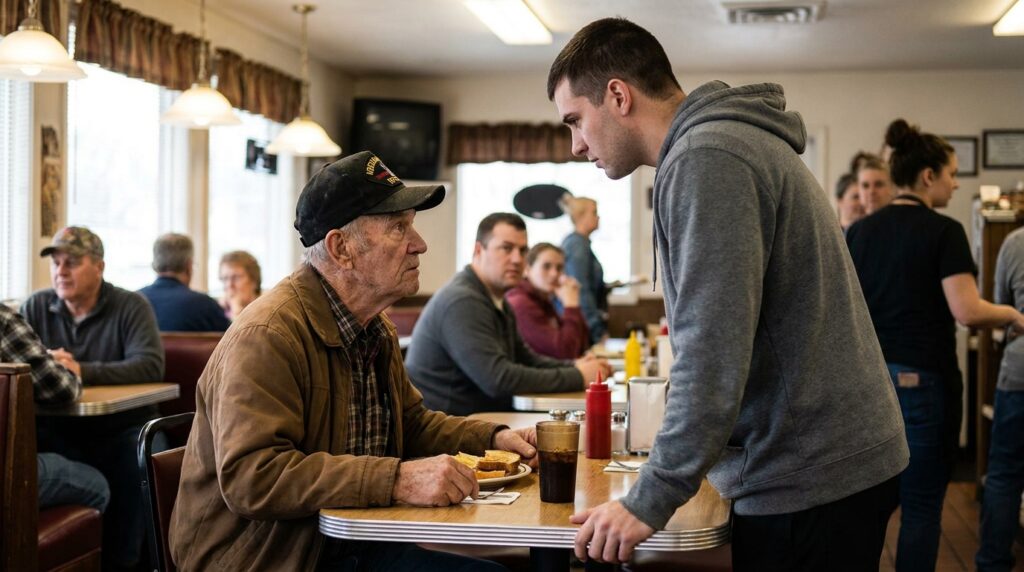
The formica was pitted with three decades of small-town grease and cigarette burns from the years before they passed the county ordinances. It smelled of bleached rags and the bitter, metallic crust that formed around the spouts of the industrial-grade ketchup bottles. Beneath the rim of his black veteran cap, the world existed only in desaturated blocks—the faded orange vinyl of the opposite booth, the dull gray of the linoleum floor where the cleaning solution had stripped the wax down to the raw composite, and the slow, heavy movement of the rain against the windowpane.
His hands remained flat against the laminate. They were dry, the skin cross-hatched with pale scars from wire-pulls and cold steel, the nails thick and split at the corners from an entire life spent maintaining things that were slowly falling apart. He didn’t look at the menu. The menu hadn’t changed since the foundry slowed its intake in ninety-four, and he knew the exact weight of the breakfast tray before the cook even dropped the lard onto the flat-top.
Then the glass door rattled against its weather-stripping. It wasn’t the steady, rhythmic pull of the wind; it was the sharp, violent jerk of someone who expected the world to yield to a thumb on a latch.
The boots that came across the floor were heavy, but they lacked the heel-to-toe cadence of a man who had walked miles under a loaded frame. They skidded slightly on the wet composite near the entrance, a minor correction in balance that his ears registered before his eyes even adjusted to the shift in light. A gray hoodie, heavy with water from the parking lot, cut into his peripheral vision. The fabric was stiff, smelling of cheap detergent and the sour oil of a machine shop that hadn’t seen an inspection since the previous winter.
“You’re in my seat, old man,” the voice said. It was too loud for the room, pushing through the low hum of the refrigeration unit behind the counter. It lacked the marrow of genuine authority, relying instead on the raw volume that younger men used when they felt the ground shifting beneath their own boots.
The veteran didn’t shift his hips. His spine remained locked against the hard wooden backing of the booth, a straight line that kept his center of gravity perfectly centered between his thighs. He could feel the cold draft from the door catching the frayed edge of his brown work jacket. Across the table, the salt shaker sat exactly two inches from the pepper, their glass facets catching the yellow glare of the fluorescent tubes above.
The young man moved closer, his hip checking the corner of the table. The laminate groaned, a high, plastic protest that died instantly against the heavy silence that was beginning to spread outward from the counter. The waitress with the copper-banded pot stopped three booths away, her wrist turning slightly so that a single brown drop fell and hissed against the bottom of her tray.
“I asked you a question,” the boy said, his shadow falling directly across the meal tray, blotting out the meager warmth of the overhead light. His fingers twitched near the pocket of his hoodie, the fabric bulging over something hard and rectangular that clicked with a dull, leaden thud against his thigh.
The veteran looked up. He didn’t look at the boy’s eyes—eyes were unstable, full of useless panic and shifting intent. He looked at the hollow just above the collarbone where the pulse was jumping against the white t-shirt, rapid and shallow, like a bird caught in an intake vent.

CHAPTER 2: THE WIDTH OF A FORGED INCH
The pulse in the young man’s throat didn’t slow. It quickened, a small, ragged hitch in the flesh that the veteran tracked with the same dull, clinical detachment he used to measure the deflection of wind through dry timber. The boy’s hand came down on the edge of the formica, fingers splaying wide, the nails rimmed with the black carbon grime of grease-guns and low-grade diesel oil. The metal table frame groaned under the sudden application of leverage.
“You think that hat makes you tough, old man?” The words were thick with the flat vowels of the river valley, but they lacked weight. They were air—vocal chords vibrating under the influence of an adrenaline spike that hadn’t found its channel yet. “Get out of my booth.”
The veteran did not drop his chin. He let his thumb remain hooked over the small, silver-rimmed edge of his coffee mug. The ceramic was thick, commercial-grade, retaining a low, greasy heat that had settled deep into the calloused whorls of his palm. Through the laminate, he could feel the vibrations of the boy’s boots—the slight, rhythmic rocking of an athletic frame shifting its weight from the heel to the toes, preparing to launch a downward vertical shove.
“You should walk away now,” the veteran said. His voice was a flat, low-register rumble, the vocal cords scarred by years of breathing alkali dust and the dry, recycled oxygen of steel bunkers. It didn’t lift above the low whistle of the kitchen exhaust fan. “Before you make a mistake.”
The young man didn’t answer with words. He answered with momentum. His right hand left the table, a short, violent hook intended to bunch the collar of the brown jacket and yank the elder out of the vinyl corner. The movement was wide, unpolished, driven by the simple confidence of a body that had never met an equal resistance on a concrete floor.
The veteran’s left hand didn’t travel more than six inches. It didn’t need to.
He didn’t stand. He didn’t shift his hips from the orange vinyl. He simply caught the boy’s wrist at the intersection of the radial bone and the tendon, his thumb driving into the narrow channel where the nerve ran open against the structure of the joint. The physics were elementary—leverage applied to an accelerated mass that had already overcommitted its center of gravity. With a short, downward rotation of his forearm, the veteran redirected the thrust, using the boy’s own forward lean as the fulcrum.
The gray hoodie bunched. The boy’s shoulder dipped violently as his balance evaporated into the narrow space between the benches. There was a brief, wet skid of rubber soles on the floor composite, followed by the dull, hollow thud of eighty pounds of bone and muscle meeting the gray linoleum.
The salt shaker didn’t move. The pepper pot remained exactly two inches away. The small, yellow pool of grease around the rim of the sausage plate didn’t even ripple.
The silence that followed was total. It was the specific, heavy quiet that always follows the sudden loss of pressure in a hydraulic line. Three booths down, the waitress stood with her arm extended, the copper-banded pot suspended an inch above a ceramic mug, her face turned toward the floor with the blank, unblinking stare of someone who had just watched a stone wall slide an inch to the left without a sound.
The boy lay on his side between the table legs, his breath coming in short, whistly gasps as his ribs reacted to the flat impact of the floor. His eyes were wide now, the arrogance stripped away to reveal the yellow white of the sclera, the pupils blown wide as they tried to find the thread of what had just occurred. His gray hoodie had ridden up, exposing the pale skin of his flank and the heavy, rectangular silhouette that had been clicking against his thigh.
It wasn’t a weapon. It was an old leather grease-pouch, its surface cracked and stained with the green oxidation of old brass rivets. From the split seam at the top, a single tarnished silver chain hung loose, its links ending in a heavy, stamped military disc that bore an inscription the veteran recognized before the light even caught the metal.
The old man looked down over the edge of the table, his hand still resting on the rim of the coffee mug. His face was identical to the face he had worn five minutes ago—weathered, gray, and completely empty of vindication.
“Patience carried me through worse than this, son,” he said. The gravel in his tone was dry, unhurried, the sound of an iron gate closing on an empty yard.
He reached down, his fingers moving with the slow, deliberate economy of a mechanic adjusting a valve. He didn’t touch the boy’s throat or his shoulder. He simply took the edge of the leather pouch where it sat against the linoleum and drew it out of the hoodie pocket. The silver chain rattled against the floor composite with a small, iron ring that seemed to occupy every corner of the frozen room.
The boy didn’t move. He remained pinned by the weight of his own sudden insignificance, his hand twitching once against the base of the table leg.
The veteran turned the leather pouch over in his palm. The brass rivets were green with salt-crust, but the name stamped into the back of the hide was still legible beneath the grease of fifty years: MILLER, J. E.
The veteran’s thumb stopped on the letter M. A small, cold draft came through the bottom of the booth, smelling of wet asphalt and the old, leaden fuel that the trucks dropped by the pumps outside. The room was still holding its breath, forty eyes locked on the quiet old man who had just taken a piece of a dead man’s history out of a bully’s pocket without rising from his seat.
CHAPTER 3: THE CALCULATION OF DISTANCE
The name MILLER, J. E. did not vanish when the veteran blinked. It stayed fixed under the yellow light, the crude indents of the metal stamp filled with grease that had hardened into a crust blacker than the leather itself. The veteran’s thumb remained on the hide, feeling the cold transfer of temperature from the oxidized rivets. Fifty years of storage in an unheated shed or a damp basement had left the leather brittle, its grain splitting into tiny, jagged canyons where the thread had rotted out.
On the floor, the young man’s breathing changed from a ragged gasp to a sharp, defensive click. He pulled his knees toward his chest, a primitive defensive curl that brought his shoulders closer to the dark composite of the booth’s support structure. His boots scraped the floor again, leaving a dull, chalky line where the wet salt from the gravel outside met the dry linoleum. He didn’t try to lunging up. The physical reality of the floor had settled into his nervous system; he was tracking the older man’s left hand, which had returned to the thick rim of the coffee mug.
“Give that back,” the boy muttered. The pitch of his voice had dropped, the public bravado drained by thirty inches of vertical displacement. “That ain’t yours.”
The veteran didn’t look at him. His eyes remained fixed on the double-link chain extending from the split pouch seam. Near the small silver disc, a secondary link had been flattened by a heavy tool—pinched together and welded with a crude bead of lead solder that had turned gray and dull with age. It was a repair job done over an open furnace, the type of field modification they used to perform on tank treads and heavy gear-straps when the supply lines were choked with mud at the mouth of the valley.
“Miller didn’t have a boy,” the veteran said. The words came out clear, without the rising cadence of a question. They were stones dropped into a shallow well. “He had a sister in Altoona who died of the croup in sixty-eight. And he had three acres of sour dirt behind the coke ovens that the county took for back taxes before the ground even froze over his box.”
The silence in the diner expanded, absorbing the small, rhythmic clink of a metal spoon hitting a ceramic saucer two rows over. The waitress had lowered her pot, her hand resting flat against the edge of the formica counter as if she needed the solid wood to anchor herself against the shift in the room’s pressure. Behind the grill, the cook stood with his spatulas down, his grease-streaked apron motionless against the white enamel of the cold-table. Everyone knew the name Miller, but in this basin, Miller was just a label on a rusted iron gate three miles north where the creek ran orange.
The boy shifted his weight, his shoulder pressing into the vinyl skirt of the booth. “My old man found it,” he spat, his fingers curling into the fabric of his hoodie. “In the dry-well behind the old pump station. When the town shut the line down.”
The veteran’s thumb didn’t move from the letter M. The information didn’t alter the set of his jaw, but his mind silently recalculated the parameters of the grid. The old pump station sat on the lower shelf of the ridge, exactly four hundred yards from the boundary line where the foundry used to dump its core sand. If the leather had been in the dry-well, it hadn’t been lost; it had been dropped into the intake shaft before the concrete cap was poured.
“Your old man is Bill Vance,” the veteran stated, his gaze finally shifting down to the boy’s face. It wasn’t an interrogation; it was a verification of a mechanical blueprint. “He was the supervisor for the third shift when the seals failed on the lower sump.”
The boy didn’t answer, but the skin around his jaw tightened, the blood returning to his cheeks in a dark, mottled flush. He looked at the patrons in the adjacent booths, searching for the collective weight that had supported him when he first crossed the threshold, but the faces he met were blank, turned away, or focused entirely on the salt shakers. The social contract of the diner had re-formed around the old man’s posture.
The veteran picked up his fork. The tines were heavy, stamped steel that had seen ten thousand washings, the edges rounded by years of scraping against thick ceramic plates. He slid the metal through the cold yolk of the egg, his movements unhurried, his breathing regular. The boy on the floor was no longer an active vector of kinetic force; he was an item of inventory that needed to be cleared from the right-of-way.
“Get up, son,” the veteran said, his tone dropping into the quiet, flat rhythm he used when the line was secured and the trucks were idling in the yard. “You’re getting grease on your jacket.”
The young man didn’t move immediately. He waited for three full cycles of his own short breath, his eyes darting between the leather pouch in the veteran’s left hand and the heavy work boots planted six inches from his nose. Then, with a clumsy, multi-stage heave that lacked any of the athletic grace he had carried through the door, he pushed himself up onto his knees, his hands gripping the edge of the table to steady his frame.
The table shook an eighth of an inch. The silver chain rattled against the formica, a small, cold sound that seemed to mark the exact micro-second the boy’s status in the valley changed from a threat to a witness.
CHAPTER 4: THE INVERSION OF RESTRAINT
“Your old man didn’t find this in any dry-well,” the veteran said. His hand remained balanced over his fork, the tines embedded in the cold sausage link. He did not look up as the young man finally wrestled his weight onto the orange vinyl seat opposite him. “Bill Vance wasn’t a scavenger. He was a keeper. He kept the logbook for the north borehole when the core drill hit the lower limestone pocket in seventy-two.”
The boy sat heavily, his chest still heaving beneath the damp gray fleece of his hoodie. The arrogance that had occupied his shoulders five minutes ago had flattened out into a gray, defensive posture, his skin looking the color of wet lime under the flickering fluorescent tubes. He placed his palms flat on the formica, his fingers trembling slightly against the grease-filmed wood.
“He died three months ago,” the boy muttered. He didn’t look at the veteran. His eyes were fixed on the tarnished silver disc resting between the salt and pepper shakers. “The cancer took him from the lungs upward. The company doctor said it was the lime dust from the aggregate pit, but my old man knew better. He gave me that pouch the night before his breath failed. He told me to find the man who signed the final containment manifest for Miller’s shift.”
The veteran’s thumb slowly traced the split hide of the leather pouch. The physical connection to the object brought a memory back through his palms—the exact vibration of a diesel generator churning through flooded clay, the oily sludge of sulfur water rising over the boots of three men who didn’t have the clearance to ask what was in the tanks.
The decoy secret was now flat on the table, clear and solid as a forged bolt. The boy thought he was tracking a rogue sergeant who had abandoned his team after an industrial accident. He thought the medallion was proof of a desertion, a cold betrayal that had left Bill Vance and J.E. Miller to choke on the runoff while someone else walked away with a clean pension. It was a perfect explanation. It covered the gap in the town’s history like a heavy iron plate over an abandoned shaft.
“He thought you ran,” the boy said, his voice gaining a thin, bitter edge that didn’t rise enough to disturb the silence of the neighboring booths. “He said the man in the black cap was the only one who didn’t sign the waiver when the state closed the creek gate. He thought you took the settlement money and left the rest of the crew to bury the slurry.”
The veteran let his fork drop back against the plate. The ceramic ring was sharp, a single clean note that caused the cook behind the counter to shift his feet against the rubber floor mat.
“The settlement money was never paid, son,” the veteran said, his voice dropping into that flat, gravelly register that left no room for interpretation. “There wasn’t any money to take. The company didn’t buy our silence. They bought your father’s house. They paid the mortgage on every property from the railway spur down to the marsh because if they didn’t, the banks would have dug into the topsoil to verify the collateral before the loans were bundled.”
He picked up the silver chain. Close up, the small flakes of zinc coating were missing from the lead weld, leaving the raw iron beneath vulnerable to the salt air. It hadn’t been modified in a tank bunker; it had been repaired in the maintenance shed of the municipal water works three days before the pumps were filled with liquid concrete.
“Miller didn’t die in the shift,” the veteran continued, his gaze narrowing on the boy’s collarbone. “He died three miles out, in the back of your father’s station wagon, while they were trying to find an intake valve that didn’t show up on the county grid. Your old man didn’t give you this to find a ghost. He gave it to you because he knew the municipal authorities were going to re-open the north borehole for the summer intake.”
The boy’s hands tightened against the formica until the knuckles turned the color of lard. “The water’s fine. The town tests it every October.”
“The town tests for iron-shavings and lime-crust,” the veteran said, his face hardening into an expressionless mask of rusted iron. “They don’t test for what happens when the limestone dissolves into the lower sump. Your father knew the concrete cap was thin. He knew it because he poured it.”
The veteran pushed the leather pouch back across the table, his fingers letting go of the silver chain with a slow, deliberate click. The micro-mystery of the rectangular weight had been solved, but the true reality—the heavy, rotting core of the valley’s soil—remained locked inside his own memory, a secret that had cost him his name and his life before this boy was even a single cell.
Across the room, the waitress finally moved, her rubber-soled shoes sticking to the floor with a soft, tearing sound as she approached the booth with the fresh pot of coffee. Her face was blank, but her eyes stayed fixed on the tarnished metal disc that now lay exactly between the two men, its silver chain coiled like a dead snake on the gray laminate.
CHAPTER 5: THE PERSISTENCE OF SEDIMENT
The bottom of the coffee pot tapped the thick ceramic rim of his mug, but the waitress didn’t tilt her wrist to pour. Her hand stayed frozen, the tendons in her forearm standing out like old rope under her skin. She wasn’t looking at the veteran, nor at the boy whose knuckles were still white against the formica. She was looking down at the baseboard behind the counter where the old copper supply line entered the wall.
A dull, rhythmic thudding was traveling up through the floorboards—not the sharp vibration of a truck on the state highway, but a heavy, liquid hammer that rattled the small steel spoons inside their tin canisters.
The veteran felt the pulse through his boot soles first. It was five beats every three seconds, the exact stroke-rate of the municipal booster pump three miles north. They had turned the valves early. The summer intake wasn’t scheduled for another twenty days, but the gray water vibrating through the pipes carried the heavy, chalky density of sediment pulled directly from the lower sump pool.
“They opened it,” the boy whispered. His eyes shifted from the tarnished leather pouch to the windowpane, where the rain was turning into a thick, yellowish sleet that left greasy streaks against the glass. “The county line. My old man said they’d wait until the budget hearing.”
The veteran didn’t move his hand from the table. His mind was calculating the flow velocity through three miles of rusted eight-inch casing. If the booster pump was already driving the head-pressure up, the thin concrete cap his team had poured over the limestone cavity in seventy-two was no longer just leaking; it was dissolving under the weight of the water columns. The decoy secret—the simple myth of a forgotten industrial accident and a runner with a pocket full of settlement cash—was crumbling right here on the linoleum.
“They didn’t wait for the hearing because the monitoring wells down at the aggregate pit went dry last night,” the veteran said. His voice was too quiet, carrying the dry, unhurried precision of an engineer watching a dial pass the red mark. “When the limestone drops into the lower pocket, the pressure doesn’t go down. It goes up until the relief lines clear themselves through the old municipal wells.”
He stood up. The movement was slow, his spine straightening with the audible click of old vertebrae adjusting to the weight of his brown work jacket. For thirty years, his entire existence had been defined by the absolute maintenance of his own absence—staying seated in the corner booths, using an assumed name on his fuel receipts, keeping his hands flat against the laminate so nobody would notice the chemical scars across his palms. Now, the space he had guarded had shrunk to the width of the room.
The boy tried to rise with him, but his knees caught the underside of the table frame, sending a sharp, metallic ring across the diner. “If that cap goes, the whole north side loses the topsoil. My old man’s house is right on the shelf.”
“Your father’s house was built on the spoil-bank, son,” the veteran said, looking down over the bill of his cap. “The foundation is six inches of slag and four inches of poured slag-cement. It isn’t anchored to the ridge. It’s resting on the crust.”
The glass door of the diner didn’t rattle this time—it blew inward an inch as the outside pressure shifted, a cold blast of air carrying the distinct, rotten-egg stench of deep-pocket sulfur and oxidized lime. Across the counter, the cook finally dropped his spatulas, the steel clattering against the grease-trough with a wet, heavy thud. He didn’t look at his grill. He walked straight to the small transistor radio that sat on the shelf above the pie case, his grease-blackened thumb turning the plastic dial until the static gave way to the flat, nasal drone of the county emergency band.
The audio was garbled by the ridge interference, but the words came through the small speaker like iron filings dropping into a tin pan: …booster station three reports an un-metered drop in head-pressure… all residents on the lower shelf are advised to isolate the intake valves…
The veteran reached down and picked up his veteran cap, pulling the brim lower over his eyes until the glare of the fluorescent tubes was cut off completely. He didn’t look back at the table or the meal tray that had remained completely undisturbed throughout the entire morning. The small victory he had won over the boy’s unearned arrogance five minutes ago felt like nothing now—a false flag that had kept him pinned in his seat while the true reality of the valley broke through the floorboards.
“Stay here,” the veteran told the boy, his voice dropping into the command register that left no room for response. “Don’t touch that pouch, and don’t go back to the ridge. The shelf is already moving.”
He didn’t wait for the waitress to clear the path. He stepped into the aisle, his boots finding the exact center of the composite tiles where the wax had been worn down to the bare, unpolished aggregate. Every eye in the room followed the line of his shoulders, but nobody spoke, nobody asked for his name, and nobody offered a hand. The town had finally recognized the discipline of the man in the booth, but the cost of that recognition was the immediate collapse of the world they had spent thirty years pretending was safe.
CHAPTER 6: THE SLAG BOUNDARY
The air outside didn’t hit like weather. It hit like the exhaust of a wet coke oven, heavy with sulfurous steam that turned the back of his throat to raw sand. The bill of his veteran cap collected three drops of sleet in the first two paces, each one leaving a light, yellowish ring against the black twill as the sediment dried instantly under the wind. His boots struck the gravel lot with a dead, crunching thud that was entirely muffled by the low-frequency rumble vibrating through the earth below the state road.
He didn’t make for an old sedan or a farm truck. He didn’t have one registered in this county. He walked straight toward the drainage ditch that marked the northernmost property line of the diner’s lot—a three-foot trench lined with un-mortared limestone rock that had stayed dry since the spring floods of eighty-two.
Except it wasn’t dry now.
A thick, milk-colored slurry was boiling up through the gaps in the stone, its surface carrying a iridescent sheen of old lubricant and fine coal dust. The runoff wasn’t flowing toward the creek basin; it was backing up, the hydraulic head from the lower sump forcing the fluid backward through the porous limestone shelves until the entire gravel shoulder of the highway was beginning to look like wet salt.
The heavy, metallic rattle of an un-muffled manifold rose behind him. Through the steam, the young man from the booth came stumbling across the parking lot, his gray hoodie unzipped and flapping against his ribs like a torn tarp. He was carrying the leather grease-pouch in his left hand, the silver chain wrapped twice around his fingers until the links cut deep into his skin. His athletic stride was gone, his feet slipping into the slushy gravel as he struggled to maintain his balance against the slope of the grade.
“The bridge road is choked,” the boy yelled. He had to push his voice through his teeth to clear the sound of the booster station. “The sheriff’s got a truck across the line near the culvert. He says the culvert’s bowing upward from the bottom.”
The veteran didn’t stop. He cleared the lip of the trench with a short, economical stride, his brown jacket catching a spray of mud from the passing state vehicle that didn’t even slow for the yellow light. “The culvert is bowing because your father ran the relief line directly through the old masonry arch. The water isn’t going under the road, son. It’s going into the core.”
“We can shut the bypass manually,” the boy said, grabbing the stiff canvas of the veteran’s sleeve. The grip was desperate, lacking any of the leverage he had attempted inside the diner booth, his fingers slick with cold grease and rainwater. “My old man had the key-iron in the back of the shop. I know where the riser is.”
The veteran stopped his boots exactly on the white line of the shoulder. He turned his head slowly, looking down at the hand on his sleeve until the boy’s fingers uncurled from the fabric.
“There is no bypass, Vance,” the veteran said. The name came out dry, level, and final. “The riser your father told you about is an inspection pipe. It doesn’t connect to a gate valve. It connects to the void. If you turn a key-iron in that slot, you aren’t closing a line—you’re relieving the top-pressure that keeps the lower cave from collapsing into the clay shelf.”
The paradigm shift hit the young man’s face like an iron rod. His mouth opened slightly, his jaw trembling as he tried to reconcile the simple mechanical instruction his dying father had given him with the massive structural failure that was currently telegraphing itself through the soles of his boots. The decoy secret—the belief that his father had been a good mechanic trying to fix an old man’s mistake—was completely dead now, broken by the physical reality of the water columns rising through the gravel.
Across the highway, the first major fracture appeared. It wasn’t a sudden explosion of dirt; it was a slow, deliberate settling of the state road’s shoulder. A fifty-foot section of the asphalt parted with a dry, tearing sound that resembled canvas ripping over a frame. The white paint line fractured into clean, three-inch segments as the aggregate beneath subsided into the lime pool, leaving the raw base-course exposed to the sleet.
The radio inside the sheriff’s truck three hundred yards down gave a long, high-register shriek of feedback that died instantly as the telephone poles near the spur tilted six degrees to the west. The wires didn’t snap—they groaned, their copper cores stretching under the sudden tension until they hummed like steel cables on a winch drum.
The veteran reached into his jacket pocket and pulled out his hands. The skin was gray, the old scars from the ninety-four containment wall showing white against his knuckles. He didn’t have a plan to save the ridge, and he didn’t have a tool to stop the limestone from dissolving. His agency was entirely bound to the preservation of the truth he had carried into the room thirty years ago—a truth that was now writing itself across the landscape in sections of collapsed road and orange creek water.
“Get behind the diner,” the veteran told the boy, his fingers pointing toward the concrete pad where the propane tanks were anchored to the bedrock. “The pad is six feet of reinforced granite mix. It’s the only thing within two miles that isn’t sitting on your father’s cement.”
The boy didn’t run. He stood looking at the split road, his hands hanging limp at his sides while the tarnished military disc from the leather pouch swung back and forth against his thigh, a small pendulum marking the final seconds of the valley’s equilibrium. The main conflict hadn’t been resolved; it had simply outgrown the walls of the booth, leaving the protagonist standing on the boundary line of a failure he had spent half his life trying to outrun.
CHAPTER 7: THE FINAL TAXATION
The sound did not travel through the air. It was a low, hydraulic groan that climbed the iron nails of the diner’s framing timbers, vibrating straight through the rubber soles of his boots until his teeth clicked together over the stale taste of lard. Behind the glass pane, the state highway did not collapse with a sudden roar; it subsided in blocks, the dark asphalt rafts tilting into the gray slush of the limestone slurry like ore-cars tipping at the sorting pocket.
The veteran did not look back at the ridge. He didn’t need to trace the line of the fault where the clay met the slag-cement. He knew every yard of that interface because his own youth was buried beneath it, tamped down with five hundred sacks of quick-setting lime that had cost him his rank, his name, and the right to exist under the light.
He reached into his jacket pocket. His fingers closed on three quarters—heavy, pre-seventy-five silver pieces that had remained at the bottom of his lining since the winter the third shift went dark. The metal was cold, smelling of gun-oil and the dry graphite dust he used to clear his firing pins. He didn’t drop them into the mud. He stepped backward, his heel finding the solid granite pad of the propane enclosure where the young man was already crouched, his gray hoodie clutched tight around his knees as if the fleece could insulate him from the motion of the basin.
The veteran placed the three coins flat on the concrete lip of the tank base. They lay exactly three inches apart, their stamped edges catching the desaturated yellow light from the diner’s emergency lamps.
“That’s for the breakfast, Vance,” the veteran said. His voice was a flat, low-register rumble that stayed underneath the hum of the power lines. It was the same rhythm he had used when the final bulkhead was secured and the pumps were left to choke on the sulfur mud. “The tax is paid.”
The boy looked up from his knees, his face the gray color of wet mortar. The leather pouch was still tangled in his fingers, the silver chain wrapped so tight the metal had turned the skin of his knuckles a bruised blue. “You’re just going to let it take the road? My father said you were the only one who had the layout of the lower galleries.”
“The layout doesn’t change the chemistry, son,” the veteran said. He pulled the bill of his veteran cap down until the cold sleet stopped hitting his eyelids. “The limestone was always going to dissolve. Your father knew it when he signed the completion certificate for the municipal water authority. He didn’t want a mechanic; he wanted an asset that could hold the bank off until the mortgages were cleared from the books.”
The ultimate truth was now open between them, flat and bare as a stripped gear. There had been no military desertion, no rogue operation, and no stolen settlement cash. The veteran hadn’t disappeared to run from his team; he had vanished to keep the county from discovering that every house built on the shelf was anchored to a dissolving lime-vault—a vault his own team had been ordered to seal with structural concrete that was too thin to resist the sulfur runoff. The silence he had maintained for three decades wasn’t an act of cowardice; it was the sovereign protection of a town that would have been uninsurable before the children were even old enough to walk the boundary lines.
Across the ditch, the telephone poles did not snap. They simply leaned together, their top-wires touching with a dry, white snap that turned the sleet into small puffs of steam before the circuit breakers tripped at the substation two miles out. The diner didn’t go dark; the auxiliary generator beneath the kitchen annex kicked in with a rhythmic, diesel-throated cough that restored the yellow glare to the corner booth where his sausage plate still sat undisturbed.
The boy looked down at the three quarters on the concrete pad. His hand slowly uncurled from the leather pouch, the silver chain slipping through his fingers link by link until the stamped military disc settled in the dust near the veteran’s boots. The unearned arrogance that had driven him across the threshold that morning was gone, replaced by the heavy, geriatric weight of an entire valley’s liability.
“Where are you going?” the boy asked.
The veteran didn’t answer with a location. He turned his face toward the state road where the asphalt rafts were settling into the gray silt, his eyes tracking the narrow strip of solid gravel that still held along the ditch line. The town’s social hierarchy had collapsed inside the walls of the booth, and the physical hierarchy was resetting itself outside in the rain, but his center of gravity remained exactly where it had been thirty years ago—planted, unhurried, and completely clear of debt.
He stepped off the granite pad, his boots finding the coarse bite of the un-poured aggregate on the lot’s edge. He walked away from the diner, his brown jacket absorbing the yellow sleet until the fabric turned the dark, desaturated color of wet iron, leaving the young man and the dead man’s medallion behind him on the only six feet of ground that wasn’t moving.







