
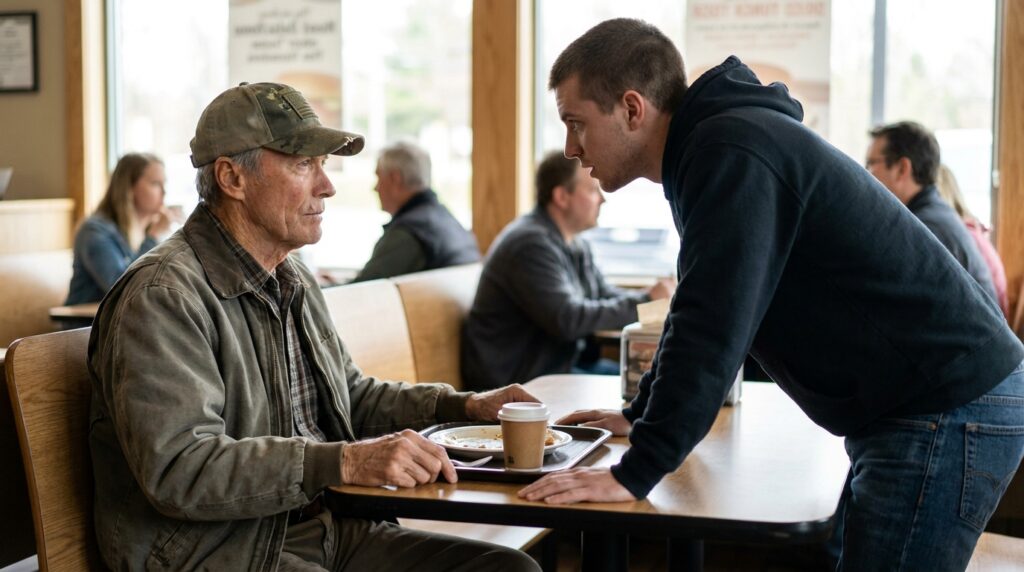
The Heavy Line of the Table: A Story of Rusted Iron, Measured Breathing, and the Price of Sovereignty
CHAPTER 1: THE WEIGHT OF THE TRAIN
“You think you’re tough, old man, you’re in my way.”
The voice was thin, but it carried the raw, unearned heat of a modern pavement outside. The young man didn’t move his feet. He just tilted his chin, his hoodie casting a gray shadow across the half-empty bowl of chili between them. The cotton of his sleeve smelled of cheap detergent and dry dirt.
The veteran didn’t look up immediately. His thumb, marked by the deep, white crescent of an old bolt scar, remained hooked around the handle of his heavy ceramic mug. The coffee inside was dark, the surface reflecting the yellowed fluorescent tubes humming in the ceiling grid above. Around them, the diner didn’t stop, but the rhythm changed. The rhythmic clack-clack of the metal spatula against the griddle slowed down. A waitress with grease-darkened cuffs froze three paces away, a glass pitcher of iced tea tilted slightly in her grip.
“I asked you a question,” the boy said. His shoulder twitched, a restless, animal movement that belonged to someone who had never seen an engine blow or a line collapse under weight. He wanted the room to watch. He wanted the gray-haired man to look small against the bright, unyielding daylight hitting the storefront window.
The veteran took a breath. It was a slow, deliberate movement that expanded his chest against the stiff canvas of his work shirt. The fabric was old, the collar frayed into neat, tiny threads that rubbed against his throat. He felt the specific friction of the air in the room—the grease, the burnt onions, the cold draft from the floorboards near the kitchen door.
He let go of the mug. The porcelain hit the table with a dull, solid click that seemed to clear a circle of silence through the immediate booths. He didn’t scramble for a response. He didn’t lean back to widen the gap.
Instead, he stood.
It wasn’t the slow, creaking rise of an old man with bad knees, though his joints carried the dull ache of fifty winters. It was a single, mechanical correction. His spine went rigid, his shoulders locking into a square, level plane that instantly took three inches of clearance out of the space between them. The movement didn’t have the cinematic speed of a theater fight; it had the heavy, inescapable momentum of a iron gate swinging shut on its hinges.
The young man’s eyes widened, just enough for the white rim below his iris to show against the gray cotton of his hood. His forward-leaning stance didn’t look like an attack anymore—it looked like an imbalance, a clumsy stumble forward against a wall that hadn’t been there a second ago.
The veteran leaned down, just enough to bring his lined, weathered face into the light of the table. His voice came from deep behind his ribs, low and gravelly, stripped of any anger but filled with the absolute certainty of a man who had timed mortars by the second.
“Step back now, son,” he said, the words falling like iron slugs into the quiet between them. “You’re making a serious mistake.”
The young man’s fingers twitched on the formica. He didn’t look at his friends by the counter. He couldn’t. His gaze was pinned by the flat, color-drained stare of the old man, whose right hand had settled flat on the table, covering the scar on his thumb. A heavy, brass-capped pen slid out from the open pocket of the boy’s hoodie, rolling across the wood until it hit the edge of the veteran’s tray with a sharp ring. The small metal clip on the pen bore three tiny, engraved numbers: 704.

CHAPTER 2: THE TERRITORIAL SHADOW
The brass-capped pen didn’t bounce. It rolled with a heavy, uneven wobble across the salt-filmed formica, its metal clip catching the yellow tint of the diner’s overhead lights before it wedged itself beneath the lip of the plastic meal tray. The three numbers engraved on the side—704—stared upward, clean and deep against the scratched metal casing.
The young man didn’t reach for it. His hand remained flat on the table, but the weight had shifted back to his heels. The aggressive lean that had defined his posture a few seconds ago had dissolved into something stiff and awkward, like a rusted gear forced into reverse. He looked down at the pen, then up at the veteran’s face, his mouth slightly open but entirely dry.
“The pen,” the veteran said. His voice didn’t rise above the low, constant murmur of the refrigerator units behind the counter, but it held the room like an anchor. “You dropped something, son.”
The boy’s throat moved as he swallowed. His chest rose and fell in short, shallow jerks beneath the heavy cotton of his hoodie. Around them, the silence of the diner was absolute now. The spatula on the griddle remained static; the grease sizzled once, a sharp, spitting sound that made a customer in the second booth flinch. The collective weight of twenty pairs of eyes was no longer on the older man’s fraying collar. It had shifted, heavy and critical, onto the boy’s shoulders.
“I don’t…” The young man started, his voice cracking on the first syllable before he managed to drop it an octave. He tried to pull his hand off the table, but his palm seemed stuck to the formica, a thin film of cold sweat leaving a gray smudge on the faux-wood pattern as he finally slid it back into his pocket. “It’s just a pen.”
“It’s an armorer’s tool,” the veteran corrected. His gaze didn’t leave the boy’s eyes. He didn’t blink. His posture remained perfectly square, his spine a straight line of iron that seemed to absorb the dim, greasy light of the room. “Specifically, a specialized gauge for a bolt-carrier group. The kind they stopped issuing when the logistics chains changed after the valley campaign. You don’t buy those at a hardware store on the interstate.”
The boy shifted his weight from his left foot to his right, his rubber soles squeaking against the unwashed linoleum with a sound like a small animal trapped under a floorboard. The confidence that had brought him to the edge of the shared table was completely gone, replaced by a restless, defensive confusion. He looked at his two friends near the cigarette machine, but they had already turned their backs, suddenly fascinated by the reflection of the streetlights in the dark glass of the entryway.
“My granddad gave it to me,” the boy muttered. The words came out defensive, a small shield raised against the crushing presence of the older man. He reached out with two fingers, his hand trembling slightly as he hooked the clip of the pen and pulled it back toward his side of the table. “He said it was from his time in the motor pool. It ain’t yours.”
“I didn’t say it was mine,” the veteran said. He adjusted his right hand, his thumb sliding over the white crescent scar on his skin. The touch was mechanical, a repetitive habit born from years of measuring the clearance of heavy machinery before the ignition turned. “But the inventory stamp on that brass belonged to a specific logistics battalion out of Fort Meade. A unit that didn’t leave many people behind to talk about the inventory.”
The boy pulled the pen entirely into his pocket, his fingers bunching the fabric around it as if he could hide the numbers from the room. He took a single step backward, his hip clearing the corner of the table by less than an inch. The bravado had completely drained from his face, leaving only the pale, sharp features of a local kid who had tried to push an old man and accidentally hit a stone wall.
“We’re leaving,” the boy said, though he didn’t look at his friends when he said it. He kept his eyes locked on the veteran’s chest, watching the steady, unhurried rhythm of the older man’s breathing. He didn’t want to turn his back.
The veteran didn’t follow him with his body. He stayed right where he was, a vertical pillar of weathered canvas and quiet authority, but his eyes followed the boy as he began to slide toward the exit. The air between them remained thick with the smell of iron, old oil, and the cold draft coming through the door frame.
As the boy reached the threshold, his hand fumbled with the glass door, his fingers slipping twice on the metal push-bar before he got it open. The bell above the frame gave a single, tinny ring that shattered the remaining tension in the room. But before the door swung shut, a small piece of dark, tarnished metal slipped from the loose pocket of his hoodie, hitting the rubber mat at the entrance with a dull, heavy thud. It didn’t roll. It lay there, a small rectangle of weathered brass with a raised edge, glinting against the dirty floor.
The veteran didn’t call out. He waited until the door settled into its frame, then turned his gaze down to his tray, where his dark coffee had finally stopped moving.
CHAPTER 3: THE MOCK BY THE COUNTER
The dull, flat hit of the metal on the ribbed rubber mat was the loudest sound left in the building. It lacked the bright, ringing resonance of clean steel; it was a heavy, dense thump that indicated high copper content and decades of oxidation.
The veteran didn’t jump to his feet. He didn’t rush the doorway like a scavenger chasing a coin. His boots, stiffened by salt stains and years of wear, ground against the grit beneath the table as he executed a slow, ninety-degree rotation of his torso. The frayed hem of his canvas trousers dragged across the top of his laces with a dry, rhythmic hiss. Every movement was budgeted, a precise expenditure of energy that kept his center of gravity perfectly locked over his heels.
The diner around him began to inhale again. The waitress dropped the pitcher of iced tea onto a plastic tray with a wet clatter, and the low, thick mutter of the lunch crowd returned, though it remained pitched lower than before, a low drone of murmurs sliding between the vinyl booths. They were looking at him now, evaluating the curve of his shoulders, trying to figure out how an old man with a lined face and an old shirt had managed to deflate a hundred and eighty pounds of aggressive local muscle without changing his pulse.
He ignored them. His attention was pinned entirely to the threshold.
He rose from the booth for the second time, but this time his hands were empty. He didn’t touch the heavy mug or the handle of his fork. He walked with an unhurried, measured stride toward the front door, his eyes tracking the dark little square resting on the mat. Up close, the setting daylight cut across its pitted surface, revealing the serrated border and the faint, compressed shapes of an insignia that had been polished so many times the sharp details had melted into smooth, rounded ridges.
He bent down from the hip, his knee joints releasing a small, dry pop that was swallowed by the hum of the overhead vents. His fingers closed over the brass. The metal was cold, holding the chill of the street outside, and it carried the distinct, unmistakable grease of a motor pool—sulfur, diesel stabilizer, and old iron.
When he turned it over in his palm, his thumb immediately found the three raised numerals stamped into the reverse side, right beneath the broken pin mount: 704.
He stood there in the doorway, the glass door vibrating slightly against his shoulder as a heavy logging truck rolled past on the state route outside, its diesel exhaust rattling the frame. The numbers matched the armorer’s tool in the boy’s pocket. It wasn’t a coincidence. A logistics company out of Fort Meade didn’t throw two separate, non-standard pieces of field-modified gear into the same small town thirty years after the battalion records were buried in an administrative fire.
He walked back to the shared table, his thumb resting over the numbers, pressing the cold brass into the center of his old bolt scar. The small, white-rimmed crescent of tissue on his skin throbbed with a dull, familiar rhythm—a physical reminder of the heavy machinery he used to balance before the world broke.
“Arthur,” a voice called out from behind the cash register.
The veteran stopped, his boots locking against the unwashed linoleum. He didn’t look back immediately. He knew the voice. It belonged to Miller, the man who spent twelve hours a day behind the formica counter, punching numbers into a mechanical register that had been out of date when the valley campaign was still a series of gray maps in a command tent.
“That kid,” Miller said, his hand reaching into a glass jar to retrieve a handful of paper napkins. His fingers were stiff, the knuckles swollen into pale knots from forty years of handling heavy porcelain and cold grease. “That’s the Miller boy from down by the old tannery. No relation to me. His people came out of the valley after the water went bad in ’92. They don’t do much but fix old trucks and look for things that aren’t tied down.”
Arthur turned his head slightly, his profile cutting a sharp, dark wedge against the bright window. “He carries his grandfather’s tools, Miller.”
“His grandfather died in a ditch outside of Sector Four,” Miller spat, his voice dropping into a dry, paper-thin rasp that didn’t cross the distance to the nearest booth. He leaned over the register, the old wood of the counter creaking under his palms. “Left nothing but a box of oxidized brass and a house with a hole in the roof. The boy thinks that box makes him someone. He thinks because his old man’s name is on a copper plaque at the courthouse steps, he owns the sidewalk.”
Arthur’s hand closed tighter around the piece of metal in his pocket. He could feel the specific edges of the insignia, the broken pin pricking the skin of his palm. He knew the name on that copper plaque. He had written the report that put it there, using a mechanical typewriter with a sticky ‘E’ key while the rain turned the mud outside the command post into a gray soup.
“He doesn’t own the sidewalk,” Arthur said softly. “But he’s carrying the wrong history.”
He didn’t wait for Miller to finish his next sentence. He walked back to his booth, his long canvas coat settling around his legs with the heavy, dry drag of a wet tarp. He sat down, adjusted his meal tray by less than an eighth of an inch until it aligned perfectly with the scratched corner of the formica, and reached for his coffee. The dark liquid had gone lukewarm, a thin, oily skin forming across the surface, reflecting the dead yellow tubes of the ceiling.
He took a sip anyway, the bitter, burnt taste clearing the dry dust from his throat. The boy would come back. Not because he was brave, but because people who lived on the edge of an old tannery didn’t lose an armorer’s gauge and a unit crest without someone noticed the inventory was short. The tools were part of a ledger that had never been balanced, and Arthur was the only man left in the county who knew how to read the line items.
CHAPTER 4: THE ANCHOR INCIDENT
Arthur let the cold weight of the brass insignia rest against his palm for three full expansion cycles of his lungs. The metal absorbed none of his body heat; it stayed stubborn, cold as a well-head casing in late November, oily to the touch. With a deliberate, unhurried precision, he slid his thumb into his vest pocket, retrieved a small linen rag stiffened with dried mineral oil, and wiped the face of the crest until the oxidized green scale gave way to the flat, unpolished yellow beneath.
The design emerged through the grime. It was a winged wheel silhouette pinned behind a broken saltire—the distinctive, non-standard unit crest of the 704th Logistics Battalion.
“You shouldn’t keep that on the table, Arthur,” Miller muttered from across the room. The cash register drawer closed with a heavy, ungreased chunk, the bell inside vibrating for a second before the silence took over again. Miller didn’t look over his shoulder while he wiped down the chrome espresso machine with a gray cloth that smelled of old milk. “That’s bad luck. That’s valley luck.”
“Luck has very little to do with parts numbers, Miller,” Arthur said, his voice level, carrying the slow, dry rhythm of a standard maintenance log. He picked up his fork, using the tines to scrape a tiny, dried nodule of old solder from the corner of his plastic meal tray. “The boy didn’t find this in a scrap heap. The pin on the back isn’t rusted off; it was clipped with a pair of double-edged wire cutters. Side-action cutters. The kind they issued to the vehicle recovery teams in Sector Four.”
He didn’t need to look at the paperwork to know who had filled those tool rolls. He had initialed the requisitions himself during the third month of the withdrawal, when the mud was so deep the heavy haulers were splitting their differentials just trying to turn around in the assembly area.
He stood up, his canvas coat dragging across the vinyl seat with a dry, sand-paper rasp. His body didn’t complain about the movement, but the heavy iron weight in his chest seemed to grow denser, pulling his shoulders into a rigid, horizontal plane. He walked across the unwashed linoleum toward the front window, his eyes scanning the empty gravel lot where the young man’s truck had been idling minutes before. The oil pool left behind by the worn oil pan was still dark and wet against the dry stone, a black circle slowly widening in the dust.
The boy had left in a hurry, but he hadn’t left alone. Two parallel lines of deep, aggressive tread marks cut into the shoulder of the state route, the rubber tearing the weeds from the ditch. It was the mark of a heavy utility vehicle—something with dual rear wheels and a frame that didn’t bounce when it hit the transition to the asphalt.
“He’ll go back to the yard,” Miller said, his voice coming closer as he walked toward the door with a broom. The straws of the broom were worn down to uneven, dirty stubs that scratched the floorboards with a dry, irritating hiss. “His uncle runs the yard behind the old lime kiln. They got four hundred tons of unrecorded military iron sitting back in the woods. Stuff that never went through the county auction. Stuff that came over the ridge in the middle of the night while the fire was still burning in the valley.”
Arthur looked down at his own right hand, the white crescent of the old bolt scar standing out sharp against his weathered skin. His fingers didn’t shake. He had spent thirty years teaching them not to move unless they were clearing a jam or setting a torque wrench.
“The yard is inside the old boundary line,” Arthur said softly.
“It is,” Miller replied, stopping his broom right at the edge of the rubber mat where the insignia had fallen. He didn’t look down at the floor; he looked straight through the glass at the dark line of the ridge three miles away. The pine trees on the crest looked like black teeth against the graying sky. “And nobody goes past the kiln without a bill of lading from the state office. Or a shotgun in the gun rack.”
Arthur didn’t answer. He reached into his coat pocket, retrieved a single, worn brass key with a filed notch along the spine, and laid it on the counter next to the cash register. The metal key was smooth from years of being turned in the same lock—the padlock of an old green footlocker currently bolted to the bed of his own truck outside.
“If the boy comes back before I clear the ridge, Miller, tell him his grandfather’s ledger is still open,” Arthur said.
He turned toward the exit, his heavy boots making no sound against the rubber mat as he pushed the glass door open. The tinny ring of the bell above the frame was cut short by the rush of cold, diesel-scented air from the road. The daylight was dying fast now, the orange tint on the horizon turning into a thin, violet bruise that offered no heat. He walked toward his vehicle, his hand already reaching for the handle of the tool box behind the cab, his fingers searching for the specific cold friction of the iron bars he had kept greased for three decades.
CHAPTER 5: THE LOW WARNING
The iron frame of the old Ford didn’t cushion the transition from the state asphalt to the unpaved shoulder of the lime kiln road. It slammed down onto its bump stops, a harsh, metal-on-metal crack that sent a violent tremor straight up through the steering column and into the meat of Arthur’s palms. The loose lug wrenches in the bed box behind the cab erupted into a heavy, rhythmic clatter against the rusted sheet metal, a jagged noise that sounded like loose shale sliding down a chute.
Arthur didn’t ease his boot off the throttle. He kept his right foot buried, the stiff, unyielding resistance of the accelerator pedal cutting into the thin leather sole of his boot. His knuckles, white-rimmed and thick with old engine grease, locked around the cracked vinyl of the steering wheel. He adjusted his focus to the two dark ribbons of chewed-up mud left by the young man’s utility truck. The tracks were fresh; the water in the deeper ruts hadn’t settled yet, the surface still swirling with thick, yellow silt that reflected the dying purple light of the timberline.
The road narrowness forced the branches of the low pines to scrape the passenger side of the cab, a continuous, dry shreem-shreem that sounded like heavy wire brushes cleaning a cylinder head. Arthur kept his gaze dead center, tracking the high, square silhouette of the ridge.
The engine block beneath his feet vibrated at a pitch that shook his teeth in their sockets—a low, mechanical groan that told him the universal joint on the driveshaft was dry and working itself to death. He knew exactly how many miles that joint had left before the needles flattened out and dropped the shaft onto the gravel. It was a matter of tolerances. Everything in the world had a threshold where the friction became greater than the design could bear.
He rounded the final bend before the old kiln site, his headlights cutting through a dense, cold wall of mist that smelled of old wood ash and sulfur. The utility truck was there, idling fifty yards ahead with its tail gate dropped open. The exhaust pipe was spitting thick, blue-gray diesel smoke that hung low to the ground, clouding the view of the dark clearing behind the cab.
Arthur let his truck roll to a stop, his boots pressing the unassisted brake pedal down until his calf muscle tightened into an iron knot. He didn’t turn off the ignition. The old engine kept chugging, a slow, heavy heartbeat that threw a steady vibration through the frame.
He opened the door, the hinges releasing a sharp, ungreased shriek that died instantly in the wet air. As his boots hit the shale, the dry crunch of stone under his weight was answered by a metallic clack from the gray fog ahead. It was the sound of an iron slide locking into place on a pump-action receiver.
“You should’ve stayed in your booth, old man,” a voice called out through the smoke. It wasn’t the boy. This voice was older, thick with the dry, gravelly rasp of a career spent breathing the dust from the lime crushers.
A figure stepped through the headlights’ glare. He wore a grease-blackened denim coat that hung low on his frame, his hands hidden behind the receiver of an old twelve-gauge field gun. His hair was a thin, white bristle that matched the color of the salt scale on Arthur’s fenders. Beside him, the young man from the diner stood by the truck bed, his arms crossed over his chest, his mouth set into a thin, tight line that tried to hide the lingering twitch in his jaw.
Arthur didn’t pull his hands from his canvas coat pockets. His fingers stayed wrapped around the cold brass crest, the broken mounting pin pressing so hard into his old bolt scar that he could feel the pulse in his thumb beating against the numbers 704.
“The boy left his receipt on the floor,” Arthur said, his voice dropping below the steady rumble of the idling trucks. It was the same tone he had used in the command tent at Sector Four, a dead, flat delivery that left no room for interpretation or bargain.
“We don’t do business by your receipts anymore, Captain,” the older man spat. He didn’t raise the barrel of the gun, but his finger moved until it rested flat against the curved metal of the trigger guard. The steel of the receiver was pitted with dark, orange rust along the ejection port. “The valley is closed. The records are burned. What’s out here in the woods belongs to whoever has the tools to haul it out.”
Arthur took one step forward, his boot sole grinding a piece of rotted limestone into a white paste against the gravel. He didn’t look at the gun. He looked straight past the older man’s shoulder into the open bed of the utility truck, where three heavy, oil-soaked crates of military inventory sat beneath a wet canvas tarp. The crates were marked with the same yellow stencil letters he had checked off every morning during the final winter: 704-BATT-SUP.
The physical decoy secret was right there, laid bare in the light of his high beams—the stolen supply ledger from his old command, the proof of an illegal salvage ring that had kept this town’s scrap yards alive for thirty years. But as Arthur’s eyes tracked the serial numbers on the side of the lead crate, his heart seemed to drop into his stomach. The number wasn’t a standard parts registry. It was 04-0012-ERR—the identifier for the faulty navigation components that had caused the artillery coordinates to shift during the final night in the valley.
The room in his head went cold. The boy’s family hadn’t just been stealing scrap iron from an old motor pool. They had been hoarding the specific mechanical evidence that proved Arthur’s own final order wasn’t just a mistake—it was an intervention that had been guided by flawed gear he had personally signed into service. The realization hit him with the physical weight of an iron slug, but his face didn’t change color. He kept his posture perfectly square, though the ground beneath his feet felt like it was sliding into the ditch.
“You’re hauling the wrong freight, Miller,” Arthur said softly, his voice barely carrying across the vibrating hoods of the trucks. “And you’re running out of road.”
CHAPTER 6: THE RETREAT
The heavy rubber tip of Arthur’s canvas coat-tail brushed the rusted bumper of his truck as he shifted his weight backward by less than two inches. The movement was so small it barely left a dry trace in the white limestone paste beneath his heel, but the older man behind the twelve-gauge noticed. The pitted steel barrel followed the line of Arthur’s buttons, the dark, unreflective muzzle tracking his center of mass with the stiff, deliberate drag of an old anti-tank pivot.
“The road don’t go no further, Captain,” Miller said. The words came out slow, dry as the dust from the lime crushers, holding no room for an extra breath. His fingers remained locked around the stock, his knuckles yellowed and thick like dried marrow bones under the glare of the high beams. “You had your supper. Go back to your town.”
Arthur didn’t pull his hands from his canvas pockets, but his thumbs moved inside the rough twill, sliding across the stamped numbers of the brass insignia until his skin felt the sharp edge of the broken pin. He looked at the young man standing near the open tailgate. The boy’s teeth were clicking together, a rhythmic, mechanical tremor that he couldn’t stop even as he buried his fists into the pouch of his sweatshirt. He wasn’t looking at Arthur anymore; his eyes were pinned to the yellow stenciled code on the side of the wooden crate: 04-0012-ERR.
“The boy doesn’t know what’s in those boxes, Miller,” Arthur said. His voice was a flat, low rasp that traveled under the diesel exhaust, carrying the exact weight of a command log being read to a cold room. “He thinks he’s hauling scrap iron to sell to the foundry at the junction. He thinks he’s clearing old inventory.”
The older man didn’t blink. The mist was settling into the coarse fabric of his denim shirt, turning the dark cotton gray with moisture, but his posture didn’t lose its alignment. “What’s in the boxes belongs to the ridge now. Thirty years of rain makes everything the same color.”
“It doesn’t change the zinc content,” Arthur countered. He took a deliberate step toward the truck bed, his boot sole grinding a piece of rotted limestone with a sound like iron teeth chewing bone. He didn’t look at the muzzle of the shotgun. “And it doesn’t wash out the inspection ink. Those aren’t standard differential housings in the second row. Those are the high-tolerance navigation gears from the central depot at Sector Four. The ones that had the directional variance in the gear teeth.”
The young man took a short step back, his heel hitting the drop-gate of the utility truck with a sharp, hollow tink. “Uncle Jesse… what’s he talking about? The boxes are just old axles. You said we were just clearing the old motor pool pad before the county inspectors came down.”
The older man, Jesse, didn’t turn his head to answer. His jaw remained set, the loose skin under his chin vibrating slightly with the rhythm of the idling engine behind him. “Shut your mouth, boy. Secure the line on that tarp. We’re running out of light.”
“He can’t secure the line,” Arthur said softly, his voice dropping another octave until it was just a vibration against the gravel. “Because the line has been short since 1994. The company that hauled those crates out of the valley didn’t leave because the fire was too hot. They left because the coordinates they were given were four hundred yards off to the east. They ran straight into their own registration fire.”
The silence that followed was different from the quiet of the diner. It was heavy, wet with the smell of rotted pine and unwashed iron, a physical pressure that seemed to tighten the throat. The young man’s hand froze on the edge of the canvas tarp, his fingers dropping the greasy hemp rope as if it had gone hot. He looked between the two older men, his mouth open but completely dry, his youthful certainty entirely crushed by the cold reality of a ledger he had never been taught to read.
Jesse’s thumb moved on the stock of the twelve-gauge, the small safety switch sliding forward with a dull, ungreased click that sounded like an old lock catching in a door frame. “You always were too particular about the numbers, Captain. That’s why you stayed behind to sign the slips while everyone else was looking for the trucks.”
“I stayed behind because someone had to lock the gate,” Arthur said. He pulled his right hand from his pocket, his fingers opening to reveal the small rectangle of weathered brass resting in his palm. The light from his own truck’s high beams hit the smooth, rounded ridges of the insignia, casting a sharp, elongated shadow across the white limestone dust at Jesse’s feet. “And I’m still holding the keys.”
The young man looked down at the floor of the clearing, his eyes tracking the glint of the brass crest. The numbers 704 were clearly readable through the grease, stamped deep into the metal. A sudden, cold gust of wind rolled down from the pine ridge, catching the loose corner of the utility truck’s tarp and snapping the heavy canvas against the wood with a sound like a small pistol shot.
The boy flinched, his boots sliding six inches into the ditch as he scrambled back from the tailgate, his hands throwing up a cloud of loose gray dirt. The older man didn’t move his weapon, but the muzzle lowered by a fraction of an inch, the physical weight of Arthur’s unwavering stance and the sudden, unvarnished truth of the serial numbers breaking the momentum of his trigger finger. The standoff remained locked, but the authority had shifted back across the gravel line, leaving the old salvage ring exposed against the wet timber.
CHAPTER 7: THE ROOM RETURNS TO ITS HUM
The click of the twelve-gauge safety going back into its housing was a thin, scraping sound that barely made it through the cold mist between the trucks. It lacked the sharp definition of factory-new grease; it was the dull, gritty friction of pitted steel rubbing against an ungreased leaf spring.
Jesse didn’t drop the weapon. He lowered the stock by three inches, letting the heavy, rust-spotted barrel point down into the white limestone dust between his boots. The muscle at the corner of his jaw gave a single, deep twitch, a quick pulse that tightened the loose skin under his neck before his face went entirely flat again, gray and dry under the headlights’ glare.
“The boy’s going back to the truck,” Jesse said. His voice didn’t rise above the chug of the two idling blocks. It held the flat, rhythmic cadence of a worn industrial piston working in a dry bore. He didn’t look at his nephew. He just shifted his shoulder slightly, a heavy, leather-stiffened gesture that shoved the young man toward the passenger side of the utility vehicle.
The boy went. He didn’t pick up the loose hemp rope, and he didn’t check the wet knots on the canvas tarp. His boots dragged through the loose shale with a soft, shifting sound that ended with the heavy slam of the truck door. The glass in the passenger window vibrated against the rubber gasket for three long cycles of the engine before the movement stopped.
Arthur didn’t move his right hand from the side of his truck’s bed box. His fingers remained flat against the oxidized paint, feeling the coarse zinc primer beneath the finish. The cold metal absorbed the moisture from the ridge, a thin film of grease and soot settling into the lines of his palm, right over the crescent shape of his old bolt scar.
“The yard is empty, Arthur,” Jesse said, his hand sliding off the receiver of the gun until he was holding it by the balance point of the wood. The stock was nicked and dark with old motor oil. “There ain’t nothing left down by the kiln but old mill frames and five tons of structural steel the county wouldn’t pay to haul out. You’re wasting your gas.”
“I came for the log slips, Jesse,” Arthur said softly. He didn’t adjust his posture. His spine stayed rigid, his shoulders forming a square, level line that cut the fog like a horizontal timber. “The ones from the depot. The ones that came over the boundary line in the back of the recovery vehicle when your brother was still driving the lead tractor.”
Jesse turned his back to the high beams, his silhouette expanding into a wide, gray shape against the blue-gray diesel smoke of his own exhaust. He took two steps toward his cab, his boots making a heavy, crunching noise in the gravel that sounded like old iron gears being forced into alignment without oil.
“The log slips went into the pit with the rest of the paperwork when the station commander closed the manifest,” Jesse said, his hand settling on the rusted latch of his door. The latch clicked twice, a loose, metal-on-metal rattle. “There ain’t no ink left on that paper after thirty years in the wet. It’s just gray mash.”
He didn’t wait for Arthur to verify the inventory. He climbed into the cab, the old springs beneath the seat groaning with a sharp, dry shriek that was swallowed instantly by the rumble of the engine block. The utility truck shifted into reverse with a harsh, metallic clunk that shook the frame from the bumper to the tailgate, the heavy dual tires spitting a shower of dry shale against Arthur’s fenders as the vehicle began its slow, unhurried retreat back through the gap in the pines.
Arthur stood in the center of the clearing until the red glow of the tail-lights was completely snuffed out by the low-hanging timber mist. The air left behind smelled of cold iron, unburnt sulfur, and the sour rot of wet needles.
He didn’t follow them. He reached down into his coat pocket, his fingers wrapping around the cold brass rectangle of the 704th insignia. The broken mounting pin caught the meat of his thumb, pressing into the scar tissue with a steady, dull ache that reminded him of the precise weight of his own signature on the final maintenance manifest. The inventory was still out here in the dark, buried under thirty years of mountain dirt and local silence, but the line items hadn’t faded. Every gear in those wooden crates carried the serial numbers of an error he had spent his entire life waiting to balance.
He turned back to his own cab, his hand adjusting the heavy brass key in the toolbox lock with a slow, mechanical rotation. The mechanism turned with a dry, heavy click, the lid rising to reveal the greased iron bars and the old field ledger resting beneath the grease rags. He closed it without pulling the book. He had the names; he had the codes; and the ridge was only so wide before the road ran out of limestone.
CHAPTER 8: THE LEGACY LINK
The small piece of metal didn’t roll when it slipped from the loose mesh pocket of the young man’s discarded hoodie. It fell with a flat, dead thwack into the wet shale, catching a single glint of yellow light from Arthur’s left headlamp before the rising mountain fog blanketed the ground.
Arthur did not rush. He did not let the cold air rattling through his radiator grate disturb the rhythmic expansion of his ribs. He waited until the final, low vibration of Jesse Miller’s utility truck completely died away behind the eastern curve of the ridge, leaving nothing but the sound of water dripping from the pine needles onto the rusted roof of his cab. The world was small now, bounded entirely by the white cones of his high beams and the gray limestone dirt beneath his soles.
He took three slow paces forward, his canvas coat-tail dragging with a heavy, sand-paper rasp across his boots. He bent his hips, his spine remaining a straight, horizontal timber as his right hand dropped into the dark. His fingers reached past a broken pine cone, their tips brushing against the grit until they closed over the small rectangle of weathered brass.
The weight was precisely three ounces. The edges were serrated, notched by an old industrial stamping machine that had been decommissioned before the highways were paved. When he turned it over, his thumb slid naturally into the smooth, hollowed-out reverse side, finding the permanent indentation where a mounting pin had been sheared off with side-action pliers. But it wasn’t the number 704 that caught the yellow light this time. It was the name hand-scratched into the soft zinc plating with the point of an armorer’s awl: M. MILLER — SGT.
Arthur’s thumb stopped on the lettering. His scar tissue—the white crescent from a blown firing pin assembly—throbbed with a dull, icy syncopation.
He knew Marcus Miller. He had known him on the last night in Sector Four, when the radio was spitting nothing but static and the registration fire was dropping four hundred yards short of the coordinates on the grid map. Marcus had been the line sergeant who had brought the final crate of navigation gears to the command tent, his fingers slick with grease as he hammered the latch pins into place. “They’re inspected, Captain,” Marcus had said through the rain. “They’re verified straight from the logistics pool.”
They hadn’t been inspected. They had been flawed from the factory floor, a batch of directional variances that Arthur had signed into the logbook because he was in a hurry to clear the staging area before the timberline caught fire. He had trusted the inventory stamps. He had trusted the paper. And because he had trusted them, he had given the command to lock the gate and fire the final trajectory based on a broken compass wheel.
Arthur stood up, his joints cracking once, a sharp, mechanical snap that sounded like dry twigs breaking under a boot. He didn’t look back at the road. He walked to the driver’s side of his truck, reached into the deep canvas pocket of his vest, and pulled out the single, worn brass key with the filed notch. He inserted it into the heavy padlock of the green footlocker bolted behind the cab.
The key turned with a dry, scratching grind. The brass tumblers inside dropped one by one, a small sequence of permissions that allowed the heavy iron lid to swing open against its rusted chain. Inside, sitting on a bed of dry burlap bags and grease-stiffened shop rags, was the original leather-bound field ledger from Sector Four.
He laid the dropped crest directly onto the scarred cover of the book. The zinc numbers of the badge matched the faded ink of the signatures on the final manifest page. For thirty years, Arthur had carried the weight of that night as a personal failure of nerve, a command error born from his own administrative haste. But looking at the stenciled codes on the crates Jesse Miller had hauled out of the ridge, and looking at the sergeant’s name scratched into the stolen brass, the ultimate reality clicked into place with the cold, absolute finality of an engine locking up from lack of oil.
The Miller family hadn’t been victims of that registration fire; they had been the ones who had hidden the logistics logs to cover the fact that the flawed navigation gears had been sold off the back of the supply trucks before the battalion ever reached the valley. His command hadn’t been a mistake of calculation. It had been an execution carried out with blank gears provided by men who preferred the price of salvage over the lives of the line companies.
Arthur didn’t tear the page out. He didn’t close the ledger with a slam. He took his oil-stiffened linen cloth from his pocket, wiped the zinc dust from his thumb, and laid his flat palm over the Sergeant’s name, his scar pressing into the leather until the pattern of the binding was stamped into his skin.
He had spent three decades using patience as a form of penance, letting the town believe he was just an old, broken-spirited captain who had lost his nerve in the mud of Sector Four. He had let the young men mock his slow steps and his frayed collar because he believed he owed them the silence. But the ledger wasn’t a memory anymore; it was an active manifest. The tools were still in the valley, the crates were still on the ridge, and Arthur was the only man left who knew exactly how to balance the shortage.
He turned the brass key back into the padlock, the iron loop catching with a single, ungreased chunk that signaled the close of the inventory. He climbed into the cab, his boots settling onto the floorboards as he shifted the heavy lever into first gear. The truck lurched forward into the purple dark of the state route, the engine chugging with a slow, mechanical certainty that carried him back toward the diner, where the coffee was still lukewarm and the lines on the formica table were already drawn.







