
The Measured Calculus of a Forgotten Soldier Retaking the High Ground at a Broken Roadside Counter
CHAPTER 1: THE EXTENSION OF APPLIED FORCE
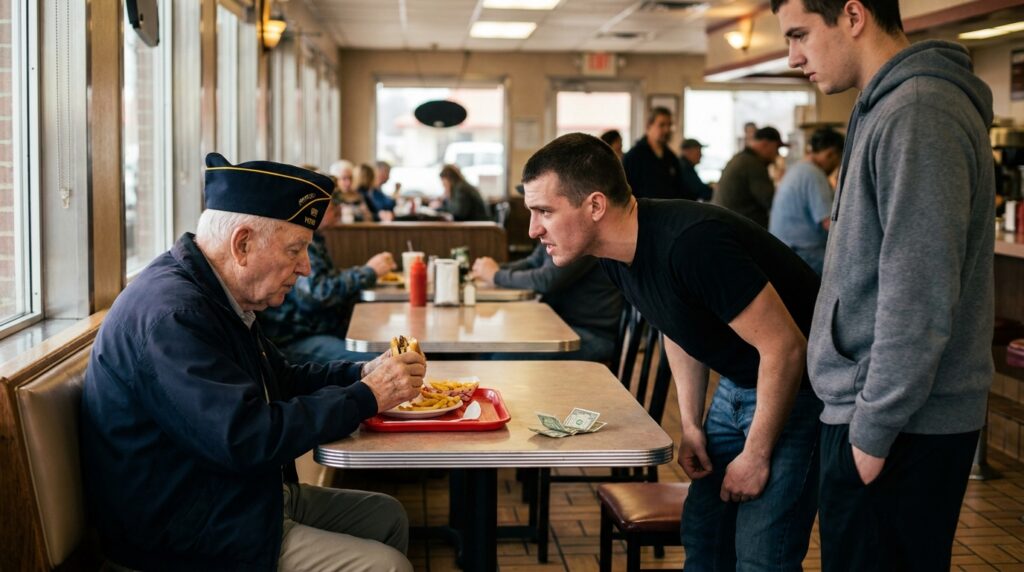
The black t-shirt smelled of cheap polyester and unearned adrenaline, and it was currently hovering exactly fourteen inches from Thomas McCall’s left eye.
Thomas didn’t look up from his plate. He didn’t adjust his posture in the low-backed vinyl booth, though his lower vertebrae signaled a dull, familiar ache from the three-hour stretch of state highway behind him. Instead, his right thumb pressed hard against the heavy silver ring on his finger, rotating the worn insignia until the metal edge bit cleanly into the callus. He calculated the geometry of the table. Formica surface, chrome edging, four rusted iron screws securing the central pedestal to the linoleum floor. If the pedestal failed under lateral pressure, the edge would shear upward, taking his kneecap with it.
“Hey old man,” the voice above him said. It was thin, serrated with a local accent that didn’t belong to the deep valley, but to the suburbs closer to the interstate. “Move aside. This table isn’t yours anymore.”
To Thomas’s right, a second silhouette shifted. A slim youth in a gray hoodie, hands buried deep in his pockets, ankles crossed. An amateur’s stance. The hoodie meant limited peripheral vision; the crossed ankles meant a delayed center-of-gravity correction if the floor became unstable. Thomas noted them both without shifting his chin. He watched the steam rise from his half-eaten burger. The grease was cooling, forming a thin, white film along the edge of the toasted bun.
The diner had gone small-town quiet. The short-order cook behind the pass had stopped scraping the grease trap with his spatula. The sound of a stainless-steel napkin dispenser rattling three booths down was the only remaining ambient noise.
Thomas let his breath out in a slow, four-count rhythm. He didn’t want the meat to get cold, but his left shoulder was already tightening, the old nerve damage from an airfield in Ninety-Two buzzing like a dormant wire. The Challenger leaned lower, placing two grease-stained knuckles on the edge of the Formica. The wood groaned. The young man’s face was close enough that Thomas could see the faint, pale scar across his bridge—an old break from a high school gym or an undisciplined Saturday night behind a tavern.
“You deaf, pop?” the Challenger whispered. His right shoulder dropped two inches. He was loading his weight onto his back leg, preparing to reach down and grab the brim of Thomas’s navy veteran cap.
Thomas felt the shift in air pressure before the hand even cleared the edge of the table. He didn’t think about the decades between them, or the fact that his left hip required a five-minute warm-up every morning just to clear the threshold of his truck. His mind simply dropped into the gray slot where things became transactional. Force, friction, mass.
He stood up.
He didn’t slide out of the booth; he rose vertically, his sturdy frame occupying the exact center lane of the confrontation before the Challenger could complete his reach. The young man’s fingers gripped air. In the same micro-second, Thomas’s right hand snapped upward—not a punch, but a rigid, mechanical wedge that caught the Challenger’s incoming wrist from the inside out. The bone-on-bone contact made a sharp, dry crack that echoed off the acoustic ceiling tiles.
Before the Sidekick could uncross his ankles, Thomas pivoted his heel. He didn’t look at the gray hoodie. He used the Challenger’s forward momentum, twisting the captured wrist downward while stepping deep into the youth’s personal space. The Challenger’s balance vanished. His face slammed into the chrome edge of the burger tray with a heavy, wet thud, his athletic frame collapsing onto the linoleum like an unstitched sack of grain.
The Sidekick made a low, wet sound in his throat and lunged, his hands finally tearing free from his gray pockets. Thomas didn’t give him the room. He met the rush with a single, measured hip check that caught the boy mid-stride, sending him spinning backward into the salad bar cart. The cart rolled six inches, its wheels screeching against the grit, before the Sidekick went down hard across the bottom shelf, his nose leaking dark crimson onto the ice tubs.
Three seconds. The room remained locked in the same dead silence, but the air had changed. The smell of copper and split vinyl now underlay the burnt coffee.
Thomas stood perfectly upright between the two groveling bodies. His navy cap hadn’t shifted an inch. He looked down at the Challenger, whose fingers were currently tracing the greasy floorboards, searching for a leverage point that his broken equilibrium couldn’t provide. Thomas’s breathing hadn’t crossed ninety beats a minute. His right ring finger was hot where the silver had ground into his skin.
“You should have let me finish lunch,” Thomas said, his gravelly voice cutting through the diner’s freeze like a cold blade, “before testing me.”
He reached into his pocket, his calloused fingers brushing against something small, metallic, and entirely foreign that had slipped from the Challenger’s pocket during the tumble—a commercial-grade GPS tracker with an active county seal stamped into the plastic casing.

CHAPTER 2: THE ANATOMY OF A STAINED COUNTER
The linoleum floor didn’t cushion the Challenger’s landing. It met his shoulder with the dull, flat impact of unyielding plywood, the sound vibrating through the grease-filmed legs of Thomas McCall’s booth.
Thomas didn’t look down at the boy’s face. His hands remained steady, though the skin across his right knuckles was white, the old joint stiffness screaming under the sudden spike of adrenaline. He turned the metallic square over in his palm. It was lightweight, roughly the size of a matchbook, made of injected-molded polymer that had been painted matte black to avoid catching the light under a vehicle’s frame. On the side, beneath a layer of road grit and dried salt, was the crisp, stamped seal of the county road commission. But it had been altered. Someone had used a three-pronged tool to score a deep groove through the serial number, rendering the hardware unvouchered.
The short-order cook had his hands flat on the stainless-steel pass, his shoulders hunched as if expecting a secondary blast. A heavy ceramic mug lay on its side two booths down, dark coffee pooling toward the edge of the Formica and dripping onto the floor in a slow, rhythmic tap.
“You touched him,” the Sidekick wheezed from the base of the salad bar. He wasn’t trying to stand. His fingers were pressed against his upper lip, checking the dark, viscous smear that ran down his chin. His legs were still tangled in the lower chrome rack of the cart, a plastic bowl of grated carrots overturned across his sneakers. “You’re dead, old man. You don’t know who his family is. You don’t know what’s coming down that road.”
“I know what a state-issued transponder looks like,” Thomas said. His voice didn’t rise above the hum of the overhead compressor. It was the dry, flat tone he’d used in briefing rooms when the humidity was eighty percent and the map coordinates were already obsolete. “And I know the county doesn’t mount them to the underside of old Kawasakis with industrial zip-ties.”
He stepped out of the booth lane, his boots catching on a stray salt shaker. The weight of his seventy-eight years felt heavy in his calves, the cold air from the diner’s vestibule settling into his joints like damp iron. He didn’t check on the Challenger, who was now rolling onto his side, his breath coming in ragged, shallow gasps as his ribs reminded him of the floor’s density. Thomas walked toward the cash register at the front counter.
The waitress, a woman named Martha whose name tag had tilted sideways during the three-second commotion, was clutching a plastic-bound menu against her chest like a breastplate. Her eyes didn’t fix on Thomas; they were glued to the navy veteran cap, specifically the gold lettering that had gone slightly frayed at the edges over a decade of garage work.
“I didn’t see anything, Mac,” she whispered, her chin jerking toward the back hallway where the payphone used to hang. “They’ve been hanging around the junction for three weeks. Trashing the pumps at the Sunoco. The sheriff won’t come out this far for a couple of broken lights.”
“They aren’t here for the lights, Martha,” Thomas said.
He laid the twenty-dollar bill on the rubber coin mat. The bill was crisp, folded lengthwise, the way he’d kept his currency since his first deployment. He didn’t wait for change. His hand went back to his pocket, his index finger tracing the three unique grooves carved into the tracking device. A professional tool had done that—a specialized crimping iron used by regional logistics companies to lock down fleet vehicles. It wasn’t the kind of hardware an unemployed twenty-year-old found in a scrap heap behind the high school.
Behind him, the Challenger let out a low, venomous curse, his boots scraping against the baseboard as he finally hauled his athletic frame into a sitting position against the vinyl padding of the booth. His black t-shirt was torn at the shoulder, revealing a pale stretch of skin that was already turning a deep, bruised purple where Thomas’s inner wedge had diverted his weight.
“That’s my tracker,” the boy spat, his mouth wet with saliva and dark blood from his split lip. He tried to glare through his tangled dark hair, but his eyes were wide, the pupils dilated with the erratic panic of a predator that had just discovered the fence was electrified. “Give it back, or I’ll find that cabin of yours. I know where you park that gray truck.”
Thomas stopped three inches from the heavy glass door of the vestibule. The afternoon light outside was flat, filtered through a low ceiling of grey November clouds that smelled of impending salt and diesel exhaust from the interstate five miles north. He didn’t turn his torso. He merely tilted his head slightly, letting his profile lock the boy into the frame of his peripheral vision.
“The truck has four-wheel drive,” Thomas said quietly. “And the road up to my place doesn’t have turning room for a motorcycle. Keep that in mind when your ribs stop hurting.”
He pushed the door open, the overhead brass bell giving a single, tinny ring that was immediately swallowed by the wind coming off the asphalt. The gravel lot was mostly empty, save for his own faded Dodge Ram and the high-piped Kawasaki enduro bike parked at an aggressive angle near the propane tank cage. Thomas walked with a slow, deliberate stride, his boots crunching into the crushed limestone. His left hand was already deep in his jacket pocket, his thumb running over the three-groove puncture mark on the casing.
The town below the ridge was small—four hundred souls, two auto-body shops, and an empty grain elevator that had been rotting since the railroad pulled its spikes out in eighty-eight. But someone with access to county tracking hardware was mapping the perimeters. They were checking who stayed, who left, and who was too old to move when the pressure started to lean.
He reached the driver’s side of the truck, his keys heavy in his palm. Before he inserted the steel into the lock, his eyes dropped to the rear wheel well. The black undercoating was scratched. A fresh, bright silver silver line ran along the frame rail, right where a magnetic base would have clung if someone had been moving in a hurry while he was inside eating his lunch.
CHAPTER 3: THE SHADOW OF THE CHALLENGER
The silver scratch on the frame rail was exactly six inches long, the exposed steel still bright and free of road oxidation. Someone had tried to clamp a magnetic housing to the undercarriage while the short-order cook was dropping fries into the vats. They had been clumsy with the placement, tearing through the factory rubberized undercoating before losing their grip.
Thomas didn’t climb into the cab immediately. He stood in the gap between the open driver-side door and the body panel, using the rusted metal as a partial shield for his torso while his eyes swept the perimeter of the gravel lot. The wind was picking up from the north, whistling through the empty propane cage and rattling the plastic sign above the Sunoco pumps across the two-lane state highway. A black pickup truck—a late-model commercial vehicle with heavy-duty leaf springs—was idling near the edge of the tree line three hundred yards down. Its headlights were dark, but the exhaust vapor rolled thick and white from beneath the bumper, matching the steady cadence of a diesel engine that wasn’t being used for farming.
He slid his thumb over the small transponder in his pocket. The plastic edges were cold, the three-groove score mark biting into his skin. They weren’t just monitoring the highway corridor; they were hunting for specific coordinates, and his faded Dodge Ram was now firmly on the grid.
He pulled himself into the driver’s seat. The springs in the old bench groaned under his weight, a sharp contrast to the silent, oiled efficiency of the tactical transports he used to map out in the sand. He turned the key. The starter motor clicked twice before the old V8 caught with a ragged, heavy rumble that shook the steering column. He adjusted the rear-view mirror. Inside the diner’s glass vestibule, the shadow of the Challenger was visible, leaning against the cigarette machine while Martha wiped down the counter with frantic, short strokes. The young man wasn’t watching the floor anymore; he had a phone pressed to his ear, his lips moving rapidly as his eyes stayed locked on the truck’s rear license plate.
Thomas shifted into reverse, the transmission dropping into place with a mechanical clunk. He backed out slowly, his boots precise on the worn rubber pads of the pedals. He didn’t accelerate hard into the turn. A hasty exit was a signature—a piece of behavioral data that told the watchers exactly how much they had rattled him. He wanted them to see a seventy-eight-year-old retired laborer driving a fifteen-year-old utility vehicle at exactly twenty-five miles per hour.
As the truck cleared the gravel apron and settled into the right-hand lane of Route 9, the black diesel pickup at the tree line clicked its running lights on. Amber rectangles broke through the grey afternoon gloom. The truck pulled onto the macadam, maintaining a consistent gap of five hundred yards, its nose heavy and stable against the crosswind.
Thomas kept his eyes on the road ahead. The highway carved through a limestone cut where the hills had been blasted out thirty years ago to make room for timber haulers. The rock walls were black with weeping groundwater, long icicles beginning to form in the deep crevices where the sun never reached. His cabin was seven miles up the ridge line, past the old lumber mill that had been sold off to a holding company out of Delaware three years back.
He reached into the glove box without dropping his gaze from the center line. His fingers bypasses the old maps, the vehicle registration, and the spare fuses until they found the heavy, cold cylinders of his old brass micrometer. He pulled it out, setting it on the bench seat beside the stolen transponder. He needed to measure the width of the three-groove puncture mark on the casing. Every machining tool left a unique signature—a microscopic variation in the die width that could be traced back to a specific batch of industrial crimpers. If the tool belonged to the county road commission, the groove would measure exactly four point two millimeters. If it belonged to a private security firm or an industrial engineering outfit, the footprint would tell him who bought the block.
The rearview mirror showed the amber running lights approaching the limestone cut. The diesel wasn’t gaining speed, but it was positioning itself on the crown of the road, blocking any oncoming traffic from passing. It was a boxing maneuver—a standard tracking protocol designed to herd a target into a predictable cul-de-sac before the secondary units moved into position at the flanks.
Thomas reached the turnoff for the old mill road. The asphalt ended here, replaced by packed shale and frozen red clay that wound upward through the dead hemlocks. He flipped his turn signal on, letting the amber light click three times before he turned the wheel. He wanted the diesel to know exactly where he was going. He wanted them to think he was heading for the security of his own porch, where the trees grew thick and the clear sight lines vanished.
As the rear wheels hit the shale, the truck kicked up a small cloud of white dust that hung in the damp air like smoke. Thomas glanced at the micrometer on the seat. The small steel dial was vibrating against the vinyl, its metric increments glinting under the dashboard’s green illumination. He didn’t need the tool to know the truth. The scratch on his own frame rail had been done by the same tool that defaced the transponder. They had already mapped the valley. Now, they were just waiting to see who would try to hold the line when the real pressure arrived.
A mile up the grade, where the hemlocks closed in and the light died completely, a heavy steel cable was strung across the access gate of the old mill. It hadn’t been there when he drove down at ten this morning. Attached to the center of the cable was a fresh, bright yellow aluminum sign, its bolt threads unrusted, bearing the emblem of the same regional logistics firm that supplied the county’s fleet.
CHAPTER 4: THE THRESHOLD OF INTERDICTION
The steel cable didn’t yield. It was a one-inch braided industrial line, anchor-bolted into the split trunks of two mature hemlocks on either side of the old mill gate. The bright yellow aluminum sign hanging from its center shivered in the northern draft, its unweathered edges throwing back a sharp, geometric glint that didn’t belong in these woods.
Thomas brought the truck to a halt six inches from the barrier. He didn’t drop the engine into park; his right boot stayed heavy on the brake pedal, feeling the low, rhythmic shudder of the V8 vibrating through the floorboards. In his rearview mirror, the amber running lights of the black diesel pickup stopped three hundred yards down the hill, its nose angled toward the left shoulder to block the retreat. They were checking his reaction time. They wanted to see if seventy-eight years of bone and cartilage would panic, break formation, or turn the wheels into the ditch.
He didn’t touch the steering column. His left hand reached down, his fingers wrapping around the cold, brass stem of his micrometer on the seat. With his index finger, he pushed the stolen transponder against the brass gauge, sliding the vernier scale until the steel jaws nipped the edges of the three-groove puncture mark. Four point two millimeters. Exactly.
The tool that had defaced the county property was the same heavy-duty crimping iron used to seal the corporate freight locks down at the rail spur. The kids in the diner hadn’t bought that hardware at a surplus store. They were field assets, hired to establish a localized perimeter, and this gate was the line where the data collection ended and the enforcement began.
A figure stepped out from behind the yellow aluminum sign. It wasn’t the Challenger, but a man older, thicker, wearing a dark canvas field jacket that lacked any commercial branding or service patches. He carried a clipboard in his left hand, his right thumb hooked under the heavy leather belt of his trousers. His boots were clean, unspotted by the red clay that lined the ditches of Route 9. An out-of-town supervisor.
“Road’s closed, neighbor,” the man said. He didn’t yell; his voice carried across the truck’s hood with the flat, institutional drone of an insurance adjuster or a structural auditor. He walked to the driver-side window, his soles crunching deliberately on the shale. “Structural decay on the upper culvert. County logistics took over the easement twenty minutes ago.”
Thomas rolled the window down three inches. The cold mountain air cut through the gap, carrying the smell of raw diesel exhaust and wet, rotting bark. He kept both hands visible on the rim of the steering wheel, his thumbs hooked loosely over the horn ring.
“The culvert has a steel corrugated bed,” Thomas said, his voice flat, gravelly, and entirely lacking in conversational grease. “It was rated for forty tons when the county laid it in ninety-four. It doesn’t decay in twenty minutes.”
The man with the clipboard smiled, though his eyes remained fixed on Thomas’s navy veteran cap, scanning the gold-threaded letters as if checking them against a roster. “The paperwork says otherwise. We have an injunction to clear the ridge line for a grid upgrade. All private access points north of the junction are under temporary containment. You’ll need to turn that rig around and head back to the interstate.”
“There isn’t turning room on this grade for a long-bed,” Thomas said.
“Then you’ll have to back it down,” the supervisor replied, his fingers tapping a slow, rhythmic pattern against the aluminum frame of his clipboard. “The driver behind you will give you all the clearance you need. He’s very accommodating about relocations.”
Thomas looked past the man’s shoulder. Beyond the hemlocks, where the old mill’s gravel sorting yard opened up, three industrial flatbed trailers were parked in a neat, diagonal row. They weren’t loaded with timber or gravel. They carried heavy, modular steel fencing sections and pre-fabricated security kiosks—the kind used to establish rapid, military-grade perimeters around commercial demolition zones or contested resource extractions. A corporate land-clearance package, fully unboxed and waiting for the local population to be drifted out of the valley by petty harassment.
The decoy secret was right there on the clipboard—a printed county maintenance order with a forged signature from the district engineer, authorized by the same logistics firm that held the tracking contract. They wanted the town to think this was a standard state utility upgrade, a bureaucratic inconvenience that would make the old holdings unlivable until the deeds were surrendered for pennies. But they hadn’t accounted for the metric scale on a brass micrometer.
“I left twenty dollars on the mat at the diner,” Thomas said, his fingers tightening on the wheel until the old leather cover creaked. “That covers the meal and the wear on the floorboards. I don’t like leaving a ledger open.”
The supervisor’s smile went rigid. He took a half-step back from the door panel, his hand dropping away from his belt line as his eyes signaled something toward the black pickup truck idling down the slope. “You’re making an error in calculation, Mr. McCall. This isn’t a local dispute. The valley is already accounted for on the balance sheets. You’re just a line item that hasn’t been cleared yet.”
“I’ve been a line item before,” Thomas said quietly.
He didn’t wait for the supervisor to counter. His right foot transitioned from the brake to the accelerator in a single, sharp punch, while his left hand slammed the heavy iron transfer-case lever forward into four-wheel-drive low. The front axle engaged with a dry, metallic thud that rattled the dashboard. The truck didn’t surge forward into the cable; instead, Thomas dialed the steering wheel hard to the left, using the low-gear torque to force the heavy steel bumper into the soft, rotting loam of the embankment.
The truck tilted fifteen degrees, the left fender scraping through the dry hemlock brush with a sound like tearing tin. The maneuver wasn’t a retreat; it was a tactical displacement. By occupying the high side of the ditch, he took away the black diesel’s primary line of approach, forcing the vehicle behind him to choose between a head-on climb through the clay or a blind reverse down the rock cut.
Through the side window, Thomas saw the supervisor reach into his canvas jacket, his hand emerging with a heavy, black radio casing. But Thomas was already moving past the gate line, the truck’s undercarriage grinding over a hidden limestone shelf as he drove deeper into the shadow of the mill yard.
CHAPTER 5: THE LOCKOUT PROTOCOL
The side mirror shattered first. A thick, unyielding hemlock bough swiped the chrome housing from the driver’s side door panel with a dry, explosive snap, spraying jagged fragments of silvered glass across Thomas’s left sleeve. He didn’t blink. His boots remained braced against the floorboards, his right heel maintaining constant, heavy pressure on the accelerator pedal as the old Dodge tore a path through the brush.
The tires screamed against the hidden limestone shelf beneath the loam, throwing up a rooster-tail of black mud and broken stone that pounded against the undercarriage like shrapnel. Behind him, the supervisor’s radio was a faint, metallic hiss through the open window, quickly drowned out by the sudden roar of the black diesel truck down the grade. They weren’t maintaining their distance anymore. The amber running lights plunged into the ditch line, the heavy front bumper of the commercial rig leveling the saplings as it attempted to cut across the angle of Thomas’s ascent.
Thomas checked his clearance. The gap between the corner of the rotting mill shed and the stacked trailers of modular steel fencing was exactly nine feet. His Ram was eighty-four inches wide from fender to fender. He had six inches of grace on either side, provided the steering rack didn’t slip on the wet shale.
He didn’t lift his foot. The truck cleared the corner of the shed with a high, metallic shriek as the rusted bedside rubbed against the corrugated iron siding. The impact pulled the steering wheel three degrees to the right, but Thomas countered with his forearms, his old muscles locking into place with the rigid precision of an engineering vise. The truck dropped down into the flat expanse of the mill yard, its suspension bottoming out against the rubber bump stops with a bone-jarring crash.
The yard was dead quiet, but it was organized like a staging base.
Thomas rolled the truck to a halt behind a mountain of rotting cedar ties, shielding his engine compartment from the entrance lane. He kept the motor running, the V8 gasping for air through a filter now choked with leaf dust and pulverized limestone. He reached across the bench seat, grabbed the brass micrometer, and shoved it into his jacket pocket next to the transponder. Then he reached under the seat, his calloused fingers wrapping around the cold, knurled handle of a forty-year-old steel pry bar.
He didn’t look back to see if the diesel had cleared the ditch. He stepped out of the cab, his boots hitting the hard-packed gravel with a dry crunch. His left hip seized for a fraction of a second, a sharp reminder of the fifteen-degree tilt of the embankment, but he forced the weight onto his heel, deadening the nerve.
The pre-fabricated kiosks inside the yard weren’t empty. Two more men in canvas coats were unboxing a heavy, commercial satellite receiver from a wooden crate, its high-gain dish already aimed at the low southern horizon. They had three-groove industrial crimping tools hanging from their equipment belts—the exact same tool signature that had scored the stolen transponder and his own truck’s frame rail.
“Hey! Get back in the vehicle!” one of the technicians yelled, dropping a coil of coaxial cable onto the gravel. He reached for his belt, his fingers wrapping around the grip of a heavy-duty industrial zip-tie dispenser.
Thomas didn’t answer. He walked past them toward the generator shed, his gaze locked on the main electrical junction box that fed the mill’s remaining overhead lights. The decoy secret had broken wide open. This wasn’t a county road upgrade, and it wasn’t a temporary utility containment. They were setting up an independent regional monitoring hub—a communications block designed to blind the valley’s communication lines before the heavy machinery arrived to level the old homesteads.
But as he reached the metal casing of the junction box, a cold realization settled into his chest, shattering the simple logic of the decoy.
The main ledger on the junction box didn’t belong to a private logistics firm. Stenciled across the gray enamel door in faded state-department ink was his own old unit designation from the ninety-two logistics command—a specific, deactivated logistics engineering battalion that had supposedly been wiped from the federal registry thirty years ago. The signature on the primary inspection tag wasn’t a forgery. It was a genuine, authorized military clearance stamp from an officer he had personally served under three decades ago.
The private security firm wasn’t invading the valley. They were occupying an old, unvouchered federal easement that Thomas himself had mapped out during his final year of active duty. They had used his own historical coordinates to track him down.
The sound of the black diesel truck breaking through the hemlock brush behind the cedar ties shattered his focus. The commercial rig didn’t stop behind his vehicle; it rammed the rear bumper of the Dodge with a sickening crunch of folding steel, driving Thomas’s truck three feet forward into the generator wall.
The impact tore the line from his hand, the iron pry bar clattering against the gravel. Thomas spun on his heel, his back pressing against the cold, stenciled steel of the junction box as the supervisor from the gate line stepped into the yard, his heavy radio unit raised to his mouth.
“The asset is pinned,” the supervisor said into the receiver, his eyes locking onto Thomas’s navy cap with a cold, triumphant certainty that had nothing to do with county paperwork. “Lock the secondary gate at the highway. The surveyor’s ledger is complete.”
CHAPTER 6: THE SETTLEMENT OF COLD ACCOUNTS
The reverberation of the crash tore upward through Thomas’s spine before the sound of splitting sheet metal even registered in the thin air of the yard. The heavy steel bumper of his Dodge Ram buckled inward, the frame rails groaning as the five-ton weight of the black diesel truck pinned it squarely into the generator shed’s concrete footing.
Thomas didn’t waste time checking the alignment of his chassis. He rolled his weight to the left, his shoulder blades scraping the raw zinc plating of the junction box door as a shower of shattered fiberglass from his truck’s tailgate rained down over his boots. His hand struck the ground, his knuckles scraping the jagged gravel before his fingers locked back onto the handle of the dropped iron pry bar.
The supervisor with the radio didn’t approach him. He stepped backward into the shadow of the pre-fabricated kiosk, his canvas sleeve clearing his waistline to reveal a compact, non-military sidearm holstered flat against his ribs. He wasn’t a county clerk, and he wasn’t a standard private security guard. His posture was balanced, his weight lowered slightly to maintain structural leverage against the unstable shale floor.
“You’re thirty years outside your operational box, Mr. McCall,” the supervisor said, his voice completely flat over the high-pitched static whine of the satellite unit behind him. “The easement was cleared on the ledger before you drove down the ridge this morning. The county line is a corporate blind spot now.”
Thomas didn’t move his chin. He watched the driver’s side door of the black diesel open. A thickset man in an identical canvas jacket stepped down onto the running board, his boots crushing a discarded cable tie. He carried a heavy-duty industrial bolt cutter across his chest, the hardened steel jaws already aligned with the padlocks of the main transformer housing. They weren’t trying to destroy the infrastructure; they were prepping the yard for hot-wire integration into the regional network.
“The inspection stamp on this box was signed by Colonel Vance,” Thomas said. His gravelly voice stayed steady, his breathing holding at eighty-five beats despite the sharp burn in his left hip. “The ninety-two logistics battalion didn’t leave an open ledger on this ridge. We closed the file when the lines were re-routed to the valley.”
The supervisor didn’t move his eyes from Thomas’s navy cap. “Vance passed away in an administrative center in Arlington five winters ago. His signature belongs to the holding company now. Every coordinate he mapped out between Route 9 and the interstate is private corporate asset. You’re sitting on a line item that has already been liquidated.”
Thomas evaluated the geometry between his boots and the technician at the satellite dish. The distance was exactly eleven feet. The technician was holding a torque wrench, his focus pinned to the vertical angle of the receiver arm. If Thomas swung the iron bar low, he would hit the base of the aluminum tripod, causing the satellite dish to tilt six degrees off its orbital path—breaking the active communication link with the regional office before the data transmission could clear the buffer.
He didn’t announce the strike.
Thomas shifted his center of gravity forward, his worn leather soles gripping the oil-slicked gravel as he unleashed a single, short-arc horizontal sweep with the iron bar. The tip of the bar struck the lower zinc bracket of the satellite mount with a sharp, metallic ping that echoed off the shed walls. The aluminum leg buckled instantly, the heavy dish groaning as it sheared its nylon guide pins and dropped three inches into the gravel, the static on the technician’s monitor exploding into a loud, flat line of gray snow.
The technician swore, dropping his wrench into the dirt as he scrambled backward from the falling array.
Before the supervisor could draw his sidearm from beneath his canvas coat, Thomas stepped into the gap, using the mass of the collapsing satellite housing to screen his silhouette. He didn’t look back at his pinned truck. He knew the V8 was dead, the radiator core smashed flat against the fan blades by the force of the diesel’s impact. The only exit lane left was the narrow, rocky footpath that cut through the old logging flume behind the generator shed—a steep, vertical grade where no four-wheeled vehicle could pursue.
“McCall!” the supervisor shouted, the flat institutional drone finally cracking as the radio in his left hand began to emit a rapid, multi-frequency alert tone from the regional hub. “The gate at the highway is locked. You have nowhere to take that file.”
Thomas didn’t look over his shoulder. He reached down and tore the printed county maintenance order from the clipboard that had fallen during the technician’s scramble. His thumb pressed against the genuine military clearance stamp on the paper, his skin feeling the slight indentation of the old steel die. It wasn’t a copy. It was an original document from the ninety-two files, stolen from a federal archive before the holding company took the valley.
He hit the edge of the tree line, his boots sinking into the wet, cold hemlock needles as the darkness of the mountain slope swallowed him. Behind him, the diesel engine roared again, its tires spinning uselessly against the loose shale of the mill yard as it tried to back away from the smashed frame of his old truck. They had the ground, but they had lost the data stream. And Thomas McCall was still calculating the distance back to the junction.
CHAPTER 7: THE RECKONING AT THE LINE LIMIT
The hemlock needles didn’t cushion the drop. They were frozen into rigid, jagged mats that tore at the knees of Thomas McCall’s trousers as he slid down the first sixty feet of the flume bed. The sheer incline forced his center of gravity low, his boots carving deep, ragged tracks through the dark shale before his heels locked against an exposed limestone root.
He didn’t check his breath. His fingers were already tightening around the edges of the stolen maintenance order, the paper crumpled against the metal body of the tracking receiver in his pocket. Below him, the forest floor opened into the flat, gravelly shoulder of Route 9, where the asphalt split the ridge from the lower valley floor. The diner was three miles south, its lights a tiny, weak amber smudge against the heavy gray bank of incoming sleet.
The tracking frequency on the handheld receiver didn’t hiss; it emitted a single, high-pitched metallic click every four seconds, indicating a localized sweep pattern coming from the mill yard behind him. They weren’t tracking his truck anymore. They were tracking the transponder code stamped into his old unit file—the legacy blueprint he had spent his forty-third year mapping out under orders that had officially ceased to exist.
He reached the base of the cut, his joints stiffening as his boots met the hard, unyielding level of the macadam shoulder. The wind off the blacktop smelled of old oil and raw salt. Across the lane, parked squarely inside the drainage ditch to avoid visibility from the upper ridge, was the Kawasaki enduro bike from the diner lot. It was idling, its high-mounted exhaust pipe puffing short, gray feathers of carbon into the weeds.
Leaning against the fork tubes was the Challenger.
His black t-shirt was covered in white limestone dust from the diner floor, his jaw swollen where the original wedge strike had redirected his momentum. He didn’t have his phone out. His hands were tucked inside a heavy utility belt he’d taken from the storage racks behind the mill—a belt lined with the same three-groove crimping tools and modular locking pins that had sealed the gate.
“The supervisor said you’d hit the flume line, Mac,” the boy said. His voice was thin, reedy from the cold, but his footing was wide, his weight distributed evenly across the balls of his sneakers. He wasn’t playing the amateur now; he had been placed at the intercept point because his mass was sufficient to delay a seventy-eight-year-old veteran until the black pickup truck could clear the shale gate. “The ledger is closed at the office. You don’t have the mileage left to get these sheets to the county seat.”
Thomas stepped onto the asphalt lane. His left hand remained deep in his pocket, his index finger pressing the power toggle on the tracking receiver until the screen went black, cutting the signal loop. He didn’t look at the bike’s engine block. He looked at the boy’s shoulders—specifically the slight, left-side drop that indicated an unhealed rib fracture from their three-second encounter at the booth.
“The county seat doesn’t have a file for this ridge,” Thomas said, his voice dropping into that gravelly, institutional register that had nothing to do with age and everything to do with terrain command. “They never did. The holding company didn’t buy this ground from the engineers. They bought the registry keys from someone who wanted the old grid wiped before the auditors arrived.”
The Challenger didn’t lunge. He took a single, calculated step to the right, his boots clicking on the frozen macadam, keeping his shadow directly across Thomas’s line of approach toward the highway junction. “It doesn’t change the printout. The equipment is already on the trailers. The fencing goes up at midnight.”
“The fencing is forty-ton modular zinc,” Thomas said, his eyes locking onto the small, silver identification plate riveted to the Kawasaki’s frame rail beneath the tank—a plate stamped with the same 1992 ordnance registry code as the junction box at the mill. “It requires a three-phase generator to carry the current. You don’t have the line cleared for that kind of load unless you use the old subterranean easement we laid under the Sunoco lot.”
The boy’s smirk vanished, the skin around his bruised mouth tightening until the pale break across his nose went white. “You’re an old man who eats lunch alone at a broken counter. You don’t own the dirt.”
“I drew the line,” Thomas said quietly.
He moved before the boy could adjust his balance. It wasn’t the explosive rush of a twenty-year-old athlete; it was a cold, mechanical step-through that eliminated the distance between their frames before the Challenger’s right arm could clear his utility belt. Thomas’s right hand didn’t strike; his forearm formed a rigid, diagnostic bar that caught the boy’s collarbone from below, utilizing his own upright mass to leverage the Challenger backward against the padded seat of the enduro bike.
The motorcycle tipped six degrees before the kickstand bit into the soft shale of the ditch, the iron metal giving a sharp, dry ping as the weight settled. The Challenger gasped, his fingers clawing at Thomas’s canvas sleeve, but the old man’s grip was locked into the fabric of the black t-shirt, his thumb pressing directly into the nerve cluster beneath the collarbone until the boy’s knees went slack.
With his left hand, Thomas reached down and tore the master ignition key from the bike’s triple clamp, along with the magnetic utility fob that swung from the brass ring. The fob was stamped with the terminal clearance code for the regional land registry—the physical key needed to unlock the digital file that masked the military easement as an abandoned utility strip.
The sound of the black diesel truck braking at the top of the flume cut signaled the end of his grace period. The heavy commercial headlights caught them both in two long, bright rectangles of amber light that turned the falling sleet into a silver screen.
Thomas stepped back from the bike, his boots perfectly balanced on the white center line of Route 9. He didn’t drop his chin, and he didn’t run. He looked up at the ridge, where the supervisor’s silhouette was visible against the glare of the high beams, his radio unit still raised to his mouth like an unheeded warning.
The ledger wasn’t open anymore. Thomas McCall had the coordinates, he had the validation stamp, and he had the physical key to the network. He slid his leg over the saddle of the idling Kawasaki, his old joints cracking once under the cold steel, before he twisted the throttle and let the rear tire bite the asphalt, heading south toward the junction where the true map of the valley would finally be restored.
CHAPTER 8: THE INTERCEPTION OF THE SYSTEM FREQUENCY
The front tire of the Kawasaki didn’t bounce when it hit the transition line of the Sunoco lot; it gave a single, sharp clack against the broken concrete edge before settling into the grease-blackened gravel. Thomas McCall killed the ignition before the bike’s momentum had fully died, letting his boots drag through the frozen slush to check his slide.
The station had been closed since the winter of ninety-eight, its single rusted island hosting two old mechanical pumps whose glass sight-globes had long since been spider-webbed by local stones. But the structural grid beneath the station was unvouchered. It was the only point in the lower valley where the old copper trunk lines of the ninety-two logistics battalion’s fuel conduit intersected with the state telephone easement.
Thomas swung his leg over the saddle, his knee joint snapping with a sound like dry kindling in the quiet afternoon. The wind off the highway brought the distant, rhythmic thrum of the black diesel truck clearing the limestone cut two miles behind him. They had his track. They knew the Kawasaki’s displacement, and they knew the fuel tank on an enduro bike didn’t carry enough mileage to reach the county line without crossing one of the three monitored valley bridges.
He walked toward the service bay door, his hand deep in his canvas jacket, his fingers locked around the magnetic utility fob he’d torn from the Challenger’s belt.
The padlock on the station’s side office didn’t require the pry bar. Thomas pressed the flat edge of the corporate fob against the electronic deadbolt housing that had been newly bolted to the weathered oak casing. The unit wasn’t county property; it was a high-frequency digital relay lock, its small LED screen blinking through a rapid sequence of amber numeric strings before giving a sharp, internal click. The latch gave way.
Inside, the room smelled of damp cardboard, ancient hydraulic fluid, and the sharp, hot ozone tang of an active transformer unit.
Thomas didn’t turn on the overhead fluorescent tubes. He didn’t need the illumination to find the trapdoor beneath the oil-drum rack in the corner. He used his boots to kick aside three empty plastic jugs of gear oil, revealing the heavy cast-iron plate of the clean-out port. This was where the legacy engineers had installed the primary terminal block—an isolated communication junction designed to monitor the underground storage pressure during the ninety-two logistics freeze.
He dropped to his knees, his denim trousers soaking up the cold condensation from the concrete floorboards. His hands moved mechanically, his fingers tracing the edge of the iron plate until they found the three-groove security bolts that sealed the casing. He didn’t have the official wrench, but he had the metric jaws of his brass micrometer.
He adjusted the micrometer’s dial to exactly four point two millimeters, sliding the hardened steel jaws over the first bolt head and applying lateral pressure until the old threads broke with a dry, metallic report that sounded like a pistol shot in the small office.
“Two minutes,” he muttered to himself, his internal clock counting down the transit time of the black diesel pickup on the grade.
He cleared the remaining three bolts, lifting the heavy iron lid to expose the core. Inside the dry zinc cavity, the original military terminal block remained intact, its copper lugs green with verdigris but untouched by the regional utility crews. But someone had spliced into the trunk line. A fresh, bright orange fiber cable was tucked into the conduit, its internal laser pulsing with a faint, rhythmic crimson light that matched the frequency of the satellite array up at the mill.
They were tapping the legacy land records in real time, routing the original geographic deeds through the Sunoco junction to overwrite the old unvouchered boundaries before the state archives could run their weekly sync.
Thomas reached into his pocket and pulled out the handheld receiver, its screen still dead from the toggle switch. He didn’t turn it on; instead, he used the secondary interface cable from the Challenger’s kit, snapping the modular lead directly into the terminal’s diagnostic bus line. The monitor on the receiver didn’t show a standard operating system. It flickered into life with the green, blocky text of an old federal database—the 1992 logistics asset register, signed by Colonel Vance.
The ledger was open on the screen, the data lines scrolling past in long columns of coordinate values. One specific block—Section 14, the ridge line where his own cabin stood—was flashing red, its designation code currently being modified from Federal Easement: Reserved to Industrial Utility Block: Liquidated.
Behind him, the shadow of a vehicle’s high beams swept across the grease-filmed windows of the service bay, turning the dark corners of the room into long, shifting wedges of gray light. A heavy engine was downshifting at the apron, its exhaust brakes snapping like firecrackers as it transitioned from the macadam to the gravel lot.
The supervisor hadn’t waited for the bridge containment grid to lock down. He had followed the frequency drop the moment Thomas cut the satellite link.
Thomas kept his eyes on the green screen. The progress bar for the local data overwrite was at eighty-four percent. If the line stayed active for another twenty seconds, the original military blueprint for the valley would vanish from the server architecture forever, leaving the holding company with a clean legal title to every acre between the ridge and the highway.
He didn’t try to download the file. He didn’t have a storage disk large enough to carry thirty years of geographical data. Instead, he took the brass micrometer from his pocket, opened the jaws to their maximum width, and drove the hardened steel edge directly into the center of the orange fiber splice, shearing the glass core cleanly against the copper frame of the terminal box.
The green monitor went black instantly. The crimson pulse inside the hole died, replaced by a low, rhythmic alarm tone that began to emit from the electronic deadbolt on the office door. The network loop was broken, but the lock was now sealed from the outside, and the sound of heavy boots was already approaching the glass panel of the service door.
CHAPTER 9: THE CONFLATION OF BOUNDARIES
The high-frequency chime of the digital deadbolt didn’t stop. It was a rhythmic, three-tone loop that vibrated through the frosted glass panel of the office door, signaling a localized breach to the regional server hub up the mountain.
Thomas didn’t pull his hand back from the severed fiber line. He held his position on the cold concrete, his fingers absorbing the faint, residual heat of the copper junction lugs while his eyes mapped the room’s single secondary exit—a high, rectangular transom window above the old tire-changing machine. The opening was twenty-four inches wide, heavily encrusted with dried salt and thirty years of airborne oil mist. It was a narrow aperture for a seventy-eight-year-old frame, but the main door was already dead-locked from the outside by the system’s emergency protocol.
Outside, the gray gravel lot was completely flooded with the stark, white glare of the black diesel’s high beams. The light cut through the dirt-rimed windows, projecting long, geometric shadows of the rusted fuel pumps directly across the office walls.
“McCall,” a voice called out from the apron. It was the supervisor from the gate line. His tone had lost its institutional neutrality, replaced by the flat, transactional weight of an enforcer whose timeline had just been compressed. “The link to the regional database went dark twenty seconds ago. You’re holding a dead terminal. Step away from the port and unlatch the panel.”
Thomas rose with slow, deliberate economy, his left hand shifting the crumpled county maintenance order into the inner pocket of his canvas coat. His boots made no sound on the oil-blackened floorboards. He didn’t answer the demand. Dialogue was a variable that only served to confirm a target’s precise vector inside an enclosed space, and the supervisor was already positioning himself on the blind side of the door frame.
Through the glass, the shadow of the supervisor’s dark canvas coat lengthened. He wasn’t using his radio now; the heavy clicking of his utility belt signaled that he was unhooking a mechanical override key from his side loop.
Thomas didn’t look at the deadbolt. He stepped toward the tire-changing machine, his calloused palms pressing against the cold, greasy iron of the turntable to establish a base of leverage. His left hip gave a brief, sharp pinch as he lifted his right boot onto the rusted rim clamp, using the machine’s structural weight to hoist his torso toward the transom window. The metal beneath his heel groaned, but it held.
He reached up, his fingers catching the zinc-plated latch of the window frame. It was frozen shut by decades of oxidation and winter condensation. He didn’t strike the glass; a fracture would spray silver fragments into the gravel lot, giving the spotters outside an immediate sound anchor. Instead, he took the brass micrometer from his pocket, using the heavy, hardened steel barrel of the tool as a wedge, driving it directly into the seam between the sash and the iron frame.
The frame budged with a dull, wooden crack.
Behind him, the digital deadbolt emitted a prolonged, flat tone as the supervisor’s manual override key engaged the cylinder. The iron bolt slid out of the striker plate with a heavy mechanical thud.
Thomas didn’t look back to check the door’s clearance. He shoved his head and shoulders through the narrow transom opening, the rough timber frame tearing at the fabric of his navy veteran cap as his weight tilted forward into the freezing air behind the service bay. The smell of rotting hemlock needles and stagnant drainage water met him instantly, a sharp contrast to the ozone-heavy heat of the office interior.
He rolled his hips through the gap, his boots swinging clear of the tire machine just as the supervisor’s heavy boots breached the threshold of the office below. The fall was short—four feet into a ditch lined with crushed limestone and frozen briers—but the impact vibrated through his shins like a hammer blow, sending a dull ache into his lower vertebrae.
He didn’t drop his chin. He stayed low in the ditch, using the rotting timber wall of the station’s old oil-storage shed to screen his profile from the gravel lot.
Inside the office, the supervisor’s flashlight beam cut through the transom window, the white circle of light sweeping the hemlock branches above Thomas’s head before dropping down to trace the deep boot prints in the frozen mud.
“He went through the north flume lane,” the supervisor said into his shoulder microphone, his voice muffled by the thick timber walls. “He’s on foot, carrying the manual registry keys. Activate the secondary containment grid at the second bridge crossing. He has to clear the culvert line if he’s heading for the district administrative terminal.”
Thomas reached down, his fingers checking the pocket of his jacket. The tracking receiver was still cold and dark, its diagnostic cable trailing through the weeds like an uncoiled wire. But the magnetic utility fob—the physical key to the land registry server—was still securely wedged between his silver ring and his palm.
He looked down the slope. The second bridge crossing was a single-lane concrete span that cut across the creek exactly half a mile below the Sunoco station. It was the only structural link between Route 9 and the county highway corridor. If they locked the steel gates there, the valley would be completely sealed, transforming the old military easement into an isolated corporate enclave before the morning sun could hit the ridge.
Thomas cleared his throat, spitting a trace of diesel soot into the briers. He didn’t look for his truck, and he didn’t check the road behind him. He adjusted the navy cap squarely on his white hair, his boots finding the hard, frozen edge of the culvert line as he began his descent into the dark throat of the valley.
CHAPTER 10: THE RESTORATION OF THE SURVEYORS LEDGER
The frozen mud at the culvert’s lip didn’t give way until Thomas McCall placed his full weight on his left heel, the hard crust fracturing with a dry snap that sent a vibration straight up his hip joint. He didn’t slow down his descent. He kept his torso low against the concrete bank of the drainage channel, his right hand shielding the crumpled maintenance document while his fingers tracked the cold, rectangular edge of the digital utility fob hidden in his palm.
Ahead, the single-lane concrete span of the second bridge rose out of the dark hemlock bottom like an iron-ribbed gate. They had already positioned their blockade. Two commercial utility vans were parked bumper-to-bumper across the bridge deck, their white roof-mounted strobe lights rotating through the falling sleet in a rhythmic, blinding pattern of amber and blue. A heavy steel barricade section had been chained across the pedestrian lane, its galvanized zinc links reflecting the cold glare.
Thomas didn’t drop into the ditch line. He stepped directly onto the concrete apron of the bridge approach, his boots clicking evenly against the hard-packed limestone aggregate.
Standing beside the left-hand strobe van was a man in an tailored winter overcoat that carried no company logo—the district administrative director, flanked by the supervisor from the mill gate. Between them sat a portable ruggedized server terminal, its cathode-ray tube screen humming with a high-pitched electric whine that cut through the sound of the rushing creek below.
“That’s far enough, McCall,” the director said. He didn’t use a radio or a megaphone; his voice was thin, dry, and carried the quiet arrogance of a legal team that had already filed its summary judgments at the state capital. “The district network loop is performing its final write operation. The server doesn’t have an entry lane for a legacy engineer’s objections.”
Thomas stopped five feet from the terminal table. He didn’t adjust his navy veteran cap, though the sleet was freezing into a clear, stiff glaze across the gold lettering. He looked at the green text scrolling across the director’s monitor—the Master Title Register for the entire county corridor, currently updating its encryption keys to lock out the local public records.
“The server is running on a three-phase loop that requires an unvouchered military token to authorize a title overwrite,” Thomas said. His gravelly voice didn’t rise above the idling diesel engines of the vans. He reached into his jacket pocket, his fingers extracting the brass micrometer alongside the stolen magnetic fob. “You didn’t generate those authorization blocks in Delaware. You pulled them from Colonel Vance’s administrative archive after the unit was deactivated.”
The director’s face went completely rigid under the amber strobe light, his fingers halting mid-stroke above the terminal’s keyboard. “Vance signed the easement transfers before the company took control of the infrastructure, McCall. The transaction is completely legal on the state balance sheets.”
“Vance didn’t have the clearance to sign off on Section 14,” Thomas said quietly. He stepped forward, his boots perfectly balanced on the expansion joint of the bridge. “He was a logistics administrator. I was the surveyor who laid the physical iron pins in ninety-two. The master ledger requires the precise physical width of the boundary die to unlock the core registry.”
Thomas didn’t look at the supervisor, who was currently reaching toward his canvas jacket for his sidearm. With his right hand, Thomas drove the steel jaws of his brass micrometer directly into the terminal’s diagnostic interface slot—the exact spot where the orange fiber splice had been monitored. He rotated the metric dial to exactly four point two millimeters.
The hardened steel jaws of the gauge met the internal copper pins with a sharp, blinding spark.
The green screen on the server terminal didn’t go dark; it flashed into an automated system override sequence, the corporate encryption layers cracking wide open as the physical signature of the original surveyor’s tool verified the command. The Master Title Register halted its write operation at ninety-nine percent, the red text reversing itself across the screen until the original federal easement designation emerged from the code: Section 14 – Public Trust – Unalterable.
“Shut it down!” the director screamed, his hand lunging toward the terminal’s main power toggle, but Thomas’s left arm was already in position.
His forearm locked against the director’s collarbone with a single, controlled defensive check that redirected the administrator’s weight into the side panel of the strobe van. The supervisor cleared his holster, his weapon leveling toward Thomas’s chest, but the sudden, high-decibel howl of the district emergency siren up the mountain signaled that the state administrative loop had just acknowledged the data correction. The corporate network was locked out. The original geographic blueprint of the valley was permanently burned back into the server architecture.
Thomas stepped back from the terminal table, his fingers pulling the brass micrometer cleanly from the destroyed interface slot. The gold-threaded letters on his navy cap glinted under the blue strobe lights as he looked at the two men pinned against the bridge rail.
“The line is drawn,” Thomas said, his low voice settling through the freezing sleet like iron into stone. “Think twice next time, boys.”
He turned his back on the blockade, his steady, measured footsteps carrying him away from the bridge and down the open lane of Route 9, where the lights of the town were finally beginning to clear the valley mist.







