
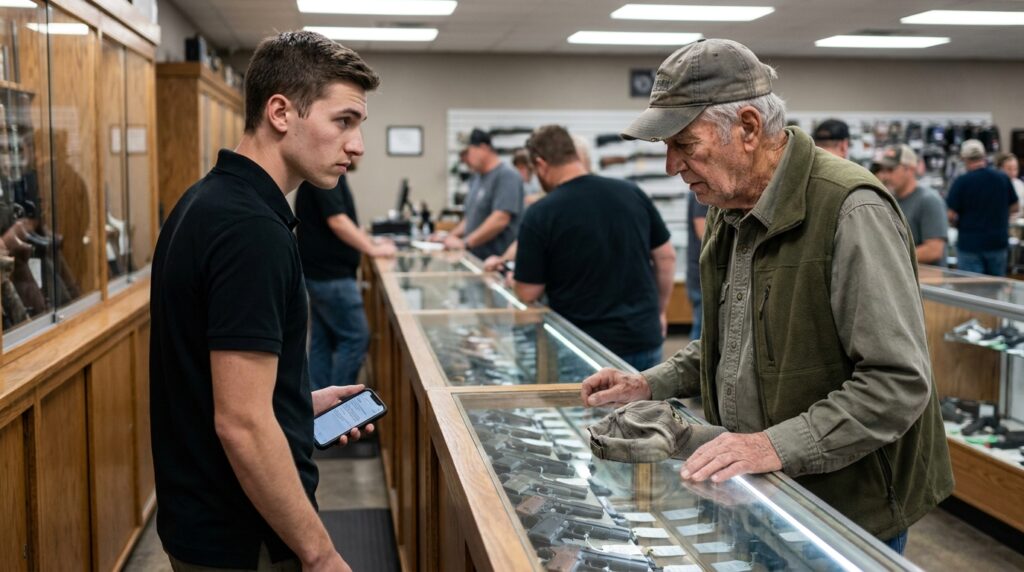
The Cold Friction of Iron and Youth Amidst the Scattered Brass of a Changing Horizon

CHAPTER 1: THE WEIGHT OF THE AGEING

“Your kind built the world just to let it rot, old man,” the youth said, his voice cutting through the heavy grease-and-solvent air of the retail shop.

Arthur did not turn around immediately. He kept his calloused thumbs resting on the edge of the glass counter, right above a row of desaturated, black polymer frames. The glass was cool, smudged with the oil of a hundred anonymous palms. In the small shop, the hum of the fluorescent lights felt heavy, vibrating against the small of his back. He took a slow breath, inhaling the familiar, sharp scent of spent iron and gun oil, letting his lungs fill before he acknowledged the presence crowding his shoulder.

When he turned, the friction of his heavy canvas vest against his flannel shirt made a dry, scraping sound.

The boy was barely twenty-two. His black polo shirt was tucked tightly into a stiff tactical belt, everything about him too clean, too sharp, like an unissued blade. His chin was tilted up, his jaw clenched to mimic the hard lines of men who had actually seen the sun go down over a broken perimeter.

“My mother learned to clear a jam before your knees gave out,” the boy sneered, leaning an inch closer, trying to occupy the air Arthur was breathing.

Arthur looked at him through eyes surrounded by deep, weathered creases—lines earned by looking into the glare of desert borders while this boy’s parents were still children. He reached into his vest pocket, his fingers brushing against the cold, rectangular edge of the tarnished brass oiler bottle he carried for weight. He didn’t pull it out. He just held it, grounding himself against the sudden, familiar heat rising in his throat.

“You should think real careful before you talk to people that way, son,” Arthur said. His voice was low, a gravelly rasp that didn’t rise in volume but filled the small space between them like stones shifting under water. “The world isn’t a screen. Actions leave scars that don’t scrub out.”

The young man didn’t blink. A small muscle twitch near his left eye betrayed the adrenaline surging through him, but his mouth remained hard. He lifted his chin a fraction higher, a public posturing for the few silent customers who had stopped browsing the rifle racks against the back wall.

“Prove it,” the boy clipped out, his hands resting loose near his hips. “Prove you’re still worth the space you’re taking up.”

The air in the room went dead and cold. Arthur felt the old, dormant machinery in his chest click over—the calculation of distance, the weight of the young man’s stance, the vulnerabilities in a soft throat and an over-extended chest. It would be clumsy now; his knuckles were swollen with arthritis, his lower back a constant ache of iron-heavy fatigue. But the desensitization was still there, an ancient, rusted tool waiting to be used.

Arthur looked at the boy’s eyes and saw no real hatred—only a desperate, starving hunger for status, a localized displacement that needed a target. He was a mirror of everything the future was becoming: undisciplined, terrified of being small, and armed with an unearned bravado.

Arthur didn’t move his hands. He let the silence stretch until the boy’s posture stiffened with the realization that he wasn’t going to get a loud, theatrical reaction.

“Go home,” Arthur murmured softly, turning his back to the boy to look down at the display counter once more. “Before you find exactly what you’re looking for.”

He heard the youth’s boots click against the linoleum floor as he stepped back, a short, sharp retreat that felt like a tactical reset rather than a surrender. Arthur didn’t look up as the shop’s front door chimed, letting in a brief gust of dry, dusty wind from the blacktop outside.

He waited three minutes, his hand still gripping the brass oiler in his pocket, before he walked out to his truck. The afternoon sun was fading, casting long, desaturated shadows across the gravel lot. He climbed into the cab, the old springs groaning under his weight, and turned the key.

As he shifted into reverse, his eyes glanced at the rearview mirror.

Tucked into the sun-bleached visor above his head was a small, handwritten receipt from his morning errands—except it wasn’t his. It was a fresh parking stub from the medical center three miles out, dated two hours ago, with a name scrawled across the back in a messy, urgent handwriting that matched the name on the young man’s embroidered shop badge.


CHAPTER 2: THE AMBUSH OF THE SHADOWS

The gravel road leading up to Arthur’s homestead was a rib-ribbon of white limestone, chewed by decades of dry frost and the heavy treads of old farm machinery. It didn’t invite visitors. The dust kicked up by his truck settled slowly in the dead evening air, coating the wild blackberry briars along the ditch in a fine, chalky powder.

Arthur kept his eyes on the rearview mirror. The medical center receipt lay on the passenger seat, its crisp white edges stark against the cracked, sun-bleached vinyl. The name scrawled on the back—Garrett Vance—was a name he didn’t know, but the handwriting was aggressive, jagged, slanting hard across the paper like a wire fence cut in a hurry.

He parked beneath the skeletal branches of the dead elm near the tool shed. When he killed the engine, the sudden silence of the valley was absolute, save for the ticking of the cooling manifold. He didn’t get out right away. He sat in the cab, his calloused palms resting on the steering wheel, feeling the subtle vibration of the old truck as it settled into the dirt.

Through the windshield, his small, single-story house looked smaller than it used to. The green paint was flaking in long, brittle curls, exposing the gray cedar beneath. It was an old structure, held together by iron nails that had turned to rust inside the wood, stubborn but decaying.

His eyes scanned the tree line at the western edge of his property, where the timber thickened into second-growth oak and pine.

There. A quarter-mile down where the county blacktop met the gravel lane, a shape sat beneath the overhang of the brush. It was a black sedan, its low profile completely out of place against the rough dirt shoulders. No lights were on. The windshield reflected the desaturated orange of the dying sun, a flat, blind glare that gave no hint of who was sitting behind the wheel.

Arthur’s hand moved back to his vest pocket, his thumb tracking the knurled cap of the brass oiler bottle. The metal was warm now, heated by his own skin.

“Still posturing,” he murmured to the empty cab.

He climbed down from the truck, his left knee popping with a dry, internal friction that made him catch his breath. He didn’t look back at the black car. Instead, he walked with a deliberate, unhurried stride toward the side door of his house, his boots crunching rhythmically in the stones. Every step was an exercise in suppressed pain, a reminder that the frame holding him up was reaching its fatigue limit.

Inside, the kitchen smelled of cold chicory coffee and old wool. He didn’t turn on the overhead light. The room was drowning in gray dusk, the shadows stretching from the corners like grease stains. He walked to the window beside the sink, careful to stay two feet back from the glass, out of the direct line of sight from the road.

He reached up to the top of the refrigerator, his fingers searching behind a stack of dusty manuals until they found the cold, heavy steel of his old service automatic. It wasn’t a modern polymer weapon like the ones in the retail shop. It was an old frame, heavy, its bluing worn down to bare, silver metal along the slide from years of friction against canvas holsters. He dropped the magazine into his palm. The brass casings of the cartridges gleamed dull in the twilight, heavy and certain.

He didn’t chamber a round. He simply slid the magazine back into the well until it clicked with a solid, mechanical finality.

Outside, the black sedan had moved.

It wasn’t speeding. It was creeping up the gravel lane, its tires turning over the stones with a slow, grinding crunch that sounded like teeth on bone. The headlights remained off. It rolled past the dead elm, its dark shape sliding through the gloom until it stopped twenty yards from Arthur’s front porch.

Through the dirty glass of the kitchen window, Arthur watched the driver’s side door swing open.

The youth from the gun shop stepped out into the dry dirt. In the fading light, his black polo shirt made him look like a shadow with a face. He didn’t have a weapon drawn, but his hands were tucked into his pockets, his elbows flared out in that same aggressive, competitive stance. He stood there for a long moment, looking at the silent house, his head tilting as if he were listening for the old man’s pulse through the walls.

Arthur didn’t move. He stood in the dark kitchen, the weight of the steel pistol balanced in his right hand, his breathing slow and shallow. The boy was hunting, but he didn’t know the terrain. He didn’t know that the porch boards were dry-rotted near the steps, or that the gravel gave away every shift in weight.

The young man took three steps toward the porch, his boots kicking up small puffs of dust that hung in the air. Then, he stopped. His eyes drifted to the bed of Arthur’s old truck.

He didn’t approach the house further. Instead, he walked over to the rear wheel well of the pickup, ducked his head down, and reached his hand up into the dark space above the tire framework. It was a quick, familiar gesture, the movement of someone checking a snare.

Arthur watched, his brow furrowing as a new calculation entered his mind. The boy wasn’t looking for a fight tonight; he was checking something else. He was confirming a perimeter.

The youth pulled his hand back, tapped the side of the truck bed twice with his knuckles—a hollow, mocking metallic sound that echoed through the quiet yard—and then turned on his heel. He climbed back into the sedan, the engine catching with a low, muffled rumble, and backed down the gravel lane without ever turning his lights on.

Arthur waited until the sound of the tires had completely died away into the main road before he moved.

He walked out onto the porch, the screen door whining on its rusted spring. The air had turned cold, smelling of iron and damp earth. He walked straight to the rear tire of his truck, knelt down on the gravel—his joints protesting fiercely—and reached his hand up into the greasy cavity above the leaf springs.

His fingers brushed against something small, rectangular, and cold. It didn’t belong to the truck. It was held fast against the frame by a heavy magnet, its tiny housing encasing a solid, red light that blinked once every five seconds.

A tracker.

Arthur pulled it free, the magnet releasing with a sharp clack. As he held it up to the faint light of the moon, he noticed a small piece of faded white tape stuck to the side of the plastic casing. Written on it in the same jagged, frantic handwriting as the medical receipt was a single word: FOUND.

He turned the device over in his hand, the small red light casting a momentary, bloody glare across his old, scarred knuckles. The boy hadn’t just followed him home by chance. He had been monitoring every stop, every turn, every mile Arthur had driven for weeks.

The realization didn’t make his hand shake, but the brass oiler bottle in his pocket suddenly felt three times heavier. The boy wasn’t just an undisciplined provocateur from a retail store. He was executing a method, and Arthur was already inside the trap.

CHAPTER 3: THE FRICTION OF THE RECKONING

The magnetic tracker felt like a cold stone in Arthur’s palm as he drove into town the next morning. He didn’t leave it under the truck frame, nor did he smash it. It sat on the dashboard, its small red eye pulsing rhythmically against the grease-filmed glass of the windshield. If the boy was watching his screen, he would see Arthur moving at his usual, unhurried pace toward the center of the valley—a predictable old machine running on a predictable schedule.

The county hardware and agricultural supplier was housed in a cavernous, corrugated iron warehouse at the edge of the rail line. The exterior sheets of metal had turned a deep, textured orange from decades of rain, the rust flaking off in brittle scales that collected in the gravel below. Inside, the air was cold, thick with the dry, powdery smell of crushed grain, commercial fertilizers, and the heavy oil used to preserve bulk logging chains.

Arthur let the heavy wooden entry door slam shut behind him, the rusted spring groaning loudly before settling into its socket. He carried a worn burlap sack under his arm, his fingers tightly laced around the neck.

He didn’t look for the boy, but he knew the black sedan was already in the lot, parked near the propane tank refill station where the shadow of the building was deepest.

He walked down the third aisle—the heavy hardware section—where the shelves were stacked with iron bolts, massive zinc hinges, and oxidized steel cables. The floorboards beneath his boots were thick oak planks, saturated with fifty years of spilled hydraulic fluid until they were near-black. The ambient sound of the warehouse was low: the distant hum of a forklift out back, the click-clack of an old ceiling fan turning lazily in the high rafters.

A shadow fell across the row of zinc wash-basins three feet ahead.

Arthur stopped. He reached out, his hand grasping a massive, six-inch iron hinge from a bin. The surface of the iron was rough, cold, unpolished. He turned it over, testing its weight, listening to the dry scrape of his thick skin against the metal.

“You’re a long way from the retirement home, old man,” a voice murmured from behind the shelf.

Garrett Vance stepped into the aisle from the intersecting row of fencing supplies. He wasn’t wearing his shop uniform today. He wore a faded canvas work jacket, but his hands were still buried deep in his pockets, his shoulders hunched forward like a young wolf tracking an aging buck through the brush. His eyes didn’t look at Arthur’s face; they dropped instantly to the veteran’s waist, scanning for the shape of the service automatic.

Arthur didn’t pull the gun. He kept his hands open, the heavy iron hinge resting flat across his palm.

“A man my age has a lot of projects to finish before the ground thaws, son,” Arthur said softly. The rasp in his chest felt dry, like sandpaper over old oak. “Some things require heavy hardware. Some things just require patience.”

Garrett let out a short, dry laugh that had no humor in it. He stepped closer, his boots kicking an unboxed iron bolt across the floor planks. The metallic skitter echoed down the narrow aisle. “Patience is just what people call it when they’re too tired to move. My old man had patience. Look where it got him. Left out in the dirt while the people who broke him kept walking.”

The subtext was a jagged, heavy thing between them, filling the space like carbon monoxide. Arthur observed the boy’s hands—the slight tremor in the fabric of his jacket pockets, the way his weight shifted constantly from heel to toe. Garrett wasn’t just posturing anymore; there was a desperate, focused venom in his eyes, an old grievance that had been kept cold for too long.

“Your father made his choices,” Arthur said, his voice dropping into a flat, level register that carried no emotion. It was a tactical guess, a probe into the dark space of the boy’s motivation. “Every man has to sign the receipt for what he buys.”

Garrett’s jaw tightened so hard the muscle beneath his ear throbbed. He took a full step forward, his chest nearly clearing the width of the display rack. “He didn’t buy what you gave him. You think because you’ve got a uniform in your closet and a patch on your vest that you get to decide who stays whole and who gets broken? You’re just an old relic holding onto a world that doesn’t want you.”

“Maybe,” Arthur replied, his thumb tracing the rough, unground weld on the iron hinge. “But a relic can still blunt an unpolished edge. Remember that.”

A clerk’s boots crunched on the gravel-strewn concrete at the front of the store, breaking the tight circuit of their standoff. Garrett didn’t back down immediately. He leaned in, his voice a sharp, whispered hiss that barely carried past the shelf of iron bolts.

“Check your truck again, Arthur. Make sure everything’s where you left it.”

The youth turned on his heel, his canvas jacket brushing against a row of hanging logging chains with a harsh, metallic rattle that lingered in the aisle long after his shadow disappeared through the rear exit.

Arthur stood alone for a minute, the iron hinge still heavy in his palm. He didn’t follow the boy outside. Instead, he walked toward the back wall of the warehouse, where an array of old, abandoned employee lockers sat against the corrugated siding, half-buried under surplus tarps.

One of the lockers—an old, olive-drab unit with a rusted latch—had been forced open recently. The paint around the lock was fresh-scratched, the bright silver steel showing through the dark green oxide.

Arthur reached out, his calloused fingers pulling the heavy metal door back. The hinges shrieked in protest. Inside, sitting on the top shelf amidst the mouse droppings and old oil rags, was a singular item that didn’t belong to the hardware store’s inventory.

It was a faded, grease-caked fragment of an old military blueprint—a schematic for a regional munitions storage facility that had been decommissioned back in the late nineties. Across the top corner, a bold, purple ink stamp had been struck through with two heavy lines, but the signature beneath the cancellation was still legible.

It was Arthur’s own signature from thirty years ago, when he still carried the rank of Major.

He pulled the paper free, the old fiber dry and brittle against his skin. Tucked behind the schematic was a single, spent brass casing from a 7.62mm rifle round, its primer struck deep and clean.

The boy wasn’t just tracking his movements to terrify him. He was digging up the old foundations, unearthing the specific, buried infrastructure of a past Arthur had spent three decades trying to let rust in peace. The decoy tracking device on the truck had been exactly what Arthur suspected—a loud, blinking provocation to keep his eyes forward while the real alignment was happening from behind.

Arthur folded the brittle paper, sliding it into his vest pocket next to the warm brass oiler bottle. The friction of the old secrets was getting hotter, and the small valley was rapidly running out of room for both of them.

CHAPTER 4: THE BREACH IN THE STONE

The brake pedal went down without any resistance, a soft, sickening sink that ended with a dull metal thud against the floorboards.

Arthur’s boot didn’t hesitate. He pumped the pedal twice, but the system was empty, the pressure completely gone. The old truck was carrying forty miles an hour of momentum down the steep, gravel incline of Ridge Road, the heavy oak timber crowding the narrow ditches on either side like stone pillars.

He didn’t panic. The machinery of his mind simply adjusted the variables. He gripped the steering wheel with his left hand, the leather wrap dry and cracked against his palm, and used his swollen right hand to yank the manual emergency brake lever. The steel cable beneath the chassis screamed in protest, a dry, ungreased screech of metal stretching beyond its limits. The rear tires caught for a fraction of a second, fishtailing the heavy tail end of the pickup through the loose limestone before the drum shoes gave way under the friction, smoking and useless.

He shifted the transmission down into second gear. The engine roared, the RPMs spiking into a high, mechanical wail as the compression slowed the truck down just enough for Arthur to guide it into the soft mud of the drainage ditch. The front bumper plowed through a thick patch of sumac bushes, the branches slapping the windshield like skeletal fingers before the vehicle ground to an abrupt, violent halt against a half-buried limestone boulder.

The sudden stop threw Arthur forward, his chest slamming hard against the steering wheel. The impact knocked the wind from his lungs, a sharp, white-hot line of pain radiating through his ribs.

He sat still for several long seconds, waiting for his vision to clear. The air inside the cab was instantly thick with the smell of scorched clutch lining, hot coolant, and the unmistakable, sweet aroma of atomized brake fluid. Through the cracked passenger window, the only sound was the drip of fluid landing on the dry earth below.

Arthur forced his lungs to expand, swallowing the iron taste of rising bile. He opened the driver’s side door, the metal hinge bent out of alignment, requiring the full weight of his shoulder to shove it open.

He dragged his stiff leg down into the weeds of the ditch, kneeling on the cold grit of the roadside. Beneath the front axle, a clean, silver glint caught the low noon light. The braided steel brake line hadn’t burst from age. It had been sheared cleanly through, the copper fittings bright and unoxidized where a pair of heavy wire cutters had bitten through the metal.

“Garrett,” Arthur muttered, his voice barely a rattle in the wind.

The decoy tracker on the frame had been exactly what the boy wanted him to find—a simple piece of electronics to make Arthur look downward, to make him believe he had discovered the full extent of the intrusion. While Arthur had been inside the hardware supplier analyzing the old blueprint fragment, the boy had been beneath the truck bed with an open blade.

The realization came with a cold, heavy finality. This wasn’t a game of intimidation anymore. The youth wasn’t waiting for a public standoff in a gun store. He was systematically dismantling Arthur’s mobility, cutting his lines of supply, isolating the old man on his own property.

Arthur stood up, his hand automatically reaching into his vest pocket. His fingers bypassed the brass oiler and closed around the cold, checkered polymer grip of the small cellular phone he rarely used. The screen was dead. A jagged fracture ran from the charging port directly through the center of the liquid crystal display. It hadn’t happened during the crash; the impact point was a small, circular dent, the exact size of a punch tool. It had been disabled while the truck was parked at the hardware store.

He was two miles from his house. The sun was already starting its long descent behind the ridge, throwing the timber road into deep, indigo shadow.

He began to walk.

Every step down the gravel lane was a lesson in endurance. The pain in his ribs was a constant, sharp needle, forcing him to keep his left arm pressed tightly against his chest to stabilize the bone. His boots made a solitary, dragging sound in the dust, a slow rhythm that felt dangerously exposed in the quiet of the woods.

The forest on either side was too still. No birds called from the upper branches of the oaks; the squirrels had gone deep into the brush. It was the heavy, pregnant silence of a firing range before the targets are raised.

Halfway down the ridge, where the trees formed a dark canopy over the road, Arthur stopped.

A hundred yards ahead, parked broadside across the gravel lane, was the black sedan. Its nose was turned toward the ditch, completely blocking the path. The headlights were off, but the driver’s door was wide open, a gaping dark mouth in the side of the vehicle.

Garrett Vance was sitting on the hood, his boots dangling over the grille. He was holding a long, wooden cleaning rod, casually running a white cotton patch down the bore of an old, bolt-action military rifle that lay across his lap. The dry, rhythmic scritch-scratch of the cleaning patch was the only sound in the valley.

“You’ve got a bad oil leak, Major,” Garrett called out without looking up from his work. His voice carried an artificial lightness that didn’t reach his cold eyes. “I saw the fluid on the asphalt back at the store. Thought about warning you, but I figured a man with your experience knows how to handle a soft pedal.”

Arthur stopped twenty paces out. He didn’t reach for his sidearm. The distance was too great for a short barrel against a rifle, and his hands were stiff from the cold and the walk. He kept his posture vertical, despite the burning in his ribs.

“You’re meddling with things you don’t have the teeth for, boy,” Arthur said, his voice flat, retaining its command structure despite the physical strain. “The blueprint in the locker. The storage facility. Your father didn’t leave you a legacy, Garrett. He left you a graveyard.”

Garrett’s hand froze on the cleaning rod. He slowly lifted his head, his face half-hidden by the shadow of his cap. The mock-playfulness vanished from his expression, replaced by a raw, hollow bitterness that made him look older, his features hardened by a localized, focused hatred.

“He left me a name that people in this town spit on because of what you wrote in that logbook,” Garrett whispered, his voice sharp as a razor edge. He slid the cleaning rod out of the barrel with a dry, metallic hiss. “He spent twenty years in the dark because a ‘Sovereign Protector’ like you needed a scapegoat for the missing inventory. You closed the gate on him, Arthur. Now I’m closing the gate on you.”

The boy slid off the hood, the rifle balance-pointed in his right hand. He didn’t shoulder it, but his fingers were wrapped securely around the small of the stock, his thumb resting near the safety catch.

“Get back to your porch, old man,” Garrett said, gesturing with the barrel toward the remaining mile of road. “Go sit in your dark kitchen and wait for the sun to go down. I want to see how much of that iron discipline is left when the lights go out completely.”

He didn’t wait for Arthur to answer. He climbed into the black sedan, slammed the door, and backed the vehicle up into the brush just enough to clear a narrow path through the dirt before turning the car around and accelerating down the ridge, leaving a thick, choking cloud of limestone dust in his wake.

Arthur stood in the settling dust, his lungs burning as he inhaled the pulverized stone. He reached into his pocket and pulled out the blueprint fragment. The paper was fraying at the creases, the old purple stamp fading into the gray twilight. Garrett believed the old man had ruined his family over stolen inventory—a simple, dirty decoy secret that explained a lifetime of poverty and shame.

But Arthur knew what was actually buried under the concrete of that decommissioned facility. It wasn’t missing rifles. It was something far heavier, a reality that had required his father’s permanent silence to protect the very ground they were standing on.

He turned his face toward the ridge and continued his slow, agonizing march toward the house. The perimeter was breached, the decoy was set, and the final night was coming down fast.

CHAPTER 5: THE COLD IRON RECKONING

The final step onto the front porch boards produced a dull, hollow groan from the dry-rotted cedar. Arthur stood in the complete dark, his left arm locked tightly over his fractured ribs, his breath a ragged, shallow wheeze that froze into tiny white plumes in the midnight air. The valley had gone entirely black. The power lines down the ridge had been cut cleanly, leaving his small house stranded like a concrete bunker in a dead sea.

He did not open the screen door. He didn’t need to.

A single spark fractured the darkness on the far side of the porch, followed by the oily, familiar smell of lighter fluid. The small yellow flame of a Zippo illuminated Garrett’s face from below, casting long, monstrous shadows up into the flaking paint of the porch overhang. The youth sat in Arthur’s old wicker chair, the bolt-action military rifle resting across his knees, its steel barrel catching a dull, yellow reflection.

“You’re late, Major,” Garrett said softly. He snapped the lighter shut, plunging the porch back into the cold grip of the moonlight. “I thought a military man lived by the clock.”

Arthur didn’t shift his weight. He kept his boots firmly planted on the gravel-dust surface of the boards. His right hand remained inside his vest pocket, fingers wrapped completely around the cold, textured slide of the service automatic, his thumb holding the safety down.

“A man walks slower when he’s carrying the dead, son,” Arthur said, his rasping voice steady, cutting through the mountain wind like an ungreased saw. “Your father didn’t go to prison for missing rifles, Garrett. You’ve spent your whole life feeding on a lie.”

The shadow in the wicker chair didn’t move for several seconds. Then, the wood creaked violently as Garrett leaned forward, his face emerging into the pale, blue illumination of the moon. His jaw was white, the skin stretched so tight over the bone it looked ready to tear.

“Don’t try to rewrite the ledger now,” Garrett hissed, his fingers tightening on the stock of the rifle until the wood groaned. “I found the report in the county archive. Your signature was on the discharge order. Your logbook entry sealed the cell door. He died with five dollars in his pocket and a throat full of dust because you needed the books to balance.”

“The books didn’t balance,” Arthur said. He slowly withdrew his left hand from his chest, ignoring the sharp, white-hot scream of his ribs, and pulled the brittle blueprint fragment from his pocket. He didn’t hand it over; he let the wind rustle its edges between them. “Look at the stamp on the upper quadrant. That wasn’t an arms storage facility. It was a disposal trench for chemical ordnance from the late seventies. The inventory your father tried to report wasn’t rifles. It was fifty tons of leaking toxic sulfur mustard that the department buried without a record.”

Garrett stood up, the rifle lifting an inch, the muzzle pointing directly at Arthur’s sternum. “You’re lying. You’re just trying to preserve your clean little legacy before I tear it down.”

“I was the presiding officer because I ordered him to stay silent,” Arthur said, his voice dropping into an absolute, chilling calm that carried the weight of thirty years of solitary guilt. “He refused. He wanted to blow the whistle to the state EPA because his friends were getting sick in the valley. If I hadn’t court-martialed him on a falsified inventory charge and hidden him away in a federal facility, they would have put him in a hole under the concrete three decades ago. I didn’t destroy his life to balance the books, boy. I broke his name to keep him breathing.”

The wind surged through the yard, rattling the dead branches of the elm tree with a sound like dry bones striking together.

Garrett’s posture shattered. The rigid, aggressive bravado he had worn like a shield since the gun store confrontation began to give way, his shoulders dropping as the structural logic of his entire life’s hatred evaporated into the cold air. The rifle muzzle wavered, dipping toward the floorboards.

“No,” Garrett whispered, his voice cracking, revealing the hollow, terrified boy underneath the tactical posturing. “No, he wouldn’t… he told me it was the old guard. He told me it was you.”

“He told you what he had to so you wouldn’t go digging in the dirt,” Arthur said, taking a slow, painful step forward, his boots crunching on the loose grit of the porch. “But you dug anyway. And now the gate is open.”

From down the ridge, the sudden, low rumble of two heavy diesel engines broke the silence of the valley. Headlights—harsh, high-intensity halogen beams—swept up through the timber road, cutting through the oaks and painting the front of Arthur’s house in a flat, blinding white glare. These weren’t local vehicles. They moved with a synchronized, disciplined velocity that Arthur recognized instantly.

The decoy secret was dead. The real alignment had arrived, and they had followed the boy’s tracking operation straight to the perimeter.

Arthur pulled his right hand from his pocket, the heavy steel automatic now visible in the white glare of the approaching lights. He didn’t point it at Garrett. He reached out and grabbed the front of the boy’s canvas jacket, his calloused fingers locking into the fabric with an iron grip that belied his age.

“Listen to me, son,” Arthur growled, his face inches from Garrett’s in the blinding light. “They aren’t here to protect my legacy. They’re here to clean the slate. If you want to fight for your father’s name, the posturing is over. Grab your bolts, get behind the kitchen counter, and don’t look at the light.”

The tires of the lead vehicle crunched into the gravel lot, the engines idling with a heavy, metallic throb that shook the old cedar porch. The final truth was unlocked, but the cost of the receipt was about to be collected in full.

CHAPTER 6: THE BREAKING OF THE SHELL

The front window didn’t shatter; it disintegrated.

A heavy, matte-black breaching cylinder crashed through the old glass and the flaking wood frame, bouncing once before rolling across the living room rug with a dry, rhythmic clack-clack-clack. A split-second later, a blinding, white-hot strobe pulse fractured the dark, accompanied by an overpressure wave that hit Arthur’s ears like a flat palm.

“Down!” Arthur roared, his rasping voice cutting through the high-pitched ringing in his skull.

He didn’t wait for Garrett to comply. He slammed his left hand into the youth’s canvas jacket, using his entire body weight to drive the boy sideways off the porch and straight through the open screen door into the narrow kitchen hallway. The impact re-ignited the white-hot needle in Arthur’s fractured ribs, forcing a wet, ragged gasp through his teeth as they hit the caked linoleum.

Outside, the synchronized, low thump of suppressed automatic fire chewed through the exterior cedar siding. The rounds traveled through the wood walls like paper, punching clean, circular exit holes through the drywall across the corridor. Flakes of white plaster exploded into the air, settling over Arthur’s gray hair like lime dust.

Garrett was paralyzed. He lay on his stomach, his hands clamped over his ears, his eyes wide and vacant as the high-intensity strobe from the front room pulsed against his pale face. The bolt-action rifle lay two feet away, useless in the dirt-choked dark.

“Garrett! Look at me!” Arthur hissed, dragging himself forward on his elbows until his weathered face blocked the glare. He reached out, his grease-stained fingers gripping the boy’s chin with a brutal, steady pressure. “The line is broken. If you stay in this hallway, you’re just a stationary target. Move to the rear exit. Now.”

The boy’s eyes focused, the raw, unpolished instinct of survival finally kicking over. He nodded once, his teeth chattering against the cold grit on his lips. He reached out, his fingers hooking into the sling of the rifle, and began crawling toward the back door, his boots scraping wildly against the slick linoleum.

Arthur rolled onto his side, his back pressed against the cast-iron base of the old kitchen stove. The iron was cold, solid, an unyielding shield against the rounds still thrumming through the outer walls. He raised his service automatic, his wrists locking into a disciplined, two-handed platform despite the fierce tremor in his muscles.

A shadow filled the broken frame of the front door.

The operator didn’t wear a local uniform. He was a silhouette of high-end equipment—a lightweight ballistic helmet, a heavy chest rig, and a short-barreled carbine that moved with a smooth, robotic sweeping motion. The weapon’s laser designator cut a sharp, red pencil-line through the plaster dust, searching the floor.

Arthur didn’t wait for the red dot to find his chest. He timed his breath between the pulses of the strobe, sighted on the mass of the rig’s shoulder pocket, and squeezed the trigger twice.

The old automatic bucked in his grip with a heavy, metallic clack-boom. The muzzle flash illuminated the kitchen for a micro-second—revealing the rusted tin panels of the ceiling and the caked grease on the stove. The operator didn’t shout; he took a heavy, uncoordinated step back into the dark porch, his carbine firing a wild, erratic burst into the ceiling before his boots hit the gravel with a dull, limp thud.

“They’re flanking the well-house!” Garrett screamed from the back exit.

The boy had the screen door open, but he had stopped at the threshold. In the blue moonlight of the backyard, two more silhouettes were moving through the high weeds near the propane tank, their movements fast, low, and quiet.

Arthur scrambled to his feet, his left leg stiffening so badly it felt like ungreased iron. He stepped over a shattered row of coffee mugs that had shaken free from the cupboard, his boots grinding the porcelain into powder. He reached the back door just as a heavy round punched through the wooden frame an inch from his ear, spraying his cheek with sharp wood splinters.

He didn’t look back at the house he had lived in for forty years. He grabbed the back of Garrett’s jacket and shoved the boy out into the cold, knee-high grass of the western slope.

“The timber!” Arthur growled, his voice a dry bark against the wind. “Head for the draw where the oak canopy thickens. They have thermal on the vehicles—the deep brush is the only thing that will diffuse the heat signature.”

They ran.

The mountain wind hit them like a wet sheet, smelling of old pine needles, damp loam, and the sharp, chemical residue of the breaching canisters. Behind them, the low rumble of the diesel engines surged as the vehicles adjusted their positions to cover the perimeter.

Every stride was an agonizing labor for Arthur. His boots slipped on the loose limestone rocks hidden beneath the weeds, the jolts radiating straight into his broken rib cage. He could feel the fluid shifting in his lungs, a thick, heavy rattle that grew louder with every breath. But his mind remained locked in the calculation: distance to the tree line, angle of the slope, the density of the undergrowth.

Garrett was faster, his youth allowing him to clear the wild briars with long, frantic leaps, but he kept looking back, his rifle held high like a torch.

“Don’t stop!” Arthur barked, his vision beginning to cloud at the edges from the lack of oxygen. “Keep moving until you hit the rock shelf!”

A heavy flare hissed into the sky behind them, a magnesium star that turned the entire valley into a flat, desaturated white desert. Their shadows stretched out in front of them, long, dark lines pointing straight into the black mouth of the timber.

They reached the edge of the second-growth oak just as the first rounds from the ridge hit the dirt at their heels, kicking up small fountains of dry earth and frozen moss. The thick canopy of the forest swallowed them, the sudden change from white light to pitch-black blinding them instantly.

Arthur stumbled over a exposed root, his frame crashing heavily into the base of a young pine tree. He didn’t try to get up immediately. He lay against the rough, sticky bark, his right hand still pinning the automatic to his chest, his eyes staring back through the branches at the white glare of his burning home.

Garrett knelt beside him, his canvas jacket soaked with sweat and melting frost. He wasn’t pointing the rifle anymore; he was looking at the old man’s face, his expression a mixture of terror and an unearned, sudden respect that had been paid for in lead.

“They’re going to search the wood-line,” Garrett whispered, his chest heaving. “What do we do when they enter the brush?”

Arthur reached into his vest, his fingers searching past the folded blueprint until they touched the cold, rectangular frame of the brass oiler bottle. He pulled it out, the metal dull and scratched under the dim moonlight filtering through the oaks. He pressed it into Garrett’s hand, his fingers closing the boy’s knuckles over the brass.

“We don’t wait for them in the brush,” Arthur said, his rasping whisper carrying a cold, pragmatic edge that settled the boy’s panic. “We go down into the draw. We’re going to open the old gate.”

CHAPTER 7: THE TRENCHES OF THE UNSEEN

The draw opened like a split seam in the ridge, its banks thick with frozen moss and sharp, loose limestone slabs that grated against each other under foot. The cold here was different—it stagnant, clinging to the low ground, thick with the smell of rotted oak leaves and old iron water.

Arthur led the way, his left arm pinned so hard against his rib cage his shoulder had gone numb. He didn’t use a light; he trusted the gray luminescence of the limestone beneath his boots to trace the drop of the terrain. Behind him, Garrett was a shadow of frantic movement, his boots sliding into the frozen mud every few yards, the sling of his rifle rattling rhythmically against the metal buttons of his canvas jacket.

“Keep your weight low,” Arthur whispered over his shoulder, his voice a dry friction rasp that barely cleared the wind. “If you snap a branch down here, the echo will give them an exact bearing. The limestone walls bounce everything straight back to the ridge.”

Garrett caught his balance against a moss-covered boulder, his breathing a rapid, white plume. He reached down, his fingers gripping the cold edge of the brass oiler bottle Arthur had handed him, still clutched tightly in his palm like a talisman.

“They’re moving along the upper path,” the boy whispered, pointing a shaking finger up toward the lip of the gorge.

Through the sparse winter branches, a blue-white beam from a tracking searchlight swept horizontally across the high timber, cutting through the frost-mist like a blade. It didn’t reach the bottom of the draw yet, but the reflection off the upper limestone slabs turned the creek bed below into a series of jagged, pale ribs.

Arthur didn’t look up. He kept his eyes on a small mound of earth fifty yards ahead, where the wash of the winter rains had cut a raw trench through the red clay. Driven directly into the center of the bank was a notched steel surveyor’s stake, its surface deeply pitted with orange rust. It was ancient, old infrastructure from the army’s regional surveyor teams, marking a perimeter that had never appeared on any county plat map.

He reached the stake, his hand closing around the cold, flaking iron to stabilize himself as his left knee gave out a fraction.

“This is the outer line,” Arthur murmured, his thumb feeling the three horizontal notches cut into the steel. “The drainage channels from the old storage facility run directly beneath this silt bank. If they’ve brought thermal units, the concrete culverts will act as a baffle for our body heat, but we have to drop three feet into the wash to hit the concrete mouth.”

Garrett dropped down beside him, his knees sinking into the freezing red mud. The bravado that had filled him by the retail display cases was completely gone, replaced by the grim, quiet reality of a man who had seen his enemy punch clean holes through cedar walls.

“The paper you showed me,” Garrett said, his voice trembling as he looked at the rusted stake. “The blueprint. If my father knew what was buried down here… why did they wait thirty years to come for you?”

“They didn’t wait for me,” Arthur said, his eyes tracking the sweep of the searchlight above. “They waited for you to start digging. When you went to the county archive and pulled those records, you triggered a silent alarm the old department left in the filing system. They don’t care about an old man waiting to die in a flaking house. They care about an unpolished mouth that doesn’t know when to close.”

The boy looked down at the brass oiler in his hand, his jaw tightening as the realization hit him. His tracking operation hadn’t just cornered an old veteran; it had drawn the wolves directly to his own doorstep.

“We have to go deeper,” Garrett said, his tone shifting from panic to a hard, desperate pragmatism that mirrored Arthur’s own. “If the evidence is under the concrete, we use it as a shield.”

“It’s not a shield, son,” Arthur said, reaching out to push a thick canopy of frozen blackberry briars away from the mud bank, revealing a low, dark archway of caked concrete and corrugated iron. “It’s an anchor. Once we’re inside, there’s only one way out, and it requires a key your father didn’t live to give you.”

He slid down into the trench, the frozen mud packing beneath his fingernails as he dragged his frame into the mouth of the culvert. The smell of oxidized iron and damp cement swallowed them instantly, the sound of the wind above dying down into a low, echoing hollow hiss.

Behind them, a sharp explosion cracked along the ridge—the distinct, heavy thud of Arthur’s propane tank being detonated to clear the line of sight around the ruined house. The orange flash illuminated the interior of the concrete pipe for a single second, showing a long, straight tube of rusted steel reinforcement ribs stretching into the black heart of the mountain.

Arthur settled against the damp wall, his automatic resting on his knee, his fingers tracing the cold iron casing of the facility’s forgotten lung. The escalation had cleared the surface; the real battle was going beneath the stone, where the rust was thickest.

CHAPTER 8: THE DEPTH OF THE RECKONING

The concrete tunnel narrowed until the overhead ribs scraped against Arthur’s canvas vest with a dry, persistent screech. The air here was dead, heavy with the suffocating weight of wet iron and an ancient, sulfurous moisture that coated the throat like oil. Every breath was a physical struggle against the fluid pooling in his lungs, his ribs grinding against one another with a sickening crunch that made his vision flicker gray.

“Keep your hand on the steel rib,” Arthur rasped, his voice a flat whisper that bounced off the curved walls. “The floor drops away into a gravel sump three hundred yards in. If you step off the center line, you won’t clear the siphon.”

Garrett crawled directly behind him, his boots squelching through two inches of stagnant, black water. The boy’s breathing had slowed from a frantic panic into a focused, desperate rhythm. In the absolute dark of the subterranean pipe, the only guide was the cold friction of the rusted reinforcement iron beneath their fingers.

They crawled into a wider chamber—a subterranean junction box where three separate drainage lines converged into a vertical shaft. Above them, a rusted steel ladder climbed up through the darkness, its rungs coated in wet, lime-scaled scales that broke off like winter bark at a touch.

A heavy mechanical clatter vibrated down through the shaft.

The operators had reached the outer culvert mouth. The muffled, rhythmic thump of heavy boots on the limestone draw outside was followed by the unmistakable, bright hiss of a thermite charge eating through the corrugated iron gate they had left behind. The pipe behind them illuminated with a brief, white-hot magnesium glare that turned the wet walls into shimmering silver mirrors.

“They’re coming down the tube,” Garrett whispered, his knuckles locking around the small of his rifle stock. “Arthur, we can’t outrun them up a ladder. Not with your ribs.”

“We aren’t climbing,” Arthur said. He dragged himself toward the base of the vertical shaft, where a massive, circular steel door was set into the concrete foundation. The surface was a solid slab of armor plate, its perimeter secured by eight heavy, radial locking lugs that had turned a dark, flaky orange from thirty years of subterranean condensation.

Hanging from the central valve wheel was a heavy lead-and-wire industrial seal, its stamped letters long since eaten away by acid moisture.

Arthur reached out, his swollen, calloused fingers closing around the lead disk. He twisted his wrist, the wire snapping with a sharp, brittle ping that echoed down the shaft. He grabbed the handle of the valve wheel, his boots searching for leverage in the slippery gravel of the floor.

“Help me with this,” Arthur growled, his teeth bared against the pain radiating from his chest. “It takes two hundred pounds of torque to break the seat when the packing is dry. Turn it counter-clockwise.”

Garrett dropped his rifle into the water, slinging his arms through the spokes of the heavy iron wheel beside the old man. Together, they threw their combined weight against the rusted mechanism. For three agonizing seconds, nothing moved. The iron creaked, a high, grating shriek of dry threads resisting the pressure, before the central spindle gave way with a heavy, subterranean clack.

The wheel spun, the eight radial lugs withdrawing from the concrete jamb with a series of deep, mechanical thuds that shook the chamber floor. Arthur threw his shoulder against the door. The armor plate swung inward on its massive hinges, releasing a violent, freezing draft of air that smelled intensely of dry earth, old paper, and a faint, sweet hint of chemical decay.

They scrambled through the threshold, Arthur yanking the heavy iron door shut behind them just as the first tactical searchlight beam swept down the drainage line behind them. He spun the inner locking wheel, the lugs sliding back into place with a definitive, ringing finality that sealed the tunnel out.

They were standing in a vast, vaulted gallery carved directly into the limestone core of the mountain.

There were no weapons racks here. There were no crates of missing rifles.

Row after row of massive, green-painted steel cylinders sat cradled in concrete berths, their valves sealed with heavy lead caps that had begun to crumble into a white, powdery oxide. In the center of the room sat a solitary steel desk, its surface covered by a thick layer of dust. Resting on the blotter was a massive, leather-bound logbook, its cover stamped with the same purple ink marks Arthur had carried in his vest pocket for three decades.

Garrett approached the desk, his hand shaking as his fingers brushed the thick dust off the leather cover. He flipped the first page, his eyes scanning the faded black handwriting of the entries beneath the official seals.

“This is the actual record,” Garrett whispered, his voice cracking as he read the names, the dates, the chemical numbers scrawled across the ledger. “The whole valley… my father wasn’t court-martialed for theft. He found the maintenance log for the integrity checks on these tanks. They were leaking into the creek bed back in eighty-eight.”

“The department didn’t have the funds or the political clearance to move fifty tons of hazardous military waste across state lines,” Arthur said, leaning heavily against the desk, his right hand still resting on his service automatic. “So they buried the facility, sealed the plat maps, and created a story about a corrupt supply sergeant to explain why the gate was locked permanently. Your father wanted to take this book to the press. If he had, the federal injunction would have cleared the county out. Every farm, every well, every family would have been evacuated. The town would have turned to salt.”

The boy looked from the book to the massive rows of green cylinders stretching into the dark corners of the vault. The ultimate truth was finally laid bare—not an act of personal malice or institutional cruelty, but a cold, pragmatic sacrifice made by a young Major to preserve the existence of the valley at the cost of one man’s honor.

“And you stayed here to watch it,” Garrett said, his eyes meeting Arthur’s through the gloom. “A sovereign protector of a graveyard.”

“Someone had to check the seals,” Arthur said softly. “Someone had to make sure the rust didn’t win.”

A heavy, muffled thud vibrated through the armor-plate door behind them—the first breach charge being placed against the external lugs. The operators were through the drainage line; they were attempting to clear the threshold to sanitize the vault.

Arthur reached into his vest pocket one last time and pulled out the brass oiler bottle. He didn’t use it for a weapon. He unscrewed the knurled cap, inverted the cylinder over the open pages of the logbook, and let the thick, amber fluid pour across the faded black ink entries, dissolving the signatures into a dark, greasy smear.

He dropped a heavy brass lighter onto the oil-soaked paper. The flame caught instantly, a low, blue sulfur fire that began to curl the edges of the leather binding, turning the thirty-year-old ledger into a black, powdery ash.

“The record is closed, Garrett,” Arthur said, the reflection of the fire dancing in his deep, weathered creases. He turned his back to the burning desk and faced the vibrating iron door, his hand locking onto the grip of his automatic with a final, unyielding certainty. “They can clear the room, but they can’t reclaim the ink. Grab your rifle. The perimeter ends here.”

The armor-plate door groaned as the breach charge detoned, the steel buckling inward as the white light of the final conflict flooded the vault.

Similar Posts

Leave a Reply

Your email address will not be published. Required fields are marked *






