
The Weight of Fraying Lines and the Cost of Holding Ground in a Terminal Dusk
CHAPTER 1: THE FRICTION OF SITANDWAIT
“You look at me again like I’m an entry on a balance sheet, Arthur, and we’re going to have a problem before the first boarding group is called.”
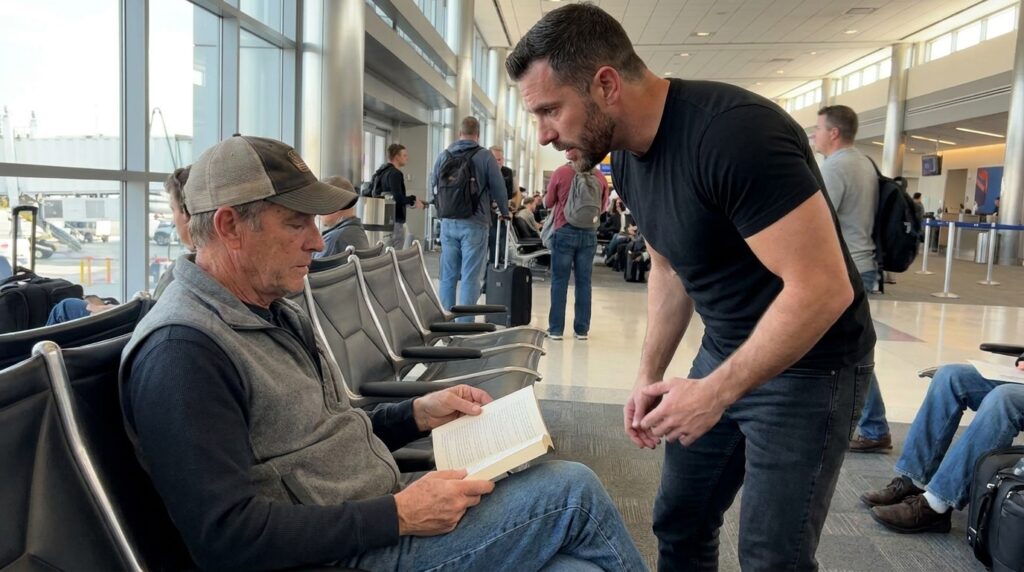
Arthur didn’t look up immediately. He let his thumb remain hooked under the corner of page one hundred and forty-two. The paper was cheap, acidic, smelling faintly of damp warehouses and old glue. On the desaturated linoleum of Gate B12, the shadow of Julian’s fitted black shirt fell straight across the print, cutting through a paragraph about the logistical failures of the winter retreat at Valley Forge.
“You’re vibrating, Julian,” Arthur said. His voice was low, dried out by thirty years of industrial air conditioning and bad diesel fumes. He didn’t raise his chin. “The boys in the back row can hear your teeth grinding from here.”
“I’m tired of the quiet act,” Julian muttered. He stepped deeper into the seating lane, his work boots squeaking against the grit on the floor. His knuckles were raw, stained with grease from the morning’s inspection at the yard. “Six months you’ve sat on the logistics reports. Six months of you playing the wise old hand while my crews are working fourteen-hour shifts on rotting tires. I built the northern route. Me.”
Arthur slowly lowered the book until it rested flat against his gray vest. The fabric of his shirt beneath it was heavy, damp with the stale heat of an airport terminal that hadn’t seen an upgrade since the late nineties. He looked at Julian’s eyes—the frantic, bloodshot tracking of a man who hadn’t slept since Omaha.
“You built a lane we can’t legally insure, Julian,” Arthur said. He let his thumbs rest on the worn binding. “And you did it with three notes that are currently floating through a secondary collections firm in Reno. You didn’t build a route. You built a fuse.”
Julian leaned down, his palms slapping the armrests of the empty seats flanking Arthur. The scent of sour espresso and leather jacket hit Arthur like a physical weight. “The board is voting on the expansion Tuesday. If my name isn’t on that prospectus as managing partner, those notes won’t matter. Because I’ll pull every driver from the line before the ink dries. Try moving forty tons of dry goods through the pass with just your memories, old man.”
Arthur didn’t pull back. He looked at the rusted rivet on the side of Julian’s watch strap. He noticed the slight tremor in the younger man’s left thumb—the classic sign of someone who had substituted amphetamines for breakfast.
“The gate agent is looking at us,” Arthur murmured, his tone shifting into something transactional, clipped. “And if she keys that mic for security, neither of us makes the 4:15 to Salt Lake. Sit down. Or stand there and let everyone see exactly how thin your skin has gotten.”
Julian’s mouth tightened into a hard, bloodless line. He looked around the sparse terminal, where two families and a traveling salesman were studiously ignoring them. He slowly stood up straight, pulling his jacket down over his belt. “We’ll see about that,” he whispered. “We’ll see who stays in the dirt when the ground moves.”
He didn’t walk away. He sat three rows over, his eyes fixed on the reflective glass of the window where the nose of an aging Boeing 737 sat in the gray drizzle.
Arthur lifted the book back to his chest. His fingers found the small, stiff ridge in the lower spine—the place where he’d tucked the certified mail receipt from the Reno firm three hours ago. The receipt wasn’t for a debt notice. It was an acquisition confirmation. Someone else already owned Julian’s fuse, and the name on the title didn’t belong to anyone in this terminal.
The overhead speakers crackled with static. “We regret to inform passengers for Flight 884 that due to an equipment discrepancy on the inbound aircraft, our departure has been pushed back forty-five minutes…”
Across the aisle, Julian’s phone began to vibrate against his thigh, the blue light reflecting off his jaw like a cold bruise.

CHAPTER 2: THE CLAUSTROPHOBIA OF ROW 14
The gate agent’s scanner beeped with a shrill, metallic chirp that sounded like a failing bearing in an old engine.
Arthur moved down the narrow jetway, his boots striking the ribbed rubber flooring. The air inside the tunnel was thick with the scent of unwashed upholstery and the faint, oily backdraft of burning kerosene from the tarmac below. It was a confined, gray space, the aluminum ribs of the structure vibrating under the pressure of the wind outside. Directly behind him, so close that Arthur could hear the uneven rhythm of his forced breathing, was Julian.
“Move it,” a voice called out from further back in the line—a tired traveler hauling an oversized roller bag.
Arthur didn’t quicken his pace. He adjusted the strap of his canvas duffel bag, his fingers brushing against a cold, notched brass key tucked securely into the side pocket of his leather boarding pass wallet. It was an old key, its teeth worn smooth by years of pocket friction, completely out of place for a modern digital warehouse operation. He felt Julian’s shadow press against his spine as the line ground to a temporary halt inside the aircraft’s threshold.
“Row fourteen,” Julian muttered over Arthur’s shoulder, his breath smelling faintly of the acidic energy drinks he’d been downing at the gate. “They assigned us the same row, Arthur. Tell me that wasn’t your administrative assistant playing games with the corporate account.”
“The system allocates by priority tier, Julian,” Arthur said, his voice level as he stepped into the carpeted cabin. The narrow aisle was a bottleneck of human friction—zippers scraping against overhead bins, plastic luggage wheels clicking violently against track lanes. “If you want the extra six inches of legroom, you have to earn the miles first. You know how the logistics work.”
Arthur reached row fourteen. The seats were covered in a faded navy blue fabric that had worn down to the rough, white structural threads underneath. The window seat was his; Julian had the middle.
Arthur lifted his duffel bag to hoist it into the overhead bin. Before he could slide it in, Julian’s heavy leather flight case slammed into the compartment, its corner catching the rusty steel rivet on Arthur’s duffel bag with a sharp, grinding screech. The impact left a bright silver scratch on the pitted metal latches of Julian’s case.
“Oops,” Julian said, though his eyes were completely dead, fixed straight on Arthur’s face. “Space is limited today. You have to be fast if you want to keep your slot.”
Arthur didn’t pull his hand back from the bin. He kept his grip on the rough canvas of his bag, using his forearm to subtly but unyieldingly pin Julian’s case against the back wall of the compartment. The physical resistance was slight, but it was absolute. For five seconds, neither man moved. The passengers behind them shuffled impatiently, their complaints a low hum beneath the roar of the auxiliary power unit beneath the floorboards.
“There’s exactly enough room for both, provided you don’t stack your ego sideways,” Arthur said softly. He shifted his wrist, sliding his duffel into the remaining gap with an efficient, practiced motion that forced Julian’s case to tilt on its side.
Julian’s jaw clenched, the muscles near his trimmed beard twitching. He dropped into the middle seat, his broad shoulders instantly invading the neutral space of Arthur’s armrest. The fabric of his black shirt rubbed against Arthur’s gray vest—a constant, abrasive friction.
As the plane taxied away from the gate, the vibrations from the landing gear rattled the loose window pane next to Arthur’s head. The sky outside was a desaturated slate gray, the rain streaking horizontally across the thick plastic oval. Arthur reached into his pocket to retrieve his paperback book, but as he pulled his hand out, his leather boarding pass wallet slipped, opening slightly on his lap.
Julian’s gaze dropped instantly. His eyes narrowed as they caught the corner of a folded document peeking out from behind the boarding passes—a sheet of thermal printer paper bearing the distinct, purple-ink stamp of the Washoe County Clerk’s Office.
“What’s that?” Julian asked, his hand shifting toward his seatbelt buckle, his posture tightening like a spring being compressed. “That’s a corporate registry filing. Why do you have a Nevada state filing on you for a Utah delivery run?”
Arthur calmly folded the leather wallet shut, the magnetic clasp snapping with a dull click. “It’s a maintenance manifest for the Reno depot. The roof has a leak. The iron girders are rusting out from the salt.”
“You’re lying,” Julian whispered, leaning closer, his shoulder hard against Arthur’s. “You’ve been talking to the auditors behind my back. I know how you operate, Arthur. You think because you’ve got thirty years of rust on your hands, you’re the only one who knows how to handle the weight. But you’re leaking oil, old man. You’re slipping.”
Arthur turned his head slowly, looking at the reflection of Julian’s tense, furious face in the dark window glass against the backdrop of the gray clouds.
“If I were slipping, Julian, you wouldn’t be sitting in the middle seat,” Arthur said, his voice entirely devoid of anger, carrying only the heavy, exhausting weight of absolute certainty. “You’d already be out on the tarmac, wondering why the stairs were pulled back.”
Julian opened his mouth to deliver a sharp, weaponized response, but the aircraft suddenly shuddered. A violent downward draft caught the wing, dropping the cabin ten feet in a single fraction of a second. The overhead bins rattled with the sound of shifting metal, and a yellow warning light flickered above their heads as the captain’s voice cut through the static of the cabin address system.
“Folks, we’ve just been informed by regional air traffic control that the storm cell over the ridge has intensified…”
Arthur watched Julian’s hand instinctively fly to the armrest, his knuckles turning white as his grip tightened around the pitted plastic. The younger man’s bravado didn’t vanish, but it froze, his eyes darting to the overhead compartment where his scratched case sat over the hidden documents.
CHAPTER 3: THE DECAY OF THE REGENESIS FREIGHT LINE
The tail wheel of the regional turboprop slammed into the uneven tarmac with a violent, structural shudder that rattled the teeth in Arthur’s jaw. Outside the scratched acrylic window, the world was a desaturated stretch of old concrete, cracked and infested with wild cheatgrass pushing up through the tar seams. They hadn’t reached Salt Lake. The storm had pinned them down in an old municipal field north of Elko—a graveyard for obsolete shipping containers and grounded agricultural dusters.
Arthur swung his legs out into the aisle before the seatbelt sign even flickered off. His joints were stiff, complaining from the cold draft leaking through the emergency exit seals.
“Where are you going?” Julian was up instantly, his shoulder heavy against Arthur’s arm as he reached into the overhead bin. He dragged his leather flight case down with an aggressive jerk, flaking tiny bits of dry gray paint from the ancient interior tracking of the plane. “The crew said we stay on the aircraft until the fuel trucks arrive.”
“The crew has an hour left on their legal duty ceiling, Julian,” Arthur said, adjusting his vest. He didn’t look back as he pushed down the metal stairs toward the rain-slicked asphalt. “They’re not going to refuel in a lightning cell. We’re being scrubbed. Look at the terminal line.”
Two hundred yards across the cracked apron sat a corrugated iron hangar with a faded logo from the old Regenesis Freight Line—the original trucking outfit Arthur had merged into their current venture ten years ago. The metal exterior was a patchwork of flaking orange rust and oxidized zinc primer, bleeding down onto the concrete like dried tea stains. It was an infrastructure built on loans that had never been fully retired, a physical testament to how much weight the business had been carrying under the surface.
Inside the hangar’s auxiliary office, the air smelled of stale grease, damp cardboard, and the metallic sting of an old kerosene space heater. A single bare bulb hung from a frayed cord, swaying slightly in the draft from the broken bay doors.
Arthur dropped his canvas duffel onto a desk topped with scarred green linoleum. His fingers went straight to his pocket, pulling out the leather wallet. He extracted the notched brass key and inserted it into the locking latch of a heavy, grease-stained steel document locker in the corner of the room. The mechanism resisted, frozen byyears of moisture, grinding with a high, rusted screech before the bolt finally gave way.
“That’s the regional archive,” Julian said from the doorway. His boots kicked a small pile of dry iron grit across the threshold. His black shirt was damp from the run across the tarmac, clinging to his ribs like a second skin. “The board closed this station three cycles ago. Why do you still have a physical key to a decommissioned file system?”
“Because the digital ledger only records what you tell it to record, Julian,” Arthur said, sliding open the top drawer. The steel rollers groaned, throwing down a small shower of dry, powdery rust onto the floorboards. He pulled a thick, ledger-bound printout from the back—a master logistics sheet bearing the corporate stamp from three weeks prior.
Julian moved fast, his muscular frame cutting off the light from the office window as he grabbed the edge of the ledger. “Give me that. You’ve been hiding the Reno asset allocations. I knew it. You’re trying to squeeze me out before the Tuesday vote by showing a cash-flow deficit at the western hubs.”
“Look at the bottom line, Julian,” Arthur said. He didn’t pull the ledger back. He simply let go of it, stepping away to stand by the window where the rain was turning the industrial yard into an orange mire. “Don’t look at the hub numbers. Look at the capital retention line under the holding company.”
Julian’s thumb ran across the paper, leaving a dark smudge of grease near the columns. His eyes tracked the numbers, his brow furrowing as he looked for the expected decoy—the administrative accounts he assumed Arthur had been using to bury his margins. But his breath caught. The red ink didn’t stop at the regional hubs. It extended upward, a bleeding line of negative variables that ran clean through the parent infrastructure.
“This is an old sheet,” Julian muttered, though his hands began to tremble slightly, his thumb twitching against the paper’s edge. “This says the operational accounts are dry. It says the Reno lease was terminated by the state in April. That’s impossible. We just cleared sixty freights through the pass last week.”
“We cleared sixty freights on credit extended by a firm that dissolved its corporate shield on the first of the month,” Arthur said calmly, his hand resting on the rusted frame of the window. The cold iron bit into his palm. “The equipment isn’t ours, Julian. The trucks are currently owned by the secondary collection house out of Washoe County. The entire venture is legally dead. It has been for forty-eight hours.”
Julian’s face went completely white, his aggressive posture collapsing as he slumped against the edge of the desk. The paper crinkled under his weight. “You… you let me sign the personal surety notes for the fuel lines last Tuesday. If the holding company is dry, those notes fall directly on my personal assets. Everything I put into the northern route… my house, the family plot in Elko…”
“You wanted the title of managing partner,” Arthur said, his voice flat, carrying the cold finality of wet stone. “You wanted to sign the papers without waiting for the audit. I told you three months ago that you were building a fuse. You just didn’t realize you were standing on the box when you lit it.”
Julian looked up, his eyes wide with a mixture of panic and a sudden, venomous clarity. “You did this. You let me take the liability so you could walk away with the clean accounts. Where’s the rest of it, Arthur? Where did the liquidation funds go from the warehouse sale? There was four hundred thousand in escrow.”
Arthur didn’t answer. He turned his head as a low, wet cough echoed from the main bay of the hangar—not the sound of the rain or the machinery, but a heavy, ragged human sound that cut through the silence of the abandoned terminal.
Julian froze, his hand still gripping the bankrupt ledger. “Who else is out there?”
Arthur reached down, picked up the notched brass key from the desk, and locked the drawer with a single, sharp twist. “The past doesn’t stay buried just because you stop paying the lease, Julian. Let’s go see what your drivers left behind.”
CHAPTER 4: THE ABSOLUTE FINALITY OF THE HORIZON
“Get back, Julian. You’re in the light.”
Arthur’s voice didn’t rise above a gravelly whisper, but it cut through the damp, echoing hollow of the decommissioned Regenesis bay. The wet cough came again from behind a stack of weathered, salt-crusted iron drums. A young man, barely out of his twenties—wearing a grease-stained driver’s uniform with the name Gavin stitched into a peeling reflective patch—was slumped against the pitted concrete. His skin was gray, covered in a slick layer of sweat that caught the weak beam of the single dangling bulb overhead.
“He’s one of my night-shift leads from the northern run,” Julian breathed, his hands dropping the crinkled ledger sheets. The paper floated into a puddle of dark oil on the floorboards, the numbers dissolving into black whorls. He took a step forward, his work boots grinding iron filings into the concrete. “Gavin? What the hell are you doing out here? The depot dispatcher said you were down in Ely.”
The young driver didn’t look up. His eyes stayed half-closed, fixed on the rusted steel tracking of the bay door. “The brake line on truck four blew out coming over the summit, Julian. The oil… the lines were dry. I told the shop lead we needed new drums three runs ago. He told me to drive it or get off the payroll.”
Julian froze. His fingers flew to his throat, clutching his collar as the weight of the personal surety notes he had signed began to press down like a collapsing steel beam. “The emergency funds… I authorized forty thousand for fleet maintenance last month. Arthur, where did that money go? If the shop leads didn’t get it, who signed for the wire transfer?”
Arthur walked over to the young man. He dropped his canvas duffel to the floor, the heavy fabric hitting the grit with a solid thud. He knelt without checking the grease stains on his jeans, his calloused fingers pressing firmly against the side of Gavin’s neck, finding the fast, thready pulse beneath the cold skin.
“The money went exactly where it needed to go, Julian,” Arthur said smoothly. He reached into his vest pocket, pulled out a small, old-fashioned silver cylinder, and unscrewed the cap to extract a nitro tablet, sliding it under the driver’s tongue. “Keep your head back, son. Breathe through your nose. The paramedics are coming off the interstate right now.”
“You took it,” Julian whispered, his voice cracking as he backed away until his shoulders hit a corroded steel girder. A shower of fine, orange rust flakes rained down onto his black shirt, dusting his shoulders like dried blood. “You hollowed out the accounts. You knew the northern route would fail. You let me sign the liabilities so you could strip the bone clean and hide the cash.”
Arthur didn’t look up from the driver. He pulled a yellowed, handwritten manifest stub from his leather wallet—the micro-clue Julian had missed while hunting for administrative decoy accounts. He laid it flat on Gavin’s knee.
“Look at the trust registration number at the top, Julian,” Arthur said. His voice was an unyielding, rhythmic hum against the roar of the rain outside the broken hangar glass. “It isn’t an escrow account. And it isn’t in my name.”
Julian snatched the small slip of paper, his eyes frantically scanning the tiny, faded print. “The Sarah and Leo Heritage Trust. That’s… those are my kids. My children’s middle names.”
“You signed three separate corporate indemnification waivers when you took the managing partner title,” Arthur said, his hand remaining steady on the driver’s shoulder as the kid’s breathing began to level out. “The state attorney’s office in Reno has been building an environmental and safety non-compliance case against your northern crews for five months. They didn’t come for the company, Julian. They’re coming for you. Personally.”
Julian’s knees gave out slightly. He gripped the edge of a rusted workbench, his fingers leaving clean streaks through the thick coat of industrial dust. “The four hundred thousand… from the warehouse liquidation…”
“It’s inside an irrevocable, blind trust managed by an independent fiduciary in Boise,” Arthur said, finally standing up and looking Julian square in the eyes. The gray light from the window showed every line of fatigue, every pit of experience etched into the older man’s skin. “You can’t touch it. Your creditors can’t touch it. The state can’t seize it for the fuel debts. When the receivership takes everything you own next month, your family still has a roof over their heads. I took the cash out of your reach because you don’t have the discipline to keep your hands off the future.”
The distant, wailing scream of a siren cut through the rhythm of the rain on the corrugated roof. Bright red and blue strobes began to paint the wet concrete of the apron outside, casting long, jagged shadows through the rusted ribs of the hangar doors.
Julian looked down at his raw, grease-stained hands. The bravado was entirely gone, replaced by the hollow, exhausting realization of a man who had fought a thirty-year veteran with nothing but noise and speed. “You knew… from the first day I brought the expansion prospectus to the office.”
“I knew how your father ran his lines, Julian,” Arthur said, picking up his paperback book and tucking it into his vest pocket. He reached down, took his duffel bag by the rough canvas handles, and turned toward the flashing lights at the entrance. “He always ran his trucks until the steel screamed. I just made sure someone was holding the net when you finally came off the mountain.”
Arthur walked toward the open bay door, his boots leaving a clean line of prints through the rust dust on the floorboards, leaving Julian standing alone in the gray, industrial silence.
CHAPTER 5: THE METALLIC TASTE OF THE RECORD
The fluorescent tubes in the drop ceiling of Room 402 hummed with a flat, alternating-current vibration that set a steady throb behind Arthur’s temples. It was a windowless box in the Washoe County Annex, where the drywall had softened from decades of roof leaks, leaving long, rust-colored maps of old water damage tracking down behind the vinyl baseboards.
“Let the record reflect that Mr. Vance has identified the master routing ledger from the Elko terminal,” the state investigator said. Her voice was dry, matching the chalky texture of the legal pads piled between them on the wood-grained laminate table.
Arthur sat with his hands folded over his gray vest. The skin of his knuckles looked yellow under the artificial light, contrasting with the cold, zinc-plated frame of the institutional chair beneath him. Across the table, Julian sat between two junior public defenders. His black shirt was wrinkled from three days of living out of a motel suitcase near the tracks; his eyes were fixed on an embossed silver zinc pill tin Arthur had placed next to his water glass. The tin’s lid was worn down to the base metal, its corporate seal almost entirely obliterated by decades of pocket wear.
“Arthur,” Julian whispered, ignoring the lawyer tugging at his sleeve. “The lease agreement from April. The investigator says the signature on the Reno yard turnover isn’t mine. They’re saying it’s a forgery.”
Arthur didn’t blink. He watched the court reporter’s fingers move over her machine—a tiny, rhythmic clicking like a mechanical grasshopper in a dry field. “The signature is valid, Julian. It was executed under the emergency power of attorney you granted the holding company during the winter freight crisis.”
“But I didn’t authorize the liquidation of the diesel reserves,” Julian pressed, his upper lip slick with a thin film of nervous sweat. He leaned forward, his broad shoulders casting a sharp shadow over the investigator’s exhibit folders. “That money went directly into the Boise trust before the state tax warrants were served. If I didn’t sign it, that’s structured asset fraud. They’re looking at ten years on the corporate shield violations alone.”
The investigator didn’t look up from her notes. She adjusted her glasses, her fingers leaving a small white smudge on the dark plastic frame. “Mr. Vance, we have the forensic audit from the Reno depository. The asset diversion began forty-eight hours before your nephew signed the personal surety notes for the fuel lines. It looks an awful lot like you engineered a controlled collapse to insulate the family holdings while leaving the junior partner holding the primary criminal liability.”
Arthur reached out, his thumb tracing the worn edge of the silver pill tin on the table. The friction was a small comfort—the raw, cold feel of zinc against a thumb that had turned wrenches in the dust before Julian’s father had even bought his first tractor.
“The northern run was already a ghost, ma’am,” Arthur said softly. His voice didn’t carry the weight of an defense; it carried the flat indifference of an inspector signing off on a scrapped boiler. “The trucks were running on retreads because the regional credit lines had been red-tagged since November. If Julian hadn’t signed those fuel notes, the drivers would have walked off the line in Ely, leaving forty tons of perishable freight to rot on the pass. I didn’t structure a fraud. I maintained the line until the equipment reached the scrap yard.”
“At his expense,” the investigator said, her pen stopping with a sharp, definitive click against the legal pad.
“At the company’s expense,” Arthur corrected. He picked up the silver tin, the small metal box clicking as his thumb popped the latch. Inside, instead of the standard industrial grease-cutters or aspirin Julian expected, there were only three small, unlabelled white tablets—and a tiny strip of blue pharmacy paper bearing the name of a palliative clinic in Salt Lake City.
Julian’s eyes caught the blue paper. He froze, his hand dropping away from his lawyer’s arm. The anger in his jaw—the frantic, aggressive energy that had driven him through the airport terminal and the abandoned hangar—suddenly hit a dead zone. He looked from the tin up to the hollows beneath Arthur’s eyes, noticing for the first time how the older man’s vest hung loose over his chest, the fabric no longer filled out by the muscle that had built the Regenesis Line.
“Arthur,” Julian muttered, his voice dropping into a guarded, ragged register that didn’t belong in a legal deposition. “What’s in the tin?”
“Maintenance,” Arthur said, sliding the box back into his vest pocket with a single, practiced movement that locked the lid away from the record. He turned his eyes back to the investigator, his jaw setting into a hard line of rusted iron. “Let’s talk about the Reno yard. The state wants the keys by Tuesday. I have them in my bag. We can skip the final injunction if you’re willing to clear the driver manifests from the secondary liability pool.”
The public defender leaned over to Julian, whispering urgently into his ear, but Julian wasn’t listening. His eyes were fixed on the small, dark smudge of rust that had flaked off Arthur’s sleeve onto the white legal pad between them—a tiny piece of the old line, breaking down in real time under the cold glare of the lights.
CHAPTER 6: THE FRICTION OF THE MIDNIGHT LINE
The bolt cutters came down with a dull, heavy clink against the case-hardened steel. Julian didn’t lean his full weight into the handles; he jerked them, his forearm muscles straining against the black cotton of his shirt until the corroded padlock chain on the Reno gate gave way, raining fine orange iron dust down into the wet gravel.
“Get the gates back,” Julian rasped, gesturing toward the shadows behind him where two of his old northern-run drivers stood shivering in the mountain wind. “We’ve got exactly three rigs left in the rear bays that haven’t been tagged by the county receiver. If we clear them past the state line before dawn, we can lease them to the wildcat outfit out of Elko. That’s sixty thousand in cash. Clean cash.”
“It’s not clean, Julian.”
The voice came out of the dark cab of a parked flatbed, low and broken by a short, rattling cough. Arthur stepped down from the running board. The glare from a distant mercury-vapor light across the tracks caught his profile, turning his skin the color of old zinc. He wasn’t carrying his duffel bag this time. He was wrapped in a faded grease-monkey jacket, his hands buried deep inside pockets that jingled with the small, metallic rattle of the silver pill tin.
Julian slammed the bolt cutters down into the dirt, his face tightening with a sudden, desperate rage. “You followed me. You’re supposed to be at the motel, Arthur. You’re supposed to be preparing your statement for the Tuesday hearing.”
“The state investigators already have my statement, Julian,” Arthur said, his boots crunching slowly through the coarse, salt-crusted gravel toward the gate. He stopped near the chain, his fingers sliding over the freshly cut link. The metal was bright silver where the jaws had bitten through, a stark contrast to the thick, scabby layers of rust covering the rest of the fence. “They don’t need me in the room to know what’s in these bays. The court orders were signed at five o’clock. If those engines turn over, it’s grand larceny. Not a corporate violation. A felony.”
“I don’t have a choice!” Julian shouted, his voice echoing off the corrugated iron walls of the maintenance shop. One of the drivers behind him shifted uncomfortably, his hand tracking down toward a heavy steel tire iron sticking out of his coat pocket. “The Reno lease you turned over… it stripped my name off the parent infrastructure, but the personal notes for the diesel fuel lines are still tied to my social. They’re freezing my personal checking account by Friday, Arthur. My kids won’t even have school lunch money if I don’t move this iron tonight.”
Arthur didn’t look at the drivers. He kept his eyes on Julian, his posture straight despite the slight, involuntary tremor in his right knee. “The Boise trust cleared its primary clearance check three hours ago, Julian. The funds from the warehouse sale are locked. Your family doesn’t need your midnight cash. They’re insulated.”
“But I’m not!” Julian stepped directly into Arthur’s path, his chest pressing against the older man’s worn jacket. The sharp scent of raw diesel and nervous sweat came off him like heat from an overworked radiator. “You saved them, but you ruined me. You gave the investigator the logs. You gave them the Reno turnover papers with your signature on them. You’re setting me up to take the whole ten-year fall so you can walk away into the sunset.”
Arthur let out a slow, dry breath that turned to mist in the midnight air. He reached into his pocket, his fingers passing past the notched brass key, searching instead for the silver zinc tin. He didn’t pull it out to take a pill. He just held it inside the fabric, using the cold metal edge to anchor his hands against the deep, systemic ache in his chest.
“I didn’t give them the papers to sink you, Julian,” Arthur said softly. “I gave them the papers to draw the perimeter. The investigator is looking at the turnover because she wants to know who directed the liquidations. As long as they’re looking at my signature on the April waivers, they’re not looking at the fuel logs you signed in June.”
Julian’s arm dropped. He looked at the bright silver cut on the padlock chain, then back at Arthur’s face, his intellect finally catching up to the strategic geometry of the room they were standing in. “The April waivers… they pre-date my partnership. If the liquidation happened under your sole authority, then the asset diversion…”
“Is my liability,” Arthur finished. He took a slow step forward, his hand coming out of his pocket to rest on Julian’s shoulder. The weight of his palm was heavy, cold, carrying the rough texture of a man who had spent his entire life maintaining machines that were designed to break down. “You’re a reckless boy, Julian. You always have been. You think the loudest voice wins the line. But the line doesn’t care about your voice. It only cares about who pays for the grease.”
“Arthur,” Julian muttered, his eyes tracking the slight gray pallor under the older man’s jawline, the way his fingers seemed to cling to the fabric of his jacket just to stay vertical. “The pills in the deposition room. The Salt Lake clinic stamp on the paper. Why were you at a palliative care facility three weeks before the audit?”
Arthur turned his back to the gate, looking out over the dark expanse of the Reno yard where fifty years of family history sat rotting in the Nevada mud. “The yard closes Tuesday, Julian. Make sure your drivers leave the keys in the ignitions. The receivers don’t like to hunt through the grass for them.”
He didn’t wait for an answer. He walked back toward the dark flatbed, his steps slow and heavy, his silhouette disappearing into the shadow of the rusted cranes before Julian could even lift his head to ask the next question.
CHAPTER 7: THE FINAL VERDICT OF THE SOVEREIGN PROTECTOR
“Call your next witness, Mr. Prosecutor.”
The words dropped through the open spaces of Federal Courtroom 3B, cold and clear as frozen iron hitting an anvil. The room was lined with old oak paneling that had dried out over sixty years, the varnish flaking into tiny yellow scales near the heating registers. Arthur did not use the gate latch to enter the well of the court. He laid his palm against the top rail of the witness box, feeling the deep pits in the wood where hundreds of transient hands had worn down the grain before him.
Julian sat behind the defense table, his black cotton shirt pulled tight across his back. His broad shoulders were rigid, his chin tilted slightly downward as he watched the thick manila folder Arthur carried to the stand. The young partner’s jaw was clamped so tight the pulse in his cheek showed through his trimmed beard like a tiny mechanical piston.
“State your full name for the record,” the clerk droned, her fingers poised over the keyboard.
“Arthur Vance,” he said. The voice was thin, but it held its ground, a steady rattle like gravel sliding down a steel chute.
Arthur adjusted his weight on the hard oak bench of the witness stand. The heavy silver zinc tin inside his vest pocket pressed against his low ribs—a hard, flat reminder of the forty-eight hours he had left before the Salt Lake clinic took over his schedule permanently. He reached down, unclasped his leather wallet, and extracted the original certified mail receipts from the Reno holding house, laying them precisely over the prosecutor’s exhibit stamp.
“Mr. Vance,” the government attorney said, stepping into the space between the tables. His shoes left dull gray streaks on the dry floor wax. “We have reviewed the supplemental filings you submitted to the grand jury on Monday. Those files include forty-eight separate asset turnover manifests signed by your hand between April and June. They show a systematic evacuation of the Regenesis operational accounts.”
“They show the closing of a broken line, son,” Arthur said softly. He didn’t lift his eyes to the bench. He looked straight at Julian’s hands, which were currently white-knuckled around a yellow legal pad. “The company was insolvent before my nephew signed the fuel line notes. I directed the liquidations because the parent infrastructure couldn’t carry the weight of the northern contracts. The debt belonged to the founder’s share. My share.”
“The defense has argued that the junior partner, Julian Vance, was the active administrator during the period of the safety violations and the tax defaults,” the prosecutor countered, leaning his arm against the wooden rail. “But these documents suggest that you maintained sole executive control over the capital allocations. Is that correct?”
Arthur let his breath out slowly. It was a shallow, guarded inhalation—the kind he used when the oil smoke got too thick in the repair bays. He felt the cold zinc of the rail beneath his thumb, his fingers noticing the small, jagged aluminum rivet where the nameplate had been pried off the box years ago.
“The boy was a driver,” Arthur said, his voice dropping into a register that made the court reporter look up from her keys. “He moved the iron because I told him where the lane was. He signed the fuel line authorizations because the regional yards wouldn’t release the tankers without a signature from the field. But the money… the money was moved under the original corporate bylaws. Section Four. The founder’s override.”
Julian stood up. The chair legs shrieked against the linoleum—a sharp, weaponized sound that brought the bailiff’s hand down toward his belt.
“Arthur, stop,” Julian said, his voice raw, completely stripping away the legal subtext the lawyers had spent three hours building. “The investigator showed me the medical logs from the Salt Lake repository. They subpoenaed the trust funding sources. I know why you signed the April waivers before the audit. You didn’t do it to clear the ledger. You did it because you knew you wouldn’t be around to serve the time when the warrants came down.”
The judge’s gavel cracked once, a sharp explosion of hickory against block. “Mr. Vance, sit down or you will be removed from the well.”
Julian didn’t sit. He stayed standing, his eyes locked on the old man in the gray vest, his posture no longer projecting the aggressive, adequacy-starved bravado of the airport terminal. The pride had been completely scraped away, leaving only the bare, rusted reality of a junior partner who had finally seen the blueprint of the wall he’d been running into.
“The Boise trust is clean,” Arthur said, turning his face slightly to look straight into Julian’s eyes. He didn’t wink. He didn’t soften his mouth. His expression remained as flat and unyielding as a boundary stone in the high desert. “The children’s names are on the title. The corporate shield is gone, Julian. The line is dead. But the ground… the ground is still there. You go back to Elko. You take the tools out of the maintenance shed, and you build a clean shop. You don’t sign notes for iron you don’t own.”
Arthur turned back to the prosecutor. He slid the thick manila folder across the rail, his calloused palm leaving a faint trace of gray graphite dust on the white paper. “The signatures are all verified, sir. Every dollar is accounted for in the grand jury summaries. I am the sole corporate officer of record for the Regenesis Freight Line.”
The prosecutor looked at the folder, then up at the bench, his legal momentum stalling against the absolute finality of a man who had built his defense out of his own mortality.
The courtroom fell into a heavy, dry silence, broken only by the distant, rhythmic thrum of the traffic out on the interstate—the big rigs moving seventy miles an hour through the Nevada dusk, their gears grinding over the same passes Arthur had cleared thirty years ago. Arthur closed his leather wallet, the magnetic clasp snapping with a tiny, definitive click that marked the absolute end of the record.







