
The Weight of Dust and Iron: A Reckoning of Unyielding Lines on the Sun-Bleached Tarmac

CHAPTER 1: THE FRICTION OF BROKEN STANCES

“If you want proof, old man, watch the clock.”

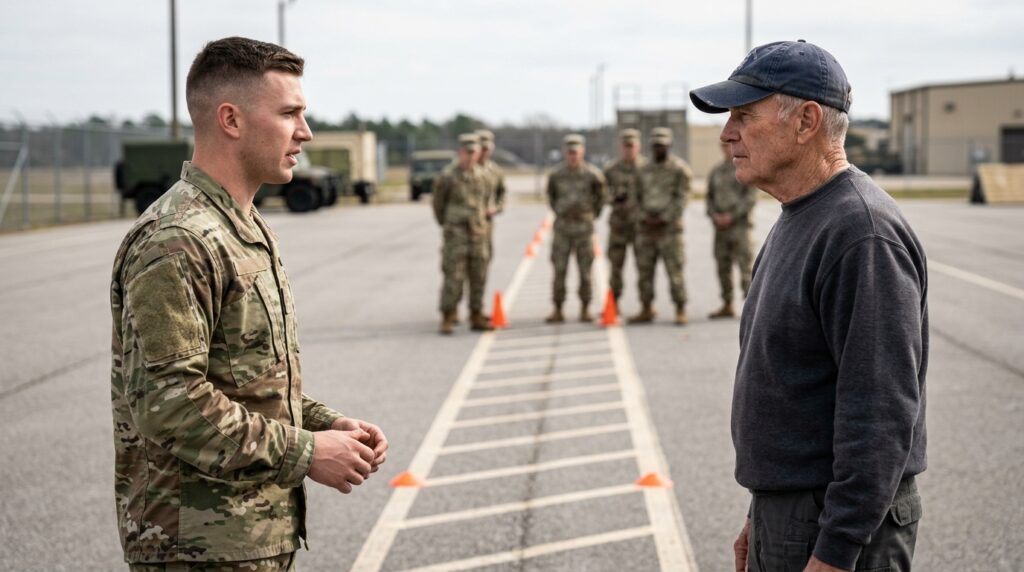
The words left Miller’s throat dry, catching on the fine, alkaline silt that hung permanently over the sun-bleached concrete of Lane Four. His boots grit against the aggregate. Before him stood Master Chief Vance, seventy-eight years of compacted salt and unyielding posture, wearing a gray sweatshirt that looked as heavy as wet canvas despite the ninety-five-degree heat beating down on the training tarmac. Vance didn’t blink. The dark navy special warfare cap cast a hard shadow across eyes that had watched three generations of men bleed out for fractions of a second.

Behind them, the midground was a static gallery of green and brown—twelve candidates, their faces dark with greasepaint and sweat, standing beside two junior instructors who had stopped breathing the moment Miller stepped across the yellow safety line.

Miller didn’t wait for an answer. He cycled the bolt of his training weapon, the metallic clatter sharp and transactional in the dead air. His internal clock was screaming. The institutional directive from Command was thirty-eight seconds for the clearing sequence; he was currently sitting at forty-one, and the administrative evaluation was less than forty-eight hours away. He had to squeeze three seconds out of the gravel. He had to prove the modern split-times were achievable without losing the unit’s lethality.

He surged forward. It was an aggressive, violent entry—the kind the modern deployment manuals praised as maximum velocity insertion. His shoulder hit the mock barricade with the weight of an athletic build trained for rapid dominance. He pivoted, muzzle tracking toward the first silhouette target, his mind already calculating the next two steps, the pivot point, the recoil recovery. He was fast. He was a machine built out of modern metrics.

Then the world slowed down, stripped of its momentum by a simple, gray sleeve.

Vance didn’t rush. He didn’t use the explosive power Miller spent hours cultivating in the base gym. The older man simply occupied the space Miller was going to need. It was a flawless, terrifyingly small movement—a half-step inside the lane, an arm positioning that intercepted Miller’s primary leverage point before his weight could transfer. The barrel of Miller’s weapon met a calloused palm that redirected the muzzle into the dirt. A split-second later, Vance’s hip was exactly where Miller’s center of gravity demanded to be.

The collision wasn’t loud. It sounded like iron hitting old leather. Miller’s forward drive simply vanished, absorbed into the older man’s static balance. Miller staggered, his heels skidding across the white paint of the lane boundary, his ribs aching from the brief, dense pressure of Vance’s forearm.

The tarmac returned to its profound, heavy silence. The twelve candidates in the background didn’t shift their feet.

Vance stood exactly where he had stepped, his breath even, his gray sweatshirt showing only a small smudge of black carbon from Miller’s rifle shroud. He looked down at the mechanical stopwatch hanging from his neck by a frayed nylon lanyard. He didn’t look at the digital wall timer that Miller had installed above the lane.

“Speed is an apology for a bad line, Miller,” Vance said. His voice had the dry, low rasp of someone who had spent thirty years shouting over diesel engines and rotor wash. “You’re running so fast to hit their spreadsheets that you’re leaving your throat open to the first kid with a rusty AK and five minutes of patience. Control isn’t something you buy with a faster pivot. It’s what keeps them from putting your name on a plaque in the quarterdeck.”

Miller’s chest heaved. His fingers remained white-knuckled around the grip of his rifle, the instinct to argue—to throw the Command’s data sheets in the old man’s face—burning behind his eyes. He looked at the dust settling around Vance’s boots. He looked at the candidates, whose eyes had shifted from the digital clock down to the scuff marks on the concrete. The defensive bravado in his shoulders slowly broke, the tension leaving him in a long, ragged exhale.

He lowered the muzzle. He gave a single, tight nod—a real submission to the iron truth of the tarmac. “I see the line, Master Chief.”

“Good,” Vance said, turning his back to the lane as if the confrontation had never occurred. “Then clean up your brass. You’ve got a discrepancy in the armory log from 0400, and it isn’t yours.”

Miller frowned, his thumb pausing on the safety selector. He hadn’t been in the armory at 0400; he’d been in the administrative office signing off on the modern syllabus. He reached down to pick up his dropped magazine, his fingers brushing against a small, jagged piece of metal embedded in the concrete directly beneath the barricade—a stamped identification tag from a foreign-made infantry rifle, caked in fresh, wet grease that didn’t belong to any weapon in the facility’s inventory.


CHAPTER 2: THE AUDIT OF THE LEDGER

“The armory cage doesn’t open itself at four in the morning, Miller.”

The voice didn’t come from Vance. It belonged to Staff Sergeant Harris, who was leaning against the rusted iron frame of the equipment locker at the edge of the tarmac, a clipboard tucked under his arm like a shield. His boots were scuffed down to the gray steel toes, the leather cracked by the unrelenting glare of the salt flats. He didn’t look at Miller; his eyes were fixed on the foreign rifle tag Miller was currently turning over between his calloused thumb and forefinger.

Miller didn’t answer immediately. He tucked the metal tag into his pocket, the sharp edge scraping against his palm. The smell of oxidized iron and old cosmoline grease clung to his skin, a stubborn residue that felt entirely out of place in a facility supposedly stocked exclusively with standard-issue domestic carbines.

“The log has my digital signature on it,” Miller said, his tone flat, stripped of the bravado he had used against Vance. He began gathering his spent brass from the gravel, each shell casing dropping into his canvas pouch with a heavy, rhythmic clank. “It says I cleared out six weapon crates for the advanced evaluation. Except I was upstairs filling out spreadsheet columns for the logistics review until dawn.”

Harris pulled a short, rusted pocketknife from his pocket and began cleaning the dirt from beneath his fingernails. The metallic rasp of blade against skin was the only sound for several seconds. “Then someone else used your token. Or the system generated the authorization from the top down and dropped your name on the bottom line to keep the ledger clean. It’s happening more often since they put the new network in.”

Miller stood up, his spine stiffening under his damp camouflage blouse. The word metrics had become a parasite in this command, eating away at the hours once spent checking headspaces and cleaning firing pins until everything was reduced to a green checkmark on a monitor three hundred miles away. “Who had the detail last night?”

“Nobody from the training staff,” Harris muttered, pointing the tip of his blade toward the low-slung administrative concrete bunker across the compound. The building was an ugly, windowless block, its corrugated metal roof bleeding orange rust lines down the stucco walls from decades of morning condensation. “The supply truck from the depot came in at 0330. They bypassed the main gate log entirely. Said they had a direct clearance code from the regional procurement office.”

Miller didn’t wait for Harris to finish. The friction in his chest wasn’t just frustration anymore; it was a cold, pragmatic alarm. He walked across the sun-baked tarmac, his boots striking the concrete with deliberate force. Every corner of this facility was showing its age—the iron gates flaking orange scale, the asphalt pitting into black teeth under the heat—yet the administrative demands were moving with a slick, frictionless velocity that made no physical sense.

He shoved the heavy steel door of the admin bunker open. inside, the air-conditioning was a stale, chilling hum that smelled of dust filters and ozone. At the far end of the narrow corridor, behind a wire-reinforced glass partition, sat the logistics terminal.

Miller entered his administrative key. The monitor flickered to life, casting a cold blue glow across his face. He bypassed the colorful charts detailing target retention and deployment readiness scores—the very metrics he had been killing his candidates to maintain—and dove straight into the raw procurement archives. He wanted the origin of the thirty-eight-second clearing standard Vance had just systematically dismantled.

His fingers flew across the sticky, grease-filmed keyboard. The document was deeply buried under three layers of generic training circulars, listed only as Tactical Doctrine Amendment 88-Alpha.

When the file opened, Miller’s breath hitched.

The document wasn’t a new innovation from a modern think-tank. It was an old after-action report from 2016, originally stamped CLASSIFIED – RETRIEVAL ONLY. The tactical framework, the rapid-entry parameters, and the exact split-times he was forcing his men to hit were all there, down to the millisecond. But it wasn’t a success story.

It was an evaluation report from a disastrous deployment in the Horn of Africa—a tactical sequence that had resulted in an entire squad being overrun in a concrete compound because their entry speed left their flanks completely blind to structural ambushes.

Miller leaned closer to the glass screen. His eyes traced down to the digital signature block at the bottom of the old ledger. There were two authorizations. One belonged to a deceased general whose name was currently on the base library.

The second signature was a hand-written scan, faded but completely legible: Master Chief V. Vance, Lead Evaluator.

The room grew suffocatingly cold. The very man who had just thrown him into the dirt for running too fast had signed the order that made that speed a law a decade ago. But beneath Vance’s signature, someone had manually scratched out a single line of text with a heavy black digital marker. Miller squinted, trying to read the pixels through the heavy compression of the old file.

The redacted text didn’t contain logistical data. Through the digital ink, he could just make out the word: EXPENDABLE.

A sharp click behind him broke the silence of the office. The light from the corridor outside was blocked by a broad, heavy silhouette.

“You’re looking at the wrong ledger, Miller,” Vance said from the doorway. The old man didn’t move into the blue light of the screen. He remained in the shadows, his hands tucked into the pockets of his heavy gray sweatshirt, the hand-wound stopwatch around his neck giving off a faint, mechanical tick that filled the quiet room like a slow fuse.

CHAPTER 3: THE GHOST IN THE TIMER

“You signed it.”

Miller’s hand remained flat against the laminate desk, the blue luminescence from the terminal catching the sweat that had beaded along his jawline. He didn’t turn around to face Vance yet. On the screen, the digitized stroke of the old master chief’s signature looked sharp, a frozen fragment of a bureaucratic compromise that had cost a squad their lives ten years ago. “Amendment 88-Alpha. Every metric I’ve been tearing my men apart to hit—the entry speed, the blind corners, the thirty-eight-second threshold—it isn’t a new efficiency standard. It’s a carbon copy of the failure at the Horn.”

Vance stepped into the room. His heavy boots made no sound on the grit-strewn linoleum, a habit born of years where noise meant a coffin. The scent of damp cotton and engine grease expanded into the air-conditioned frost of the bunker.

“The command doesn’t throw away old files, Miller. They just change the letterhead,” Vance said. He stopped three feet away, his shadow completely covering the keyboard. He reached down with a hand that looked like split wood and pressed the power button on the monitor. The blue light died instantly, leaving only the dim amber indicators of the tower hum. “You think you’re the first instructor to believe he could outrun a bad doctrine with better athletes?”

“They died because of this timeline,” Miller rasped, turning his head sharply. His eyes adjusted to the gray gloom, catching the dull silver gleam of the stopwatch hanging from Vance’s neck. “And now Command is forcing it down my throat for this current rotation. Why did you sign off on a failure?”

Vance’s jaw tightened, the old skin over his cheekbones hardening like cured leather. “Because ten years ago, the regional procurement office told me the same thing they’re telling your current commander today: the theater of operation doesn’t wait for mastery. They needed boots in the dirt by the end of the quarter. They wanted an evaluation that proved the accelerated pipeline worked on paper, so they could secure the deployment funding. I refused three times. Then they reminded me that if I didn’t sign it, they’d find a junior lieutenant who would—and those boys would go out there with zero training instead of three weeks of it.”

“So you gave them a survival rate based on a lie,” Miller said. The words were transactional, a cold calculation between two men who understood the value of resources.

“I gave them a line they could try to hold,” Vance countered, his voice dropping into a low, rumbling register that vibrated against the metal studs of the walls. “And I spent the last ten years watching this facility rot from the edges while the metrics grew prettier. But you aren’t just auditing old paperwork, Miller. If you were, you wouldn’t have been looking at the gate logs at 0330.”

Miller’s fingers reached into his pocket, his knuckles scraping against the sharp serrations of the foreign rifle tag he had pulled from Lane Four. “Harris said a depot truck bypassed the gate. They left grease on the concrete that isn’t ours. And when I checked the procurement queue before you shut the screen down, three of our standard armory inventory crates were missing their tracking numbers. They weren’t replaced by domestic carbines.”

Vance didn’t look surprised. He reached out and grabbed Miller’s rifle by the iron sling mount, lifting it slightly to feel the weight. “The administrative team isn’t just accelerating the schedule to look good for the inspectors on Friday, Miller. They’re balancing a second set of books. When the candidates go down to the depot for the live-fire phase tomorrow night, they aren’t using the training rifles.”

“What are they shooting?”

“The equipment that came off that truck,” Vance said, letting the rifle drop back against Miller’s gear with a dull metallic clink. “Foreign-caliber systems. Unmarked receivers. The kind of iron that doesn’t leave a trail back to a domestic supply chain when it’s abandoned in a ditch.”

The realization hit Miller like the forearm blow on the tarmac—dense, heavy, and stripping the breath from his lungs. The administrative pressure, the frantic rush to shave seconds off the clearing sequence, the sudden influx of unaccounted logistics—it wasn’t an evaluation at all. The candidates weren’t being prepared for a standard deployment review. They were being scrubbed from the grid before they even finished the course.

“They’re deploying them early,” Miller whispered, his eyes scanning the dark corners of the admin room as if the rusted iron frames themselves were listening. “Without the final phase. That’s why the metrics are fixed to the old Horn of Africa file—it’s the exact logistical template for an deniable operation.”

“They’re setting the clock,” Vance said, his hand moving to his stopwatch, his thumb resting over the mechanical crown. The faint, rhythmic ticking seemed to grow louder in the shadow of the bunker. “And your name is the one on the training sign-off sheet. By tomorrow night, if those boys don’t hit the thirty-eight-second mark on the live lane, the system logs it as an instructional failure. If they go into the dirt and don’t come back, it’s because Miller didn’t push them hard enough. The ledger stays perfectly balanced.”

The steel door at the end of the corridor groaned on its rusted hinges, a sharp scrape of iron against concrete echoing through the building. The sound of two sets of heavy, official boots entered the air-conditioned hall, moving deliberately toward the logistics cage.

Vance didn’t look back. His eyes remained locked on Miller’s, cold and probing. “That’s Captain Albright’s detail from District. They aren’t here to check your spreadsheets, instructor. They’re here for the signed clearance logs.”

Miller looked down at his terminal key, still slotted into the dead machine. The foreign metal tag in his pocket felt like an anvil. He had less than five seconds before the flashlights swept the glass partition.

CHAPTER 4: THE ORDER OF DEPLOYMENT

Miller’s thumb jammed into the terminal slot. He didn’t pull the key straight out; he twisted it hard to the left, snapping the internal copper pins with a dry, metallic pop. The amber lights on the tower blinked out, plunging the workstation into total dark just as the first sweep of a heavy incandescent flashlight brushed the wire-reinforced glass partition.

“Miller?”

The voice from the corridor was broad, thick with the weight of authority that didn’t belong to the grease-stained mechanics or the training staff. It was Captain Albright.

Vance didn’t move. He remained an immovable block of gray fleece against the filing cabinets, his breathing so shallow it didn’t even register against the low hum of the cooling fans. He merely pointed his chin toward the floor-level escape hatch beneath the desk—an old utility tunnel built when the facility still stored heavy artillery propellant.

Miller dropped. His knees scraped the concrete, the rough aggregate tearing the fabric of his trousers as he slid into the black recess of the hatch. He pulled the iron grate closed above his head, matching the click of the latch to the exact moment Albright’s heavy boot struck the door of the office.

Through the narrow slits of the iron grate, Miller looked up. The light from Albright’s flashlight cut across the room, illuminating the white hair on the back of Vance’s head.

“Master Chief,” Albright said, his voice flat, professional, and entirely missing the reverence usually afforded to the old veteran. “We’re looking for Miller. His terminal key is still registered as active on the grid, but the main gate didn’t log him out.”

“He’s out on Lane Four,” Vance lied. His voice didn’t waver a fraction of a hertz. It had the same dry, static-crackle stability it had during an artillery barrage. “The boy broke his lane timer. He’s out there with a wrench trying to fix the digital display before the colonel’s inspection tomorrow.”

Albright stepped further into the room. The beam of his light caught the broken key shaft still protruding from the dead terminal. He walked over, his gloved fingers touching the shattered plastic. “Looks like he broke more than the timer. The regional desk just received an automated alert. System failure on Lane Four’s database.”

“The wiring here is forty years old, Captain,” Vance said, taking a slow step forward to block Albright’s view of the floor grate. “Everything in this facility is rusted down to the thread. If you want a clean network, buy us new boxes. If you want signatures, wait until the morning log is printed.”

Albright didn’t answer immediately. He reached into his coat pocket and pulled out a stiff, double-sealed manila envelope. The paper looked pristine, entirely untouched by the dust that claimed every surface on the base. He dropped it on top of the dead terminal.

“We don’t have until morning,” Albright said. “The deployment orders were signed off by District an hour ago. The live-fire phase at the depot is canceled. The candidates are boarding the transport at 2300 tonight.”

Miller felt the cold air of the utility tunnel settle into his bones. His fingers clutched the iron rungs of the ladder below him. Tonight. They were cutting twenty-four hours out of the schedule—cutting the final safety drills entirely.

“They haven’t cleared the thirty-eight-second lane,” Vance said, his tone dropping into a dangerous, static quiet. “They aren’t stable on the entry. If you push them into the line now, they’ll break before they get three doors deep.”

“They don’t need to be stable, Master Chief. They just need to be there,” Albright replied. He turned toward the door, his flashlight beam dropping to the floor, missing Miller’s fingers by an inch. “The operational window for the eastern sector opened early. Command doesn’t care about their split-times anymore. They care about numbers in the block. Tell Miller he has two hours to sign the readiness manifest in the order pack. If his signature isn’t on it when the truck leaves, the failure of the unit belongs entirely to his ledger.”

The boots retreated down the hall, their heavy thuds fading until the steel exterior door groaned shut.

Vance reached down and pulled the iron grate open. The old man’s face looked gaunt in the dim light of the corridor, the deep lines around his mouth resembling cracks in dried river mud. He offered Miller a hand, his grip like a rusted vice as he hoisted the younger instructor back into the room.

Miller didn’t waste time. He tore the seal on the manila envelope. Inside lay a thick stack of green-bordered deployment logs. The text at the top read: TASK FORCE RED HORIZON – PRIMARY EXPEDITIONARY MANIFEST.

His eyes didn’t look at the tactical coordinates. They went straight to the logistics pages. Attached to the back was a typed inventory sheet for the weapons loaded onto the depot truck at 0330—the unnumbered crates. They were listed under a generic foreign classification code, but the weight metrics matched exactly what Vance had warned him about.

Then he saw the roster. Twelve names. All twelve of his current candidates.

But it was the column next to their names that made Miller’s hand shake. The tactical tracking codes assigned to them weren’t the standard active-duty identifiers. They were listed under a budget code reserved for non-recoverable logistical units.

“They aren’t coming back,” Miller said, his voice a low whisper that didn’t sound like his own. “This isn’t a deployment. It’s a clearance. They’re using my training scores to show that these men were fully qualified when they went missing in the gray zone.”

Vance walked over to the window, looking out through the grease-filmed glass at the dark shape of the transport truck idling at the edge of the tarmac. The headlights cut through the swirling dust, twin yellow eyes in the desert night.

“They want you to sign the lie, Miller,” Vance said without turning around. “Just like I signed it ten years ago. If you sign, the boys go into the truck believing they’re ready. If you don’t, Albright’s MPs take you out of the lane, sign it themselves, and the boys go anyway—only they go without you.”

Miller looked at his broken key on the desk. He looked at the heavy manifest in his hands. The system had them completely bracketed; there was no external rescue coming, no administrative appeal that would travel faster than the wheels of that transport truck.

He reached into his pocket, pulled out the jagged foreign rifle tag, and dropped it onto the papers, the metal clinking against the pristine sheets.

“We aren’t signing the manifest,” Miller said, his voice hardening into a pragmatic, unyielding line. “We’re going back to the tarmac. If they want those boys at 2300, they’re going to have to take them from Lane Four while the brass is still hot.”

CHAPTER 5: THE UNYIELDING LINE

The halogen floodlights hissed above Lane Four, casting a harsh, desaturated glare that turned the concrete into a landscape of bone and shadow. Diesel exhaust from the transport truck rolled across the aggregate in thick, oily waves, sweet and suffocating. The candidates stood in a clean line at the active boundary marker, their knuckles white around the receivers of weapons that had never passed a domestic inspector’s ledger. They weren’t their standard M4s. These were stamped with rough, gray phosphate finishes and foreign serial blocks that felt cold and wrong under their gloves.

Albright stood by the front bumper of the idling transport, his hand resting on the canvas tailgate. Two military policemen stood behind him, their holsters unclipped, their posture stiff against the desert wind.

“The manifest is unsigned, Miller,” Albright said. His voice was nearly lost to the low, rhythmic thrum of the diesel engine. “You’re obstructing a strategic transit order. Step out of the lane.”

Miller didn’t step back. He stood directly in the entry mouth of the barricade, his feet set wide on the chalk line where Vance had dropped him hours before. His fingers didn’t touch his weapon’s grip; they were tucked inside his rig, holding a heavy steel armory gauge—a tool used to check bore erosion, old and pitted with dark rust along its barrel.

“The unit hasn’t cleared the verification block, Captain,” Miller said. The words came out slow, rhythmic, matching the ancient, mechanical tick of the stopwatch still hanging around Vance’s neck thirty feet back in the dark. “According to the facility charter, no operator leaves this tarmac for an active theater until the lead instructor signs off on their baseline stability. They are currently sitting at forty-one seconds on a thirty-eight-second line. They fail.”

“The line was written by a computer ten years ago,” Albright barked, stepping into the white glare. The flaking rust on the base of the light pole behind him looked like dried blood under the mercury vapor. “The theater doesn’t give a damn about three seconds, Miller. The aircraft is turning its rotors at the coast right now. Move them into the truck.”

“The line wasn’t written by a computer,” Miller said. He didn’t look at Albright; his eyes went down the line of his twelve candidates, meeting the gaze of the youngest—a kid named Evans whose greasepaint had started to run down his neck from the sheer heat of the idling engine. “It was written in the Horn of Africa. It was written in a concrete compound where twelve men took an entry three seconds too fast and left their rear security to a blank brick wall. They died because the man who signed their readiness sheet allowed an administrative schedule to dictate the speed of their boots.”

Evans shifted his grip on the foreign rifle, his eyes darting from Miller to the dark silhouette of Master Chief Vance standing just beyond the perimeter wire.

Albright nodded to the two policemen. They moved forward, their boots crunching on the gravel, their hands coming down toward Miller’s shoulders.

They didn’t reach him.

Vance stepped out of the shadow of the equipment lockers. He didn’t use force. He didn’t raise his voice. He simply placed his old, grease-filmed clipboard directly between the lead policeman’s chest and Miller’s shoulder line. The wood of the board was notched and splintered at the corners, showing thirty years of operational friction.

“The instructor is within his directive, Captain,” Vance said. The rasp in his throat had the cold, heavy finality of an iron door dropping into a groove. “I signed that ledger in 2016. I spent ten years watching the administrative desk use my name to justify shortcuts that turned young men into statistics before their first laundry rotation. The thirty-eight-second line is a failure threshold. If they go out there with these metrics, they aren’t going as operators. They’re going as a screen.”

Albright’s face went dark, the skin around his jaw tightening until the bone showed white through his tan. “This isn’t a training evolution anymore, Master Chief. The authorization came from the regional procurement director. These men have already been allocated. Their identification logs are deleted from the branch mainframe. If they stay here past midnight, they don’t exist on any ledger in the system.”

The final truth hit the lane like a physical weight—the cold, pragmatic reality of the gray zone. The system hadn’t broken down; it was operating exactly as designed. The candidates weren’t being trained to survive; they were being prepared to vanish into a conflict that didn’t have a name, using weapons that didn’t have a source, certified by an instructor whose keys were already broken in the lock.

Miller looked at Vance. The older man’s thumb was static on the stopwatch crown. The mechanical ticking had stopped.

“Then we stay on the tarmac,” Miller said. He reached down and gripped the iron rail of the barricade, his fingers catching on the rough, peeling paint. “If they don’t exist on your ledger, Captain, then you can’t log them out of my armory. We’ll run the lane again. And we’ll keep running it until their line is straight, or until the fuel in that truck runs dry.”

Albright looked at Miller, then at Vance, then at the twelve candidates who had simultaneously lowered their weapons from their shoulders, their barrels dropping into an unyielding, unified guard position across the yellow safety line. The two policemen stopped, their eyes tracking the sudden shift in the unit’s weight. The logic of the tarmac had overtaken the authority of the envelope.

“You’re ending your career right here, Miller,” Albright said, his voice dropping into a flat whisper as he stepped back toward the transport cab. “Both of you. The command will replace you by morning.”

“The morning is five hours away,” Miller said, his boots settling deeper into the alkaline dust of Lane Four. “That’s five hundred runs. Evans, take the point. Watch your rear security on the pivot. Don’t look at the clock.”

The transport truck began to back away, its gears grinding as it retreated into the darkness beyond the floodlights, leaving the tarmac to the raw hiss of the halogens and the steady, rhythmic sound of twelve men cycling their bolts in the cold air.

Similar Posts

Leave a Reply

Your email address will not be published. Required fields are marked *






