
The Weight of the Altar: A Tale of Secrets, Iron, and the Heavy Cost of Keeping the Peace
CHAPTER 1: THE STONE THRESHOLD
“You think you own every square inch of dirt this shadow hits, Arthur?”
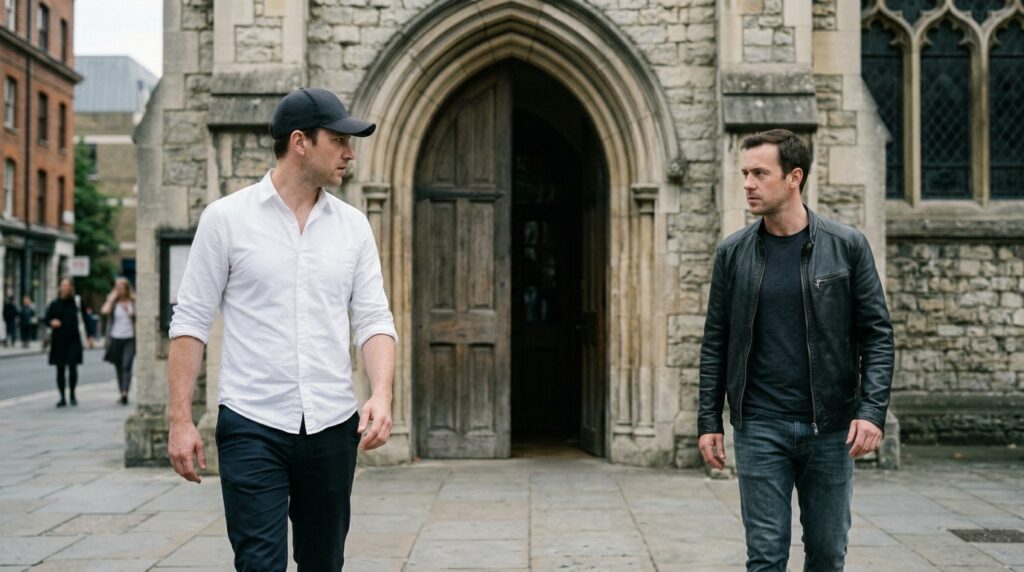
The leather jacket creaked, the sound sharp against the heavy, dead afternoon air. Tommy stood five paces out from the church steps, his boots kicking up small plumes of pale dust from the gravel drive. He was breathing through his nose, his stocky frame hunched forward like an old dog looking for a tear in the fence. The tattoos crawling out from his collar were dark, blurred lines against skin that looked like it hadn’t slept since Tuesday.
Arthur didn’t answer right away. He adjusted the brim of his black baseball cap, letting the shadow settle back over his eyes. The crisp white of his dress shirt felt stiff against his neck, smelling faintly of cold iron and starch. In his right pocket, his thumb ran over the square edge of the heavy sanctuary key, pushing it into his callus until the metal bit back.
“This is church ground, Tommy,” Arthur said. His voice didn’t rise. It had the flat, unyielding weight of a fence post driven deep into dry clay. “Go home to your sister.”
“My sister’s apartment is getting locked up tomorrow morning because your board decided our name wasn’t worth the ink on the extension,” Tommy snarled. He didn’t wait for a reply. He took two explosive, heavy strides forward, the gravel screaming under his heels. His right fist came up wild, a desperate, swinging arc aimed straight for Arthur’s jaw.
The air moved first. Arthur didn’t blink. He didn’t step back into the safety of the heavy oak doors behind him. Instead, he met the heat of the attack with a practiced, freezing economy. His left hand shot out, palm flat, catching the inside of Tommy’s forearm to redirect the momentum. The fabric of the leather jacket ground against Arthur’s sleeve with a dry rasp. Before Tommy could bring his weight down, Arthur pivoted his hips, his right hand hooking hard into the soft space just beneath Tommy’s ribs.
The breath left the younger man in a wet, ragged grunt.
Arthur used the momentum, twisting his fingers into the collar of the leather jacket and driving his weight downward. It wasn’t a cinematic throw; it was the clinical leverage of a man who spent his youth breaking horses and his winters shifting limestone blocks. Tommy’s boots lost traction. He hit the gravel on his shoulder, his head snapping back against the hard-packed earth with a dull, hollow thud.
The dust settled over them both, fine and gray.
Arthur stood completely upright, his breathing steady, his shirt still tucked perfectly into his black trousers. Only the slight tremor in his knuckles betrayed the strike. He looked down at Tommy, who was curling onto his side, clutching his ribs, his mouth open as he tried to drag the hot air back into his lungs. Small pieces of sharp gravel were embedded in the skin of Tommy’s cheek, drawing tiny, dark beads of iron-smelling blood.
“The board didn’t lock the door, Tommy. Your father did, twenty years ago,” Arthur said, his voice dropping an octave, cold enough to freeze the sweat on the back of the younger man’s neck. He stepped closer, his boot coming down an inch from Tommy’s twitching fingers. “Stay down. And walk away.”
Tommy spat into the dirt, his eyes red and unfocused, but he didn’t try to lift his shoulder from the gravel.
Arthur turned his back, his fingers finding the key in his pocket once more. As he reached for the iron handle of the church door, his eyes caught a flicker of movement across the street. Behind the faded screen of the hardware store, the blinds adjusted. Someone was standing in the dark of the shop, watching the blood dry in the dust.

CHAPTER 2: THE CRACKED FOUNDATION
The noon light off the limestone was flat, white, and completely devoid of warmth. Arthur pulled the brush across the seam, the stiff wire bristles scraping a dry, high-pitched scream from the gray mortar. A fine cloud of powdered lime rose into his face, settling on his tongue with the taste of copper and dried earth. He didn’t turn around when the bell in the tower struck two, its heavy bronze vibration rattling the iron bucket of wet mix at his boots. He didn’t need to look at the road to know the hardware store’s rusted delivery truck had just pulled into its slot across the lane, its engine dieseling twice before dying with a wet, oily cough.
The town didn’t stop moving because Tommy had hit the dirt. It just moved slower, like grease thickening in a cold engine.
Arthur dipped his trowel into the bucket, the gray slurry slapping against the steel with a heavy, wet sound. He targeted the gap. The stone church was stable to anyone looking at it from a passing sedan, but up close, the mountain was giving way. A hairline fracture had started three feet up from the water table, cutting directly through the granite foundation blocks and snaking downward into the shadows of the basement air vent. It was fresh. The edges of the break were clean, not yet rounded by the rain or clogged with the black moss that grew on the north-facing masonry.
He pressed the mortar into the split, using his thumb to pack it tight. His knuckle caught the sharp edge of a flint protrusion, tearing a thin line through his skin. He didn’t wipe the blood. He watched it mix with the gray lime, turning the wet dust into a dark, rusty paste before it vanished under the steel blade of the tool.
“You’re using the wrong mix, Artie.”
The voice came from behind the boxwood hedge. It was Miller, the sexton, his boots dragging through the dry grass with the rhythmic, heavy rasp of a man whose knees had surrendered to the winter damp thirty years ago. He stopped at the edge of the gravel walk, his hands dug deep into the pockets of a grease-stained canvas coat that smelled of fuel oil and old wood.
Arthur didn’t drop the trowel. He smoothed the joint, his shoulder blades tight under the starch of his white shirt. “The mortar is three parts sand, one part lime. Same as the original build.”
“The original build didn’t have the county trucks hauling forty tons of gravel past the gate every twenty minutes,” Miller said. He spat a dark stream of tobacco juice into the weeds. “The vibration is shaking the shelf under the cellar. You can patch the skin all you want, but the bone’s splitting.”
Arthur turned slowly. He kept his cap low, his gaze fixing on the older man’s boots. “The bone is fine.”
“Tommy’s uncle was down at the station before the grease on his jacket was dry,” Miller said, his voice dropping into that quiet, transactional tone that passed for news in the county. “He wasn’t talking about the fight. He was talking about the ledger from ninety-two. The one your father kept in the lockbox behind the boiler.”
Arthur’s thumb tightened against the handle of the trowel until the wood groaned. The iron key in his pocket felt hot against his thigh, an anchor dragging him down into the dry earth. He looked past Miller’s shoulder, toward the hardware store. The screen door was propped open with a block of cedar, but the dark interior remained opaque, a square of pure oil-black shadow in the middle of the whitewashed storefront.
“The station has its own business,” Arthur said.
“They’re making it church business,” Miller replied. He reached into his coat, his thick fingers emerging with a small, brass-plated padlock that had been sheared clean through the shackle. The metal at the cut was bright, silver, and fresh. “Found this by the coal chute twenty minutes ago. Someone didn’t use a key, Artie. They used the long bars from the truck bed.”
Arthur looked at the broken lock. The weight of his authority, the quiet respect he’d spent thirty years cultivating like an orchard in dry soil, felt suddenly thin—a layer of paint over rotted timber. He didn’t ask if Tommy had gone inside. He knew the boy’s habits; he knew the desperation that came when a house was four weeks from the county gavel and the only name left on the deed was a ghost.
“Get the extra boards from the shed,” Arthur said, his hand dropping to his pocket, his fingers locking around the cold iron shape of the master key. “Nail the chute from the inside.”
“And if they’re already under the floor?” Miller asked.
“Then they’re sitting in the dark,” Arthur said.
He left the bucket by the wall, the lime already beginning to skin over with a dry, white crust. He walked around the corner of the transept, his boots silent on the packed earth where the grass refused to grow under the drip-line of the slate roof. The door to the basement was low, a heavy piece of rough-sawn pine that had swollen into its frame during the spring rains. He had to put his shoulder against the wood to force it, the hinges screaming as the rust ground against rust.
The air inside smelled of old sulfur, damp anthracite, and the specific, cold rot of paper that had stayed out of the sun since the turn of the century. It was an absolute darkness, save for the single gray finger of light that poked through the foundation vent he had just been patching from the outside.
Arthur didn’t light a lantern. He knew the three steps down—the first one soft, the second one cracked, the third one solid stone. He reached out into the blackness, his palm finding the rough stone of the chimney breast. His fingers traced the cold mortar until they hit something that didn’t belong—a gap where the stone should have met the flue, and the distinct, oily texture of fresh grease on a steel handle that hadn’t been turned since his father’s funeral.
His hand closed on the latch of the hidden iron plate behind the boiler. It didn’t take a key. The lock had been broken before he was born, held shut only by the weight of the soot and the town’s collective silence. He pulled, and the dark space opened with a long, dry hiss, like an intake of breath from a throat full of dust.
Inside, his fingers didn’t find the leather bound ledger of parish marriages. They closed on a stack of cold, smooth legal size sheets, bound with a rusted paperclip that left a brown smear across his thumb. He brought the first sheet into the thin pencil of light from the vent.
It wasn’t a record of tithes. It was a list of names—every farm along the creek road, each one followed by a date, a dollar figure in black ink, and a red cross drawn through the signature line. The top name on the sheet was Garrick, Tommy’s grandfather, dated October of nineteen eighty-eight. Beneath it, in his father’s precise, ledger-style handwriting, were the words: Title held in trust for diocese protection. Obligation permanent.
A floorboard creaked directly above his head—the slow, deliberate weight of someone moving through the altar rail in the sanctuary above.
CHAPTER 3: THE VESTRY SHADOWS
The vibration traveled down the hand-hewn oak joists, dropping a fine skim of gray cobwebs across Arthur’s shoulder. He didn’t drop the papers. His fingers slipped the rusted paperclip back into place, the sharp wire scraping a crescent of dried orange scale under his thumbnail. He shoved the pages into the deep pocket of his trousers, right beside the heavy iron sanctuary key. The metal clinked—a single, bright note that felt as loud as the tower bell in the dead, dead quiet of the cellar.
Above him, the boots moved again. They didn’t have the heavy, dragging scrape of Miller’s leather work shoes. These steps were light, shifting from heel to toe with a restless, rhythmic click. Someone who didn’t want to be heard, but didn’t know which planks were soft.
Arthur moved toward the stairs. He didn’t use the handrail; his palms knew the rough stone face of the chimney by heart. He cleared the third step, then the second, his body staying low until his chin was level with the threshold of the vestry door.
The afternoon sun had moved, casting long, desaturated bars of white through the leaded glass windows. The room was thick with the smell of floor wax and old wool cassocks. Standing by the walnut cabinet where the communion silver was locked was Sheriff Vance. He didn’t have his hat on. His thin, sand-colored hair was combed flat against his skull, shiny with sweat despite the draft coming off the stone floor. His fingers were busy with an iron pry-bar, the flat edge already dug two inches into the old paneling of the cabinet frame.
“The church office handles the deeds, Vance,” Arthur said.
The sheriff didn’t jump. He froze, his shoulder blades bunching under his brown wool uniform coat. He left the pry-bar wedged in the splintering walnut, turning his head just enough to show the gray stubble along his jawline.
“The office doesn’t have what I’m looking for, Artie,” Vance said. His voice was transactional, flat as a gravel road. “And neither do the county archives. I checked the dead-files three times this morning before the sun cleared the pines.”
“You’re four miles outside your jurisdiction for an archive search,” Arthur said, stepping out of the cellar stairwell. He didn’t brush the lime dust from his white shirt. He let his hands hang loose at his sides, his right thumb hooking slightly into the pocket where the ledger pages lay flat against his thigh. “Tommy’s uncle doesn’t have the leverage to put you on my floor.”
Vance pulled his hand away from the pry-bar. The iron tool remained stuck in the wood, vibrating slightly like a knife thrown into a target. “Tommy’s uncle is a drunk who can’t find his own boots in the morning. But the state tax office called my house at dawn. They aren’t looking at Tommy, Artie. They’re looking at the church property lines. Every acre your father signed over to the parish between eighty-five and ninety-five.”
Arthur looked at the floorboards between them. Near the edge of the copper heating grate, a single brass casing—short, notched at the rim, and dark with corrosion—was jammed into the seam of the pine planks. It had been there so long the wood had grown around it, a metal tooth embedded in the church’s skin. A micro-mystery his father had left behind, one that Arthur had walked past a thousand times without looking down.
“The land belongs to the diocese,” Arthur said. “The signatures are legal.”
“The signatures are on paper that shouldn’t exist,” Vance countered. He stepped away from the cabinet, his boots clicking on the brass casing, forcing it deeper into the wood with a dull crunch. “Tommy’s grandfather didn’t default on a bank note. The bank didn’t even hold the paper. Your father bought the debt with money that came out of the county road fund while he was still sitting on the grand jury.”
The words hit the room with the dry, hollow weight of stone dropping into an empty well.
Arthur felt the skin across his forehead tighten. The ledger in his pocket—the decoy secret he’d just unearthed, the neat lines of financial leverage that he thought explained the town’s silent obedience—was fracturing under his feet. It wasn’t just a matter of the church holding a few local mortgages to protect the parish from a default. It was bigger. The foundations weren’t just cracked; they were laid in grease.
“My father didn’t touch the road fund,” Arthur said, though his own voice sounded thin to his ears, like paper tearing in another room.
“He didn’t have to,” Vance said, reaching down to pull the pry-bar free from the cabinet with a sharp, splintering groan. He didn’t point the iron at Arthur, but he didn’t drop it either. “He just had to look the other way while the diocese cleared the deficit for the bishop’s building project in the city. And now Tommy’s got the receipts from his grandfather’s old safe-deposit box. He isn’t looking for a settlement, Artie. He’s looking to burn the fence down.”
“Tommy doesn’t have the stomach for a fire,” Arthur said.
“He doesn’t need the stomach. He’s already given the copies to the federal marshals in the valley,” Vance said. He walked past Arthur toward the side exit, his coat brushing against the stenciled lettering on the vestry wall. “I give it until tomorrow noon before the cars show up at your gate. If I were you, I’d stop fixing the mortar. There won’t be enough left of this parish to hold a roof up by Sunday.”
The side door clicked shut, the latch dropping home with the finality of a spade hitting gravel.
Arthur stood alone in the fading light of the vestry. His hand went into his pocket, his fingers curling around the cold, rusted ledger pages. He had spent thirty years policing the boundary, throwing boys like Tommy into the dirt to keep the town’s ledger clean, believing he was the sovereign protector of something holy.
He looked down at his shoes. The gray lime dust from the foundation was tracked across the dark floorboards, every step he’d taken leaving a white, powdery scar on the old wood. He reached down and touched the notched brass casing near the grate, his fingers coming away black with ancient soot. The final truth wasn’t in the ledger. It was deeper under the floor, locked in a vault he hadn’t even found yet, and the timer was already running out.
CHAPTER 4: THE LOCKED ARCHIVE
The silence that Vance left behind was a physical pressure, thick and tasting of old wool. Arthur stood unmoving, his hand still buried in his pocket, his fingertips tracing the jagged edge of the old paperclip bound to the ledger pages. The sheriff’s warning about federal marshals didn’t make his heart race; it made him feel heavy, like a machine left out in the rain until the gears froze solid. He looked at his boots, at the pale white tracks of lime dust he had dragged through the vestry. It was the skin of the church, sloughed off and scattered across the dark floorboards.
He didn’t wait for the noon deadline Vance had thrown out. Waiting was for people who believed a storm would change its mind.
Arthur moved back down into the cellar stairwell, his shoulder blades catching the rough limestone block of the frame. The darkness came back to meet him, cold and smelling of dead coal. He bypassed the hidden plate behind the boiler where the decoy ledger had lived. That layer was already broken open; the town had eaten it, Vance had mapped it, and Tommy had weaponized it. But his father hadn’t spent forty years policing the gravel drive just to hide a few misappropriated road funds. The old man’s unwritten code had a harder core.
He reached the absolute bottom of the basement, where the concrete floor gave way to the original nineteen-hundred dry-packed earth. The air here was thin, carrying the metallic bite of groundwater leaking through the deeper foundation seams. He knelt in the dirt, the knees of his black trousers soaking up the cold moisture of the ground.
His hand reached into the dead-space beneath the iron frame of the lower boiler intake. There was no keyhole here, no brass plate. There was only a heavy slab of rusted boilerplate iron, set flush into the stonework like a grave marker. He jammed his fingers into the narrow lip beneath the iron, the sharp edge cutting into his calluses, grinding the orange scale deep under his fingernails until the skin split.
He pulled with his shoulders, his teeth grinding against the grit in the air. The boilerplate didn’t slide; it groaned, a heavy, scraping screech of metal against granite that vibrated through his knee bones.
Behind it lay the secondary vault—a small, brick-lined cavity no larger than a bread box. It was dry inside, sealed against the damp by a thick wrap of tarred canvas. Arthur dragged the bundle out into the dim gray pencil of light coming from the foundation vent above. His hands were shaking slightly now, a slow, rhythmic tremor that he couldn’t force down. He cut the hemp twine with his pocketknife, the coarse fibers snapping with a sharp sound like dry twigs breaking.
The canvas fell away to reveal a leather logbook, its cover rotted down to the grey board beneath. But it wasn’t the diocese ledger. It was a diary written in his father’s wide, sweeping hand, dated from the summer of nineteen eighty-eight—the exact month Tommy’s grandfather had signed over the family acreage.
Arthur opened the first page, his eyes tracking the faded purple ink through the gray shadow.
October 4, 1988. Garrick came to the house after dark. He had the fuel cans from the mill. He told me the fire at the old schoolhouse wasn’t an accident—he’d set it to clear the mortgage insurance, but he didn’t know the rector’s boy was sleeping in the annex. He was shivering so hard he couldn’t hold his tobacco. He wanted to give himself to the state police.
Arthur’s thumb froze on the margin. He didn’t turn the page. Time seemed to dilate, stretching out until the click of the cooling boiler pipes sounded hours apart. The cold of the stone floor crept up through his legs, settling deep in his chest.
I told him the state wouldn’t give his family the land back once the court cleared the arson charge. The diocese would take it anyway for the loss of the annex. I took the deeds into the parish trust tonight. Not to punish him. To keep the boy’s name out of the dirt and keep the Garrick family from the state farm. We are both carrying the ash now. The church is the only roof left that can hide this kind of rot.
It wasn’t theft. It wasn’t a diocese default covered by stolen grand jury funds. It was a mutual, agonizing pact of survival between two men who had traded their family legacies to keep a child’s death from burning the town to the ground. His father hadn’t been an enforcer for a corrupt machine; he had been the warden of a graveyard, keeping the boundary secure so the ghosts couldn’t get out. And Arthur had spent thirty years breaking knuckles to protect a lie that was actually a shield.
A sudden, sharp shadow broke the light from the foundation vent above.
Arthur looked up. Through the iron bars of the cellar window at ground level, he saw the tires of the hardware store truck stop in the gravel. A pair of worn leather work boots stepped down into the dust. Then another pair—heavy, black, and shuffling with a limp. Tommy was back, and he wasn’t alone.
The front door of the sanctuary far above groaned as it was kicked off its latch, the heavy wood slamming against the plaster wall with a sound like a rifle shot echoing through the valley. They were inside, and the federal marshals Vance had promised weren’t going to find a financial ledger. They were going to find thirty years of mutual protection that the town had twisted into a cage.
Arthur didn’t move to hide the book. He sat in the damp mud of the foundation, his fingers resting on his father’s purple ink, his cap shadowing an expression that had finally run out of code to enforce. The ultimate reality was out of the vault, but the lock on the town’s future was still firmly jammed.
CHAPTER 5: THE ALTAR TRIAL
“Bring him up out of the hole, Tommy!”
The shout came from the center aisle, its edges ragged and flat as it bounced off the high timber rafter beams of the nave. It wasn’t the law. It was Miller’s voice, but the old sexton didn’t sound like a man who spent his mornings sweeping lime dust from the walks anymore. He sounded like a man who had finally seen the fence line go down.
Arthur didn’t drop the canvas wrap. He rose from the mud of the lower cellar chamber, his knees clicking in the dark like dry pine branches. The leather logbook was tucked tight beneath his left arm, the rotted cardboard cover crumbling under the pressure of his ribs. He didn’t use the flashlight. He climbed the three steps—the soft one, the cracked one, the stone one—his boots finding the center of each riser by the memory of the weight alone.
When he cleared the vestry door and stepped into the light of the sanctuary, the air was different. The smell of cold floor wax had been replaced by the wet, sharp reek of unwashed denim and the raw turpentine smell of cedar shavings from the hardware store lot.
Three men stood at the altar rail. Tommy was in the center, his leather jacket torn at the shoulder where Arthur had pinned him into the gravel an hour before. His face was swollen, a dark knot of purple rising under his left eye, but his hands were steady. He was holding the heavy iron crowbar Vance had left stuck in the cabinet. To his left stood Miller, his canvas coat open, revealing a rusted wire-cutter shoved into his belt. To his right was Old Man Garrick’s brother, Elias, his eyes milky with cataracts but his hand fixed tight on the arm of Tommy’s jacket.
“You’re done writing the book, Artie,” Elias said. He didn’t look at Arthur’s face; his blind gaze was fixed somewhere near the height of the brass cross behind the altar. “Your father’s dead and the diocese isn’t sending a lawyer down the valley to save your skin. Give Tommy the papers.”
Arthur walked past the walnut pulpit, his shoes silent on the green carpet runner. He stopped five paces from the rail, letting his right hand fall flat against the polished oak of the front pew. The wood felt cold, grease-filmed from forty winters of local palms.
“The papers don’t say what you think they say, Tommy,” Arthur said. His voice was flat, devoid of the authority he’d used on the steps. It was the voice of a man counting the remaining posts on a falling corral. “Your grandfather didn’t lose the creek lot to a bank default. He didn’t lose it to the church.”
“He lost it because your old man put his name in the red box!” Tommy shouted. He took a step forward, the iron crowbar scraping against the brass rail with a sound that made Arthur’s teeth ache. “My sister’s paying rent on land our people cleared before the county road had stone on it. I saw the tax maps at the station, Artie. I know what the parish did with the signatures.”
“The signatures were a shield,” Arthur said. He didn’t look at Tommy. He looked at Miller. The old sexton was watching the vestry door, his ears cocked toward the road outside where the afternoon log-trucks usually rumbled past. But the road was dead quiet. The state police hadn’t arrived, and the federal marshals Vance promised were still forty miles south in the county seat.
“Elias,” Arthur said, his eyes shifting to the old man. “Who bought the kerosene for the schoolhouse annex in eighty-eight?”
The blind man’s jaw went slack. The yellow skin around his mouth twitched once, his fingers tightening on Tommy’s sleeve until the leather bunched into a hard knot. “That’s buried, Artie. The state cleared that thirty years back. It was a bad flue.”
“It wasn’t the flue,” Arthur said, his voice dropping into the small, cold space between them. “Garrick signed the deeds over because he killed the rector’s boy in the annex. My father took the land into the parish trust so the state wouldn’t hang your name from the courthouse gate. He kept your family on the mountain, Elias. He spent thirty years letting this town call him a thief so you could keep your gardens.”
Tommy looked between his uncle and Arthur, the crowbar lowering an inch. The blood in his swollen eye made him squint, his face twisting into something small and confused. “Uncle? What’s he talking about?”
Elias didn’t answer. He reached out with his free hand, his liver-spotted fingers clawing through the air until they hit the brass upright of the altar rail. He didn’t look like a patriarch defending his clan anymore; he looked like a horse that had smelled the grease-fire before the barn door opened.
“He’s lying to save the house, Tommy,” Miller said from the shadow of the pillar. He hadn’t looked at Arthur once since the stairs. His hand was on the wire-cutters. “The old man’s always had a story for why the church needs the dirt. But the dirt’s worth three hundred an acre to the timber mill now, and the diocese is selling the paper whether Artie likes it or not.”
Arthur’s gaze locked on Miller. The sexton wasn’t surprised by the schoolhouse story. He didn’t look at the rotted diary under Arthur’s arm with fear; he looked at it with the cold, calculating eye of a man who had already cleared his own ledger.
Beside the altar rail, the heavy brass candlestick that usually held the paschal candle was gone. Only the dark circle in the velvet runner remained where the iron base had sat for twenty years. A micro-mystery that didn’t fit the financial maps or the old arson pact.
“Where’s the brass, Miller?” Arthur asked quietly.
Miller didn’t answer. He turned his head toward the side door as the sound of gravel crunching under heavy tires finally broke the silence of the lane outside. It wasn’t the federal marshals. It was the high, screaming rattle of a flatbed truck with its muffler gone—the mill truck from the valley, its headlights yellow and dim in the gray afternoon fog.
CHAPTER 6: THE TIMBER MILL LEVERAGE
The headlights of the flatbed swept through the leaded glass windows, cutting long, greasy bars of yellow across the timber trusses. The engine idled with a loose, metallic knock that shook the floorboards beneath Arthur’s boots, making the dust jump in the cracks.
Miller didn’t take his hand off the wire-cutters. He took three backward steps toward the side door, his gaze never leaving Arthur’s face. “The marshals aren’t coming to pull deeds, Artie. The mill owner bought the parish debt from the diocese administrative office three weeks ago. This structure doesn’t belong to the congregation anymore. It belongs to the clearing crews.”
Arthur’s thumb rubbed the cold edge of the sanctuary key inside his pocket. The unwritten code he had policed his entire life was dissolving into the smell of low-grade diesel exhaust. He looked at Tommy. The younger man had lowered the crowbar, his knuckles pale where the grease from the iron had stained his skin. Tommy was staring at his uncle Elias, whose breathing had turned shallow and wet, a rattling gasp from a chest that had carried the weight of the schoolhouse fire for thirty-four years.
“You knew,” Tommy whispered, his voice small against the rumble of the idling truck outside. “Uncle, you knew why we lost the timber rights.”
Elias didn’t look up. His blind eyes stayed fixed on the brass ring where the paschal candle should have been. “Your grandfather couldn’t live with the boy’s ghost, Tommy. He gave the old man the land to pay for the silence. He wanted the church to hold it so the county wouldn’t dig up the cellar under the annex.”
“But they’re going to dig it up now,” Arthur said, stepping past the front pew. The rotted logbook under his arm felt heavier than a block of quarry stone. “Miller didn’t call the marshals. He called the mill’s clearing crew. If those dozers hit the old schoolhouse foundation, the bones are coming up anyway.”
Miller reached behind his back, his fingers wrapping around the brass handle of the side door. “The mill doesn’t care about thirty-year-old teeth in the dirt, Artie. They care about forty thousand board-feet of old-growth pine behind the parsonage. But they can’t clear the acreage while your name is still signed to the maintenance covenant.”
“I’m not signing the release,” Arthur said.
“You don’t have a choice,” Miller replied, and for the first time, he pulled the wire-cutters from his belt. They weren’t tool-steel for cutting fence lines; the jaws were notched, darkened with a crust of dried grease that matched the oily film on the altar rail. “The safe-deposit box at the local branch didn’t just have the ninety-two ledger. It had your father’s grand jury deposition from the arson investigation. The one he never filed. The one where he took five thousand dollars from the diocese building fund to sign off on a faulty chimney.”
The silence came back, thicker than the diesel smoke creeping under the door sill.
Arthur’s hand came out of his pocket. The iron key felt like a dead weight against his fingers. The decoy secret—the idea that his father had stolen county road funds—had been a lie. The second layer—the idea that his father had protected a desperate family out of mercy—was a half-truth. The core reality was a dirty transaction, a cold-veined trade where a child’s life was valued at the cost of a diocese project and a lifetime of security for the man who kept the keys.
He looked at Tommy. The challenger’s face wasn’t angry anymore; it looked like the gray clay down by the creek after a flash flood has cleared the topsoil. Everything they had fought over—the unwritten code, the dominance on the steps, the pride of the territory—was just the rusted cage built around a rotten post.
“The deposition is already at the mill office,” Miller said, his boots clicking on the floorboards as he pushed the side door open. The fog from the lane rolled in, a damp, desaturated blanket that smelled of wet slate and rotted sawdust. “You have until six o’clock to bring the master key down to the clearing gate. If you aren’t there, the county sheriff’s going to execute the trespass warrant Vance signed before he left.”
“Vance didn’t sign a warrant,” Arthur said, though his voice lacked the friction it had carried an hour ago.
“He signed whatever the mill owner told him to sign,” Miller said from the fog. “He’s got three nephews working the saws, Artie. This town doesn’t live on faith. It lives on the whistle.”
The side door slammed shut, the vibration rattling the leaded panes until one of the small diamond-shaped pieces of glass popped out of its lead came, hitting the stone floor with a sharp, clear ping.
Tommy didn’t move toward the door. He sat down on the altar step, his leather jacket bunching around his ears, his fingers digging into his eyes until the skin turned white. “We don’t have anything left, Elias. The house is gone. The name’s gone.”
Old Elias didn’t answer him. He had dropped to his knees, his hands searching the carpet until they found the empty spot where the brass candlestick had been. His fingers rolled into the dark velvet circle, tracing the grease ring left by twenty years of prayer.
Arthur didn’t look back at them. He walked into the vestry, his boots leaving faint, white lime tracks on the dark wood. He didn’t turn on the lamp. He sat at the walnut table, his hand resting on the rotted canvas bundle he’d dragged from the cellar. The final chapter wasn’t written in his father’s ledger; it was waiting out at the clearing gate, where the iron teeth of the saws were already turning in the gray light.
CHAPTER 7: THE TENSION AT THE GATE
The mountain air at the county line was sharp, smelling of cold iron, wet pine needles, and the bitter sulfur of a diesel exhaust stack. Arthur didn’t slow his truck down until the rusted wire of the clearing gate scraped against his front bumper. The engine gave one final, oily backfire before he cut the ignition, leaving only the high, rhythmic scream of the mill saws a hundred yards into the timber. The sound ground against his teeth like sand.
He didn’t take his black baseball cap off. He stepped into the gray mud, his boots sinking two inches into the churned earth where the heavy flatbeds had torn up the turf. Under his arm, the rotted canvas bundle felt cold, its mold-softened corners flattening against his ribs.
Miller was waiting by the iron winch. Beside him stood Sheriff Vance, leaning his lower back against the fender of his patrol car, his fingers hooked into his utility belt right next to the leather holster. Between them, jammed top-first into a pile of gravel to hold a makeshift surveyor’s string, was the missing brass candlestick from the church altar rail. Its polished face was scratched, covered in a thin skin of yellow mud and road grease. It looked small out here, stripped of the sanctuary light, just three pounds of junk metal holding up a nylon cord.
“You’re late, Artie,” Miller said. He didn’t drop the heavy iron pliers he was using to twist the boundary wire. “The saws already cleared the first stand behind the old creek bridge. The office wants the signed release before the crews cross into the parsonage lot.”
Arthur walked straight to the surveyor’s string, his shoes crunching on the wet shale. He didn’t look at Vance. He looked down at the brass candlestick, then at the thick stack of papers Miller had weighted down with a flat stone on the hood of the car.
“My father didn’t take the five thousand for himself, Miller,” Arthur said. His voice was lower than the whine of the saws, flat and dry as a winter drought. “He put it into the county road fund under the Garrick name so the state inspectors wouldn’t look at the insurance filings for the schoolhouse.”
Vance shifted his weight, his leather belt creaking in the cold. He didn’t look Arthur in the eye; he watched a logging truck shift gears down in the hollow, its blue smoke rising through the hemlocks. “It doesn’t change the ink on the grand jury sheet, Artie. The state tax folks don’t care where the money went. They care who signed for the delivery.”
“You did, Vance,” Arthur said.
The sheriff’s hand went still on his belt.
Arthur pulled the rotted logbook from the canvas wrap, the old twine dropping into the mud between his boots. He turned the page with his thumb, forcing the rotted board backing to split until the purple ink of nineteen eighty-eight was exposed to the flat gray sky. He didn’t read it aloud. He just held the paper three inches from Vance’s face, close enough for the sheriff to smell the basement rot on the fibers.
Beneath his father’s signature was a third name, written in the thin, scratching stroke of a fountain pen that had run dry twice before finishing the line: Vance, Deputy Recorder. Witnessed and verified.
“Your uncle didn’t have the saws, Tommy,” Arthur said, his head turning toward the cab of the truck where Tommy had stayed behind the glass, his swollen face pressed against the wet pane. “The sheriff’s family owned the mill debt before the diocese ever defaulted. This wasn’t an estate settlement. It was an extraction.”
Miller dropped the pliers into the gravel. The iron made a dull, wet splash. He looked at Vance, then back at Arthur’s shirt, where the gray lime dust from the foundation had dried into a hard white smear across his heart. “The release is still legal, Artie. The church board approved the transfer when the diocese closed the registry.”
“The board didn’t have the master key,” Arthur said.
He reached into his trouser pocket and pulled out the iron key—the real one, the heavy, square-bitted piece of blacksmith’s work that had locked the sanctuary doors for forty years. He didn’t hand it over. He walked to the pile of gravel, grabbed the mud-stained brass candlestick by its neck, and jerked it out of the dirt, snapping the surveyor’s string with a sharp thwack.
He dropped the iron key into the empty socket where the paschal candle should have sat. It fit with a dull, heavy clink, the rusted teeth of the key locking into the brass rim. He threw the whole piece into the back of his flatbed, where it hit the steel floor with a ring that cut through the noise of the machinery.
“The parsonage isn’t in the trust,” Arthur said, stepping back into the mud toward his cab. “My father took that acre out of the diocese boundary two days before he died. If your dozers cross the creek road, you’re breaking state timber laws, Vance. And the federal marshals won’t be looking at the church deeds when they get here. They’ll be looking at the road fund receipts from eighty-eight.”
Vance didn’t pull his hand away from his belt, but he didn’t unhook the strap either. He looked down at the broken nylon string trailing through the wet mud, its bright orange tail dissolving into the gray silt of the lane.
“You can’t keep the roof up by yourself, Artie,” Miller called out as Arthur slammed the truck door shut. The glass rattled in its channel, loose and dry. “The town’s going to leave that stone to rot by winter.”
“Then let it rot,” Arthur said to the dark dashboard.
He twisted the key, and the engine caught with a heavy, scraping roar that drowned out the saws in the timber. He backed the truck into the lane, his tires spinning once in the clay before catching the hard stone of the creek road, leaving the county line gate behind in the fog.







