
The Weight of Dry Earth and the Cost of Standing One’s Ground In an Unyielding World

CHAPTER 1: THE FRICTION OF THE REBOUND

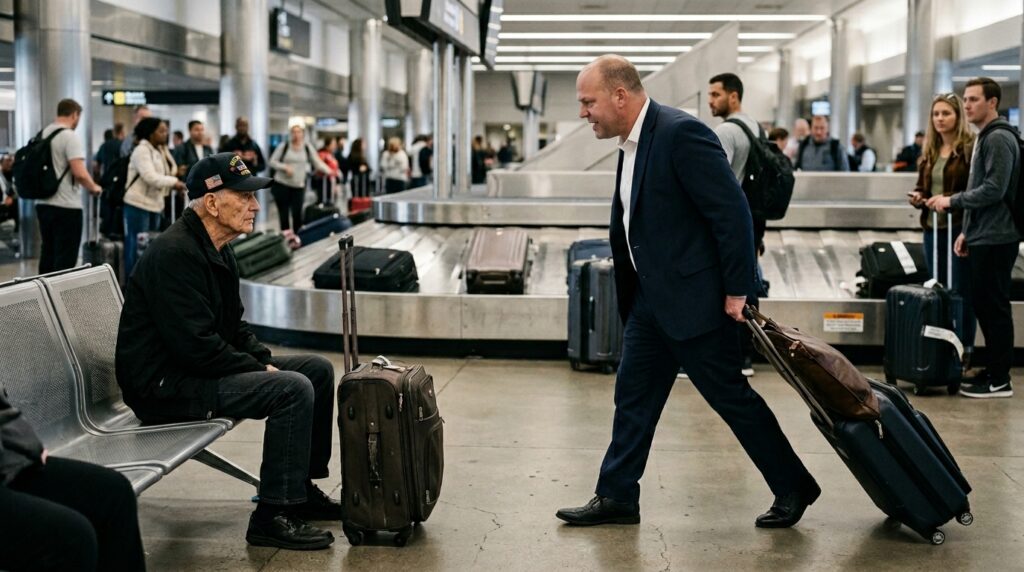
The floor smelled of stale industrial wax and the burning grease of the carousel belt. When the stocky man in the dark suit hit the tile, the sound was short, like a wet sack of feed dropping from the bed of a truck. He stayed down for three full seconds, his palms flat against the desaturated gray linoleum, his breath coming in ragged, shallow gasps that sucked in the lint of a thousand travelers.

Above him, the old man did not adjust his cap. The dark wool of the veteran’s crown remained square, casting a hard shadow over eyes that had stopped tracking the movement of civilian crowds thirty years ago. His knuckles felt hot inside the pockets of his black jacket, the skin dry and splitting along the grain like old cedar. He didn’t breathe hard. His chest rose and fell with the slow, mechanical rhythm of a pump jack working an empty well.

“Stay back,” the man on the floor hissed. The words were choked, caught in the back of a throat filled with the sour taste of a ruptured ego. He didn’t try to get up. He just braced himself on one elbow, his white collar torn loose from the button, a dark streak of grease from the luggage bumper smeared across his jawline. “Just… stay the hell back.”

The old man looked at him. He didn’t look at the face; he looked at the center of mass, the slight tremor in the younger man’s right knee, the way the dark fabric of the suit jacket bunched around a thick waist. The carousel behind them gave a heavy, rhythmic groan as a massive hard-shell suitcase slid down the metal ramp, striking the rubber bumper with a dull thud. None of the passengers gathered around the lane moved. They had become a wall of wet wool coats and pale, silent faces, their eyes fixed on the grease stain on the floor and the old man’s boots.

The boots were scuffed at the toe, the leather showing the pale gray of real earth beneath the polish. They didn’t move an inch.

“You dropped your ticket,” the old man said. His voice was sparse, dried out by decades of high-desert wind, lacking the anger the crowd expected. It was a statement of inventory, nothing more.

The man on the floor didn’t look down. His eyes stayed locked on the old man’s chin, searching for a trace of hesitation or the frailty his superiors had promised him would be there. Finding none, his fingers twitched against the floor, sliding an inch backward toward the passenger lane.

Between them lay a square leather folder that had slipped from the corporate man’s inside pocket during the turn. The brass corner of the leather was scratched, bright yellow metal showing through the cheap plating. The old man didn’t bend to pick it up. Instead, he shifted his weight slightly, the iron in his knees giving a low, familiar click that only he could hear. He looked past the stocky man’s head, toward the plate-glass windows where the afternoon light was turning the color of wet zinc.

A yellow sheet had begun to fan out from the mouth of the leather folder, caught in the draft of the terminal’s ventilation system. The top line was visible against the gray floor, printed in the blocky, unyielding font of a state regulatory office. It wasn’t an eviction notice. It was a certified death certificate with the name field left blank, signed three days prior by a medical examiner three hundred miles away in the veteran’s own county.


CHAPTER 2: THE BOUNDARY OF RUST

The gravel road didn’t so much end as it dissolved into the dry, chalky silt of the foothills. By the time the old truck rattled to a halt against the cattle guard, the smell of airport wax had been thoroughly scoured from the cab, replaced by the bitter, metallic tang of unwashed iron and alkaline dust. The old man sat with his hands resting on the cracked vinyl of the steering wheel, his eyes fixed on the three-strand barbed wire that marked his western boundary.

The wire was down. It wasn’t a clean snap born of a winter freeze or the heavy shoulder of a stray bull. The rusted galvanized steel had been snipped clean at the cedar post, the tension releasing so violently that the barbs had curled into the wild cheatgrass like dead scorpions. The tool that made the cut had left a bright, unoxidized scar on the wire’s core—a tiny, yellow-white gleam against the dull gray patina of sixty years of exposure.

Beside the gate, a white Ford cruiser sat idling, its exhaust pipe coughing thin, blue smoke into the pale sagebrush.

Deputy Vance didn’t get out of the car immediately. He waited until the old man killed the truck’s engine, letting the silence of the valley settle over them like gravel filling a trench. When Vance finally swung his leg out of the cruiser, his leather duty belt creaked with a heavy, ungreased stiffness. He didn’t look the old man in the eye. Instead, his gaze wandered along the dry creek bed, his thumbs hooked loosely into his vest panels, hovering two inches above his service weapon.

“You took a late flight,” Vance said. His voice lacked the natural weight of a lawman in his own territory; it was thin, dry as paper, catching on the wind before it could reach the truck’s fender.

The old man opened the door. The hinge gave a sharp, iron shriek that made the deputy’s shoulder twitch. The old man stepped down into the dust, his scuffed boots sinking an inch into the gray earth. He didn’t look at Vance’s badge or the low-slung holster. He looked at the ground between them, tracking the wide, flat tread marks of a commercial utility vehicle that had backed up to the fence line within the last six hours.

“Someone used a pair of twenty-four-inch bolts cutters,” the old man observed. He didn’t raise his voice. He walked to the severed wire, his black jacket rustling against the dry brush as he knelt. He touched the cut end with his thumb. The steel was cold, but the grease from the tool’s pivot pin was still wet enough to leave a dark smudge on his skin. “Not local work. Local man uses fencing pliers. Saves the wire.”

Vance shifted his weight, his boot heel grinding a piece of quartz into the grit. “Winds are picking up from the north. Could’ve been scavengers, Miller. Or kids looking for cedar posts to burn up by the reservoir.”

“Scavengers don’t drive eight-lug Michelins,” Miller said. He stood up, his knee joint giving that same low, mechanical click that had echoed in the terminal. He reached into his coat pocket, his fingers brushing against the stiff leather of the folder he had taken from the terminal floor. The blank death certificate remained tucked inside, a cold weight against his ribs. “And they don’t leave their high-beams on while they do it. There’s battery acid dripped right there by the corner post. They were jumping an auxiliary winch.”

Vance let his hands drop from his vest. He took a slow step forward, his shadow stretching long and distorted across the broken fence line. The desaturated orange of the setting sun hit the deputy’s face, revealing the deep, gray rings under his eyes—the kind that come from three days of sleeplessness and a telephone that wouldn’t stop ringing at three in the morning.

“Miller, you ought to consider that offer they made you last month,” Vance said, his voice dropping into a flat, transactional drone. “The county’s changing. The water tables are dropping out by the flats, and the commissioners are looking at the utility corridors. An old man alone out here… it’s a lot of acreage to fence by yourself. Things break down. The timber goes rotten. The wire rusts out. Sometimes it’s better to let the dirt go to people who have the grease to keep the machinery turning.”

Miller didn’t answer. He walked past the deputy toward the back of his truck, his fingers trailing along the rusted iron of the bed rail. He reached down and lifted a five-gallon jerrycan from the payload, the fuel inside sloshing with a heavy, rhythmic gurgle. The scent of gasoline cut through the dry smell of the sage, sharp and toxic.

“My father put these posts in,” Miller said, looking over the cab toward the low ridge where the soil turned to red clay and shale. “He used split juniper because the bugs won’t touch it and the rot takes fifty years to find the heart. The wire’s old, Vance. But the iron under the rust is still thick enough to hold.”

“The people in the suit cars don’t care about juniper, Miller,” Vance hissed, the professional veneer cracking just enough to let the panic show through. He stepped into Miller’s perimeter, his breath smelling of stale gas-station coffee and tobacco. “The man you left on the floor back at the hub… he’s already filed the paperwork with the district attorney. They’re calling it an unprovoked assault by a hostile local. They aren’t coming with surveyors next time. They’re coming with a conservatorship order. They’re going to say your mind went soft out here in the dust.”

Miller stopped. He didn’t turn around, but his shoulders squared under the black jacket, his frame catching the final, desaturated sliver of daylight. The silence between them grew so thick that the mechanical hitch of the pocket watch in his vest seemed to fill the valley.

“Tell them the wire is three-ply,” Miller said softly. “And tell them I’ve still got forty rods of it left in the shed.”

Vance stared at the old man’s back for a long second, his mouth opening as if to spit another warning into the dirt, but the stillness of the old soldier silenced him. Without another word, the deputy turned and climbed into the white cruiser. The door slammed with a tinny, hollow ring, and the car backed down the gravel road, leaving a hanging screen of white dust that smelled of lime and old bones.

Miller watched the taillights disappear into the gray fold of the hills. Then he carried the jerrycan toward the dark shadow of his tool shed. As his hand found the cold iron handle of the latch, his boot struck something hard hidden in the weeds beside the door. He looked down. It was a standard-issue county lock, identical to the one he had placed on his own gate three years ago, but this one had been completely dissolved by a concentrated chemical solvent, the steel turned to a gray, crumbly paste that stained the dry earth like salt.

CHAPTER 3: THE WEIGHT OF LABOR

The iron latch didn’t move under the first cold weight of Miller’s hand. It was frozen, fused by a fine skin of midnight frost that had begun to coat the hinges like salt. When he applied pressure, the ice gave way with a dry, splintering crack that sounded loud enough to rouse the crows down in the wash. He pulled the door open six inches, his nostrils instantly filling with the heavy, ancient odor of the shed—grease-soaked pine, decaying burlap, and the dead, zinc tang of historical tools.

But beneath the familiar musk lay something sharp, foreign, and synthetic. It was the synthetic chemical scent of modern tactical gear, the heavy nylon off-gassing that always accompanied men who were paid by the hour to wear black boots.

Miller didn’t reach for the light switch. The old ceramic toggle on the wall was useless anyway; he’d seen the black line where the wire had been snipped clean outside the pane. Instead, he stepped into the blackness, his left hand remaining flat against the cedar frame, his scuffed boot sliding across the dirt floor without lifting from the surface. He knew every discrepancy in the boards. He knew the spot three feet in where the floor settled over a rotted joist, and he knew the hollow iron pipe he kept leaned against the oil drum.

The pipe was gone. His hand met only the cold, oily rim of the steel drum.

A shadow shifted in the rear of the shed, near the workbench where the old crosscut saws hung like rusted teeth. The movement was silent, a fluid compression of weight that only a man trained to move in the dark would notice. A pale beam from a tactical flashlight snapped on, not aimed at Miller’s eyes, but dropped low to bounce off the dirt floor, illuminating the heavy, square toes of two pairs of tactical boots.

“You should have stayed at the terminal, Mr. Miller,” a voice said from behind the glare. It wasn’t the stocky executive from the baggage lane. This voice was thicker, flat and rhythmic, carrying the blunt cadence of a corporate contractor whose job profile was strictly clean-up. “The suitcase didn’t belong to you. The folders inside didn’t belong to you.”

Miller didn’t blink against the scattered light. His gaze was already tracking the angle of the beam, calculating the distance between the two figures. One stood by the drill press, his arms hanging with the loose, heavy symmetry of a man holding a short-barreled weapon beneath his coat. The second was kneeling by the wood-box in the corner—the exact spot where the wall boards were double-thickness to hide the cavity behind the studs.

The cavity was open. The split cedar slat had been pried back with a crowbar, the fresh yellow wood showing through the flaking gray paint like a broken bone.

“You’re a hard man to find paperwork on,” the kneeling man said, standing up slowly. In his gloved fingers, he held Miller’s old olive-drab canvas logbook—the one with the mildewed spine and the zinc staples that had turned green forty years ago in a jungle that no longer appeared on official maps. “Nothing in the county recorder’s office goes back past seventy-four. It’s like this valley just sprouted out of the rocks when you bought it. But this… this has names we need.”

“That book belongs to a dead unit,” Miller said. His voice was too quiet for the small room. It didn’t carry the anger of a homeowner being violated; it had the cold, flat resonance of a mortar shell sliding down an iron tube. “It stays on the property.”

“The property isn’t yours anymore,” the man with the light said. He didn’t raise his weapon, but he shifted his grip, the nylon strap of his sling clicking against a plastic buckle. “The county signed the emergency infrastructure easement at four o’clock this afternoon. If you check your mailbox by the highway, you’ll find the check. It’s generous. More than this dirt is worth. But the book stays with us. Consider it part of the transition costs.”

Miller looked at the old saws on the wall. The flaking rust on their blades caught the low reflection of the flashlight, glowing a deep, bruised orange. He didn’t look at the logbook. His mind was executing a different inventory, counting the seconds since the deputy’s cruiser had cleared the ridge, measuring the distance to the five-gallon jerrycan he had left sitting just outside the door frame.

The man holding the book took a step toward the exit, his boots crunching on a scattering of rusted wood-screws. “We aren’t here to do what Evans did at the airport, old man. We aren’t here to make a scene. We just want the ledger, and then the fence crews come in tomorrow morning to start the grade. You can stay in the house until the utility trucks arrive, or you can take the truck and go to the VA hospital in the city. Nobody’s going to stop you.”

“The check won’t clear,” Miller said.

The kneeling man paused, his silhouette hardening against the light. “What?”

“The county bank doesn’t handle corporate paper from Wilmington,” Miller said, his hand slowly sliding off the oil drum, his fingers curling into the heavy leather belt of his jacket. “And Vance didn’t sign that easement because of a utility line. He signed it because he’s got three sons working the logistics yard down at the railhead, and he thinks if you pave this valley, they get to keep their houses.”

The man with the flashlight raised the beam slightly, the circle of white light climbing Miller’s chest until it hit the dark brim of his veteran’s cap. “It doesn’t matter why he signed it. It’s done. Move out of the lane.”

Miller didn’t move. He reached into his coat pocket and withdrew the leather folder he had taken from Evans at the airport terminal. He didn’t open it. He simply let it drop into the dirt between them, the brass corners striking a discarded iron horse-shoe with a sharp, clear ring that broke the tactical silence of the room.

“Look at the name on the third page,” Miller said. “The one Vance filled out before he drove down here to cut my wire.”

The man holding the logbook tilted his head, his eyes flickering down toward the leather folder on the floor for a fraction of a second. It was the only opening Miller needed—a tiny, single heartbeat of divided attention from an intellect that believed age was the same thing as slowness.

Miller’s left boot drove backward into the base of the wood-box, shifting his weight in a compact, horizontal lunge that bypassed the flashlight’s beam entirely. His hand didn’t go for the weapon under the contractor’s coat; it went for the cold, flaking iron handle of the bench vise bolted to the frame beside him. With a single, heavy pull, he wrenched the ungreased lead-screw free from its housing, the iron shaft coming away in his grip with a scream of dry metal.

Before the light could track his movement, the shed went entirely dynamic, the silence shattering into the dull, heavy thud of iron meeting canvas-covered bone in the dark.

CHAPTER 4: THE DUSTY GRAY COMPASS

The heavy lead-screw of the vise left a dull, vibrating ache in Miller’s shoulder, a stark reminder that the bone beneath his skin was seventy-eight years deep into its wear. On the dirt floor, the flashlight lay on its side, casting a long, horizontal wedge of white light across the boots of the two fallen men. Neither moved. The one who had held the canvas logbook was curled around his ribs, his breath coming in a rhythmic whistle through his teeth. The ledger had slipped from his glove, sliding back into the dust near the threshold.

Miller picked it up. His thumb brushed the zinc staples on the spine, feeling the flaking oxidation crumble under his touch. He didn’t check the pulse of the men. A sovereign protector didn’t waste time on inventory when the perimeter was already breached. He stepped over the fallen flashlight, leaving the shed behind as the high-desert air caught his face, freezing the cold sweat on his jaw.

The moon had risen over the eastern shale ridge, casting a hard, desaturated zinc light across the whole valley. Miller didn’t look back at his house. He walked toward his old truck, his boots cutting a straight line through the dry cheatgrass until he reached the cab. He laid the canvas book flat on the grease-stained passenger seat, opened the glove box, and withdrew a small, heavy piece of brass. It was an old military compass, its casing pitted with green rot, the fluid inside gone dry twenty years ago, leaving the black needle to bounce nakedly against the glass.

He turned the pages of the logbook. The paper was translucent with age, smelling faintly of old river mud and gasoline. His fingers traced the blocky, faded columns written in his own young hand—long before the skin had split across his knuckles like dry timber. The entries didn’t list supplies or fuel reserves. They listed eight-digit coordinates, mapped out across a specific sector of the western plateau that the corporate contractors were now calling an infrastructure corridor.

The last entry on the final page was marked with an unpainted circle. Below it, a single line of text was scrawled in charcoal pencil: The juniper holds the deep lime.

Miller looked out through the dirt-streaked windshield toward the ridge line. The three-ply fence wire he had mentioned to Vance ran straight up the grade, anchored by the ancient juniper posts his father had split with an iron wedge. Under the gray light of the moon, those posts looked like old gray bone sticking out of the red clay. They weren’t just boundary markers. They were a structural map.

He left the truck cab open, the interior light casting a dim, amber rectangle into the dust. He took the heavy iron shovel from the bed, his palms finding the smooth, worn wood of the handle—a surface shaped by forty years of his own labor until it fit the curves of his fingers perfectly. He walked up the ridge trail, the wind rising from the north, carrying the scent of wild sage and the distant, chemical reek of the highway logistics yard three miles away.

He stopped at the third juniper post from the corner. The earth around its base had settled over the decades, creating a small, dish-shaped depression where the rain collected and dried into hard, alkaline crust. Miller drove the spade into the dirt. The iron blade gave a sharp, metallic ring as it struck a layer of buried shale, the shock vibrating up through the wooden handle into the meat of his forearms.

He dug without haste. The rhythm was old, a mechanical piston-like movement that ignored the burning in his chest. At eighteen inches, the color of the soil changed, turning from the pale gray of the topsoil to a thick, chalky white that smelled faintly of old lime and chemical rot. The shovel struck something that wasn’t stone. The sound was flat, hollow—the distinct crunch of degraded zinc-coated metal.

Miller knelt in the cold dirt, his fingers scraping the white silt away from the object. It was an old military footlocker lid, the corner broken open by the weight of the shifting shale above it. Inside the gap, the white lime had preserved the contents, keeping the dampness of the earth from entirely reclaiming the remnants. A row of dog tags hung from a rusted wire loop, their metal faces covered in a fine, white film that looked like salt.

He wiped the top tag with his sleeve. The name stamped into the steel was completely readable under the zinc moonlight: Vance, E. Senior.

The deputy’s father hadn’t died in a VA ward in seventy-four. He had been laid down right here, under the fence line his father had built, alongside seven other men from the same unlisted reconnaissance unit that had crossed into the gray zone three generations ago. The parent defense contractor of the entity down at the travel hub hadn’t come for the water tables or the utility easement. They had come to erase the coordinates before the modern satellite grids mapped the specific chemical signature of the burial trench under the juniper roots.

A low sound rose from the bottom of the trail—the crunch of heavy tires on gravel, followed by the high-beam sweep of two more corporate utility vehicles clearing the eastern gate. The white light washed across the hillside, turning the juniper posts into long, black needles that pointed straight toward the ridge where Miller stood.

He didn’t run. He stood up slowly, his spine giving that familiar, iron click as he adjusted the brim of his veteran’s cap against the glare. He reached into his pocket, drew out the mechanical pocket watch, and felt the irregular, hitched pulse of the gears against his thumb. The time for maintenance was over. The boundary had been redrawn, but the iron under his feet was still thick enough to hold.

He picked up the shovel, turned his face toward the approaching lights, and waited on the high ground.

CHAPTER 5: THE HIGH GROUND COVENANT

The high-beams didn’t flicker. They cut through the low sagebrush like twin white chisels, turning the dust particles into an industrial screen that blinded the valley floor. Miller didn’t drop behind the dirt mound he had thrown up from the trench. He stood three feet back from the third juniper post, his black jacket absorbing the cold, desaturated light, his right hand flat against the worn ash handle of the shovel.

The first utility vehicle—a black, armored crew-cab with its plates obscured by dried red clay—halted fifty yards down the slope where the shale became too steep for standard commercial tires. The engine didn’t die. It gave a heavy, turbodiesel whistle that vibrated through the shale beneath Miller’s boots, a mechanical pulse that seemed to challenge the slow, irregular hitch of the watch in his vest pocket.

The doors didn’t slam. They opened with a smooth, expensive click, and three men stepped down into the white glare of the headlights. They didn’t wear corporate suits or local khaki. They wore gray ripstop nylon and low-profile vests that didn’t catch the light.

“Miller,” a voice called out from behind the glare. It wasn’t the flat cadence of the contractors from the shed. This voice had authority—the kind bought with a federal retirement pension and an institutional retainer. “The men in the shed are still breathing. That means you haven’t crossed the line yet. Put the spade down and step away from the post.”

Miller didn’t move his chin. He looked down at the white silt on his boot toes, where the dust of Senior Vance’s grave had settled into the cracks of the leather. “You’re thirty yards inside the sovereign line,” Miller said. His voice was small against the diesel whistle, but it didn’t travel; it stayed right on the ridge, hard and heavy like an iron wedge. “The county easement doesn’t cover private burials.”

A short silence followed, filled only by the ticking of the truck’s cooling manifold. The middle figure took two steps up the slope, his boots slipping slightly on the loose shale before finding purchase against an old cedar root. The desaturated white light caught the lower half of his face, revealing a short, graying beard trimmed to a sharp, clinical line.

“There are no burials on the county grid, Mr. Miller,” the man said. He held his hands away from his sides, palms open, but his fingers were curved—the resting state of a man who spent his mornings at a firing range. “What’s under that juniper is eighty yards of old lime and agricultural run-off from the fifties. The state surveyors checked the water table three weeks ago. There is nothing here but dirt and a very old man who is obstructing a regional utility line.”

“The surveyors didn’t look for zinc,” Miller said. He shifted his grip on the shovel, his thumb tracking a long splinter that had started to rise from the wood. “And they didn’t check the serial numbers on the dog tags. Vance’s father had a dental bridge from the ninety-first general hospital in Tokyo. It’s sitting three inches from my left heel.”

The man with the gray beard didn’t answer immediately. He reached into his vest, his movement deliberate, and withdrew a small, black radio. He didn’t speak into it; he just tapped the side of the housing twice with his thumb—a directional signal that Miller recognized from an age when radios were the size of a field pack and smelled of burning rubber.

From the shadow of the second truck down by the gate, a low, metallic rattle began. It was the sound of a heavy steel spool being uncoiled—the same three-ply galvanized fencing wire Miller kept in his shed, but this spool was being dragged by a mechanical winch, the iron wire screeching against the rocks as the crew began to anchor a new perimeter fifty yards behind his position. They weren’t here to dig. They were here to cage him in.

“We have two more trucks coming from the railhead, Miller,” the gray-bearded man said, his voice dropping into that flat, pragmatic drone that belonged to the modern state. “By six o’clock tomorrow morning, this ridge will be behind a eight-foot commercial barrier with a federal security variance. Nobody is going to dig you out of here, and nobody is going to come up that road to bring you kerosene. The county signed the order. It’s done.”

“Vance didn’t tell you about the well,” Miller said.

The contractor paused, his shadow narrowing against the white glare. “The well is dry.”

“The well goes down four hundred feet into the limestone,” Miller said softly. He turned his head slightly toward the dark silhouette of his house, where the old windmill sat frozen against the stars. “My father didn’t dig it for water. He dug it because when the unit came back from the plateau in seventy-three, they had three crates of signal logs that didn’t belong to the Department of Defense. They belong to the estate. If your fence goes up before those crates come out of the casing, the county gets a copy of the manifest from an IP address in Zurich.”

The man with the beard didn’t move, but behind him, the mechanical rattle of the wire spool stopped instantly. The silence returned to the valley, heavier this time, smelling of cold iron and the deep, bitter ozone that comes before a mountain freeze.

“You’re bluffing, old man,” the contractor said, but his right hand had dropped back toward his belt, his fingers tightening against the ripstop fabric of his trousers. “You don’t have the teeth for that kind of play.”

Miller didn’t argue. He turned his back on the headlights, struck the iron shovel into the white earth one last time to mark the boundary, and began walking down the dark side of the ridge toward his truck, his scuffed boots finding the trail by memory alone. Behind him, the white lights stayed fixed on the juniper post, but none of the men down by the crew-cab made a move to follow him into the gray shadow of the juniper grove.

CHAPTER 6: THE FORCED CHRONOLOGY

The engine oil of the old truck was thick, smelling of old zinc and unburned fuel as Miller pulled into the gravel lot behind the county station. The morning hadn’t broken yet, but the horizon was already turning the color of a wet slate shingle. The two-story municipal building sat low in the valley, its concrete blocks flaking under decades of frost and cheap gray paint, looking more like an abandoned lime kiln than a seat of law.

Miller didn’t leave his engine running. He turned the key, letting the mechanical rattle of the cylinders die down into a long, ticking silence that was answered only by the drip of moisture from the chassis. He sat for a moment, his gloved fingers tracing the green canvas spine of the logbook on the seat beside him. The white film of the grave-lime had dried into the fabric, leaving a chalky residue that looked like dried salt against the drab cotton.

Inside the station’s back office, the light was yellow, flickering through the grease-filmed glass of the rear door.

Deputy Vance was alone at the desk. He didn’t have his vest on; his tan uniform shirt was unbuttoned at the throat, the fabric wrinkled and stained with the grease of a commercial sausage wrapper. A half-empty glass of cold tap water sat between his elbows, his thumbs drumming an erratic, nervous cadence against the fake wood veneer of the desk. When the back door clicked open, his whole frame jerked backward, his hand dropping by reflex toward the lower drawer where he kept his private inventory.

“The fence crews are already out past the creek, Miller,” Vance said. His voice was cracked, rough with the sleep that hadn’t come. He didn’t look up at Miller’s face; his eyes stayed locked on the old black jacket and the scuffed boots that had carried the ridge-dirt into the room. “You shouldn’t be in the town limits. The DA’s office is already processing the hub incident. They’ve got a signature from the regional authority.”

Miller didn’t sit down. He walked to the edge of the desk, his boots leaving two dry, white tracks of silt on the brown industrial carpet. He laid the canvas logbook flat on the blotting paper, right over the county’s daily vehicle manifest.

“Your father’s initials are on page twenty-four,” Miller said. The words were sparse, matching the cold, ungreased click of his knee joints as he leaned forward. “He didn’t go to the hospital in Salt Lake, Vance. He didn’t die of a coronary in the winter of seventy-four. He’s three feet under the third juniper post on the western boundary line, and he’s been there since the day the unit crossed back over the salt flats.”

Vance’s hands went perfectly still against the desk. The tan fabric of his collar seemed to tighten around his throat as his gaze slowly slid from the old man’s knuckles to the faded green cover of the ledger. The initials E.V. were faintly visible near the bottom staple, stamped into the cloth with a hot iron die that had scorched the threads fifty years ago.

“You don’t know what you’re digging into, old man,” Vance whispered. His voice had lost its bureaucratic weight entirely; it was small now, thin as the paper notices he had been nailing to the valley gates for six weeks. “The county didn’t have a choice. The company… they didn’t just come with an easement. They brought the original federal land grants from the railroad era. They showed the commissioners the old liability exclusions. If that ridge gets opened up, the whole county’s water district goes under probate. The town ceases to exist on the map by the end of the fiscal year.”

“The town’s already gone,” Miller said. He reached into his pocket and drew out the leather folder he had taken from the executive at the airport hub, throwing it down beside the logbook. The certified death certificate with the blank name field slid out across the desk, its white surface catching the yellow fluorescent glare from the ceiling. “They aren’t trying to save the water district, Vance. They’re closing the accounts. This was in Evans’ pocket before he ever got on the plane to the terminal. It’s got the state medical examiner’s seal on it, backdated three days. The name field isn’t blank because they’re waiting for an accident. It’s blank because they hadn’t decided whether it was going to be my name or yours.”

Vance reached out, his fingers trembling slightly as he touched the edge of the certificate. He didn’t open the folder. He didn’t need to; the signature at the bottom belonged to his own cousin—the coroner who had taken a corporate board seat on the regional logistics yard three months before the fence wire arrived.

“They said it was just a relocation,” Vance said, his eyes drilling into the blank line on the paper as if the ink might sprout by itself. “They told me the old man’s unit was classified under the seventy-three defense reorganization. They said the site had to be cleared for the utility line because the grade required three feet of packed clay to protect the high-tension anchors. They didn’t say anything about a certificate.”

“They don’t tell the grease what the engine’s hauling,” Miller said. He reached down and took the logbook back, tucking the canvas spine under his arm with a short, final movement. “The fence crews will hit the white lime by noon tomorrow. If your father’s tags aren’t in the state archive by then, the company clears the ditch with a heavy scraper and pours five hundred yards of commercial cement over the whole line. The names won’t be on the probate report, Vance. They won’t be anywhere at all.”

Vance stood up, his leather duty belt catching on the armrest of the chair with a dry, ungreased shriek. He reached for his uniform hat, his fingers fumbling with the silver badge on the crown before he set it square on his head. His face had gone the color of the slate horizon outside—desaturated, gray, and completely empty of the small-town authority he had worn for twenty years.

“The district office has a satellite terminal down at the crossroads line,” Vance said, his voice tightening into a hard, pragmatic knot. “They keep the active easement logs there until the county clerk opens the vault at nine. If we change the coordinate parameters on the state application before the digital lock sets at sunrise, the crews can’t drop the blades without an appellate review from the circuit judge.”

“They won’t wait for the judge,” Miller said, walking toward the rear door, his boots already clearing the carpet line. “But they’ll wait for the wire.”

CHAPTER 7: THE FINAL INVENTORY

The satellite terminal sat inside a corrugated zinc equipment shack behind the crossroads rail yard, its cooling fan giving off a high, thin whistle that vibrated through the metal wall studs. The light coming through the door frame was the pale, ungreased blue of a high-desert dawn, striking the plastic housing of the network deck and turning the dust in the air into millions of tiny, floating iron filings.

Vance’s fingers were shaking against the rubber keys. His sleeve had dragged a streak of grease from his duty belt across the screen, distorting the blocky numbers of the state land-registry grid.

“It’s asking for a secondary security override,” Vance muttered. His eyes looked hollowed out by the glare of the monitor, two dark pits of bone against the sweat on his temples. “The town’s administrator key won’t clear the appellate layer. The defense contractor… they locked the server paths out from the regional yard at midnight.”

Miller didn’t answer with words. He laid the green canvas logbook on top of the network terminal’s metal casing. The green rot on its zinc staples seemed to match the color of the digital text flickering on the screen. He opened the ledger to the final page, where the scrawled circle around the boundary coordinate sat like an unhealed scar in the charcoal pencil.

“Use the serial number from the Tokyo bridge,” Miller said. His voice was flat, rhythmic, carrying the slow weight of an old clock that had survived the dust by keeping its gears ungreased. “Eight-zero-four-four. It was the reconnaissance unit’s logistical allocation code before they struck the names from the registry.”

Vance’s thumb struck the key three times. The terminal gave a low, mechanical click from its internal relay—the sound of an old circuit breaker dropping into place—and the screen went from the bright orange of a corporate lock to the flat, desaturated gray of the state archives.

The file didn’t contain maps or infrastructure blueprints. It contained eight rows of military dental records, each matched to a death certificate with the name field left blank, identical to the paper Miller had pulled from the terminal floor at the hub. The administrative metadata at the top of the deck listed the primary funding source for the regional utility line: an off-shore asset holding company whose registration address matched the exact office building where Evans’ corporate superiors kept their corporate ledgers.

The decoy of the utility easement was completely gone. The screen showed the absolute final truth of the dirt—a historic mass liability file that the contractor had spent three months trying to bury beneath five hundred yards of high-grade commercial cement.

“They’re dropping the blades now, Miller,” Vance whispered, looking through the greasy window toward the north ridge. “The fence crew… they don’t need the digital lock to clear the ditch. If they hit the white lime before the circuit judge gets the automated notice from the network deck, they’ll say the remains were disturbed by agricultural grading. They’ll pave the trench anyway.”

“The fence crew works by the foot,” Miller said, his hand finding the cold iron cylinder of the shovel handle he had carried from the cruiser. “They don’t move when the wire stops rattling.”

He didn’t wait for the deputy to shut down the deck. He stepped out of the equipment shack, his scuffed boots sinking into the wet gravel of the rail yard as the first real sunlight hit the valley. The orange light was desaturated, filtered through the smoke of the logistics yard down by the highway, turning the sagebrush into a long, gray sea of spikes that ran all the way to his fence line.

Halfway up the ridge trail, the black crew-cab utility vehicle was already backing toward the third juniper post, its turbodiesel engine coughing gray soot into the morning mist. The steel scraper attachment on its rear bumper was lowered to within six inches of the dry crust, its unpainted iron edge showing a bright, yellow-white gleam where it had already scraped the grass from the boundary lane.

The man with the gray beard stood by the truck’s open door, his tactical radio held to his chin, his eyes tracking the movement of the heavy blade. He didn’t see Miller until the old man’s shadow broke the glare of the high-beams.

Miller didn’t raise the shovel like a weapon. He drove the blade straight into the path of the truck’s rear tire, jamming the heavy ash handle between the axle housing and the leaf spring with a single, short lunging movement that used the truck’s own backward momentum against the frame. The ash wood splintered with a sound like a rifle shot, but the iron head held, locking the wheel against the chassis with a dry, mechanical screech that killed the diesel engine instantly.

The contractor with the beard dropped his radio into the dust. His hand went to his belt by instinct, his fingers hooking into the nylon strap of his weapon, but he stopped when he saw the old man’s face.

Miller’s crown was clear under the morning sky, his veteran’s cap casting no shadow now that the sun was high over the shale. His eyes were wide, unblinking, tracking the contractor’s grip with the cold, predator-prey logic of a soldier who had spent his youth calculating the exact transit time of an iron ball through human muscle.

“The registry is updated,” Miller said. The words were sparse, dry as the clay under the juniper roots. “The circuit court has the tags, Vance has the manifest, and the county bank just frozen the easement account. You can leave the scraper in the dirt, or you can stay here until the state marshal clears the perimeter.”

The gray-bearded man looked at the splintered handle of the shovel jammed into his truck’s suspension, then looked past Miller’s shoulder toward the crossroads, where the white cruiser was coming up the ridge trail with its blue lights spinning silently through the mist. The contractor’s fingers slowly unhooked from the nylon strap. He didn’t monologue; he didn’t make a speech about the company’s reach or the value of the grid. He simply picked his radio up from the dirt, wiped the lime dust from the casing with his thumb, and climbed back into the cab.

The utility truck rolled slowly down the slope, its damaged axle giving a low, rhythmic groan against the shale until it cleared the western gate.

Miller stayed on the high ridge. He didn’t look down into the trench where his father’s juniper posts still held the wire. He reached into his vest, pulled out the brass watch, and waited until the mechanical hitch in the gears gave one more slow, ungreased click against his palm, marking the return of the silence to the dry earth.

Similar Posts

Leave a Reply

Your email address will not be published. Required fields are marked *






