
The Slow Grinding of Old Iron: A Legacy Left in the Dust of a Changing World

CHAPTER 1: THE FRICTION OF AGE

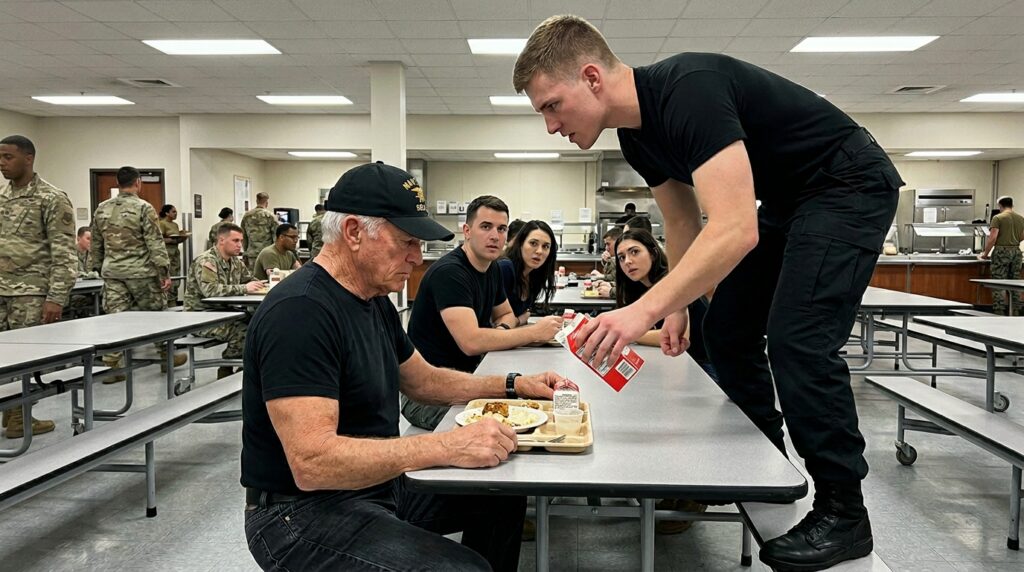
The white liquid splattered across the stainless steel tray, pooling around the edges of the cold meatloaf and gray peas. It ran down the lip of the metal, dripping onto the heavy wool of Arthur’s trousers. The scent of souring lactose rose immediately, mixing with the sharp smell of floor wax and old grease that permeated the facility’s mess hall.

Above him, the cafeteria table groaned under the weight of work boots.

Arthur didn’t look up. His eyes remained fixed on the small puddle of milk creeping toward his bread roll. His thumb, thick and scarred across the knuckle from a pressure-line blowout forty years ago, pressed firmly against the edge of his fork. He could feel the vibration through the tabletop—the rhythmic, nervous shifting of the boy’s weight. The boy was twenty-two, maybe twenty-three. He smelled of cheap tobacco, synthetic sweat, and the raw, unearned adrenaline of someone who had never seen an engine block crack or a lung collapse.

“Look at him,” the boy’s voice boomed, rattling against the high, industrial rafters of the ceiling. It was too loud for the room, a performative roar meant to curd the silence. “The great anchor. Just sits there and takes it. They told us you people were made of iron. Looks like old rust to me.”

The mess hall had gone completely dead. The scraping of plastic chairs and the clink of heavy ceramic mugs stopped instantly. Seventy men, most of them with silver at their temples and the slow, deliberate movements of old injuries, watched from their respective tables. Nobody moved to help. In this place, you didn’t interfere with another man’s friction until the blood hit the floor.

Arthur took a slow, deep breath through his nose. The air tasted of iron and dust. His knees ached—a dull, throbbing reminder of the humidity coming off the river outside. His late seventies had delivered a daily ledger of small pains, a constant tax on his posture. He calculated the distance between his boots and the metal legs of the table. He calculated the density of the boy’s shin bone, visible just above the leather of his work boot.

One move, Arthur thought, his mind clear and cold, operating with the mechanical precision of an old diesel generator. One clean lever.

“Down,” Arthur said. His voice wasn’t loud, but it had the gravelly weight of a stone dragging across concrete.

The boy laughed, a short, barking sound that lacked true marrow. “What’s that, old man? Can’t hear you over the dripping.”

Arthur stood up. He didn’t scramble. He rose with the stiff, unyielding momentum of a hydraulic lift. The movement carried all his seventy-eight years, the collective mass of a life spent pulling lines and holding ground.

Before the boy could adjust his balance on the slick surface of the table, Arthur’s left hand shot out. It wasn’t the lightning-fast strike of a young man; it was a heavy, structural grab. His fingers, calloused into leather, locked onto the boy’s ankle right where the tendon met the bone.

He didn’t pull back. He drove forward, using his shoulder as a wedge.

The boy’s balance disintegrated. With a sharp gasp, he came off the table, his arms flailing against the greasy air. He hit the linoleum floor with a wet, hollow thud that echoed into the corners of the kitchen. The breath left his lungs in a single, ragged whistle.

Arthur followed him down, his knees popping with a sound like dry twigs. He didn’t use a fist. He placed his forearm across the boy’s throat, utilizing his entire body weight to pin the youth into the dirt and wax of the floor. The boy’s eyes widened, the misplaced bravado vanishing instantly, replaced by the primitive, frantic white of a horse caught in a fence.

“You don’t know the weight of what you’re trying to lift, son,” Arthur whispered, his face inches from the boy’s nose. He could smell the sour milk on his own shirt now, a heavy, domestic humiliation that he was currently grinding into the floorboards. “You want to test the strength of this place? You pay for it in teeth.”

The boy thrashed, his fingers clawing at the rough wool of Arthur’s sleeve, but Arthur’s frame was locked, a dead weight anchored by decades of knowing exactly how to hold a body down.

“Say it,” Arthur growled, the gravel in his throat scraping raw. “Say the word.”

The boy choked, his lips turning a faint shade of blue under the pressure of the forearm. “Sorry… loose… get off…”

Arthur didn’t let go immediately. He held the pressure for three more seconds, letting the cold reality of the linoleum settle into the boy’s spine. When he finally rose, his joints protested with a deep, systemic ache that made his vision blur for a fraction of a second. He stood over the gasping youth, his chest heaving, the white stain on his chest looking like a jagged scar in the desaturated light of the hall.

The room remained frozen. Arthur reached down to retrieve his heavy mechanical pocket watch from his trousers to ensure the casing hadn’t cracked during the drop.

He clicked the latch open. The glass face was intact, but the second hand wasn’t moving. It was jammed against a tiny, dark metallic sliver that had somehow shaken loose from the interior gears during the impact—a piece of debris that didn’t belong to the watch’s original mechanism at all. It was a serial tag fragment from an old military-grade canister.

Arthur’s blood turned to ice water. He knew that specific alloy. He had buried fifty cases of it in the desert thirty years ago.


CHAPTER 2: THE SCARS OF THE FRICTION

“You broke his collarbone, Arthur. And you broke my table.”

Director Vance didn’t look up from his desk. His fingers, thin and stained yellow from decades of state-issued tobacco, were busy threading a fresh ribbon into an ancient mechanical typewriter. The ribbon hissed as it pulled through the rusted iron gears of the machine, a dry, grating sound that vibrated through the small, unventilated office. The room smelled heavily of damp ledger paper, cold coffee, and the sharp sulfur tang of the coal-fired heater down the hall.

Arthur stood stiffly in front of the desk. His knees had begun to swell, the fluid building up beneath the caps with a dull, throbbing pressure that felt like sand ground into a bearing. He didn’t ask to sit. His civilian trousers were still damp with the sour milk from the mess hall, the fabric stiffening as it dried against his skin.

“The boy was off-balance,” Arthur said. His voice was too thick for the small space, scraping against the plaster walls. “The floor was slick. If he broke, it’s because he was made of soft timber.”

“He’s thirty years younger than you,” Vance countered, finally snapping the metal casing of the typewriter shut with a hollow clack. He raised his eyes, gray and filmed with the cataracts of an administrator who had watched three generations of men rot from the inside out in this valley. “His name is Miller. His father was field artillery in the nineties. A bad liver and a worse temper. The boy has been living out of a truck in the lower lot for three weeks, waiting for his old man’s back-benefits to clear the board. He thinks this place is hiding the money.”

Vance reached into his drawer, his hand brushing against a stack of desaturated, yellowed intake forms before pulling out a small, heavy object. He dropped it onto the green blotter between them. It landed with a dull metallic thud.

It was a notched brass locker key, its head wrapped tightly in three layers of oxidized black electrical tape. The tape was frayed at the edges, revealing a dark, rusted crust underneath that looked less like iron corrosion and more like dried fluids.

“The kitchen staff found it under the table after they carried the Miller boy out,” Vance said, leaning back until his wooden chair screamed in protest. “It’s not for any locker in the public pavilion. The serial number stamped on the barrel belongs to the old subterranean ordnance vaults beneath the dry-kiln. The ones we sealed when the rail line was pulled up in eighty-eight.”

Arthur looked at the key. His left hand, still cramped from holding the boy down, twitched against the seam of his trousers. The tiny metallic sliver he had pulled from his broken pocket watch was currently pressed into his palm, its sharp corners biting into his skin. The alloy of that sliver matched the exact chemical grade of the vault locks—a hardened, zinc-dipped steel intended to withstand industrial caustic wash.

“The vaults are empty,” Arthur said, his tone flat, defensive. He felt the phantom weight of his old rank settling over his shoulders like a wet canvas coat. “We cleared them under the detachment directive.”

“Then why was the boy carrying the key?” Vance’s voice dropped, becoming transactional, sharp. He slid the key an inch closer to Arthur. “The facility board doesn’t want the county sheriff sniffing around the lower lot, Arthur. They don’t want people asking why a twenty-two-year-old casual laborer is trying to dig into the foundations of a state-supported veteran home. You clean your own friction. Take the key. Find out what he’s been tampering with before he comes back from the clinic with a lawyer or a tire iron.”

Arthur’s fingers moved before his brain could countermand the instinct. He picked up the brass key. The oxidized tape felt cold, greasy against his skin. The smell of old adhesive and wet iron lifted from it, a familiar, stale odor that instantly brought back the gray, suffocating heat of the underground bunkers where he had spent his final months of active duty.

He didn’t thank Vance. He turned and walked out, his boots striking the gray concrete floor of the corridor with a slow, uneven rhythm.

The descent to the lower kiln lot was a transition through layers of decay. The main facility gave way to the old industrial skin of the compound—weathered red brick that had turned black from decades of coal smoke, corrugated iron roofing that rattled in the river wind, and the pervasive, heavy silence of abandoned machinery. Arthur walked through the drizzle, his eyes scanning the rusted perimeter fences, his mind automatically cataloging the blind spots in the security lights.

He wasn’t thinking like a retired old man anymore; the “Predator-Prey” lens had clicked back into place with the mechanical certainty of a locked bolt. Every shadow between the rusted fuel tanks was a potential counter-move; every puddle of orange, iron-heavy water reflected a sky that felt like a low ceiling closing in.

He reached the timber door of the old dry-kiln. The padlock on the exterior chain was intact, coated in a thick, undisturbed skin of brown rust. But when Arthur looked closer, his eyes caught a clean, silver scratch along the hinge plate—the bright, unmistakable shine of fresh friction where a crowbar had recently been wedged.

The boy hadn’t broken in here. He had already been inside.

Arthur used his body weight to push the heavy oak door open, the wood scraping against the grit on the sill. The interior was pitch black, smelling of dry rot and the old, chemical preservative they used to spray on the ammunition crates. He reached into his pocket, his hand passing past the watch to pull out a small, brass-cased penlight.

The narrow beam cut through the dark, illuminating the thick layer of limestone dust on the floor.

There were two sets of tracks in the dust. One belonged to the heavy, treaded work boots of the Miller boy. The other set was older, smaller, the edges of the prints softened by months of settling silt—the sharp, narrow heel-strikes of an administrator’s shoe.

Arthur followed the boy’s boots toward the rear of the kiln, where the concrete floor had cracked away to reveal the iron staircase leading into the subterranean drainage vaults. At the top of the stairs lay a discarded manila folder, its corners chewed by mice.

He knelt, his joints groaning in the dark. He shone the penlight onto the paper.

It was an official military medical discharge log, dated August 14, 1991. The name at the top was Corporal Thomas Miller. Across the center of the page, a massive red stamp had obliterated the diagnostic notes: CLAIM DENIED – LACK OF PROXIMATE SERVICE CONNECTION.

Beneath the stamp, the authorization signature was a neat, microscopic scrawl that Arthur recognized before he even read the typed name below it. It was Vance’s signature. But stuck to the back of the file with a rusted paperclip was a secondary document—a yellowed carbon copy of a shipping manifest for forty-gallon steel drums, marked with the specific, restricted classification code for toxic compound storage that Arthur himself had logged into the company record books thirty years ago.

A sharp rustle from the top of the stairs made Arthur freeze. The penlight died as his thumb clicked the switch off in the same microsecond. In the absolute, heavy darkness of the vault, he heard the wet, dragging sound of someone breathing through a broken nose.

The boy was back. And he wasn’t alone.

CHAPTER 3: THE UNEARTHING OF IRON

The absolute dark did not last. A sudden beam from a heavy, industrial flashlight sliced through the black air of the dry-kiln, bouncing off the damp limestone walls and catching the edge of the iron staircase. The glare was harsh, fracturing the shadows into jagged lines.

“I know you’re down there, old man,” a voice called out. It wasn’t the boy’s voice. This voice had a dry, rhythmic wheeze, like an old bellows pumping coal dust. “Vance said he sent his best collector to clear out the grease. I didn’t think he’d send a ghost.”

Arthur slipped the manila folder beneath his wool coat, pressing his spine flat against the rusted iron support beam of the stairs. His thumb remained clamped tightly over the lens of his dead penlight. His heart rhythm didn’t spike; it slowed down, his internal systems adjusting to the parameters of a breach. The sovereign protector didn’t panic when the walls narrowed; he calculated the entry point.

A shadow broke the plane of the flashlight beam at the top of the stairs. It wasn’t the Miller boy. This man was broader, older, wearing a grease-stained canvas maintenance jacket that smelled heavily of diesel oil and cold hydraulic fluid. It was Miller Senior—Thomas. His nose was crooked, poorly set from an old break, and his right shoulder hitched higher than his left with every dragging step he took down the metal rinks. Behind him came the boy, his collarbone wrapped tightly in a clean white medical sling, his face pale and marked with dark purple bruising around the eyes.

“He’s got the key, Dad,” the boy muttered, his voice muffled through a swollen lip. “He took it from the mess hall floor.”

Thomas Miller stopped halfway down the stairs. The beam of his flashlight tracked across the limestone dust, pausing on the fresh footprints Arthur had left near the filing cache. “He’s got more than the key, Danny. He’s standing right behind the separator housing.”

Arthur did not wait to be hunted. He stepped out from the shadow of the beam, his movements heavy but intentional, his boots crunching softly against the fallen grit. The desaturated yellow light caught the front of his stained wool shirt.

“Thomas,” Arthur said, his voice flat as iron plate. “You’re trespassing on facility foundations.”

“Foundations?” Thomas let out a short, wet bark of a laugh that ended in a rattle. He didn’t lower the light; he aimed it straight into Arthur’s eyes, trying to force a blind spot. “This whole valley is built on what you buried under these kilns, Arthur. My boy didn’t come here to steal. He came to find the manifest you signed off on in ninety-one. The one Vance used to tell the state board that our ordnance unit never handled the zinc-dipped casings.”

Arthur held his ground, his eyes narrowing against the glare. The rusted metal sliver in his palm felt hot, the sharp edges pressing into his leather skin. “The records are what they are, Thomas. The unit was decommissioned. The storage was classified under standard detachment protocols.”

“Classified?” Thomas took another step down, the iron grate groaning under his heavy work boots. The smell of cold sulfur and damp earth rose with his movement. “You call it protocols. I call it thirty years of my lungs turning into wet tissue paper while Vance bought a third car and you sat in the dining hall looking like a monument to the good old days. Look at the boy, Arthur. Look at his hands.”

Arthur’s gaze flicked past the light to the young man. Even in the dim, yellow glare, he could see the gray, flaky texture of the skin around the boy’s fingernails—the same chemical vitrification that had taken the men of the old ordnance logistics detachment.

“The boy didn’t serve,” Arthur said, his mind tracking the logic, searching for the structural leak.

“He works the scrap yard at the rail-cut,” Thomas spat, his hand trembling slightly as he held the light. “The same yard where the facility board sold off the old subterranean drainage pipes three months ago. He handled the scale-crust without gloves, Arthur. He’s got the same rattle I have. Vance told us the line was clean. He signed the clearance ledger himself.”

The decoy secret locked into place within Arthur’s calculations. The boy hadn’t been acting out of generational spite; he had been digging for evidence of a recent administrative cover-up—a corrupt deal where Vance sold off contaminated surplus pipe to line the facility’s private maintenance fund, using the old ninety-one denial files as his legal shield. It was a perfect, self-contained truth that explained everything. The boy was the victim of Vance’s current greed, and Thomas was the vengeful hand trying to extract a settlement from the old ledger.

But the metal tag fragment in Arthur’s pocket—the one that had jammed his watch—didn’t belong to a drainage line. It belonged to the primary valve of the deep-core storage cisterns. The ones Arthur had been told were welded shut from the inside before the concrete caps were poured.

If that fragment had shaken loose now, it meant the deep cisterns weren’t sealed. They were leaking into the water table beneath the dry-kiln right now. And Vance wasn’t covering up an old pension lie; he was covering up a dead zone.

“You think Vance is the only one who signed those papers, Thomas?” Arthur asked, his voice dropping into a deeper, colder register.

“He’s the one with his name on the board,” Thomas said, reaching into his canvas jacket. His fingers closed around the rusted handle of a heavy, twelve-inch pipe wrench. The iron tool caught the yellow light, its teeth packed with old black grease. “And you’re the one who keeps his secrets for forty dollars a month and a free bed.”

“Dad, wait,” the boy whispered from the top of the stairs, his voice suddenly small, stripped of its cafeteria bravado. “Someone’s coming down the upper chute.”

A distinct, rhythmic sound vibrated through the iron framework of the kiln—the crisp, synchronized snap of leather soles on the upper concrete floor. Not the dragging gait of a veteran. Not the heavy stomp of a laborer.

The light from Thomas’s flashlight wavered as he swung it toward the upper landing. The glare illuminated a third figure standing at the top of the staircase, silhouetted against the gray drizzle of the lot outside.

It was Director Vance. He wasn’t holding a typewriter ribbon. In his right hand, the dull gray barrel of a standard-issue security piece caught the reflection of the limestone dust, pointing down into the dark.

“I told you to clean the friction, Arthur,” Vance’s voice echoed down the shaft, dry and completely devoid of its administrative patience. “I didn’t tell you to have a town meeting.”

Thomas shifted his weight, his pipe wrench raised, his body coming between the light and his injured son. The micro-tension in the vault solidified into a dead lock, where every participant’s intellect was calculated to the millimeter, and every move carried a heavy cost.

Arthur’s hand slipped slowly into his pocket, his fingers wrapping around the cold, mechanical watch that had ceased to tick. The ultimate final reality remained buried beneath their feet, but the immediate survival loop had just narrowed to zero.

CHAPTER 4: THE HORIZON RECKONING

The gray barrel of Vance’s piece remained level, a cold and unblinking eye cutting through the yellow glare of Thomas’s flashlight. Nobody breathed. The rhythmic drip-drip of condensation hitting the corroded iron pipe behind the stairs counted down the seconds in the heavy, sulfurous dark.

“Step away from the file, Arthur,” Vance said. His voice was lower now, lacking the dry rattle it had upstairs. It carried the precise, chilling weight of an administrator who had computed the cost of three lives against the survival of a ledger. “You’ve done your years. Don’t add a line to the record that you can’t erase.”

Arthur’s thumb rubbed the jagged edge of the watch casing inside his pocket. His joints were stiff, frozen by the damp cold of the subterranean floor, but his mind remained clear, tracking the geometry of the vault. Thomas was three steps down from the platform, his heavy pipe wrench lowered but notched firmly in his right grip. The boy, Danny, was a liability at the top—pale, injured, and shivering against the brick framing.

“The cisterns aren’t empty, Vance,” Arthur said. He didn’t drop his hands; he kept them hanging loosely at his sides, the exact posture of a soldier who knew how to draw mass from his heels. “You told the board the line was pulled up in eighty-eight. You told me the core was concrete-capped.”

Vance didn’t blink. The light from Thomas’s hand caught the clean edges of his polished leather shoes on the landing above. “The core was stabilized, Arthur. According to the documents you signed off on. If there’s a leak now, it’s an environmental anomaly. A legacy issue. But the scrap yard sale was approved by a quorum. It keeps the roof over your head. It pays for the medicine that keeps Thomas’s liver from hardening into wood for another six months.”

“You sold the poison back to our kids,” Thomas growled. His boots shifted on the iron grate, a tiny, metallic screech that drew Vance’s barrel two inches to the left. “You signed my denial thirty years ago, and now you’re scrap-lining the town with the leftovers.”

“I protected the institution,” Vance countered sharply, his finger steady against the trigger guard. “Without the facility, none of you have a flag to sit under. Arthur knows that. He handled the logistics. He knows what happens to an engine when you let one broken rod throw the whole drive shaft.”

Arthur looked at the boy’s hands again—the gray, flaking skin, the tremors. He looked at Thomas’s bent, wheezing frame. The “Sovereign Protector” lens through which he had viewed his entire retirement—the belief that he was guarding a sanctuary of order and discipline—fractured completely. The peace he had cultivated within the fragile architecture of his daily routine wasn’t a reward for service; it was a quarantine block. They were all just old stock left to rust in a valley full of buried grease.

“The second hand stopped, Vance,” Arthur murmured, his voice cutting through the damp air like a dry saw.

Vance frowned, his gaze flicking down to Arthur’s face for a fraction of a second. “What are you talking about?”

“My watch,” Arthur said, slowly pulling his hand from his pocket. He didn’t reach for a weapon. He held out the heavy mechanical piece, its cracked crystal reflecting the desaturated yellow beam. “The tag that jammed the mechanism came out of the primary core valve. The one we buried under forty tons of aggregate. It didn’t wash down a drainage line. The pressure is building from the bottom. The whole kiln floor is sitting on a hydraulic piston of old sludge.”

A low, subterranean groan vibrated through the limestone walls, confirming his words with the perfect, terrifying timing of an ancient machine waking up. It wasn’t loud—a deep, bass rumble that shook the grit loose from the mortar joints and sent a fine white powder drifting down through the light beam.

Thomas didn’t look at the ceiling. He looked at Vance. “It’s coming up through the well-heads, isn’t it?”

Vance’s expression tightened into a hard, defensive mask. “The facility has a relocation plan if the perimeter monitors trip. It’s handled.”

“It’s not handled,” Arthur said. He took one heavy step forward, his boot crushing a discarded piece of rusted iron scale. His late seventies seemed to drop away, replaced by the immovable mass of his original directive. “The boy stays with the file, Vance. And you’re going to open the service log.”

Vance’s jaw set. He raised the iron piece, aligning it directly with the center of Arthur’s chest. “I built this place, Arthur. I won’t let three broken old men drag it into the dirt.”

He didn’t fire.

Arthur didn’t give him the split second required to squeeze. He didn’t lung; he tilted his weight, slamming his good shoulder into the rusted vertical support pipe of the staircase. The iron column, already corroded through by decades of sulfurous moisture, snapped at the base with a sound like a rifle shot.

The middle section of the metal stairs sagged instantly, dropping six inches. The sudden shift threw Thomas forward and caused Vance’s heel to skid on the slick limestone landing above. The gray barrel wavered, the round discharging into the high brick archway with a deafening roar that brought down a shower of black soot and old mortar.

Before the echoes could clear, Arthur was moving. His joints screamed, the sand in his knees grinding with a hot, biological agony, but he used the momentum of the collapsing frame to haul Thomas up by his canvas jacket, shoving him toward the upper chute where Danny was already scrambling into the gray rain outside.

“Go,” Arthur barked, his gravelly authority leaving no room for argument. “Take the manifest to the county line. Don’t look back at the lot.”

Thomas didn’t speak. He gripped his pipe wrench, caught his boy by the belt, and dragged him out into the desaturated daylight of the kiln lot, their boots splashing through the orange, iron-heavy puddles.

Arthur turned back to the stairs. Vance was recovering his balance on the landing, his face pale and smeared with black soot, his breath coming in short, ragged gasps. He looked down at Arthur through the gap where the iron rinks had dropped away. The gray piece was still in his hand, but the administrative certainty had been completely stripped from his eyes.

“You’re staying down here with it, then?” Vance whispered, his hand shaking slightly against the cold brick wall. “You signed those papers too, Arthur. If I go down, your name is on the first page of the ledger.”

Arthur looked down at his watch, still open in his hand. The metallic sliver remained jammed between the gears, a permanent record of the cost. He reached up, his leather fingers gripping the edge of the broken landing to haul himself up out of the dark, his movements slow, old, and unyielding.

“My name has been in the dirt for thirty years, Vance,” Arthur said, his eyes locking onto the director’s face with the finality of an iron door closing. “I’m just here to see the ledger closed.”

He broke through the door into the cold drizzle. The valley was silent, the desaturated hills rising up like gray walls around the facility grounds. The confrontation in the dining hall had been a simple fracture, but the reckoning was an open horizon, stretching out into the dark remaining years of his life.

CHAPTER 5: THE LEDGER IN THE RAIN

The rain didn’t fall; it drove sideways, sharp and heavy with the grit of the valley’s coal-cuts, soaking the wool of Arthur’s coat until it clung to his shoulders like wet canvas. His boots found no purchase on the gravel path between the dry-kiln and the main administrative block. Every stride was a deliberate negotiation against his swollen left knee, the joint clicking with a faint, hydraulic wetness inside the bone.

Behind him, the kiln door remained open, a dark mouth breathing out the sulfurous stench of the rising core. Thomas and the boy were gone, their tracks already dissolving into the orange puddles leading toward the western perimeter fence.

Arthur didn’t look back to see if Vance was following. He knew the director’s intellect; Vance wouldn’t chase a physical threat through the mud. He would run for the files. He would run to burn the clearance ledger before the county sheriff’s cruiser cleared the lower rail-gate.

Arthur reached the rear entrance of the administrative building, his leather palm slamming against the heavy iron fire door. The latch was stiff, choked with years of external rust and dried grease. He threw his weight against the panel. The iron yielded with a screech that was swallowed instantly by the rumble of the facility’s old steam turbines down the hill.

The interior corridor was dead quiet, smelling of cold floor wax and the stale grease of the nearby kitchens. The desaturated yellow light from the overhead bulbs flickered rhythmically, timed to the erratic pulse of the old generators.

Arthur walked with an uneven, heavy stomp, his boots leaving thick, gray cakes of limestone mud on the linoleum. He reached Vance’s private office within two minutes. The typewriter ribbon he had watched Vance change earlier was sitting on the green blotter, a twisted black snake in the dim light. But the desk drawers were open, their contents turned over in a frantic scramble.

Vance had already been here. And he had taken the primary keys to the underground vault archive.

Arthur stood in the center of the office, his chest heaving, his eyes scanning the room through the sharp, gray lens of the protector. He didn’t take everything, Arthur thought, his eyes tracking a thin line of white lime dust that led from the corner of the desk toward the wall-mounted gun locker.

He stepped toward the locker. The steel door was locked, but the hinge pins were old, unhardened iron. Arthur didn’t look for a key. He gripped the heavy, cast-iron bookend from Vance’s desk—a miniature anvil used to hold up the facility regulations—and drove the corner of it down into the upper hinge with a single, massive drop of his arm.

The iron pin sheared with a dry, metallic snap. Arthur pried the steel door open with his bare fingers, the rough metal biting into his callouses until a thin line of dark blood ran into the rust.

Inside, behind a pair of unused security shotguns, sat a small, dented ledger tin. It was stamped with the old 1991 logistics detachment code—the same code that was on the fragment in his watch.

Arthur pulled the tin out, his thumbs forcing the brass clasp.

Inside lay a duplicate iron key, identical to the one he had taken from the mess hall floor, but this one was clean, free of tape, its teeth sharp and unused. Beneath the key was a single sheet of blue carbon paper—a duplicate manifest that hadn’t been included in Thomas’s stolen file.

The text was written in Arthur’s own neat, military script from thirty years ago. It detailed a secondary injection site beneath the main residential barracks—not the dry-kiln. The kiln was just the drainage point. The true heart of the cistern pressure loop was sitting directly beneath the beds of seventy retired men.

Vance hadn’t been executing a relocation plan; he had been falsifying the perimeter monitors for months to keep the state from condemning the land before the facility’s insurance policy matured. If the core blew, the residential floor would collapse into the caustic soup first.

The floor beneath Arthur’s boots trembled—a faint, rhythmic shudder that made the inkwells on Vance’s desk rattle against the wood. The pressure was moving up the line faster than the drainage could clear.

“You always were too thorough, Arthur.”

The voice came from the doorway. Arthur didn’t drop the tin. He turned slowly, his spine straight, facing the director who stood in the frame, his coat drenched, his face a hard, pale stone in the flickering corridor light. Vance wasn’t holding the security piece now; he was holding a heavy master-switch box he had pulled from the main corridor panel.

“The county line is closed,” Vance said, his voice flat, deadened by the sound of the rain against the glass behind him. “There’s an accident at the rail-cut. A logging truck turned over. Nobody is coming down this road for four hours, Arthur. Not the sheriff. Not the board.”

Arthur looked at the clean iron key in his hand. “The barracks are sitting on the main loop, Vance. You knew the concrete cap was thin.”

“It was thick enough for thirty years,” Vance said, his knuckles turning white as he gripped the iron handle of the switch box. “It would have held another six months if that boy hadn’t started digging into the line-scale. I’m clearing the lower tier now. The rest of them will move when the board signs the emergency transfer tomorrow morning.”

“They won’t survive the night if the core vents through the floor-drains,” Arthur said. He dropped the ledger tin onto the desk, his boots shifting into a wide, heavy stance. “Turn the main pumps back on.”

“The pumps will fracture the lower pipe-walls,” Vance countered, his eyes wide, illuminated by a cold, desperate intellect. “If I turn them on, the whole valley gets the water. The state shuts us down by noon. We lose the charter, Arthur. We lose the home.”

Arthur took a slow breath, the smell of damp wool and sulfur filling his throat. The “Sovereign Protector” didn’t choose between the myth and the men. He chose the iron reality of the lives in front of him.

“Then we lose it,” Arthur whispered.

He moved forward, his heavy wool coat swinging like a shroud as he stepped into the light of the door.

CHAPTER 6: THE RUSTING WITNESS

Arthur stepped into the dark corridor before Vance could drop the heavy master-switch handle. The sovereign protector didn’t look back at the office. His boots left wet, gray impressions on the linoleum as he broke into a heavy, rhythmic trot toward the basement access door at the end of the east wing. Every impact through his heel felt like an iron spike driven straight into his hip joint, but his focus remained locked on the structural map of the compound.

Behind him, the lights went dead.

The flickering yellow overhead tubes blinked twice and vanished, plunging the administrative wing into an absolute, suffocating blackness. The high-tension rumble of the main turbines down the hill shifted octave, dropping into a low, strained whine as Vance pulled the breakers. The emergency backup circuits didn’t engage; Vance had quarantined the grid.

Arthur reached the basement fire door by touch alone. His leather-skinned hand found the cold iron lock-latch, his fingers registering the fine, rhythmic vibration humming through the steel panel. The pressure wasn’t rising in inches anymore; it was surging through the main intake columns.

He shoved the door open. The air that rushed up from the subterranean maintenance tier was thick, hot, and heavy with the distinct, eye-stinging smell of alkaline silt and old caustic detergents. It was the breath of the deep core, forced upward through the cracked foundation seals by fifty tons of displaced wastewater.

He descended the concrete steps without a light, using his left hand to track the cold, rusted surface of the guide rail. At the foot of the stairs, the floor was already flooded. Two inches of grey, opaque water swirled around his leather boots, leaves of old intake logs floating like dead skin across the surface.

The facility’s secondary board room sat adjacent to the pump station—a stark, windowless concrete vault where the retired engineers and officers held their weekly maintenance quorums. As Arthur approached, the beam of a single kerosene lantern leaked through the cracked frosted glass of the door.

Inside, three men sat around a long oak table that had gone gray with dry rot. They were old guard—Captain Halloway, Chief Petty Officer Miller’s former logistics chief, and two retired line mechanics whose names had faded from the duty rosters twenty years ago. They sat in their heavy winter coats, their medals pinned to their lapels out of a fragile, structural habit, watching the gray water seep under the baseboards.

“Arthur,” Halloway said, his voice a dry whisper that barely carried over the sloshing water. He didn’t rise. His hand, twisted into a permanent claw by old shrapnel, was clamped around a vintage brass valve-wheel locking pin stamped with the institutional seal. “Vance pulled the breakers. The residential tier is losing auxiliary pressure.”

Arthur didn’t take a seat. He walked straight to the end of the table, his wet coat dripping onto the gray wood. “The residential core is the injection center, Captain. Vance lied about the eighty-eight clearance. The cistern valves under the barracks are open.”

The two line mechanics looked at each other, their weathered faces tightening in the dim lantern light. One of them reached down to touch the concrete floor, where a hairline fracture was actively bubbling, spitting out tiny gray geysers of alkaline mud.

“We checked the perimeter logs last month, Arthur,” the mechanic said, his voice transactional, searching for a mechanical logic. “Vance showed us the state clearance certificates. He said the drainage from the kiln lot was within the baseline.”

“He sold the line-scale to the scrap yard to mask the pressure drop,” Arthur said, dropping the clean iron key onto the center of the table. It landed with a sharp clink that silenced the room. “The file Thomas Miller took contains the original shipping manifest. Forty-gallon steel drums of caustic compound, logged into the core vaults thirty years ago. I signed the ledger. Vance knew the casings would fail when the water table rose this winter.”

Halloway picked up the brass locking pin, his thumb tracing the stamped seal. The subtext between the old men didn’t require an info-dump; they had all spent their lives holding units together with bad grease and lies. They knew exactly what a compromise looked like when the skin was stripped away.

“If we turn the main pumps on from here,” Halloway murmured, looking toward the iron wall that separated the board room from the primary valve station, “the pressure will split the residential intake pipes. The water in the kitchen wells will turn to lye before the shift changes.”

“And if we leave them off,” Arthur countered, leaning his heavy frame over the table, “the foundation under the third barracks drops into the core vault by midnight. Seventy men are sleeping over that slab right now.”

The room shook again—a sharp, violent jar this time that shattered the kerosene lantern on the table. The flame died instantly, leaving only the blue, sulfurous glow of the electrical conduits shorting out in the water outside the door. In the dark, the sound of concrete cracking—a dry, tearing scream—echoed through the floorboards beneath their boots.

The failure wasn’t coming tomorrow. The structural limit had just been reached.

Arthur turned toward the pump room door, his hand already reaching into his pocket for the watch that would never tick again. He had spent thirty years protecting the myth of this place, keeping the secret to keep the peace. But a sovereign protector didn’t defend a rotting hull at the expense of the crew.

“Arthur, wait,” Halloway called out through the dark, the sloshing of the water growing louder as the floor-drains began to back up in earnest. “Vance locked the primary bypass wheel from the upper mezzanine. You can’t turn it without the master lever.”

Arthur didn’t stop. He pushed through the concrete doorway into the flooded main pump tier, his boots throwing up sheets of gray, chemical foam as he drove his old body toward the ladder. The decoy secret had been broken, but the ultimate realization—the horrific depth of his own original signature on those logistics papers—was waiting for him at the top of the column.

CHAPTER 7: THE FINAL CLEARANCE

The rusted iron rungs of the maintenance ladder cut into the raw callouses of Arthur’s hands as he hauled his frame upward through the darkness. The water below had reached his thighs before he cleared the floor, a gray, swirling soup that gurgled with the release of pocketed subterranean gasses. Above him, the upper mezzanine was a cage of shadows, vibrating with the frantic, mechanical shrieks of overloading pipe walls.

His left knee didn’t throb anymore; it had gone entirely numb under the chemical chill of the mist spraying from the secondary joints. He climbed by the sheer leverage of his shoulders, his teeth ground down until the enamel clicked. Every breath tasted of raw lime and the bitter, familiar iron of ancient, unvented cisterns.

He broke over the lip of the mezzanine landing. The steel floor was a grid of rusted diamond-plate, slick with a fine coating of alkaline grease.

Director Vance stood twenty feet away, framed by the skeletal silhouettes of the massive primary intake columns. The beam from a battery-powered lantern sat on an iron housing behind him, casting his elongated shadow across the brick ceiling like a broken pillar. He wasn’t trying to leave. He was using a heavy, three-foot steel breaker bar to pin the wheel lock of the primary bypass manifold, his knuckles white, his breath whistling through his teeth as he threw his full weight against the iron gears to prevent the flow from shifting.

“You can’t vent it, Arthur!” Vance roared over the roar of the high-pressure water. His tie was torn away, his white administrative collar stained grey with soot and grease. “If you force the bypass, the pressure blows the main line under the valley town. The facility won’t just lose its charter—it becomes a federal slaughterhouse!”

Arthur rose to his feet. He didn’t rush. He walked across the slick diamond-plate with the deliberate, heavy equilibrium of a man who spent forty years holding hulls together against the sea. The rusted surfaces beneath his boots ground to powder under his weight.

“The line under the town is steel, Vance,” Arthur said, his voice dropping into a hollow, gravelly timber that didn’t need to compete with the machinery. It had the internal mass of an unyielding truth. “It was replaced in ninety-six. It’s the concrete under the residential beds that’s rotting. You didn’t lock the valve to save the valley. You locked it to keep the state inspectors from seeing the core manifest before you collect the exit pension.”

Vance’s shadow flickered as he adjusted his grip on the steel bar. His eyes were wide, wet with the frantic desperation of an executive who had spent his entire life balancing numbers that could no longer be sustained. “I saved this home! For forty years, I kept seventy men out of the county poorhouses! Who do you think paid for the heating oil when the state allocation failed in ninety-four? Who do you think covered the burial costs when old Halloway’s brother died without a name? I did it by turning the ledger! I did it by moving the scrap!”

“And you did it by killing Thomas Miller’s unit,” Arthur said, stopping five feet from the manifold housing.

The silence that fell between them was heavier than the roar of the water.

Arthur reached into his coat and pulled out the blue carbon manifest he had taken from Vance’s office. He didn’t read it. He let the wind from the leaking gaskets catch the edge of the paper, the thin sheets snapping in the gray mist.

In the dim yellow light of the lantern, Arthur looked at his own signature at the bottom of the column—the neat, military scrawl he had been proud of when he was forty years younger. The “Sovereign Protector” model he had built to survive his old age collapsed into ash. The internal monologue was gone. The chess moves were over. He hadn’t been protecting a sanctuary; he had been protecting his own grave. He had hidden the records thirty years ago because he couldn’t bear to look at the men he had poisoned to preserve the sanitized lie of a flawless command.

“The boy has the same rattle, Vance,” Arthur whispered, the words scraping his throat like sand. “He’s twenty-two. He never wore the uniform. And he’s rotting from the inside out because we wanted the ledger to look clean.”

Vance’s hand trembled against the breaker bar. His jaw worked, but no sound came out. The equal intellect had run out of columns to balance. The cost had finally caught up to the asset.

A violent concussion rocked the entire mezzanine. Down below, the primary foundation slab of the east block cracked with a wet, hollow snap that sounded like an ice sheet parting. The gray water in the main tank rose three feet in a single surge, the foam reaching the underside of the diamond-plate floor.

“Arthur…” Vance choked, his posture breaking as he looked down at the rising tide. “The lock pins… they’re shearing.”

“Get behind the column,” Arthur said.

He didn’t wait for Vance to move. He stepped forward, his leather fingers closing around the iron wheel of the bypass valve. His boots found purchase in the rust-pitted steel of the plates. He didn’t use the breaker bar. He used the raw, primitive leverage of his shoulders, his spine groaning as he fought the thirty years of corrosion that held the iron threads together.

The wheel didn’t budge. The pressure from the lower core was holding the gate shut with the force of a hydraulic press.

Arthur closed his eyes. The ticking of his pocket watch was gone, but he could feel the pulse of his own blood in his temples—a heavy, irregular countdown. He didn’t pray for rescue; there was no external rescue coming to this valley. Every piece of gathered truth had been paid for in skin, and the final clearance required the full balance.

He threw his entire mass into a single, explosive twist.

The iron lock pins sheared with a dry, metallic scream that filled the vault. The valve wheel turned four inches, the gears catching with a sickening crunch that sent a spray of black, sulfurous sludge straight into Arthur’s chest. The high-pressure bypass split open, the gray water rushing through the main diversion pipe toward the deep-core reservoirs far beneath the abandoned rail-cut.

The vibration in the floorboards changed immediately, the frantic scream of the residential intake dropping back into a dull, manageable throb. The barracks would hold. The seventy men upstairs would wake up to a cold breakfast and a dry floor.

But the reaction had a price. The manifold housing, structural integrity ruined by the sudden shift in flow, sheared off its mountings. A three-inch steel pipe stud blew from the casing like a shell casing, striking Arthur squarely across the ribs before he could drop his arms.

The force of the blow threw him back against the iron guide rail, his breath leaving his body in a wet gasp. He didn’t fall. He held onto the rusted pipe with both hands, his head hanging low, his vision graying down to a narrow, pin-pricked circle of yellow light.

Vance was gone. The mezzanine was empty except for the lantern sitting on the housing, its battery dying, casting a faint, desaturated glow over the flooded diamond-plate.

Arthur reached into his pocket with a numb, trembling hand. He pulled out the mechanical watch. The casing was bent, the glass completely shattered now, but beneath the debris, the metallic sliver had fallen free from the gears.

The second hand twitched once. Then it began to move again, a slow, rhythmic click that sounded exactly like a man walking down a long, empty road in the rain.

Arthur leaned his back against the rusted iron support, his wool coat waterlogged and heavy, his eyes fixing on the low gray ceiling above the maintenance tier. The ledger was closed. The remaining years of his life had been reduced to a single, clean hour of truth, and he was content to let the dust settle over the iron.

Similar Posts

Leave a Reply

Your email address will not be published. Required fields are marked *






