
The Calculus of Dust and Copper: A Chronicle of the Ghosts on the Mountain Ridge

CHAPTER 1: THE FRICTION OF EXPOSURE

The heat did not merely sit on the ridge; it pressed against the skin like a dull blade.

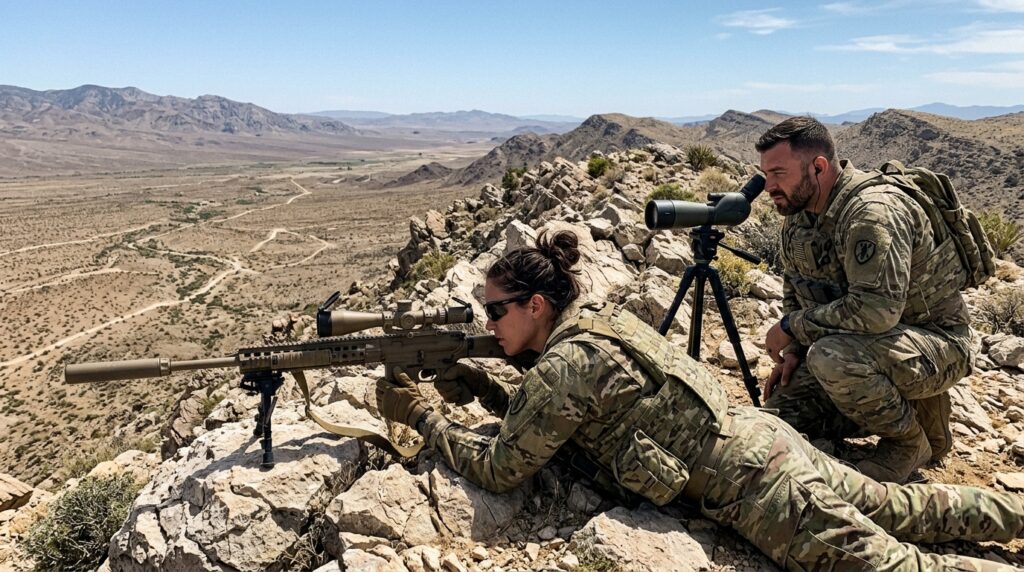
Elena pulled her cheek away from the carbon-fiber cheek weld of the rifle. The movement was slow, deliberate, a practiced theft of inches that kept her silhouette flat against the calcified shale. The dry wind hissed across the lip of the basin, carrying the faint, metallic stink of alkaline dust that had already settled into the lines of her palms.

“Movement,” she whispered. The words barely carried across the two-foot gap separating her from Miller. “Left ridge. Hold your mark and watch the dead space below the crest.”

Miller did not turn his head. His stocky frame remained locked behind the tripod-mounted spotting scope, his right hand glued to the coarse rubber of the focus ring. A single bead of sweat tracked through the graying stubble along his jawline, cutting a clean path through the film of desert grit. He didn’t speak. Instead, his left hand rose two inches from the dirt, fingers flaring once before flattening back into the gravel—the silent receipt of her data.

Through her peripheral vision, Elena watched him adjust the elevation dial. It gave a dry, grinding click as the fine sand trapped within the brass threads resisted the turn. That sound was the soundtrack of their deployment: the slow, mechanical erosion of their gear by a landscape that wanted everything reduced to powder.

She lowered her brow back onto the optic. The world shrunk to a crisp, circular cross-section of heat sickness. At twelve hundred meters, the desert floor danced. The black tarmac of the valley road warped under the thermal bloom, looking less like asphalt and more like a river of spilled oil.

Five minutes ago, the tactical net had gone completely cold. The steady, low-level hiss of encrypted static in her earpiece had died, replaced by the hollow, absolute silence that usually preceded a systemic failure at the tactical operations center. They were out here on the rim because the bureaucracy back in the green zone required two names on a ledger to validate the sector’s safety, but the lack of air support in their briefing meant they were already written off as acceptable losses if the ledger caught fire.

“Two targets,” Miller murmured, his voice a low gravel rasp that stayed beneath the wind. “Flannelette shirts. Local weave. No tactical gear, but they aren’t tending goats. The lead one is carrying a long-gun by the balance point. They’re tracking the grade.”

Elena’s fingers adjusted the pressure on the match-grade trigger, taking up the first half-millimeter of slack. Her lungs emptied in a slow, rhythmic exhale that timed the rise and fall of the reticle between her own heartbeats. The crosshairs hovered over the chest of the lead figure emerging from the shadow of a sun-bleached boulder.

Her training demanded a decision. The rules of engagement, revised three weeks ago after a disastrous patrol in the south, stated that presence within the western sector after curfew constituted hostile intent. But the civilian pension boards back home didn’t care about sector rules; they cared about unauthorized expenditures of ordnance that resulted in political inquiries. If she squeezed now, the signature of the muzzle brake would echo down the canyon like a hammer on an anvil, and they would be running out of water long before the recovery vehicle ever checked their grid.

“They’re stopping,” Miller said.

Elena watched the lead target drop into a low crouch. The man wasn’t looking at the valley road. He turned his head upward, his gaze rising toward the very ridge where her bipod legs were dug into the stone.

Through the twelve-power magnification, she saw him lift a heavy, olive-drab plastic case from behind the rock. It wasn’t a weapon case. It was an old tactical transceiver, its long whip antenna already extending toward the sky.

A sharp, metallic pop echoed from the base of the spotting scope tripod. Miller stiffened. Elena blinked, shifting her eye from the scope just enough to see the small, digital display of the laser rangefinder on Miller’s rig flicker once and go dark, a clean, narrow hole punched directly through the casing from an angle that shouldn’t have been possible.


CHAPTER 2: THE CORRODED FREQUENCY

“Don’t move,” Miller barked, though his own body had already gone stone-still.

Elena didn’t look at him. Her eyes remained glued to the primary optic, her finger maintaining its uniform pressure against the cold face of the trigger. “Optic status?”

“Dead,” Miller said. His voice was low, flat, a professional shield against the sudden rush of adrenaline. “The casing is split. No smoke, no electrical fire. A clean puncture through the lead-shielded battery housing.”

Slowly, using only the muscles in her neck, Elena rotated her head toward Miller’s tripod. The desaturated desert light caught the jagged edge of the entry wound on the rangefinder’s aluminum frame. It wasn’t the neat, round puncture of a high-velocity rifle round. The metal was peeled back in a jagged, violent star shape, exposing a nest of shredded green circuit boards and a single, cleanly sheared strand of thick copper wire that didn’t belong to the factory schematic. The wire was bright, unoxidized, and coated in a thin film of industrial grease.

“That wasn’t a shot,” she whispered, her teeth grinding against the layer of fine silt coating her lips. “There was no report. No supersonic crack.”

“Internal failure,” Miller muttered, his fingers working the quick-release levers of the tripod with practiced, mechanical efficiency. He lifted the ruined three-thousand-dollar piece of optics and flipped it over. The bottom plate was rusted along the seal, the orange oxidation flaking off under his thumb like dried blood. “The spring-loaded battery terminal was shimmed. Someone packed the housing with a high-yield blasting cap. Wired to the internal clock.”

The realization settled between them like the heat. The threat wasn’t just on the left ridge; it had been sitting in their gear bags since they left the staging area at Firebase Nomad. The system hadn’t just abandoned them without air support—it had sent them out with a countdown running in their kits.

“The convoy,” Elena said, her eyes snapping back to the valley road. The black asphalt continued to shimmy in the distance, a fractured mirage under the noon sun. “The supply column is due at the checkpoint in twelve minutes. If we can’t lase the ridge, we can’t call in the coordinates for the defensive fire box.”

“We have the backup tactical net,” Miller said, already dropping to his knees and dragging the heavy, canvas-wrapped transit case from beneath the ledge’s shadow. He popped the rusted iron latches with the heel of his palm, the friction leaving a orange smudge across his skin. Inside lay the AN/PRC-117 transceiver, its drab green finish scuffed down to the bare, pitted aluminum along the corners.

He twisted the primary frequency knob. The heavy click echoed against the stone face behind them. Instead of the clear, rhythmic chirp of an encrypted handshake, the small liquid-crystal display began to cycle through numbers frantically, a chaotic loop of frequencies that refused to lock.

“Lock it down,” Elena said, her voice dropping an octave as she spotted a cloud of yellow dust billowing from the northern mouth of the canyon. The lead vehicle of the convoy—a heavily armored six-wheeled transport—had just cleared the defile.

“It won’t lock,” Miller said. His thumb was raw from forcing the manual override switch, the small iron lever resisting his weight with a dry, metallic squeak. “The cryptographic keys are rolling. They aren’t matching the daily slate we were given at operations. It’s an automated lockout. The network thinks we’re a compromised station.”

“Or they don’t want us talking to that column,” Elena said.

Through her rifle scope, she watched the lead transport rumble down the center of the valley floor. It wasn’t moving at the standard tactical speed for an un-cleared sector. It was roaring at sixty miles an hour, its diesel engine spewing a thick column of black soot into the clean desert air. Behind it came three more identical vehicles, all closed up, tarpaulins tied down tight over their beds with heavy steel cables.

On the left ridge, the figure in the flannelette shirt was no longer crouched. He was standing openly on a flat slab of limestone, the long antenna of his transceiver pointed directly toward the valley floor. He wasn’t looking at the convoy. He was looking across the gorge, straight toward Elena’s position, his arm raised in a slow, mocking gesture of invitation.

“He wants the shot,” Elena calculated aloud, her mind working through the predator-prey matrix. “He knows our comms are down. He knows our rangefinder is gone. He’s offering himself up because he knows a rogue shot from this ridge is the only thing that justifies what happens next.”

“Elena,” Miller said, his hand stopping on the radio’s dial. “Look at the lead vehicle’s chassis. The rear axles are bottomed out against the bump stops. That thing isn’t carrying MREs or medical crates. That’s heavy ordnance mass. It’s sitting too low.”

She shifted her crosshairs from the man on the ridge down to the lead truck’s suspension. The massive iron leaf springs were curved backward under a crushing, unnatural weight. The rust along the truck’s wheel wells was shaking loose from the vibration, dropping tiny red flecks onto the spinning tires.

“We have no command authorization,” Miller whispered, his eyes meeting hers. “If we fire, we’re rogue. If we don’t, that truck hits the curve in ninety seconds.”

Elena’s finger tightened on the cold metal of the trigger. The world narrowed to the small, dark space between her eyes and the glass. “Get the kit packed, Miller. We’re leaving the high ground.”

CHAPTER 3: THE DECOY TRIGGER

The heavy match-grade primer ignited with a dull, subterranean thud that hammered straight through Elena’s collarbone.

A high-pressure jet of gray smoke spat from the side vents of the muzzle brake, stirring the dead gravel around her boots. Across the white-hot chasm of the basin, twelve hundred meters out, the lead target on the limestone shelf flattened. The man didn’t drop with the sudden, asymmetric collapse of a body striking iron; he simply rolled backward into a shallow depression, his olive-drab transceiver tumbling after him down the scree.

“Hit,” Miller growled, his hand already clamped around the handle of the canvas radio transit case. “But it’s soft. He was diving before the copper reached him. He knew the shot was breaking.”

Elena didn’t waste time looking for a blood trail through the thermal distortion. She rose into a low, dynamic crouch, her spine curving against the weight of the bolt-action system as she slung it over her shoulder. The heat coming off the bare rock was heavy enough to taste—dry, bitter lime that coated the back of her throat like chalk.

“We’ve got forty seconds before they map the flash,” she said, her fingers finding the nylon straps of her chest rig. “Move.”

They didn’t run. Running on the loose shale of the upper rim meant leaving deep, bright white scars in the sun-bleached limestone that a low-altitude reconnaissance drone could spot from five thousand feet. They slid down the reverse slope, keeping their hips low, their boots biting into the crumbling, rusty crust of the mountain. Every step sent a small cascade of dry dirt and ancient shell fragments down the draw behind them.

Before they cleared the secondary shelf, the sound hit them. It wasn’t the distant, crackling rattle of small-arms fire they had been trained to expect from an ambush. It was a rhythmic, heavy thumping that vibrated through the soles of their boots—a heavy twelve-point-seven-millimeter anti-material gun, buried somewhere deep in the low brush near the left ridge’s base.

“That’s not an intercept squad,” Miller said, pausing behind a jagged pillar of ironstone. He pulled his compact thermal monocular from his pocket, the rubber eyepiece clicking against his protective glasses with a faint, metallic scrape. “Elena. Look at the road. They aren’t tracking the convoy.”

She leaned against the rough, flaking stone, ignoring the sharp heat of the rock through her shirt. Taking the monocular from his hand, she brought it to her eye.

The digital screen rendered the basin in shades of lime green and blinding white. On the left ridge, three figures were moving toward the position where her target had dropped. They weren’t taking cover. They were walking upright, their silhouettes completely exposed to the valley below. Through the thermal sensor, their weapons didn’t show the white-hot signature of functional iron; the barrels remained cold, dark bars against the radiant heat of the limestone.

“The guns are scrap,” she said, her thumb adjusting the gain on the display. “They’re carrying hollowed-out frames. No bolt groups, no magazines. It’s a stage set.”

“They wanted the signature from our ridge,” Miller muttered. His face had gone the color of old paper under the grease and dust. He reached down, pulling a loose strip of rusted steel wire from the broken latch of the radio case and wrapping it around his palm until the skin went white. “If our station is logged as firing on an unarmed group during a ceasefire window, the regional command gets to claim a rogue element violation. They shut down the sector networks legally. They lock out our families’ security vouchers before the ink on our reports is even dry.”

“Look at the lead vehicle,” Elena interrupted, handing the optic back.

The six-wheeled transport had finally reached the sharp hairpin turn at the bottom of the grade. The driver hadn’t slowed down. The front tires caught the loose gravel at the edge of the asphalt, throwing up a massive fan of yellow stones that hammered against the rusted guardrail. The truck lurched, its heavy rear suspension bottoming out with a mechanical shriek that floated all the way up the ridge line.

But there was no fire from the twelve-point-seven gun at the base of the hill. The weapon was firing systematically into the empty air, two hundred meters above the convoy’s roof line, creating the perfect auditory illusion of a heavy ambush for any remote monitoring station listening to the satellite net.

The convoy wasn’t being defended, and it wasn’t being attacked. It was being escorted into a blind box by a script they had just activated with a single match-grade round.

“They’re going to dump it in the dry wash,” Elena said. Her eyes traveled from the road to the narrow, shadow-filled ravine that cut beneath the highway three hundred meters ahead of the lead truck. “If that cargo is what the suspension says it is, they don’t want an explosion on the road. They want it down in the basin where the lime will swallow the residue.”

“We can’t stop four armored trucks with five rounds of seven-point-six-two,” Miller said. He looked down at the heavy rifle slung across her back, his voice flat with the stark, arithmetic certainty of an old logistics sergeant.

“We don’t stop the trucks,” Elena said, her boot already finding the lip of the steep path that led straight down into the throat of the draw. “We find out who signed the manifest on that lead dashboard.”

CHAPTER 4: THE SHIFTING CRUCIBLE

The mountain did not want them to leave. The ridge path dissolved into a cascade of sharp, calcified teeth that tore at Elena’s gloves as she slung her body over the final shelf.

Beneath them, the wash was a throat of grey dust and crushed slate, baking under the dead glare of the noon sun. The roar of the six-wheeled transport’s diesel engine hit them first—a wet, mechanical thrumming that rattled the pebbles inside the dry creek bed. The vehicle didn’t stop on the shoulder. It veered cleanly off the asphalt, the heavy rubber tires grinding over the concrete drainage lip with a loud, metallic scrape that sheared the leaf-spring shackles from the front axle.

Elena’s boots struck the loose shale of the basin floor, her knees absorbing the jar of the weight. Miller came down right behind her, his breath a ragged hitch in his throat as the canvas radio box slammed against his hip. The smell of unburned fuel and scorched iron brakes was already thick in the low air, trapped between the high clay walls of the ravine.

“Elena,” Miller hissed, dragging her down behind the rusted chassis of an abandoned road grader half-buried in the silt. “The trailing trucks. They aren’t dropping down.”

She peeked through the gap in the grader’s iron blades. The other three transports had ground to a halt on the high asphalt shelf above the wash, their engines idling in a high, synchronized whine. Their drivers didn’t dismount. The heavy armored doors remained locked, the dark ballistic glass reflecting nothing but the desaturated glare of the ridge line.

The lead vehicle sat thirty yards away, its nose buried deep in the yellow dust of the creek bed. The front axle was snapped, the giant left tire tilted inward at an impossible angle against the wheel well. A thick, dark stream of engine oil was already soaking into the parched earth below the radiator, looking like old ink on parchment.

The driver’s door didn’t open. Instead, a low, hydraulic hum echoed from the rear cargo bed. The heavy canvas tarpaulin didn’t pull back—it was sliced open from the inside.

Elena unslung her rifle, her fingers sliding over the receiver to clear the dust from the bolt assembly. The metal was burning hot to the touch, having soaked up the basin’s heat during their descent. Through her close-range backup iron sights, she watched a figure lift themselves from the dark interior of the truck bed.

It wasn’t a logistics driver. The man wore the sterile, un-badged khaki drill of a private security contractor, his chest rig stripped of any unit indicators or national flags. He didn’t check the road or the ridge for enemies. He swung a heavy, short-barreled demolition tool down onto the iron lock box bolted to the center of the cargo deck.

The sound of steel striking steel was flat, deadened by the high clay walls.

“He’s destroying the manifest,” Miller whispered, his fingers digging into the gravel as he crawled two inches closer to the grader’s wheel. “He’s not checking the perimeter. He’s clearing the inventory.”

“Watch the high shelf,” Elena said. Her sights were fixed on the contractor’s shoulder.

The man didn’t look up when the iron lock box gave way with a sharp snap. He reached inside, pulling out a thick sheath of heavy water-resistant paper. But instead of tossing it into the burning pool of oil beneath the engine, he tucked it straight into the zipped pocket of his vest. He then reached back into the bed, dragging a long, heavy cylinder toward the tailgate.

The cylinder was encased in a rough, rusted iron cage. It didn’t have the markings of a standard military munition—no yellow stencils, no hazard classification numbers, no batch codes. But stamped into the center of the brass pressure valve at the top of the tank was a small, circular crest: three interlocking triangles inside a notched gear.

Elena’s heart hit her ribs. It was the old ordnance stamp of the Third Logistic Division—their own parent command’s logistics locker at Firebase Nomad. It was an inventory registry that had officially been declared incinerated during the depot fire three years ago, a loss that had cleared two million dollars in black-budget appropriations from the central ledger.

The contractor wasn’t trying to save the cargo. He reached for a small, grey plastic block with a digital countdown display—the exact same model of spring-loaded initiator that had just punched a hole through Miller’s rangefinder on the ridge.

“Miller,” Elena said, her voice dropping into the cold, calculated stillness of a sniper before the break. “The radio keys didn’t roll by accident.”

The contractor turned toward the front cab, his thumb hovering over the initiator’s arming toggle. He didn’t look at the high shelf where his three sister trucks sat waiting. He looked back up at the ridge line where Elena and Miller had spent the last four hours tracking shadows. He knew exactly where the shot had come from.

Above them on the asphalt, the first trailing truck clicked its air brakes open. A long, black steel tube rose from the center of its cargo bed—a commercial remote-activation link antenna, rising like a dead tree against the sun-bleached sky.

CHAPTER 5: THE UNMARKED OVERRUN

The contractor’s hand never made it to the arming toggle.

Elena didn’t fire for a center-mass drop. The seven-point-six-two millimeter round struck the grey plastic initiator housing right in the contractor’s palm, shattering the digital countdown face into a spray of sharp, silver components. The impact tore the unit from his grip and threw him sideways against the heavy steel tailgate of the transport, his boots skidding through the black puddle of spreading engine oil.

“Move!” Elena commanded, her shoulder already dropping as she pivoted away from the old grader’s blade.

The high-altitude wind caught the scream of the heavy antenna array on the asphalt shelf above. Before the contractor could clear the oil from his eyes, Miller was out from the shadow of the wheel, his short frame moving with surprising, low-slung velocity across the rutted silt. He didn’t head for the driver’s cab. He slammed straight into the side of the truck bed, his thick hands catching the flaking green paint of the side panel to haul his torso over the rim.

Through her sights, Elena monitored the upper road. The trailing trucks weren’t dropping ramps. The long, black tubes of their remote links were humming now—a high, piercing frequency that made the water inside her canteen vibrate against her hip. They weren’t transmitting a detonation signal anymore; they were broadcasting a locator beacon, drawing whatever assets remained on the regional grid directly down onto this coordinates block.

She scrambled to the rear of the wrecked transport, her boots sinking two inches into the soft, diesel-soaked clay. The smell of hot enamel and rotting rubber was suffocating down in the throat of the wash.

“Elena,” Miller called out from inside the cargo bed. His voice was muffled, competing with the steady, wet dripping of the punctured oil pan below. “Look at the registration block on the cylinder’s mount.”

She hauled herself up onto the metal tailgate, her rifle slung tight across her shoulder blades. The contractor was still down in the dust below, his breath a wet, gurgling wheeze as he clutched his shattered right fingers against his chest rig, but he wasn’t screaming. He was watching them with a cold, steady indifference that felt heavier than a weapon threat.

Inside the bed, the heavy iron cage surrounding the cylinder was bolted directly to the truck’s frame with unpainted steel brackets. Miller had already scraped away the grease covering the small aluminum data plate near the brass pressure valve.

The serial sequence wasn’t just a logistics match for Firebase Nomad. The manufacturing stamp was dated four weeks prior—the exact day she and Miller had been pulled from their home station and reallocated to this isolated observation detail. The paper trail hadn’t just been erased three years ago; it was being created in real-time, using their specific deployment window as the operational cover. The dirty asset wasn’t old surplus being scrubbed. It was active material, pulled from the reserve storage they were supposed to be guarding back at the main depot.

“They didn’t leave us without air support because the logistics failed,” Miller said, his thumb tracking the fresh tool marks on the bracket bolts. “They left us out here because the overwatch team had to be the ones who reported the hostile breach. We were the signature that made the loss real on the satellite log.”

“And the convoy drivers?” Elena asked, her eyes dropping to the locked, silent cab of the lead truck.

“There aren’t any,” Miller said. He reached through the shattered rear glass of the driver’s compartment and pulled back a thick bundle of heavy, grey hydraulic lines wired directly into the steering column. “It’s a slave rig. Remote guidance from the trailing trucks on the shelf. The whole column is an empty collection run.”

The realization hit like the desert sun. The tactical operations center hadn’t gone dark because of an insurgent strike. They had turned off the grid because the transaction was already complete. The three trucks sitting on the asphalt above were the clean buyers; this wrecked hull in the wash was the paper loss, and she and Miller were the dead witnesses required to close out the entry.

A sharp, digital chirp cut through the high hum of the antenna above.

Elena snapped her head back toward the contractor in the wash. The man had used his left hand to pull a second, smaller transponder from the lining of his boot. The indicator light on the casing wasn’t red—it was a steady, solid green, syncing perfectly with the high-frequency whine coming from the upper road.

“The beacon’s locked,” Elena calculated, her perspective filter narrowing down to the sharp edges of the iron cage before her. “We have less than three minutes before the automated counter-battery fire sweeps this entire basin to clear the residue.”

“We can’t carry the cylinder,” Miller said, his hand resting on the heavy, cold iron of the casing. “And if we run up the slope, the trucks on the shelf have the high-angle glass on us.”

Elena reached down, her rough glove grabbing the zipped vest pocket of the fallen contractor. She ripped the thick sheath of water-resistant manifest paper from the lining. The front page wasn’t a standard military form; it was an un-coded, single-source transfer sheet stamped with the private emblem of the regional logistics chief—the man who signed their weekly survival vouchers.

“We don’t run up the slope,” Elena said, her teeth bared against the yellow dust rising from the wash as the first distant rumble of incoming artillery split the mountain air. “We take the lead truck’s registration plates and we go deeper into the dead space. They think they bought our names. Let’s make them spend the rest of the war looking for the bodies.”

Miller didn’t hesitate. He pulled his heavy wire cutters from his belt and slammed them down into the copper fuel line leading to the secondary reserve tank, letting the volatile fluid flood the dry silt around their boots.

The gravel beneath them began to dance as the first spotting round cleared the northern crest.

CHAPTER 6: THE RETALIATORY ISOLATION

The sky above the wash turned the color of shattered slate as the first high-explosive round struck the rim.

The compression wave hit Elena like a physical plank, slamming her ribs against the iron tailgate of the stalled transport. A blinding rain of pulverized limestone and yellow clay geysered into the air, blotting out the noon sun and turning the narrow ravine into a dark, suffocating funnel of sulfur and hot rock splinters. Through the sudden gloom, the high frequency hum of the antenna on the asphalt shelf above died instantly, cut short by the roar of the blast.

“Down!” Miller pulled her arm, his fingers digging through her sleeve into her muscle as he dragged her off the tailgate.

They dropped into the diesel-soaked silt just as the second shell found the center of the road bed fifty yards behind them. The impact lifted the three-ton road grader off its rusted axles, flipping the iron blade through the air like a discarded tin coin before it buried itself in the clay wall with a wet, heavy thud. The ground beneath their bellies shook with a violent, rhythmic shuddering that threatened to loosen the entire shelf above their heads.

Elena coughed, her mouth filling with the bitter, gritty taste of pulverized limestone and unburned fuel. She scrambled forward on her elbows, her rifle dragged flat against her side, its muzzle taped shut to keep the debris from ruining the rifling. Behind them, the pool of leaked fuel from the transport’s reserve tank caught a stray fragment, igniting into a low, smoky orange crawl that licked against the rusted iron cage of the cylinder.

“The counter-battery matrix is sweeping the grid sequentially,” Elena spat, wiping a smear of dark grease from her forehead with the back of her raw glove. “They aren’t aiming at us. They’re neutralizing the entire box. Standard protocol for a high-risk asset compromise.”

“The trailing trucks are backing off the ledge,” Miller reported, his head pressed flat against the gravel as he squinted through his compact thermal monocular. The digital display was cloudy, clogged by the dense particulate matter hanging in the air. “They’re clearing the safety radius before the automated batteries lay down the final suppression sheet. We have ninety seconds before the center of the wash gets ironed flat.”

“There,” Elena pointed toward the base of the opposite clay wall, where the force of the second explosion had peeled back a massive section of loose shale and ancient, rotting timber shoring.

Beneath the collapsed crust of the mountain lay a dark, ragged tear—a horizontal shaft no wider than a drainage culvert, its opening half-choked with rusted iron ore scrap and fraying wire mesh from a pre-war mining concession. The air venting from the hole didn’t carry the parched, baking heat of the basin; it was cold, wet, smelling of stale iron oxide and deep groundwater.

“The old San Carlos workings,” Miller said, his boots already kicking against the loose scree as he scrambled across the floor of the wash toward the opening. “They aren’t on the current tactical maps. The logistics branch cleared them from the database when the boundary lines were redrawn in ’18.”

Elena crawled after him, her eyes tracking the contractor they had left by the tailgate. The man was gone—not dead, but dragged into the shadow of the truck’s rear axle, leaving a dark, slick trail through the grease where his boots had clawed for purchase. He hadn’t tried to follow them toward the shaft. He knew the parameters of the counter-battery program better than they did; he was trying to crawl back toward the road before the final shell cluster converted the ravine into a level graveyard.

Miller reached the wire mesh first. He didn’t use his hands—the metal was old, brittle, and jagged with orange rust needles that would tear through standard nomex gloves. He slammed the butt of his empty spotting scope tripod into the center of the screen, the iron welds giving way with a sharp, dry pop that sounded like a small-arms report inside the narrow space.

He hauled his torso through the breach, the canvas radio transit case scraping along the jagged metal frame with a screech that set Elena’s teeth on edge.

Elena turned back for one final glance at the high road. Through the swirling veil of yellow dust, she saw the silhouette of the third trailing transport. It had reached the crest of the grade, its black remote antenna lowering back into the bed like a folding arm. On the side of its armored cab, a small stenciled marking caught the low, filtered light: a four-digit sequence that matched the exact serial number of the logistics locker they had been assigned to guard at Firebase Nomad.

The transaction wasn’t being conducted by some external entity. Their own base commander was the one managing the manifest from the comfort of an air-conditioned command trailer thirty miles away.

A low, deep whistle tore through the air directly above them—the sound of the final six-gun cluster leaving the tubes.

Elena lunged forward, her fingers catching the rough, wet cedar of the internal shoring as she dragged her legs through the broken mesh. The darkness of the mine shaft swallowed them whole a fraction of a second before the world outside dissolved into an absolute, ear-splitting white sheet of fire.

The roof of the tunnel groaned, dropping a heavy blanket of cold, ancient dust onto their shoulders as the mouth of the shaft collapsed behind them.

CHAPTER 7: THE SUBSURFACE AUDIT

“Miller. Status.”

Elena’s voice was flat, compressed by the millions of tons of shifting limestone that had just sealed the tunnel mouth behind them. The echo died instantly against the wet, low-slung rock face above her head.

“Still breathing,” a muffled rasp came from five feet to her left. A small, click-clack sound followed—the unmistakable turn of a dead-man’s dial on an old tactical flashlight. A narrow, sickly yellow beam of light sliced through the airborne silt, illuminating Miller’s face. He was kneeling in a pile of grey shale, his fingers dug into the canvas straps of the radio box to clear a heavy splinter of rotting cedar timber from the casing. “The battery housing on the 117 is cracked, but the frame took the weight. We’re clear of the drop zone.”

Elena rolled onto her side, her boots dragging through a layer of cold, stagnant water that covered the tunnel floor. The dampness was old, smelling of iron deposits and decayed sulfur ore. She reached behind her back, her fingers tracking the long frame of her rifle until they confirmed the scope mounts were still aligned. The aluminum chassis was nicked, stripped of its anodized coating along the bolt handle, but the action slid back with a smooth, oiled click when she checked the chamber. One round remained.

“The entrance is flat,” she noted, looking back over her shoulder. The yellow beam hit a solid wall of fractured limestone blocks and crushed shale where the mesh screen had been. The air was already changing, losing the sharp, dry ozone of the artillery fire and taking on the heavy, oxygen-poor chill of the deep bedrock. “Nothing is coming through that way without an engineering crew.”

“We move down the drift,” Miller said, using the tripod legs as a staff to test the floor ahead of him. The light caught the walls—pitted, rough limestone showing the jagged tooth marks of old mechanical drills. Rusted iron rods protruded from the ceiling every few paces, weeping dark lines of orange oxidation down the stone like old grease stains. “The old San Carlos plans had a ventilation raise that broke the surface near the dry wells two miles west of the checkpoint. If the timbering hasn’t choked the throat, we can haul up there.”

They walked in single file, their boots making a rhythmic, sucking slap in the mineral mud. The silence here was different; it wasn’t the tactical holding pattern of the ridge line, but the heavy indifference of a tomb.

Elena pulled the water-resistant manifest sheet from her pocket, the heavy paper crinkling under her thumb. She clicked her own small map-light on, keeping the blue beam low against her chest. The ink was fresh, unsmudged by the dust.

As her eyes scanned the hand-written columns of the transfer log, her fingers slowed. It wasn’t just an inventory receipt for the dirty asset cylinder they had found in the wash. Below the weight parameters and the depot codes was a secondary section—a three-line administrative remark titled Personnel De-allocation Protocol.

“Miller,” she said, her voice staying low, but carrying a sharp edge that made him stop his stride. “Look at the authorization slate on page two.”

Miller turned, the yellow beam of his light splashing across the paper in her hand. His eyes fixed on the ink.

The slate contained three names. The first belonged to the private contractor they had left behind under the truck axle. The other two were their own—complete with their service numbers, their family security voucher codes, and their active unit assignments at Firebase Nomad. But it was the date of the stamp that mattered. The ink wasn’t fresh from this morning. The authorization had been approved sixty days ago—weeks before their reconnaissance mission had even been drafted on the operations board.

“They didn’t scramble the frequency because we saw the movement on the ridge today,” Elena said, her thumb tracking the clean line of the commander’s signature. The ink was a dark, dried indigo. “They drafted the sector assignment because they needed two names that were already flagged for administrative deletion to be on that mountain when the asset log was scrubbed. We were dead on paper before we even packed the bipod.”

“The equal intellect,” Miller whispered, his voice dropping into the pragmatic stillness of an old soldier who had just calculated his own survival probability. He turned his light back down the dark tunnel ahead. “The commander didn’t make a mistake with the logistics. He didn’t forget the air support. He was balancing a ledger that has been running deficit since the ’18 withdrawal. If we don’t clear the ventilation raise before the operations center logs the post-strike assessment, our names go onto the casualty list as ‘unrecoverable due to hostile action,’ and the files are closed at headquarters permanently.”

Elena folded the paper and tucked it back beneath her armor plate, the crisp texture of the manifest pressing against her ribs like an iron plate. “Then we don’t go to the dry wells, Miller.”

He stopped, the yellow light catching the rough, pitted surface of a timber frame where the tunnel split into two branching drifts. “Explain.”

“The commander thinks the counter-battery fire resolved the transaction,” Elena said, her eyes tracking the left-hand drift, where the air felt slightly drier, carrying the faint, distant scent of surface heat. “He’s already moving the remaining three transports to the secondary staging point to complete the delivery. If we break out at the wells, we’re just two ghosts running across a bare basin with no network coverage. We go where the ledger is being kept.”

Through the darkness ahead, a low, wet dripping sound began to accelerate—not groundwater, but the steady, rhythmic splash of a mechanical pump working somewhere in the deep system below them.

CHAPTER 8: THE COLD ARCHITECTURE

The rhythmic thudding of the mechanical pump vibrated through the limestone floor, humming directly into the soles of Elena’s boots.

The low-slung mining drift ended not in a natural fault line, but in a massive wall of cast concrete, pockmarked with old iron aggregate that had turned the color of dried liver under the damp chill. This was the foundation block of the secondary staging point—the underbelly of the very facility that had routed them to the rim.

Miller stopped at the lip of a wet brick sluiceway, his flashlight beam sinking into a pool of black, stagnant drainage water. A thick, grey scum of industrial lubricant floated on the surface, spinning slowly in the lazy current coming from an iron culvert. “This is the drainage dump for the vehicle maintenance bays directly above us,” he whispered, his sleeve slick with old lime mud. “The pump is cycling on a automated timer. If the check valves are clear, we’re sitting right under the main motor pool.”

Elena knelt, her fingers clearing the slick slime from a heavy brass registration plate riveted to the concrete casing of the pump housing. It wasn’t standard military issue; it was commercial surplus from the early reconstruction era, its surface pitted and green with corrosion. She reached into her thigh pocket and pulled out the metal registration plate she had wrenched from the wrecked transport back in the wash.

She laid the two pieces of iron side-by-side on the concrete ledge. The font on the stamped serial numbers was identical—the same broad, flat serifs used by the maintenance shops at Firebase Nomad. The commander hadn’t just faked a paper trail; he had used the base’s own infrastructure to modify the transport chassis before they ever left the perimeter. The trucks above them weren’t part of an external logistical column. They were the base’s own heavy equipment pool, systematically stripped of identification markings to run the asset transfer across the ceasefire line.

“They’re directly above us,” she said, her voice dropping into a quiet stillness that cut through the mechanical drone of the pump.

“Elena,” Miller muttered, pointing his flashlight upward.

Through a heavy iron grating set into the concrete ceiling thirty feet up, a narrow shaft of desaturated daylight sliced down into the dark chamber. Along with the light came the distinct, heavy crunch of gravel under massive rubber tires. The remaining three transports were moving into position across the surface yard, their air brakes snapping open with a dry, metallic hiss that echoed down the drainage pipe like small explosions.

They climbed the rusted iron rungs set into the concrete wall, each step a deliberate test of weight against brackets that flaked away in red scales under their fingers. The air grew thicker as they neared the grating, carrying the hot, greasy breath of idling truck engines and the distinct smell of burning insulation.

Elena pressed her face against the iron bars of the grate. The viewpoint gave her a flat, ground-level perspective of the motor pool yard.

Thirty yards away stood the three un-badged six-wheel transports, parked in a tight crescent around the central refueling point. Their rear tarpaulins were still tied down with heavy steel cables, but the long remote antennas had been lowered. Standing between the vehicles was the base logistics chief, his pristine khaki uniform a sharp contrast to the grease-stained overalls of the two technicians working on the lead truck’s suspension. He held a leather-bound clipboard in his left hand, his thumb tracking a column of figures with a slow, mechanical precision.

He wasn’t acting with the urgency of a commander under attack. He was checking off a routine delivery manifest.

Elena reached down, her hand finding the nylon strap of her rifle. Her finger slid through the trigger guard, feeling the cold, uniform resistance of the trigger face. She had one round left in the chamber. One round to settle an account that had been balanced two months ago with her own name.

“The manifest,” Miller whispered from two rungs below her, his hand holding the heavy canvas radio transit case against the vertical wall. “If we take the chief out from here, the automated system at Nomad locks down the entire sector within five minutes. The gate barriers drop, and the security grid goes into full isolation. The trailing trucks won’t clear the compound.”

“And our names stay on the deletion log,” Elena said, her eyes locked on the indigo signature on the paper tucked beneath her armor plate.

“They stay on the log either way,” Miller said, his voice flat with the stark, arithmetic logic of the dusty gray. “But if we pull that lever, the commander doesn’t get to spend the assets he traded our lives for.”

Through the iron grating, the logistics chief turned, his gaze sweeping the perimeter of the motor pool before landing briefly on the dark concrete drainage slit near the fence line. He didn’t see the barrel rising through the bars. He simply reached into his pocket, pulled out a heavy brass mechanical token identical to the one Elena had found in the mine drift, and dropped it into the automated slot box of the refueling station.

The high-pressure fuel pumps clicked on, a low, electric whine that signaled the final phase of the transfer.

Elena closed her left eye, the iron sights aligning perfectly with the small, silver insignia on the chief’s collar. Her breath left her lungs in a slow, silent stream that misted against the cold iron bars of the grate. The world outside the motor pool didn’t matter anymore; there was only the friction of the steel against her finger, the weight of the ledger, and the cold architecture of the survival they were about to steal.

The trigger broke.

CHAPTER 9: THE SYSTEMIC BREAKBOX

The bullet shattered the chief’s collar insignia, and the base infrastructure didn’t wait for his body to hit the gravel.

Before the brass casing had even finished clattering against the concrete rungs below Elena’s boots, the motor pool’s automated defense network tripped. A high-pitched, warbling siren tore through the air from the central tower, accompanied by the blinding, rhythmic pulse of amber strobe lights that turned the desaturated daylight into a series of jagged, mechanical spasms. Above them, the iron rachet gears of the perimeter barriers groaned as the massive steel blast doors began to slide shut, their tooth-tracks spitting sparks into the dust.

“Down!” Elena dropped through the hatch, her boots clearing the top rung as she slid into the stagnant water of the sluiceway.

“The gate is locking out,” Miller said, his flashlight beam swinging wildly across the concrete roof as the structural vibrations from the closing doors rumbled through the floor. He hoisted the canvas radio box onto his shoulder, his face slick with a fresh layer of cold drainage grease. “The chief’s terminal went into automated quarantine. The network is treating this as an external sabotage event.”

They didn’t look back at the grating. They scrambled down the maintenance crawlway toward the main hydraulic lift station that serviced the vehicle bays. The air here was hot, thick with the smell of vaporized oil and the sour, chemical sting of scalding coolant venting from the idling transports above.

Elena reached the base of the secondary access ladder, her palm slamming against the rusted iron manual release lever of the bay’s emergency hatch. The steel lever resisted her weight, the internal gears locked tight by a thick accumulation of hardened industrial grease and old paint. She threw her shoulder against the iron, using the chassis of her rifle as a lever until the internal locking pins sheared with a sharp, metallic crack.

The hatch swung upward, exposing the undercarriage of a parked six-wheel transport.

They hauled themselves onto the grease-slicked concrete floor of Maintenance Bay 3. The bay was a cavern of corrugated iron and exposed steel rafters, lit only by the sweeping amber flashes of the emergency sirens. The automated diagnostic terminals along the walls were flashing in unison, their cathode-ray screens displaying the emergency lockdown sequence in rows of cold, emerald-green code.

Elena lunged toward the nearest logistics computer terminal, her blood-stained glove typing their unit credentials into the mechanical keyboard. The keys gave a stiff, plastic clatter under her fingers.

The screen blinked twice. The local unit registry didn’t show a security error or an incorrect password prompt. It displayed a high-contrast digital scan of their service files, but their names, records, and family allocation codes had been entirely stripped away, replaced by a single, solid bar of pixelated black text: [STATUS: PURGED – ADMINISTRATIVE RECLASSIFICATION INCOMPLETE].

“The operations center didn’t wait for the post-strike drone assessment,” Elena calculated aloud, her teeth showing through the film of grit on her lips. “They didn’t just delete our files from Firebase Nomad. They pulled our biological markers from the regional defense database. To the automated perimeter guard guns, we aren’t even personnel anymore. We’re unregistered biomass.”

“They’ve already deployed the interior sweeps,” Miller shouted over the roar of the ventilation fans, pointing toward the heavy iron roller doors at the front of the bay.

Through the thick wire-glass window of the personnel exit, the first pair of remote-operated perimeter drones dropped from their overhead gantry crane tracks into the yard outside. Their wheels ground into the loose limestone gravel with a sharp, synchronized shriek, their dual-lens optical pods scanning the structures with narrow beams of intense violet light. They weren’t looking for intruders; they were clearing the logistics block with systemic, lethal precision.

Elena turned toward the transport parked over the hatch. The driver’s door was unlatched, swinging loose in the vibration of the facility’s emergency generators. On the vehicle’s steel dashboard, a small, circular copper plate was riveted next to the starter key—the physical maintenance seal of their unit’s supply locker, its stamped numbers pristine beneath a layer of fresh engine oil.

“We don’t try to clear the personnel gate,” Elena said, her glove catching the handle of the truck’s heavy armored door. “The network doesn’t recognize our clearance, but it still recognizes the registration tag on this frame. Get the radio secured in the tool chest, Miller. We’re going to see how much weight these concrete barriers can take before they crack.”

Miller threw the canvas case into the rear footwell, his heavy wire cutters already snipping the hydraulic safety override lines beneath the steering column to give them full manual control of the transmission.

Outside the glass, the violet beams of the perimeter drones swung toward the maintenance bay doors.

CHAPTER 10: THE UNMARKING BREAKOUT

The starter motor didn’t grind; it caught with a violent, air-splitting rattle that hammered through the floorboards of the armored cab.

Elena jammed her boot flat onto the heavy steel accelerator plate. The modified six-wheel transport lurched backward off the maintenance lift, the massive rubber tires chewing into the grease-slicked concrete floor of the bay with a deafening screech. Behind the steering column, a nest of bypassed hydraulic lines hissed, spitting hot, foul-smelling fluid across her shins as the manual steering box took the full, unassisted weight of the front axle.

“Drone tracking!” Miller roared, his upper torso twisted completely around as he jammed his shoulder against the rear ballistic glass. “The left pod is pivoting. It’s registering the frame profile, but the automated gate barriers aren’t clearing the track!”

“Hold on,” Elena said.

She slammed the gear lever forward into low-ratio drive. The transmission gave a sickening, dry metallic clunk as the straight-cut gears mashed together. The massive truck surged toward the closed corrugated iron doors of Maintenance Bay 3. Through the cracked windshield, the world narrowed to the sweeping amber strobe of the facility’s emergency lights and the flat, reinforced steel lattice of the exterior roller gate.

The impact was a dull, deafening boom that compressed the air inside the cab until Elena’s ears popped.

The corrugated panels tore away from their tracks like wet paper, wrapping around the truck’s massive iron bumper assembly before shearing off into the gravel yard outside. The transport didn’t stall. The twelve-liter diesel engine screamed through its straight-pipe exhaust, the forced-induction turbine whining like a circular saw as the front tires cleared the wreckage and hit the loose limestone scree of the motor pool yard.

To their left, the first remote gantry drone fired. A sharp, narrow line of violet light tracked across the truck’s side panel, cutting a smoking groove through the flaking olive enamel before striking the reinforced steel wheel well. The sound was a high-frequency hiss, like ice on a red-hot stove.

“Shear it!” Elena barked.

Miller didn’t use a weapon. He reached down into the open engine cover between their seats and hauled back on the exposed manual governor wire he had spliced with his cutters. The engine’s pitch shifted from a heavy thrum to a wild, unchecked shriek as the mechanical fuel injectors bypassed their factory limits, flooding the cylinders with raw fuel. The transport accelerated with an unnatural, bucking surge, throwing up a fifty-foot roost of gray dust and pulverized stones that completely choked the drone’s optical lens array.

The main perimeter gate lay two hundred yards ahead. It wasn’t an open checkpoint; it was a three-ton slab of reinforced cast iron that slid horizontally across the concrete gap between the sector watchtowers. The automated system had already nested the locking pins into the bedrock sockets, the red status lights on the gate frame glowing solid through the dust.

“The frame tag won’t clear it,” Miller shouted, his palm slamming against the dashboard to steady himself as the truck hit the transition from gravel to the hard tarmac of the main exit lane. “The gate is locked out at the systemic level. The network thinks the vehicle is being stolen by un-designated biomass!”

“It isn’t being stolen,” Elena said, her fingers clamping tighter around the steering wheel until the old leather wrapping split under her palms. “It’s being returned to inventory.”

She didn’t track the center of the iron gate. She pointed the truck’s nose three feet to the left, aiming the heavy structural frame rail of the chassis directly at the secondary concrete anchor pillar where the main hinge rollers were bolted. The pillar was old, its surface showing the long vertical fissures of frost-wedging and decades of structural neglect.

Through her peripheral vision, she saw the second watchtower’s automated light array pivot down toward the cab. A heavy, dual-purpose weapon system at the top of the tower whined as its internal electric motors tracked her approach, the automated fire-control computer calculating the lead time with mechanical indifference.

But the machine was tracking the vehicle’s standard profile registration code, expecting the driver to hit the brake boxes at the twenty-meter line. It didn’t calculate for the notched governor ring that Miller was dragging back with his bare hand.

The transport cleared the internal checkpoint fence at seventy miles an hour, its heavy leaf springs bottoming out against the iron frame rails with a sound like an anvil breaking. The world inside the cab became an chaotic smear of gray clay walls, flashing red lights, and the massive, unyielding face of the concrete anchor block.

Elena didn’t close her eyes. She watched the first fracture line on the pillar open up before the metal bumper struck.

CHAPTER 11: THE SYSTEMIC REASSESSMENT

The concrete anchor block didn’t shatter cleanly; it pulverized under the frame rail’s iron nose with a wet, heavy boom that shoved Elena’s chest hard into the non-reactive steering column.

A vertical wave of white limestone dust and ancient rebar fragments geysered over the hood, blinding the windshield as the three-ton iron gate tore from its roller tracks with an agonizing mechanical shriek. The front axle slammed down onto the shattered remnants of the perimeter curb, the leaf springs snapping like green twigs, but the truck’s massive rear wheels kept churning through the debris. They chewed through the base boundary markers, dragging a tangled web of rusty fence wire and torn steel cables onto the black asphalt of the western highway.

“We’re through!” Miller wheezed. His shoulder was wedged tight against the dashboard, his hands white where he had clamped down on the governor override wire to keep the engine from dying. “The automated tower guns are tracking behind us—the dust cloud is throwing off their ranging lasers.”

Elena didn’t shift gears. She maintained her boot flat against the accelerator plate, forcing the smoking twelve-liter engine to its absolute limit as the vehicle rattled down the long, desaturated grade of the mountain pass. Behind them, the burning outline of the maintenance block faded into a gray blur under the baking sun, its emergency strobes reduced to faint, rhythmic sparks against the vast expanse of the limestone basin.

The heat came back instantly, thick and alkaline, rushing through the shattered side windows of the cab to mix with the bitter smell of scorching brake linings and hot engine coolant.

They drove for forty minutes without speaking. The silence between them was an old tool, sharpened by years of shared watches on the high ground. Elena’s hands vibrated in unison with the unaligned front wheels, her eyes scanning the desaturated horizon for the telltale yellow dust columns of a mechanized recovery patrol from Firebase Nomad. But the road remained empty. The base commander hadn’t deployed a pursuit; to the automated logistics ledger at headquarters, the transaction in the wash had already been verified as a total loss by the counter-battery strike. A living pursuit would only create a paper trail where none was permitted.

At the fifteen-mile marker, the black tarmac gave way to a broad, sun-bleached salt flat where the international neutral zone began. The border wasn’t defined by high concrete walls or automated towers, but by a long, low line of rusted iron pickets and a single, corrugated metal checkpoint booth flying the faded blue emblem of the non-proliferation commission.

Elena guided the limping transport off the shoulder, the shredded front tires groaning over the salt crust before coming to a final halt thirty yards from the gate. The engine gave one last, ragged knock through its warped valves and went dead, a thick column of dark steam venting from beneath the buckled hood.

Miller popped his door, his boots sinking two inches into the white salt crust with a dry, crunching snap. He dragged the canvas radio transit case from the rear footwell, its aluminum frame dented and blackened by the fire in the maintenance bay.

An official in an un-badged gray field coat stepped out from the corrugated booth, his eyes tracking the torn perimeter wire still wrapped around the truck’s rear axle. He didn’t reach for a holster. He held a weathered leather-bound logbook, his thumb marking a blank page with a small, mechanical ink stamp.

“You’re outside your sector assignment,” the official noted, his voice flat, carry the professional indifference of a man who had spent ten years documenting the slow decay of the regional frontier.

Elena dismounted, her spine stiff from the jar of the breakout impact. She reached beneath her armor plate and pulled out the water-resistant manifest sheet she had taken from the contractor’s vest pocket. The paper was stiff, creased along the edges, but the indigo signature of the Nomad base commander remained sharp and clear under the noon light.

She laid the sheet down across the open page of the official’s logbook. Beside it, she placed the stamped registration plate she had ripped from the truck’s chassis.

The official’s eyes didn’t look at her face; they tracked the serial sequences on the manifest page down to the interlocking triangles of the logistics registry. His hand paused above the ink stamp. He turned the page over, his fingers finding the Personnel De-allocation Protocol section where her service number had been marked for deletion sixty days prior.

From the zipped sleeve of his coat, the official pulled a thick, official non-proliferation envelope. The paper was heavy, un-coded, and sealed with a vintage mechanical lead wafer stamped with an obsolete border-station code from before the ’18 realignment. He slipped the manifest sheet and the iron plate inside, the heavy paper crinkling with a dry, metallic rustle.

“This log entry was closed two hours ago,” the official said, his voice staying below the constant, high hiss of the basin wind. “The satellite assessment registered an ordnance cook-off in the wash at twelve-fifteen. According to the database at the capital, there are no survivors from your observation station.”

“We know,” Elena said. Her fingers detached the nylon sling of her rifle, letting the heavy bolt-action system rest against the iron rail of the checkpoint gate. She didn’t look back toward the ridge line. “The registry is clean.”

The official pressed his mechanical stamp down onto the envelope’s lead seal, the dry click marking the final transfer of the data into an archive that the base commander’s network could never legally access. He pointed his thumb toward the gravel path that led west across the white flats, deep into the gray, unmapped space where the military ledger held no jurisdiction.

Miller picked up the canvas case by the strap, his eyes meeting Elena’s with the silent, arithmetic understanding of ghosts who had finally paid their own balance. They turned away from the truck’s smoking hull, their boots cutting two fresh, parallel lines through the salt crust as they walked into the open horizon.

Similar Posts

Leave a Reply

Your email address will not be published. Required fields are marked *






