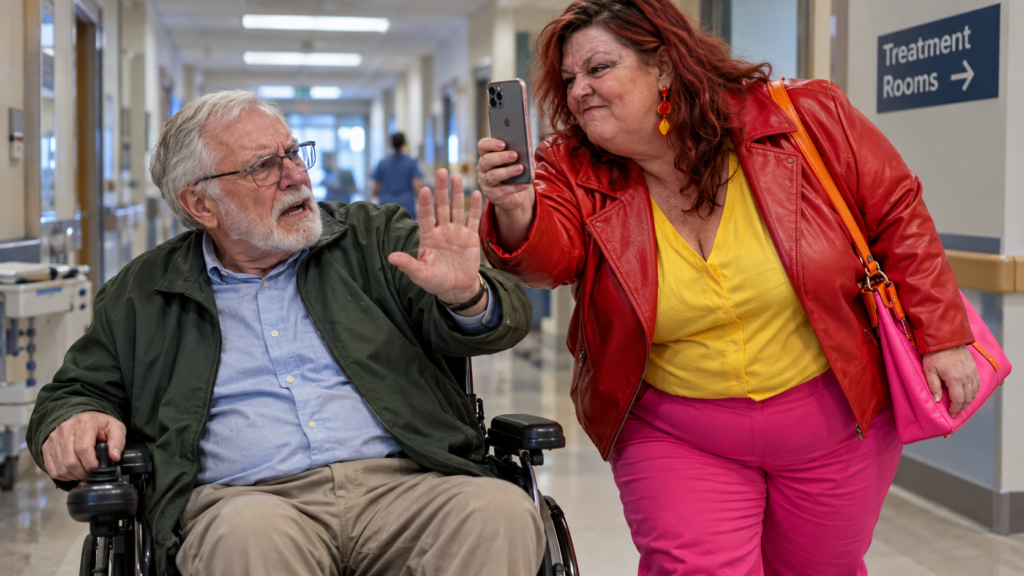
Chapter 1: Get That Phone Out of My Face
“Get that phone out of my face! Stop filming me!”
The elderly man’s voice cracked through the quiet hospital corridor.
His powered wheelchair had barely cleared the corner when Karen stepped closer, her smartphone held inches from him. The live camera preview filled her screen with his startled face, silver-white hair, rectangular glasses, and the dark-green jacket draped over his shoulders.
She did not lower the phone.
Instead, she smiled.
“Why?” she asked. “What are you so desperate to hide?”
The question landed harder than the recording itself.
The man stared at her for a moment, trying to understand what he had done to become the subject of a stranger’s attention.
Then he raised one hand between his face and the phone.
Karen simply moved the device around it.
He turned his wheelchair slightly.
She moved with him.
He turned farther.
Again, she followed.
The polished hospital floor reflected the bright orange sneakers beneath her fluorescent pink trousers. Her cherry-red jacket and golden-yellow blouse made her impossible to miss. Yet she behaved as though she were the one who had been wronged.
“I said stop,” the man told her. “This is my medical appointment.”
“Then explain why you’re acting like I caught you doing something wrong.”
She lifted the phone higher.
The man looked down the corridor toward the treatment area. He had been trying to reach that door without causing a scene. He had no desire to argue with anyone. At his age, after years of learning that hospitals were places where patience mattered, he knew how quickly a small delay could become exhausting.
But Karen kept coming.
The wheelchair motor hummed as he accelerated.
Karen walked beside him.
He turned left.
She immediately turned left.
“You’re following me now?”
“I’m not following you,” Karen replied. “I’m documenting you.”
The distinction sounded absurd.
The phone remained pointed directly at his face.
He stopped.
Karen nearly walked into the front of the wheelchair.
For the first time, the amusement in her expression faded.
The man looked straight at her.
“You don’t belong anywhere near my medical information.”
Karen glanced past him.
Her eyes settled on the treatment-room doorway.
It was only a second.
But he saw it.
She raised the phone again.
“Then why did I see you come out of there?”
The man’s expression changed.
This was not simply a stranger being rude anymore.
Karen believed she had seen something.
Something she thought gave her a reason to investigate him.
The man slowly turned his wheelchair until he was facing her completely.
“Back away,” he said. “You’re harassing me.”
Karen stepped closer.
“Harassing you? I’m asking questions you’re obviously afraid to answer.”
The wheelchair moved forward.
Karen instinctively stepped backward.
The man kept moving just far enough to reclaim his space without touching her.
Her smug smile disappeared for half a heartbeat.
Then her jaw tightened.
She raised the phone once more.
The man noticed.
He also noticed where she was looking.
At the treatment-room door.
“That’s what this is about, isn’t it?” he said. “You think you saw something.”
Karen stopped.
Her eyes narrowed.
She lowered the phone slightly.
Then raised it again.
Her expression hardened.
“If your disability means nobody is allowed to question you,” she said, “then maybe you’re not protecting your privacy—maybe you’re using that wheelchair to hide behind it.”
The man’s face went still.
The phone continued recording.
And for one long second, neither of them moved.
The question hanging between them was no longer whether Karen had crossed a line.
It was what she thought she had discovered.