CHAPTER 1: THE TINE AND THE TRENCH
The blade hit hardpan, ringing flat and ugly through the ash handle into the meat of Jesse’s thumbs. He did not get the chance to lever it back.
“You can’t just dig right along my property line without asking me first!”
The shout was high, tight at the cords, vibrating with the kind of outrage people practiced in front of bathroom mirrors before bringing it outside. Jesse kept his boots planted in the clods of dry clover and turned soil. He let his grip loosen on the ash wood, just an inch, letting the shovel head rest where it had struck. Between his boots and the asphalt of the public sidewalk ran the fence—galvanized mesh, rusted amber around the lower tension wire, held taut by pitted aluminum posts that tilted two degrees into the yard.
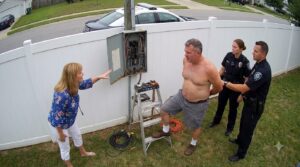
On the other side stood the woman. Navy patterned blouse, sleeves pushed past the elbows, denim pressed with a sharp laundry crease over scuffed leather sandals. Her right index finger was thrust through an aperture of the zinc-coated diamond weave, rigid, aimed squarely at Jesse’s collarbone. Her knuckle was pale against the gray metal.
“I asked you whose truck that was at six this morning,” she said, her voice dropping into a clipped, punitive rhythm that didn’t invite an answer. “You didn’t answer then. You don’t get to chew through my turf now.”
Jesse exhaled through his nose, smelling the sour tang of damp clay, unburned two-stroke fuel, and the dry mid-morning dust rising off the sidewalk. Three feet to his left, the small gas-powered rototiller sat dead in the furrow, its tines caked with wet loam and fibrous root hair. A smear of clean grease glistened on its red engine shroud.
He kept his gloves on. Heavy split cowhide, stiff with grime around the stitching.
“I’m within the setback, ma’am,” Jesse said, his tone deliberately level, stripped of heat. He did not point; he did not raise his chin. In this line of work, you never gave an angry homeowner a gesture they could call a threat on an incident report. “Fourteen inches off the post line. Work order says trench the perimeter for the drainage run.”
“You don’t have a permit to touch this side of the ditch,” she snapped, stepping closer until the front of her blouse brushed the links. “I know the code in this borough. I know where the easement lies, and I know you didn’t pull a utility flag before you dropped that blade.”
Before Jesse could cite the work ticket tucked in the cab of his beat-up Ford, the low rumble of a heavy engine rolled in from the curb.
A white-and-blue patrol SUV had pulled in against the gravel verge, its tires crunching slow and deliberate over the curb stones. The cruiser’s suspension dipped as the driver’s door swung wide.
Jesse didn’t move his feet. He knew better than to jerk his hands toward his pockets or make for the truck. Two officers stepped out into the dry noon glare. The one who took the lead was broad-shouldered, mid-thirties, his duty belt creaking under the weight of leather and steel, short light hair cropped tight to the skull. Behind him, a younger partner lingered near the rear quarter-panel, eyes already scanning the street, hands resting casually near the buckle of his vest.
Down the block, a screen door slapped shut. A middle-aged man in cargo shorts drifted onto his porch, coffee mug in hand, joined by a woman in garden clogs. They stood like fence posts in the heat, watching without coming closer.
The lead officer stepped into the gap between the sidewalk curb and the chain-link boundary, placing his body directly into the line of sight between the pointing finger and the trench. He didn’t unholster anything, but his presence was an anchor dropped into shallow water.
“Let’s take a step back, everyone, and talk this through calmly,” the officer said, his voice flat, practiced, carrying the dry institutional weight of a man who handled six domestic boundary calls before lunch every Saturday.
The woman didn’t drop her hand immediately. She kept the finger leveled at Jesse’s chest for two ticks of the cruiser’s idling radiator fan before her knuckles receded from the wire.
Jesse shifted his weight back onto his heels, keeping the shovel point buried where it sat. He let his palms rest on the rounded T-grip of the handle.
“Officer,” the woman started, her pitch sharpening again, “he’s destroying the structural root bed on my side of—”
“Ma’am,” the officer cut in, not looking at her yet, his pale eyes locked straight on Jesse’s gloves. “Hold on. Let’s keep everyone separated for now.”
Jesse opened his mouth to offer the parcel number written on the grease-stained clipboard in his truck, but the words withered before he could draw breath.
Down in the six-inch trench, just beneath the curved lip of his shovel blade where the topsoil had fallen away, lay an object the rototiller hadn’t broken. It wasn’t a cedar taproot, and it wasn’t an old clay sewer pipe. Protruding from the yellow clay was a loop of braided aircraft cable, fastened with a tarnished brass padlock that had been secured shut with fresh industrial lead-wire seals—stamped with a five-digit number that matched nothing in any municipal residential code.