
The Line We Draw in the Earth When the World Tries to Steal Our Ground

CHAPTER 1: OVER THE LINE

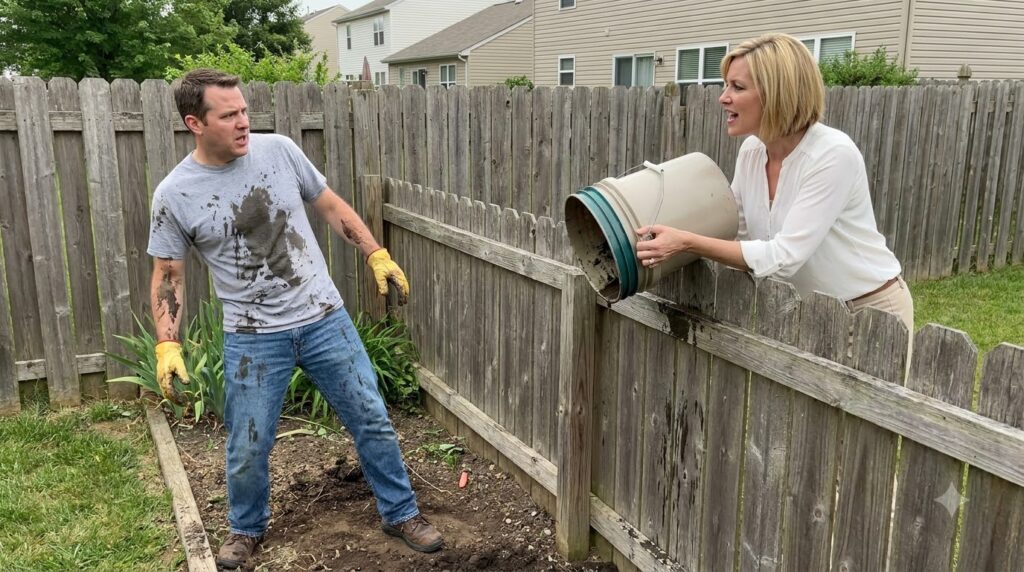
The heavy, wet slap of cold sludge hit Mark’s chest before he even heard the bucket scrape against the cedar rail.

He was crouched low in the damp dirt along his south property line, his yellow rubber gloves buried four inches deep in dark compost, when the cascade tore through the afternoon quiet. The stench hit him first—stagnant rainwater, rank rot, and the unmistakable metallic sharp bite of used motor oil. It soaked through the weave of his gray T-shirt, clinging heavy and cold against his skin, and ran in dark streaks down the denim of his jeans.

Mark didn’t shout. His heart slammed against his ribs with a sudden, violent thud, but years of military discipline locked his limbs into place. Slowly, deliberately, he unbent his knees and rose from the garden bed.

On the other side of the six-foot cedar fence, Evelyn stood with two nested plastic buckets tipped over the top rail. Her blonde bob was impeccably styled, her white button-down blouse crisp against the afternoon glare. Her face was locked in a sneer of petty victory.

“Maybe now you’ll learn to stay on your side of the fence!” she snapped. Her voice carried over the wood, sharp enough to cut through the quiet hum of suburban lawnmowers two doors down.

Mark stood six feet tall in his mud-caked work boots, the dark stain spreading across his ribs. He didn’t wipe his shirt. He didn’t raise his voice. He took one deliberate step toward the wooden barrier, stopping two inches shy of the cedar boards. He lifted his right hand—the yellow glove dripping with black, foul silt—and held it steady in the air right at the edge of the fence line, pointing directly at her eyes.

“Back away,” Mark said. His tone was low, flat, and stripped of all heat. “I’m not letting this slide.”

Evelyn’s smirk faltered for a fraction of a second. The complete absence of screaming seemed to throw off her script. She pulled the plastic buckets back over her side, the handle clinking against the rim, but held her position, her chin thrust out in rigid defiance.

Mark didn’t wait for her next sentence. He turned on his heel and walked toward the back patio, his boots leaving dark, wet prints across the grass.

Under the eaves of his roof, the small blue status light of an optical lens blinked twice. Tucked right beneath the soffit, angled at a sharp forty-five degrees along the entire length of the cedar fence, the 4K security camera sat silently in its housing—its mic still capturing the faint clatter of Evelyn’s buckets on the other side of the wood.

Mark reached the patio door, unbuttoned his soaked shirt with steady fingers, and dropped it onto the concrete. The smell of oil hung thick in the warm air. When he reached down to pull off his left glove, his thumb caught on a small, sharp piece of rusted metal embedded in the sludge on his palm—a fresh, jagged washer that had never belonged in his soil.

CHAPTER 2: THE GREASE AND THE DEED

The rusted washer felt cold and sharp against Mark’s bare palm. It wasn’t an accidental pebble from a compost pile or gravel from a garden path. It was a half-inch galvanized lock washer, coated in a thick, tacky film of black engine grease that smelled of scorched petroleum and old iron.

He didn’t drop it. He carried it into the garage, his boots making heavy, damp thuds on the stained concrete floor. He placed the washer on his workbench under the harsh white glare of an overhead LED strip, right next to the brass casing of his digital caliper.

Outside, the neighborhood returned to a brittle, deceptive quiet. A lone crow called from the power lines over the cul-de-sac, but the space beyond the cedar fence remained dead air. No buckets clattered. No doors slammed. Evelyn was already indoors, likely sitting behind her polished mahogany desk with a cup of herbal tea, reviewing whatever unwritten rule she believed gave her domain over the earth.

Mark pulled off the ruined gray T-shirt, dropping it into an empty steel bucket. The dark stain on his chest was already drying into a stiff, dark crust that smelled faintly of sulfur and burnt oil. He grabbed a rag soaked in mineral spirits and wiped the dark film from his ribs and forearm. The solvent stung where the grit had chafed his skin, the sharp friction bringing a dull, steady warmth back to his muscles.

He didn’t waste time on anger. Anger was a useless engine—it burned dirty and ran hot without turning a single gear. Instead, he pulled up his workstation monitor on the corner bench, bringing the home security interface out of sleep mode.

The local server interface was clean, devoid of unnecessary clutter. He navigated straight to the timestamped file from twenty minutes prior: Cam_02_SouthBoundary_1432.mp4.

He hit spacebar. The 4K feed was razor-sharp, captured at sixty frames per second under the unblinking glare of afternoon light.

On screen, Mark saw himself from the high eaves—crouched in the dark dirt, quiet, working with the steady rhythm of a man who measured his life in quiet labor. Then came the shadow. Evelyn’s blonde hair caught the sun first, followed by the white fabric of her blouse. She didn’t stumble. She didn’t trip over a root or struggle with a heavy load. Her movements were deliberate, rehearsed, and swift. She hauled the nested plastic buckets over the cedar rail with a sharp, levering motion of her elbows, aiming directly for his upper torso before tipping the lip.

Mark paused the frame at 14:32:08.

The stream of sludge was mid-air, a dark, viscous curtain suspended in the sunlight. Droplets bounced off the top of the fence post. He zoomed in 300 percent. The resolution held up, revealing the interior of the primary bucket. It wasn’t garden soil mixed with rain. The bottom of the white bucket was coated in a dark, sludge-thick residue with distinct rainbow sheens running through the slurry—hydrocarbons.

He pressed play. The audio captured every decibel. The heavy slap of the waste hitting his gray shirt, the rattle of the plastic handles, and then Evelyn’s voice, clear as a bell: “Maybe now you’ll learn to stay on your side of the fence!”

Mark clicked export, saving three separate copies—one to the local encrypted drive, one to a hardened offsite cloud partition, and one to an external thumb drive he pulled from his desk drawer.

He stood up, pulled a fresh black cotton shirt over his head, and walked back out onto the patio. The air was turning cooler as the sun dipped behind the western pines, casting long, sharp shadows across the grass. He walked down the side path to the garden bed, his eyes scanning the ground.

The dark waste had pooled in the loose, tilled earth where he meant to plant his native clover and shrubs. The soil beneath it was ruined for the season; the oil would leach down into the root layer if he didn’t excavate it immediately. But as he bent down with a clean flathead trowel to scrape a sample into a glass mason jar, he noticed something else.

Along the base of the cedar fence posts, two inches above the turf, were three small, fresh drill holes. The wood around the holes was bright, pale, and unweathered, small piles of sawdust clinging to the grass blades below.

Evelyn hadn’t just dumped waste over the fence. She had been boring into the support posts from her side of the line.

A soft crunch of gravel echoed from the front driveway. Mark didn’t jump. He capped the mason jar, tightened the metal ring with a mechanical click, and walked slowly around the corner of the garage to see who had arrived on his ground.

A white county code enforcement sedan was idling near the curb, its yellow roof bar dark but present. The driver’s door opened, and a officer in a tan uniform stepped out, a thick vinyl clipboard gripped in his left hand. Behind him, stepping off her front porch with the smooth, practiced stride of a woman about to deliver a verdict, was Evelyn.

“Mr. Miller?” the officer called out, his voice flat, tired, and accustomed to suburban misery. “Code Enforcement Officer Miller. We received a priority report regarding an unpermitted hazardous earthworks obstruction blocking a municipal drainage corridor.”

Evelyn stopped three paces behind the officer, her hands folded neatly over her stomach, her face a mask of solemn, civic duty.

Mark stood on his driveway, the glass mason jar in his hand, his eyes locking onto hers with the cold, unyielding weight of iron.

CHAPTER 3: THE FORGED BLUEPRINT

Officer Miller didn’t look up from his vinyl clipboard as Mark approached the foot of the driveway. The summer sun was beating down on the blacktop, radiating waves of dry, oppressive heat that made the asphalt smell like fresh tar.

“I have a formal civil nuisance complaint,” Miller said, his thumb flicking against the steel clip. “Dumping of heavy waste into an active stormwater easement, along with unpermitted earthworks blocking a designated watershed flow.”

“There is no easement on my south boundary,” Mark said, stopping four feet short of the officer’s front bumper. His hands were loose at his sides, the mason jar resting in his right palm like a piece of cold ammunition.

Evelyn took a step forward, smoothing the front of her white blouse with two manicured fingers. She produced a folded sheet of heavy, yellowed paper from under her arm—a document that looked older than the neighborhood itself.

“Officer,” Evelyn said, her voice dripping with practiced, civic concern, “Mr. Miller is mistaken. When the Oakridge division was platted in 1998, a six-foot public utility and drainage corridor was established right along his south line. He’s been digging up the ditch line all morning, causing toxic runoff from his yard to back up onto my property. I had to clear the overflow myself just to keep it from seeping into my foundation.”

She unfolded the paper with a sharp, crisp snap, holding it out for Miller to inspect.

Mark stepped closer, his eyes narrowing as he scanned the ink lines. It was a municipal blueprint map—or a very convincing copy of one. Bold blue lines traced the boundaries of Lots 12 and 13, and right along the dashed line representing the cedar fence was a shaded hatch mark labeled 6′ PUBLIC DRAINAGE EASEMENT – COUNTY REG #98-402. At the bottom corner sat an official-looking circular rubber stamp in faded red ink, bearing the county engineer’s seal.

Miller leaned in, squinting at the stamp. “Looks like a registered conveyance, Mr. Miller. If you’ve been filling in a drainage trough on a recorded easement, that’s a Class B civil violation with an immediate cease-and-desist order.”

Mark didn’t reach for the paper. He knew every inch of his deed. He knew every line item, every tax parcel map, and every survey marker recorded in the county courthouse when he bought the house five years ago. There was no easement. There had never been an easement.

“May I see the stamp date?” Mark asked, his voice steady as a plumb line.

Evelyn’s grip on the edge of the paper tightened slightly, her knuckles turning pale against the yellowed margin. “It’s a certified copy from the 1998 master filing, Officer. He has no right to question official county records.”

“Hold it steady, ma’am,” Miller grunted, pulling a small magnifying loupe from his breast pocket. He leaned down, placing the lens an inch from the red ink seal.

Mark watched Evelyn’s jaw muscles flex. She wasn’t sweating, but her breathing had shifted—shallow, tight, and controlled.

“This stamp,” Miller murmured, rubbing his thumb over the red ink, “the ink isn’t offset. It’s an inkjet print on heavy bond paper. And the county engineer signature at the bottom… Harvey Vance didn’t take office until 2004.”

Evelyn pulled the document back with a quick, defensive snap of her wrists, folding it in half before Miller could take a second look. “It’s a working reference draft provided by the original developer’s estate,” she insisted, her voice rising half an octave. “The point is the water flow, Officer! He redirected the water! He dumped soil, and I had to push the sludge back onto his side before it ruined my lawn!”

“You didn’t push anything back, Evelyn,” Mark said, stepping into her line of sight. He held up the mason jar. Under the harsh sunlight, the dark liquid inside separated into two distinct layers—a murky black sediment at the bottom, and a thick, iridescent golden sheen floating on top. “You carried two nested buckets of used motor oil mixed with stagnant gutter water from your garage, lifted them over my cedar fence, and dumped them directly onto my chest while I was kneeling in my garden.”

Evelyn’s eyes flashed with cold, sharp malice. “That’s an absurd lie! You’re trying to cover up your illegal excavation!”

“Officer Miller,” Mark said, ignoring her completely, “I have dual 4K security cameras under my eaves. They record at sixty frames a second with full directional audio. The entire incident—from the moment she walked up to the fence with the buckets to the moment she told me to ‘learn to stay on my side’—is saved on a local drive.”

Miller looked from the mason jar in Mark’s hand to the folded blueprint tucked under Evelyn’s arm, then back to Mark’s unreadable face. The tired, bureaucratic routine had evaporated from the officer’s eyes, replaced by the grim realization that he had walked into a legal landmine.

“Show me the footage,” Miller said.

“Follow me to the side yard,” Mark replied, turning on his heel. “And you might want to call Deputy Callahan from the sheriff’s department while we walk. Because this isn’t a code dispute anymore—it’s a crime scene.”

CHAPTER 4: BRASS AND EARTH

Mark led Officer Miller around the corner of the garage, the gravel crunching beneath their boots. Evelyn trailed ten feet behind, her polished white leather sneakers stepping around the damp patches of turf with stiff, hesitant precision.

Before they reached the side gate, a battered yellow pickup truck with Vance & Associates – Certified Land Surveying stenciled on the door pulled up alongside the curb. The engine killed with a heavy, metallic sigh, and County Surveyor Vance stepped out. He was a broad, weather-beaten man in a hi-vis vest, carrying a steel tripod in one hand and a magnetic pin locator in the other.

“Mark,” Vance called out, nodding over the roof of his truck. “Got your dispatch call. Brought the parcel plat maps from the county recorder’s vault.”

Evelyn stopped dead in her tracks, her hand flying to her chest. “What is this? I didn’t authorize a survey crew on this street!”

“Mr. Miller hired us privately three weeks ago when you started sending those anonymous fence notices, ma’am,” Vance said smoothly, setting his gear on the grass. “And under state property code, a licensed surveyor doesn’t need your permission to establish deeded corners.”

“This is an ambush,” Evelyn snapped, turning sharply to Officer Miller. “Officer, he’s fabricating an elaborate distraction! Look at the fence—the fence has been there for twelve years! The fence is the boundary!”

“A fence is just wood, ma’am,” Miller replied, his voice flat as he pulled his notebook out again. “Let the surveyor work.”

Vance didn’t waste words. He set his optical transit over the concrete sidewalk monument at the corner of the lot, dialed in the elevation sight, and extended his magnetic locator pole toward the south lawn. The device gave off a low, rhythmic hum that accelerated into a high-pitched, solid whistle as he approached the base of the cedar fence.

“Got a pin,” Vance muttered. He pulled a hand trowel from his belt and dug a quick four-inch trench through the sod. The blade struck iron with a loud, ringing clack.

Mark stepped over to look. Three inches below the roots sat a heavy, solid iron pin topped with a stamped brass disk that gleamed dull gold in the dirt.

Vance knelt, wiped the silt away with his thumb, and read the stamped numbers aloud: “DO NOT REMOVE – RECTIFIER PIN #4092 – LOT 12 BOUNDARY.”

He pulled a high-visibility orange tape measure from his vest and ran it straight perpendicular to the cedar fence. The tape hit the wood paneling at exactly twenty-four inches.

“The wooden fence was built two feet inside Mr. Miller’s deeded line,” Vance declared, locking the tape measure with a loud plastic snap. He pulled a bundle of wire survey flags from his vest and plunged a bright orange marker directly into the manicured grass on Evelyn’s side of the fence line, two feet past the cedar wood. “Everything from this orange flag to the fence—and the fence itself—is sitting on Mark’s deeded acreage. It isn’t a shared boundary. It’s his land.”

Evelyn’s face turned from pale white to a deep, blotchy crimson. “That’s impossible! I’ve mowed that grass for a decade! Adverse possession—I own that strip!”

“Adverse possession requires open, notorious, and hostile occupation without written objection for fifteen years in this state,” Vance replied coldly, pulling out a second orange flag. “And Mark filed a formal boundary reservation letter with the county clerk three years ago. You’re trespassing every time you push your lawnmower over this line.”

Mark didn’t celebrate. He stood in the dry dirt of his garden bed, watching the realization hit Evelyn like a physical blow. But as he looked down at the orange flag planted in her lawn, his eye caught a strange discrepancy near the fence footing.

Where Evelyn had dumped the dark sludge, the liquid hadn’t just sat on top of his soil—it had seeped down directly toward the buried iron boundary pin. The oil slick wasn’t a random bucket of gutter waste. It was concentrated, black as pitch, and smelled of chemical solvent.

If a soil sample tested positive for heavy hazardous hydrocarbons along a lot boundary, county environmental law mandated an immediate land freeze—blocking any property line adjustments, construction permits, or boundary disputes until a full state environmental audit was completed.

The fake blueprint wasn’t just meant to trick Officer Miller. Evelyn had been trying to trigger an official soil hazard quarantine on Mark’s lot before the upcoming county zoning vote next month.

Mark reached into his pocket and pulled out his phone, unlocking the screen as Deputy Callahan’s sheriff cruiser turned into the cul-de-sac with its strobe lights flashing silently against the trees.

“Officer Miller,” Mark said, his voice dropping into a hard, metallic register. “The survey is verified. The boundary is locked. Now let’s go inside my patio and watch the 4K recording of what she dumped on top of that brass pin.”

CHAPTER 5: THE SCREEN AND THE STRIKE

Deputy Callahan’s boots made a slow, rhythmic crunch against the patio gravel as he joined Officer Miller, Surveyor Vance, and Evelyn under the shade of the back eaves. His tall frame cast a long, sharp shadow over the flagstones, his hand resting casually near his duty belt.

“Let’s see what we’re dealing with, Mr. Miller,” Callahan said, his voice deep, gravelly, and entirely stripped of small talk.

Mark didn’t offer seats or water. He picked up his ruggedized field tablet from the outdoor bench, unlit screen reflecting the pale blue sky overhead. With two quick taps of his thumb, he pulled up the local storage directory and hit play on Cam_02_SouthBoundary_1432.mp4. He angled the 10-inch glass display so all four of them could see it at once.

The video opened with absolute clarity. The 4K resolution rendered every detail of the backyard with pristine sharpness: the green leaves of the native clover, the freshly turned dark earth along the cedar fence, and Mark crouched peacefully in his gray shirt and yellow gloves.

In the upper-right corner of the frame, Evelyn appeared behind the cedar top rail. On screen, her white blouse caught the full glare of the midday sun. She wasn’t holding a lawn tool or clearing a storm drain. She was carrying two nested white five-gallon pails, her knuckles white with the strain of a heavy liquid load.

“Pause it right there,” Callahan murmured, leaning in closer.

Mark tapped the screen. The image froze at timestamp 14:32:04.

Zooming in with a pinch of his fingers, Mark expanded the image of the bucket interior. The glare off the plastic dropped away, exposing the thick, black slurry inside—and floating right near the rim, a severed yellow plastic pull-tab from a commercial quart of 10W-30 engine oil.

“That’s not rain runoff, ma’am,” Officer Miller said dryly, looking over Callahan’s shoulder at Evelyn. “Stormwater doesn’t come with oil container seals.”

“Play the rest,” Mark said softly.

He unpaused the clip. On the tablet, Evelyn’s on-screen image lifted the buckets over the rail with a violent, levering thrust. The dark, viscous curtain of sludge flew across the two-foot gap, slapping hard across Mark’s chest, splashing his face, and soaking the soil over the newly uncovered brass boundary pin.

The audio track played through the tablet’s stereo speakers, clear and loud in the outdoor quiet: “Maybe now you’ll learn to stay on your side of the fence!”

A collective silence settled over the patio. Across the lawn, two neighbors who had been watching from their back deck went utterly motionless. Evelyn’s jaw twitched, her throat working as she swallowed hard, but no sound came out.

“Now,” Mark said, pausing the video again and looking directly at Officer Miller, “let’s look at the timing. She didn’t just throw waste. She attempted to use that fake 1998 blueprint to claim I altered a drainage corridor. But why dump motor oil mixed with industrial solvent onto an exact property line?”

Surveyor Vance stepped forward, pointing a calloused finger at the screen. “Because under County Code 14-B, any lot line subject to an active hazardous chemical investigation is frozen for ninety days. No boundary enforcement, no fence removals, no survey filings can be finalized until the state EPA clears the site.”

Callahan turned slowly toward Evelyn. His face was unreadable, his eyes cold as flint. “You weren’t trying to clean a ditch, Mrs. Evelyn. You were trying to lock his lot line in court before the HOA board elections next month.”

Evelyn’s composure finally fractured. “He’s been building unpermitted structures!” she shrieked, her voice cracking across the quiet yard. “He’s destroying the aesthetic continuity of this cul-de-sac! Someone had to take control!”

“You don’t take control by dumping hazardous waste onto another man’s chest on his own deeded land, ma’am,” Callahan said, pulling his leather handcuff pouch open with a loud, metallic snap. “Officer Miller, write the municipal environmental citations. I’m taking the criminal charge.”

“On what grounds?!” Evelyn backed away a step, her white sneakers skidding on the gravel. “This is a private civil matter!”

“Misdemeanor property destruction, illegal dumping of hazardous petroleum, and filing a false police report,” Callahan said, stepping toward her with calm, deliberate authority. “Turn around and put your hands behind your back.”

CHAPTER 6: THE BOUNDARY RESTORED

The metallic click of the handcuffs locking shut was sharp enough to echo off the brick wall of the garage.

Evelyn didn’t scream this time. The shrill protest died in her throat as Deputy Callahan clicked the steel cuffs over her wrists, controlling her hands with dispassionate, practiced ease. Her white button blouse was wrinkled, her blonde bob disheveled from the wind as Callahan escorted her step-by-step down the concrete driveway toward the idling patrol cruiser parked at the curb.

The neighborhood was no longer silent. Along the cul-de-sac, three separate homeowners stood at the edge of their driveways, phones held low, watching the street enforcer who had terrorized their fence lines for six years get placed into the back seat of a sheriff’s vehicle.

Officer Miller stayed on the driveway, his vinyl clipboard resting on the hood of his sedan as he filled out two full-page yellow citations.

“Environmental Abatement Notice 88-A,” Miller said, handing the carbon-copy receipt to Mark. “This requires her estate to pay for a certified hazardous material crew to excavate every inch of that contaminated soil within forty-eight hours. If she misses the window, the county steps in, cleans it, and attaches a lien directly to her house.”

“I’ll be here when the crew arrives,” Mark said, taking the paper with steady fingers. His voice was low, flat, and grounded.

Surveyor Vance walked back to his yellow truck, his magnetic locator tucked under his arm. Before climbing into the cab, he reached down and tapped the orange survey flag he had plunged into the sod—the marker sitting two full feet past the cedar fence, deep inside what Evelyn had claimed was her lawn.

“That pin is brass-capped and recorded in the county vault, Mark,” Vance said, leaning out his window. “That orange ribbon stays right where it is. If anyone touches it, it’s a state felony for tampering with a boundary marker.”

“It’s not moving,” Mark said.

The sheriff’s cruiser pulled away from the curb, its tires leaving faint dark tracks on the dry pavement as Callahan drove Evelyn away. Officer Miller finished packing his clipboard, gave Mark a brief, respectful nod, and pulled out into the quiet street right behind the patrol car.

By six o’clock, the afternoon heat had finally broken. A cool, evening breeze drifted in from the western woods, carrying the scent of pine needles and damp grass, washing away the bitter petroleum stench that had hung over the patio all afternoon.

Mark walked back through his side gate into the backyard.

The dark sludge was still pooled in the soil along the cedar fence, but the threat was gone. The fake 1998 blueprint was secured in Officer Miller’s evidence bag, the 4K footage was backed up in three secure servers, and the true property line was anchored by two feet of deeded brass and iron.

Mark walked into the garage, pulled a pair of pristine, unused yellow rubber gloves from the box on his workbench, and snapped them over his hands. He picked up his flathead trowel and a clean steel bucket, walking deliberately down to the garden bed.

He didn’t wait for the environmental abatement crew to start the preliminary work. He knelt in the damp soil, digging out the top layer of contaminated silt around the posts, scraping it cleanly into the bucket to isolate his native clover roots from the chemical runoff.

Across the cedar fence, Evelyn’s house sat dark, cold, and dead quiet. No buckets clattered. No clipped, mocking voices called over the wood.

Mark smoothed the fresh, unpolluted earth with his gloved palm, his fingers tracing the edge of his true boundary line. He picked up his spade, sank it deep into the dark, fertile soil, and went back to planting his garden in the quiet rustle of his own land.

Similar Posts

Leave a Reply

Your email address will not be published. Required fields are marked *






