
The Cold Geometry of Oakridge Lane: A Novel of Suburban Calculation, Fractured Glass, and Sudden Public Vindication

CHAPTER 1: THE IMPACT LINE

The sound did not ring out like metal or snap like dry timber; it landed as a dense, sickening thud followed by the high-frequency spidering of tempered glass.

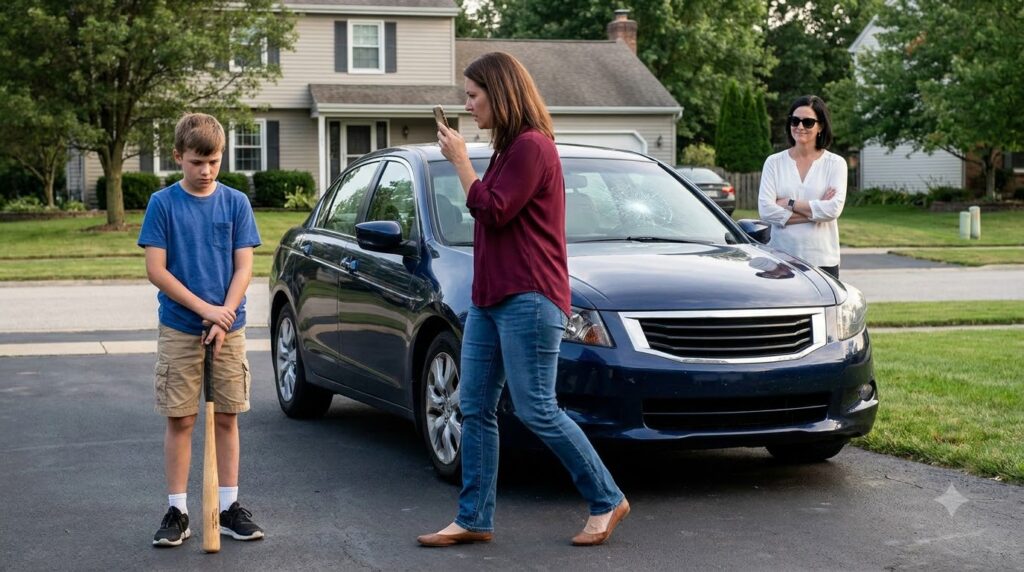
Laura Miller reached the bottom of her porch steps at a hard stride, her dark flats striking the sun-scalded concrete of the driveway. Ten feet ahead, beside the front passenger corner of her dark blue sedan, eleven-year-old Timmy Vance stood frozen, his small hands still gripped around the tape-wrapped handle of an old Louisville Slugger. A fresh starburst fracture spread across the glass, its center white and pulverized, reflecting the flat glare of the mid-afternoon heat.

Two paces behind the boy, planted on the manicured edge of the lawn in black heels that sank slightly into the turf, stood Brenda Vance. Her arms were folded tightly across her white linen blouse, her oversized dark sunglasses tilted slightly up toward the sun. A thin, sharp smile remained pinned to her lips—a expression that did not register Laura’s approach until the black frame of Laura’s smartphone crossed her line of sight, raised steady at chest height.

“Stop,” Laura said. Her voice did not carry a shake or an octave of panic. It cut across the heat in a flat, measured line. “Drop the bat. You already cracked the windshield.”

Timmy’s shoulders hitched. The boy’s brown eyes darted from the web of fractured glass up to Laura, his fingers loosening until the heavy end of the wooden bat thudded softly against the grass near his sneakers. The confidence that had carried his swing evaporated instantly, replaced by the pale, slack-jawed confusion of a child who realizes the adult rules he was just following were a lie.

Brenda’s smile did not disappear; it curdled. She took a half-step forward, the heels of her shoes pulling out of the sod with a dry tearing sound, her hands dropping to her hips as she stepped into the gap between the car and her nephew.

“Timmy, what on earth!” Brenda’s voice pitched upward, loud enough to bounce off the vinyl siding of the house across the cul-de-sac. She threw her hands out toward the boy, her movements broad and theatrical, designed for the porch shadows where two neighbors had already paused. “I turn my back for five seconds to check the mail, and you take a baseball bat out of the garage? Put that down right now!”

Laura did not lower the phone. She adjusted her stance by six inches, framing both Brenda’s flustered, gesturing hands and the shattered glass behind her in the exact center of the screen.

“Put the bat down on the grass, Timmy,” Laura repeated calmly, her eyes fixed entirely on the boy. “And step away from the vehicle.”

“Laura, please,” Brenda snapped, her tone dropping two octaves as she stepped directly into Laura’s line of sight, her posture rigid and defensive. “The child made a mistake. He’s eleven. There’s no reason to stand out here waving your phone in his face like a weapon when I’m clearly handling it.”

“You aren’t handling it, Brenda,” Laura said, her finger resting firm against the record button. “You’re positioning.”

Behind Brenda’s left shoulder, tucked underneath the eave of Laura’s front porch forty feet away, a small blue LED ring glowed steady on the face of the smart doorbell camera—recording the exact forty-seven seconds of audio that had preceded the swing.


CHAPTER 2: THE CURDLING SMILE

“Don’t talk to me about positioning,” Brenda spat, her voice dropping into a harsh, breathless rasp meant strictly for the five feet of heat-rippled air between them. Her oversized dark sunglasses reflected the distorted silhouette of Laura holding the phone—a small, rigid shape against the sprawling pastel brick of the cul-de-sac.

“Put the bat in the grass, Timmy,” Laura repeated. She didn’t blink, her focus splitting with practiced calculation between the boy’s trembling hands and the sudden, telltale flicker in Brenda’s jawline. “Step toward the porch. Now.”

The boy didn’t look at his aunt. The Louisville Slugger rolled through the dry rye grass, its scuffed barrel coming to rest against the curb. Timmy backed away three steps, his sneakers dragging through the dust, before turning and bolting up the rise of Brenda’s manicured lawn toward her front door. The screen door slapped shut behind him with a sharp, hollow crack.

With the child gone, the framing cleared. Brenda was left alone on the apron, her black heels wedged into the lawn border, her white linen blouse pristine except for a dark crescent of sweat beginning to bloom along her ribs.

“You think you’re very clever, don’t you, Laura?” Brenda took a deliberate step forward, crossing the property line by four inches. Her right hand came up, manicured fingers pointing directly at the shattered starburst on the sedan’s windshield. “You’ve been looking for an excuse to cause a scene ever since the county thrown out your illegal parking exemption. The boy was helping me clean up the dead ash stump near the property stake. I handed him the bat to knock off the loose bark. He tripped, he panicked, and he lost his grip. It was an accident.”

Laura didn’t take the bait. She didn’t counter the lie, nor did she lower the phone. Instead, her eyes tracked down to the base of her windshield, where a tiny, unnatural sliver of yellow caught the sunlight.

Pinned beneath the passenger-side wiper blade was a freshly torn piece of cardstock. It hadn’t been there when she parked two hours ago. It was dry, uncreased by the wind, and bore the distinct neon tint of a county code violation notice—except there was no official seal, only a series of handwritten numbers scrawled across the top in heavy black ink.

“A dead ash stump,” Laura said, keeping her tone flat, transactional. “Which is six feet inside my property line.”

“It’s on the shared easement, as you well know,” Brenda countered smoothly, though her chin hitched upward. She folded her arms again, a defensive shield against the camera lens. “And as a co-holder of the access lane, I have a legal right to mitigate safety hazards. If a child mishandles a tool because you left an unauthorized, unregistered vehicle blocking the turning radius, any insurance company in the state will call that contributory negligence.”

“The sedan is registered, insured, and parked entirely on my concrete pad,” Laura said. She shifted her weight, bringing her shoulder in line with the driver’s side door, physically blocking Brenda from stepping any closer to the yellow tag. “And you didn’t tell him to hit a stump, Brenda. You told him the car was scrap.”

Across the street, Mrs. Gable’s porch light flickered on—a useless gesture in the blazing two o’clock sun, but a clear sign that the neighborhood audience was consolidating. Down the block, the low, rhythmic idle of a V8 engine echoed off the brick facades. The white-and-green patrol car of a county sheriff’s deputy was turning into the mouth of the cul-de-sac, its roof lights dark but its intent clear.

Brenda’s eyes darted toward the sound of the approaching cruiser, then snapped back to Laura. For a fraction of a second, the polished mask slipped, exposing a cold, predatory assessment beneath the dark lenses.

“You should have moved the car when I asked you nicely in March,” Brenda whispered, stepping back across the grass line as the cruiser slowed to a crawl at the curb. “Now you’re going to learn what an easement dispute actually costs.”

CHAPTER 3: THE EASEMENT ARCHIVE

“An easement dispute costs whatever you let it cost,” Laura said softly under the rumble of the approaching cruiser.

She reached out with two fingers, pinching the corner of the neon cardstock where it lodged beneath the rubber wiper blade. The glass beneath it crackled faintly, a microscopic hair-line fracture expanding an eighth of an inch from the primary starburst strike. As she pulled the paper free, her thumb brushed the rough, hand-cut edge. It wasn’t an official citation from the township code enforcement department. It was a section cut from an archaic legal filing, complete with a typed excerpt and a heavy, underlined handwritten note at the bottom: Ordinance 84-B: Unobstructed Turning Radius & Timber Encroachment.

Laura’s mind raced back through six months of relentless, quiet escalation.

When she had bought the two-story home four years ago, the shared concrete driveway had been nothing more than a shared strip of pavement—twenty feet wide, divided down the center by a subtle seam in the pour. For three and a half years, there had been silence. Laura parked her dark blue sedan on her concrete apron, well within her ten-foot boundary, leaving ample room for any vehicle to pass.

Then Brenda had filed her first formal grievance in March.

It had started with an anonymous municipal complaint alleging that Laura’s sedan was inoperable and blocking emergency vehicle access. When the inspector arrived, Laura had turned the key, started the engine on the first crank, and produced a clean registration and insurance card. The inspector had apologized, signed off on the compliance form, and left.

Two weeks later, the passive-aggressive notes began appearing. “Please consider your neighbors’ property values.” “A driveway is for movement, not storage.” Then came the bogus hazardous tree filing targeting the mature oak near the rear fence line. Every attempt followed the exact same pattern: Brenda would weaponize an administrative lever, wait for Laura to defend herself, and then shift to a new angle the moment the previous claim collapsed under legal scrutiny.

Laura stared at the handwritten numbers on the cardstock: Case 409-E: Mutual Easement Dissolution & Forced Partition.

The realization hit her like a cold shock despite the sweltering heat. Brenda hadn’t just been trying to force her to move the car out of petty malice or suburban snobbery. Brenda was laying a documented paper trail of alleged safety hazards and property line disputes. Under the township’s civil code, if an easement became a persistent site of safety violations, hazardous obstructions, or physical property damage, a co-holder could petition the county land court for a forced dissolution—allowing the dominant parcel to buy out the subordinate parcel’s access rights at a discounted appraisal rate.

Brenda wasn’t trying to make Laura park on the street. She was trying to seize the driveway.

She had given the boy the baseball bat under the guise of clearing a “dead ash stump” on the property line so she could claim in court that the shared lane was structurally hazardous, poorly maintained, and prone to violent accidents caused by Laura’s obstructed sightlines. The smashed windshield was supposed to be the final physical evidence attached to her petition—a child’s panic, caused by an illegally parked car blocking his view.

Laura folded the yellow paper into a neat square and slid it deep into her jeans pocket. She looked up just as the white-and-green patrol car brought its front tires to a gentle rest against the curb.

The driver’s door swung open. Deputy Miller stepped out into the heat, his dark sunglasses reflecting the sun-bleached asphalt, his left hand resting casually over his duty belt near his radio. He looked at the cracked windshield, then at the wooden bat resting in the grass, and finally at Brenda, who had already plastered a tight, pained expression of civic concern across her face.

“Afternoon, ladies,” Deputy Miller said, his boots crunching against the loose gravel at the edge of the apron. “Dispatch got a call about a disturbance and property damage. Who wants to tell me what happened here?”

“Officer, thank goodness,” Brenda began immediately, stepping forward with her hands clasped in front of her white blouse. “It was a terrible, chaotic accident. My nephew was trying to help me clear an unsafe dead branch near the easement line, and he panicked when he couldn’t see past Miss Miller’s vehicle.”

Laura didn’t interrupt. She simply unlocked her smartphone screen, opened the video playback menu, and held the glass up toward Deputy Miller’s eye level.

“I have the accident on video, Deputy,” Laura said quietly. “Along with the exact instructions Miss Vance gave him before he took the swing.”

CHAPTER 4: THE TACTICAL INTERCEPT

“I’d suggest you hold that screen steady right there, ma’am,” Deputy Miller said, stepping onto the concrete pad. His polished leather boots brought him within arm’s length of Laura, his frame blocking the harsh sun and casting a long, hard shadow across the shattered windshield.

“Officer, you cannot seriously take a private, unverified recording as gospel,” Brenda interjected instantly. She closed the distance between them with quick, precise steps, her heels clicking against the concrete like small hammer strikes. “She’s been harassing my family for six months! She sets up camera traps, she leaves her vehicle parked in a manner specifically designed to provoke an incident, and now she’s terrorizing an eleven-year-old child with a smartphone screen!”

Deputy Miller didn’t turn his head. He merely held up a single gloved left hand, flat and decisive, halting Brenda’s momentum two feet short of Laura’s shoulder.

“Miss Vance, I am speaking with Miss Miller right now,” the deputy said, his tone dropping into the low, unhurried cadence of a patrol veteran who had parsed a thousand driveway arguments. “You’ll have your turn to make a statement. Step back to the grass line, please.”

Brenda’s jaw tightened into a rigid square. For a second, her dark sunglasses reflected the deputy’s badge, her posture quivering with the indignant weight of someone unaccustomed to being ordered off her own neighborhood stage. But under the deputy’s flat, unblinking glare, she retreated two paces, her heels biting back into the turf.

Laura adjusted her grip on the smartphone, angling the screen so the midday glare didn’t wash out the playback. She pressed play.

The high-definition video opened with the crisp, wide-angle perspective of her front porch camera before seamlessly cutting to her live handheld footage. On the screen, the spatial relationships were undeniable. The camera captured Brenda standing two paces behind Timmy, her hands folded over her chest, her dark glasses tilted toward the dark blue sedan. The audio cut through the hum of the idling patrol car with brutal clarity:

“Go on, Timmy. It’s just an old junk car the owner abandoned. Give the windshield a good whack, it’s getting scrapped anyway.”

Deputy Miller leaned in closer, his brow furrowing as he watched the child raise the Louisville Slugger, saw Brenda’s lips curve into a distinct, unmistakable smile, and then heard the sharp, terrifying crack of the windshield shattering.

The deputy’s chest expanded in a slow, deep breath. He tapped the screen to pause the video, freezing the frame on Brenda’s smiling face right beside the swinging bat.

“Is that your nephew, Miss Vance?” Deputy Miller asked, his voice turning ice-cold as he finally turned his head toward the grass line.

“That clip is taken out of context!” Brenda’s voice cracked slightly, losing its polished, aristocratic cadence. She crossed her arms again, but her fingers were trembling against her linen sleeves. “I was using hyperbole! I was trying to illustrate to the child how an abandoned, illegally parked vehicle creates a nuisance! I never intended for him to actually make contact—”

“You told an eleven-year-old child to hit a motor vehicle with a wooden baseball bat,” Deputy Miller interrupted, his right hand moving off his belt to unclip a leather notebook from his side pocket. “And then you stood by and watched him do it.”

“He misjudged the distance!” Brenda shouted, her eyes darting past the deputy toward the sidewalk, where three more neighbors had gathered near the fire hydrant, their faces pale and watchful in the heat. “He was trying to tap the dead tree branch behind the trunk! Look at the curb! The property line runs right through that soil patch!”

Laura’s gaze followed Brenda’s desperate pointing gesture down to the edge of the curb. Near the front tire of her sedan, a small square of topsoil looked freshly turned, loose dirt scattered over the sun-bleached grass. Sticking out of the dark earth by less than an inch was the glint of a brass cap—the official county survey pin marking the exact property boundary.

The pin hadn’t been exposed yesterday. Someone had used a trowel to dig up the sod within the last two hours, trying to visually shift the perceived property line six inches closer to Laura’s tire.

Laura felt a cold ripple run down her spine. The decoy story about the boy hitting a rotting stump or misjudging a tree branch wasn’t just an on-the-spot lie—it was part of a meticulously pre-dug defense. Brenda had altered the physical boundary markers before handing the boy the bat, creating a physical discrepancy she could point to when the police arrived.

“Deputy,” Laura said, her voice steady as she gestured toward the curb. “Look at the dirt near my front tire. That survey pin was buried under established turf this morning.”

Deputy Miller looked down at the freshly turned earth, then back at Brenda’s pale, sweat-sheened face. The trap was springing, but not the one Brenda had spent six months preparing.

CHAPTER 5: THE UNCOVERED REASON

Deputy Miller dropped to one knee, the heavy leather of his duty belt creaking as he crouched beside the front tire of Laura’s sedan. His gloved fingertips touched the freshly turned mound of dark topsoil, pushing aside loose grass clippings to expose the brass cap beneath.

“This pin hasn’t been sitting in open air,” Deputy Miller observed, his voice low and hard. He ran a finger around the rim, where the bright gold metal showed zero oxidation compared to the weathered concrete apron four inches away. “Someone dug out this sod within the last few hours.”

“That pin marks the easement boundary,” Brenda blurted, taking a sharp step forward onto the concrete pad. Her dark sunglasses slid down the bridge of her nose, exposing wide, bloodshot eyes. “It proves her vehicle is encroaching on the shared turning lane! If her car was parked four inches further back, Timmy would have had clear line of sight to the branch!”

Laura reached into her jeans pocket, pulling out the folded yellow cardstock she had retrieved from under her wiper blade. She unfolded it with two hands, letting the stiff paper snap taut in the heat.

“She didn’t dig up the pin to show line of sight, Deputy,” Laura said, stepping into the space beside the deputy’s shoulder so the phone screen and the paper were in his direct field of view. “She dug it up to match the clause listed on this notice. Look at the handwritten file number at the bottom.”

Deputy Miller stood up slowly, taking the yellow cardstock from Laura’s hand. He adjusted his glasses with his thumb, scanning the scrawled ink. “Case 409-E: Mutual Easement Dissolution & Forced Partition.”

Brenda’s posture collapsed by a fraction of an inch. Her arms unlocked from her chest, dropping limply to her sides. For the first time since the bat had struck the glass, the cold, imperious mask was completely gone, replaced by a raw, calculating desperation.

“That’s a private legal research document,” Brenda stammered, reaching a hand toward the paper before Deputy Miller raised it out of her reach. “That has nothing to do with this traffic incident! She took that off my property!”

“It was pinned under my wiper blade when I walked out,” Laura replied, keeping her voice level and devoid of anger. “Right beside the shattered glass.”

Deputy Miller looked from the handwritten case number down to Brenda’s open leather handbag resting on the lawn chair near her porch steps. Sticking out of the side pocket was a thick manila folder bearing the official blue seal of the County Land Records Office—the master filing for the entire Oakridge Lane subdivision easement.

The picture snapped into sharp focus for everyone standing on the concrete pad. The smashed windshield was never an accident, nor was it a random outburst of juvenile vandalism. Brenda had spent six months manufacturing an administrative paper trail of alleged safety hazards, property-line encroachments, and physical damage. She had dug up the boundary marker to fake an illegal obstruction, drafted the legal citation, and then handed her eleven-year-old nephew a wooden bat to create the physical destruction required to file a forced partition suit.

Brenda wasn’t trying to enforce neighborhood rules. She was executing a calculated land grab to dissolve Laura’s driveway rights and absorb the concrete apron into her own deed.

“Miss Vance,” Deputy Miller said, his tone flat and unyielding as he pulled out his digital citation pad. “You’re going to stay right here while I call dispatch for a secondary unit. You told an eleven-year-old minor to commit property destruction, you deliberately falsified a property boundary line at an active incident scene, and you attempted to shift criminal liability onto a child.”

Across the street, Mrs. Gable stepped off her front porch and walked down to the curb, joining four other neighbors who were now staring directly at Brenda. The silence on Oakridge Lane was total, heavy, and absolute.

Brenda stood frozen on the grass line, her mouth opening to speak, but no words came out. The camera on Laura’s phone continued to record, capturing the exact second Brenda’s six-month campaign shattered into complete, public exposure.

CHAPTER 6: THE BOUNDARY HELD

The click of Deputy Miller’s pen locking into place sounded like a small, metallic snap in the midday heat.

Time dilated over the concrete pad. The sun blazed off the starburst fracture in the sedan’s windshield, throwing jagged ribbons of light across the driveway. Laura stood motionless beside the driver’s door, her dark flats planted firmly on her side of the concrete seam, her smartphone still holding the raw, unedited footage of Brenda’s downfall.

“Miss Vance,” Deputy Miller said, his voice carrying with absolute, unhurried authority across the quiet cul-de-sac. “I am issuing you a formal citation for criminal solicitation to commit property damage and contributing to the delinquency of a minor. You will also receive a court summons from the county prosecutor regarding the falsification of boundary markers at a civil dispute site.”

Brenda did not move. Her oversized dark sunglasses had slipped fully down to her cheekbones, exposing hollow, unblinking eyes. The linen of her white blouse was damp and rumpled at the waist where she had spent six months standing tall as the self-appointed gatekeeper of Oakridge Lane. Now, her black heels were planted awkwardly in the dirt gap she had dug herself, her shoulders slouched forward under the gaze of the six neighbors standing silently along the curb.

“I have a right to protect my property value,” Brenda whispered, her voice stripped of its crisp cadence, sounding thin and dry in the summer air. “I live here. My family has lived on this lane for twelve years.”

“Your property ends at that concrete seam,” Deputy Miller replied, tearing the yellow duplicate carbon from his summons book with a sharp, rhythmic ripping sound. He extended the paper toward her. “And Miss Miller’s property begins right where you stood when you handed that boy the bat. Sign at the bottom. It’s an acknowledgment of receipt, not an admission of guilt, though the digital evidence files attached to this case file will speak for themselves in magistrate court.”

Brenda’s hand trembled as she took the pen. Her signature was a jagged, barely legible scribble across the yellow line. When she handed the clip back, she didn’t look at Deputy Miller, nor did she look at Mrs. Gable, who was watching her from the curb with her arms crossed in silent, unmistakable judgment.

Brenda turned on her heel and walked up her front steps, her black heels clicking once against the porch before her front door shut with a final, heavy latch.

Deputy Miller turned back to Laura, taking out his business card and handing it to her alongside a case reference card for her insurance company.

“Miss Miller, I’ve logged both video files into the department’s evidence locker,” Deputy Miller said, his tone softening into a professional, reassuring cadence. “Your insurance adjuster can contact our clerk directly using this case number. Given the criminal citation attached to the incident report, her personal liability policy will be responsible for full windshield replacement, detailing, and any civil costs related to the boundary tampering.”

“Thank you, Deputy,” Laura said. She took the card, her fingers cool and steady against the paper. “I appreciate your thoroughness.”

“Keep the car right where it is until the glass crew arrives,” the deputy advised, tipping his cap slightly as he turned back toward his cruiser. “It’s parked entirely within your rights.”

As the patrol car backed out of the cul-de-sac and rolled away down the street, the tension on Oakridge Lane broke like a fever. Mrs. Gable gave Laura a brief, respectful nod from across the pavement before turning to walk back to her porch. Down the block, the lawnmowers started up again, their engine hums filling the afternoon, but the social atmosphere of the neighborhood had permanently rearranged itself.

Laura walked slowly to the front of her sedan. She reached down and picked up the Louisville Slugger from the grass where Timmy had dropped it. She laid the wooden bat neatly on the grass inside her own property line, beside the freshly exposed brass survey pin that marked her ten-foot boundary.

She pulled her phone from her pocket and tapped the screen, saving the raw video file to two cloud backups and her personal legal folder.

For six months, Brenda Vance had used passive-aggressive notes, anonymous complaints, and legal threats to make Laura feel small, uncertain, and isolated in her own home. Brenda had tried to construct a web of rules to force Laura off her own land. But in the end, Brenda’s arrogant overreach had forced her into the open, exposing her manipulation to the police, her family, and the entire neighborhood.

Laura looked up at the quiet facade of Brenda’s house, then turned and walked up her front porch steps. As she reached her front door, she paused, looking back down at her dark blue sedan resting securely on the concrete pad under the sun. The windshield was fractured, but the boundary was held, documented, and unbroken.

Similar Posts

Leave a Reply

Your email address will not be published. Required fields are marked *






