
The Cold Geometry of a Suburban Line Drawn in Sunlit Concrete and Silence

CHAPTER 1: THE DRIVEN LINE

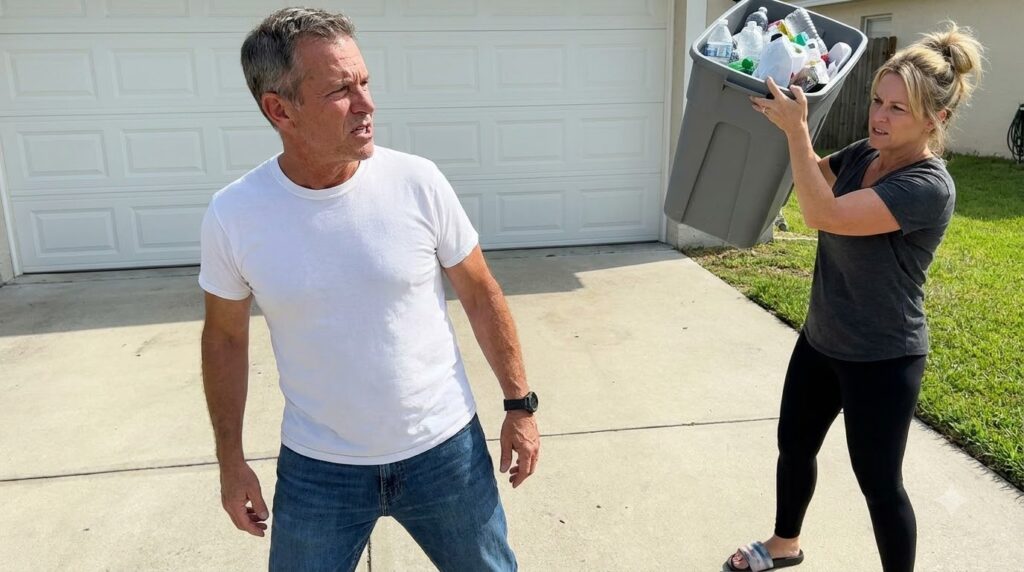
The sound reached Mark before the shadow did. It was a sharp, shifting clatter—heavy glass grinding against brittle plastic—less than three feet behind his neck.

Mark didn’t flinch. Decades of directing forty-ton cranes through tight utility corridors had taught his nerves to skip the panic phase and go straight to calculation. He planted his right work boot hard against the fresh, sun-cured concrete, using the leverage of his broad frame to snap his torso around in a single fluid pivot.

Brenda Vance stood frozen in his danger zone.

Her arms were locked high above her messy blonde hair, trembling under the weight of a heavy gray household trash bin tilted forward at a forty-five-degree angle. Inside, wine bottles and crushed cans shifted toward the lip, suspended directly above the pristine, light-gray pour Mark had spent three weeks curing. Her dark gray T-shirt was stretched taut, her slide sandals skidding an inch across his clean concrete as her forward momentum choked out.

Mark took one measured step into her line of sight, squaring his shoulders without extending a hand. He didn’t raise his fist. He didn’t reach for her. He simply occupied the space she needed to finish the dump.

“What are you doing,” Mark said. It wasn’t a question. It was a flat, low-frequency command that rattled against the metal of his sectional garage door. “Put that thing down right now.”

Brenda’s eyes widened, the hostility in her posture buckling under the sudden, physical wall of his presence. She had expected him to jump forward, to grab at the handles, or to scream—something she could frame as a physical assault to the county board. Instead, she was staring into the motionless, lined face of a man who treated her presence like a fallen high-voltage line: a hazard to be isolated and contained.

“I’m… I’m just moving it,” Brenda stammered, her voice dropping an octave as her forearms began to shake under the bin’s thirty-pound weight. “It’s in the way.”

“You’re four feet past your property edge,” Mark said, his dark wristwatch glinting under the harsh August glare. His pulse remained dead steady. “Set it down on your side.”

Slowly, her elbows giving out inch by inch, Brenda lowered the gray container down past her chest, her slide sandals scraping backward across the smooth surface. The glass inside clinked a soft, nervous rhythm in the silence of the cul-de-sac.

Across the street, a lawnmower engine sputtered and died as a neighbor let go of the safety bar, staring openly at the standoff. Brenda’s face flushed a deep, blotchy crimson as she realized she was caught holding the weight of her own trap.

She dragged the bin backward across his boundary line, the plastic base dropping onto her patchy turf with a dull thud. But as her feet cleared his space, her mouth tightened into a jagged line. She pulled her smartphone from her leggings pocket, the camera lens pointed directly at his chest.

“You threatened me, Mark!” she shouted, her voice suddenly elevated for the benefit of the watching street. “You stepped up on me! I felt physically endangered on my own boundary line!”

Mark didn’t cover his face or reach for her phone. He reached down to his belt, pulled his key ring, and unlocked his front door without taking his eyes off her position.

“Call the sheriff, Brenda,” Mark said quietly, his voice carrying clearly across the driveway. “Tell Deputy Vance to bring his tablet.”

He stepped up onto his porch, sitting down on the top brick step. Behind her, resting quietly in the shadowed corner beneath his garage eaves, a tiny red status light on a matte-black camera lens blinked twice—recording the subtle, metallic glint of a steel survey pin buried flush in the concrete right where her left heel had just slipped.


CHAPTER 2: THE AFTERMATH ON THE APRON

“You’re not going to leave that bin sitting on the property line, Brenda,” Mark said, his voice dropping into the low, measured register he used when a high-voltage cable had snapped and hung live over a wet trench.

Brenda’s phone was still pointed at his chest, the screen flickering with the high-contrast preview of his motionless frame. Her thumb trembled against the glass edge. Her slide sandals were dusted gray with concrete powder from his fresh pour, a pale chalk line marking where her heels had skidded.

“It’s on my grass, Mark!” She gestured wildly with her free hand toward the gray plastic container, though its left wheel still rested directly over the clean, four-inch border of his concrete apron. “You don’t own the easement! You don’t own the air space! You think because you poured five thousand dollars of concrete you own the whole dammed block?”

“I own to the iron pin,” Mark said. He didn’t look down at the ground; he didn’t need to. He knew the precise spatial geometry of the lot. “And your bin is three inches over it. Move it.”

“I was bringing it to show you what your workers left behind!” Brenda’s voice pitched higher, catching the attention of two more neighbors who had stepped onto their porches down the cul-de-sac. She reached into her dark gray T-shirt pocket and pulled out a folded slip of yellowed paper, shaking it in the air between them. “Chemical residue! Solvent bottles! Your concrete crew dumped hazardous materials right along my drainage swale, and I have the documentation!”

Mark looked at the paper in her hand. Even from four feet away, under the hard glare of the midday sun, he could see the faint, purple-ink stamp at the top of the sheet—a county filing mark, but the typeface was wrong. It was the blocky, manual-typewriter impression from the old regional office that had been decommissioned five years ago, not the sleek digital header used by current code enforcement.

“Show me the log, Brenda,” Mark said softly, taking a single step toward the edge of his porch.

She pulled the paper back instantly, shoving it deep into her stretch leggings pocket. Her knuckles were white against her phone casing. “I don’t have to show you anything! I’m submitting this directly to the county inspector! They’re coming out here tomorrow morning, Mark. You think you can just pave over the natural runoff and pretend you’re above the law? We’ll see what the county says about your ‘pristine’ driveway when they look at the hazardous waste report!”

“You brought a bin full of empty household wine bottles and rusty tin cans onto my concrete,” Mark said, his eyes narrowing slightly as he tracked the nervous, darting movement of her pupils. “That’s not contractor solvent. That’s your domestic garbage.”

“It came off your side!” she snapped, backing up two steps until both her slide sandals were firmly buried in her own overgrown, weeds-choked turf. “Your crew threw it over the fence while you were out! I’m taking this to the sheriff! I’m filing an injunction!”

She grabbed the plastic handle of the heavy trash bin with her left hand, yanking it backward with a violent, metallic crash. The glass inside rattled violently, a green wine bottle neck cracking against the inner plastic lip. She turned her back on him, dragging the heavy bin behind her like a battle-damaged sled, her slide sandals slapping loudly against the dry asphalt of her own driveway.

Mark remained seated on his top brick step, watching the heavy wooden door of her garage slam shut. The mechanical thud echoed off the surrounding houses, followed by the high-pitched whine of her automatic garage opener pulling the panel down to seal her inside.

He didn’t move for three full minutes. Across the street, the neighbor holding the idle lawnmower gave a brief, tight nod of understanding before pulling the pull-cord again. The engine roared back to life, masking the quiet hum of the neighborhood.

Mark reached down and picked up his tablet from the porch floor. He opened the local storage directory for the eaves camera. The raw file from five minutes ago had already rendered: 1080p, sixty frames per second, crisp daylight exposure. He zoomed in on Brenda’s hand as she had waved the yellow paper in the air.

On the magnified screen, the purple stamp was clear enough to read in the direct light: COUNTY EASEMENT AUDIT – DIVISION 4. Below it was a handwritten case number, scribbled in dark blue ballpoint pen.

Mark stared at the case number. Division 4 hadn’t handled residential code enforcement since the county rezoned the creek basin three years ago. They only handled one thing now: public access rights-of-way and eminent domain assessments for county drainage expansion.

He set the tablet on his knee and looked down at his clean, light-gray concrete. The pour was solid, reinforced with rebar, cured to perfection. But right along the property edge, buried four inches beneath the turf where Brenda’s weeds grew thick and unchecked, lay the iron survey pin he’d driven into the earth himself twenty-two years ago.

She wasn’t just trying to get him fined for a messy yard. She was trying to build a paper trail.

CHAPTER 3: THE PAPER TRAIL IN THE SHADOWS

Mark stood inside the cool, concrete-floored interior of his third garage bay, the air smelling faintly of bar-and-chain oil, cured lime, and dry cedar. Outside, the afternoon sun baked the newly poured apron into a blinding slab of pale gray, but inside, the shadows were long and sharp.

He dragged a heavy steel toolbox away from the wall, exposing a low metal locker he hadn’t opened since he retired from the utility line crew. He unlocked the brass padlock with a small key off his ring and pulled the door wide.

Inside sat three heavy blue binders and a thick, expanding accordian folder bound in faded black vinyl.

Mark lifted the accordian folder onto his workbench, the metal latches snapping open with a dry, mechanical clack. He didn’t need to guess what was inside. For six months, every time Brenda Vance had slid a handwritten “VIOLATION NOTICE” under his wiper blades, tacked a notice to his fence post, or dropped a folded warning into his mailbox slot, Mark had logged it. He hadn’t confronted her. He hadn’t argued over his property line. He had simply filed the evidence.

He spread the slips out across the galvanized workbench top under the cool fluorescent overheads.

The handwriting on the early slips was hurried, sharp, written in red felt-tip marker. VEHICLE ENGINE IDLING IN EXCESS OF SUBDIVISION NOISE ORDINANCE – 6:15 AM. DRAINAGE PIPE RUNOFF EXCEEDING NATURAL PROPERTY BOUNDARY. UNPERMITTED LUMBER STORAGE ALONG NORTH EASEMENT.

Mark touched the corner of a slip dated four months ago. The paper was rough, torn from a standard legal pad. But as he arranged them chronologically, the pattern shifted.

The felt-tip scribbles gave way to pre-printed forms—generic orange warning templates bought in three-packs at the office supply store down on State Route 4. But stapled to the back of the three most recent slips were official county communications, complete with the formal seal of the Department of Public Works.

Mark picked up the latest one, dated three weeks before he broke ground on the new concrete pour.

It was an official notice of inquiry regarding a “Sub-Surface Drainage Obstruction.” Attached to the back was a carbon-copy receipt showing a fifty-dollar administrative filing fee paid in cash at the county clerk’s desk. The applicant name wasn’t listed, but the handwriting filling in the property address was unmistakable: tight, backward-slanting script with hooked ts and underlined numbers.

Brenda hadn’t just been complaining to her husband or shouting across the lawn. She had been paying filing fees out of her own pocket to create a public record of dispute.

Mark reached into the back compartment of the accordian folder and pulled out a heavy manila envelope he’d received by certified mail two days after his contractor poured the main slab. The window seal had been sliced open with a razor blade.

Inside was a single sheet of formal county letterhead. It was an advisory warning regarding an “Upcoming Survey Assessment for Cul-de-Sac Municipal Drainage Realignment.”

Mark read the small print at the bottom of the page, his eyes tracking across the technical language: Notice is hereby given that properties adjoining Segment 4-B may be subject to compulsory temporary access easements pending the review of historical runoff complaints.

His jaw set into a hard, rigid line.

She hadn’t been trying to make him clean up his yard. She knew his lot sat three inches lower than her unkempt lawn, right at the natural choke point where the cul-de-sac met the storm drain. If she could establish a six-month paper trail of uncorrected “hazards” and “illegal obstructions” on his driveway edge, the county engineers wouldn’t bother negotiating a civil compromise. They would declare the drainage corridor compromised, invoke an emergency easement, and seize a six-foot strip of his new concrete for a municipal culvert.

And because her property sat on the higher side of the slope, the seized land would come entirely out of his parcel, leaving her lawn untouched while cutting his driveway width in half.

Mark folded the letter slowly along its original creases and slid it back into the manila envelope. He picked up his tablet from the workbench, opened his browser, and typed in the county land records portal.

He entered his parcel number first: clean, clear title, zero liens, approved building permit for a reinforced concrete driveway dated June 12th.

Then he entered Brenda’s parcel number.

The screen refreshed. A yellow warning banner flashed across the top of the county summary sheet: PENDING REVIEW – ACCESS RIGHT-OF-WAY DISPUTE – FILE #4B-8819.

Mark stared at the yellow banner in the dim light of his garage. The game wasn’t about trash bins or broken wine bottles. It was a calculated land grab disguised as a neighborhood squabble, and Brenda was already four steps ahead on paper.

He closed the tablet, locked the metal cabinet, and walked out onto his bright, sun-scorched concrete. Down the street, Brenda’s front blinds twitched once, a dark silhouette standing motionless behind the glass.

Mark didn’t look at her window. He walked to the corner of his house, pulled a heavy steel tape measure from his belt, and hooked the brass end against the corner of his garage foundation. He had forty-eight hours before the county inspector arrived, and he wasn’t going to rely on a paper trail.

CHAPTER 4: ANCHORS IN THE CLAY

The heavy iron sledgehammer hit the steel surveyor pin with a high-pitched, ringing ping that echoed off the white garage door and carried straight across the quiet cul-de-sac.

Mark stood on the wet grass of his lawn edge, his arms crossed over his chest, his boots caked with fresh black earth. Beside him, Greg Mercer, a licensed county surveyor with thirty years of commercial fieldwork behind him, wiped a bead of sweat from his forehead with the back of his canvas work glove. Mercer knelt in the dirt, adjusting his optical transit tripod, its laser beam painting a thin, invisible crimson line along the outer lip of Mark’s concrete apron.

“That pin hasn’t moved an eighth of an inch since the original subdivision plot was recorded in ’98,” Mercer said, his voice gravelly from decades of outdoor labor. He pointed his brass-tipped plumb bob down at the ground. “Your driveway border is four inches inside your deeded line, Mark. You gave her four inches of your own dirt just to be clean.”

“I don’t need her dirt,” Mark said, his eyes tracking the red laser line as it cut straight through the patch of overgrown crabgrass Brenda had claimed as her property. “I just need mine clearly marked.”

Mercer picked up a bright wooden survey stake painted neon yellow, driving it deep into the soil right beside the iron pin with two sharp, heavy blows of his mallet. He tied a fluttering strip of hot-pink surveyor’s ribbon around the top notch, letting it snap in the cool morning breeze.

Down the block, the front passenger door of a dark blue sedan slammed shut. Brenda Vance walked briskly down her sidewalk toward the curb, wearing a heavy trench coat despite the morning humidity, her phone raised at chest height as she recorded every strike of Mercer’s hammer.

“You can put all the wooden sticks in the mud you want, Mark!” Brenda called out, her voice sharp and trembling with nervous energy. She stopped right at the curb line, her slide sandals replaced by stiff leather walking shoes. “That pin is unverified! I’ve filed an official injunction with the County Public Works department! They’re issuing a freeze on all disputed boundaries in Division 4!”

Mercer didn’t even look up from his transit lens. “I’m a state-licensed land surveyor, ma’am. This pin is tied to the county monument on State Route 4. If you touch this stake, it’s a misdemeanor interference charge.”

Brenda’s mouth twitched, her eyes flicking toward the newly installed camera array mounted under Mark’s garage eaves. The sleek black housing sat flush against the vinyl siding, three high-definition lenses pointing down at the driveway, the curb line, and the newly staked iron pin.

“That camera is an invasion of my privacy!” she snapped, stepping around Mercer’s truck to point her screen at Mark. “You have a lens pointed directly at my front porch steps! I’m adding voyeurism and harassment to the county report!”

“The lens is static, Brenda,” Mark said calmly, taking two steps toward the edge of his new concrete apron. He pulled his smartphone from his pocket, tapping the screen once to mirror the camera’s live grid view. He held the screen up, showing her the crisp, wide-angle field of view: it cut off precisely two inches inside her lawn line, capturing every inch of his concrete and the pink-ribboned stake, but leaving her porch entirely in shadow. “It records public space and my property line. Nothing else.”

“We’ll see what the sheriff says when he reviews the file!” Brenda pulled a folded white envelope from her coat pocket—the same certified county notice Mark had seen in his garage file—and held it up like a shield. “The drainage audit is active! You think you can build a wall out of concrete and cameras, but the county owns the easement! They’re taking six feet of this apron for a culvert, and your little security cameras won’t stop a bulldozing crew!”

Mark didn’t answer. He watched her turn on her heel and stride back up her driveway, her trench coat flapping against her legs.

He walked over to Mercer, who was tightening the locking thumb-screws on his tripod legs. “Did you check the county drainage overlay when you pulled the parcel map this morning, Greg?”

Mercer paused, his hand resting on the aluminum tripod frame. He looked up at Mark, his weathered face darkening slightly. “I pulled the file from the clerk’s office at eight AM. The official parcel record shows zero active drainage realignments for this cul-de-sac.”

Mark felt a subtle shift in his chest—a cold, calculating click. “What about File #4B-8819?”

Mercer frowned, reaching into his back pocket and pulling out a folded printout of the official county map. “That case number was rejected by the board three weeks ago, Mark. It was a private petition filed by an individual home owner trying to force a municipal buyout of a low-lying backyard. The county denied it because there’s no public water flow here. The drainage is working exactly as designed.”

Mark looked past Mercer toward Brenda’s garage door.

She wasn’t trying to help the county fix a drainage problem. She had filed a fraudulent buyout petition, trying to trick the county into seizing Mark’s land so the local municipality would pay her for the “impacted” portion of her own yard. The fake hazardous waste reports, the bottle-loaded trash bin, the handwritten notices—they weren’t just petty harassment. They were her desperate attempts to manufacture evidence of a “flooding crisis” before the county clerk officially closed the file and threw out her petition for good.

And now that Mark’s 4K camera and certified survey pins were locked in place, her window to fabricate the crisis was closing by the second.

“Leave the stakes high, Greg,” Mark said, looking down at the pink ribbon fluttering in the wind. “She’s going to make her move before the sun goes down.”

CHAPTER 5: THE PORCH RECKONING

The white county sheriff’s cruiser pulled into the cul-de-sac with a low, hydraulic sigh, its tires crunching over dry gravel before coming to a rest along Mark’s curb line. The driver’s door opened, and Deputy Wayne Vance stepped out into the August heat. Tall, broad-shouldered, wearing a crisp tan uniform and a black leather duty belt, Deputy Vance carried the calm, unhurried air of an officer who knew every porch on this beat.

Brenda was down her steps before the deputy’s boots hit the asphalt.

“Deputy Vance! Thank God you responded!” Brenda’s voice rang across the cul-de-sac, trembling with rehearsed indignation. She held her phone in one hand and her yellowed paper log in the other, marching straight for the patrol car. “I was physically endangered on my own boundary line! Mark Miller lunged at me, threatened me while I was attempting to clear hazardous dumping from my property edge, and he’s installed unauthorized surveillance pointed directly into my yard!”

Deputy Vance adjusted his sunglasses, resting his left palm flat against his belt. He didn’t interrupt her. He let her speak, his eyes scanning the property line—the neon-yellow survey stakes, the pink ribbons fluttering in the heat, the pristine slab of reinforced concrete, and the sleek black camera array mounted under Mark’s eaves.

When Brenda finally paused to take a breath, Deputy Vance looked past her shoulder toward the porch. “Afternoon, Mark.”

“Deputy,” Mark said, leaning back against the brick pillar of his porch. His tablet rested flat across his knees. He didn’t stand up, and he didn’t raise his voice. “Hot day to be driving the county loop.”

“It is,” Deputy Vance said, stepping past Brenda and walking slowly up the front walkway. “Mrs. Vance here filed a physical intimidation report through dispatch twenty minutes ago. Said there was a physical confrontation over a waste container on the property line.”

“He backed me up into my own yard, Wayne!” Brenda shouted, trailing behind the deputy like a shadow. “He put his hands near my chest! He yelled commands at me! I have it all documented right here in my county complaint file!”

Mark tapped the screen of his tablet once, unhooking the digital lock. “Deputy, before you open your notepad or write a single line in that report, I suggest you take ten seconds to watch this angle.”

Deputy Vance stepped onto the porch, pulling his sunglasses down past his eyes. Mark handed the tablet over.

The high-definition 4K feed played in crystal clarity. The ultra-wide lens captured the full sunlit driveway from eight feet above ground level.

On the screen, Brenda could be seen marching out from her garage, dragging the heavy gray plastic bin. She crossed her own grass, stepped past the yellow surveyor pins, and walked four feet deep into Mark’s private driveway space. She raised the bottle-loaded container entirely above her head, tilting the sharp edge toward Mark’s back while he was inspecting his door trim.

The audio captured the precise sequence: the metallic clatter of glass, the flex of plastic, and then Mark’s instant, measured pivot. The video showed him planting his boots firmly on his side of the line, keeping a full three feet of clearance between them, his hands at his belt as he issued the command: “What are you doing, put that thing down right now!”

The clip showed Brenda’s arms trembling, her eyes widening in shock, and her immediate, nervous compliance as she lowered the bin: “Okay, okay, I’m putting it down now.”

Deputy Vance froze the video at the exact frame where Brenda held the bin overhead on Mark’s concrete. He zoomed in on her feet. Her slide sandals were clearly positioned two feet inside Mark’s property line, directly adjacent to the steel survey pin.

The silence on the porch grew thick and heavy under the baking sun. Across the street, three neighbors stood on their lawns, watching the deputy’s face.

Deputy Vance handed the tablet back to Mark. He turned slowly around on the top step, looking down at Brenda as she stood on the walkway holding her yellow paper.

“Mrs. Vance,” Deputy Vance said, his voice dropping into a flat, icy register that held zero room for compromise. “You told dispatch Mr. Miller lunged at you on your land.”

Brenda’s jaw worked silently for a moment before her face turned a dark, blotchy red. “Well… the angle is misleading! He startled me! He was aggressive! And he’s obstructing a county drainage easement!”

“There is no drainage easement on this slab, Mrs. Vance,” Deputy Vance said, taking a step down the porch stairs toward her. He pulled a thick manila folder from his own clip-board—the official dispatch packet from the county clerk. “I checked Division 4’s registry before I drove out here. File #4B-8819 was formally dismissed and closed three weeks ago. There is no active county audit, there is no eminent domain investigation, and there is no hazardous waste investigation on this parcel.”

Brenda took a slow step backward, her heels catching the edge of Mark’s grass. “That… that file is still under appeal! I have the handwritten receipt!”

“You paid a filing fee for a petition that was thrown out for lack of merit,” Deputy Vance said, pulling his pen from his chest pocket. “And then you brought a heavy waste container onto private property, raised it over a neighbor’s head, and filed a false police report claiming assault.”

“I was returning his mess!” she stammered, her voice cracking as her phone slipped an inch in her sweaty palm.

“If Mr. Miller asks me to write a citation right now, I am citing you for filing a false report and attempted property damage,” Deputy Vance said, his tone cutting like a steel blade through the hot afternoon air. “This video is clear, it’s timestamped, and it’s going directly into the county master file.”

Mark stood up from the porch step, setting the tablet on the outdoor table. He walked down to the edge of his new concrete apron, stopping right beside the yellow surveyor stake with the pink ribbon. He looked across the four-inch gap at Brenda.

“Deputy,” Mark said quietly, his voice carrying across the entire cul-de-sac. “I’m not asking for an arrest today. I just want my boundary respected.”

Deputy Vance looked at Brenda, his pen hovering over his official log. “You heard him, Mrs. Vance. Consider this your official, recorded criminal trespass warning. You do not step over these yellow stakes. You do not bring your waste bins near this concrete. And if I am called back to this block for another ‘complaint’ from your address, you won’t be standing on your lawn when I leave.”

Brenda stood motionless on her turf, her chest heaving, the yellow paper crumpled tight in her fist. Down the street, the watching neighbors turned and began walking back to their homes, their quiet conversations marking the total collapse of her six-month reign of terror.

“Move your bin back to your garage, Mrs. Vance,” Deputy Vance ordered flatly. “Right now.”

Brenda dropped her head, grabbed the plastic handle of her heavy trash container, and dragged it up her driveway, the loose glass inside rattling in loud, humiliating thuds against the dry pavement.

CHAPTER 6: THE SILENT GEOMETRY

The red tail lights of Deputy Vance’s cruiser glinted once as the patrol car rounded the bend of the cul-de-sac, leaving behind a heavy, sun-bleached silence.

The air smelled of heat-cured lime, dry asphalt, and crushed grass. Across the street, the hum of neighborly activity had completely ceased. Windows remained open, blinds slightly tilted, but no one stepped out onto their lawns. The boundary had been drawn, certified, and officially witnessed; the street had absorbed the shock of the collapse.

Mark Miller stood at the absolute corner of his driveway apron. His work boots rested two inches inside the crisp edge of his concrete slab. He didn’t look back toward Brenda Vance’s house, though the metallic clatter of her garage door locking into its floor track still echoed faintly off the surrounding siding.

He reached into his back pocket and pulled out his folding pocket knife, thumbing the stainless steel blade open with a soft, mechanical click.

He walked slowly down the four-inch margin between his concrete and Brenda’s lawn. Kneeling where the turf met the fresh pour, Mark checked the base of the primary survey pin. The steel pin sat perfectly plumb, driven deep into the clay, capped with its bright yellow plastic head. He smoothed the disturbed dirt around the base with his palm, pressing the loose soil firm until it aligned flush with the edge of the slab.

The yellow surveyor stake stood tall, its pink ribbon fluttering lightly in the late afternoon breeze.

Mark rose to his feet, adjusting his dark wristwatch. He pulled his smartphone from his pocket, opened the security app, and reviewed the live feed. The four-inch camera housing under his garage eaves caught every square inch of the apron in pristine, uncompressed high definition. The yellow stake sat sharply defined in the lower right quad of the frame, a permanent digital marker locked into the local server’s redundant storage.

He walked over to his porch step, picked up his push broom, and began sweeping the edge of the apron.

The stiff bristles made a steady, rhythmic rasping sound against the aggregate—shhh, shhh, shhh. He swept away a handful of loose gravel, a dry oak leaf, and the faint dusting of pale concrete dust that Brenda’s slide sandals had scraped across his line hours before. He worked with methodical, unhurried precision, clearing every inch until the gray surface stretched smooth and uninterrupted from the garage door down to the public street.

The yellow paper log, the fake hazardous waste complaints, the fraudulent easement petition—they were all buried under the official weight of Deputy Vance’s police record and Greg Mercer’s state-certified survey map. The paper trail Brenda had spent six months trying to construct had been dismantled in under ten minutes by the cold, unyielding reality of physical evidence.

Mark stopped at the top of his driveway, resting the handle of the broom against his hip.

He looked across the four-inch gap at the unkempt, patchy grass of Brenda’s lawn. A single crushed wine bottle lay half-hidden under her overgrown hydrangeas where her bin had tipped—a messy, chaotic remnant of a battle she had completely lost.

He didn’t cross over to clean it. He didn’t offer a word of advice, nor did he look toward her darkened front blinds. The line was no longer an argument; it was a law.

Mark turned, walked into his open garage, and set the broom neatly against the tool rack between his torque wrench and his laser level. He hit the wall button, watching the sectional white garage door glide smoothly down its steel tracks.

As the bottom rubber seal pressed tight against the pristine, sunlit concrete, sealing his home in quiet, unbroken order, Mark stepped inside and locked the door behind him.

This concrete stays clean. Don’t cross that stake again.

Similar Posts

Leave a Reply

Your email address will not be published. Required fields are marked *






