
The Weight of Churned Earth and Public Lines Along the Water’s Edge

CHAPTER 1: THE EDGE OF THE MUD

The diesel exhaust hung heavy in the humid air, smelling of burnt oil and wet iron. Beneath the steel tracks of the CAT 320, the bank was giving way, churning into a thick, gray-brown paste that sucked at the grousers.

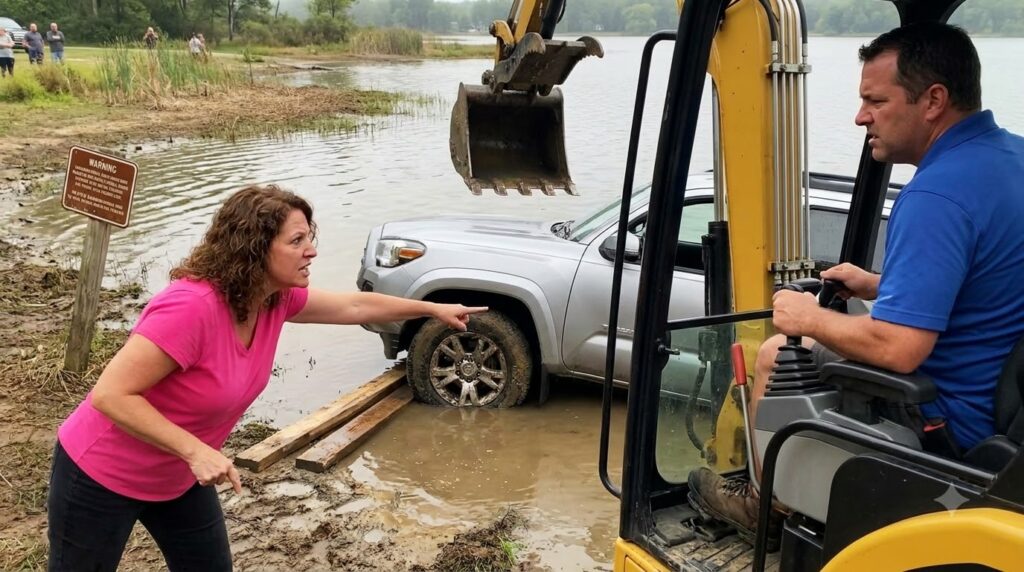
Jesse Vance kept his right hand resting flat against the boom lever, feeling the tremor of the hydraulics through his palm. Ten feet ahead, where the gravel boat ramp melted into the murky water of Lake Oconee, the nose of a silver SUV sat buried to its bumper. The lake was rising, brown ripples lapping against the lower rim of the front wheel well.

“Get that machine away from my car, you’re making this worse!”

The voice was sharp enough to slice through the idle of the engine. Jesse didn’t flinch. He looked down through the cab’s side window.

Brenda Hollings stood ankle-deep in the mud, her bright pink top a harsh stain against the dull gray of the washed-out shoreline. Her shoulder-length brown curls were damp from the mist, but her posture was stiff as rebar. She leaned forward, one arm extended toward the excavator’s steel bucket hovering six feet above the water, her index finger jabbed like a weapon.

Jesse lowered the throttle a notch. The engine dropped to a low, throaty hum.

“Step back, I’m getting the car out,” Jesse said. His voice was flat, carrying the mechanical calm of a man who had spent twenty years moving dirt for County Public Works.

“You touched it!” Brenda shouted, chopping her hand down toward the waterlogged front tire. “I saw you! You brought that bucket down and pushed the frame into the silt! You’re destroying my vehicle, Jesse, and the county is going to pay for every square inch of bodywork!”

Jesse didn’t answer right away. He reached across the console, grabbed two heavy, creosote-soaked wooden wheel braces from the footwell, and pushed open the cab door. The humid heat hit him like a wet blanket, thick with the smell of overturned earth and rotting algae. His dark work sneakers sank two inches into the clay as his feet touched the ground, but his grip on the timber blocks remained solid.

Across the mud, three park visitors who had been forced off the upper trail stood near the rusted, half-buried restricted-equipment sign. They watched in silence, their phones raised, capturing the confrontation.

Jesse waded directly toward the submerged front tire, ignoring Brenda as she stepped into his path, her face flushed red with rage.

“Did you hear me?” she demanded, her voice rising an octave. “Don’t you touch that wheel!”

Jesse leaned down, the weight of the creosote timber heavy in his arms. He wedged the first brace deep into the mud right behind the rubber tread, feeling the tire bite against the wood. He set the second brace on the outer flank, locking the wheel against the undertow of the lake.

He stood up, wiping a streak of grease from his palm onto his khaki shorts. He looked Brenda squarely in the eyes. Her breath came in short, ragged gasps, her hand still trembling as she pointed toward the road where the flashing strobe of a sheriff’s cruiser cut through the tree line.

“I didn’t touch your bumper, Brenda,” Jesse said softly, his voice dropping into the quiet space between the lap of the water and the idle of the machine. “And you know it.”

Brenda pulled a folded, water-stained piece of paper from her dark pants pocket, her fingers digging into the paper until the edges tore. “We’ll see what Deputy Miller has to say about who owns this bank.”


CHAPTER 2: THE LINE IN THE SINKHOLE

The paper tore with a sound like wet silk. Brenda didn’t seem to notice. Her thumb pressed hard against the rip, pinning the yellowed, water-stained page against her hip while the strobe of Deputy Miller’s cruiser painted her face in rhythmic flashes of blue and red.

Jesse didn’t look up at the cruiser. He kept his weight low, centered on the balls of his dark work sneakers, feeling the churned mud creep over the eyelets. The lake was moving faster now. A small wave, kicked up by a passing bass boat out in the main channel, slapped the silver SUV’s rear bumper and sent a muddy film skimming over the wooden wheel braces he had just set.

The creosote timber held, but the ground beneath it was liquefying.

“You’re wasting time, Brenda,” Jesse said. He wiped his forearm across his forehead, leaving a dark smudge of clay near his hairline. “That front axle is setting into the silt. Five more minutes of wave action and I won’t be able to get a strap under the lower control arm without tearing your steering rack out.”

“Let it tear,” she snapped, stepping closer until the toe of her leather shoe was inches from the track of the CAT 320. “You don’t touch a frame rail until Miller sees this document. This isn’t county land. It never was. My father paid the county surveyor in eighty-four to record the boundary line forty feet past that warning sign. The water line belongs to the Hollings estate.”

Jesse looked past her shoulder toward the tree line. In the brush, half-choked by wild blackberry vines and rotted pine needles, sat a square post. It was split down the middle, bleached gray by thirty years of Georgia sun, but near the base, a small aluminum tag remained wired to the wood. It was caked in rust and lichen, the notched edge bent inward as if someone had struck it with an axe blade decades ago.

He knew that tag. Every contractor who worked the eastern shore of Oconee knew it. It was a corner marker, but it wasn’t a county boundary.

“Your father paid for a plat map, Brenda,” Jesse said quietly, his voice grinding like gravel under a tread. “He didn’t pay for the dirt.”

Deputy Miller’s car door slammed shut up on the gravel turnout. The heavy crunch of boots on loose stone signaled his approach before his silhouette cleared the pine branches. Miller was a tall man, his uniform shirt stiff with starch despite the thick, heavy humidity hanging off the water. He held a long flashlight in one hand, though the late afternoon sun was still high enough to make the mud glare like wet lead.

“Jesse,” Miller nodded, stopping short of the mud line where the ground turned soft. He looked from the yellow excavator idling on the bank down to the silver SUV, then to Brenda. “Mrs. Hollings. Dispatch said we had an unauthorized operator obstructing private property.”

“He’s trespassing, Thomas,” Brenda said immediately, her voice taking on the sharp, practiced cadence of someone used to giving orders at town hall meetings. She thrust the torn document toward Miller’s chest. “He drove heavy machinery onto my private shoreline access without a permit. He’s already damaged the front air dam, and now he’s trying to winch it into deeper water to hide the structural impact.”

Miller took the paper by the dry edge, his eyes scanning the faded ink while his flashlight beam flickered uselessly against the paper in the daylight. He frowned, his brow furrowing over the bridge of his nose.

Jesse didn’t wait for Miller to finish reading. He turned back to the excavator, taking two heavy, sucking steps through the clay toward the cab’s steel ladder.

“Jesse, hold up a second,” Miller called out, holding up a flat palm. “Let me look at this plat before you drop the bucket again.”

“Look at it all you want, Deputy,” Jesse said, his hand gripping the cold, grease-slicked steel of the handrail. He paused, his boot resting on the bottom step, feeling the vibrations of the idling diesel engine travel through his bones. “But while you’re reading, the undertow is pulling two hundred pounds of silt under her oil pan. You tell me to stop, I stop. But when that car rolls into four feet of lake water, it’s on your log, not mine.”

“He’s threatening us!” Brenda shouted, turning toward the three bystanders on the bank who were still holding up their phones, recording every breath. “You hear that? He’s refusing to halt operations!”

Miller shifted his weight, his boots sinking an inch into the shoulder. He looked at the paper, then down at the water lapping against the SUV’s tires, then back at Jesse. The deputy was trapped between the legal weight of a stamped document and the physical reality of two tons of steel sliding into a lake.

“Jesse,” Miller said, his tone dropping into a guarded, transactional hum. “What’s holding the front end right now?”

“Two timber blocks,” Jesse replied, pointing down at the water. “And my track on the upper bank. But the bank is sloughing off. If I don’t set the winch line now, the braces are going to float.”

Brenda stepped directly between Jesse and the excavator ladder, her pink shirt practically touching the iron grousers. “Touch that lever again, Vance, and I’ll have the sheriff’s department seize this rig before sunset.”

Jesse looked down at her. He didn’t raise his voice. He didn’t move his hand from the rail. He simply reached into his back pocket, pulled out his heavy leather work gloves, and began pulling them on, finger by finger, feeling the stiff leather conform to his knuckles.

“The rig belongs to the county under Emergency Order 402, Brenda,” Jesse said. “And if you don’t move your feet off my track path in three seconds, Deputy Miller isn’t going to be reading your paper—he’s going to be pulling you out of the mud.”

CHAPTER 3: THE FRICTION OF STANDING STILL

Brenda didn’t retreat. Her dark shoe soles remained wedged against the iron cleat of the excavator’s left track, though the vibration of the idling diesel engine shook the mud around her ankles into liquid ripples.

“Move your feet, Brenda,” Jesse repeated, his voice low, almost drowned out by the metallic clatter of the hydraulic pump.

She held her ground, her pink top dampening under the humid spray rising off the lake, but her chin tilted upward with cold defiance. “Deputy Miller, you are witnessing an officer of the county permitting an assault with heavy machinery!”

Miller didn’t raise his voice. He took three deliberate, heavy strides down the embankment, his boots making a wet, tearing sound as they broke through the top crust of red clay. He reached out and caught Brenda firmly by the elbow. “Step off the track, Mrs. Hollings. Right now.”

“Don’t touch me, Thomas!” she spat, but Miller’s grip was unyielding. He leveraged his weight backward, pulling her three feet clear of the steel grousers onto the upper bench of solid gravel.

Jesse didn’t waste a second. The instant her toes cleared the steel, he hauled himself up the three rungs of the cab ladder. He swung into the vinyl seat, pulled the cab door shut to cut the worst of the roar, and grabbed the twin control levers.

Inside the glass box, the smell of warm hydraulic fluid and stale tobacco filled his lungs. Through the front pane, he watched the water line. A five-inch surge from a passing ski boat rolled into the cove, slapping hard against the silver SUV’s tailgate. The rear tires bobbed slightly—just half an inch—but it was enough to shift the weight forward. The front bumper dipped lower into the brown silt, forcing the two creosote wheel braces deeper into the muck.

Jesse eased the left pedal forward. The CAT 320 pivoted on its axis with a heavy, grinding groan, steel tracks tearing two fresh trenches into the access road gravel. He boomed down, lowering the heavy steel bucket until the tooth bar rested four inches above the mud, creating a physical shield between the incoming lake swells and the submerged front tire.

Outside, Miller was holding Brenda’s torn document against the flat hood of his cruiser. He flattened the creased pages with the back of his hand, his thumb tracing the blue ink signature at the bottom.

Jesse opened the cab window three inches. “Miller! Check the county stamp on the margin!”

Brenda stepped forward again, though Miller kept one arm outstretched to bar her path. “That stamp was notarized by the Clerk of Superior Court in eighty-four!” she yelled up at the cab. “It gives the Hollings estate exclusive riparian rights to this entire drainage cove! The county road ends at the pine line!”

Jesse rested his wrist on the throttle lever. “Look at the seal number, Deputy. It’s an eighty-four plat, but it’s stamped over an older county reference number. Read the top left corner.”

Miller squinted, bringing his flashlight beam down within two inches of the paper. His finger stopped on a faint, raised brass seal that had embossed a series of tiny numbers through the dry fiber. He muttered something under his breath, then looked up at Brenda, his eyes narrowing.

“This document references a 1978 survey, Brenda,” Miller said, his voice flat.

“Because my father incorporated the seventy-eight boundary map when he filed for the extension!” Brenda countered immediately, her hands trembling as she smoothed her curly hair away from her damp forehead. “It’s a linear progression of title! You can’t invalidate a forty-year-old property line because a storm washed out some gravel!”

“I’m not invalidating anything,” Miller said, his tone shifting into something cooler, more official. “But this ninety-degree offset on your eastern boundary—the part that covers this ramp—is marked as a conditional right-of-way. It lists a prior restriction.”

“What restriction?” she demanded, reaching for the paper.

Miller didn’t hand it back. He folded it carefully along the tear line and slipped it into his breast pocket. “The kind that means I’m not stopping Jesse Vance from pulling that car out of the channel.”

A murmur drifted down from the upper bank. The three park visitors had stepped closer to the wooden guardrail, their phones still raised, capturing the exchange. One of them, an older man in a yellow rain poncho, called out, “Water’s coming over the hood line, buddy! You better hook it now!”

Jesse glanced down through the side pane. The lake had crept another two inches up the silver wheel well. The engine compartment was taking on water; he could see a thin, iridescent film of motor oil beginning to rainbow across the surface of the brown lake water near the front bumper.

“Miller,” Jesse called out, his voice cutting through the rising wind off the lake. “I need you to secure the winch cable to her rear recovery eye while I hold the front frame with the bucket. If I leave the cab to set the hook, the bank shifts and the whole rig slides.”

Brenda turned on Miller, her eyes wide with frantic intensity. “If you attach a county cable to my vehicle without my consent, I will file a formal complaint with the district attorney by eight o’clock tomorrow morning!”

Miller looked at the oil slick spreading across the water, then at the three onlookers recording his response, and finally up at Jesse in the cab. He unclipped his heavy leather work gloves from his belt loop.

“Hand me the strap, Jesse,” Miller said softly.

CHAPTER 4: THE TENSION ON THE WIRE

“You step into that water, Thomas, and you’re signing your own termination!” Brenda’s voice screeched, raw and cracking against the roar of the diesel engine. She made a desperate grab for Miller’s forearm, her manicured nails digging directly into the dark wool of his uniform sleeve.

Miller didn’t even look back at her. He pulled his arm straight through her grip with an efficient, practiced twist of his elbow, leaving a thin thread hanging loose from his cuff. He reached up toward the excavator cab.

Jesse reached through the open window, his heavy leather glove holding the coiled end of the two-inch polyester recovery strap. The webbing was stained dark with old hydraulic oil, stiffened by years of red dust and lake grit, but the alloy master-link at the end gleamed dull gray in the fading sunlight.

“Hook the rear hitch receiver,” Jesse called down over the rattle of the pump. “Not the axle housing. If you anchor to the axle, the sway bar snaps when I lift.”

Miller took the strap, the weight of the steel shackle dragging his hands down. He turned toward the rising brown water, his polished leather boots splashing into the silt without hesitation. The clay sucked at his ankles, making a thick, hollow pop with every step as he waded three feet out to the rear bumper of the silver SUV.

“Stop him!” Brenda yelled toward the bank, turning frantically to face the three onlookers with their phones raised. “Is anyone recording this? He is trespassing on deeded private property! This man is assisting a rogue contractor in destroying my family’s shoreline!”

The older man in the yellow rain poncho didn’t lower his camera. “Lady,” he shouted back over the wind, “your tailpipes are bubbling water. If he don’t pull it now, you’re gonna be fishing that engine block out of the main channel by sunset!”

Jesse eased the boom down another half-inch, setting the steel bucket teeth firmly into the mud two inches from the front bumper. The hydraulic pressure gauge on his dash spiked into the yellow zone, the engine laboring as the tracks pressed six inches deep into the gravel bed to counter the weight.

Through the rear-view mirror of the cab, Jesse watched Miller drop to one knee in six inches of muddy water. The deputy reached blindly under the submerged rear bumper, feeling around the frame rails. The lake was moving faster now, waves lapping against Miller’s belt line, sending ripples of murky brown silt across his chest.

“I’ve got the frame loop!” Miller hollered, his voice straining against the suction of the mud. He slotted the alloy pin through the steel receiver, lining up the locking hole. He reached into his pocket, pulled out the notched steel cinch-pin Jesse had tossed him earlier, and drove it through the shackle with the heel of his palm. A sharp metallic clack echoed off the water. “Pin’s in! Set the tension!”

“Miller, don’t you dare!” Brenda screamed. She lunged down the bank, her feet sliding out from under her on the wet clay. She went down hard on her hip, her bright pink top plunging into the red mud, but she scrambled back up onto her knees, reaching blindly for the taut yellow strap dragging through the water.

Jesse saw her movement in the side mirror before anyone else did. “Miller! Get her back!”

Miller scrambled out of the water, grabbing Brenda by the belt line of her dark pants just as her fingers hovered two inches from the tensioned strap. “Mrs. Hollings, back up! If that line snaps under four tons of load, it will cut you in half!”

“It’s my land!” she wept, her voice breaking into a ragged sob as the mud coated her face and hair. She thrashed against Miller’s hold, her hands clutching at the wet earth. “My father built this launch! He filed the deed in eighty-four! He paid the county surveyor five thousand dollars to sign that paper!”

The words hung in the air, sudden and sharp, cutting clean through the mechanical rumble of the excavator.

Up on the bank, the crowd went dead silent. The man in the poncho slowed his recording, his eyes widening.

Jesse froze his hands on the levers. Slowly, he leaned his head out the cab window, looking down at Brenda as she lay on her side in the clay, her pink shirt ruined, her face smeared with red soil.

“He paid him?” Jesse asked, his voice dead quiet, carried effortlessly by the wind.

Brenda’s mouth snapped shut. Her eyes went wide as she realized what had just escaped her lips in front of three rolling cameras and a uniformed sheriff’s deputy.

Miller didn’t let go of her belt. His expression hardened into stone. He pulled his official notebook out from his dry breast pocket with his free hand, his eyes locked on her face. “You want to repeat that for the record, Brenda? Who did your father pay in 1984?”

“I… I meant for the survey fee,” she stammered, her voice shrinking, her previous arrogance vanishing into the wet gravel. “The filing fee. The county clerk.”

Jesse reached down and pulled the hand-throttle back to full RPM. The engine roared, the black exhaust puffing from the stack into the humid sky. He pulled the main hoist lever back toward his chest.

The steel winch cable snapped taut with a sound like a rifle shot. The yellow strap vibrated, spraying a fine curtain of lake water into the air as four tons of hydraulic tension bit into the submerged frame of the silver SUV. The front tires groaned, the two creosote wheel braces wedged in the mud snapping like toothpicks under the tremendous force.

The SUV didn’t budge. The mud had formed a vacuum around the undercarriage, sealing the vehicle to the lakebed.

The CAT 320’s tracks groaned, the front of the thirty-ton machine lifting two inches off the gravel as Jesse pushed the engine to its absolute limit. The hydraulic lines hummed, vibrating through the cab floorboards, through Jesse’s work boots, straight into his teeth.

“She’s stuck in the suction!” Miller yelled, holding Brenda back with one arm while shielding his face from the tensioned wire. “Jesse, it’s not breaking loose!”

Jesse slammed his boot down on the left track pedal, swinging the excavator’s counterweight three degrees to the right to change the pull angle. “It’s coming out!” Jesse shouted back, his jaw locked. “I’m not leaving two tons of scrap metal in a county waterway!”

With a loud, sickening THWACK, the mud released its grip. A huge bubble of trapped air and black marsh gas erupted to the surface of the lake, smelling of sulfur and rot. The silver SUV lurched backward out of the water, its front wheels dripping with gray muck as it slid four feet up the gravel ramp onto dry land.

Brenda stared at her dripping, mud-caked vehicle, her chest heaving, her hands trembling uncontrollably in the red dirt.

And then, as the SUV settled on the gravel, a heavy steel box bolted beneath the front bumper swung loose, its rusted hinges giving way under the strain of the pull. It hit the stones with a hollow clatter, spilling a stack of plastic-wrapped, water-logged documents directly onto the wet shore.

CHAPTER 5: THE UNRAVELING ON THE RAMP

The black steel box hit the wet river rock with a sound like a cracked anvil. Its bottom latch had rusted through, eaten away by road salt and lake water, and the impact popped the lid wide open.

A stack of plastic-sleeved papers skittered across the wet gravel, landing directly at Deputy Miller’s boots.

Brenda moved before the mud had even settled around her knees. She lunged forward, her fingernails tearing into the wet earth as she reached for the top document, but Miller’s boot stepped firmly down on the edge of the plastic sleeve, pinning it to the gravel.

“Don’t,” Miller said. His voice wasn’t loud, but it carried a weight that made Brenda freeze in the clay, her hands hovering two inches from his leather toe cap.

Jesse disengaged the excavator’s hydraulic winch, locking the main boom in place. He cut the throttle, and the engine’s deafening roar collapsed into a rhythmic, low-frequency idle that let the sound of lapping water take over the shoreline. He pushed open the cab door and stepped down into the mud, his dark work sneakers sinking into the churned clay as he walked toward the spilled papers.

Up on the bank, the three onlookers leaned over the timber guardrail, their phone cameras pointed straight down at the gravel ramp.

“Is that the deed?” the man in the yellow poncho called down, his voice cutting through the humid air. “Is that what she was talking about?”

Miller didn’t answer. He bent down, keeping one hand resting casually on the butt of his sidearm, and scooped up the top three plastic envelopes with his gloved fingers. Moisture had seeped into the edges, fogging the interior plastic, but the bold black letterhead at the top of the first page was still readable through the water droplets.

U.S. ARMY CORPS OF ENGINEERS – SAVANNAH DISTRICT

OFFICIAL FLOOD-PLANE CONTROL MAP & EASEMENT RESTRICTIONS (1978)

Jesse stopped two feet away, wiping a streak of black grease off his palm onto his khaki shorts. He looked down over Miller’s shoulder at the blue-line topographic map sealed beneath the plastic.

“That’s not an eighty-four county plat, Miller,” Jesse said softly.

“No,” Miller agreed, his thumb wiping a smudge of algae off the date stamp at the bottom right corner. “It’s not.”

Brenda scrambled to her feet, her pink top covered in red clay, her face pale beneath the mud splatters. She clutched her torn copy of the 1984 land-grant document to her chest like a shield. “That’s private family correspondence! You have no warrant to search a locked vehicle box!”

“The box broke open when the frame cleared the water, Brenda,” Miller said, turning his head slowly to look at her. “And when a box mounted behind a front bumper drops onto a public right-of-way during an emergency extraction, it’s on the ground. It’s part of the scene.”

Miller flipped the top sleeve over. Beneath the Corps of Engineers map was a second document, typed on onion-skin paper that had turned yellow along the margins. The signature at the bottom was bold, written in dark blue fountain pen ink, bearing a red wax seal beside the name: H. R. Hollings, Sr.

Jesse’s eyes narrowed as he read the second line of the typed text. “Her father signed a federal flood-plane exclusion.”

“He signed a perpetual public access easement,” Miller corrected, his voice dropping into a razor-sharp register as he read the legal clause aloud. “‘In consideration of county road maintenance and federal dam overflow protections, the undersigned waives all future private enclosure, gate construction, or vehicle access restrictions below the ninety-foot contour line.'”

Miller looked up from the page, his eyes locking onto Brenda.

“Your father didn’t buy the shoreline in eighty-four, Brenda,” Miller said, the words falling heavily between them. “He sold the access rights to the federal government six years before he ever filed that county plat. He took thirty thousand dollars in seventy-eight to guarantee this boat launch stayed open to the public forever.”

Brenda’s mouth worked silently. The color had drained completely from her lips. “He… he had a private agreement with the commissioner. They promised the lower lane wouldn’t be enforced if we maintained the gravel—”

“A county commissioner can’t override a federal flood easement, Brenda,” Jesse interrupted, his voice flat as a iron bar. He gestured toward the silver SUV sitting dripping on the upper ramp. “You knew that land-grant paper you’ve been waving at tourists for twenty years was worthless the day it was printed. You put that box under your bumper so nobody in the county clerk’s office would ever pull the seventy-eight record.”

“You don’t understand!” Brenda yelled, her voice pitching into a desperate, jagged scream as she took a step toward Jesse. “The county ruined the drainage when they built the upper road! The water washes out my lawn every spring! If I don’t control who parks down here, the whole bank collapses into my foundation!”

“Then you talk to the county engineer,” Jesse said, taking a step back toward his machine. “You don’t block an emergency extraction crew, and you don’t blame a contractor for pulling a car out of a ditch you drove it into.”

Miller pulled his radio off his shoulder strap and clicked the side button. “Dispatch, this is Unit Four. I need a county transport and a heavy flatbed at the Oconee lower launch. I have a vehicle obstruction, a violation of Emergency Order 402, and a contested property boundary involving a seventy-eight federal easement.”

“Unit Four,” the speaker crackled back. “Deputy, do you require additional units for crowd control?”

Miller looked up at the three visitors on the bank, then down at Brenda, who had sunk onto the rear bumper of her ruined SUV, her head in her muddy hands.

“Negative, Dispatch,” Miller said, his eyes meeting Jesse’s as the contractor climbed back up the steel ladder to the excavator cab. “The situation on the ramp is under control.”

CHAPTER 6: THE CRACK IN THE LEVEE

The click of Miller’s radio microphone cutting off was instantly swallowed by a sudden, sharp crack from the treeline.

Jesse’s boots froze on the second rung of the cab ladder. He swung his torso around, his eyes locking on the high bank where the ancient, storm-damaged loblolly pine leaned out over the gravel access lane. Its root ball, loosened by three days of torrential runoff and the heavy vibration of thirty tons of steel tracks, was shifting.

Red clay crumbled in a steady, thick curtain from the embankment, raining down over the rear roofline of Deputy Miller’s parked cruiser.

“Miller! Clear the lane!” Jesse hollered, dropping his weight back down to the mud in a single fluid leap.

Miller didn’t hesitate. He grabbed Brenda by the back of her muddy shirt collar, hauling her bodily off the SUV’s bumper just as a three-inch thick pine root snapped with the sound of a pistol shot. Clay and shale tumbled down the slope, burying the rear tires of the cruiser beneath a foot of wet earth.

Up on the timber guardrail, the onlookers scrambled backward, their phones wobbling wildly as the ground beneath the upper fence line gave way another two inches.

“The whole bank is sloughing!” the man in the poncho yelled, his voice cracking with sudden panic. “The road’s washing out!”

Brenda thrashed against Miller’s grip, her eyes wide, staring up at the sliding slope with a look that wasn’t anger anymore—it was pure, unadulterated dread. “The retaining wall… the drainage pipe under my driveway! If that slope drops, the whole culvert goes into the lake!”

Jesse didn’t listen to her panic. He moved with cold, mechanical speed, sprinting through six inches of slurry toward the excavator cab. The CAT 320 wasn’t just a tow rig anymore; it was the only thirty-ton anchor sitting between the eroding hillside and the main channel.

He hauled himself into the vinyl seat, slammed the cab door shut against the shower of dirt hitting the glass, and shoved both track levers forward. The steel grousers bit deep into the gravel bed, grinding against the bedrock below as he walked the machine six feet up the incline, angling the heavy steel tracks directly against the toe of the sliding bank.

He dropped the boom hard. The bucket’s five forged steel teeth slammed into the shifting clay at the base of the pine, digging four feet deep into the root structure. The hydraulic lines screamed under the sudden spike in pressure, the engine belching a thick plume of black diesel exhaust straight into the humid air, but the slide stopped.

The earth held.

Inside the cab, Jesse wiped a bead of sweat from his eyebrow with the back of his leather glove. His hands stayed glued to the twin joysticks, feeling every micro-fracture in the soil travel up through the boom hydraulics into his palms. Through the front windshield, he looked down at the exposed root ball.

Wedged directly beneath the main taproot of the falling pine, scraped raw by the excavator’s steel bucket teeth, was an old iron surveyor’s pin. It wasn’t the aluminum county tag from 1984, nor was it the rusted wire post in the brush.

It was a heavy, square-headed steel rod painted in faded federal yellow, stamped with a deep, hand-chiseled seal: U.S.ACE – BOUNDARY 1978.

It sat six feet behind Brenda’s fence line, buried right in the middle of what she had spent twenty years claiming was her private front lawn.

Miller had dragged Brenda clear to the far side of the road, shielding her behind the front fender of his cruiser. He looked up at the excavator’s bucket holding the hillside in place, then down at the yellow steel pin sticking out of the torn earth like a buried monument.

“Look at the pin, Thomas!” Jesse shouted through his open side window, his voice raspy over the idle of the engine. “Look where the Corps set the corner!”

Miller stepped forward, his flashlight beam pinning the yellow steel rod against the dark red clay. He reached down, cleared a clump of wet root fiber from the top of the pin, and ran his thumb over the chiseled numbers.

“Seventy-eight,” Miller called back, his voice grim. “The federal line doesn’t just cover the boat ramp, Jesse. It takes in her entire driveway apron and the culvert.”

Brenda sat in the mud against the cruiser’s tire, her pink top torn, her hands trembling so violently she couldn’t pull her wet hair out of her eyes. The 1984 paper she had fought so hard to defend lay soaked and ruined in the gravel at her feet, its blue ink running into the brown water of Lake Oconee.

She didn’t speak. She didn’t scream. She simply watched as the weight of thirty years of deliberate lies collapsed under the steel bucket of a county excavator.

Up on the road, the air horn of the arriving county heavy-flatbed echoed through the pines, signaling the end of the standoff.

Jesse didn’t relax his grip on the levers. He kept his eyes fixed on the yellow pin in the clay, holding thirty tons of hydraulic pressure against the bank, waiting for the public works crew to set the shoring timbers.

The shoreline belonged to the public. And as long as the engine ran, the line was going to hold.

CHAPTER 7: THE PROOF IN THE DIRT

The hiss of air brakes echoed down through the pine canopy as the county lowboy transport pulled onto the upper shoulder, its yellow strobes painting the wet foliage in sweeping arcs of amber light.

Jesse kept his left foot pinned on the swing pedal, maintaining five hundred pounds of hydraulic pressure against the pine’s root ball. Through the cab’s front windshield, he watched Deputy Miller stride toward his cruiser, grab the official laptop from its dash mount, and walk back down the mud slide toward the excavator.

Miller didn’t look at Brenda. She sat motionless on the gravel, her hands wrapped around her shins, her wet pink shirt clinging to her shoulders like a rag as two public works crew members set orange traffic cones around her ruined SUV.

“Jesse,” Miller called up, stepping over the yellow steel Corps pin sticking out of the red clay. “I need your digital log before the county flatbed hooks her winch.”

Jesse reached down to the dash bracket, unclipped his ruggedized county tablet, and slid the side door open three inches to hand it down. His palm was calloused and stained black with grease, the screen smudged with dried red clay, but the green LED charging light blinked steady.

“File 08-04,” Jesse said, his voice gravelly from the diesel fumes. “Automatic cab camera logged my arrival at four-twelve p.m. GPS is locked to six decimal places.”

Miller tapped the glass with his gloved thumb. The tablet’s screen flickered, casting a sharp blue glow across the deputy’s face. A high-resolution, wide-angle photograph loaded instantly.

The image showed the shoreline at four-twelve p.m., ten minutes before Jesse ever touched a hydraulic control. In the photo, the yellow excavator was still sitting on the upper lowboy trailer. The silver SUV was already nose-down in the murky brown water, its front bumper submerged to the fog lights, two feet past the rusted, half-buried county warning sign. Standing right beside the driver’s door, holding a pair of muddy rubber floor mats she had tried to wedge under the spinning tires, was Brenda Hollings.

Miller tapped the screen again, pulling up the embedded metadata overlay.

“Timestamp: 16:12:04,” Miller read aloud, his voice amplified by the quiet stillness that had settled over the cove. “Vehicle elevation: three hundred and forty-one feet above sea level. Two feet below the federal easement line.”

He turned the tablet screen toward Brenda. She didn’t look up, but her shoulders collapsed another inch into the mud.

“You told dispatch the contractor drove his tracks onto your bumper and shoved your car into the lake, Brenda,” Miller said, his tone devoid of anger, carrying only the dry, administrative finality of a law enforcement officer closing an incident report. “Your own vehicle’s position was recorded by automated county telemetry before Jesse Vance ever unchained his bucket.”

Up on the timber guardrail, the man in the yellow poncho lowered his phone. “She tried to pin a insurance fraud on the county worker,” he muttered to the woman standing next to him. “Whole thing was a setup to cover her own bad driving.”

“It wasn’t just the car,” Jesse said, looking down from the cab. “She wanted the excavator off the ramp because she knew if I dug two feet into that bank to set shoring timbers, I’d hit her father’s seventy-eight boundary pin. Once that pin came out of the dirt, the whole eighty-four deed story was dead.”

Miller closed the digital file on the tablet and handed it back up to Jesse. He reached into his belt pouch, pulled out a thick yellow citation book, and began writing in deliberate, measured strokes. The scratch of his ballpoint pen against the carbon paper was the only sound along the water’s edge besides the quiet idle of the CAT 320.

“Brenda Hollings,” Miller said as he tore the top carbon copy from the pad. “You’re being cited under County Code 402 for obstructing emergency operations during a declared flood event, filing a false report to law enforcement, and unauthorized encroachment on a federal public waterway.”

He offered the paper to her. Brenda didn’t reach for it. Miller leaned down and placed the yellow slip gently on her knees, right on top of her mud-soaked, ruined top.

“The county flatbed is taking your vehicle to the impound lot in Eatonton,” Miller added, stepping back toward his cruiser. “If you want it back, you’ll need to present proof of insurance and clear the obstruction fines with the magistrate on Monday morning.”

The two public works crewmen stepped past her, hooking the flatbed’s heavy steel cable to the SUV’s rear recovery loop. With a high-pitched metallic whine, the winch began to reel the silver vehicle up the gravel ramp, pulling it cleanly away from the shoreline once and for all.

Jesse pulled the boom lever back, easing the bucket out of the clay as the crew slid a three-ton concrete retaining block into the gap at the base of the pine. The bank held firm. The mud stopped sliding.

Jesse wiped his hands on his gloves, cut the excavator’s engine, and finally stepped down onto dry ground.

CHAPTER 8: THE SHORELINE HOLDS

The silence that settled over the cove as the CAT 320’s engine died was heavy, thick with the smell of hot iron, wet clay, and cooling diesel exhaust.

Jesse didn’t move away from the machine right away. He stood by the steel track, his dark work sneakers planted on the crushed stone, watching the winched SUV disappear over the crest of the access road behind the county lowboy. The amber strobes reflected off the pines one last time before fading into the dusk, leaving only the steady, rhythmic lap of Lake Oconee against the newly shored mud bank.

Ten feet away, Brenda Hollings remained on the low concrete curb near her driveway apron. Her hands rested limp in her lap, her mud-streaked pink top drying into a crusty red shell in the cooling evening breeze. She stared at the yellow slip of paper Deputy Miller had left on her knees, her shoulders slumped, the sharp, entitlement-driven posture completely drained out of her frame.

Deputy Miller closed the trunk of his cruiser with a solid metallic latch. He walked over to where Jesse stood, stepping around the three-ton concrete retaining block that now pinned the base of the pine slope.

“Flatbed’s taking her vehicle straight to the impound in Eatonton,” Miller said, taking off his hat and wiping his brow with the back of his wrist. “County road crew’s dropping two loads of surge stone at the top of the ramp to seal the upper approach until Monday morning.”

Jesse nodded slowly, his thumb rubbing a spot of dried grease off the cuff of his leather glove. “And the seventy-eight survey pin?”

“Staying right where your bucket uncovered it,” Miller replied, pointing his flashlight down at the yellow steel rod embedded in the red clay. “I notified the public works director on my radio. County surveyor will be out at dawn to stake the entire easement line from the bridge to the state park boundary. Nobody’s putting up private gates down here again.”

Brenda stirred slightly at the sound of Miller’s voice, looking up through tangled hair. Her voice was raspy, stripped of its loud authority. “My grandfather cleared this timber in fifty-two, Thomas. You know what this shoreline used to look like before the dam went in.”

Jesse turned his head toward her. His voice was quiet, lacking malice, carrying only the weight of twenty years on heavy equipment. “Your grandfather cleared timber on land he was paid for, Brenda. The water doesn’t care who cleared the trees. The county line is where the survey pin sits.”

She didn’t argue. She pushed herself up off the concrete curb, her mud-caked shoes making a heavy scraping sound on the gravel, and began the long, slow walk up her driveway toward her house, leaving the torn 1984 paper fluttering in the mud behind her.

Up on the timber guardrail, the three park visitors began heading back toward their truck. The man in the yellow poncho paused, looking down at Jesse. “Good job with that bucket, pal,” he called out. “Would’ve hated to see that ramp closed all weekend.”

Jesse offered a short, single-nod gesture, but didn’t speak. He reached up, grabbed the cab door frame, and hauled himself back onto the bottom step to perform his end-of-shift walkaround. He checked the track tension, inspected the main boom cylinders for hydraulic weeping, and unhooked the heavy safety chains from the rear frame.

Miller walked over to his cruiser, opening the driver’s door. “Need a ride up to the main shop, Jesse? Or are you staging the rig here overnight?”

“I’m staying until the stone truck drops the gravel,” Jesse said, taking a shop rag from his back pocket and wiping down the bucket teeth. “Got to make sure the grade is level before the morning tide rolls in.”

“Fair enough,” Miller said, turning his key in the ignition. The cruiser’s engine purred to life, its headlights cutting a long, bright beam through the lingering mist along the access lane. “See you at the depot, Vance.”

“Take it easy, Deputy.”

Jesse watched the cruiser’s red taillights climb the hill and disappear beyond the tree line. Left alone on the bank, the only sound was the steady hum of the lake against the fresh stone and the cooling ping of the excavator’s exhaust manifold.

He walked over to the edge of the bank, where the rusted wire corner post sat half-buried in the wild blackberry vines. He reached down, grabbed the bent aluminum tag that Brenda’s father had wired to the wood forty years ago, and pulled it free with a sharp jerk. He tossed it into the back of his work truck alongside his grease gun and timber blocks.

He walked back to the water’s edge, stood on the fresh gravel ramp, and looked out over the dark, open water of the lake. The access road was open. The shoreline line was drawn. And the dirt was right where it belonged.

Similar Posts

Leave a Reply

Your email address will not be published. Required fields are marked *






