
The Cold Physics of Pressure, Aerosol Pigment, and the Collapse of False Authority
CHAPTER 1: THE COLD ANGLE OF A SHADOW
The steel edge of the sheet-metal ductwork bit into the calloused meat of my thumb through my leather work gloves. It was a familiar friction—a thousand psi of cold galvanized zinc refusing to sit flush until you forced it with a hand-seamer and a four-pound mallet.
I set the seamer back into the leather loop of my tool belt, the metal clinking sharply against a stubby screwdriver. The sun was sitting high over Oakridge Estates, baking the concrete driveway of 412 Birchwood Lane until the heat rose in clear, shivering waves off the expansion joints. It smelled like fresh wood mulch, baking asphalt, and the sharp, chemical bite of grey HVAC joint sealant curing on my knuckles.
Across the cul-de-sac, a front door closed with a dull, heavy thud.
I didn’t turn around right away. When you work service calls in neighborhoods where the lawns look like they were trimmed with nail scissors, you learn to read shadows before you look at faces. A dark figure moved past the manicured hydrangeas at 415—stiff-backed, rhythmic, heels clicking against the exposed aggregate walkway with the precise timing of a metronome.
I bent down to my gray-black fabric tote, picking up a pair of red-handled snips. When I straightened, she was standing at the edge of the property line.
Early sixties. A cream-colored pantsuit that looked like it had never seen a washing machine, held together by pearl earrings and a rigid posture that belonged to someone who measured her self-worth in property values. A heavy wooden clipboard rested under her left arm like a shielded weapon.
She didn’t speak. She just watched. Her eyes were hidden behind oversized black sunglasses, but the tight, drawn lines around her mouth told me everything I needed to know. She wasn’t looking at me like a technician doing an emergency central-air overhaul. She was looking at my service van like an infection on her pavement.
Beside my van sat a pristine silver luxury sedan. The metallic paint caught the midday glare, reflecting the quiet, dead-silent street back at her. The car belonged to a visiting medical consultant Dr. Sterling was hosting for the week—a guest who had arrived less than two hours ago and parked neatly within the concrete apron of the driveway.
I picked up my gauge manifold, the brass fittings heavy and cold in my palm. I calculatingly ignored the woman in cream, stepping back toward the side access path leading to the compressor unit behind the garage.
Let her measure the grass, I thought, slipping into the narrow shadow between the brick veneer and the air-handling unit. I have four hundred pounds of copper line to purge before three o’clock.
As I hooked the blue hose to the suction valve, a faint, pressurized clack echoed from the front of the house. It wasn’t the sound of my van door. It wasn’t the sound of the wind in the birch trees. It was the distinct, metallic rattle of a heavy mixing ball bouncing against the inner walls of an aerosol can.
My hand froze on the brass valve manifold.
The air blew across the side yard, carrying a sudden, unnatural scent above the baking asphalt and pine needle mulch—a heavy, volatile stench of industrial solvent and raw black pigment.
I set the brass manifold onto the concrete pad, stepped around the copper line set, and walked back toward the sunlight.
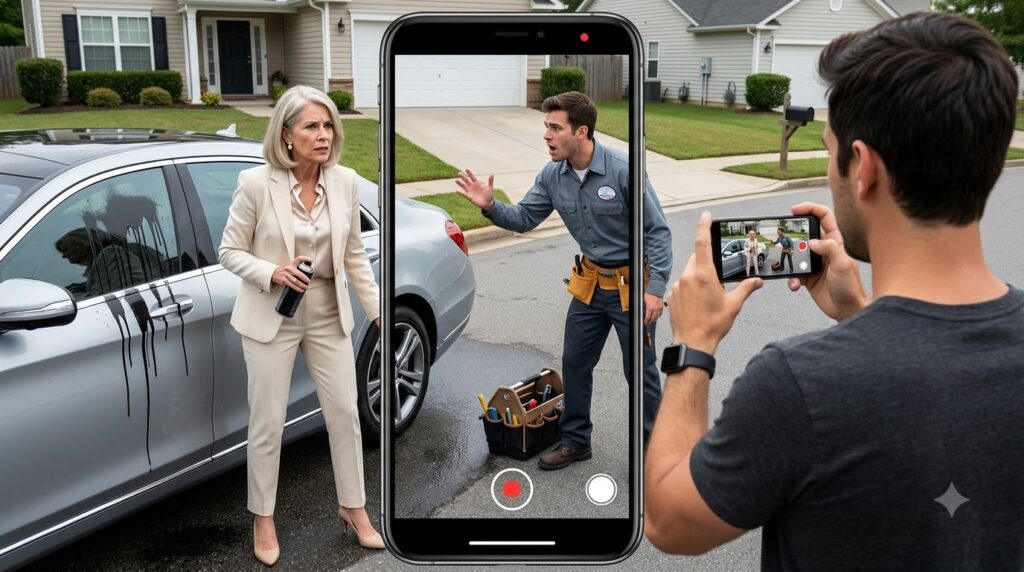
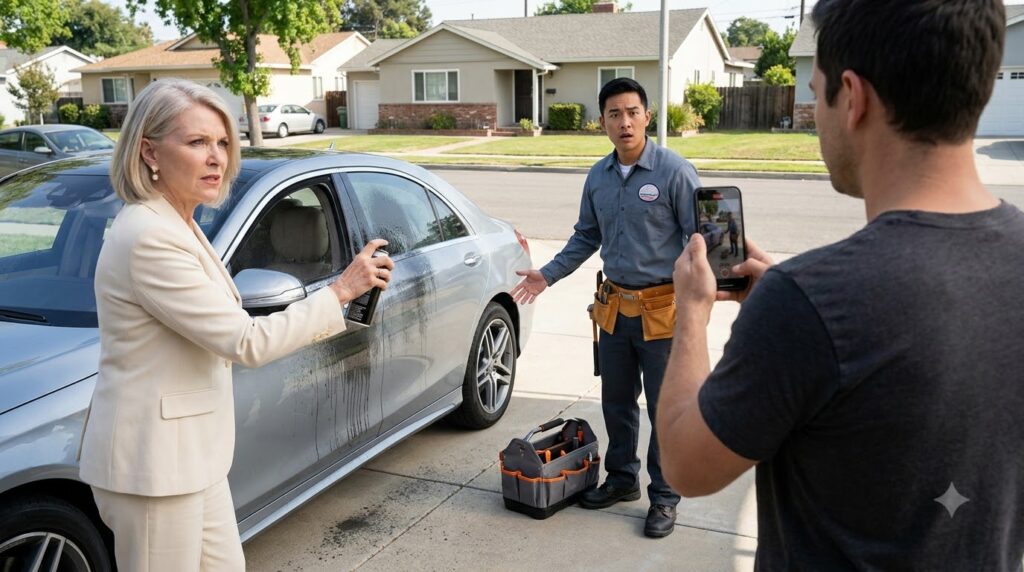
When I cleared the corner of the garage, she was standing three inches from the driver’s door of the silver sedan. Her clipboard was gone, tossed onto the grass. In her right hand, raised chest-high, was a black industrial spray can.
A thick, dark streak of wet paint was already spreading across the driver-side window, running down the polished chrome trim in heavy, glistening tears that pooled on the silver door handle.
“Ma’am, drop that can,” I said, stepping hard onto the driveway, my work boots striking the concrete like an anvil. “What are you doing to that car?”
Evelyn Prescott didn’t flinch. She slowly turned her head toward me, her thumb still planted firmly on the aerosol nozzle.
Across the asphalt, on the porch of 415, a screen door creaked open, and a man stepped out into the light, lifting a smartphone with both hands.

CHAPTER 2: THE WEIGHT OF A PERMIT
“Set the can down and step away,” I said. My voice didn’t carry anger—anger was a luxury that cost you leverage on a job site. It was low, flat, and weighted with the same calm precision I used when checking line pressure on a cracked manifold. “Set it down on the concrete, Mrs. Prescott.”
She didn’t move. Her cream-colored sleeve trembled, just a fraction of an inch, but her knuckles remained locked around the dark plastic spray cap. The wet black paint was already thickening in the heat, forming heavy, glossy droplets along the bottom edge of the silver sedan’s window frame. A single bead fell, landing with a faint, wet tock on the driveway’s exposed aggregate.
“You don’t command me on this street,” Evelyn said. Her tone was razor-thin, forged from decades of unchallenged authority in this cul-de-sac. “You are an unvetted vendor operating an oversized commercial rig in a residential zone without a posted waiver. This vehicle”—she jabbed a silver-manicured finger toward the stained glass—”has been parked in open violation of the aesthetic perimeter code since eight-thirty this morning.”
“It’s a private vehicle,” I said, taking half a step forward. I kept my hands open, palms facing her, well clear of the heavy iron seamer hanging from my leather belt. “Parked on a private driveway. On private land.”
“This entire development is governed by the Oakridge Covenant!” Her voice spiked, pitching up into the quiet afternoon. “Every square inch of visible frontage falls under board oversight! I am exercising emergency abatement protocols!”
Across the street, Ethan Reed didn’t say a word. He stood at the edge of his manicured turf, charcoal T-shirt dark against the bleached white siding of his house. His smartwatch glinted in the sun as he shifted his stance, both hands holding his phone perfectly level at chest height. The red recording indicator on his screen was a tiny, glowing pinprick against the glare.
Evelyn caught the glint of his screen out of the corner of her eye. Her jaw tightened, the muscles along her neck corded like dry rope.
“Ethan!” she called out, turning half an upper body toward him without dropping the aerosol can. “Put that device away! You are filming on private association easement without a media release! I will have you cited for harassment!”
“Keep recording, Ethan,” I said quietly, keeping my eyes locked on Evelyn’s right hand. “She’s holding the evidence.”
“This isn’t evidence, you arrogant little mechanic!” Evelyn snapped. Her composure was cracking, small fissures of panic showing through the heavy foundation and the oversized sunglasses. “This is a non-permanent marking compound! It’s a standard industrial indicator used by municipal code officers to log illegal obstructions!”
She reached into her cream pantsuit pocket with her left hand, her fingers fumbling against the silk lining before pulling out a folded piece of heavy ivory parchment. It wasn’t the standard yellow carbon-copy violation slip the HOA usually tacked to light poles. It was thick, deckle-edged paper, sealed at the corner with a dark red wax stamp that looked ancient and entirely out of place beside a can of industrial spray paint.
She shoved the paper toward my face, her arm shaking.
“Read it!” she spat. “Emergency Ordinance 4-B! Passed by the executive committee! It grants the board immediate physical authority to mark, tag, and impound any unflagged vehicle parked on property subject to an outstanding municipal lien or covenant breach!”
I didn’t reach for the paper. I didn’t need to. The wax stamp was pressed with an emblem I didn’t recognize—not the stylized oak leaf of the Oakridge Estates logo, but a heavy, geometric seal that looked like a bank crest.
“Dr. Sterling doesn’t have a municipal lien,” I said smoothly, running the math in my head. Dr. Clara Sterling was a chief pediatric surgeon. She paid her invoices before the ink dried on the work orders. “Her property taxes are cleared through the county auditor every January. I saw the title clearance when I pulled the mechanical permit at the township office yesterday morning.”
Evelyn’s breath hitched. For a fraction of a second, the sunglasses slipped down the bridge of her nose, revealing pale, bloodshot eyes rimmed with dark, exhaustion-heavy circles. She looked less like a suburban dictator and more like someone standing on the edge of a roof, calculating the distance to the pavement.
“The township doesn’t oversee internal association covenants!” she hissed, snatching the paper back and stuffing it deeper into her pocket. “The board operates under sovereign property covenants recorded in 1994! This home is under active review!”
“Then call the police,” I said. “Call the sheriff. Tell them you’re standing on Dr. Sterling’s concrete with a can of black enamel, enforcing a twenty-year-old covenant.”
“I don’t need to call the police,” she said, her voice dropping into a harsh, rasping whisper. “I am the authority here. And you are going to pack your tools, put your truck in reverse, and leave this driveway before I have your contractor’s license revoked by the county board.”
She shifted her footing, her beige heel catching on the lip of the concrete expansion joint. The aerosol can tilted, its nozzle aimed directly at the silver sedan’s side mirror.
I didn’t answer her with words. I took one slow, deliberate step into her line of sight, placing my body squarely between her and the car, blocking her arm with the broad, grey-blue bulk of my work shirt. The heat radiated off her cream suit—dry, perfume-heavy, and sour with cold sweat.
“The police are already coming, Mrs. Prescott,” Ethan’s voice carried clearly across the quiet asphalt from forty feet away. He hadn’t lowered his phone by an inch. “I called dispatch two minutes ago. They logged it as an active destruction of property in progress.”
Evelyn froze. The quiet of the cul-de-sac settled back over us, heavy and suffused with the sharp, toxic stench of wet paint drying under the August sun.
CHAPTER 3: THE PAPER BARRIER
“Two minutes,” Evelyn whispered. Her head pivoted toward the open mouth of the cul-de-sac, where the suburban silence hung heavy over heat-softened asphalt. “Two minutes until you realize how thoroughly out of your depth you are, mechanic.”
She didn’t drop the aerosol can, but she lowered it four inches, tucked tightly against the side seam of her cream-colored trousers. Her left hand snatched her wooden clipboard off the turf with a sharp, aluminum-edged snap. She clicked a silver pen twice—a fast, aggressive rhythm—and pressed a printed form against the board.
“This is an administrative hold,” she said, her voice flattening into the practiced drone of a courtroom clerk. “Under Article 7, Clause C of the Oakridge Covenants, any non-resident asset stationed on a private parcel during an active compliance audit is seized in place as collateral for uncollected municipal remediation fees.”
“You’re making up words, Mrs. Prescott,” I said. I stood my ground on the concrete, four feet from the driver’s side door of the ruined sedan, calculating the physical space between us. “There’s no municipal hold. I cleared this address with the township building department yesterday at seven-thirty in the morning. Permit M-8842. Signed by Inspector Vance.”
“The township has no jurisdiction over private residential trusts!” She slammed the clipboard down against her thigh, the hard masonite slapping against cream wool with the crack of a pistol shot. “This parcel is subject to a private master covenant recorded in 1994. Dr. Sterling owes fourteen thousand dollars in delinquent capital reserve assessments.”
I narrowed my eyes. Fourteen thousand dollars for a residential lot in a eighty-home development wasn’t a late fee—it was a foreclosure baseline.
“Dr. Sterling paid her annual HOA dues in January,” I said. “I saw the cleared check taped to her breaker box alongside the mechanical specs.”
“That was for maintenance,” Evelyn countered smoothly, her panic suddenly smoothing over into cold, practiced malice. “Not the emergency capital assessment levied by the executive board in June. She was served notice at her hospital office. She defaulted. Which means every vehicle parked on this pad is legally classified as abandoned commercial property.”
She reached into the side pocket of her leather binder to pull a yellow carbon-copy violation tag, and as she did, a heavy brass key slid out with the paper. It hit the concrete with a hard, ringing ping, tumbling twice before coming to rest near the toe of my work boot.
It wasn’t a standard house key or a mailbox tumbler key. It was long, double-bitted, and stamped with a five-digit serial number—the kind used exclusively for safe-deposit boxes or commercial ledger vaults.
Evelyn’s eyes went wide behind her dark lenses. She dropped to one knee with frantic, ungraceful haste, her beige heel twisting on the concrete edge as she snatched the brass key off the driveway. Her fingers dug into the dust, her nails scraping against the concrete so hard I heard the lacquer crack.
“Don’t look at that,” she hissed, jamming the key back into the dark velvet lining of her pocket before standing up, her chest heaving under the satin blouse. “Don’t you dare touch my personal property.”
“A safe-deposit key doesn’t look like HOA paperwork,” I said quietly, watching the pulse hammering in the hollow of her throat.
“It is association records!” she snapped, her knuckles turning chalk-white around the clipboard. “Confidential financial archives! Which you would know nothing about, considering you spend your life pulling grease out of ductwork!”
Across the street, Ethan Reed adjusted his grip on his phone, stepping off the curb and onto the blacktop. “She’s lying, Marcus,” he called out, his voice sharp and clear in the midday sun. “There was no emergency capital assessment in June. I’m on the neighborhood mailing list. The board hasn’t published a balance sheet since November.”
Evelyn turned on Ethan like a whip, her cream suit swirling. “You are in breach of your non-disclosure agreement, Mr. Reed! Every line of board correspondence is proprietary! One more word out of you and I will file an immediate injunction against your parcel!”
“Try it,” Ethan said, taking two deliberate steps across the double-yellow line, keeping the camera lens locked on her face. “The police car just turned off the main road.”
A low, distant warble of a siren echoed through the tree line at the edge of the development. Evelyn’s rigid spine stiffened, her chin coming up in a desperate, final attempt to hold the high ground.
“Let them come,” she said, her voice trembling with an icy, fragile conviction. “I have the paper. I have the covenant. And by the time the deputy reads this notice, this car will be towed, and your permit will be revoked.”
She didn’t run. She didn’t drop the spray can. She stood on the hot concrete beside the dripping black stain, holding her clipboard like a shield against the truth that was turning onto Birchwood Lane at forty miles an hour.
CHAPTER 4: THE THREAT OF TENSION
“A tow truck is already dispatched,” Evelyn said, her voice dropping into a tight, quiet frequency that barely carried past the front bumper of the silver sedan. She adjusted the heavy wooden clipboard, sliding a second sheet of paper to the top. “Private impoundment under Section 9 of the township municipal access act. You have ninety seconds to remove your service van, Mr. Vance, or your vehicle will be hooked right alongside this one.”
I didn’t step back. The heat off the hood of the luxury sedan radiated through my gray-blue work shirt, smelling faintly of hot oil, baked clearcoat, and the sharp, volatile chemical stink of black aerosol paint drying into a dull skin.
“Section 9 applies to public thoroughfares,” I said. My voice was measured, clipped, and completely stripped of pitch. I let my eyes ride down her posture—the rigid line of her jaw, the way her beige heels were pinned against the expansion seam of the concrete pad like she was trying to root herself to the land. “This apron is private residential real estate. Owned by Dr. Clara Sterling. The township line ends six inches past the curb.”
“The easement belongs to the association!” she shot back. She shoved the clipboard forward, the sharp aluminum corner missing my chest by three inches. “Look at the line! Look at the county plot map on page two! Every driveway in Oakridge Estates carries an unencumbered municipal utility and code access easement extending twenty feet from the road centerline!”
I reached out, my thick leather glove leaving a dusty smudge on the margin of her laminated paper as I held it steady in the glaring sunlight.
The paper wasn’t just an HOA violation slip. It was a printed county assessor map, overlaid with red ink lines that marched straight across Dr. Sterling’s front yard, slicing through the concrete apron and terminating right where the silver sedan was parked. But stamped across the bottom in dark blue ink was a case index number—a civil court filing mark from the County Court of Common Pleas.
My thumb ran across the cold, smooth laminate. “This isn’t a zoning easement,” I said softly, my eyes narrowing as I read the small print under the blue stamp. “This is an active foreclosure motion. Docket C-409. Filed four days ago.”
Evelyn’s thumb twitched on the frame of her board. A micro-flash of panic flickered in the tight muscles around her mouth before she pulled the board back against her chest like a shield.
“That is confidential board correspondence!” she hissed, her sunglasses slipping a fraction of an inch down her sweat-glistening nose. “It is a matter of record between the executive committee and the county sheriff’s civil division!”
“Dr. Sterling doesn’t have a civil judgment against her,” I said. I stepped closer, closing the distance until I could smell the sharp, metallic perfume clinging to her cream suit. “I checked the public land records when I pulled the mechanical permit for her new heat pump system yesterday morning. Her title is clean. Her tax parcel is unencumbered.”
“She’s four months behind on the capital reserve assessment!” Evelyn spat out the words, her voice rising into an unsteady, bird-like screech that echoed off the brick facade of 412 Birchwood. “The board issued an administrative lien in April! Under the 1994 master covenant, an unpaid assessment automatically converts to a priority land debt!”
“An administrative lien requires a judge’s signature,” Ethan Reed’s voice cut across the hot air. He had advanced to the middle of the cul-de-sac, his two-handed grip on his smartphone completely motionless. “And a certified notice delivered by registered mail. I work in legal compliance for a commercial bank, Mrs. Prescott. You can’t attach a priority lien through an HOA board vote without a public hearing.”
Evelyn didn’t turn around to face Ethan this time. She couldn’t. She was pinned between the front bumper of the ruined sedan, the weight of my presence blocking her exit path, and the approaching wail of the police cruiser as it turned the corner onto Birchwood Lane, its tires squealing against the hot pavement.
“I am the vice president of this association,” she whispered, her voice cracking under the pressure as her knuckles turned stark white against the wood of her clipboard. “I have maintained the integrity of this street for fourteen years. I will not let a surgeon and a grease-monkey tear down what we built.”
“You didn’t build this street, Mrs. Prescott,” I said, reaching into my tool belt and pulling out my brass air-line pressure gauge. The solid metal tool clicked against my palm with a heavy, lethal clarity. “You just live on it. And right now, you’re standing on private property holding the weapon you used to commit a felony.”
The white-and-black Ford Explorer patrol car swung into the cul-de-sac, its roof lights flashing silently against the blinding glare of the afternoon sun. The cruiser slowed, its tires crunching over the loose gravel near the gutter before turning its grill directly toward Dr. Sterling’s driveway, pinning all three of us in the stark, unblinking focus of law enforcement.
Evelyn stood frozen. The aerosol can dangled from her right hand, a single drop of black enamel clinging to the red plastic nozzle, ready to fall.
CHAPTER 5: THE BLACK DRIP ON SILVER
The cruiser’s engine idle rumbled through the soles of my work boots, a low, mechanical vibration that cut right through the mid-afternoon heat. Its roof lights cut short, leaving only the amber running lamps reflecting in the dark, fresh enamel streaked across the driver’s side of the silver sedan.
Evelyn didn’t move. Her posture remained rigid, but her shoulders had dropped half an inch, the crisp tailoring of her cream pantsuit suddenly looking pinched, tight around the neck. The black aerosol can stayed glued to her palm, her index finger resting on the nozzle like a trigger she couldn’t decide whether to pull again or abandon.
“Step back from the vehicle, ma’am,” I said. My voice was quiet, kept strictly within the four-foot gap between us. “Don’t make this harder on yourself than it already is.”
“I am standing on association easement,” she said, though the sharp edge in her voice had frayed into something thin and rasping. “I have full authority under the emergency ordinance. You are interfering with an active code enforcement action, Mr. Vance.”
“That’s not code enforcement,” I said, pointing down with my gloved hand toward the driver-side door.
The paint was still wet. Thick, tar-black rivulets were crawling down the polished clearcoat, pooling along the chrome trim of the door handle before dripping onto the concrete driveway. The chemical reek of the solvent was suffocating in the stagnant air—industrial-grade enamel, the kind used for iron fences and steel beams, formulated never to wash off without stripping the primer beneath it.
Across the street, Ethan Reed took three deliberate steps off the asphalt, stepping straight onto the edge of Dr. Sterling’s driveway. His smartphone remained perfectly level, the screen displaying a crisp, high-definition frame that locked both Evelyn’s face and the dripping door in two-hundred-and-forty-frame-per-second clarity.
“I have the entire approach on camera, Evelyn,” Ethan said. His tone wasn’t loud, but it carried the cold weight of a deposition. “From the moment you walked off your porch with the can hidden under your folder, to the exact second you pressed the nozzle against Dr. Thorne’s car. It’s all logged. Timestamped.”
Evelyn’s head snapped toward him, her sunglasses reflecting his shadow across the driveway. “You had no right to film across property lines! That footage is inadmissible!”
“It’s a public street,” Ethan replied smoothly. “And you’re standing on an open driveway in plain view of six houses.”
Her grip on the clipboard slipped. The wooden board tilted, and as she scrambled to catch it against her hip, the top sheet of paper shifted. Beneath the county assessor map I’d seen earlier lay a folded green ledger sheet—a dot-matrix bank printout with columns of handwritten red numbers running down the right margin. At the top of the sheet, stamped in red ink, were the words: SPECIAL EMERGENCY ASSESSMENT – CAPITAL RESERVE ACCOUNT 004.
I caught the top number before she slammed her hand over it: a negative balance of over ninety thousand dollars.
The realization settled in my chest like a cold piece of iron. The emergency ordinance wasn’t an aesthetic dispute. It wasn’t about a visiting doctor’s car or my service van blocking a sightline. The board’s accounts were empty, and she was using the authority of her position to manufacture immediate, unappealable fines against high-value properties to plug a hole in a ledger.
“You’re not enforcing a rule,” I said softly, the words cutting right through her remaining composure. “You’re trying to collect a debt that isn’t on the books.”
Evelyn’s mouth opened, but no sound came out. The rigid pretense of the neighborhood board member dissolved, leaving behind the stark, terrified eyes of someone whose sanctuary had just been stripped away in broad daylight.
“Set the can on the ground,” I repeated, stepping directly into her retreat path as the driver’s door of the police cruiser swung open behind us. “Right now.”
She froze, caught between the camera, the officer stepping onto the pavement, and the cold, unyielding reality of the black paint dripping onto the driveway at her feet.
CHAPTER 6: THE STALEMATE ON THE DRIVEWAY
Evelyn didn’t drop the aerosol can to the concrete. Her white-knuckled fingers remained locked around the dark cylinder, lowering it only three inches until the nozzle pointed harmlessly toward her own beige heel.
“Do not move, Mr. Vance,” she whispered, her voice rattling with a frantic, paper-thin authority. Her dark sunglasses hid her eyes, but the pale, bead-slick skin around her jaw showed every tremor of her pulse. “You are actively aiding a property code violation. The police officer will resolve this administrative matter the moment he steps on this apron.”
“He’s not a municipal code inspector, Evelyn,” I said, staying planted firmly on the heat-softened concrete between her and the driver’s door. My hands remained out, open and visible at chest height. “He’s a patrol deputy. And he’s looking at three square feet of fresh paint dripping onto a ninety-thousand-dollar automobile.”
“It is an indicator tag!” she snapped, her chest heaving beneath the satin blouse. She shoved her wooden clipboard under her arm, the masonite corner digging into her ribcage while her left hand scrambled inside her suit pocket. “Under Ordinance 4-B, the association retains full power of physical distraint on default parcels!”
“Ordinance 4-B was struck down by the county court two years ago,” Ethan Reed called out from the middle of the street. He didn’t lower his smartphone by a millimeter. The phone’s screen showed a bright, stabilized frame—the wet black streaks, the aerosol can held at her hip, and the dark blue cruiser coming to a stop at the foot of the driveway. “I have the docket judgment pulled up on my screen right now, Evelyn. You know as well as I do that the board never had distraint authority.”
Evelyn’s head jerked toward Ethan, her pearl earring swinging wildly. “You have no standing here, Mr. Reed! You are a third party committing unlawful surveillance on a private residential lot!”
“I’m standing on the public asphalt,” Ethan said smoothly. “And I’m documenting a felony in progress.”
The driver-side door of the Ford Explorer opened with a heavy, mechanical latch-click. Officer Miller stepped out onto the driveway. He was in his late thirties, built like an anvil, wearing a dark blue tactical uniform dusted with white road salt around the boots. His sunglasses were tucked into his bulletproof vest strap, and his grey eyes swept over the scene with the cold, practiced efficiency of a man who dealt with suburban squabbles every day of his life.
He didn’t pull his sidearm. He didn’t sprint. He walked up the slight incline of the driveway, his heavy utility belt creaking softly with every stride, his gaze fixing first on the black aerosol paint dripping from the luxury sedan’s chrome trim onto the concrete.
“Alright,” Miller said, his voice a flat, gravelly baritone that cut straight through the humid air. “Nobody move. Everyone keep their hands where I can see them.”
“Officer!” Evelyn blurted out instantly, stepping two inches past my shoulder toward the policeman, her voice pitching up into a shrill, rehearsed cadence. “Thank goodness you arrived. I am Evelyn Prescott, vice president of the Oakridge Estates Executive Committee. I caught this unvetted contractor performing illegal commercial work without a township waiver, and when I attempted to apply a temporary administrative tag to this unauthorized vehicle, he became physically aggressive and blocked my egress!”
Officer Miller didn’t look at her face. He looked down at her right hand.
The black industrial spray can was still held tightly in her fingers, the red plastic spray tip glistening with wet black enamel.
“Ma’am,” Miller said quietly, stopping four feet away. “Set the can on the hood of my cruiser.”
Evelyn blinked behind her dark lenses, her mouth opening and closing like a landed fish. “Officer, you don’t understand the statutory background—”
“I asked you once,” Miller interrupted, his tone dropping an octave into a hard, non-negotiable command. “Set the spray can on the hood of the patrol vehicle. Right now.”
A long, suffocating silence descended over the driveway. Across the street, two curtains twitched in a second-story window of 418 Birchwood. The heat hummed off the silver sedan’s roof, smelling of volatile solvent and hot metal.
Evelyn’s composure shattered completely. Her shoulders collapsed inward, the illusion of board authority evaporating in the blinding midday sun. Slowly, with stiff, trembling movements, she turned around and set the heavy black aerosol can onto the white steel hood of Officer Miller’s patrol car.
“Now,” Miller said, pulling a small pocket notepad and a black ballpoint pen from his vest. “Who owns this vehicle?”
“It belongs to Dr. Aris Thorne,” I answered, stepping forward so my contractor patch was clearly visible. “He’s a visiting medical consultant staying with Dr. Clara Sterling. I’m Marcus Vance, the HVAC contractor hired by Dr. Sterling to overhaul her mechanical system.”
Miller glanced at my dusty work boots, the tool belt hanging off my hip, and the open tool tote sitting by the garage access path. Then he looked at the black streak covering the silver sedan’s driver-side window.
“And Mrs. Prescott,” Miller said, turning his gaze back to the woman in cream. “Who authorized you to apply paint to Dr. Thorne’s automobile?”
“The board,” she whispered, her hands scrambling against the edge of her clipboard as if searching for a document that could save her. “The master covenant… Article 7…”
“There is no Article 7 that permits paint, Evelyn,” Ethan said, stepping up to the edge of the driveway and holding out his phone to Officer Miller. “Officer, I have three unedited minutes of video from the moment she walked across the street with the can until Mr. Vance stopped her. You can watch it right now.”
Miller looked at Ethan, then at the phone screen, then back to the frantic woman standing beside his cruiser. The trap had closed, tight and absolute.
CHAPTER 7: THE REVERSED COUNTER
“Nobody moves,” Officer Miller said again, his voice dropping into the quiet, absolute weight of an officer who had already sized up the crime scene.
He took two step-downs from the curb apron, his boots scuffing the concrete. He reached out with a gloved hand, holding the black aerosol can by its plastic rim, lifting it off his cruiser’s hood. He held it up to the midday light. A residual drop of wet black enamel fell from the tip, landing with a thick plink on his polished leather boot.
He didn’t flinch. He just looked at Evelyn Prescott.
“Mrs. Prescott,” Miller said, his gray eyes cold behind his brow. “You’re going to keep your hands rested against the fender of my car.”
“Officer, this is a civil misunderstanding!” Evelyn’s voice cracked, rising into a shrill, breathless pitch. She didn’t press her hands to the hood; instead, she hugged her wooden clipboard against her chest like a shield, her cream suit jacket creaking at the seams. “This contractor is trespassing! He’s operating a unauthorized heavy installation on a residential parcel! I was exercising a lawful administrative hold—”
Before she could finish her sentence, the low, smooth hum of an electric motor cut through the cul-de-sac.
A dark gray crossover pulled into the driveway, stopping four feet behind my service van. The driver’s door swung open immediately, and Dr. Clara Sterling stepped out onto the concrete.
She was still wearing her surgical scrubs—pale blue, rumpled from a nine-hour hospital rotation, with her white doctor’s coat draped over her arm. Her dark hair was pulled back into a tight bun, and her sharp, tired eyes took in the entire scene in less than two seconds: the police cruiser, Ethan standing in the street with his phone, me standing in my work belt by the garage, and Evelyn Prescott cornered against the patrol car beside a silver sedan coated in dripping black paint.
“Clara,” Evelyn blurted out, trying to take a step forward before Officer Miller raised a single flat palm to lock her in place. “Thank goodness you’re back. Your contractor has caused an absolute scene. He refused to yield to an official board audit, and your guest’s vehicle is in direct violation of the covenants—”
“Shut your mouth, Evelyn,” Dr. Sterling said.
The words weren’t yelled. They were spoken with the icy, surgical precision of a woman who managed trauma bays for a living. Dr. Sterling walked straight past Evelyn, not even granting her an eye contact glance, and stood in front of the ruined silver sedan.
Her fingers reached out, stopping an inch away from the wet, foul-smelling black enamel smeared across the driver-side window and chrome trim.
“This is Dr. Aris Thorne’s car,” Clara said quietly. Her jaw muscles clenched hard. “He flew in from Johns Hopkins to assist me on a pediatric heart reconstruction tomorrow morning. He is resting inside my home right now.”
She turned slowly, her dark eyes locking onto Evelyn Prescott with a cold, terrifying intensity.
“You sprayed industrial enamel on a visiting surgeon’s vehicle,” Clara said, her voice trembling with suppressed rage. “On my driveway. On my private property.”
“It’s a temporary indicator mark!” Evelyn insisted, her knees trembling visible against her cream trousers as her hand slipped inside her binder. As she fumbled with the folder, a second plastic card slid out—a corporate debit card printed with the Oakridge Estates logo, but the magnetic strip was worn raw, scratched from hundreds of rapid card-swipes. “The association levied an emergency lien! You owe fourteen thousand dollars in delinquent capital reserve fees! If you don’t pay, the board has the right to distrain assets!”
“Fourteen thousand dollars?” Dr. Sterling let out a short, hollow laugh. “I paid my full annual assessment six months ago. The check cleared. My attorney verified the escrow receipt with the bank.”
“The capital reserve account is empty!” Evelyn screamed, the filter completely blowing off her control as her face flushed a dark, blotchy red. “Someone has to cover the deficit! The property values in this cul-de-sac will plummet if the county audits our reserves!”
The word hung in the air like a dropped anvil.
Ethan Reed lowered his phone by an inch, his eyes widening. Officer Miller didn’t say a word, but his hand moved deliberately to his utility belt, unclipping a heavy pair of steel handcuffs.
I looked at the green ledger sheet sticking out of Evelyn’s clipboard, then at the scratched corporate debit card lying on the concrete at her feet, and finally at her bloodshot, panicked eyes.
“She didn’t spray the car because of a parking rule,” I said, my voice carrying clearly across the driveway. “She sprayed it to force a confrontation. She needed a reason to issue a fine big enough to cover what she already spent.”
Evelyn’s breath hitched. She looked at me, then at Clara, then at the steel handcuffs in Officer Miller’s hand. The pretense of the HOA vice president was gone. All that was left was a woman standing on hot asphalt, surrounded by witnesses, holding the evidence of her own destruction.
“Mrs. Prescott,” Officer Miller said, stepping behind her and taking her wrist. “Turn around and place your hands behind your back.”
CHAPTER 8: THE PROOF ON THE GLASS
“Wait!” Evelyn gasped, her shoulder jerking backward against Officer Miller’s gloved grip before the cold steel ring could catch her right wrist. “Officer, listen to me! That video means nothing! He recorded it from fifty feet away through a heat distortion! It’s altered!”
“Stop pulling, ma’am,” Miller said, his voice dropping into that dark, flat register that meant the next movement would end on the hood of his car. He didn’t slam her, but he locked her elbow against her hip with a iron lever of his forearm. “Keep your feet still.”
“Look at the phone,” Ethan Reed said, stepping completely off the curb and onto the concrete apron. His thumb tapped the glass face of his device twice. “Officer Miller, I’m locking the file so the hash value stays clean for evidence. It’s four-K resolution at sixty frames a second, optical stabilization. You can see her face, her suit, her ring, and the aerosol nozzle.”
Miller didn’t take his eyes off Evelyn, but he angled his posture so he could look down at the display Ethan held three feet away.
The screen glowed bright in the midday sun, cutting right through the glare. In high-definition clarity, the video played in real time: Evelyn Prescott marching across the asphalt with her wooden clipboard, stopping beside the silver sedan, pulling the black aerosol can from behind her folder, shaking it once with a practiced snap of her wrist, and spraying a broad, dark coat directly across the driver-side glass.
The video captured every detail—the wet, glistening sheen of the black enamel, the aerosol hiss captured by the phone’s microphone, and then my voice cutting across the driveway: “Ma’am, drop that can. What are you doing to that car?”
On the screen, Evelyn froze, her face turning toward the camera, her mouth half-open in a look of calculating shock.
Miller watched the clip twice. The second time, he leaned closer, his eyes zeroing in on her right hand as she squeezed the valve.
“That’s a clean shot,” Miller said quietly. He glanced up at Evelyn, whose face had gone from blotchy red to the gray, chalky shade of cured drywall. “That shows intent, premeditation, and active execution of criminal damage.”
“He was baiting me!” Evelyn rasped, her voice cracking as she tried to shift her weight onto her left heel. “The contractor! He deliberately provoked me! He knew about the board meeting! He’s in league with Clara Sterling to sabotage the association!”
“I’ve never seen this woman before two o’clock today,” I said, leaning my shoulder against the warm brick veneer of the garage wall. I kept my gloves on, my hands clasped together over my tool belt. “I was inside the basement running three-quarter-inch copper lines for an hour before I came out to get my vacuum pump. I caught her mid-spray.”
“The video confirms that, Officer,” Ethan added, tapping a button to bring up a second tab on his screen. “And while you’re logging this, you should look at the county land records. I pulled Dr. Sterling’s tax deed and the HOA’s master covenant filing while I was waiting for your cruiser to turn onto Birchwood.”
Ethan pulled a small, silver USB drive with a bright red audit label out of his pocket, holding it alongside his phone.
“Every single notice Evelyn has issued this year has been processed through a private holding company, not the registered HOA bank,” Ethan said, his eyes turning to Evelyn with cold, methodical precision. “She’s been filing false lien notices against owners who pay their dues, using the legal threat to extort immediate cash settlements into a private account. Dr. Sterling refused to pay the unitemized ‘special assessment’ last month, so Evelyn came over here to create a physical violation she could use to force a emergency foreclosure.”
Dr. Sterling took a slow step forward, her scrub sleeves pulled up to her elbows, her gaze sweeping over the legal papers still sticking out of Evelyn’s dropped binder.
“My attorney filed a formal audit request with the county prosecutor’s office yesterday morning, Evelyn,” Clara said softly. “They signed the subpoena at noon.”
Evelyn’s breath hitched—a wet, rattling sound in the back of her throat. Her clipboard slipped out from under her arm, striking the driveway with a loud, hollow clack that scattered yellow carbon forms and white ledger papers across the concrete.
Miller didn’t wait any longer. He brought her left hand behind her back, clicked the second steel cuff over her wrist, and pulled the double-lock mechanism into place with a sharp, metallic snap.
CHAPTER 9: THE FALL OF THE BOARD
The double-lock click of the steel cuffs echoed off the concrete driveway with a hard, final clarity.
Evelyn Prescott didn’t scream this time. Her posture collapsed, her knees buckling two inches before Officer Miller’s firm grip under her left elbow held her upright. Her dark sunglasses slid completely off her nose, landing on the hot asphalt near her beige heels, exposing her bloodshot, terrified eyes blinking against the unblinking glare of the afternoon sun.
“Watch your head,” Miller said, his voice flat and unhurried as he guided her toward the rear door of the white patrol car. He opened the door, pressing his gloved hand over the crown of her styled silver-blonde hair as he guided her onto the vinyl bench seat inside.
Across the cul-de-sac, two front doors opened. Mrs. Gable from 418 stepped out onto her porch holding a pair of pruning shears, her jaw slack. Beside her, a delivery driver in a brown uniform slowed his step on the sidewalk, pulling out his phone to capture the sight of the neighborhood’s most dreaded board officer sitting handcuffed in the back of a police cruiser.
Officer Miller pulled the heavy door shut. The latch caught with a deep, heavy thud that echoed down the quiet street.
He turned back to the driveway, where the loose papers from Evelyn’s dropped binder were still skimming across the concrete in the light breeze. Miller bent down, picking up the wooden clipboard, the black aerosol can, and the green ledger sheet stamped with the negative capital reserve balance.
“Mr. Vance,” Miller said, looking over at me as I stood beside my service tote. “I need your contact information and a brief written statement on this incident form. You’re the primary eyewitness to the active spraying.”
“I’ll write it right now, Officer,” I said. I pulled my blue ballpoint pen from my tool belt loop and took the clipboard he handed me. I wrote fast, my handwriting neat and precise, logging the exact timeline: 2:14 PM, observed suspect holding aerosol can, actively coating driver-side door and window of silver sedan. Issued verbal command to cease. Suspect refused to drop can until law enforcement arrived.
While I wrote, Officer Miller turned to Dr. Clara Sterling. He pulled a yellow carbon-copy citation form from his vest pocket and handed it to her alongside his card.
“Mrs. Prescott is being charged under State Code 2909.05—Felony Vandalism, Grade 4, given the market value of the luxury vehicle and the permanent clearcoat damage,” Miller explained calmly. “She will be processed at the county jail. The prosecutor’s office will follow up with you regarding restitution and the subpoenaed bank records.”
Clara took the yellow slip, her eyes running down the formal police charges. “Thank you, Officer. My attorney will be at the station before four o’clock.”
Miller nodded once, pulled his sunglasses out of his vest strap, and slipped them over his eyes. He walked back to his cruiser, got into the driver’s seat, and shifted the engine into drive. As the white patrol car pulled away from 412 Birchwood, Evelyn Prescott’s pale face was visible through the tinted rear glass, her gaze fixed straight ahead, completely stripped of the authority she had wielded over Oakridge Estates for over a decade.
Ethan Reed walked up the driveway, offering his smartphone to Dr. Sterling. “I already uploaded a backup of the full video to a secure cloud drive, Clara. I’ll email the raw file directly to your lawyer and Officer Miller’s division.”
“Thank you, Ethan,” Clara said, her voice softer now, the surgical coldness giving way to genuine relief. “I don’t know what would have happened if you hadn’t been standing on your porch.”
“She’s been terrorizing this street for ten years,” Ethan said, looking down at the black aerosol stain still glistening on the concrete apron. “It took a contractor with a backbone and a camera to finally stop her.”
I handed the completed statement back to Ethan to forward to the precinct, then reached down into my tote to grab my line-purging gauges. The air in the cul-de-sac felt lighter now—the suffocating, passive-aggressive pressure that had hung over the street all afternoon evaporating into the hot August sky.
“Alright, Dr. Sterling,” I said, setting my gauge manifold over my shoulder. “Let’s get back to your heat pump. I’ve got two hours of vacuum testing left before this system is ready to run.”
CHAPTER 10: THE CLEAR SKY OVER BIRCHWOOD
The hum of my micron vacuum pump was the only sound left on Birchwood Lane. It ran with a steady, rhythmic vibration against the concrete, pulling twenty-nine point nine inches of mercury on the new suction line, boiling off every trace of moisture hidden inside Dr. Sterling’s copper coils.
I sat on the edge of my flipped-over gray tool tote, my gloved hands resting on my knees, watching the brass manifold needle hold dead still.
Across the driveway, the flatbed tow truck arrived at four-fifteen. Its hydraulic bed tilted with a heavy, grinding whine, its steel cable winch singing as the operator carefully pulled Dr. Thorne’s silver sedan onto the ramps. The wet black paint had skinned over into a dull, ugly scab along the driver’s door, but the flatbed driver secured the wheels with soft straps, working with quiet, professional care.
Dr. Sterling stood by her front porch steps, holding two iced glasses of water. She walked down the concrete apron, her blue scrubs moving softly in the evening breeze, and handed one glass to me.
“The shop manager at the dealership called,” Clara said, her voice relaxed for the first time all day. “They’re stripping the clearcoat tonight and repainting the panel tomorrow. Evelyn’s personal carrier already accepted full liability after Officer Miller logged the police report.”
I took a long drink of the cold water, feeling the chill cut through the heat that had built up in my chest over four hours on the asphalt. “And the HOA?”
Clara looked across the cul-de-sac toward 415. The house was dark. The blinds were drawn tight, and the front porch light—which Evelyn had kept burning every afternoon for twelve years—was switched off.
“Ethan called an emergency meeting of the street for seven o’clock,” she said quietly. “Three other board members stepped down by email twenty minutes ago. The bank’s forensic team is taking over the reserve accounts tomorrow morning. It turns out Evelyn wasn’t just covering a deficit—she had opened three line-of-credit accounts in the association’s name over four years, siphoning the funds into a private shell company before the annual audit caught up with her.”
She looked down at the dark, dried stain on the driveway where the spray paint had dripped before Officer Miller bagged the can.
“She spent ten years making everyone in this cul-de-sac feel small, Marcus,” Clara said, her eyes turning back to me with deep, earned respect. “She made people believe she held every key to their homes. But a camera, a contractor’s permit, and a coat of paint just showed everyone exactly who she was.”
I set my glass down, stood up, and reached for my brass manifold wrench. The vacuum gauge reading hadn’t flickered by a single micron. The line was sealed, airtight, and clean.
“System’s tight, Dr. Sterling,” I said, cracking the liquid line service valve with a crisp, metallic click that let fifty pounds of virgin refrigerant charge into the lines. “Your air conditioning will be running in five minutes.”
She smiled—a real, genuine smile that cleared the tiredness from her face. “Thank you, Marcus.”
I packed my gauges into the leather pockets of my tool belt, zipped my tote shut, and tossed it into the back of my service van. As I climbed into the driver’s seat and turned the key, the engine caught with a smooth, heavy rumble.
I looked in my side mirror one last time before pulling out of Birchwood Lane. The street was quiet. Ethan was leaning against his porch rail across the asphalt, chatting easily with Mrs. Gable over the fence. The sun was dipping below the tree line, casting long, peaceful shadows across concrete driveways that no longer belonged to anyone’s false authority.







