
The Concrete Seam: A Novel of Suburban Sovereignty and Unyielding Boundaries

CHAPTER 1: THE LINE IN THE STONE

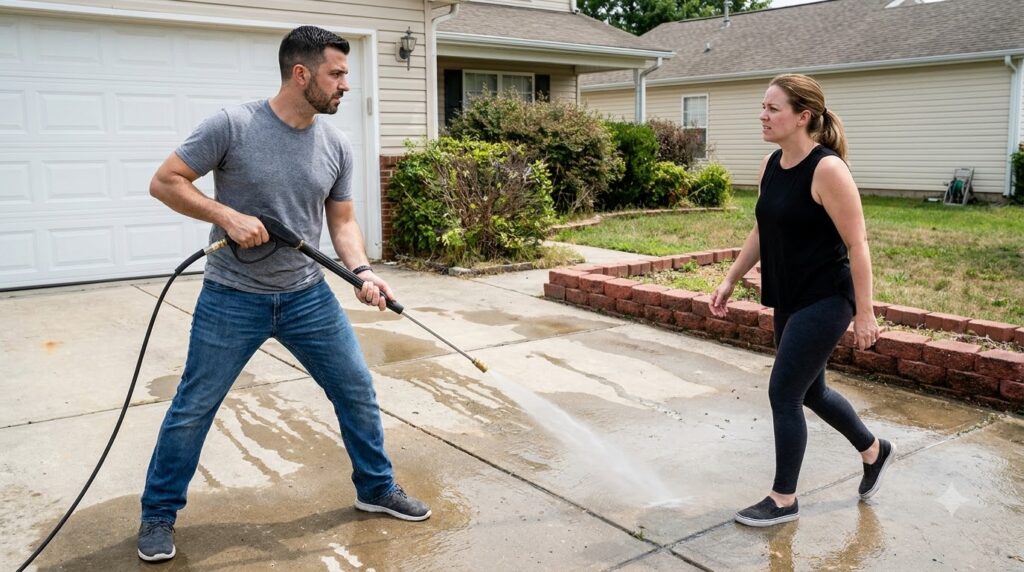
The 3,100-PSI Honda engine roared against the sun-bleached driveway, sending a high-pitched whine bouncing off the garage door. A thick fan of pressurized water tore through six months of accumulated road grime, lifting oil stains and red clay to reveal the pale, aggregate concrete beneath. Mark kept his boots planted four inches back from the control joint—the thin, tar-filled crevice where his property met the public sidewalk. His forearms burned from forty minutes of continuous backpressure, but the mechanical rhythm of the spray was the first clean thing he’d touched since landing at O’Hare twelve hours ago.

“Turn that machine off right now!”

The voice didn’t carry over the engine so much as it cut through it—a sharp, shrill pitch conditioned by years of unchecked authority.

Mark didn’t let up on the trigger. Through the fine mist hanging in the August heat, he saw the white sneakers first. They stopped precisely at the edge of his grass. Evelyn stood with her feet shoulder-width apart, a black leatherette binder tucked under one arm like a commander’s sidearm. She wore a sleeveless dark top, her posture rigid, her chin tilted at the precise angle she used when inspecting trash cans left out past 7:00 PM.

She pointed a manicured finger directly at the nozzle. “Did you hear me, Mark? You’re flushing gray-water runoff into the storm drain! That’s an automatic Class II civil citation under section four of the covenant!”

Mark released the trigger. The engine dropped to a low, throbbing chug, the sudden drop in noise making the quiet suburb feel unnaturally heavy. Sweat ran down the bridge of his nose, stinging his eyes. He didn’t wipe it away. He kept both hands locked around the rubber grip of the wand.

“It’s tap water, Evelyn,” Mark said. His voice was flat, scraped raw from dry cabin air and lack of sleep. “No chemicals. Just pressure.”

“It doesn’t matter what’s in it!” She took two aggressive steps onto his driveway, her sneakers crunching over the wet sand he’d just blasted from the expansion joint. She was five feet into his space now, her body blocking the narrow path between his truck bed and the raised brick flowerbed. “You didn’t submit a drainage mitigation plan to the committee. You don’t get to flood the common driveway apron just because you’ve been gone for three weeks!”

Behind her, across the cul-de-sac, a garage door paused halfway through its lift cycle. Mrs. Gable stood in the shadows of her carport, holding a pair of hedge shears, completely motionless.

Mark shifted his lead foot back an inch, lowering the tip of the steel wand until it pointed straight at the wet concrete six inches in front of her right shoe. The engine sputtered, then caught its idle again, vibrating through his palms.

“You’re standing in the wash line, Evelyn,” Mark said softly.

“Don’t you turn your back on me!” She stepped closer, her binder raised like a shield, her chest heaving as she reached out to grab the metal lance itself. “I will have a tow truck in this driveway by noon, and I will personally lock your—”

Hidden inside the shadow of her black leatherette binder, clipped securely over the HOA logo, was a official pink County Sheriff’s Notice of Lien stamped with Mark’s parcel number and date-marked three days ago.


CHAPTER 2: THE PAPER SHIELD

The pink paper vibrated against the black leatherette of her binder, the bottom corner fluttering in the exhaust backdraft of the Honda engine. Mark didn’t drop the tip of the pressure washer. He shifted his grip along the rubber sleeve, his forearms rigid, locking the lance as a three-foot bar of hardened stainless steel between his chest and her forward foot.

“You’re stepping across my property line, Evelyn,” Mark said. The water stream hissed into the concrete seam three inches from her left shoe, spraying a fine line of wet sand and red clay across her white laces.

“I am executing an official administrative notice!” Evelyn didn’t step back. Her body remained braced, her chest pressed against the tension of the scene. She thrust the binder forward until the edge of the stamped pink document nearly touched the brass quick-connect fitting on his wand. “This is a official County Sheriff’s Notice of Lien. Issued three days ago. Your property is under immediate covenants-enforcement lock due to unpaid structural assessment fees and unmitigated runoff violations.”

Mark’s eyes narrowed. He looked at the paper, not at her face. The red ink of the sheriff’s seal was crisp, but the parcel number typed across the top line—44-092-B—had a faint shadow behind the numbers, like a second-generation photocopy aligned over an old stencil.

“I pay my HOA dues by automatic draft on the first of every month,” Mark said. “And the county doesn’t issue liens for driveway runoff without a civil hearing.”

“They do when the runoff crosses into designated common drainage easements!” Evelyn’s voice rose, striking the concrete driveway and echoing toward the open garage across the street. “You were served by registered mail. If you were off galavanting for three weeks instead of maintaining your domicile, that is a personal negligence issue, not an administrative error!”

She took another half-step forward. Her right foot crossed the tarred expansion seam, coming down hard on the wet, slick slab where the algae hadn’t been blasted away yet.

Mark didn’t argue. He didn’t cite the bylaws or reach for his phone. His mind worked through the mechanics of the friction before him: three hundred pounds of head pressure, an unstable footing on wet aggregate, and an entitled neighbor using a suspicious piece of county stationery as a battering ram.

“Take one more step toward me, and you’re getting sprayed!” Mark’s voice dropped an octave, steady and cold, devoid of anger. It was the same tone he used when calling out structural load shifts on commercial job sites.

Evelyn scoffed, a short, sharp bark of disbelief. “You wouldn’t dare. You lay one drop of water on me, Mark, and I’ll have the deputy here before—”

Her right heel shifted. She pushed forward to plant her weight, intending to crowd him off the wand, her binder held out like an iron shield.

Mark squeezed the trigger.

He didn’t aim for her face or her chest. He whipped the nozzle downward in a short, controlled arc, sweeping a zero-degree knife of water across the wet concrete directly between her feet. The 3,100-PSI jet struck the wet film on the slab with a sharp CRACK, atomizing the standing water into a wall of dense spray and lifting a sheet of slick, liquefied algae straight into her pathway.

Evelyn’s lead foot hit the micro-thin layer of wet mud and instantly lost traction.

Her leg shot out from under her. Her arms pinwheeled, the black binder flying from her grip as her center of gravity collapsed backward. She hit the wet concrete with a heavy, wet thud, her hip catching the edge of the raised red-brick flowerbed before she settled onto the soaked driveway.

The silence that followed was instant and absolute, broken only by the low, idling thrum of the pressure washer.

Evelyn sat on the wet concrete slab, her dark leggings soaked through, her ponytail dripping dirty driveway water onto her collarbone. Her black binder lay open in the mud two feet away, the pink county notice floating face-down in a puddle of grey runoff.

She stared up at Mark, her mouth open in a perfect, wordless square of absolute shock.

“You…” she gasped, her voice thin, stripped of all its bureaucratic authority. “You actually sprayed me!”

Mark held the wand low, the tip pointed harmlessly at the concrete seam, his stance unyielding, his eyes fixed on the floating paper.

Across the street, the shears in Mrs. Gable’s hands clicked shut with a sharp, distinct metallic ring.

CHAPTER 3: THE SHOCKWAVE

“You actually sprayed me!”

The words hung over the wet driveway like exhaust fumes in winter air. Evelyn sat on the concrete, her palms planted flat in the dirty gray puddle that had pooled around her thighs. Water dripped from the tail of her ponytail, tracking dark streaks through the powdered foundation along her jawline. Her sleeveless black shirt was plastered to her ribs, exposing the sharp, shivering angle of her collarbone.

Mark didn’t move the lance. He lowered the throttle lever on the Honda engine with his thumb, dropping the RPMs until the high-pitched whine settled into a guttural, uneven chug. The vibration traveled up through the rubber grips, thrumming against the callous on his palm.

“I gave you a clear warning, Evelyn,” Mark said. His voice was quiet, pitched just under the idle of the motor, but in the dead silence of the cul-de-sac, it carried straight across the street. “You stepped into an active wash line on my property.”

“This is assault!” Her voice cracked on the second syllable, losing its measured, managerial register. She scrambled backward on her hands and knees, her sneakers squealing against the wet aggregate as she tried to gain leverage against the red-brick flowerbed. Her dark leggings were coated in fine gray grit from the driveway sand. “You assaulted a member of the board on common-interest land!”

“You’re five feet past the easement boundary,” Mark said. He pointed the tip of the stainless-steel lance down at the expansion seam—the thick line of black asphalt sealant separating his driveway from the sidewalk. “The common land ends at that tar joint. You know that. You signed the 2018 survey plat.”

Evelyn’s head snapped toward the curb.

For the first time since she had marched down the sidewalk, her eyes didn’t fix on Mark. They darted to the left, toward the silver sedan parked two houses down, then to the right, where the garage door across the street remained stuck at hip height.

Mrs. Gable was no longer just watching from the shadows of her carport. She had stepped out onto her porch steps, the heavy iron shears resting against her thigh, her eyes wide behind round bifocals. Down at the cul-de-sac turn, a lawnmower engine sputtered to a halt. Two men in high-visibility vests from the commercial landscaping crew stood motionless beside their trailer, hands resting on their hips, watching the water drip from Evelyn’s elbow.

Evelyn felt the weight of the street shifting. The cold concrete beneath her wasn’t just wet—it was public.

She lunged forward, her knees dragging through the muddy runoff, and snatched her leatherette binder from the puddle. The pink paper—the official County Sheriff’s Notice of Lien—was saturated. As she grabbed it, Mark noticed the red seal at the top. The ink wasn’t offset printing from a municipal press; the edges were bleeding into the wet paper fibers in a faint, water-soluble purple halo. Real county lien seals were stamped with oil-based pigment that didn’t run when wet.

Mark stepped forward, his boots making a heavy, wet suction sound on the clean slab. He extended his hand, not to help her up, but to reach for the corner of the floating document.

“Let me see that notice,” Mark said.

Evelyn yanked the paper back against her chest, crumpling the wet sheet into her fist. Her face contorted into a mask of pure, vicious panic—not the outrage of an official whose authority was challenged, but the primal fear of a trespasser caught with something stolen.

“Touch me and I’ll have the deputies here in five minutes!” she hissed, her teeth clenching as she pushed herself up using the brick flowerbed for balance. Her knees wobbled as her wet sneakers found traction on the grass edge. “You think you’re clever because you’ve got a pressure washer and a temper? This neighborhood is built on order, Mark. You don’t get to ruin it because you think you’re above the rules!”

She didn’t wait for a reply. Holding the wet, balled-up pink paper against her ribs, she turned and marched down his driveway, her wet sneakers making a sharp, rhythmic squelch-squelch-squelch against the pavement. Her back was rigid, but her shoulders were hunched, trying to minimize the footprint of the huge, dark water stain covering the entire back of her shirt.

Mark watched her clear the expansion seam. She didn’t look at Mrs. Gable. She didn’t look at the landscaping crew. She kept her eyes locked on her own driveway three houses down, her pace accelerating into a stiff, frantic stride.

Mark bent down, killed the ignition switch on the Honda engine, and absolute silence descended over the street.

The air smelled of hot exhaust, damp earth, and pulverized stone. Mark reached into the puddle where the binder had rested. His fingers closed over a small, laminated plastic card that had slipped out of the side pocket when the binder hit the brick edge.

It was a contractor’s gate pass for the county landfill, issued to E. Vance / Architectural Oversight, stamped with an expiration date three years past due—and on the back, handwritten in faded blue ballpoint ink, was the private cell phone number of the chief county tax assessor.

Mark turned the card over in his hand, feeling the rough, unsealed edge of the laminate, as the garage door across the street finally began to rattle all the way open.

CHAPTER 4: THE RESIDUAL SILENCE

The rough edge of the plastic card bit into Mark’s thumb as his grip tightened. Across the asphalt, the heavy garage door at 412 finished its mechanical climb, settling into its overhead track with a metallic clack-clack.

Mrs. Gable didn’t retreat into the shade of her workbench. She stepped off the lip of her garage floor, her orthopedic shoes making a slow, deliberate rustle over the dry leaves scattered along her apron. She still held the iron hedge shears against her apron, but her gaze wasn’t on the wet driveway where Evelyn’s boots had left two muddy streaks. Her eyes were fixed on the laminated card in Mark’s hand.

Mark didn’t pocket the card. He held it by its corner, letting the glare of the noon sun strike the faded ballpoint numbers written on the back.

“She’s been taking that binder to every door on the south loop since Tuesday,” Mrs. Gable said. Her voice lacked the frail tremor typical of her eighty years; it was dry, flat, and carried the unvarnished weight of someone who had lived in the subdivision before the developer poured the first curb.

Mark walked to the brass spigot at the side of his house, coiled the black rubber hose over his shoulder, and uncoupled the high-pressure wand. Water dripped from the brass fitting, splashing onto his boot. “She claimed the county issued a lien against my parcel.”

“Evelyn claims a lot of things when the quarterly audit gets close,” Mrs. Gable replied. She stopped three feet short of the control joint, her eyes scanning the clean, pale concrete slab Mark had just blasted. The contrast between his washed driveway and the yellowed, oil-stained curb in front of her own house was stark. “Three years ago, she told the Miller family their oak tree was overhanging the utility easement. She brought a man in a plain white pickup with a chainsaw at seven in the morning. By noon, the oak was firewood, and two weeks later, the board approved an eight-thousand-dollar landscape improvement grant for the entrance island.”

Mark turned the card over again. “The entrance island uses dwarf boxwoods. Those don’t cost eight grand.”

“No,” Mrs. Gable said, her mouth setting into a thin, tight seam. “They don’t.”

She looked down at the puddle near the brick flowerbed where the pink paper had floated. A corner of the wet cellulose had torn off and stuck to the brick mortar, the bleeding purple ink leaving a faint, violet bruise against the red clay.

“You should turn off your main breaker before you go inside,” she added softly, nodding toward Mark’s utility box mounted on the side wall. “Evelyn’s brother-in-law is the regional supervisor for the water authority. When she gets soaked, she doesn’t just write fines. She looks for levers.”

Mark didn’t answer right away. He walked over to the edge of the flowerbed, reached down, and peeled the damp fragment of pink paper off the brickwork. The wet fibers disintegrated between his fingers, but the printed text remained legible: PARCEL BOUNDARY ADJUSTMENT / DRAINAGE EASEMENT CLARIFICATION.

It wasn’t a fine for gray-water runoff. It wasn’t even a standard covenant violation notice.

It was an administrative application to reclassify the two-foot strip along his driveway as dedicated municipal property—a legal mechanism that would give the HOA board the unilateral right to alter his property line without a vote of the full membership.

Mark smoothed the wet scrap of paper against the back of the plastic gate pass. The parcel numbers matched, but the county seal was misaligned by three millimeters—the signature mark of a document scanned on a home bed printer and assembled from two separate public records.

“She didn’t come here to stop the pressure washer,” Mark said, his voice dropping into the quiet, calculating cadence he used when reviewing fraudulent sub-contracts. “She came here to establish a record of non-compliance before the board meeting.”

“The meeting is Thursday night at the library,” Mrs. Gable said. She turned back toward her driveway, her shears clicking once in the still air. “She’s got three proxies signed by the snowbirds on the corner. If you aren’t standing in that room with something stronger than a garden hose, Mark, that tar line isn’t going to be your boundary by Friday morning.”

Mark watched her walk back under her garage door, the heavy shadow swallowing her slippers. He didn’t unhook the pressure washer motor from its frame. Instead, he pulled his phone from his back pocket, tapped the screen, and dialed the direct county tax assessor extension written on the back of the landfill pass.

The line rang twice before a dry, recorded voice answered: You have reached the Office of Records and Mapping. All boundary disputes and easement modifications are currently under administrative hold pending the annual grand jury audit…

Mark ended the call, his thumb hovering over his calendar app. He didn’t look at the wet driveway. He looked at the black tar seam running down the center of the concrete, where the water had pooled, refused to drain, and begun to seep into the soil on Evelyn’s side of the fence.

CHAPTER 5: THE FORGED MAP

“The grand jury audit.”

Mark repeated the words to the empty driveway, letting them settle over the smell of drying concrete. He dropped his phone into his pocket, gripped the handle of the pressure washer, and dragged the heavy frame into the dark rectangle of his garage. The rubber tires left two thin, black tracks across the clean slab he’d just cleared.

He didn’t head inside to change out of his damp jeans. He walked straight to the steel workbench at the back of the garage, grabbed a flathead screwdriver and a brass wire brush, and pried open the rusted lock on the gray metal filing cabinet beneath his shelving unit.

Inside sat three binder-clipped stacks of yellowed paper: the original deed from 2011, the closing plat from the title company, and the boundary survey stamped by Miller & Associates Civil Engineering when the subdivision was platted.

Mark spread the large, folded blueprints across the hood of his truck. The heavy paper crackled, releasing a puff of dry dust that caught the afternoon light filtering through the garage window.

He ran his thumb over the boundary lines. The asphalt control joint wasn’t an approximation. According to the original recorded plat, parcel 44-092-B extended exactly two feet beyond the concrete seam, encompassing the raised brick flowerbed and the soil line where Evelyn’s lawn began. The drainage easement she kept screaming about didn’t exist on the original county survey.

Ten minutes later, Mark was behind the wheel of his truck, heading toward the county clerk’s public records repository on West Main Street.

The basement of the county administration building smelled of stale floor wax, ozone, and decades of decaying paper. A single fluorescent tube overhead hummed with an irritating, low-frequency buzz that vibrated in Mark’s jaw. Behind the scratched plexiglass counter, a clerk with thick bifocals slid a heavy, canvas-bound ledger across the Formica surface.

“Microfilm reels for 2018 are in drawer four,” she said, her voice gravelly and indifferent. “If you need certified copies, it’s three dollars a page. Cash or cashier’s check.”

Mark carried the ledger to the optical reader in the corner. The machine’s cooling fan rattled like a loose heat shield on an old exhaust pipe. He fed the film through the glass plates, spinning the manual crank until the microfilmed records for the Oakridge Estates subdivision flickered across the green monitor.

Page 142: The 2018 Master Drainage Amendment.

Mark locked the focus dial. The document displayed on the glowing screen was the exact compliance report Evelyn had held against her chest—the same layout, the same bold header, the same pink paper texture reproduced in grainy monochrome.

He zoomed in on the bottom right corner, where the county surveyor’s seal was stamped.

The seal was there, but the registry number inside the inner ring—#40912—was typed in a sharp, modern sans-serif font that stood out against the feathered, hand-stamped ink of the surrounding ring. Beneath it, visible under the green light of the reader, was the faint, ghosted imprint of a completely different text string that had been whited out prior to scanning: TAX REASSESSMENT EXEMPTION – PARCEL 44-088.

Parcel 44-088 wasn’t Mark’s property.

It was Evelyn’s.

Mark leaned back, the vinyl chair groaning under his weight. His pulse stayed slow, calculated, and cold.

She hadn’t just fabricated a noise or drainage violation to bully him off his own driveway. She had altered official county parcel records, filed a forged architectural compliance report, and registered a fake drainage easement on his property to cover up an illegal parcel modification on her own land.

By shifting the official drainage map two feet onto Mark’s driveway, she had effectively transferred a major structural runoff violation on her property—one that carried a fifteen-thousand-dollar municipal remediation mandate—directly onto his parcel, making his home liable for the repairs while clearing her own title.

Mark pulled out his phone, snapped a high-resolution photo of the illuminated screen, and printed three certified copies at the counter.

“Is this the official filed record?” Mark asked, sliding a twenty-dollar bill across the glass to the clerk.

The woman stamped the copies with an embossed seal, the heavy iron press striking the paper with a sharp thwack. “If it’s on that reel, mister, it’s what’s legally on file with the registrar. Unless somebody presents a court order proving forgery, that map is the law of the county.”

Mark took the certified papers, the fresh ink cool against his fingertips.

He had the physical evidence. He had the forged seal, the altered registry number, and the certified paper trail that proved Evelyn had committed administrative fraud to saddle him with her property liability. It was a complete, bulletproof defense that would crush her standing at Thursday’s board meeting.

Yet as he walked out into the blinding sunlight of the parking lot, something in the math didn’t add up.

A home bed printer and a whited-out document couldn’t bypass the registrar’s intake desk. A private citizen couldn’t get an altered microfilm reel logged into the county vault without an insider pushing the spindle into the drawer.

Mark unlocked his truck, the hot leather seat burning through his shirt, and looked down at the second number handwritten on the back of the landfill gate pass—the direct line to the regional water authority supervisor.

He hadn’t found the end of the line. He had only found the decoy she wanted him to hit.

CHAPTER 6: THE SHADOWED RECORD

The heavy door of Mark’s diesel truck slammed shut, the iron latch echoing through the quiet cul-de-sac. He held the manila folder containing the certified 2018 county survey firmly under his arm. The paper felt heavy, crisp, and definitive—a legal hammer ready to drop at Thursday night’s meeting.

Then he saw the orange utility truck parked on his grass.

The vehicle had no municipal seals on the door, only a磁石 magnetic panel reading REGIONAL INFRASTRUCTURE MANAGEMENT SERVICES. A man in a heavy canvas vest and steel-toed boots stood on Mark’s driveway, holding a battery-powered drill and a bright yellow roll of adhesive tape.

Taped across Mark’s electrical meter and main water shut-off panel was a laminated administrative order printed on thick neon cardstock.

“Can I help you?” Mark’s voice was dangerously low as he crossed the expansion seam, his boots hitting the clean concrete slab.

The worker didn’t look up from his digital tablet. “Mark Vance?”

“Just Mark,” he said, stepping into the man’s working radius. “And you’re standing on private property without a permit.”

“Emergency utility isolation order,” the worker said mechanically, tapping the screen with a stylus. “Section 12-B of the regional sanitary code. Reported structural backflow hazard originating from uncertified drainage alterations. We’re lock-out tagging your main supply line until a regional inspector conducts an environmental impact audit.”

Mark reached out, grabbed the corner of the neon notice, and ripped it off his meter box in one clean motion. The adhesive tore with a sharp scritch.

“The county records office verified two hours ago that my parcel has no active drainage easements,” Mark said, slapping the certified microfilm copy flat against the utility box cover. “The map filed in 2018 is a forged duplicate. Look at the registry stamp.”

The worker glanced at the embossed seal, then back at his tablet. For a fraction of a second, a flicker of hesitation crossed his face, but he cleared his throat and tapped a field on his screen.

“I don’t process land records, sir. I process dispatch tickets,” the man said. His tone wasn’t hostile—it was worse. It was the indifferent, procedural stonewall of an outside contractor hired to perform an execution. “Ticket was generated at 1:15 PM by the regional authority desk. Authorized by Supervisor Vance.”

Vance.

Mark looked down at the paper in his hand, then at the laminated gate pass he’d picked up from the puddle earlier. The supervisor at the regional water authority wasn’t just a bureaucrat reviewing filings. He was Evelyn’s brother-in-law.

“She didn’t just alter the microfiche,” Mark realized aloud, the cold logic assembling itself in real time. “The altered map wasn’t meant to win a court case. It was meant to create a paper trail long enough to justify an administrative shut-off.”

The decoy secret—the idea that Evelyn was merely trying to dodge a fifteen-thousand-dollar drainage liability on her own yard—was too small. It was a local cover story designed to make any neighbor who looked into the records think they’d caught a petty HOA president in a personal tax dodge.

If Mark brought the forged microfilm to the library meeting on Thursday, Evelyn wouldn’t argue the boundary line. She wouldn’t have to. By Thursday morning, Mark’s house would be tagged as an active environmental biohazard by a regional utility, his water cut, his occupancy permit suspended, and his standing to speak at an HOA meeting legally severed under section nine of the community bylaws.

The trap hadn’t sprung when she stepped onto his driveway with her binder. It had sprung the moment he drove to the county repository to investigate her.

“I have to apply the tag, sir,” the utility worker said, holding up a heavy steel lock shank. “If I don’t sign off on this dispatch, my company forfeits its regional maintenance contract.”

“How much is the contract worth?” Mark asked, his voice sharp as a lathe.

The worker paused, his hand hovering over the breaker box. “That’s public record. Two hundred and forty thousand annually.”

“Look at the line item on the invoice on your tablet,” Mark commanded, pointing a rigid finger at the screen. “Look at the budget coding for this emergency dispatch. Is it funded by the county water district, or is it drawn from an private escrow account labeled Oakridge Estates Improvement Fund?”

The worker frowned, swiping his thumb across the glass. He scrolled past the work order, down to the billing authorization block. He stopped. His eyebrows pulled together as his finger traced the twenty-digit account routing string.

“That’s… that’s a private commercial clearinghouse,” the worker muttered, his professional detachment slipping. “That’s not municipal funds.”

“She isn’t using the county to bully the neighborhood,” Mark said, his eyes darkening as the true scope of the machinery shifted beneath his feet. “She’s using the neighborhood’s own bank account to buy regional utility enforcement.”

The worker stared at the account code, then at the certified county paper in Mark’s hand. He slowly pulled the steel lock shank back from the breaker box, lower his tablet, and stepped back toward his truck.

“I’m marking this dispatch as delayed due to an active property line dispute,” the worker said quietly. “It gives you forty-eight hours before a supervisor comes out personally. But Mark… when the supervisor comes, he won’t be bringing a tablet.”

He climbed into the cab of the orange truck, started the engine, and backed out of the driveway, leaving Mark standing alone beside his meter box.

Mark looked down at the certified microfilm copy in his hands. The paper was useless. The forged map was just a smoke screen covering a massive, systemic funnel of community money.

Across the street, behind the blinds of her top-floor window, a shadow moved as Evelyn pulled the curtain closed.

CHAPTER 7: THE RECKONING AT THE TABLE

“Item four on the agenda,” the board vice president announced, his voice echoing off the cinderblock walls of the public library basement. “Oakridge Estates Architectural Compliance and Easement Enforcement.”

A rustle of folding chairs rippled through the room. Forty residents sat shoulder-to-shoulder under the buzzing fluorescent lights. At the head table, flanked by two passive board members, sat Evelyn. She wore a tailored burgundy blazer, her hair pulled back into a rigid, immaculate bun. No one looking at her now would guess that forty-eight hours ago she had been sitting soaked and shivering on Mark’s wet driveway.

Her eyes swept the room with practiced composure until they locked on Mark, standing at the back beside the drinking fountain.

“Before we hear public comments,” Evelyn said, tapping her microphone until it emitted a sharp squeal, “the board must address a critical administrative issue. Parcel 44-092-B is currently under an active municipal infrastructure hold. Under covenant section nine, any resident with an outstanding environmental hazard tag forfeits their voting and speaking privileges until remediation is complete.”

She lifted a blue folder, opening it with a crisp, authoritative snap. “Therefore, Mr. Vance is not permitted to address the assembly tonight.”

A low murmur ran through the rows of neighbors. Mrs. Gable, seated in the second row, turned her head and looked directly at Mark.

Mark didn’t yell. He didn’t raise his voice. He walked down the center aisle, his heavy work boots hitting the thin carpet with a dull, rhythmic thud. In his right hand, he carried a thick manila folder. In his left, he held a portable USB flash drive.

“The utility worker who brought that tag left an hour ago,” Mark said, stopping two feet from the board table. The air between them smelled of stale library books and cold air conditioning. “He didn’t lock the meter because the billing authorization code for his dispatch didn’t come from the county water district.”

Evelyn’s hands froze on the blue folder. “This is an official administrative procedure—”

“It’s a private clearinghouse account,” Mark interrupted, his voice dropping into that cold, steady, lathe-sharp cadence. He opened his folder and laid three copies of a bank ledger statement flat on the table, directly over her microphone cable. “Account number ending in 4109. Registered to the Oakridge Estates Improvement Fund.”

The board vice president leaned forward, squinting through his reading glasses at the paper. “What is this?”

“That is where sixteen thousand dollars of our annual HOA dues went last November,” Mark said, turning to face the room. The forty residents leaned in, the folding chairs creaking in unison. “Evelyn told you the money was spent on dwarf boxwoods and entrance island stone. But the contractor who swept into my driveway with an emergency utility tag was paid directly out of that same private account.”

Evelyn stood up so fast her chair screeched backward against the linoleum. “This is a slanderous breach of decorum! Mr. Vance is fabricating financial documents to distract from his own drainage violations!”

“The 2018 drainage map is a forgery,” Mark said, placing the certified microfilm copy beside the ledger. He pointed a broad thumb at the bottom seal. “The registry stamp belongs to parcel 44-088. Evelyn’s home. She altered the county record to shift her own fifteen-thousand-dollar structural drainage liability onto my property line.”

The room erupted.

Mrs. Gable stood up first. “I saw her on his driveway! She had a fake sheriff’s notice in her binder!”

“Check the books!” a man from the back row shouted, standing up from his chair. “We paid a special assessment for drainage two years ago!”

The vice president pulled the certified microfilm copy toward his chest, his eyes widening as he compared the forged registry stamp to the bank ledger line items. “Evelyn… these account routing numbers match the board’s reserve signatures.”

Evelyn’s face drained of color. The rigid, managerial posture that had intimidated the subdivision for five years cracked in a single second. She looked at the vice president, then at the wall of angry faces rising from the folding chairs, and finally at Mark—standing immovable before her, his posture grounded like a concrete corner post.

She didn’t offer a defense. She didn’t cite the bylaws. She grabbed her blue folder, slammed her pen into her purse, and shoved past the board table toward the emergency exit.

“Meeting adjourned!” the vice president called out over the shouting crowd, his gavel striking the wooden table with a hollow, echoing crack.

Mark didn’t follow her out into the night. He stood by the table as neighbors pressed forward, gathering around the certified papers, their voices rising in a wave of collective realization and reclaimed autonomy.

He looked down at the paper in his hands. The decoy secret—the forged map—had collapsed in front of the entire community. The public overreach was exposed, her authority shattered, and his property line cleared.

Yet as Mark watched the emergency exit door swing shut behind her, his eyes caught the final line item on the third page of the bank ledger—a line he hadn’t read aloud to the room.

The sixteen thousand dollars hadn’t gone to a private contractor or a drainage repair. The monthly wire transfers from the improvement fund were routed directly to a residential real estate trust holding the deed to the cul-de-sac’s main access road.

Evelyn hadn’t just been stealing dues or shifting drainage fines. She was systematically buying the private legal title to the subdivision’s only access gate—meaning every homeowner in Oakridge Estates was about to become a tenant on her private road.

Mark folded the ledger sheet, tucked it into his pocket, and stepped out into the cool August night air, where the final line of defense still waited to be drawn.

CHAPTER 8: THE UNYIELDING LINE

The heavy iron sledgehammer hit the top of the brass survey stake with a dull, ringing THWACK.

Night had settled fully over Oakridge Estates. The streetlights cast long, amber rectangles across the clean driveway slab, reflecting off the pale aggregate Mark had scrubbed clean that morning. Sweat tracked through the fine gray dust on his forehead, but his grip on the hickory handle was loose, comfortable, and steady.

Four brass pins sat flush in the concrete now—driven four inches deep into the soil directly along the tarred expansion seam. They didn’t lie. They didn’t bleed purple ink when wet, and they didn’t rely on the word of a self-appointed board president. They were stamped with the official seal of the state land surveyor, anchored into the bedrock beneath the subgrade.

Across the cul-de-sac, headlights swept through the darkness as a dark sedan backed out of Evelyn’s driveway.

There were no blue folders in her arms. No black leatherette binder tucked under her elbow. Her house sat dark behind her, the front lawn unpoliced, the porch light switched off for the first time in five years. The board vice president had spent the last two hours in her kitchen alongside a sheriff’s deputy, going over the escrow ledgers, the forged drainage maps, and the wire transfers that had systematically funneled thirty-two thousand dollars of community funds into her private real estate trust.

The car paused at the entrance to the cul-de-sac. Through the tint of her passenger window, Mark saw her silhouette—rigid, turned toward his driveway, watching him stand under the glow of the halogen work lights.

Mark didn’t lift a hand. He didn’t offer a final word or a gesture of triumph. He rested the head of the sledgehammer against the wet aggregate, his boots planted firmly four inches behind his control joint.

Evelyn’s car turned onto the main road, its red taillights shrinking into the dark until the subdivision gate clicked shut behind her, the iron latch settling with a cold, definitive thud.

The street was silent.

Mrs. Gable stepped out onto her front porch, carrying a warm mug in her hands. She stood at the edge of her grass, her eyes tracing the four brass pins shining under Mark’s work lights.

“They look solid, Mark,” she said quietly across the dark asphalt.

“They aren’t moving,” Mark said. His voice was calm, the gravelly edge gone, leaving only the quiet weight of a man who had reclaimed his land.

He walked over to his utility panel, clicked off the halogen work lights, and closed the steel breaker door with a firm, solid latch. The dark wrapped around the driveway, but beneath his boots, the concrete seam remained unbroken—a permanent boundary where authority ended and sovereignty began.

Similar Posts

Leave a Reply

Your email address will not be published. Required fields are marked *






