The Iron Boundary of Oak Ridge Lane and the Silence of Stamped Paper

CHAPTER 1: THE DRIVEWAY THRESHOLD

The low, rhythmic thud of the diesel engine had barely settled into the driveway pavement before the pink sweatshirt crossed the yellow tape.

Artie Miller did not shift his feet. He kept his steel-toed boots planted two inches inside the chain-link gate boundary, his hands resting low across his belt line, the yellow plastic job folder tucked firmly against his ribs. Decades spent calculating fluid dynamics and pressure variances in county water mains had trained him to measure human motion the same way he measured pipe stress: you didn’t react to the first surge of kinetic energy; you waited to see where the seam would burst.

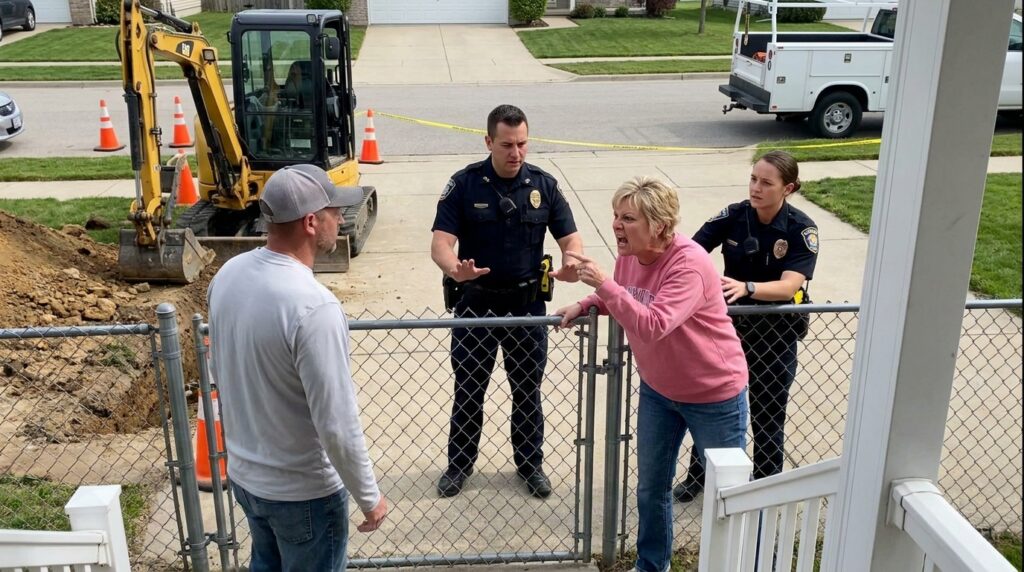
Evelyn Vance came down the asphalt slope like a storm front trapped in thirty feet of suburban frontage. Her white sneakers hit the cracked driveway surface with hard, flat slaps, her shoulders pitched forward, her chin thrust out beneath a cloud of short blonde curls. She didn’t look at the orange traffic cones. She didn’t look at the mini-excavator’s idling steel arm. She saw only the five-foot trench line marked in fresh blue spray paint, and the quiet man standing beside it.

“Shut it down!” Her voice ripped through the morning air, harsh and breathless, carrying straight across the cul-de-sac where three front curtains instantly twitched aside. “Turn that machine off right now!”

The excavator operator paused, his gloved hands hovering over the dual control levers. He looked toward Artie, his eyebrows raised beneath a hard hat. Artie gave a single, microscopic shake of his head—keep the engine idling, hold your position.

Evelyn reached the yellow plastic caution tape, grabbed it with both hands, and snapped it down, tearing the knot free from the chain-link fence post. She stepped straight over the fallen strip, her pink fleece cuff dragging across the blue utility line, and lunged into the three-foot gap separating the work zone from Artie’s chest.

“You don’t have the right, Arthur,” she rasped, her face flushed dark red, a rigid index finger driving forward until it hovered an inch from his gray long-sleeve shirt. “This is private property. You are digging on my land, you are destroying my driveway boundary, and I am telling you for the last time—get this rig off my street!”

Artie didn’t flinch. He let the heat of her breath clear before he spoke, his voice low, flat, and devoid of cadence. “The county recorded this easement thirty years ago, Evelyn. The paperwork is stamped, and the culvert line is failing.”

“I don’t care about your imaginary paperwork!” Her voice hit a sharp, strident peak that rattled against the metal gate. Her left hand shot out, catching the galvanized chain-link mesh, her knuckles turning white as she pulled herself closer, physically blocking the excavator’s swing radius. “My husband built this fence line in ninety-eight! Every square inch on this side of the post belongs to parcel forty-two. You put one steel bucket into this asphalt, and I will have you in handcuffs before noon!”

Artie watched her eyes. There was no strategy in them—only the raw, panicked calculation of a person who realized her invisible domain was shrinking by six inches of crushed gravel. He felt the cold weight of the weather-resistant folder against his forearm. Inside was the 1994 county plat map, sealed with blue ink. But beneath that map lay a folded carbon copy from 1999—a hand-noted site amendment signed by her late husband, granting the township emergency access rights that Evelyn had spent twenty years trying to burn out of memory.

Evelyn whipped her mobile phone from her fleece pocket with her free hand, her thumb jamming into the screen with furious pressure. “I’m calling dispatch. I’m reporting an active land seizure and destruction of private property.”

She pressed the phone to her ear, staring directly into Artie’s eyes, waiting for the flinch, waiting for the hesitation that would prove her authority still governed Oak Ridge Lane.

Artie slowly adjusted the brim of his gray cap, his thumb tracing the worn cotton edge. “Call them,” he said quietly.

As the first mechanical ring echoed from her phone speaker, the distant wail of a siren turned the corner onto the upper street.


CHAPTER 2: THE PAPERWORK PARADOX

“Dispatch, I have an active trespasser refusing to vacate parcel forty-two!” Evelyn’s screech cut through the speaker of her phone, sharp enough to vibrate the plastic casing. “He’s got heavy machinery running on my driveway line! Send a unit right now!”

Artie didn’t turn around to watch her wave her arms at the empty street. He stepped sideways, keeping his boots locked against the bottom bar of the galvanized gate, his left shoulder angled to block her from reaching past the chain-link fabric. He could hear the distinct sound of a police cruiser accelerating three blocks over—the rising whine of a V8 engine pushing past the neighborhood speed bumps.

“The line is marked blue, Evelyn,” Artie said, his voice dropping into the flat, low register he used when addressing cracked water mains. “County locators flagged it two days ago. That blue paint means township infrastructure.”

“That blue paint is spray-can vandalism!” She shoved her phone into her sweatshirt pocket, her face flushed dark crimson as she gripped the upper rail of the gate. Her knuckles pressed against the wire until the skin turned white. “My husband planted these cedar posts in ninety-eight. He filed the survey with the township clerk himself. You think because you worked for the water department you own the dirt under this street?”

Artie’s thumb pressed against the corner of his yellow plastic folder. He didn’t open it. He didn’t need to look at the blue-ink stamp from the municipal authority dated June 14, 1994. But as his fingers traced the seam of the folder, he felt the outline of the second document tucked inside—a narrow strip of folded carbon paper he’d pulled from a rusted tin cylinder hidden inside the hollow steel post of Evelyn’s fence line two nights ago.

It was a hand-noted site amendment from October 1999, signed in faded ballpoint by her late husband, Harold Vance. The writing was shaky, written in the stiff, formal hand of a man trying to claim what wasn’t his: Private maintenance easement granted to Parcel 42 for drainage control.

Evelyn saw his eyes shift toward the fence post. A sudden, dangerous flick of movement crossed her face—a tightening around her jaw that had nothing to do with property lines and everything to do with panic.

“You’ve been snooping around my property,” she whispered, her voice dropping out of its high-pitched scream into something much colder. She leaned over the wire, her pink fleece dragging against the sharp edges of the chain-link mesh. “I saw you out here Tuesday night with a flashlight, Miller. You think I don’t see what you’re doing? You think because Harold is gone you can just rewrite thirty years of history?”

“Harold didn’t have a land surveyor’s license, Evelyn,” Artie replied quietly. “And a hand-drawn sketch tucked into a fence post isn’t a county deed.”

She recoiled as if he had struck her with a pipe wrench. Her chest heaved, her breath coming in shallow, ragged hitches. “He built this neighborhood! He sat on the planning board when your house was nothing but a hole in the mud!”

Behind her, the white utility truck idling at the curb vibrated, its side mirror shivering under the low frequency of the mini-excavator’s diesel motor. The contractor, a burly guy named Marcus with red dirt smeared across his work boots, leaned out of the cab window.

“Artie!” Marcus called out, pointing toward the corner of Oak Ridge Lane. “We got flashing lights coming up the hill. You want me to shut the bucket down or leave her running?”

“Leave her idling, Marcus,” Artie said without turning his head. “The permit covers the idle time.”

Evelyn let out a bitter, choked laugh. “Keep it running. Go ahead. Let Officer Reyes see you running heavy equipment three feet from my property line without a safety perimeter. Let’s see whose permit holds up when the county sheriff gets involved.”

She reached down, her fingers catching the edge of the fallen yellow caution tape, and yanked it violently upward, trying to wrap it around Artie’s wrist to force a physical contact. Artie took a measured half-step backward, letting the plastic tape snap uselessly against the fence wire. He kept his hands open, palms down, right at waist height—the universal posture of a man who knew he was being filmed, recorded, or judged by approaching headlights.

The black-and-white patrol car rounded the curve, its tires chirping against the loose gravel at the edge of the cul-de-sac. The light bar on top flashed silent blue and red bursts against the front windows of the ranch houses lining the lane.

Evelyn didn’t wait for the cruiser to come to a complete stop. She turned away from the gate and strode directly toward the driver’s side door, her pink sweatshirt bright against the gray morning asphalt, her arms already rising in an frantic, demanding gesture.

Artie stayed by the gate. He unbuttoned the top snap of his yellow folder, revealing the edge of the laminated 1994 plat map, and waited for the driver’s door to open.

CHAPTER 3: THE OBSTRUCTION AT THE CURB

Officer Daniel Reyes swung his boots out of the cruiser before the engine had fully died, the heavy click of his utility belt signaling the arrival of a trained spatial boundary. He adjusted his dark cap with a single movement, his eyes already sweeping the narrow throat of Oak Ridge Lane—taking in the idling yellow excavator, the blue spray paint cutting across the asphalt, and the bright pink fleece sweatshirt moving at a fast clip toward his front bumper.

“Officer! Thank God you’re here,” Evelyn called out, her voice dropping an octave into a forced, breathless cadence as she reached the edge of the driver’s side door. “I called dispatch five minutes ago. They’re attempting to breach my property boundary without authorization. Look at this work zone—there’s no safety setback, no official township signage, and they’re threatening to tear up my driveway!”

Reyes didn’t immediately respond. He stood to his full height, his solid frame blocking her path to the curb while his partner, Officer Sarah Chen, stepped out from the passenger side, her eyes scanning the perimeter with disciplined neutrality.

“Ma’am,” Reyes said, his voice flat, low, and anchored in procedural routine. “Step back from the vehicle door, please. Give us room to clear the roadway.”

Evelyn blinked, her forward momentum checking against his posture, but she didn’t retreat. Instead, she pivoted, pointing a sharp, rigid finger back toward the white utility truck parked three feet off the curb line. “That truck is parked over my drainage outlet, Officer. They didn’t just bring heavy machinery onto a residential street; they’re actively obstructing my right-of-way. Tell that man to turn off the engine before he damages my foundation.”

At the truck bumper, Marcus held his clipboard against his chest, his jaw set as he looked to Artie for cueing.

Artie didn’t rush forward. He moved with the deliberate, slow gait of a man who knew that in any land dispute, the first person to run was the first person to look guilty. He walked down the incline of his driveway, his steel-toed boots making a dry, crunching sound against the loose gravel at the boundary line. He held the yellow plastic folder flat against his thigh.

“Morning, Officer,” Artie said, stopping two paces short of the caution tape Evelyn had ripped down. “I’m Arthur Miller. It’s my property permit on the line.”

“Artie,” Reyes acknowledged with a brief nod. He had worked the township sector long enough to know Artie’s background—thirty years with the water authority meant Artie knew the underground utilities better than the county engineers who drew the maps. Reyes turned back to Evelyn, his hands resting lightly near his duty belt. “Ma’am, Mr. Miller called in the underground utility locator two days ago. Dispatch has a record of the work ticket.”

“A work ticket is not a deed, Officer!” Evelyn’s voice climbed back into its sharp, strident register. She pulled a folded piece of paper from her fleece pocket—a worn, yellowing copy of the hand-noted 1999 amendment her late husband had drawn up. She shoved it toward Reyes’ chest. “Look at the survey markers! Harold recorded this private maintenance line with the clerk in ninety-nine. Parcel forty-two holds exclusive drainage maintenance rights over this entire five-foot strip. He has no right to put a trenching bucket into this ground without my signed release!”

Reyes took the paper, unfolding it with a single hand while Chen stepped in closer, her boots quiet against the pavement, positioning herself subtly between Evelyn and the open driver’s cabin of the excavator. Reyes skimmed the shaky, blue-ballpoint lines—the hand-drawn arrows pointing to the chain-link post, the neatly lettered note claiming private jurisdiction.

For a long second, the only sound on Oak Ridge Lane was the low, rhythmic thud of the diesel engine idling in the driveway.

Artie watched Reyes’ eyes track across the paper. He knew what Reyes was seeing: a document that, on its face, looked like a legitimate property covenant. It had a signature. It had a date. To an officer trying to keep the peace on a Tuesday morning, it presented just enough legal ambiguity to make him consider calling a halt to the job until the civil courts could sort it out.

“This note mentions a private maintenance agreement, Artie,” Reyes said, his thumb resting on the corner of the faded paper as he looked up. “Does the township have a record of this ninety-nine amendment on the master plat?”

Evelyn leaned in, a tight, triumphant smile touching the corners of her mouth. “It’s on file at the municipal building, Officer. My husband made sure of it. If Miller touches that asphalt today, he’s committing willful property destruction under an active covenant.”

Artie didn’t lose his temper. He reached into his yellow plastic folder, his fingers sliding past the blue-ink 1994 plat map to pull out a second piece of evidence—a high-resolution photo he’d taken forty-eight hours ago.

He held it out to Reyes. The photo showed the base of the chain-link fence post, where the dirt had been scraped away to reveal a notched steel survey pin driven deep into the ground, buried two inches beneath a thin layer of settled asphalt.

“That pin was driven by the county surveyor in June of ninety-four, Officer,” Artie said, his voice as unyielding as the iron marker in the photograph. “Harold drove his fence post four inches inside the municipal line to avoid paying for a professional land boundary survey. That paper in your hand isn’t a recorded covenant. It’s a private sketch that was never ratified by the board—because you can’t record an amendment over a dedicated public easement.”

Evelyn’s face paled, the triumphant smirk vanishing as her eyes locked onto the photograph in Reyes’ hand.

“That’s a lie,” she breathed, her voice cracking as she took a half-step toward Artie. “He took that photo on my side of the fence! He was trespassing!”

“Reyes,” Chen interrupted quietly, her radio crackling softly at her shoulder as she gestured toward the driveway entrance. “We’ve got a line of cars backing up behind the utility rig. We need to clear this lane or lock the site down.”

Reyes looked from the hand-drawn 1999 paper to the photograph of the notched steel pin, then directly at Evelyn. The air between them tightened, the quiet, technical reality of county boundaries pushing hard against twenty years of loud suburban illusion.

“Ma’am,” Reyes said, his tone dropping into an absolute, unyielding line. “I need you to step off the driveway asphalt and stand behind the curb line right now while I verify this plat number with dispatch.”

Evelyn didn’t move. Her hands curled into tight, white-knuckled fists at her sides, her chest heaving as she glared at the idling excavator. “I am not moving an inch until that machine is turned off.”

CHAPTER 4: THE WEAPONIZED DISPATCH

Officer Reyes didn’t repeat the verbal order. The stillness in his broad shoulders deepened, a subtle shift in center gravity that every blue-collar worker who had ever dealt with municipal authority recognized instantly.

He unclipped the shoulder mic from his epaulet. “County Dispatch, 241-Reyes. Run a record check on parcel index 42-09-A and cross-reference with township engineering file 1994-storm-08.”

The static burst through the small speaker was loud enough to make Marcus wince from the high step of the utility truck cab. Evelyn stood frozen on the driveway pavement, her pink fleece bunched around her forearms, her chin still thrust out like a wall raised against a tidal wave.

“Reyes,” she said, her voice dropping into a desperate, razor-thin register. “You are wasting time. Look at the carbon stamp on that ninety-nine paper! That is Harold’s signature! He sat on the township planning board! The township accepted his private drainage amendment in executive session!”

Artie watched the officer’s eyes. He didn’t interrupt her. He let her words hang in the cold morning air, heavy and loud, echoing off the vinyl siding of the surrounding ranch houses.

The executive session. That was the phrase.

Artie reached into his yellow folder, sliding his thumb beneath the laminated sheet of the 1994 plat map. Beneath it lay the thin, brittle carbon copy he’d retrieved from the hollow fence post—the document Evelyn believed was her shield. On the lower right-hand corner of the carbon flap, almost invisible under thirty years of dust, was a faint, faded purple ink seal: Township Clerk Provisional Holding.

It was the decoy Harold had left behind. In October 1999, Harold Vance had indeed submitted a handwritten amendment petition to the township clerk. He had stamped it himself with a provisional holding seal during a closed committee meeting, using his temporary board chair status to bypass the public registry. For twenty-seven years, Evelyn had lived behind that paper, believing it was an ironclad covenant that granted parcel forty-two legal dominion over the drainage strip.

She didn’t know—couldn’t know—that a provisional holding seal expired automatically after ninety days if not ratified by a full board vote and recorded in the county deed vault.

“Unit 241,” the radio crackled back, the dispatcher’s voice flat, synthetic, and completely detached from the drama on Oak Ridge Lane. “Engineering file 1994-storm-08 shows an active public utility easement recorded June 14, 1994. Dedicated to the township in perpetuity. No recorded amendments or private covenants on file for parcel 42-09-A.”

Evelyn’s breath hitched. A sound came out of her throat—a tiny, dry choke—as if someone had pulled a pin from her chest.

“Check it again!” she screamed, taking a wild step forward toward the radio on Reyes’ shoulder. “He didn’t record it under storm-08! It was filed under private covenants! My husband held the title!”

Officer Chen moved before Evelyn’s sneaker could hit the blue spray-painted line. Her action was smooth, fluid, and utterly devoid of hostility: she stepped into Evelyn’s path, her gloved hand extending to catch the pink fleece sleeve at the elbow, steering her back toward the curb line with firm, measured momentum.

“Ma’am,” Chen said calmly. “Do not step toward my partner.”

“He lied to me!” Evelyn yelled, her voice breaking into a ragged sob as she tried to pull her arm free, her eyes darting between Artie’s yellow folder and the idling excavator. “Arthur lied! He bribed the clerk! He altered the map!”

Artie took a single step forward, his steel-toed boots stopping at the exact edge of the trench line. He pulled the laminated 1994 plat map from the folder and held it up—not toward Evelyn, but toward Officer Reyes.

“The 1994 dedication deed is signed by the county developer, the township engineer, and the mayor,” Artie said, his voice flat and steady as iron. “It covers three hundred feet of drainage from the cul-de-sac to the main basin. Harold’s 1999 paper was a provisional request that died in committee because you can’t grant a private covenant on land the township already owns.”

Reyes looked from the purple provisional seal on the carbon paper to the gold county seal on Artie’s laminated plat. The ambiguity was gone. The legal gray area Evelyn had manufactured over three decades dissolved into cold, unyielding municipal code.

Reyes turned back to Evelyn, his posture rigid, his hands resting low on his duty belt.

“Mrs. Vance,” Reyes said, his voice dropping into the clipped tone of an official warning. “The township recorded this easement thirty years ago. The contractor has a valid permit to dig. You are currently standing inside an active work zone and obstructing a municipal utility operation.”

Evelyn’s eyes widened, the dark pupils shrinking as she looked at the two officers, then at Artie, and finally at the neighbors who had gathered at the edge of their driveways across the street. Her hands shook violently against her pink fleece.

“You’re taking his side,” she whispered, her voice trembling with pure, unadulterated shock. “You’re letting him break my ground.”

“I am enforcing the law, ma’am,” Reyes replied. “Now step back behind the curb, or I will have Officer Chen place you under arrest for disorderly conduct and obstruction.”

Evelyn didn’t move. Her fingers hooked into the chain-link gate wire, her knuckles white, her jaw locked in a final, defiant refusal.

CHAPTER 5: THE ANCHOR INCIDENT

Lead Officer Reyes didn’t wait for her fingers to slip off the galvanized wire. He moved forward into the cleared driveway lane, his boots cutting across the blue spray-painted utility line, his posture square, unyielding, and tactical.

He placed himself directly between Evelyn’s pink fleece sweatshirt and the yellow plastic caution tape that bordered the trench. Raising one low, open palm toward her chest, he established an absolute spatial boundary—a barrier of cold, official authority that left zero room for negotiation.

“Ma’am,” Reyes’ voice boomed, flat, clipped, and loud enough to command the entire cul-de-sac. “Step back now—hands down.”

Evelyn gasped, her head jerking back as if the words themselves carried a physical impact. Her grip on the chain-link gate slipped. Her eyes darted from Reyes’ dark tactical uniform to the heavy leather duty belt at his waist, where his radio and cuffs sat in rigid black holsters. For thirty years on Oak Ridge Lane, she had been the one issuing orders, filing complaints, and threatening neighbors with enforcement. Now, the full weight of actual municipal power was arrayed against her, six inches from her face.

Before she could process the collapse of her authority or open her mouth to scream another protest, Officer Sarah Chen closed the distance from the left midground.

Chen’s movement was disciplined, swift, and completely devoid of roughness. She didn’t grab or tackle; she simply placed a firm, professional guide-grip directly under Evelyn’s left elbow, leveraging her body weight to pivot the older woman away from the open utility trench and the idling mini-excavator.

“Let go of me!” Evelyn shrieked, her voice cracking into a high, pathetic pitch as Chen smoothly guided her backward toward the curb. “I live here! You’re taking his side! You’re letting him destroy my land!”

“You are obstructing an active, permitted utility repair on a recorded municipal easement, Mrs. Vance,” Chen said evenly, her grip remaining firm as she steered Evelyn out of the work zone. “If you refuse to stand behind the curb line, I will place you under arrest for disorderly conduct and failure to obey a lawful order.”

Artie stood on his side of the chain-link gate, his steel-toed boots motionless, his sun-faded gray cap pulled low. He held the yellow plastic job folder tucked tightly under his arm. He didn’t smile. He didn’t gloat. He simply watched the scene unfold with the cold, methodical detachment of a man who knew that when physical facts met emotional illusions, the facts always won in the end.

Across the street, three front porch doors had swung open. Mrs. Gable stood by her mailbox, phone in hand, watching Evelyn Vance—the woman who had cited her two months ago for leaving a hose coiled on the lawn—get escorted down a driveway by a armed police officer. Two delivery drivers stopped their vans at the corner of the cul-de-sac, staring at the bright pink sweatshirt retreating under the firm guidance of law enforcement.

Reyes turned away from the curb, leaving Chen to maintain the perimeter, and stepped back toward Artie. His eyes swept the work zone—taking in the yellow excavator, the fresh five-foot trench, the orange cones, and the white utility truck parked at the curb.

“Mr. Miller,” Reyes said, his voice dropping back into a professional, conversational tone. “I need to review those stamped permits one more time before we clear the operator to break asphalt.”

Artie unzipped the yellow weather-resistant folder and pulled out the primary document: the original 1994 county plat map, sealed with blue ink, accompanied by the township engineer’s signed excavation clearance and the fresh boundary survey performed three days prior.

Reyes took the binder. He didn’t skim. He ran a gloved index finger along the coordinate lines, verifying the plat numbers against the dispatch record he’d just received. He traced the five-foot shaded corridor that ran straight along the driveway seam, right through the chain-link gate line, ending at the municipal catchment basin.

“Permit is valid,” Reyes said quietly, looking up. “Easement is clearly marked and township-owned. You’re legally clear to execute the repair.”

Evelyn, standing at the curb under Chen’s watchful eye, let out a ragged, desperate sob. “He’s tearing up my driveway! You’re letting him do it!”

Reyes closed the folder and handed it back to Artie. He turned to face Evelyn, his expression turning to stone.

“Mrs. Vance,” Reyes called out across the pavement, his voice carrying straight to the watching neighbors. “The township recorded this easement in 1994. Mr. Miller has full legal right to maintain this drain line. If you cross this caution tape again, or if you interfere with these workers while they operate this machinery, you will be taken directly to the county lockup.”

The silence that fell over Oak Ridge Lane was absolute. For the first time in twenty years, Evelyn Vance had nothing left to say.

CHAPTER 6: THE PROCEDURAL RESET

Officer Reyes did not break his gaze until Evelyn Vance took two small, shuffling steps back toward the curb line. Her shoulders slumped under the bright fleece sweatshirt, the defiant tension draining from her spine like water escaping a broken fitting.

Reyes clicked a pen from his front shirt pocket, tearing a yellow carbon copy from the official citation pad held on his clipboard. He walked to the curb where Officer Chen maintained her quiet guard.

“Mrs. Vance,” Reyes said, his voice flat, devoid of anger or satisfaction, carrying only the weight of recorded law. “I am issuing you a municipal summary citation under Township Ordinance 402 for obstructing a permitted utility operation, along with a warning for misuse of the emergency dispatch system. You have thirty days to respond to the district court.”

Evelyn stared at the yellow paper held out to her. Her hand trembled as her fingers took the slip, but she did not raise her chin. Across the street, Mrs. Gable slowly lowered her phone, exchanging a silent, heavy look with the delivery driver stopped at the corner. The era of clipboard inspections and unearned boundary threats on Oak Ridge Lane was over, sealed not by shouting, but by the cold carbon ink of a township summons.

Reyes turned away from her and walked back across the driveway. He gave a sharp, downward nod to Marcus in the cab of the utility truck.

“Site is clear, driver,” Reyes instructed. “Keep your work zone contained inside the blue tape.”

Marcus let out a long breath, pulled his hard hat down snug over his brow, and leaned out the window. “Copy that, Officer. Throttling up.”

Artie stood by the chain-link gate post as Reyes approached. The lead officer held out his hand. Artie met it with a firm, dry grip, the calloused palm of a retired water technician meeting the leather glove of an officer who appreciated quiet compliance.

“Appreciate the clarity, Artie,” Reyes said softly. “The paperwork made the call simple.”

“Paperwork is just the map of what’s already under the dirt, Daniel,” Artie replied, his thumb brushing the edge of his yellow folder. “It holds up if you don’t lie to it.”

Reyes gave a single nod, turned on his heel, and gestured for Chen to join him. Within two minutes, the black-and-white cruiser pulled away from the curb, its tires crunching smoothly over the loose gravel at the mouth of the cul-de-sac.

The low, rhythmic thud of the mini-excavator’s diesel engine shifted into a high-pitched hydraulic whine. Marcus pulled the dual control levers back. The heavy steel arm lifted, swiveled over the cracked asphalt along the driveway seam, and paused above the five-foot blue marker line.

Artie took a half-step back, his boots firmly planted on his side of the chain-link gate. Through the wire mesh, he saw Evelyn standing near her porch steps, her back turned, her pink sweatshirt a tiny, motionless blot of color against the white vinyl siding of her house.

The excavator’s steel bucket descended. The teeth caught the edge of the sunken asphalt, breaking through the brittle crust with a sharp, heavy crunch that shook the ground beneath Artie’s boots. Red clay and crushed stone erupted from beneath the surface, exposing the rusted, collapsed rim of the fifty-year-old corrugated pipe.

Artie looked down into the open trench. The line was broken, but the water would finally flow where it was supposed to go.

CHAPTER 7: THE UNYIELDING EARTH

The heavy steel bucket bit again, six inches deeper into the exposed red clay. A low, shuddering vibration traveled through the asphalt of the driveway, straight into the thick rubber soles of Artie Miller’s work boots.

He didn’t move away from the chain-link gate. He watched the bucket teeth hook under a massive section of crushed, rusted corrugated pipe—the fifty-year-old steel culvert that Harold Vance had tried to claim, cover up, and control with forty feet of illegally poured asphalt and a hand-drawn paper sketch.

With a slow, wet suction noise, the hydraulic arm swung upward, lifting the corroded metal pipe free from the trench. Black, stagnant water that had been trapped behind the blockage for eighteen months suddenly found its channel. It surged forward through the newly cleared gravel bed, flowing clean, fast, and unhindered down toward the township catchment basin at the end of Oak Ridge Lane.

“Look at that pipe,” Marcus called out from the cab, his hand resting on the throttle as he lowered the bucket. “It was ninety percent collapsed, Artie. Another heavy rain, and her entire front lawn would’ve washed into your basement.”

Artie didn’t answer right away. He stood quietly, his gray cotton shirt catching the crisp morning breeze, his hands tucked loosely into his back pockets. The yellow plastic job folder sat safely on the hood of his truck, the stamped 1994 county plat map gleaming under the clear suburban sunlight.

Across the property boundary, forty feet back on her front porch, Evelyn Vance sat on a green wicker chair. She was still wearing the bright pink fleece sweatshirt, but her posture was no longer pitched forward in aggressive challenge. She sat stiffly, her hands folded over the yellow citation slip resting on her lap.

Her front screen door clicked open. Mrs. Gable walked down her own driveway from across the street, holding a glass jar of cold water. She didn’t look toward parcel forty-two. She walked straight past the yellow caution tape, stopping three feet from Artie’s gate.

“Morning, Artie,” Mrs. Gable said quietly, setting the jar on the flat wooden fence post. “Looks like the water’s moving again.”

“Morning, Clara,” Artie replied, nodding once toward the jar. “It’s moving. Line’s clear.”

“Good,” she said, her eyes shifting for a fraction of a second toward the pink fleece sitting motionless on the porch across the fence line. “We’ve needed this line open since ninety-eight.”

She turned and walked back across the street without another word. There was no victory speech, no triumphant shouting, no viral spectacle for the cul-de-sac to chew on. There was only the steady, unyielding sound of water running through a proper drainage channel, guided by thirty-year-old stamped paper and three inches of blue spray paint.

Artie walked over to his utility truck, picked up the yellow weather-resistant folder, and zipping it tight, placed it behind the bench seat of his cab. The 1994 municipal deed would go back into the steel filing cabinet in his home office, right where it belonged—ready, preserved, and completely indifferent to whoever tried to claim the dirt above it.

He stepped back toward the trench where the crew was already laying down the new three-foot concrete drainage conduit.

“Get the gravel bedding level first, Marcus,” Artie said, adjusting the brim of his gray cap as he looked down at the exposed earth. “The dirt doesn’t care about complaints, complaints don’t move water, and a paper in a fence post doesn’t change who holds the deed.”

Similar Posts

Leave a Reply

Your email address will not be published. Required fields are marked *