The Unbroken Threshold of Cedar Lane and the Quiet Weight of Restraint
CHAPTER 1: THE PORCH BOUNDARY
“Don’t stand there judging me like you know my life!”
The words didn’t just cross the threshold; they slapped against the humid afternoon air, sharp and unprovoked.
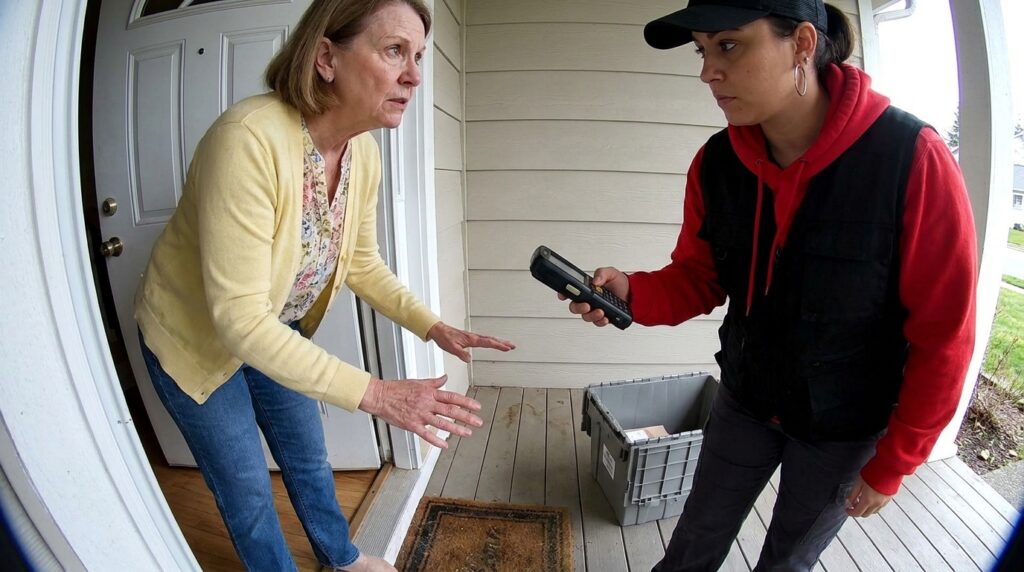
Maya didn’t flinch. Her boots remained anchored to the third concrete step of 412 Cedar Lane, her knees slightly bent under the familiar weight of the grey plastic delivery tote resting beside her shin. Above her, framing the doorway like a sentinel, stood Brenda. Early sixties, slim, wearing a pale yellow cardigan that looked too heavy for July over a faded floral blouse. Her hands weren’t tucked away or resting on the doorframe; they were spread wide at waist height, open-palmed, physically occupying the four feet of concrete space between the porch railing and the entrance.
Between them, suspended in the narrow gap of air, was Maya’s right hand, holding the black handheld delivery scanner. The screen glowed with a faint digital green, displaying the delivery address, the active GPS lock, and a countdown timer ticking down the seconds allotted for this stop.
Maya’s thumb hovered over the physical scan trigger. In her red hoodie and black work vest, her dark hair pulled tight under her ballcap, she felt the familiar prickle of heat behind her eyes—the accumulated friction of eight hours on the asphalt, forty-two dropped packages, three gated entries with wrong codes, and the quiet, persistent erasure that came with wearing a high-visibility vest in a neighborhood where every lawn was manicured to an identical half-inch.
Brenda leaned forward, her short blonde bob shifting, her jaw set into a hard, defensive line. Her eyes weren’t looking at the box inside the tote; they were fixed on Maya’s face, searching for a twitch, a sneer, a sign of disrespect to justify the tremor in her own voice.
“You’ve been sitting out on that curb for three minutes,” Brenda said, her voice dropping into a lower, venomous register, though her spread palms shook slightly against the fabric of her cardigan. “Checking your phone. Staring at my front window. You think I don’t see you people? You think because you carry a scanner you own the sidewalk?”
Maya kept her lips pressed together. The scanner in her grip felt heavy, its rubberized casing warm from the sun. Across the cul-de-sac, a lawnmower sputtered and died, leaving only the low hum of distant highway traffic and the ambient heat rising off the driveway. Above Brenda’s left shoulder, the tiny lens of a black doorbell camera blinked once with a steady, cold blue light, recording the physical footprint of the porch.
Maya didn’t lower the scanner. She didn’t take a step back down the stairs. Instead, she adjusted her grip, raising the screen just two inches higher, bringing the glowing address verification directly into the line of sight between Brenda’s spread hands and her own chest.
“I’m just doing my job, ma’am,” Maya said.
Her voice didn’t rise to meet Brenda’s pitch. It was flat, grounded, carrying the precise, unhurried cadence of someone who had repeated those six words on fifty different porches in fifty different towns.
Brenda’s chest heaved. For a fraction of a second, the open-palmed blocking gesture faltered, her left fingers curling inward as if to grasp at something that wasn’t there. Her eyes dropped from Maya’s face down to the scanner screen, where the red laser diode flickered once, catching the barcode on the parcel inside the grey tote.
Then Brenda’s gaze slid past the screen to the small white return-address label stuck beneath the main barcode—and the color drained from her face so fast it looked as if the porch light had shifted.

CHAPTER 2: THE PORCH LANE
The color didn’t just leave Brenda’s face; it seemed to drain downward into the yellow weave of her cardigan, leaving her skin the gray-white hue of salt-cured lard.
Her palms remained extended in that wide, rigid blocking gesture, but her elbows buckled half an inch, lowering her posture from an aggressive stance into something precarious and off-balance. For a second, the quiet between them was so absolute that Maya could hear the faint, dry click of Brenda’s throat as she tried to swallow.
“Where did you get that?” Brenda asked. Her voice lacked the sharp, brassy rasp it had possessed three seconds ago. It was thin now, frayed at the edges like an old towel washed too many times.
Maya didn’t lower the handheld scanner. The green glow of the screen reflected off the metallic hoop of her right earring, casting a cool, square-shaped highlight against her jawline. She kept her eyes level, locked on the bridge of Brenda’s nose, refusing to look down at the label herself. She didn’t need to read it. She knew the shape of those specific orange-and-white high-priority barcode stickers; she’d sorted forty of them in the dim light of the distribution depot at five this morning.
“It’s in the system, ma’am,” Maya said softly. She kept her tone inside the narrow, professional register mandated by the district metrics—neither hostile nor apologetic. “Certified routing. Requires a digital signature or a logged visual confirmation of drop at the primary threshold.”
“You… you aren’t supposed to have that,” Brenda whispered. Her eyes darted past Maya’s shoulder toward the empty cul-de-sac. Across the asphalt, a neighbor’s sprinklers began their rhythmic, hissing sweep, casting fine white mist over a freshly manicured lawn. “That’s… that’s personal mail. That’s a private matter.”
“It’s a package,” Maya corrected gently. “Item ending in four-nine-eight-two. I’m the courier assigned to the route.”
Brenda’s left hand slowly collapsed from its wide stance. Her fingers reached out to grasp the edge of the screen door, her knuckles turning white as she anchored herself against the aluminum frame. As the door shifted inward an inch, the afternoon light slipped past her hip, illuminating the dark foyer behind her.
There, hanging on a brass hook just inside the entryway, was an object that didn’t fit the pristine, sterile aesthetic of Cedar Lane. It was a heavy, faded blue canvas satchel, its leather shoulder strap cracked and darkened by decades of sweat, the brass hardware oxidized into a dull, chalky green. It was the exact shade of US Postal Service issue canvas from thirty years ago—scuffed, stained, and worn thin at the bottom seam where heavy flats of mail had rubbed against someone’s hip for thousands of miles.
Maya’s eyes flicked to the satchel for a fraction of a second before returning to Brenda’s pale face.
Brenda caught the movement. A sudden, sharp tremor ran through her shoulders, and her posture snapped back into a brittle, defensive rigidity. She pulled the yellow cardigan tighter around her floral blouse, cross-stitching her arms over her chest as if trying to physically cover the view into her hallway.
“I know what you’re doing,” Brenda spat, though the venom lacked its earlier force, sounding instead like panicked static. “You stand out there with your little computer, taking pictures of my porch, checking my door, writing down who comes and goes. You think because I’m by myself out here I don’t know how this works? You report back to the office. You tell them the lawn isn’t swept. You tell them the paint on the shutter is peeling.”
Maya didn’t answer right away. She lowered her gaze slightly, taking in the small, physical truths of the porch floor between them. The concrete steps were immaculate, scrubbed clean with bleach, but near the threshold, in the narrow gap where the floor met the house foundation, a tiny line of dry rot had begun to eat into the trim. A single, unread local shopper paper lay rolled up under the iron bench near the wall, its plastic wrapping yellowed and brittle from weeks of direct sunlight.
This wasn’t an aggressive property owner guarding a kingdom. It was a woman barricading a crumbling fortress with her own body.
“I don’t report on your shutters, ma’am,” Maya said, her voice dropping another octave into a quiet, grounded resonance. “I have eighty-four stops left before my five o’clock scan deadline. If I miss my window, the algorithm docks my route tier, and I don’t get the weekend shifts. I don’t care about your shutters. I care about this barcode.”
Maya stepped forward one half-inch—not an aggressive move, but a shift of weight onto her front boot, resting the heavy grey plastic tote securely on the second step. She turned the scanner so the digital signature pad faced Brenda directly.
“I need you to press your finger on the screen to confirm receipt,” Maya said. “Or I log it as an uncollected threshold attempt, leave the notice on the handle, and the system automatically flags it for secondary service tomorrow morning.”
Brenda stared at the small glass screen. The green light washed over her lined forehead, highlighting the faint, dry crow’s-feet around her eyes. Her lips parted, but no sound came out. She looked at the scanner, then at Maya’s red hoodie, then down at the worn canvas tote sitting on her pristine step.
For three long seconds, the suburban silence settled over the porch like heavy wool.
Brenda’s hand lifted slowly from her chest. Her forefinger trembled in the warm air, reaching toward the glass display like someone dipping a toe into freezing water. But just as the tip of her nail hovered an inch from the screen, a loud, sharp chiming sound erupted from inside the house—a high-pitched electronic alert from the security console mounted in the hall, indicating a motion trigger from the driveway.
Brenda jerked her hand back as if the scanner had burned her. She turned her head toward the street, her eyes widening in pure, unadulterated panic.
Down at the mouth of the driveway, a dark gray sedan with tinted windows had pulled up to the curb, its engine idling with a low, throaty rumble.
CHAPTER 3: THE WATCHING CURB
The low, guttural thrum of the sedan’s exhaust vibrated straight through the concrete porch steps, shuddering in the soles of Maya’s work boots.
Brenda didn’t just freeze; she shrank. Her chin tucked tightly toward her neck, her hands flying instinctively to the lapels of her pale cardigan, pulling the thin cotton knit over her chest as if wrapping herself in armor against the glare of the tinted windshield idling fifty feet away.
“Get off my porch,” Brenda whispered. The panic in her voice had turned brittle, laced with a raw, cornered fury. “Get your tote and get down there. Right now.”
Maya didn’t shift her feet. Her posture stayed rooted to the concrete, her weight balanced evenly, though her heart gave a heavy, deliberate thump against her ribs. She looked from Brenda’s pale, trembling lips down to the street.
The dark gray sedan sat perfectly parallel to the curb, its passenger-side window rolling down with a smooth, mechanical whir. Sunlight glinted off the polished chrome trim, catching the silhouette of a man in his mid-forties wearing a crisp, unbuttoned navy blazer over a white polo. On the leather passenger seat beside him lay a thick, brass-trimmed vinyl binder, its white legal tab sticking out like a marker on a battle map.
“Mom!” the man called out across the manicured lawn. His voice wasn’t raised in a shout; it was practiced, smooth, carrying the hollow resonance of a corporate representative addressing a crowd through a microphone. “Is there a problem up there? Do you need me to step out?”
Brenda’s jaw worked silently. A red, blotchy stain flared across the base of her throat, creeping up toward her ears. She didn’t look at the sedan. She kept her eyes locked on Maya’s scanner, her breathing coming in shallow, ragged gasps.
“No, Greg,” she called back, her voice cracking on the first syllable before forcing it into an uncomfortable, artificial calm. “It’s… it’s just the delivery. She’s dropping a package.”
Maya took in the scene with a cold, observational sweep—the crisp navy blazer, the idling sedan blocking the mail delivery path, the brass-trimmed binder, and the way Brenda’s knuckles turned white where she clutched her cardigan. Greg wasn’t a stranger. He was family, or as good as family, operating with the cold authority of an attorney who had drawn up documents in a carpeted conference room ten miles away.
Greg shifted in the driver’s seat. His left arm rested casually along the open door frame, a heavy silver wristwatch catching the harsh July glare. “Because if she’s harassing you or refusing to leave the property, Mom, you just have to say the word. I’ve got the inspector’s deputy on speed dial. We can have the route supervisor here in five minutes.”
The word harassing hung in the muggy air between the porch and the curb, heavy and weighted with implied threat.
Maya felt the blood rush to her knuckles where she gripped the rubber casing of her scanner. She’d heard that tone before—the smooth, litigious cadence of a man who knew exactly which magic words triggered administrative investigations, route suspensions, and unpaid leave. One complaint from a clean-cut man in a gray sedan, backed by a distraught homeowner, and the district dispatcher would pull Maya off the road before her shift ended.
“No one is harassing anyone, sir,” Maya said. Her voice didn’t carry across the lawn; she spoke directly to the air between herself and Brenda, keeping her volume low enough that Greg had to lean slightly out his window to catch the rhythm of her words. “I am fulfilling a trackable service order.”
She turned her body three inches to the left, angling her shoulder to shield Brenda from Greg’s direct line of sight. It was a subtle physical adjustment, but it created a narrow, private corridor on the porch—a private pocket between the red fabric of Maya’s utility vest and the front doorframe.
“Ma’am,” Maya said softly, her eyes holding Brenda’s panicked gaze. “If I log this as a refusal, he gets a digital receipt on his portal within ninety seconds stating that delivery was attempted and denied by the occupant. That notification triggers an automatic compliance review under county filing protocol.”
Brenda’s eyes widened. She looked at Maya, really looked at her—not as an invasive stranger in a high-visibility vest, but as someone who understood the precise, unrelenting mechanics of administrative paperwork.
“You know what that envelope is,” Brenda whispered, her lips barely moving.
“I know what a certified priority manifest looks like when it comes out of the depot vault,” Maya answered, her voice barely a breath above the hum of the sedan’s engine. “And I know that once I press ‘Complete,’ the paper trail is sealed. Nobody can edit a timestamp once it hits the central server. Not Greg. Not the district supervisor. Nobody.”
From the street, the sound of a car door opening snapped through the heat. Greg stepped out of the sedan, adjusting his navy blazer over his chest as he took two slow, deliberate paces onto the edge of the driveway apron. His polished leather shoes clicked against the concrete.
“Mom,” Greg said, his voice tightening with an edge of impatience. “What’s taking so long? Hand her the tote if she needs it, or tell her to step off the walkway. We have the three o’clock walkthrough scheduled.”
Brenda’s chest rose and fell in a long, shuddering inhalation. Her gaze flicked to the blue canvas postal satchel hanging just inside her dark hallway, then down to Maya’s scanner screen, where the barcode digits shimmered in green light.
“Give me the pen,” Brenda said quietly.
Maya didn’t offer a pen; she raised her thumb and tapped the digital touch-stylus button on the side of the scanner, handing the lightweight plastic pointer to the older woman.
Brenda took it. Her hand was cold against Maya’s fingers for a fraction of a second—a quick, dry touch that felt like paper. She lifted the stylus toward the glass pad, her elbow shaking as she prepared to trace her mark across the screen, right as Greg’s heavy footsteps began their steady climb up the front walkway.
CHAPTER 4: THE SHIELD AND THE SCAN
The tip of the stylus made a faint, dry drag across the scanner glass.
Brenda’s hand shook so violently that her first attempt produced only a jagged dot of black digital ink in the bottom left corner of the signature box.
“Mom, put that down,” Greg called out, his leather soles snapping hard against the third concrete step. The smooth, practiced cadence of his voice had evaporated, replaced by a sharp, commanding edge. “Do not sign anything from that courier until I inspect the bill of lading.”
Maya didn’t turn around. She kept her back square to Greg, using her shoulders and the bulk of her black work vest to block the step behind her. With her left hand, she steadied the base of the scanner, holding it firm so Brenda had a solid surface to press against.
“Steadily, ma’am,” Maya said under her breath, keeping her eyes locked on the screen. “Just a cross or a line. The system only requires a unique human mark.”
Brenda’s teeth pressed into her lower lip until the pale skin turned white. With a sudden, desperate jerk of her wrist, she dragged the stylus across the glass, leaving a long, sloping loop that cut through the center of the confirmation window.
Greg reached the second step right behind Maya, his shadow falling heavily over her shoulder. His hand darted out to grab the edge of the scanner casing. “I said stop!”
Maya didn’t pull back aggressively; she simply pivoted her right hip, letting her weight transfer smoothly into her back boot. The movement brought her shoulder into firm contact with Greg’s arm, checking his momentum without throwing a blow. The physical friction was brief—cloth against cloth, the heat of his dry-cleaned sleeve pressing against the rough nylon of her vest—but it held him back just enough.
“Hands off the device, sir,” Maya said. Her voice wasn’t raised, but it carried the cold, dense authority of a federal transit worker on duty. “Interfering with an active handheld terminal during a logged transaction is a municipal offense.”
Greg recoiled an inch, his mouth opening in shock at her refusal to yield. “I am the appointed power of attorney for this property!”
“And this terminal belongs to the regional logistics authority,” Maya replied instantly, her thumb already descending onto the green ‘ENTER’ key.
The scanner emitted a sharp, high-pitched double beep—beep-beep.
On the screen, the green text flashed: TRANSACTION COMPLETE / TIMESTAMPED 14:32:09 / RECORD SEALED.
A quiet sigh escaped Brenda’s throat, a sound so soft it was almost lost beneath the hum of the air conditioner unit cycling on beside the porch. She dropped the stylus, her hand falling back to clutch the lapel of her yellow cardigan.
Maya reached into the grey plastic tote resting on the step. Her fingers closed around the parcel—a thick, stiff, water-resistant envelope reinforced with fiberglass string. As she lifted it out, the afternoon sun caught the crisp black text on the front.
The top line didn’t read Foreclosure Notice. It didn’t bear the seal of the county sheriff or the tax assessor’s stamp.
In bold, razor-sharp type, the sender address was listed as:
UNITED STATES POSTAL SERVICE — REGIONAL OVERSIGHT DIVISION / OFFICE OF ANNUITY AND BENEFIT AUDITS.
Directly beneath it, printed in bright red ink across the margin, was the secondary routing tag:
CERTIFIED NOTICE OF ADMINISTRATIVE RESTORATION & UNCLAIMED BACK PENSION RELEASE.
Maya paused, her thumb resting right over the word RESTORATION.
Layer 1—the assumption that Greg was here with an eviction crew to tear this woman’s home away from her—shattered in an instant. Greg wasn’t an aggressive bank officer trying to seize a deed. The binder under his arm wasn’t a foreclosure portfolio; it was a private conservatorship filing designed to claim administrative control over Brenda’s uncollected federal pension before the state audit finalized the release to her directly.
Greg saw Maya’s eyes linger on the red lettering. His face went instantly flush, his smooth composure breaking into a tight, desperate sneer. He lunged forward, extending his hand over Maya’s shoulder. “Give me that. I hold the file.”
“The package is addressed to Brenda M. Vance,” Maya said calmly.
She didn’t hand the envelope to Greg. She didn’t drop it on the floor. With a smooth, deliberate motion, Maya stepped past Greg’s reaching hand and placed the heavy envelope squarely into Brenda’s open, trembling palms.
“Delivery verified, Mrs. Vance,” Maya said softly, looking the older woman dead in the eye. “The paper trail is logged to your personal file. It’s in your hands now.”
Brenda looked down at the red lettering on the envelope. Her fingers brushed over the raised fiberglass threads of the seal, and for the first time since Maya had walked up the porch steps, the tense, defensive lines around her mouth softened into something fragile and ancient.
Greg stood on the top step, his arm still half-extended in mid-air, looking from the envelope to the glowing scanner in Maya’s grip. Across the quiet cul-de-sac, the neighbor’s sprinkler clicked off, leaving the porch in an absolute, suffocating silence.
CHAPTER 5: THE SYSTEM RECOIL
The scanner in Maya’s palm vibrated—a long, continuous buzz that rattled through the plastic housing and pulsed against her thumb.
The screen flickered, the green text vanishing behind a bright orange system alert: ROUTE OVERRIDE INITIATED — DISTRICT DISPATCH CALLING.
Greg looked down at the orange glow, a thin, triumphant smile cutting across his sharp features. He didn’t reach for the envelope in Brenda’s hands anymore; he reached into his navy blazer, pulling out a slim silver smartphone already showing an active call screen.
“I told you,” Greg said, his voice dropping into a low, controlled register that felt far more dangerous than his earlier shouting. “You interfered with a legal estate proceeding. I’ve got Dispatcher Miller on the line right now. You’re going to hand that scanner over so he can void the transaction hash, or your contract is terminated before you reach the end of the block.”
Maya looked at the orange blinking light on her terminal. The district dispatcher. Miller was a numbers man who sat in a air-conditioned cubicle twenty miles away, managing three hundred routes on a digital map. To Miller, Maya wasn’t a person on a porch; she was a blue dot moving three minutes behind schedule. If Greg gave Miller a reason to suspect a dispute, Miller would hit the remote override, flag Maya for a safety review, and freeze her pay account until Monday.
Her thumb hovered over the decline button on her scanner. If she dropped the call, it was insubordination. If she answered it, Miller would order her to retrieve the parcel from Brenda’s hands and place it in Greg’s possession to avoid “liability.”
Behind them, Brenda’s fingers tightened on the heavy envelope. The stiff fiberglass paper creaked under her grip.
“Greg,” Brenda said. Her voice wasn’t loud, but it had lost the hysterical edge from ten minutes ago. It carried a strange, heavy weight that made Greg’s eyes flick back to her face. “Put the phone away.”
“Mom, stay out of this,” Greg snapped, his eyes remaining fixed on Maya’s terminal. “You don’t understand what she just did. She logged an official receipt with the federal database. Once that record clears the system, the state audit freezes the conservatorship petition. All the paperwork I filed for the past six months goes into administrative review.”
“I know what she did,” Brenda said softly.
She took a step forward—not back into the shadowed doorway, but out onto the sunlit concrete of the top porch stair, standing right beside Maya. The yellow cardigan hung loose around her shoulders, exposed to the humid glare of the cul-de-sac.
Brenda raised her left hand, lifting the heavy fiberglass envelope until the red-stamped return address sat three inches from Greg’s face.
“You knew this was coming,” Brenda said, her voice trembling slightly, but rooted in an unshakeable, quiet clarity. “You knew the Regional Oversight Division was finalizing the audit on the thirty-year clerk annuities. You knew my back pension was being released to me directly.”
Greg’s jaw tightened. “Mom, you couldn’t handle the filing. You can’t even manage the HOA letters. You leave them unopened under the iron bench!”
“Because every letter that comes to this door feels like a threat!” Brenda’s voice cracked, spilling out across the silent lawn. “Every knock, every car idling at the curb! For five years, every time someone stood on these steps, they were telling me I owed something, or I did something wrong, or I didn’t fit the rules anymore!”
She turned her head slowly, looking at Maya.
Maya stood motionless, holding the vibrating scanner down at her hip, listening to the raw, unpolished truth pouring out of the older woman.
Brenda looked at the red utility vest, the dark ballcap, the dark circles under Maya’s eyes, and the scuffed plastic of the delivery tote sitting on the second step. Then, Brenda reached into the open doorway behind her. Her hand brushed past the edge of the screen door and reached inside the hall, her fingers closing around the brass hook.
She didn’t pull out a document or a key. She pulled down the heavy, faded blue canvas postal satchel.
The cracked leather strap creaked as Brenda lifted it into the light. Near the top fold of the blue canvas, pinned to the inside pocket lining, was a small, tarnished piece of metal—a thirty-year USPS service pin, its gold plating worn down to the dull gray nickel underneath.
Maya’s breath caught in her throat.
The realization hit her like a cold draft on a hot afternoon. Brenda wasn’t just a defensive homeowner hiding behind her property line. She was a former carrier. She was a clerk who had spent three decades behind the iron-grilled counters of the old main branch, enduring the same screaming customers, the same rigid metrics, the same endless line of angry faces blaming her for their lost mail, until her own mind had turned every visitor into an enemy.
Greg stared at the satchel, his face turning an ugly, mottled red. “Mom, put that old trash away. You’re making a scene in front of the neighbors.”
“I carried this bag for thirty years, Greg,” Brenda said, her voice dropping into a deep, gravelly quiet. “And I know what it means when someone stands on a porch in a vest, just trying to finish their route.”
Brenda turned back to Maya. She reached out with her free hand, her fingertips touching the cold plastic edge of Maya’s vibrating scanner.
“Answer your phone, child,” Brenda whispered, her eyes shining with unshed tears. “Put him on speaker.”
Maya looked at Brenda, then down at the screen where the orange light continued to flash. She didn’t press decline. She slid her thumb across the green bar and pressed the speaker icon, bringing the terminal up between the three of them.
“Courier 409,” Dispatcher Miller’s tinny, mechanical voice burst through the small speaker, sharp and impatient. “We’re tracking a five-minute stationary hold on Cedar Lane. Is there a refusal or a safety incident? Speak clearly for the log.”
Greg leaned in toward the terminal, opening his mouth to speak, but Brenda stepped directly into his path, her faded blue satchel pressed against her side like a shield.
CHAPTER 6: THE SHARED ANCHOR
“Courier 409, report status immediately,” Miller’s voice squawked through the tinny speaker of the terminal, flat and stripped of human inflection by miles of digital compression.
Greg’s hand shot across the space between them, his fingers curling toward the scanner’s top housing to press the red disconnect button. “Dispatcher, this is Gregory Vance, legal representative—”
Brenda didn’t yell. She didn’t raise her arm to strike. She simply shifted the weight of the blue canvas satchel, bringing the cracked leather strap up between Greg’s wrist and the terminal. The dry, aged leather met his forearm with a dull thud, stopping his reach dead in mid-air.
“This is Brenda Vance,” she said into the speaker. Her voice was firm now, quiet and resonant, carrying the exact vocal rhythm of someone who had spent thirty years answering dispatch calls from a postal counter. “Employee ID 4108, retired, Main Branch. Courier 409 is standing on my porch. She has delivered item four-nine-eight-two under certified protocol. The transaction is complete and verified by signature.”
Silence stretched through the tiny speaker. For two agonizing seconds, the only sound on the porch was the faint hiss of static and the low thrum of the idling sedan down at the curb.
“Employee… 4108?” Miller’s tone shifted slightly, the mechanical edge softening just enough to reveal a human pause. “Brenda Vance… from the regional central sorting depot?”
“That’s right, Dispatcher,” Brenda said, her fingers curling tightly around the satchel’s shoulder strap. “And I know the delivery window rules as well as you do. Courier 409 has eighty-four stops remaining and twelve minutes to clear her current zone. Clear her status on your board.”
Greg’s face turned from red to an ash-gray pale. “Mom, what are you doing? You’re letting her file the audit receipt! If that record hits the state database, my petition is voided!”
“The petition was always void, Greg,” Brenda said, turning her head slowly to look at him. There was no anger in her eyes now—only a profound, exhausted sadness that made her look fragile, yet impossible to push aside. “You didn’t come here to protect my house. You came because you thought I was too tired, too scared of the letters and the knocks, to realize that the thirty years I gave to those counters belonged to me. Not to your estate plan.”
Greg opened his mouth, but no sound came out. He looked at the heavy fiberglass envelope resting in Brenda’s left hand, then at the tarnished brass service pin gleaming faintly on the satchel’s inner seam. The crisp, litigious authority that had carried him up the porch steps seemed to evaporate into the humid afternoon heat, leaving him standing there in his navy blazer looking like a stranger on a porch he had never truly known.
“Clear,” Miller’s voice crackled through the terminal. “Route 409 status updated to green. Good afternoon, Mrs. Vance. Thank you for your service.”
The terminal beeped once, closing the line. The orange override screen dissolved back into the familiar green main menu, displaying the route progress bar jumping from 42% to 43%.
Maya lowered the scanner to her side. The plastic housing felt cool now against her palm. She looked at Brenda, seeing past the yellow cardigan, past the tense lines of defensive isolation that had guarded this porch for years, and saw the shared thread connecting them both—the quiet, grueling endurance of a life spent carrying the weight of public demands without ever dropping the bag.
Greg stepped backward down the first concrete stair, his leather shoes making a hollow, scraping sound against the step. He didn’t look at Maya, and he didn’t address Brenda again. He turned, his shoulders hunched, and walked briskly down the driveway toward his idling sedan.
Brenda didn’t watch him go. She lowered the blue canvas satchel, letting it rest gently against her knee, and held the heavy fiberglass envelope against her chest like a shield that had finally served its purpose.
Maya reached down to the second step and lifted her grey plastic tote. The handles were hot from the sun, but the weight inside felt lighter now.
“Thank you, 408,” Maya said softly, using the old department handle.
Brenda looked up, a small, genuine smile touching the corners of her lips for the first time—a faint, tired expression that erased the years of bitterness from her face. “Watch your clock, 409. You’ve got eighty-four stops left.”
CHAPTER 7: THE UNBROKEN HORIZON
The door of the gray sedan slammed shut with a heavy, airtight thud.
Down at the mouth of the driveway, the engine revved, the tires crunching over stray gravel as Greg backed out without looking toward the porch. He didn’t check his rearview mirror for his mother; he didn’t wait for the garage door to close. Within seconds, the car rounded the curve of the cul-de-sac, its dark metallic shell swallowed by the shimmering heat waves rising off the suburban asphalt.
On the top step of 412 Cedar Lane, Brenda stood alone.
Her fingers were still wrapped tightly around the edge of the fiberglass envelope, holding the red-stamped postal audit against her floral blouse like a shield she had carried for thirty years. The pale yellow cardigan hung soft and quiet over her shoulders, no longer pulled tight across her chest in panicked defense. Beside her hip, the blue canvas satchel hung from its brass hook, its tarnished service pin catching the sharp, golden slant of late-afternoon light.
Maya didn’t offer a final speech. She didn’t offer a grand declaration of victory. The rhythm of the road didn’t allow for speeches, and neither did the six-digit clock ticking in the upper corner of her scanner screen.
She picked up the plastic delivery tote by its handles, the heavy-duty molded nylon flexing under her grip. As she backed down the concrete stairs, her boots made a steady, rhythmic tap against each step—three short steps, landing squarely on the concrete apron of the front walkway.
She paused at the bottom, turning back just once.
“Have a good afternoon, Mrs. Vance,” Maya said.
Brenda didn’t retreat inside her house. She didn’t pull the screen door shut to hide behind the curtains. She stood in the full glare of the afternoon sun, her head held up, looking down the long, manicured stretch of Cedar Lane.
“Drive safe, 409,” Brenda called out, her voice clear and unbroken. “Watch the intersections on 4th Street. They always rush the light around five.”
Maya nodded once, a brief, silent gesture beneath the brim of her ballcap.
She turned and walked down the driveway toward her delivery truck, parked under the shade of an overgrown oak tree at the curb. The heavy aluminum side door stood open, revealing the stacked metal shelving inside—row upon row of brown cardboard boxes, plastic mailers, padded envelopes, and heavy freight totes waiting for the remaining eighty-four stops of her shift.
As Maya stepped into the cab, the heat inside the truck hit her—a dense, familiar wall of warm air smelling of diesel exhaust, hot vinyl, and cardboard dust. She slid the heavy plastic tote onto the sorting shelf, set her handheld scanner into its dash-mounted charging dock, and reached for the ignition key.
The engine turned over with a rough, metallic roar, vibrating through the floorboards and into the soles of her boots.
On the dash display, the GPS map recalculated her route automatically, plotting a thin blue line that pointed out of Cedar Lane, onto the main artery of the district, and toward the endless grid of residential streets beyond.
Maya looked into her side mirror.
In the small convex glass, 412 Cedar Lane was already shrinking. She could see the pristine lawn edges, the iron bench, and the quiet front porch. Brenda was still standing at the threshold, holding her envelope, a solitary figure framed against the pale siding of her house, no longer barricaded behind her door, but claiming the space she had earned over a lifetime of service.
Above the porch door, the small black lens of the security camera blinked once with its steady blue light—no longer an instrument of silent intimidation, but an unblinking witness to a boundary that had finally been held.
Maya pulled her ballcap down slightly to block the glare of the setting sun, clicked the gear lever into drive, and pressed her foot down on the accelerator. The truck rolled forward into the afternoon heat, carrying the quiet weight of restraint out onto the open road.