The Weight of the Iron Pin: How Thirty Years of Quiet Silence Broke a Neighborhood’s False Empire

CHAPTER 1: THE TURNOUT

The air smelled of damp cedar and stale exhaust. Julian Vance left the diesel idling, letting the vibration hum through the floorboards of his utility flatbed while he waited for the smoke to clear behind his eyelids. Across the asphalt of the county road, the suburban sprawl of Lakewood Ridge pressed tight against his fence line like a concrete tide trying to find a low spot in the dike.

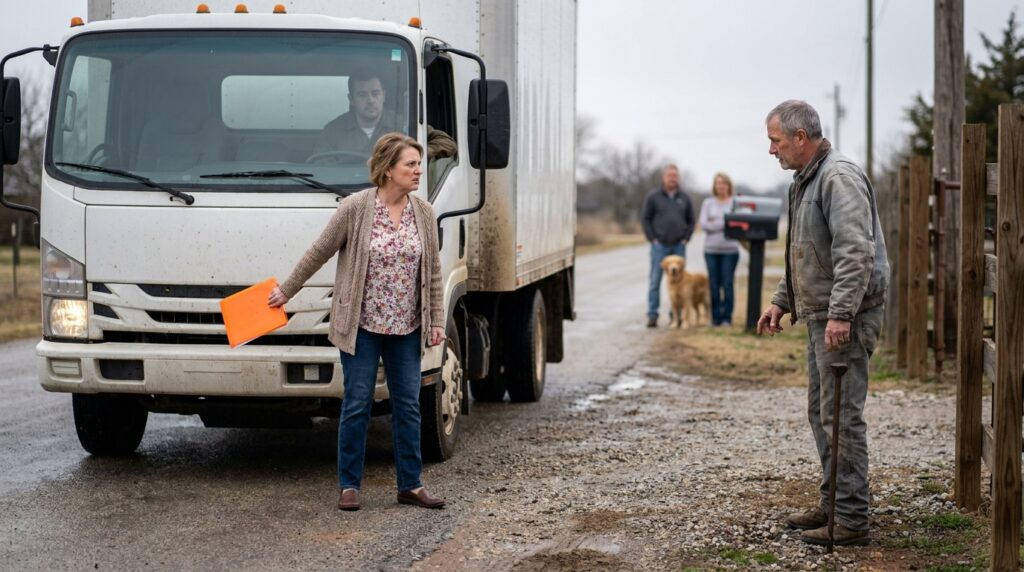
Brenda Sterling stood squarely in the center of the gravel entrance, her floral print blouse looking entirely foreign against the gray mud and the rough-hewn posts his grandfather had sunk into the earth forty years ago. She had a laminated clipboard clutched under one arm like a shield, and her fingernails tapped a rhythmic, impatient tattoo against a neon-orange violation notice. Behind her, a commercial box truck idled with an anxious hiss of air brakes, its driver slumped over the steering wheel, wishing himself anywhere else in the world.

“Mr. Vance,” Brenda called out, her voice pitched to carry over the heavy rumble of the diesel. She didn’t step back when Julian eased the truck forward by six inches, a calculated nudge of momentum that made her sunglasses slip an eighth of an inch down the bridge of her nose. “You have been notified twice by electronic portal. This access lane is designated as community common-transit under the updated district code. You cannot park, load, or drive commercial-grade equipment across this apron without an active gate permit and a thirty-dollar daily waiver.”

Julian didn’t shout. He didn’t slam the door or curse the gray sky. He shifted the transmission into park, pulled the handbrake with a solid mechanical click, and cut the engine. The sudden silence that rushed into the cab was heavier than the noise had been.

He pushed the door open, his boots hitting the damp gravel with a dull, familiar crunch. At sixty-two, his joints registered the morning damp before his mind did, but his posture remained square—the steady, unyielding stance of a man who had spent thirty years dispatching freight cars on split-second schedules where a single miscalculation could derail a mile of steel.

Across the road, two neighbors walking a golden retriever stopped dead near the mailbox array, lowering their coffee cups to watch the theater unfold. Brenda leaned forward, her chin tilted up with the practiced martyrdom of someone accustomed to getting her way through sheer volume of paperwork.

“You’re holding up the contractor delivery,” she snapped, gesturing sharply toward the box truck behind her. “Sign the compliance waiver, pay the administrative fee at the clubhouse desk, or turn your vehicle around right now. We are not going to let your unmanaged property depreciate home values along this corridor another day.”

Julian reached down slowly, brushing a fleck of dried mud off the cuff of his faded canvas work jacket. He didn’t look at the clipboard. He looked past Brenda’s shoulder, past the idling truck, toward the cluster of administrative buildings sitting on the low rise fifty yards away—buildings that sat on land his family had owned since the Eisenhower administration.

A small, cold realization settled behind his ribs, sharp as a rusted nail.

“Brenda,” Julian said, his voice dropping an octave into a low, flat register that carried easily across the ditch. “Take a look at the ground beneath your left heel.”

She blinked, her pen pausing mid-tap. “What?”

“That iron pin,” Julian said, his gaze fixed on the asphalt seam near her shoe. “It’s been there since Jimmy Carter was in office. And every inch of pavement you’re standing on right now stops about four feet short of where you think it does.”


CHAPTER 2: THE GREEN FOLDER

The gravel driveway stayed dead silent for three long seconds after the name of the county surveyor was dropped into the dust. Brenda Sterling’s jaw tightened, the neat pink line of her lips thinning into a hard seam as she looked down at the asphalt seam near her heel. She didn’t move her foot, as if shifting her weight might somehow alter the subterranean geography laid down forty years before she ever bought her first townhouse down the hill. Behind her, the delivery van’s engine let out a low, impatient shudder.

“That’s a county road easement, Mr. Vance,” Brenda said, her voice rising an octave to recapture the public performance she had started. “The board had the civil engineers map every foot of this corridor last November. You don’t get to rewrite property lines with a folk tale about a dead president.”

“Jimmy Carter didn’t set that pin, Brenda,” Julian said softly. He didn’t raise his voice; shouting was for men who weren’t sure of their ground. “A surveyor named Miller did, using iron salvaged from the old Northern Pacific rail spur. If you scrape the silt off the top with your car key, you’ll still see his stamp.”

He turned his back on her before she could find an answer, climbed back up into the high cab of the flatbed, and dropped the gear into low. He didn’t rush. He let the truck crawl backward into the shade of the hickory trees, clearing the apron entirely so the frustrated delivery driver could swing wide and rumble up toward the subdivision. Brenda stood stranded on the gray edge of the asphalt for a moment longer, her clipboard clutched like a weapon that had suddenly lost its edge, before she spun on her heel and marched back toward the administrative complex.

Julian didn’t watch her go. He parked the flatbed beside the weathered barn, unlatched the heavy wooden tailgate, and carried two newly split cedar posts across the damp grass toward the eastern fence line.

The physical labor was a habit older than the subdivision, older than the county’s incorporation, older even than his own memory. Every swing of the heavy framing hammer drove the rusted point deeper into the stubborn clay, sending a dull shock up through his forearms and into his shoulders. The air smelled of crushed thistle and dry pine needles. It was the smell of a place that asked for nothing except endurance.

Yet, as the sun climbed higher, casting short, sharp shadows across the property line, the rhythmic strike of the iron mallet felt less like maintenance and more like a metronome ticking down an inevitable collision.

When the sun hit its zenith, Julian dropped the hammer into the dirt, wiped his palms against the thighs of his canvas trousers, and walked back toward the house. The kitchen was cool, dim, and smelled of chicory and old floor wax. The house had been quiet since his wife passed three winters ago, a quiet that he usually welcomed, but today the silence had a different texture—the tight, compressed air before a summer squall.

He walked past the scrubbed pine table and pulled open the second drawer of the heavy steel filing cabinet tucked into the pantry alcove. His fingers brushed past tax receipts, seed warranties, and equipment manuals until they found what they were looking for: a worn, dark green cardstock folder labeled simply Lease 1978 Callaway.

The cardboard corners were soft and frayed, chewed by time and decades of humid Oklahoma summers. He carried it to the table, sat down, and pulled off the faded rubber band that held it shut.

Inside, the papers were yellowed to the color of old ivory. He didn’t have to search for the specific page. He had looked at it enough times as a boy while his father explained the mechanics of survival against a changing county. He turned directly to page four, section seven, clause three.

Any assignment, sublease, or transfer of interest in the leased acreage situated on the western quarter-section shall be null and void without prior written acknowledgment and notarized signature executed directly by the landowner or their designated direct heirs.

Julian traced the faded blue ink of his grandfather Solomon’s signature with the tip of his thumb. Then he looked at the stapled rider attached to the back—the 2001 transfer document where Callaway Development had casually handed over its leasehold interest to the newly minted Lakewood Ridge Homeowners Association. The lines for the landowner’s signature were completely blank. Not forged. Just ignored. A shortcut taken by a developer who assumed an old man on a lake ranch wouldn’t notice, or wouldn’t care, about eighteen acres of scrub timber and gravel access.

He closed the folder gently, the dry scrape of paper sounding loud in the quiet kitchen.

The door chime didn’t ring—the house was too old for chimes—but the heavy iron knocker on the front screen door rapped twice. Sharp. Authoritative.

Julian didn’t get up immediately. He looked at the green folder resting beside his coffee mug, then at the single window facing the front porch. A shadow cut across the rippled glass of the screen door, neat and square-shouldered, wearing a uniform that didn’t belong to the neighborhood kids or the county road crew.

He stood up, his joints popping dryly in the quiet room, and walked out to the hallway.

Sheriff’s Deputy Marcus Reed stood on the porch, his hand resting casually near his duty belt, looking out over the overgrown pasture with the practiced, neutral expression of a man who spent his entire shift mediating boundary disputes between people who had shared fences for fifty years. When Julian unlatched the screen door and pulled it open, Reed gave him a small, tight nod.

“Morning, Mr. Vance,” the deputy said, his voice flat and professional. “Got a call from the association office down the road. They’re claiming you’ve placed unapproved obstacles blocking a designated emergency transit corridor on the eastern approach.”

Julian leaned one shoulder against the wooden doorframe, looking past the deputy’s shoulder toward the cruiser idling in the drive, its light bar dark against the bright afternoon glare.

“There’s no corridor out there, Marcus,” Julian said, his voice entirely even. “Just my fence line. And the only thing blocking it is a man trying to keep his cattle from wandering onto the asphalt.”

Reed sighed, pulling a small plastic-wrapped notepad from his chest pocket with a gloved thumb. “They’re pushing hard for a formal stop-work citation this time, Julian. And they brought a lawyer from the city who’s throwing around terms about public safety liabilities.”

Julian didn’t flinch. He reached into his pocket, his fingers brushing the cool steel of his pocketknife, and met the deputy’s steady gaze with a look that carried thirty years of unbent patience.

“Tell you what, Marcus,” Julian said quietly, the micro-mystery of the missing signature humming silently in the back of his mind. “Before you write any paper, let’s walk down to the eastern corner together. There’s a piece of iron in the dirt I think you ought to see before we talk about who owns the road.”

CHAPTER 3: THE BACK ROW

The fluorescent tubes in the Lakewood Ridge community hall hummed with a thin, institutional vibration that matched the pulse behind Julian’s eyes. He sat in the third seat from the back wall, his work jacket folded neatly across his knees, smelling faintly of cedar bark and machine oil. Around him, the folding metal chairs were crowded with thirty-odd suburban residents who had come out on a Tuesday evening to care about property values and decorative mailbox standards.

At the front of the room, behind a modular podium veneered in fake walnut, Brenda Sterling stood with her hands resting lightly on the edges of a printed agenda. Her posture radiated the clean, untouchable authority of someone who believed every rule in the world was written in a clean font by people who wore matching shoes. Beside her sat Gordon Lyle, a corporate attorney whose gray suit looked like it had been pressed inside a vacuum-sealed bag.

Julian didn’t look at them. He opened a small leather-bound notebook on his thigh and ran his thumb over the blank, unlined paper.

“Moving on to infrastructure and neighborhood optimization,” Brenda said, her voice projecting clearly through the lapel mic. She clicked a wireless remote, and a projector mounted to the ceiling threw a bright, rectangular image onto the motorized screen behind her.

It was an aerial photograph. Taken from high above, tilted slightly on an axis that revealed the long, sloping boundary of Hale Lake Ranch. The sunlight caught the exact patch of fence line Julian had spent his Saturday repairing.

A murmur rippled through the middle rows. Several heads turned instinctively toward the back of the room, as if expecting Julian to be wearing a warning label.

“As many of you know,” Brenda continued, her tone shifting smoothly into the cadence of civic stewardship, “the western corridor represents a persistent bottleneck for aesthetic compliance and community-wide emergency transit. The board has initiated a comprehensive feasibility study to evaluate the acquisition and integration of this underutilized zone into the Lakewood Ridge common-access master plan.”

Gordon Lyle leaned into his microphone, his voice smooth and legally buttered. “Under state code governing community influence over contiguous zones,” Lyle added, citing a statute he had neatly excerpted, “an association may exercise administrative oversight when neglected infrastructure threatens the collective safety and property equity of the adjacent development.”

Julian picked up a short wooden pencil from his breast pocket. He didn’t interrupt. He didn’t stand up to wave a hand or shout objections. He simply wrote down the exact section number Lyle had just cited in the margin of his notepad. He already knew the rest of that statute. He knew the sentence Lyle had conveniently left out—the one that limited the provision strictly to parcels bound by a recorded, mutual covenant. A covenant that had never touched a single square inch of the 120 acres his grandfather cleared.

Beside him, a familiar rustle of fabric marked Rhea Voss sliding into the seat next to mine. She didn’t look at Julian; her eyes stayed fixed on the glowing projection of the ranch.

“They’re moving fast,” Rhea whispered, her breath brushing Julian’s ear, carrying the sharp, faint scent of mint. “They brought in an engineering firm from the city yesterday. Measuring the grade near your western culvert.”

Julian didn’t turn his head. He just shaded a small square in his notebook with the tip of the pencil. “Let them measure,” he murmured back. “Measuring doesn’t move the pins.”

Up at the podium, Brenda brought her presentation to a practiced, dramatic pause, scanning the rows of residents before her eyes landed with deliberate precision on the back row. A tiny, tight smile touched the corners of her mouth. She had orchestrated the moment down to the second.

“Mr. Vance,” Brenda said, her voice dropping into a tone of false, public-spirited invitation. “You’ve been sitting quietly through the whole briefing. Is there anything you’d like to share with the neighborhood regarding your intentions for the western corridor?”

Every head in the room whipped around. Thirty pairs of eyes locked onto the back row, waiting for an outburst, a defensive denial, a crack in the old man’s composure.

Julian closed his leather notebook with a dry, quiet snap. He slid the pencil back into his pocket, stood up slowly, and looked straight at Brenda across forty feet of cheap folding chairs and stale air.

“No, thank you, Brenda,” Julian said, his voice flat, level, and entirely devoid of heat. “I’m just listening.”

He didn’t wait for her to answer. He turned down the aisle, his boots clicking rhythmically against the linoleum floor, and walked out through double glass doors into the cool evening air, leaving thirty people staring at an empty chair and a projection screen that showed a piece of land they didn’t yet realize they could never touch.

CHAPTER 4: THE CIRCUIT BENCH

The Caldwell County Circuit Courtroom smelled of floor wax, old law books, and the flat, recycled chill of an overworked air conditioner. Pale oak paneling reflected the glaring fluorescent light overhead, casting sharp shadows across the three rows of public seating that were packed to capacity by nine o’clock. In the second row, Rhea Voss sat with her hands folded tightly in her lap. Near the aisle sat a reporter from the county weekly, his ballpoint pen poised motionless over a spiral notepad, waiting for the legal machinery to grind into motion.

Julian sat quietly at the respondent’s table, his canvas work jacket draped over the back of his chair, leaving him in a clean, collarless blue shirt that smelled faintly of starch and outdoor dust. To his left sat Vance O’Rourke, turning the pages of a thick accordion folder with slow, deliberate precision. A heavy banker’s box sat on the floor beside Julian’s boots, packed tight with forty years of carbon-copied receipts, tax assessments, and surveyor maps.

Twelve feet away, at the petitioner’s table, Brenda Sterling sat upright, her floral blouse swapped for a severe navy blazer that felt like armor. Beside her, Gordon Lyle adjusted his gold-rimmed glasses, his expression a mask of corporate calm as he stacked a neat row of color-coded exhibits.

Judge Karen Wosu entered from the side door at precisely nine-five. She did not waste time with pleasantries. Known across three counties for an encyclopedic grasp of property law and an absolute intolerance for procedural posturing, she set her black leather pen case down on the bench with a dry clack and immediately bypassed the preliminary summary Lyle had spent the morning preparing.

“Mr. Lyle,” Judge Wosu said, her voice dry as parchment, cutting straight through the morning hush. “Before we discuss aesthetic violations or community standards, I want you to point me to the specific recorded instrument that grants this association jurisdiction over a property that has never entered into your covenant pool.”

Lyle stood smoothly, buttoning his jacket with practiced grace. “Your Honor, under the Meridian community influence statute, subsection twelve, an association maintains a clear duty to protect contiguous property values and manage regional access corridors when unmanaged parcels threaten public safety—”

“Mr. Lyle,” Judge Wosu interrupted, her gaze fixing on him with heavy, unblinking focus. “Did you read the second sentence of that subsection, or did you stop reading at the semicolon?”

A sudden, sharp drop in the room’s temperature seemed to occur. Lyle’s fingers paused on the edge of his legal pad. The smooth cadence of his voice hitched for a fraction of a second—just long enough for anyone paying attention to hear the structural weight of an argument buckling under pressure.

“The statute provides broad latitude for administrative interpretation,” Lyle recovered, though his voice lacked its initial resonance.

“It provides latitude for properties bound by a recorded HOA agreement,” Judge Wosu corrected, picking up a single sheet of paper from the file before her. “Which this property is not. Mr. Obi, your turn.”

O’Rourke stood without haste. He didn’t raise his voice, and he didn’t gesture toward the gallery. He simply reached into the banker’s box, pulled out the worn, dark green folder Julian had brought home from the filing cabinet, and laid the original 1978 lease flat on the mahogany table.

“Your Honor,” O’Rourke began, his tone conversational, as if he were explaining a shipping manifest to a board of directors, “we submit the complete chain of title from 1923 onward. Furthermore, we draw the court’s attention to section seven, clause three of the active lease governing the eighteen-acre western parcel.”

He didn’t read the whole text. He didn’t need to. He placed a secondary transparent overlay on the overhead projector—a county GIS map marked with a dense, crimson perimeter line.

“The association’s entire administrative footprint,” O’Rourke continued, his finger tapping the projected map, “including the community hall where these fines were voted, the parking lot where thirty vehicles sit every morning, and the internal access road utilized for their daily operations, rests entirely within this eighteen-acre parcel.”

The courtroom went dead silent. Even the air conditioner seemed to drop its hum.

Judge Wosu leaned forward over the high bench, her eyes narrowing as she studied the red lines overlapping the administrative complex. “Are you telling this court, Mr. Obi, that the petitioner is currently operating its primary facilities on land leased from the respondent?”

“Not merely operating, Your Honor,” O’Rourke replied softly. “They are occupying it under a 2001 transfer assignment that was executed without the required written acknowledgment from the landowner—a procedural defect that renders their entire tenancy legally vulnerable.”

Brenda Sterling snapped her head around, staring down Gordon Lyle with sudden, undisguised panic. Lyle didn’t look back at her; his eyes were fixed on the GIS overlay glowing green and red against the courtroom wall, his pen frozen halfway across his notepad.

Judge Wosu turned her gaze slowly from the defense table toward the petitioner’s corner, her voice dropping into a register that left no room for retreat. “Ms. Prescott—or in this case, Ms. Sterling, as board representative—were you aware when this injunction was filed that your administrative buildings sit on land belonging to the man you are currently attempting to fine?”

Brenda’s mouth opened, but the polished, theatrical authority she had worn like a shield outside Julian’s gate vanished entirely. She looked at Lyle, then back at the judge, her voice cracking into a dry, stammered whisper. “We… we relied on the title company’s broker assignment from twenty years ago. We assumed the administrative rights were absolute.”

“Assumptions,” Judge Wosu said, picking up her pen and writing a single word across the top of her docket, “do not constitute a legal instrument.”

The judge looked up, her expression hard as flint. “All fines issued against Marcus Julian Vance are dismissed with prejudice for lack of jurisdictional authority. All HOA enforcement actions against Hale Lake Ranch are permanently enjoined. Furthermore, the court orders a formal review hearing for the 2001 lease assignment sixty days from today, at which point the petitioner will show cause why their occupancy of the western parcel should not be terminated for material defect.”

The gavel came down once. A sharp, final crack that echoed off the oak paneling.

In the second row, Rhea Voss let out a long, audible exhale. The reporter’s pen flew across his notepad in a furious scratching rhythm. Julian didn’t smile, and he didn’t look at Brenda. He simply reached down, picked up his canvas jacket from the back of the chair, and folded it neatly over his arm, knowing the ground beneath his boots was still holding firm.

CHAPTER 5: THE EASTERN FENCE LINE

The leaves on the hickory ridge had turned the color of rust and old copper by the time the settlement ink dried in Vance O’Rourke’s conference room. September brought a low, gray skin to Hale Lake Ranch, the water sitting flat and unblinking between the reeds while the morning frost skimmed the edges of the cattle troughs. Julian Vance stood at the eastern boundary, his heavy framing hammer gripped in his right hand, its hickory handle worn smooth and dark by thirty years of palm oil and sweat.

He struck the head of a fresh cedar post. Thud. The wood bit deep into the stubborn clay, solid and unyielding.

Three weeks earlier, Gordon Lyle had arrived at the attorney’s long oak table without Brenda Sterling by his side. Brenda had resigned from her chairmanship in August, two weeks after Judge Wosu’s bench ruling, following a quiet, emergency-mandated leadership review requested by four of the seven board members who had finally realized what kind of cliff she had driven them off. Lyle had looked tired, his professional armor slightly dented, ready to accept the terms that could no longer be argued away.

The agreement was comprehensive, final, and bound by the Caldwell County court. The association had wired twenty-four thousand dollars to cover O’Rourke’s full legal fees, alongside an additional sum for the civil damages accrued during the unauthorized towing and property trespass attempts. A formal, board-approved written apology had already spent thirty days displayed on the physical corkboard inside the community hall and pinned to the top of the neighborhood digital portal.

More importantly, the 2001 lease assignment had been officially struck down as procedurally defective under section seven, clause three of Solomon Hale’s original document. A brand-new lease had been drawn up and signed under Julian’s explicit terms: a commercial rate adjusted to current Caldwell County valuations, a strict prohibition against structural expansion without notarized landowner consent, an annual disclosure of financial records to the property owner, and an eighteen-month termination notice requirement instead of the old ninety-day cushion.

Julian struck the post a second time. The iron head rang with a dull, satisfying vibration that traveled straight up his forearm, settling deep into his bones.

Down the county road, past the hickory line, the asphalt loop of the Lakewood Ridge administrative complex sat quiet under the morning sun. The office lights were on, and a new property manager named Carl Whitfield was running things now—a man who had called Julian twice just to confirm property line boundaries before authorizing any routine parking lot maintenance. Whitfield had learned quickly that the easiest way to manage a neighborhood association was to respect the ground it stood on. Gordon Lyle was facing a separate reckoning entirely, tangled in a professional conduct review with the Meridian State Bar for his selective quotation of the community influence statute. Julian hadn’t followed every detail of the bar proceedings. That was a machine built to run on its own fuel; he had never seen the point in throwing extra wood on a fire that was already burning clean.

A crunch of gravel behind him marked Rhea Voss walking down the slope from the drive, carrying a small Mason jar filled with amber-colored peach preserves. She stopped a few paces back, her breath pluming faintly in the crisp morning air, watching him work with the quiet, understanding stillness of someone who had lived long enough to know when a storm had truly passed.

“Carl Whitfield called the office yesterday,” Rhea said, leaning her weight against the fender of her parked sedan. “They’re repainting the parking lines down at the hall. Keeping well inside the red markers your lawyer drew on the map.”

Julian stopped swinging the hammer. He rested the heavy iron head on the top of the cedar post, wiping his brow with the back of a weathered forearm. “Good for him,” Julian said quietly. “Saves everyone a lot of trouble.”

“People in the subdivision are talking,” Rhea added, a faint, dry smile touching the corners of her mouth. “Mostly about how quiet things are now. A few of them mentioned they wished they’d looked at the county books before they let Brenda run the board into a brick wall.”

“People usually look at books after the roof caves in,” Julian replied, his voice level as he gazed out across the gray water of the lake. “Rarely before.”

Rhea nodded once, set the jar of preserves on a flat-topped boulder near the fence line, and turned back toward her car without another word. She knew better than to interrupt a man who was busy finishing what his grandfather had started.

Julian picked up his hammer again. He drove the final nail home with three short, precise taps, flush against the grain of the cedar. The fence line stood straight, true, and uninterrupted, cutting a clean line between the modern sprawl of the valley and the old, deep earth of the ranch. Nothing had been taken. Nothing had been lost. He gathered his tools, slung his canvas jacket over his shoulder, and walked back toward the white-painted farmhouse, accompanied only by the distant calls of the mallards and the steady, unbreakable silence of ground that knew exactly who it belonged to.

Similar Posts

Leave a Reply

Your email address will not be published. Required fields are marked *