
CHAPTER 2: THE GREEN FOLDER
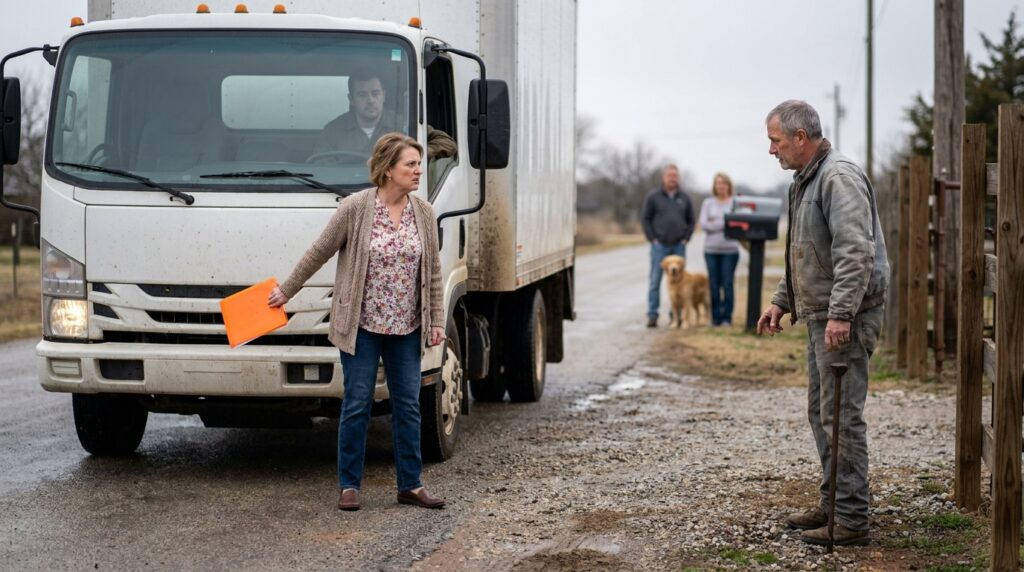
The gravel driveway stayed dead silent for three long seconds after the name of the county surveyor was dropped into the dust. Brenda Sterling’s jaw tightened, the neat pink line of her lips thinning into a hard seam as she looked down at the asphalt seam near her heel. She didn’t move her foot, as if shifting her weight might somehow alter the subterranean geography laid down forty years before she ever bought her first townhouse down the hill. Behind her, the delivery van’s engine let out a low, impatient shudder.
“That’s a county road easement, Mr. Vance,” Brenda said, her voice rising an octave to recapture the public performance she had started. “The board had the civil engineers map every foot of this corridor last November. You don’t get to rewrite property lines with a folk tale about a dead president.”
“Jimmy Carter didn’t set that pin, Brenda,” Julian said softly. He didn’t raise his voice; shouting was for men who weren’t sure of their ground. “A surveyor named Miller did, using iron salvaged from the old Northern Pacific rail spur. If you scrape the silt off the top with your car key, you’ll still see his stamp.”
He turned his back on her before she could find an answer, climbed back up into the high cab of the flatbed, and dropped the gear into low. He didn’t rush. He let the truck crawl backward into the shade of the hickory trees, clearing the apron entirely so the frustrated delivery driver could swing wide and rumble up toward the subdivision. Brenda stood stranded on the gray edge of the asphalt for a moment longer, her clipboard clutched like a weapon that had suddenly lost its edge, before she spun on her heel and marched back toward the administrative complex.
Julian didn’t watch her go. He parked the flatbed beside the weathered barn, unlatched the heavy wooden tailgate, and carried two newly split cedar posts across the damp grass toward the eastern fence line.
The physical labor was a habit older than the subdivision, older than the county’s incorporation, older even than his own memory. Every swing of the heavy framing hammer drove the rusted point deeper into the stubborn clay, sending a dull shock up through his forearms and into his shoulders. The air smelled of crushed thistle and dry pine needles. It was the smell of a place that asked for nothing except endurance.
Yet, as the sun climbed higher, casting short, sharp shadows across the property line, the rhythmic strike of the iron mallet felt less like maintenance and more like a metronome ticking down an inevitable collision.
When the sun hit its zenith, Julian dropped the hammer into the dirt, wiped his palms against the thighs of his canvas trousers, and walked back toward the house. The kitchen was cool, dim, and smelled of chicory and old floor wax. The house had been quiet since his wife passed three winters ago, a quiet that he usually welcomed, but today the silence had a different texture—the tight, compressed air before a summer squall.
He walked past the scrubbed pine table and pulled open the second drawer of the heavy steel filing cabinet tucked into the pantry alcove. His fingers brushed past tax receipts, seed warranties, and equipment manuals until they found what they were looking for: a worn, dark green cardstock folder labeled simply Lease 1978 Callaway.
The cardboard corners were soft and frayed, chewed by time and decades of humid Oklahoma summers. He carried it to the table, sat down, and pulled off the faded rubber band that held it shut.
Inside, the papers were yellowed to the color of old ivory. He didn’t have to search for the specific page. He had looked at it enough times as a boy while his father explained the mechanics of survival against a changing county. He turned directly to page four, section seven, clause three.
Any assignment, sublease, or transfer of interest in the leased acreage situated on the western quarter-section shall be null and void without prior written acknowledgment and notarized signature executed directly by the landowner or their designated direct heirs.
Julian traced the faded blue ink of his grandfather Solomon’s signature with the tip of his thumb. Then he looked at the stapled rider attached to the back—the 2001 transfer document where Callaway Development had casually handed over its leasehold interest to the newly minted Lakewood Ridge Homeowners Association. The lines for the landowner’s signature were completely blank. Not forged. Just ignored. A shortcut taken by a developer who assumed an old man on a lake ranch wouldn’t notice, or wouldn’t care, about eighteen acres of scrub timber and gravel access.
He closed the folder gently, the dry scrape of paper sounding loud in the quiet kitchen.
The door chime didn’t ring—the house was too old for chimes—but the heavy iron knocker on the front screen door rapped twice. Sharp. Authoritative.
Julian didn’t get up immediately. He looked at the green folder resting beside his coffee mug, then at the single window facing the front porch. A shadow cut across the rippled glass of the screen door, neat and square-shouldered, wearing a uniform that didn’t belong to the neighborhood kids or the county road crew.
He stood up, his joints popping dryly in the quiet room, and walked out to the hallway.
Sheriff’s Deputy Marcus Reed stood on the porch, his hand resting casually near his duty belt, looking out over the overgrown pasture with the practiced, neutral expression of a man who spent his entire shift mediating boundary disputes between people who had shared fences for fifty years. When Julian unlatched the screen door and pulled it open, Reed gave him a small, tight nod.
“Morning, Mr. Vance,” the deputy said, his voice flat and professional. “Got a call from the association office down the road. They’re claiming you’ve placed unapproved obstacles blocking a designated emergency transit corridor on the eastern approach.”
Julian leaned one shoulder against the wooden doorframe, looking past the deputy’s shoulder toward the cruiser idling in the drive, its light bar dark against the bright afternoon glare.
“There’s no corridor out there, Marcus,” Julian said, his voice entirely even. “Just my fence line. And the only thing blocking it is a man trying to keep his cattle from wandering onto the asphalt.”
Reed sighed, pulling a small plastic-wrapped notepad from his chest pocket with a gloved thumb. “They’re pushing hard for a formal stop-work citation this time, Julian. And they brought a lawyer from the city who’s throwing around terms about public safety liabilities.”
Julian didn’t flinch. He reached into his pocket, his fingers brushing the cool steel of his pocketknife, and met the deputy’s steady gaze with a look that carried thirty years of unbent patience.
“Tell you what, Marcus,” Julian said quietly, the micro-mystery of the missing signature humming silently in the back of his mind. “Before you write any paper, let’s walk down to the eastern corner together. There’s a piece of iron in the dirt I think you ought to see before we talk about who owns the road.”








