The Grain and the Binder: How an Urban Artisan Held the Line Against a Neighborhood Enforcer

CHAPTER 1: The First Notice on the Windshield

The morning air smelled of wet asphalt, iron filings, and the dry, sweet scent of walnut shavings drifting up through the basement ventilation grates. Julian Vance did not look up from the workbench immediately. He kept his thumb pressed firm against the back of a hand plane, guiding the steel blade in a slow, continuous stroke that peeled a curl of wood as thin as onion skin.

Outside, the scrape continued. It was a calculated sound, rhythmic and grating, meant to summon an audience from the brick row houses that now crowded the old industrial fringe.

Julian set the plane down on the oak trestle. His palms were gray with fine dust, the skin across his knuckles calloused and cracked from decades of handling rough lumber. He wiped his hands on his canvas apron, crossed the flagstone floor of the basement, and climbed the three wooden steps to the side exit that opened onto the narrow alley strip.

The sunlight hit him square across the eyes, sharp and white off the slate sidewalk.

Brenda Sterling stood with her weight shifted to one hip, an expensive metallic clipboard tucked under her arm like a weapon. Her sunglasses mirrored the distorted reflection of the brick facade across the street. She didn’t drop her hand away from the van’s windshield until Julian’s boots hit the concrete.

“Commercial clunkers like yours drag down property values for everyone who actually belongs on this block, Julian,” she said, her voice dropping into that smooth, practiced register that carried easily across open pavement. “The association bylaws explicitly prohibit overnight staging of work vehicles on municipal rights-of-way without an active neighborhood aesthetic permit.”

Julian didn’t touch the pink paper stuck beneath the wiper. He looked past her shoulder at the blue city parking sign bolted to the weathered cedar utility pole five feet away, its white lettering freshly painted and unambiguous: Public Parking Permitted 24 Hours. No Commercial Restriction.

“The city zoning board manages this curb, Brenda,” Julian said, his voice flat, stripped of any inflection that might invite a debate. “Not your clipboard.”

Brenda’s jaw tightened, the skin pulling thin across her cheekbones. She adjusted the lapels of her bright yellow blazer with a sharp, bird-like jerk. “The city doesn’t live here, Julian. We do. And when the new municipal planning commission reviews our block-wide integration plan next month, unregistered anomalies like this van are going to be the first things flagged for administrative removal.”

She turned on her heel, her loafers clicking a crisp, agitated tattoo against the flagstone as she walked toward a gleaming SUV parked half-a-block down.

Julian watched her go, his eyes lingering on the neat, professional crease of her trousers before dropping to the corner of his van’s windshield where the pink slip fluttered in the draft. He reached out, peeled the paper loose, and folded it twice without reading the text inside.

He walked back into the dim warmth of the basement workshop, tossed the paper into the scrap bin beneath the table saw, and reached for his hand plane. But as his fingers closed around the polished wood handle, the sharp, metallic echo of a distant car door slamming shut rang out from the street above, leaving behind a silence that felt heavier than before.

CHAPTER 2: The Escalation at the Morning Loading Curb

The sound of iron rattling against iron carried up through the floorboards before Julian even set his morning coffee down. It wasn’t the rhythmic thrum of the table saw or the muffled thump of passing delivery trucks on the main thoroughfare. It was sharp, deliberate, and impatient—the unmistakable ring of a steel clipboard edge rapping against the heavy oak frame of his service door.

Julian wiped his palms down the front of his canvas apron, his jaw set as he crossed the cool flagstone floor. When he threw the bolt and yanked the heavy wooden door inward, the bright morning glare caught the oil on his forearms and the grease smudge smeared across the iron latch.

Brenda Sterling stood on the threshold, her chin tilted up at an angle that looked rehearsed in a hallway mirror. Her bright yellow blazer had been swapped for a muted, charcoal-colored trench coat, but the metallic clipboard remained gripped in her right hand like a badge of office. Behind her, two men in matching navy windbreakers stood near the property line, one of them kneeling with a surveyor’s rod while the other wedged a bright orange wooden stake into the narrow strip of gravel bordering Julian’s driveway.

“You’re operating out of compliance, Julian,” Brenda said, stepping uninvited across the threshold by half an inch. Her voice had that smooth, glass-shattering crispness that belonged in a corporate boardroom rather than a dusty brick-lined alley. “The board received three formal grievances this morning regarding the persistent particulate discharge from your exhaust vent and the unauthorized storage of industrial timber within sixty feet of a residential corridor.”

Julian didn’t move. He stood planted in the center of the doorway, his broad shoulders filling the gap, his eyes fixed on the man kneeling by the gravel strip. “There is no industrial timber here. That’s quarter-sawn walnut for a custom mantelpiece. And the exhaust vent meets every municipal code the county set down back in nineteen-eighty-four.”

“Municipal codes evolve,” Brenda countered, tapping her clipboard against her thigh with a dull, rhythmic thud. “And local governance adapts to protect community equity. You’ve been given fair warning, Julian. The neighborhood development committee is prepared to petition the zoning board for a comprehensive site review. Unless, of course, you’d prefer to discuss a voluntary variance waiver with our legal representative this afternoon.”

She pulled a folded white card from her pocket and held it out between two manicured fingers.

Julian didn’t take it. Instead, his gaze drifted past her shoulder down to the orange wooden stake the kneeling man had just driven into the earth. Stenciled in black ink along the side of the stake was a corporate abbreviation he hadn’t seen before: Vanguard Horizon Properties, LLC — Phase 3 Acquisition Grid.

It wasn’t a standard city survey mark. It was clean, factory-printed, and entirely foreign to the municipal boundary stakes his grandfather had hammered into the dirt four decades ago.

“You didn’t get that from the county clerk,” Julian said quietly, his voice dropping an octave as he looked back at her.

Brenda’s fingers twitched around the edge of the white card. For a fraction of a second, the immaculate composure across her face fractured, her eyelids tightening before her professional smile snapped back into place. “The association acts in the best interest of all property stakeholders. Whether you choose to acknowledge our oversight now or after the citations arrive is entirely your decision.”

She dropped the white card onto the concrete threshold, turned on her heel, and walked away toward the waiting surveyors without waiting for an answer.

Julian watched them pack their instruments into the back of a slate-gray sedan bearing out-of-county plates. When the engine finally turned over and the car dissolved into the morning traffic, he bent down, picked up the white card, and turned it over in his hand. The address printed on the back wasn’t the local town hall or the municipal zoning office. It was a suite number in a commercial office park three towns over—a private real estate holding firm with no legal standing on Cedar Street.

He tossed the card onto the workbench beside his chisels, the small piece of heavy stock paper landing softly among the wood shavings. He walked back to the exterior back step to inspect the orange stake Brenda’s crew had left behind. As he pried the wooden marker loose from the gravel with the claw of a hammer, something metallic fell out from beneath the base—a small, clipped piece of an engineer’s blueprint fragment, fluttering down into the dust like a discarded leaf.

CHAPTER 3: The Unauthorized Towing Attempt Thwarted by a Neighbors Watchful Eye

The pneumatic hiss of a rollback truck’s hydraulic bed scraping downward cut through the quiet hum of Cedar Street before Julian could finish turning the blueprint fragment over in his fingers. The heavy iron chain of the winch clinked rhythmically against the chassis, striking the gravel drive with an aggressive, metallic chatter.

Julian didn’t hesitate. He dropped the paper onto the bench, vaulted the low workbench rail, and hit the side alley exit just as the rollback’s amber emergency lights began to pulse against the weathered red brick of the workshop’s exterior wall.

A tow truck bearing the emblem of a county-line impound service was already reversing into his private access lane, its rear tires crushing the low border stones his grandfather had laid down in seventy-six. Behind the wheel, a driver in a stained denim jacket leaned out the window, his arm hanging over the door frame as he checked his side mirror. Fifty feet away, half-hidden behind the corner of a neighbor’s box hedge, Brenda Sterling stood with her phone raised, her thumb hovering over the screen as she recorded the maneuver with clinical detachment.

“Hold it right there,” Julian said, his voice carrying the hard, flat edge of a timber axe striking dry ash. He didn’t run; he walked with deliberate, heavy-footed strides that matched the mechanical clank of the truck’s gears.

The driver glanced down, flicked a toothpick from his teeth, and shoved the transmission into park. ” Got a private impound authorization signed by the neighborhood oversight committee. Abandoned commercial staging on a shared access easement. Move out of the way or I hook the bumper and let the yard sort it out.”

“That easement is private property, and this vehicle is registered to a tax-paying resident,” Julian said, stepping directly into the path of the hydraulic bed, his boots planting firmly on the crushed limestone. “You pull that winch cable one inch further onto this concrete and you’re committing grand theft under color of a fraudulent tow order.”

The driver scoffed, reaching for the handbrake. “Lady in the yellow blazer said the title paperwork was cleared through the municipal board.”

“The municipal board doesn’t own this dirt,” Julian replied, his eyes locked on the driver’s window while his peripheral vision caught Brenda stepping out from behind the box hedge, her phone still angled toward them.

Before Brenda could open her mouth to deliver her rehearsed speech about neighborhood covenants, a weathered blue sedan roared around the corner from the main thoroughfare, tires spitting gravel as it slammed to a halt directly behind the tow truck, blocking its exit entirely. The driver’s door swung open with a rusty groan, and Arthur Pendelton—a retired postal worker who had lived across the street since the Reagan administration—stepped out onto the asphalt. He wasn’t wearing a blazer or holding a clipboard. He was wearing a faded flannel shirt, carrying a heavy brass-headed walking cane, and looking like a man who had survived forty years of postal route dogs and had no patience left for amateurs.

“Turn that rig around, boy,” Arthur rasped, pointing his cane straight at the tow driver’s chest. “I’ve lived on this corner longer than your daddy’s been driving trucks, and that lane has been deeded to the Vance family since the county had dirt roads. You touch that van, and I’ll have the state police impound your entire company fleet before lunch.”

The tow driver blinked, looking from Arthur’s fierce, unblinking glare to Julian’s motionless stance in front of the hydraulic bed. He looked back toward the hedge where Brenda was now lowering her phone, her expression tightening into a mask of pure fury as she realized her private asset seizure was dissolving into a public street argument.

“Look, I just take the calls,” the driver muttered, shifting the gear lever back into drive with a sharp clunk of resistance. “I don’t get paid enough for title disputes.”

He released the handbrake, feathered the throttle, and pulled the rig forward in a tight, awkward arc, kicking up a spray of limestone dust that settled over Brenda’s polished shoes as she marched toward the curb.

“This is an illegal obstruction of community remediation,” Brenda snapped, her voice pitching upward as she stopped three feet from Julian, her fingers clamped white around her metallic clipboard. “You are deliberately defying the administrative code of Cedar Estates, and every day you stall this transition will be added to your final municipal fine dossier.”

Julian didn’t shout back. He reached down to the asphalt where the tow driver had spat out a crumpled paper ticket during the scramble—a carbon copy of an expired municipal lien waiver bearing a signature that didn’t belong to any city official, but rather to a junior accountant at Vanguard Horizon Properties. He smoothed the corner against his thumb, folded it into his pocket, and looked down at Brenda with a steady, unyielding calm that made her take an involuntary half-step backward.

“Tell your private-equity friends down at the county line to send their own surveyors next time, Brenda,” Julian said quietly, the low rumble of his voice cutting through the morning air. “Because the next time someone steps foot on this property without a judge’s signature, I won’t be calling the tow company.”

He turned his back on her, walked back into the dim, familiar safety of the workshop, and slid the heavy oak bolt home into its iron socket.

CHAPTER 4: The Delivery Blockade and the Convergence of Municipal Code and Street Pressure

The dual rear wheels of the lumber carrier spun in the damp limestone gravel, throwing up white gray dust that clung to the wet cedar boards stacked in the open trailer. The diesel engine let out a low, concussive groan, its heavy exhaust pipe chuffing a cloud of blue-tinged smoke into the narrow corridor between the brick row houses.

Julian didn’t need to step outside to know what had happened. The vibration alone—that deep, shuddering hum of a heavy payload constrained against a dead stop—shook the hanging chisels on the workshop wall.

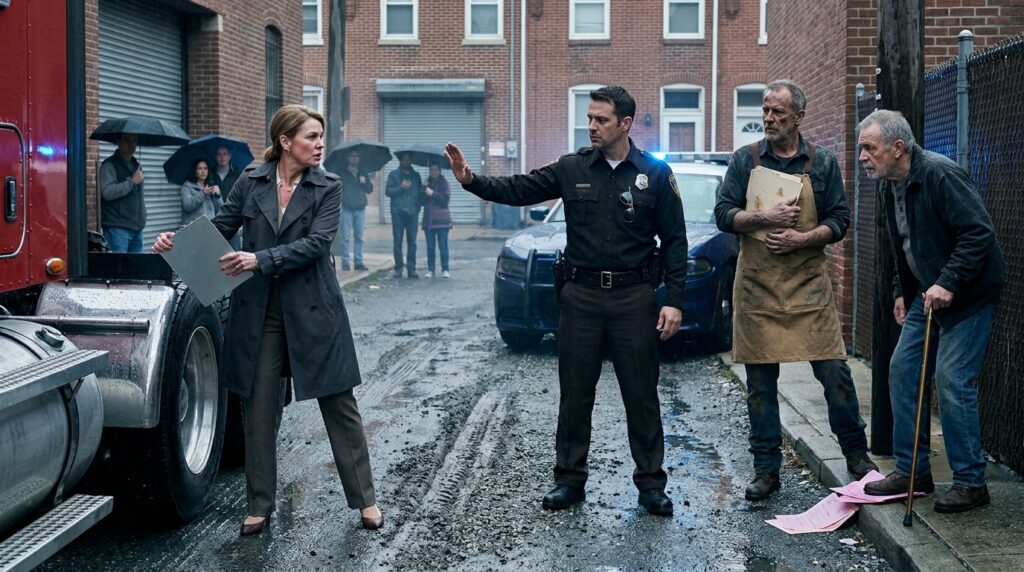
He threw open the side loading door, his boots hitting the ground just as the truck driver killed the ignition with a harsh pneumatic sigh. A massive red semi-tractor trailer, its chrome bumper polished to a mirror shine, was parked dead-center across the alley mouth. It wasn’t on the public street where it could draw a municipal parking ticket; it was wedged directly over the private apron of his property line, its rear trailer gate lowered just enough to block any foot or vehicle traffic from entering or leaving the lot.

On the far side of the blockade, standing near the edge of the neighbor’s curb with her arms crossed tightly over a charcoal trench coat, Brenda Sterling watched the scene with the cold satisfaction of a chess player executing a forced trap.

Julian wiped his palms down his jeans, his jaw tightening as he walked around the chassis of the massive truck. The driver’s door swung open, and a burly man in a reflective vest dropped down to the pavement, shaking his head and wiping grease from his thumb.

“Can’t drop your load here, pal,” the driver muttered, gesturing toward the rear trailer. “Management from the property association flagged the route. Said there’s an emergency utility restriction on this private lane. They told me to park it sideways and wait for site control.”

“That lane is private property,” Julian said, his voice dropping into that flat, dangerous register that left no room for argument. “And there is no utility restriction. That trailer is trespassing on a deeded right-of-way.”

“Hey, don’t look at me,” the driver threw his hands up, stepping back toward his cab. “They showed me a clipboard and a county-line permit copy. Paid in advance. I’m just following the manifest.”

Before Julian could answer, Brenda stepped past the edge of the trailer’s rear bumper, her metallic clipboard gleaming under the midday sun. Her face was flushed with a triumphant heat, her expression hard and unyielding.

“You’ve been given every opportunity to comply with neighborhood integration standards, Julian,” Brenda announced, her voice pitching to carry over the residual ticking of the cooling diesel engine. “When you refuse basic administrative cooperation, the community has a legal right to utilize commercial staging limitations to protect local infrastructure. That lumber isn’t reaching your basement today, and until you sign the zoning variance waiver, this blockage remains active under association authority.”

A small cluster of morning commuters, cafe patrons, and neighborhood residents had already slowed down along the public sidewalk outside, their footsteps halting as they took in the scale of the red semi blocking the narrow lane. Heads turned, whispers rippled through the concrete gap, and the faint, glowing rectangles of cellular phone screens began to rise from the crowd.

Julian did not shout. He did not lunge forward or reach for a tool. Instead, he reached into his jacket pocket and pulled out a heavy, water-stained document folder—the certified county plat map and the original 1973 property deed registered under his grandfather’s seal. He walked past the driver, past the massive chrome fuel tank of the semi, until he stood six feet from Brenda.

“You brought a commercial freight carrier onto a residential apron without a municipal permit, Brenda,” Julian said, his tone unnervingly calm against the backdrop of the idling engine. “And your association president credentials don’t grant immunity from state highway code violations, let alone unauthorized private impoundment.”

“I am protecting property values,” Brenda snapped, her composure slipping slightly as she noticed the crowd pressing closer against the curb. “You’re running an eyesore out of a historical zone, and the executive board is done waiting on the county to act.”

“The executive board doesn’t own this dirt,” Julian replied.

Just then, the familiar, sharp warop of a municipal patrol cruiser siren cut through the morning air. A standard county squad car pulled up alongside the curb, its blue lights sweeping a slow, rhythmic pattern across the brick facade. Officer Marcus Reed stepped out from behind the driver’s door, hooked his thumbs into his tactical belt, and looked past the crowd at the massive red semi straddling the private line.

Brenda’s expression shifted in an instant. Her posture straightened, her hand snapping up to thrust her metallic clipboard toward the approaching officer before he even cleared the cruiser’s rear fender.

“Officer Reed, thank goodness,” Brenda said, her voice instantly adopting a theatrical register of public distress. “We are executing an emergency neighborhood access containment. This unpermitted commercial property is violating association zoning mandates, and this resident is refusing to comply with public safety protocols.”

Officer Reed stopped midway between his cruiser and the truck. He looked at Brenda’s clipboard, then down at the deep tire ruts carved into Julian’s gravel drive, and finally at the red semi blocking a registered private entrance. He slowly took off his sunglasses, hooked them into his shirt pocket, and let out a long, weary sigh that smelled faintly of black coffee.

“Ma’am,” Officer Reed said, his voice flat and heavy. “This is a private property easement, not a community parking lot. And blocking an active delivery lane with a semi-tractor is a class-four civil obstruction.”

Brenda’s mouth parted, the triumphant certainty in her eyes wavering for the first time as the weight of the officer’s words settled over the quiet street.

CHAPTER 5: The Official Municipal Record Verification and the Final Public Reversal

“Move that rig right now, driver, or I’m writing an impound ticket that will cost your company its operating bond before noon,” Officer Reed repeated, his hand resting casually near the clasp of his utility belt.

The truck driver, his face pale under the shadow of the semi’s massive front grill, glanced from the officer’s steady gaze to Brenda Sterling standing frozen by the curb. The threat of losing a commercial CDL over a neighborhood dispute cut through any loyalty he might have felt toward a clipboard and a corporate promise. Without a word, he scrambled back up the aluminum ladder into the cab, slammed the door shut, and fired up the heavy diesel engine with a roar that rattled the storefront windows across the street.

Brenda lunged forward, her high heels clicking frantically against the asphalt as she slapped her palm against the chrome fender of the idling semi. “Don’t you dare move! This is an active administrative quarantine zone under association code—”

“Ma’am, step back from the vehicle,” Officer Reed intervened, his tone hardening as he took two deliberate steps toward her. “You are currently obstructing a public right-of-way and trespassing on a registered private easement. One more word and you’ll be joining your truck driver in the back of my cruiser for disorderly civil interference.”

A collective murmur rippled through the assembled morning crowd. Phones remained elevated, capturing every rigid twitch of Brenda’s jaw, every desperate shift of her eyes as she realized her carefully orchestrated blockade had entirely unraveled. Behind her, the two junior board members who had accompanied her earlier slowly backed away into the sidewalk foot traffic, melting into the crowd to distance themselves from the collapse.

Julian didn’t raise his voice. He didn’t gloat or step forward to crowd her space. He simply unclasped his leather work apron, tossed it over the top of the wooden gate post, and reached into his folder to pull out the certified municipal deed once more. He walked calmly toward the front of Brenda’s blocked path, his boots striking the gravel with a measured, heavy cadence.

“You wanted a zoning review, Brenda,” Julian said quietly, his words cutting through the rumble of the departing semi as it backed awkwardly into the main street. “Here it is. Recorded in nineteen-seventy-three, verified by the county clerk yesterday, and backed by every resident on this block who actually works for a living.”

In her panic, Brenda whipped her metallic clipboard upward, trying to push past the officer to salvage her authority. But as she jerked the board away, the metal clip gave way, and a cascade of loose paperwork fluttered out across the dusty asphalt.

Among the pink warning notices and fake association citations, a single pink slip of heavy cardstock drifted down into the dirt face-up. Arthur Pendelton, leaning heavily on his brass cane, reached out with his boot and pinned the corner of the paper against the ground. He bent down with a groan of stiff joints, picked it up, and squinted at the bold print.

“Well, what do you know,” Arthur muttered, loud enough for the front row of the sidewalk crowd to hear. “Foreclosure notice from First Metropolitan Bank. Past due on Townhome 412. Looks like someone’s been spending a lot of energy trying to sell dirt that doesn’t belong to them just to keep the bank off their porch.”

Brenda went completely rigid. All the color drained from her face, leaving her skin the gray, flat tone of weathered concrete. She snatched at the paper in Arthur’s hand, but the old postman simply pulled it back out of reach, handing it directly to Officer Reed.

The officer glanced down at the bank header, let out a short, humorless breath, and looked back up at Brenda. “Looks like you’ve got bigger problems than parking enforcement, Ms. Sterling. I suggest you go home and sort out your own property lines before you worry about anyone else’s.”

The semi-truck completed its wide, clumsy three-point turn and rumbled away down Cedar Street, its exhaust fading into the distance. The morning crowd slowly parted, shaking their heads, their phone screens lowering as the spectacle died down into the quiet reality of an ordinary Tuesday.

Brenda stood alone on the pavement, her clipboard clutched to her chest like a broken shield. Without another word, she turned and walked away down the sidewalk, her heels clicking too fast, her head down, swallowed up by the morning commuter traffic.

Julian watched her go until she turned the corner. He didn’t feel anger; he only felt the deep, steady weight of the ground beneath his boots—the same ground his grandfather had cleared, the same ground his family had defended through decades of weather and change. He picked up his canvas apron, dusted the wood shavings from the hem, and walked back down the steps into the cool, shadowed interior of the basement.

The heavy oak door swung shut behind him with a solid, satisfying thud. Down in the pit, the electric motor of the planer whined to life, its steady, rhythmic drone filling the room as Julian reached out, picked up a fresh block of walnut, and went back to work.

Similar Posts

Leave a Reply

Your email address will not be published. Required fields are marked *