The Asphalt Gatekeeper: A Meticulous Compliance Analyst Dismantles a Suburban Tyrant Through Cold County Archives and Unyielding Resolve
CHAPTER 1: The Weight of the Curb
The idling diesel engine vibrated through the floorboards of the cab, humming a low, flat bass note that rattled against Marcus Holloway’s chest. He stood near the open tailgate of his crossover, a pair of heavy work gloves dangling from his left hand, watching the red indicator light of the delivery truck blink against the glare of a Sacramento afternoon.
Thirty-eight minutes ago, the boxes had still been a chaotic wall blocking his living room. Now, they were a promise of permanence he wasn’t sure he was ready to keep.
Then the shadow cut across the pavement.
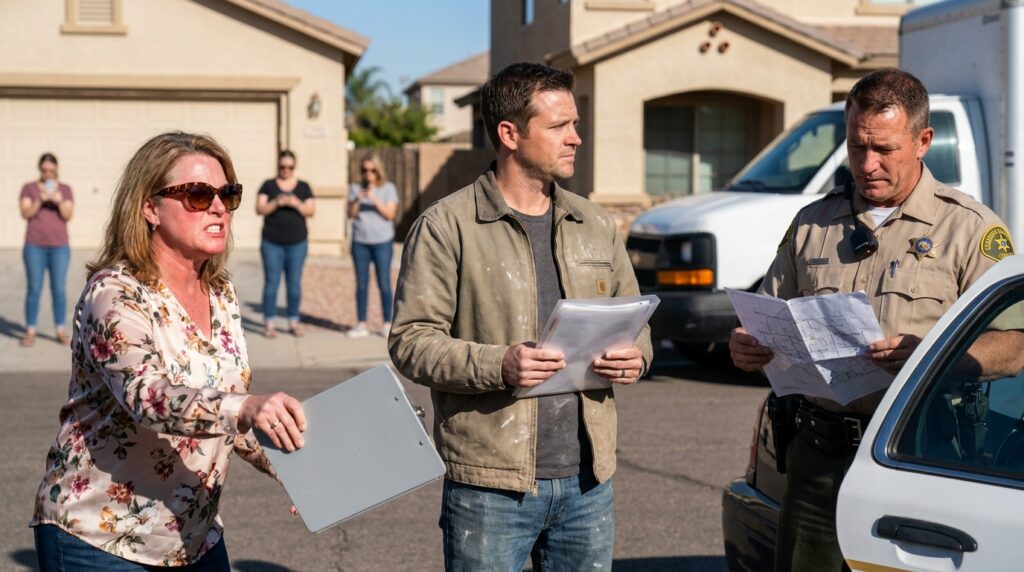
She moved with an practiced, rhythmic certainty—the sort of walk belonging exclusively to people who believed the earth rotated on an axis of their own choosing. Brenda Vance. Mid-fifties, draped in a silk floral blouse that looked immune to dust, wearing oversized tortoiseshell sunglasses that mirrored the pale beige stucco of the houses lining Pembroke Court. Her right hand clutched a gray plastic clipboard holding a laminated permit sheet.
She didn’t look at Marcus. She looked at the front bumper of the multi-axle freight truck as if it were an uninvited insect.
“Cut the engine,” she said. Her voice didn’t carry the raw volume of a shout; it carried the thin, brittle authority of a woman accustomed to being obeyed before she finished her sentence.
The driver, a young man with a sweat-stained collar and a lanyard dangling from his pocket, glanced uncertainly toward the rearview mirror, then down at Marcus.
Marcus stepped forward, his canvas jacket stiff against his forearms. “Is there a problem, Ms. Vance?”
“There is a commercial obstruction problem, Mr. Holloway,” Brenda said, finally turning her head. The tortoiseshell lenses locked onto him with zero warmth. “Commercial freight transport is strictly prohibited on residential cul-de-sacs on weekdays without a pre-approved architectural release form and a seventy-five-dollar impact processing fee paid directly to the board office.”
She tapped the corner of her clipboard against her palm. A hollow, rhythmic clack-clack.
“This is a delivery of residential shelving,” Marcus said, keeping his voice level. He had spent ten years as a senior compliance analyst dissecting corporate risk portfolios; he knew the exact cadence of a person inventing policy on the fly to mask a total absence of jurisdiction. “It takes twenty minutes. It’s not a commercial route.”
“Everything that enters Pembroke Commons through Gate Seven falls under architectural review,” Brenda replied, her chin lifting an imperceptible fraction of an inch. “Which you would know if you had submitted to your mandatory new-resident interior layout orientation during your first week. That’s strike two on your compliance ledger.”
Across the street, a pair of hedge shears stopped clipping. A retired neighbor three houses down paused behind a row of boxwood, pretending to inspect a leaf while his ears strained for the audio.
Marcus felt the old, familiar weight settle behind his ribs—the cold, calcified irritation he’d felt every time a vice president in his former firm asked him to sign off on a metric he knew was fabricated. It wasn’t anger. It was the heavy exhaustion of dealing with small minds armed with rubber stamps.
“There is no provision in the Pembroke Commons governing documents for interior inspections, Ms. Vance,” Marcus said, his gaze steady. “And there is no restriction against delivery trucks using a public access lane.”
Brenda’s mouth tightened into a pale, hard line. The warmth of her welcome packet routine had completely evaporated, leaving behind the raw, naked mechanics of control.
“We define the rules of this community, Mr. Holloway,” she said, stepping closer, her perfume—something sharp and expensive—cutting through the smell of hot asphalt. “And if that truck does not back out of this cul-de-sac within sixty seconds, I’ll be issuing an immediate five-hundred-dollar emergency violation notice. Let’s see how comfortable your living room boxes feel when your account is sent to collections.”
She turned her back on him, waiting for the compliance machinery to crush him as it always had.

CHAPTER 2: The Midnight Archival Audit
The glow of the laptop screen cast sharp, blue-tinged highlights across the stack of cardboard boxes still littering Marcus’s living room. Outside, the Sacramento wind rattled the dry palm fronds along Pembroke Court, a dry, papery whisper against the glass. It was past midnight, but sleep was a luxury reserved for men who didn’t have a $300 penalty notice sitting on their kitchen counter like a ticking fuse.
Marcus adjusted his desk lamp, sliding the violation slip into the pool of light. He didn’t look at the printed boilerplate text threatening collections or credit score degradation. He looked at the bottom left corner, right where the administrative seal was supposed to be embossed.
There was no seal. Just a clean, sharp indentation of bare paper where a stamp had been deliberately omitted, signed off in the same heavy, manicured blue ink Brenda Vance used for her welcome packets.
His fingers moved across the trackpad, clicking open the California Department of Real Estate public records portal. For two hours, he had been tunneling through municipal GIS maps, corporate registry filings for Pembroke Commons Inc., and archived county subdivision plats from nineteen-ninety-eight. The public right-of-way easement for Callaway Ridge Road and its intersecting spurs—including the service lane bordering his property—was crystal clear. It belonged to the county department of transportation, maintenance bond number 44-B. Not the HOA. Not Brenda Vance’s architectural committee.
Yet, as he cross-referenced the names of previous owners on his parcel, a stranger anomaly surfaced. Three distinct families who had lived at 3318 Pembroke Court over the past four years had all paid mysterious “late compliance processing fees” ranging from two hundred to six hundred dollars. None of those transactions appeared on the official annual balance sheets filed with the state registry.
Marcus leaned back, the cheap rental chair groaning under his weight. His eyes burned from hours of staring at digitized PDF files, but his mind was ice-cold. Brenda wasn’t just an overzealous neighborhood busybody flexing arbitrary power. She was running a closed loop. Every new resident who complied out of ignorance was funding a ghost ledger that bypassed the board treasurer entirely.
He reached for his phone, scrolling through his contacts until he found Winifred Fairweather, the retired librarian across the street who had watched him unpack on Sunday. He drafted a text, deleted it, drafted another, then locked the screen without sending it. It was too early to pull neighbors into the line of fire. He needed hard paper trail proof first—something structural enough to survive a board challenge.
A soft tap against his front window made him freeze.
It wasn’t a knock at the door. It was a dull, rhythmic clink, like a pebble or a fingernail flicked against the double-pane glass.
Marcus stood up slowly, keeping his shadow out of the light beam. He stepped through the dim hallway, his socks making no sound on the hardwood floor, and peered through the wide-angle peephole of the front door.
The porch was empty. The amber glow of the coach light illuminated only the manicured strip of lawn, the pristine concrete walkway, and Brenda Vance’s silver sedan parked two houses down. But tucked firmly under the door handle was a fresh sheet of heavy cardstock, folded once and sealed with a strip of blue painters’ tape.
Marcus unlocked the deadbolt with a soft, mechanical click, pulled the door open three inches, and snatched the paper from the handle before stepping back into the entry.
He unfolded it under the kitchen light. It wasn’t an HOA letterhead this time. It was a handwritten note scrawled in heavy blue ink: You are making a very expensive mistake, Mr. Holloway. Comply now, or the board will ensure your property cannot be sold.
There was no signature. But the blue ink matched the missing seal on the violation notice down to the microscopic slant of the capital letters.
CHAPTER 3: The Second Enforced Notice and the Attorneys Briefing
The rain had begun to spit against the plate-glass windows of the Capital Mall office tower, turning the Sacramento skyline into a smear of slate-gray and neon. Marcus sat across a heavy oak table from Evander Cross, a civil rights and property litigator whose office smelled faintly of old parchment and expensive leather.
Evander didn’t look like a man who wasted time. His sleeves were rolled up to reveal forearms mapped with faint, pale scars, and his desk was entirely clear except for a single manila folder labeled Pembroke Commons – Holloway v. Vance.
“She escalated,” Marcus said, laying the heavy cardstock note he had pulled from his door handle onto the center of the desk.
Evander picked it up with the tips of his fingers, sliding it closer under the directional brass lamp. He didn’t read it aloud. He inspected the blue ink trace, tilting the paper against the light to check the grain.
“Handwritten. No official letterhead. No board registry number,” Evander noted, his voice a dry, gravelly hum. “She’s slipping. When board presidents start leaving anonymous notes on doors instead of official certified mail, it means they’re operating outside the corporate insurance umbrella. She’s exposing the HOA to personal liability.”
“She’s also running a ghost ledger,” Marcus replied, leaning forward, resting his forearms on the edge of the oak. He slid a printed spreadsheet across the desk—his midnight compilation of county property archives and previous resident disclosures. “Look at the four parcels prior to mine. Every single one of them paid a ‘compliance processing fee’ ranging from three hundred to six hundred dollars during their first thirty days. None of those numbers exist in the state-filed annual disclosures for Pembroke Commons Inc. The money never hit the community trust account.”
Evander adjusted his half-moon spectacles, scanning the columns of dates, parcel numbers, and county stamps. A slow, thin smile touched the corners of his mouth—not a warm smile, but the expression of a chess player who had just spotted an unfortified rook.
“You didn’t just defend your front door, Mr. Holloway,” Evander murmured, tapping a finger against the paper. “You mapped her perimeter.”
“I spent ten years auditing corporate compliance portfolios,” Marcus said evenly. “People who invent rules always leave a paper trail of exceptions. She’s been doing this for four years. Fourteen inspections, fourteen compliance fees collected under coercion. If we subpoena the personal banking records tied to the architectural committee’s processing address, we’ll find where those cash and check payments landed.”
Evander closed the folder with a dry snap that echoed in the quiet office. “Let her issue one more notice. Just one. Preferably with a formal financial penalty attached that crosses the threshold into extortion under state civil code. Once she steps across that line, we don’t just file an injunction against her inspections—we pull the corporate veil back entirely and expose her personal liability.”
Marcus stood up, buttoning his canvas jacket. “She’s planning another confrontation. I can feel it in the way she watches the driveway.”
“Let her watch,” Evander said, standing to shake his hand with a grip like iron. “The tighter she squeezes the handle, the faster the whole mechanism breaks.”
When Marcus stepped back out onto Capital Mall, the rain had turned into a steady, driving downpour. His phone buzzed in his pocket—an automatic notification from his front-door camera app. He pulled it out, thumbing the screen open to live view.
The camera feed flickered, sharpening into a rain-streaked view of his porch. Brenda Vance was standing right there under the eaves, her silver sedan idling at the curb with its hazard lights flashing. In her hand, she wasn’t holding a clipboard. She was holding a second certified envelope, her face twisted into a mask of cold, unyielding fury as she pressed her thumb repeatedly against his doorbell.
CHAPTER 4: The Whispered Confirmations from LongTerm Neighbors
The wind had picked up by four o’clock, carrying a sharp edge of autumn down Pembroke Court. Marcus stood on his front porch, his hand resting on the splintered wood of the railing, watching the gray sedan idle down the street before turning the corner toward Alderton Court. Brenda had left her warning note taped to the handle, but she hadn’t stayed. She didn’t need to; the psychological friction was doing the work for her.
A soft click across the street drew his gaze.
Winifred Fairweather, the retired librarian from number 3317, was standing behind her screen door, her fingers beckoning him over with a slow, deliberate motion. She had lived in Pembroke Commons for nine years—three years longer than Brenda’s reign.
Marcus didn’t hesitate. He pulled his canvas jacket closed against the wind, stepped off his porch, and crossed the asphalt cul-de-sac. Before he could knock, Winifred swung the heavy wooden door open just enough for him to slip inside the hallway. The interior smelled of old paper, lavender wax, and peppermint tea.
“She’s been circling your block three times a day, Mr. Holloway,” Winifred whispered, her voice dry and steady despite the slight tremor in her hands. She led him back toward a sunlit kitchen overlooking a pristine backyard garden. “When Brenda targets a new resident, she doesn’t stop until they either break or leave. But you’re digging into the ledger numbers, aren’t you?”
Marcus stopped midway across the linoleum floor. The air in the room felt heavy, charged with a quiet tension. “How did you know about the ledger numbers, Ms. Fairweather?”
Winifred walked over to a cluttered mahogany sideboard, pulled open a shallow middle drawer, and extracted a composition notebook bound in black marble oilcloth. The pages were yellowed at the edges, filled with meticulous rows of handwritten dates, amounts, and names—each entry penned in neat, precise librarian script.
She laid the notebook flat on the kitchen table and flipped it open to a marked page dated three years prior.
“When I moved in back in nineteen-ninety-nine, I was on the initial welcome committee before Brenda restructured the bylaws,” Winifred said, her finger tracing a column of figures. “She told me to keep track of the cash and check compliance penalties collected from homeowners who missed architectural deadlines. For two years, I recorded every transaction. But when I asked to submit the cash drawer to the corporate accountant on Alderton Court, Brenda told me to leave it in her personal filing cabinet.”
Marcus leaned down, his eyes scanning the columns. The entries weren’t just informal notes; they were exact receipts matching the phantom fees he had discovered in the county archives. But here, next to each entry, was a notation in Brenda’s own familiar blue ink: Allocated for structural adjustment – B.V.
“She didn’t just hide the money,” Marcus muttered, his breath catching as the pieces clicked into place. “She wasn’t just pocketing processing fees for herself. Look at these property parcel numbers next to the cash totals.”
Winifred nodded grimly, her gaze sharp behind her wire-rimmed glasses. “Those parcels belong to three vacant lots on the eastern ridge that the board supposedly foreclosed on two years ago for non-payment of dues. But the county assessor’s office never registered the tax liens. Brenda’s personal name is tied to the tax remittance filings on those lots.”
The decoy secret—that Brenda was merely skimming minor architectural fines for extra pocket money—shattered completely in the quiet kitchen. The reality was far darker and more fragile: Brenda was running a massive structural Ponzi scheme with neighborhood cash to cover the mounting tax arrears on properties she had illegally seized under false compliance claims. If the county audited the subdivision’s actual bank records, her entire fraudulent empire would collapse overnight.
“She’s overextended,” Marcus said, his voice dropping an octave as the strategic landscape shifted. “She’s using new resident fines to service her own property liabilities. If we present this notebook along with the county GIS right-of-way maps to Evander Cross tomorrow morning, we aren’t just filing an injunction against home inspections. We’re handing the district attorney a complete financial fraud package.”
Winifred closed the notebook slowly, sliding it across the table toward him. “Take it, Mr. Holloway. But be careful. When an autocrat realizes the vault door is swinging open, they don’t negotiate. They strike.”
As Marcus tucked the black ledger under his arm and stepped back out onto the porch, his phone buzzed violently in his pocket. A text message from an unknown number flashed across the screen: Your delivery scheduled for Tuesday morning has been legally blocked by order of the Pembroke Architectural Board. Do not attempt to unload.
Marcus looked down the street toward Brenda’s house. The front windows were dark, but the silver sedan was parked in the driveway, its tires turned sharply toward the curb as if ready to move at a moment’s notice.
CHAPTER 5: The Escalation and the Arrival of County Deputies
Tuesday morning broke with a hard, unyielding glare over Pembroke Court. The heavy oak shelving components packed inside the delivery truck back room were scheduled to arrive by eleven, and Marcus Holloway was already standing at the edge of his gravel shoulder when the blue-and-white Sacramento County sheriff’s cruiser turned the corner off Callaway Ridge Road.
It didn’t roll in quietly. The cruiser drifted to a sharp, aggressive halt right across the mouth of Marcus’s driveway, tires spitting tiny loose stones against the curb.
Before the driver’s side door even clicked open, Brenda Vance stepped out from behind a parked silver sedan down the block. She moved with a calculated, predatory grace, flanked by Montgomery Stubbs—the board treasurer whose entire administrative output consisted of nodding at whatever Brenda dictated. Brenda clutched her gray plastic clipboard like a shield, her tailored silk blouse snapping slightly in the morning draft.
“There he is, officers,” Brenda called out, her voice pitching high and carrying across the entire cul-de-sac with calculated theatricality. She pointed a manicured finger directly at Marcus’s chest. “That is the resident at thirty-eight-eighteen. He is in flagrant, continuous violation of neighborhood traffic ordinances, he has obstructed authorized community compliance officers on four separate occasions, and right now, he is orchestrating an unpermitted commercial delivery meant to damage our shared asphalt roadbed.”
The lead deputy, a broad-shouldered man in his late forties named Terry Briggs whose name tag bore a faint scuff mark, stepped out of the cruiser. He adjusted his duty belt with a slow, heavy sigh—the universal physical language of a man who had spent twenty years mediating petty suburban hysteria and loathed every second of it.
“Mr. Holloway?” Deputy Briggs asked, his tone flat, neutral, and entirely devoid of the compliance panic Brenda expected.
“Officer,” Marcus said calmly, his hands resting naturally at his sides. He wore his stiff canvas jacket, his breathing steady, his gaze locked past Brenda straight at the cruiser’s dashcam lens. “I am the homeowner. There is no commercial obstruction. This is a local residential furniture delivery using a public right-of-way easement.”
“He’s lying!” Brenda interjected, stepping closer, her face flushing a tight, mottled crimson. Her composure was beginning to crack at the edges, the veneer of untouchable authority wearing thin under Marcus’s icy lack of panic. “The Pembroke Commons board holds exclusive jurisdiction over all access corridors within our subdivision boundaries! I demand you issue a citation for trespassing and non-compliance immediately, or we will hold the department liable for infrastructure damage.”
Deputy Briggs didn’t look at Brenda. He looked at Marcus, who reached slowly into the inside pocket of his canvas jacket and pulled out a slim, clear plastic file folder.
“I have the county public right-of-way plat map, parcel deed 44-B, the department of transportation maintenance record confirming municipal jurisdiction over this specific access lane, and the delivery manifest,” Marcus said, his voice dropping into the even, rhythmic cadence of a senior corporate auditor presenting a fatal risk assessment. He held the folder out horizontally. “Furthermore, I have two certified mail delivery receipts showing unresponded-to formal inquiries directed to the board regarding the legal basis of their alleged authority, alongside an archived record of unrecorded cash processing fees.”
Brenda let out a sharp, incredulous laugh, though her hand trembled slightly as she clutched her clipboard. “Those are forged documents! He’s manufacturing administrative paper to cover up his defiance of community standards!”
Deputy Briggs took the folder from Marcus’s hand. He opened it, flipped past the property deed to the large, folded county GIS plat map marked with the official Department of Transportation seal, and traced the thick black line designating Callaway Ridge Road and its intersecting spurs. Then he pulled out the delivery manifest, checking the timestamp and the origin warehouse code.
Across the street, Winifred Fairweather’s front door creaked open three inches. Down the block, another neighbor paused while walking a golden retriever, stopping dead on the sidewalk to watch. The entire cul-de-sac had gone dead silent, holding its collective breath.
Deputy Briggs closed the folder with a deliberate, slow movement. He turned his head slowly, fixing his dark eyes on Brenda Vance.
“Ma’am,” Deputy Briggs said, his voice dropping an octave into a low, rumbling authority that brooked no argument. “This access road is a county-maintained public right-of-way. The HOA has zero legal jurisdiction over traffic flow here, and your architectural board has no authority to regulate commercial deliveries on public asphalt.”
Brenda stiffened, her jaw dropping open slightly. “That… that is community practice! The board has enforced this rule for four years!”
“Community practice doesn’t override state transport code,” Deputy Briggs cut across her sharply, stepping forward until the height difference between them was stark and absolute. “Furthermore, calling emergency dispatch and requesting a police presence to enforce a non-existent internal HOA rule is an inappropriate use of public safety resources. If I receive another call from you regarding a lawful delivery on a public road, we’re going to be filing formal charges for filing a false police report.”
Montgomery Stubbs took an immediate, unceremonious step backward, his hands diving deep into his slacks pockets as if trying to shrink away from Brenda entirely.
Brenda’s mouth opened and closed twice, but no words came out. The absolute terror of exposure flashed across her eyes—not just the embarrassment of public defeat, but the sudden, horrifying realization that her entire financial and administrative house of cards had just collapsed in broad daylight.
Behind Marcus, the heavy rumble of the delivery truck’s engine finally rounded the corner of Callaway Ridge Road, its tires rolling smoothly onto the public asphalt without hesitation.
CHAPTER 6: The Public Reversal and the Collapse of Manufactured Authority
The final echo of Deputy Briggs’s cruiser engine faded down Callaway Ridge Road, leaving behind an unnatural, heavy quiet that settled over Pembroke Court. The delivery truck’s air brakes hissed as the driver shifted into position by the gravel shoulder, but the sound felt distant, muted by the sudden deflation of the entire neighborhood’s collective tension.
Brenda Vance stood frozen on the asphalt strip, her fingers still clenched around the grey plastic clipboard as if it were a spar from a sinking ship. Montgomery Stubbs had already retreated, his head down, his footsteps clicking rapidly against the pavement as he hurried back toward Alderton Court without a backward glance. Across the street, Winifred Fairweather closed her front door with a soft, decisive click, the black marble notebook safely resting on her mahogany sideboard as permanent testimony.
Marcus did not gloat. He did not step forward to rub victory into the wound. He simply watched with the cold, calculated neutrality of an auditor observing a corporate subsidiary enter total liquidation.
“Let’s get the boxes unloaded,” Marcus said quietly to the delivery driver, his voice cutting cleanly through the thick afternoon air.
The driver nodded, releasing the cargo latch with a loud metallic clatter. The heavy oak shelving components slid down the ramp, piece by heavy piece, their solid timber weight striking the earth with an undeniable physical reality. Every thud felt like a structural nail driven straight into the coffin of Brenda’s fabricated empire.
By late afternoon, the emergency session of the Pembroke Commons board was convened at the Alderton Court clubhouse—not by Brenda’s schedule, but by a formal petition signed by sixteen long-term residents who had read Evander Cross’s emergency injunction packet delivered via certified courier an hour after the deputies left.
When Marcus walked into the clubhouse meeting room, carrying the black oilcloth ledger and the county right-of-way plats under his arm, the air smelled of stale coffee and panicked silence. Brenda sat at the head of the mahogany conference table, her floral blouse looking suddenly crumpled, her eyes hollowed out by the realization that her ghost ledgers, unrecorded cash drawers, and tax-delinquent ridge lots were now sitting square in the center of a district attorney’s preliminary fraud review.
She didn’t speak. She didn’t raise her clipboard. When the temporary acting chair moved to suspend her architectural powers indefinitely and bar her from holding any neighborhood leadership role for five years, Brenda didn’t even contest the vote. She stood up, her jaw tight, left her grey plastic clipboard on the edge of the table, and walked out through the side exit without looking at anyone.
By dusk, the heavy lifting was done.
Marcus stood alone in his living room, the last of the flat cardboard boxes finally broken down and stacked against the baseboard. The scent of fresh cedar sawdust from the newly assembled workshop shelving filled the space, sharp and grounding. He walked over to the front door, gripped the brass handle, and pulled it shut against the evening chill. The deadbolt slid home with a solid, absolute click, locking the outside world securely behind a boundary that no one would ever cross without permission again.