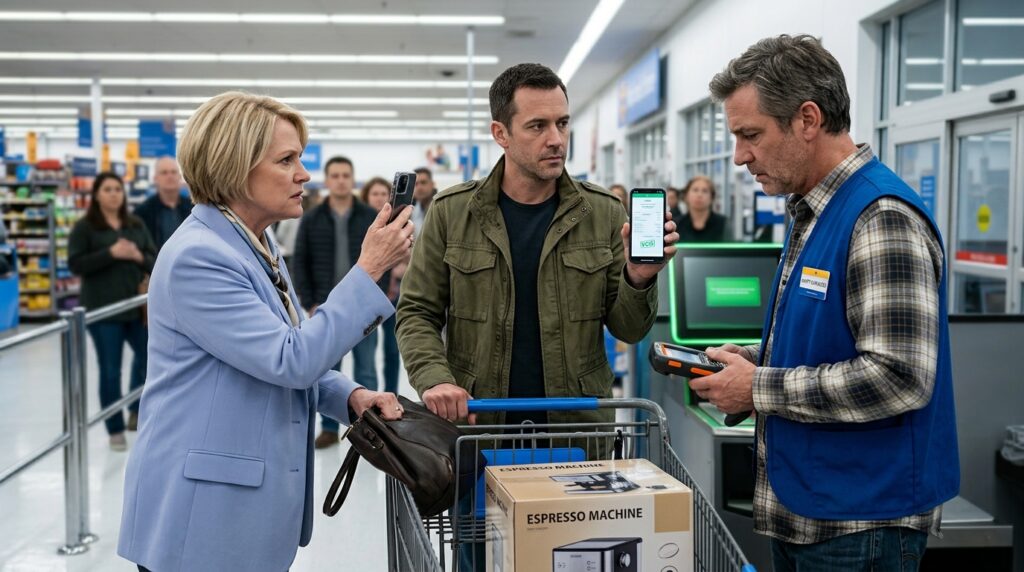
Accused at Checkout He Stayed Calm Until One Digital Receipt Exposed the Truth and Silenced Everyone

CHAPTER 1: THE TRAP OF THE CONCOURSE

The glare of the overhead fluorescent tubes hit the white linoleum with a sterile, shifting intensity that made every surface edge look razor-sharp. Marcus Vance kept his hand flat against the rubberized grip of his shopping cart, his fingers motionless, registering the faint, rhythmic vibration of the store’s HVAC system through the metal frame. Below him, nestled securely in the dark wire basket of the bottom rack, sat the heavy cardboard box containing the commercial espresso machine. The factory plastic sealing was still cold from the storage dock, catching the light in dull, grey squares. He had already scanned the barcode using the store’s mobile application two minutes ago; his digital wallet had cleared the payment, and the transaction confirmation was securely locked into his phone’s active memory. He was precisely three paces from the exit threshold when the world lost its rhythm.

A sharp, synthetic rustle broke the ambient hum of the marketplace. Brenda Gantry stepped into the center of the lane, her feet planted wide apart on the linoleum seam, her physical frame entirely obstructing the exit path. She wore an oversized pastel blazer that seemed to absorb the clinical light without reflecting it, and her large, stiff leather handbag was wedged firmly against the metal handrail of Marcus’s cart like a chock block behind a tire. Before Marcus could calculate the trajectory of her movement, she snapped her arm upward, holding her smartphone less than eighteen inches from his face. The glass lens of the camera stared back at him, an unblinking circle of dark plastic.

“He didn’t scan it,” Brenda announced, her voice pitched perfectly to carry across the front concourse, instantly severing the low chatter of the adjacent registers. “I watched him pocket his device the second he stepped out of the appliance aisle. He didn’t use the conveyor belt. He bypassed the cashier window entirely.”

Marcus did not flinch. He let his gaze drop to his silver wristwatch, watching the brushed steel second hand tick forward in absolute, unyielding increments. Three seconds of public exposure. His pulse remained measured, bound tightly by the data analyst’s habit of internal containment, though a cold, familiar pressure began to tighten at the base of his neck. It was the exact psychological weight of the old scapegoat lane—the ghost of a previous professional life where a loud, unverified accusation had been allowed to reshape reality because he had chosen to remain silent.

To his left, the cashier at Lane 4 froze, a carton of milk suspended over the scanner bed, the red laser grid painting a momentary crimson line across her knuckles. The low, shifting murmurs of the weekend crowd began to drift toward them, a collective tightening of attention from the shoppers holding paper receipts in Lanes 3 and 5. They were looking for the visual tells of guilt: the rapid blink, the defensive posture, the sudden stammer. Marcus gave them none of it. He maintained his geometric posture, his spine aligned perfectly with the cart’s vertical bar, staring directly past the glowing screen of Brenda’s phone into the cold, calculated space of her eyes.

Brenda’s finger tapped the recording icon on her screen, her manicured nail making a sharp click against the glass protector. “Look at him,” she told her invisible audience, her voice dripping with a calculated, civic righteousness. “Caught red-handed and can’t even offer an excuse. Security, we need an immediate manual lock on the exit doors before he drops the merchandise.”

Marcus felt the metal handle of the cart grow warm under his palm. The conflict was no longer about an unbagged appliance; it was a tactical demonstration of public policing, and Brenda had just overextended her first piece.


CHAPTER 2: THE GATHERING SHADOW

The white linoleum floor felt rigid beneath Marcus’s boots, a vast grid of sterile squares that seemed to magnify the sudden deceleration of the room. Brenda Gantry’s smartphone remained suspended between them, a small pane of dark glass reflecting the overhead fluorescent banks as a series of distorted white bars. Her index finger hovered near the screen’s edge, twitching in time with her breath. To Marcus, every element of her posture was an exposed lane—the white-knuckled grip on her leather handbag, the overextended lean of her torso across the cart’s metal perimeter, the rapid, shallow rise of her pastel lapels. She was operating on the absolute certainty of her social capital within the store’s geography, transforming the narrow corridor of Checkout Lane 4 into a makeshift tribunal.

Marcus kept his left hand locked on the rubberized handle of the cart, his palm registering the microscopic texture of the molded grip. He did not shift his weight. He did not pull his phone from his field jacket to counter her recording with his own. In the logic of a strategic pursuit, moving too early simply provided the opponent with an anchor for their momentum. Instead, he watched the small, rectangular register terminal mounted to the side of the bagging carousel. Beneath its grey plastic housing, a tiny amber LED indicator was pulsing in a irregular, broken rhythm. It was a three-quarter beat—the specific diagnostic signature of a localized network buffer queue trying to push a heavy data packet through a throttled corporate switch.

“You’re quiet, Mr. Vance,” Brenda said, her voice dropping an octave into a low, transactional hiss that didn’t lose its carrying power. She leaned forward, the sharp scent of synthetic lavender perfume breaking through the store’s ambient smell of floor wax and cardboard. “That’s the data office habit, isn’t it? Sit behind a double monitor, keep your head down, and assume the people who actually live in this community won’t notice when you start treating the inventory like a private warehouse. I know exactly what your type does when you think nobody is watching the high-value aisles.”

The accusation hung in the dry, static-charged air. To his left, the cashier’s register lane had transformed into a physical dead zone. The belt had stopped moving; a half-scanned plastic container of spinach sat directly over the red optical window, its laser beam scattering across the clear wrapping in a web of thin, crimson lines. The murmurs from the adjacent queues had solidified into a heavy, collective silence. Marcus could feel the geometric distribution of the crowd changing behind his shoulder. Shoppers from Lanes 3 and 5 were shifting their positions, leaning over the chrome dividing bars, their faces hardening into the passive, uniform mask of a public audience awaiting a confession. They were not analyzing the data; they were responding to the volume of the claim.

“The item is fully accounted for,” Marcus said. His voice was flat, devoid of the defensive spikes that a guilt-driven panic would produce. He kept his vocal register low, forcing Brenda to lower her device slightly to catch the frequency. “Please step away from my cart so I can leave.”

“Accounted for by whom?” Brenda countered, her thumb snapping against her phone case with a sharp clack. She turned her torso slightly, addressing the perimeter of watching shoppers without lowering the camera lens. “He expects us to believe the box just walked into the bottom rack on its own. Harrison! Over here, please. We have a clear failure at the perimeter.”

Harrison Blake, the evening shift manager, broke through the line of waiting carts at Lane 3. His movements were governed by the profound, structural exhaustion of a middle manager whose entire career was spent mitigating friction within tight corporate parameters. His store vest was slightly unaligned at the shoulder, and his eyes carried the dull glare of someone who had spent the last four hours reviewing spreadsheet discrepancies in a windowless back office. Behind him, a uniform security guard moved with a slow, heavy gait, his hand resting automatically on the thick leather utility belt housing his radio and flashlight.

“What’s the disruption, Brenda?” Blake asked, his voice carrying the practiced, neutral weight of an official intervention. He stopped at the axis point where the two carts intersected, his eyes immediately dropping to the large, unbagged espresso machine box in the lower rack.

“A direct bypass,” Brenda said, her finger pointing sharply toward the grey cardboard. “He took it from the appliance bay, avoided the cashier registers entirely, and was moving toward the automatic exit doors when I intervened. He’s refusing to show a physical paper slip.”

Blake turned his head toward Marcus, his eyebrows gathering into a tight, professional knot. The security guard moved an inch closer, his boots squeaking against the linoleum, his shadow falling across the metal front of Marcus’s cart.

Marcus kept his eyes fixed on the register terminal’s housing. The amber light was still blinking its broken, irregular code. The localized server was hanging, holding the confirmation packet in suspension while the terminal waited for an override signal from the front desk. The system wasn’t broken; it was simply delayed, leaving a visual gap that Brenda was currently filling with her own narrative. Marcus slid his right hand into the pocket of his field jacket, his fingers finding the cool, smooth glass face of his smartphone. He pulled it out, the screen activating instantly to display the high-contrast matrix code of the digital receipt.

“I used the mobile application,” Marcus said, holding the device steady at Blake’s eye level. “The digital invoice cleared the corporate ledger three minutes ago.”

Brenda let out a short, jagged laugh that rattled the plastic dividers in the bagging rack. “Harrison, look at the screen texture. It’s a static image file. It’s an offline template. They’re running these mock invoice codes through the community forums every week now. Scan his physical cart, or let the guard take him to the holding room.”

Blake stepped closer, his hand reaching for the portable inventory scanner at his hip. But before the red laser could line up with Marcus’s screen, a sharp, electronic chime echoed from the main supervisor’s terminal behind the customer service counter. A bright red text alert began to flash across the master monitor screen: Transaction Discrepancy — Terminal 4 Override Required.

Brenda’s posture snapped back into its full, dominant height, her eyes gleaming under the fluorescent tubes. “There it is,” she whispered, her voice tightening like a ratchet. “The system flagged it. He didn’t pay for it.”

CHAPTER 3: THE THREAT OF THE THRESHOLD

The high-priority chime from the supervisor’s terminal did not break Marcus’s concentration; it merely shifted the geometric parameters of the room. Harrison Blake’s shoulders dropped three degrees, his left hand shifting away from his pocket toward the central console. The word Discrepancy flickered across the master monitor in thick, low-resolution red blocks, casting a pale crimson hue across the brushed steel backing of Checkout Lane 4. To the surrounding ring of shoppers, the red text was an unvarnished verdict. The subtle shift in the crowd’s mass was physical—a collective lean forward, the tightening of a circle that had previously been loose and unformed.

Brenda Gantry stepped closer, the rigid seam of her pastel blazer pressing directly against the wire nose of Marcus’s cart. The movement was calculated to choke off his physical exit lane completely. Her smartphone lens remained locked on his face, the tiny reflective glass of the camera aperture capturing the flickering alert light behind him.

“The system doesn’t lie, Harrison,” Brenda said, her tone hardening into a sharp, structural drill. She did not look at the monitor; she kept her eyes anchored on Marcus, checking for the microscopic shoulder drop or the shallow breath that signaled a crack in his defense. “It flags what the human eye misses. This isn’t a simple scanning glitch. It’s an explicit inventory halt. He knew the network would lag in the back corridor, and he timed his run precisely to beat the baseline ledger update.”

Marcus turned his head slowly toward the register terminal housing. He did not look at Brenda’s phone. He did not offer a verbal contradiction to her theory. Instead, his eyes scanned the specific string of digits scrolling beneath the error code on the master console: ERR-404-SYS-SYNC-0914. In a relational database, a 404 sync error was never a validation of a missing payment; it was a tracking hold—a sign that the local node had committed the transaction to the primary cloud server but had failed to download the handshake receipt block before the local lane checkout time expired. The system hadn’t caught a thief; it had simply dropped a packet.

“We need to follow the protocol, Mr. Vance,” Blake said, his voice losing its neutral diplomatic weight and taking on the cold, transactional edge of corporate liability. He tapped the touchscreen on the console twice, his finger leaving a faint smudge of oil on the matte display. “The front terminal is locking this lane out from the central database. Until we run a manual inventory verification, the cart cannot cross the baseline threshold. Please hand your mobile device to the officer so we can cross-check the internal token ID.”

The uniform security guard took a single step forward, his boots making a dry, scraping sound against the white linoleum tile. His hand stayed flat against his heavy utility belt, but his body weight shifted onto his front leg, casting a wide, dark shadow that cut across Marcus’s field jacket and the top handle of the shopping cart.

“The device remains in my possession,” Marcus said. His voice was a calm, unyielding baseline that didn’t rise to match Brenda’s pitch. He held the smartphone perfectly steady at Blake’s eye level, his index finger resting precisely on the active security signature flashing at the bottom of the PDF invoice. “The internal token ID is fully visible on the display interface. If your terminal is experiencing a localized synchronization block, scanning the matrix code directly from this panel will force a manual query through the core network backbone.”

“He’s stalling,” Brenda interrupted, her manicured index finger snapping outward to point directly at the silver wristwatch on Marcus’s left arm. “Look at the timing loop. He’s waiting for the shift change at five o’clock when the concourse clears out. He wants you to pull the lane offline so he can argue his way past the security desk without a line-item audit. I’ve watched three different crews run this exact corporate bypass in the north-end branch last winter.”

The witness layer behind the chrome dividing bars grew completely motionless. A cashier at Lane 5 lowered her hand, leaving a black plastic divider resting on the moving rubber belt as she leaned over the register housing to see the screen. The initial, vague suspicion in the room had hardened into something far more dangerous—a quiet, collective consensus that Marcus’s restraint was merely a polished corporate mask designed to conceal an ongoing grand larceny. They wanted the box opened; they wanted the manual search; they wanted the visible exposure of the hidden truth.

Blake hesitated, his eyes darting between Brenda’s confident posture and the specific alphanumeric string on Marcus’s screen. The pressure of the public square was a physical weight in the narrow corridor, and his corporate training dictates were forcing him toward the path of least resistance. He reached out his hand toward the handle of Marcus’s cart, his fingers wrapping around the metal frame. “We’re moving this into the asset protection office, Mr. Vance. Let’s clear the lane.”

Marcus did not pull the cart back. He kept his fingers locked on the rubber grip, his body weight anchoring the wheels against the linoleum tile seam. “Scan the barcode on the console screen first, Mr. Blake,” he said, his voice dropping into a razor-sharp register that seemed to isolate itself from the ambient noise of the market. “If the core network backbone returns a zero-balance verification after a manual query, I will walk into the back room myself. If it returns a cleared invoice, you are currently executing a false detention on an authenticated customer.”

The manager’s hand froze on the chrome frame, his knuckles turning a dry, pasty white as he calculated the legal friction of Marcus’s proposition.

CHAPTER 4: THE COLD ENCRYPTION

Harrison Blake’s fingers tightened on the chrome handle of the cart, his palm leaving a dark patch of condensation against the polished plating. He did not pull the hand scanner from his tactical vest belt; instead, he initiated a manual override from the terminal side-panel, bypassing Marcus’s display entirely. Across the main screen, the system executed a complete hard-reset sequence, shifting the error output string from a network queue block into a rigid local lockout. To the surrounding ring of observers, the sudden visual transition from a flashing alert to a completely dark interface was a devastating failure. The subtle friction of the room intensified as the security guard placed his forearm across the metal guiding bar of the bagging carousel, physically narrowing Marcus’s remaining spatial footprint to a single line of linoleum tiles.

Brenda Gantry’s phone screen glinted under the overhead fluorescent tubes, capturing the reflection of the dark monitor. Her breathing had stabilized into a rhythmic, triumphant cadence, her pastel lapels flaring slightly as she shifted her heavy leather handbag closer to Marcus’s shoulder.

“The time loop has fully collapsed, Harrison,” Brenda said, her words carrying a sharp, transactional weight that left no room for customer service compromise. She tapped the camera housing on her device twice, aligning the optical tracking dot directly with the silver buckle of Marcus’s field jacket. “He didn’t account for the manual ledger fallback. They think because they can code a clean interface layout on a mobile display, the local physical nodes won’t verify the unbagged inventory baseline against the daily sales register history. This isn’t an isolated anomaly; it’s a deliberate corporate penetration maneuver.”

Marcus felt the cold air from the automatic sliding doors spill across his neck, carrying the dry, industrial smell of asphalt and commercial exhaust from the outside concourse. He kept his feet anchored behind the cart axle, his posture completely vertical, refusing to let his spine compress under the physical proximity of the uniform guard. His fingers remained open on the black rubberized handle, registering the precise micro-vibrations of the conveyor belt’s internal belt drive. On the secondary screen mounted beneath the register counter, a microscopic cluster of green data lines was beginning to execute an unprompted diagnostic loop—the specific mechanical artifact of a hardware-level network interface card trying to recover its primary gateway address after a forced supervisor hard-reset. The system was currently trapped in a hard-wired handshake loop, holding the authentic payment authorization hostage within the local cache memory blocks.

“The lane is completely bricked, Mr. Vance,” Blake said, his vocal register dropping into a severe, bureaucratic monotone as he keyed a private security code into his belt radio. The small plastic speaker hissed with static before a low dispatcher voice acknowledged the call. “The local node won’t accept an external mobile display input once a supervisor lockout has been initiated from the main service desk. We are legally required to remove the merchandise from the active concourse until the regional administrative ledger confirms the funds. Please pull your hands away from the cart bar.”

The security officer took a full half-step inward, his heavy leather utility belt clattering slightly against the chrome cart guard as his shadow completely obliterated Marcus’s remaining light field.

Marcus did not adjust his grip. He turned his smartphone display ninety degrees, pressing the face of the tempered glass directly against the optical laser aperture built into the side of the register console housing. “The network backbone hasn’t dropped the token, Mr. Blake,” Marcus said, his voice entirely flat, stripped of the emotional spikes that would signal an admission of structural guilt. “Your local console is reading an empty string because you terminated the connection sequence mid-packet. The regional database isn’t returning a zero-balance; it’s waiting for the terminal to clear its physical memory buffer.”

“He’s running an unverified script through the local interface terminal,” Brenda said, her voice rising to pierce the low, static hum of the checkout lanes as she addressed the surrounding circle of grocery shoppers. “He’s trying to force a database bypass while the manager has the register lane offline. Look at his posture—he’s completely calculating his risk metrics in front of the cameras. Harrison, take the appliance box out of his possession immediately.”

The witness layer behind the adjacent metal queue rails remained perfectly rigid, a solid wall of human observation watching the tactical impasse. A customer holding a wire basket at Checkout Lane 3 raised his personal phone, the camera lens catching the stark, crimson glare of the terminal’s manual override indicator light as it began to strobe across Marcus’s face. The room was no longer evaluating a potential retail dispute; they were witnessing a calculated physical extraction, and the public consensus had entirely shifted toward Marcus’s absolute, systemic failure.

Blake reached across the top rack, his fingers wrapping around the cardboard lip of the espresso machine box to lift it from the bottom basket. But before his arms could clear the metal frame, Marcus’s right hand moved with geometric precision, his index finger tapping a specific, deep-level command prompt directly into the hidden diagnostic layer of his mobile banking interface.

Across every terminal in the front concourse, the checkout registers simultaneously emitted a continuous, high-pitched system chime. The master monitor screen didn’t display an error string; instead, a massive white window overwritten with encrypted system data flashed across the display interface: Transaction Token Authenticated — Corporate Payment Clearing Protocol Active.

The manager’s hands stopped on the grey cardboard, his eyes widening as the local network database suddenly began downloading the handshaking ledger blocks in a rapid, unprompted sequence.

CHAPTER 5: THE SOCIAL EXORCISM

The high-pitched system chime from the supervisor’s terminal did not fade; it multiplied. Across the front concourse, the registers at Lanes 3, 4, and 5 simultaneously emitted a rhythmic, synchronized sequence of electronic tones that shattered the artificial tension of the checkout grid. Harrison Blake’s hands retreated from the cardboard edge of the appliance box as if the surface had suddenly grown hot. On the master monitor, the thick red error string dissolved, replaced by a cascading waterfall of white system text that consolidated into a single, high-contrast block: TRANSACTION TOK-98124 AUTHENTICATED — FUNDS SECURED.

Brenda Gantry did not lower her device, but the structural alignment of her arm shifted. The smartphone tilted three degrees toward the floor, its glass lens catching the sudden, brilliant green wash of the terminal’s master clearing screen. Her lips remained open, but the rapid, confident cadence of her breathing caught in her throat, her pastel collar stiffening against her neck as the room’s baseline mechanics reversed.

“Scan the screen now, Mr. Blake,” Marcus said. His voice was a calm, level plane that cut through the low industrial hum of the store’s network hardware. He maintained his rigid, unmoving posture, his left hand still anchored to the black rubberized handle of his cart. “Match the serial number on the box to the invoice that cleared through the corporate gateway while your local node was holding the packet. The ledger has been verified since the initial pass-through.”

Blake reached for the hand scanner with an uncharacteristic, frantic acceleration. He did not look at Brenda. He did not seek her verbal confirmation. He aligned the red laser grid with the matrix code on Marcus’s smartphone screen and pulled the trigger. The scanner responded with a loud, dual-tone confirmation chime—the specific network handshake signal that indicated a fully closed transaction file. On Blake’s portable terminal display, Marcus’s full customer profile, his encrypted loyalty token, and the exact timestamp of the payment populated across the user interface in crisp, green typography.

The shift in the room’s mass was absolute. The loose circle of fifteen shoppers who had previously clustered around Checkout Lane 4 to witness a physical detention began to expand, their faces shedding the passive mask of suspicious observers. To Marcus’s left, a woman holding a wire basket let out a sharp, audible scoff, turning her back completely on Brenda’s pastel blazer. The young man near the exit barrier shifted his phone camera, his lens zooming in directly on Brenda’s manicured knuckles as they began to tremble against the leather strap of her handbag. The public square she had attempted to command had transformed into a closed corridor of collective disgust.

“This… this is an irregular display,” Brenda stammered, her voice rising an octave as she attempted to re-establish her defensive perimeter. She took a half-step backward into the bagging bay, her heavy leather bag striking the plastic bag rack with a dull, hollow clack. “The server override flagged a systematic discrepancy, Harrison. You’re allowing an unverified digital account signature to bypass standard asset protection audit controls. I’ve tracked this specific tracking pattern—”

“Lower the phone, Brenda,” Blake broke in, his voice stripped of his usual conflict-averse middle-management neutrality. His face had hardened into a severe, professional mask, his eyes fixed tightly on her recording lens. “The transaction is entirely legitimate. The customer has fully paid for the merchandise. Your interference has compromised the operational access of this exit concourse for over eight minutes.”

“I am performing an authorized community safety review,” she insisted, her head snapping toward the perimeter of watching shoppers, searching for a single nodding head or a shared glance of solidarity. She found only stone-faced silence and the cold glass faces of three personal devices recording her face. “The store presence requires citizen vigilance when the automated platforms fail to report standard inventory movement. I have a right to document—”

“You have no rights on this property outside of your customer status,” Blake said, his vocal register dropping into a razor-sharp, transactional monotone that carried directly to the back of the queue lines. He stepped forward, his uniform vest cutting off her line of sight to Marcus. “Your guest conduct privilege is officially revoked for dynamic customer harassment. Officer, record her membership billing data from her active profile and escort her past the perimeter barrier immediately. She is blocked from this location.”

The uniform security guard moved with a heavy, deliberate stride, his leather utility belt clattering against the metal handrail as he placed his physical frame between Brenda and the exit threshold. His hand did not touch his belt, but his shadow completely enveloped her pastel blazer, forcing her another step back until her heels met the base of the checkout lane wall.

Marcus watched her collapse in silence. He did not offer a mocking remark. He did not raise his own device to document her retreat. He simply adjusted his silver wristwatch, checking the time against the green confirmation indicator on the terminal housing. The entire performance of false authority had broken apart within eighty-four seconds, undone not by a louder argument, but by the clean, unyielding mechanics of an encrypted record.

Brenda lowered her phone completely, the glass display going dark as her fingers lost their grip on the side brackets. She gripped her heavy leather handbag against her ribs like a piece of salvaged cargo, her chin dipping toward her collar as she turned and moved through the cleared space between Lanes 3 and 4. Her boots made a fast, squeaking sound against the linoleum tile, a desperate, irregular rhythm that faded only when the automatic glass doors slid open with a heavy rustle of rubber seals and let her out into the gray asphalt parking lot.

Blake turned back to Marcus, his shoulders dropping as he offered a deep, professional nod of apology. “My apologies for the delay, Mr. Vance. The network sync gap should have been manually bypassed before the threshold check. If you need assistance loading the appliance box into your vehicle—”

“The cart is sufficient,” Marcus said. His voice remained perfectly measured, free of the adrenaline spikes that normally follow a public confrontation. He gripped the rubberized handle, aligned the front wheels with the center of the exit concourse, and pushed the cart forward across the chrome threshold plates.

As he stepped out into the crisp afternoon air, the heavy static hum of the fluorescent market dissolved, replaced by the clean, neutral space of the open parking field. The weight of the old professional misread that had occupied his internal thoughts for months felt entirely clear—bleached out by the absolute clarity of an unbending baseline. Some people needed a loud microphone to feel important, but a quiet record outlasts them every time. He unlocked his vehicle trunk with a single touch, the metal lid rising smoothly against the sky, leaving the concourse behind him in the quiet shadow of the glass front.

Similar Posts

Leave a Reply

Your email address will not be published. Required fields are marked *