
CHAPTER 5: PUBLIC COLLAPSE ACCOUNTABILITY
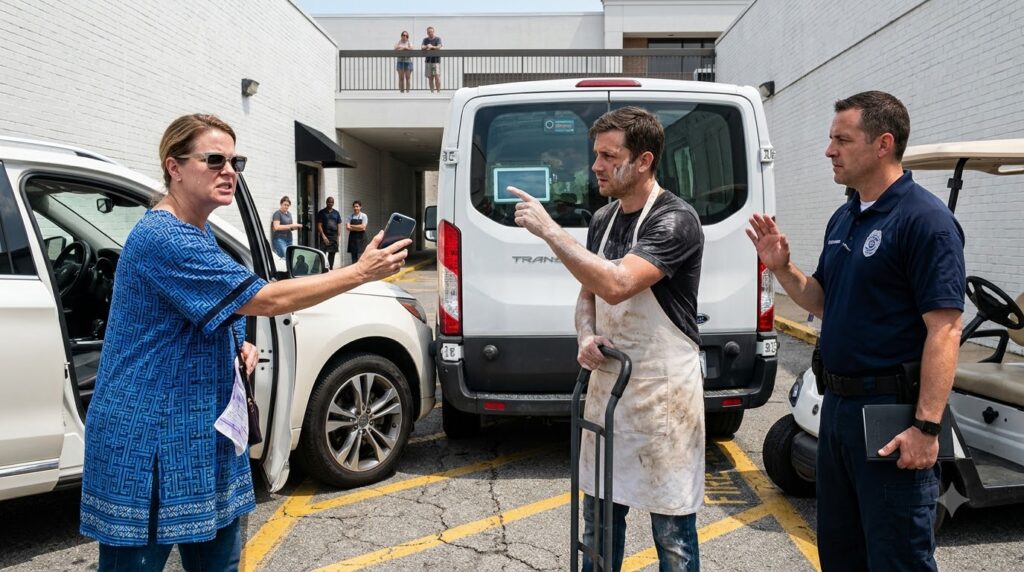
“You can’t write me a ticket,” Brenda said, her voice dropping an octave into a brittle, trembling rasp. “I am going to phone property management right now. I will have your job by three o’clock, Greg.”
Carver didn’t look up from his citation book. The yellow carbon sheet fluttered against the hard plastic backing as his pen pressed into the paper, making a sharp, scratchy sound that carried clearly across the quiet alley.
“The plaza director is on the copy of this notice, ma’am,” Carver said smoothly, his posture rigid and unyielding. “Along with the high-definition footage from Mr. Holloway’s vehicle. If you refuse to move this SUV in sixty seconds, I’m signing the dispatch order for the flatbed tow truck waiting at the east gate.”
Brenda’s phone slipped another inch in her grip. The screen went dark, its live-stream recording finally cutting off as her thumb accidentally hit the lock button. She looked up at the elevated walkway. The line of spectators hadn’t moved. The boutique manager stood with her arms crossed over her apron, while the pharmacy runner held his phone openly, capturing every second of Carver filling out the heavy yellow slip.
Her theatrical authority had vanished. What remained was a woman standing in a bright, ridiculous tunic in the middle of a sun-baked loading dock, completely exposed under the midday glare.
“Get in the car, Brenda,” a quiet, strained voice called from the passenger window of the luxury SUV.
Brenda turned sharply. Her teenage daughter had slid down in her seat, her face pale with burning embarrassment, her hands holding her denim jacket up to block the view of the onlookers above.
“Get in the car,” her daughter repeated, her voice cracking. “Please. Everyone is watching.”
Brenda’s jaw worked silently. For three long seconds, she looked at Marcus. She looked at his flour-dusted hands resting steadily on the handlebars of his delivery cart, his expression completely devoid of anger, mocking, or excitement. There was no victory in his posture, only the cold, unyielding weight of a man who had set a boundary on asphalt and refused to let anyone push him across it.
Without another word, Brenda ripped her sunglasses off her face, shoved them into her purse, and yanked the SUV’s heavy door open. She climbed into the driver’s seat and slammed the door with a violent, metallic bang that echoed off the brick concourse.
Carver stepped forward, peeled the top yellow copy from his citation book, and slapped it flat under the luxury SUV’s driver-side wiper blade.
The engine roared to life with a harsh, aggressive surge of horsepower. Brenda threw the transmission into reverse, the tires screeching loudly as she backed the heavy vehicle out across the yellow hatch marks. The rear bumper swung wide, missing the concrete pillar by inches, before she slammed the shifter into drive and tore down the service alley, kicking up a cloud of dust and dry leaves into the hot air.
The alley went still again.
The line cooks on the back porch of the Italian bistro let out a low, collective whistle, returning to their prep work. Above, the crowd on the walkway slowly dispersed, their voices dissolving into the ambient hum of the shopping center.
Carver tore the white original from his pad, folded it once, and turned toward Marcus.
“You’ve got five minutes left on your loading timer, son,” Carver said, a faint, weary trace of a smile tugging at the corner of his mouth.
“I only need three,” Marcus replied.
He turned to his delivery van, pulled the remaining two trays of fresh sourdough onto his hand truck, and wheeled them through the service door of the anchor cafe. The cool, air-conditioned air inside smelled of roasted coffee beans and toasted yeast—a sharp, clean contrast to the hot exhaust of the alley outside.
When Marcus returned to the alley three minutes later, his hand truck was folded flat and secured in the side rack of the Transit. He closed the heavy rear doors, the steel latches clicking into place with a solid, resonant thud.
Carver was sitting in his electric patrol cart near the exit gate, his radio humming softly with routine maintenance calls. As Marcus climbed into the driver’s seat of the van, he looked at his dashboard tablet. The red recording light was still blinking silently, logging the quiet, empty alley.
On the screen, the green LED timer hit zero: 00:00.
Marcus turned the key in the ignition. The diesel engine rumbled to life, smooth and steady under his boots. He adjusted his side mirror, put the van in gear, and pulled out onto the main perimeter road, right on schedule, leaving the sun-baked asphalt behind him in perfect, unbroken order.








