CHAPTER 2: THE SHADOW ON THE PARCEL
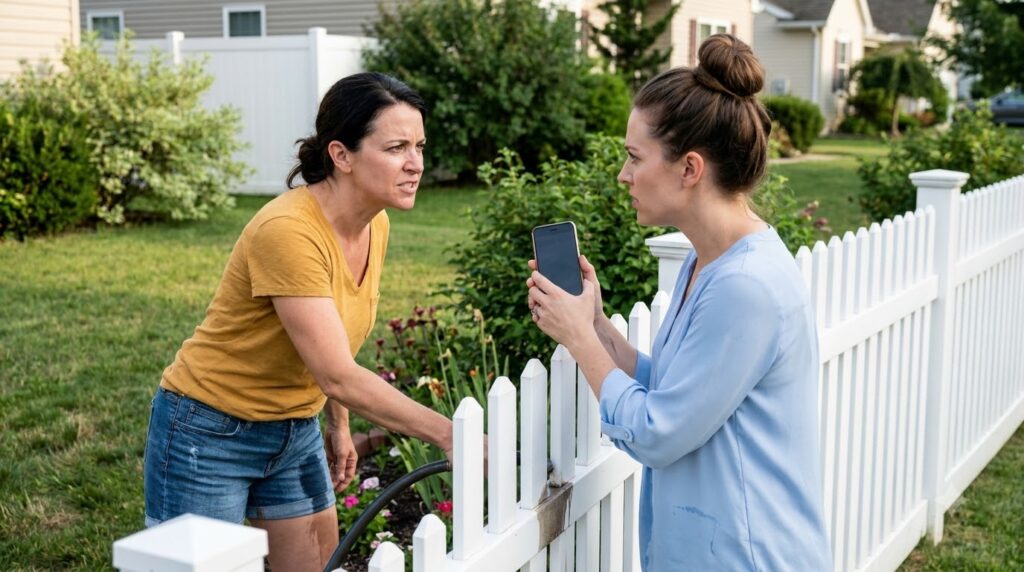
The silence stayed heavy as I backed away from the white vinyl fence, my thumb locking the smartphone screen to a dark, blank mirror. Brenda didn’t say another word. She stood frozen in her mustard-yellow shirt, her flat sandals half-sunk into the damp mulch, watching me through the narrow gap between the pickets.
I turned my back on her and walked across the grass toward the rear patio. The wet fabric of my light-blue blouse clung cold and heavy against my spine, sending a slow, rhythmic chill through my ribs with every step. Water dripped from my hem, leaving a dark, fading trail across the gray flagstones.
Inside the kitchen, the air was cool and smelled faintly of lemon cleaner and stale coffee. I didn’t stop to change out of the soaked shirt. I placed the phone flat on the granite countertop, plugged in the charging cable, and immediately initiated a cloud backup of the video file. The blue progress bar crawled from left to right—12%… 48%… 100%. Once the checksum verified the transfer, I mirrored the encrypted file to a local flash drive and dropped it into my pocket.
Only then did I peel the clammy cotton from my skin, throwing the ruined blouse into the sink. I pulled a dry gray sweatshirt over my head and walked down the hallway to the small front office where I kept the house records.
On the bottom shelf of the filing cabinet sat the thick accordion folder labeled Property Title & Survey. I pulled it out, bringing it under the harsh desk lamp.
When I bought this three-bedroom ranch four years ago, the closing documents had been standard—a stack of white legal paper, notary stamps, and a boundary sketch from twenty years back. I unrolled the original plot map drawn by the previous owner’s surveyor in 2004.
Under the bright LED bulb, the sharp edges of the faded blue ink lines looked clear enough at first glance. But as I traced the eastern boundary—the exact three-hundred-foot line running between my lot and Brenda’s—my finger caught on an anomaly.
The line wasn’t straight.
Near the rear corner, where Brenda’s overgrown hydrangeas now crowded the fence, the original draftsman had drawn a subtle, three-degree jog inward, carving a long, sliver-shaped notch out of my property and awarding it to lot 14. But beneath the faded blue line, faintly visible under the legal seal, was a erased pencil mark—a straight line running true from the iron corner pin.
Beside the alteration was a small, hand-initialed stamp: B.V. / Exception Approved.
Brenda’s initials.
I leaned closer, my pulse ticking methodically against my jaw. The modern survey I paid for three weeks ago had used satellite GPS and uncovered iron corner pins driven four feet deep into the subsoil—pins that matched the original, erased pencil line, not the hand-altered ink map. Brenda hadn’t just been protective of her garden beds; she had been relying on a falsified document for two decades to claim an extra fourteen inches of my land.
A soft knock rattled the glass of my back patio door.
I closed the accordion folder, slipped the 2004 plat map into a clear protective sleeve, and walked back through the kitchen. Through the glass, I saw Arthur, the homeowner association president, standing on the flagstones. He was a retired accountant in his late sixties, wearing his usual khaki vest, a clipboard tucked beneath his arm, looking visibly uncomfortable.
I slid the door open. The afternoon air outside was turning cool as shadows lengthened across the lawn.
“Martha,” Arthur began, adjusting his wire-rimmed glasses and shifting his weight on the flagstones. “Brenda called me five minutes ago. She was… quite hysterical, to be frank. She claims you harassed her at the property line and threatened her while she was watering her garden.”
I didn’t answer right away. I let the silence stretch until Arthur shifted his clipboard, his eyes darting toward the wet patches still drying on my patio stones.
“Come inside, Arthur,” I said, my voice flat and even. “I want to show you something.”
He stepped past the threshold, wiping his loafers on the mat. I didn’t hand him a cup of coffee or offer a chair. I walked straight to the granite counter, tapped my phone screen, and turned the display to face him.
“This is what Brenda calls watering her garden,” I said, pressing play.
Arthur leaned in, his eyebrows rising behind his lenses as the high-definition video filled the screen. The footage was crystal clear: Brenda’s squared stance, her arm deliberately extending over the white vinyl pickets, the high-pressure jet pinning me against my own lawn, and the tight, mocking grin as she delivered her line.
The audio played loudly in the quiet kitchen: “It’s just an accident, I can’t help where the water goes.”
Arthur stared at the screen long after the video ended. The color slowly drained from his weathered face. “Good lord,” he muttered softly. “She… she aimed right at you.”
“She did,” I replied, opening the folder on the counter and pulling out the 2004 plat map alongside the new, stamped state survey. “And before we talk about HOA nuisance rules, Arthur, I want you to look at these two boundary descriptions. Look at the corner pin coordinates.”
Arthur pulled his glasses down his nose, peering at the papers. His eyes narrowed as he spotted the erased pencil line beneath the ink. “Where did you get this old plat?”
“It was in the seller’s disclosure file,” I said. “Brenda had someone alter this map twenty years ago to justify her garden expansion. But when I put the new fence in, I followed the real iron pins. She isn’t mad about the fence, Arthur. She’s terrified because the real line puts her right in violation of county setback laws.”
Arthur touched the edge of the paper, his fingers trace-following the erased pencil line. “This isn’t just an HOA dispute, Martha. If she altered an official county land plat…” He trailed off, looking toward the window that faced Brenda’s yard.
“It’s fraud,” I said simply.
Arthur shook his head, looking troubled. “I’ll call an emergency board meeting. But Martha… be careful. Brenda’s been on this street since it was built. She knows every inspector in the township.”
“So do I,” I said.
After Arthur left, I walked out to the fence line once more. Twilight was settling over Oakridge Court, turning the grass a deep, bruised purple. On the other side of the white pickets, Brenda’s house was dark, except for a single lamp burning in her kitchen.
I knelt near the rear corner post, where the white vinyl met the dense shadow of her hydrangea bushes. Reaching through the lower pickets, I pushed aside a layer of wet mulch.
My fingers brushed against something hard and metallic buried four inches down in the soil—not an iron survey pin, but a heavy PVC coupling connected to a corrugated metal pipe, running straight out from under Brenda’s foundation and terminating directly onto my side of the line.
It was wet, coated in dark, foul-smelling silt.