Chapter 6: The Comment She Never Expected to Write
Karen typed slowly.
She deleted the first version.
Then the second.
Finally, she wrote:
“I was wrong to immobilize a vehicle I had no authority to lock. The parking sign was also improperly placed. Both things can be true.”
She stared at the sentence.
It was difficult to post.
Karen had spent most of her adult life believing that admitting fault made people weaker.
David had always believed the opposite.
She pressed Post.
Within minutes, responses appeared.
Some people mocked her.
Some praised her.
Others continued arguing about whether the military vehicle should have been parked there.
Karen did not answer them.
Instead, she called Emily.
They spent Saturday morning going through David’s estate paperwork at the kitchen table.
For the first time in months, Karen wasn’t thinking about somebody else’s lawn, driveway, trash bin, parking space, or guest.
She was thinking about her own family.
By Monday, the paperwork had been submitted.
The house was secure.
The deadline was met.
And something inside Karen had shifted.
Not completely.
She still noticed crooked parking.
She still hated trash cans left out overnight.
She still believed rules mattered.
But now she had learned that rules without judgment could become another kind of disorder.
A week later, the HOA held its emergency-preparedness demonstration again.
This time, the temporary signs were large, visible, and properly placed.
Daniel returned with the same military unit.
Karen watched from the edge of the parking lot.
When Daniel saw her, he smiled.
“You staying away from the wheel locks?”
Karen laughed.
“I retired from enforcement.”
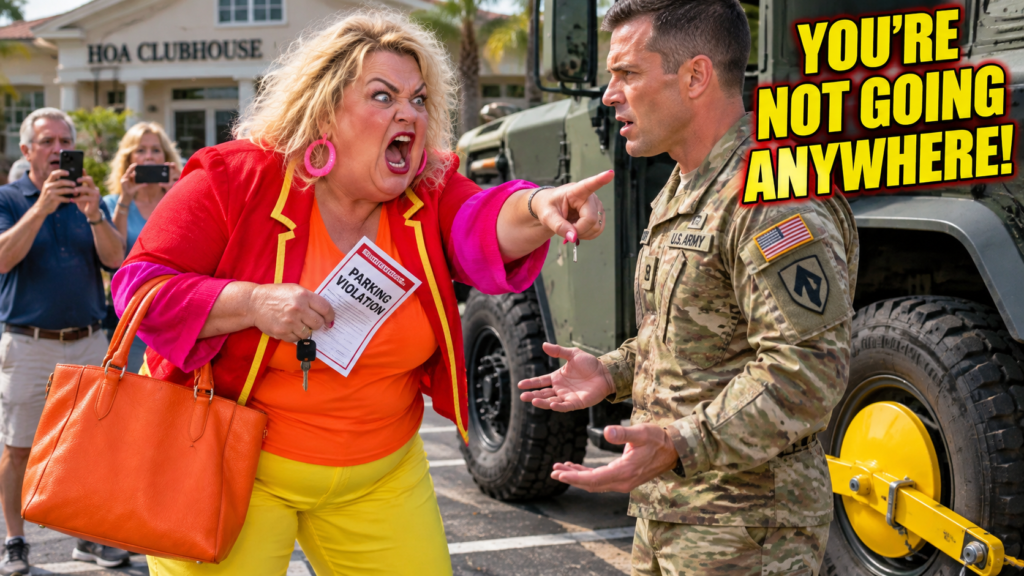
Daniel looked at the bright-yellow device sitting on a table nearby.
“Good career move.”
They shook hands.
Then Daniel noticed something behind Karen.
A new sign had been installed:
AUTHORIZED VEHICLES ONLY — CONTACT HOA MANAGEMENT WITH QUESTIONS.
Karen nodded toward it.
“That sign cost me a lot less than the first one.”
Daniel smiled.
But before they could continue, a siren sounded in the distance.
The demonstration was about to begin.
Residents gathered near the clubhouse.
And Karen noticed an elderly man struggling with a folding chair.
Without thinking, she walked over and helped him.
No lecture.
No rule.
No complaint.
Just help.
Linda watched from nearby.
“You’re changing,” she said.
Karen shook her head.
“No.”
She looked toward the military vehicle.
“I’m learning.”