
CHAPTER 6: The Fall of the Orange Blazer
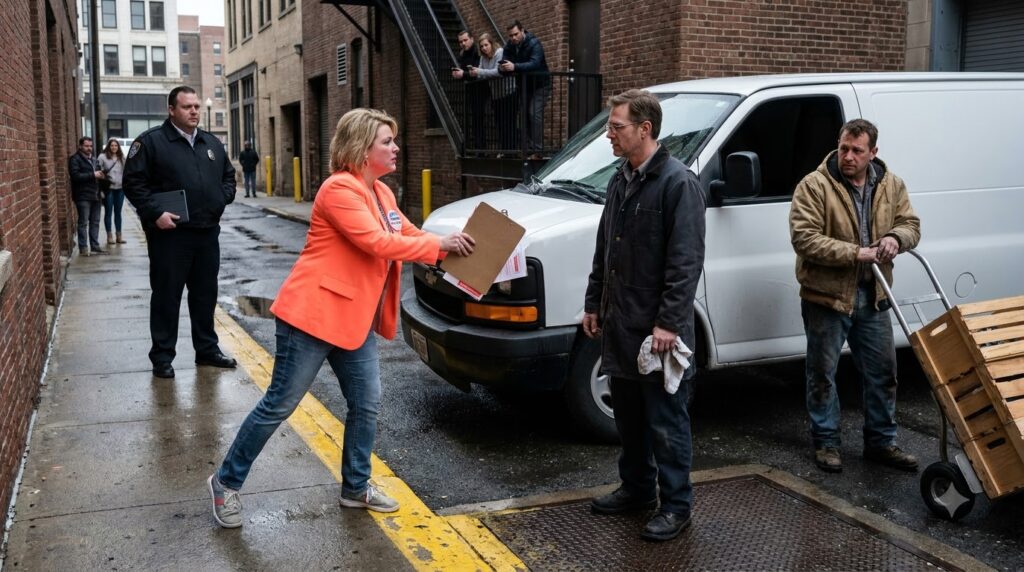
The finality of Officer Harris’s words hung in the narrow corridor of brick like the heavy, stagnant air before a summer squall. Brenda stood frozen, her fingers twitching uselessly against the faux-leather clipboard as if waiting for a phantom law to materialize and rewrite the scene. But the digital tablet in Harris’s hand remained steady, glowing with the irrefutable data of municipal zoning codes, and the crowd on the iron stairwell above leaned in with silent, unblinking intensity.
Arthur did not gloat. He did not step forward to press the advantage or offer a parting jab. He simply adjusted the canvas strap of his work jacket, reached down to his hand truck, and gripped the wooden handle of his second crate. The quiet mechanics of his labor were the ultimate counterweight to her noise. Every second she spent standing there, trembling inside her blinding neon-orange blazer, was a second the city moved forward without her permission.
“Brenda,” Officer Harris said, his tone softening with a weary, professional patience that stung worse than a direct accusation. “You need to clear the right-of-way. Now. If I have to write an official obstruction citation and log this prop badge into evidence, it won’t just be a past-due utility notice you’re dealing with.”
The threat of an official paper trail—the very thing she had tried to weaponize against others—seemed to snap the last remaining wire in her mind. Her eyes widened, darting from Harris’s steady gaze to Marcus’s impassive stance in the doorway, and finally to Arthur, who looked right through her as though she were already fading into the concrete shadows.
Without a word, without a final screech or a defiant gesture, Brenda crumpled.
The fierce, manufactured posture collapsed inward. Her shoulders hitched, her jaw went slack, and the plastic novelty badge pinned to her lapel seemed to lose its pathetic luster under the midday sun. She spun on her heel, her stiletto heel catching sharply in a shallow groove of the asphalt with a dry, splintering crack. She stumbled violently, nearly pitching forward into the brick wall, before catching her balance with a frantic, ungraceful lurch.
The plastic novelty badge tore loose from her lapel, clattering against the concrete and rolling into a narrow puddle beside the curb, where it drifted unnoticed in the gray runoff.
Without looking back, Brenda bolted. Her neon-orange blazer flashed like a dying ember against the desaturated walls as she scrambled down the length of the service lane, her heels clicking in a ragged, panicked rhythm until she reached her parked luxury SUV. She wrenched the driver’s side door open with both hands, flung herself into the seat, and slammed the heavy door shut.
Seconds later, the engine roared to life with an aggressive, stuttering growl. The tires screamed against the loose gravel, spitting small stones against the brickwork as the vehicle fishtailed out of the alley and vanished around the corner into the anonymous grid of downtown traffic, leaving behind only a faint, lingering plume of blue exhaust smoke and a thick, profound silence.
Arthur let out a long, slow breath, feeling the hard knot of tension in his lower back finally begin to loosen. He didn’t smile, but a quiet, steady warmth settled behind his ribs. He gripped the handles of his hand truck and rolled the heavy wooden crate forward across the threshold into the mercantile store’s interior, the wheels humming smoothly over the clean concrete.
Marcus stepped inside behind him, closing the heavy steel door just enough to shut out the street noise while leaving the fresh morning air circulating through the lower corridor. He clapped Arthur once firmly on the shoulder, his grip strong and grounding.
“Well handled, Arthur,” Marcus said quietly. “She’s been bleeding this block dry of its patience for over a year. Nobody ever had the stomach to make her stand still long enough to look at the ground she was standing on.”
“She didn’t lose because of us, Marcus,” Arthur replied, setting his clipboard down on the receiving desk as he unlatched the first crate. “She lost because she forgot that a uniform doesn’t make the road, and a clipboard doesn’t change the deed.”
Outside, the city resumed its ordinary, relentless rhythm. The delivery vans hummed in the distance, the office workers on the stairwell turned back toward their desks with quiet murmurs, and the yellow commercial line on the pavement sat clean, unbothered, and entirely free. Bullies only hold the keys to the kingdom as long as everyone else agrees to stay locked outside; once the door is pushed open, the walls are nothing more than dust and painted lines.








