
CHAPTER 2: THE ANCHOR ON THE PORCH
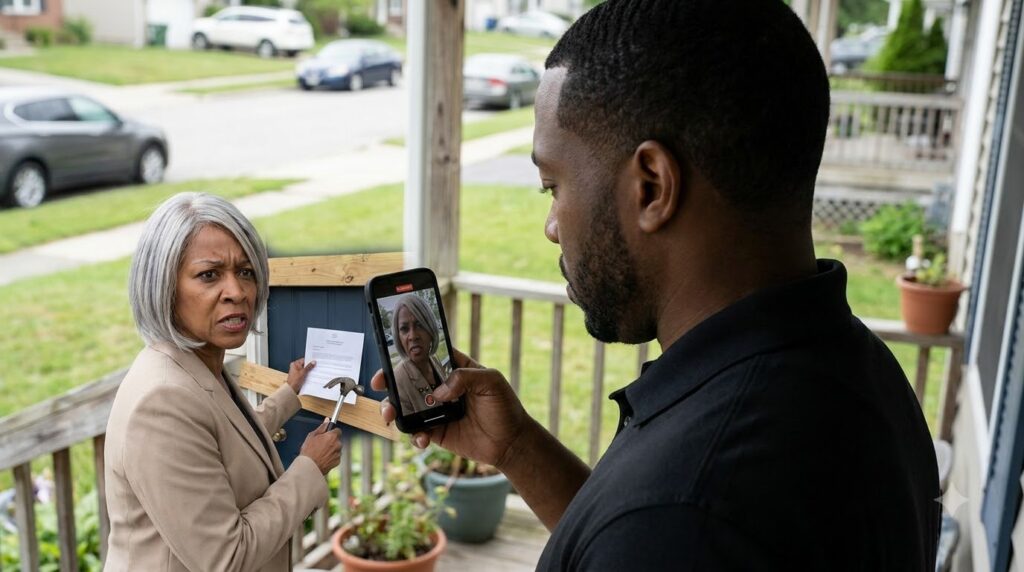
“You are fifty-two days past the curing window, Mark,” Evelyn said, her voice dropping into a flat, practiced cadence that sounded like a deposition transcript. She didn’t lower the claw hammer. The polished steel head glinted in the harsh midday light, resting an inch from the dark blue door casing. “The Board gave you written notice on the twelfth. You chose to pour unapproved masonry on a secondary structure.”
“I replaced rotting pine with concrete,” Mark said. He didn’t shift his weight. The soles of his work boots were glued to the red brick step, the heat of the clay burning right through the thick rubber. He raised the smartphone three inches higher, centering Evelyn’s face and the raw pine board in the frame. “And this isn’t a secondary structure. This is my front door. My kids are inside that house.”
Evelyn’s chin tilted up, just enough for the midday sun to flash off the lenses of her reading glasses. She reached into the left pocket of her beige blazer with her free hand, her fingers rustling against a stiff sheet of paper. For a fraction of a second, the corner of a yellow legal pad slipped into view—unstamped, handwritten, and lined with dense black ink—before she shoved it deeper into the lining and pulled out her printed HOA notice instead.
“The covenants grant the Architectural Committee emergency lien status in cases of willful structural alteration,” she said, her voice entirely unbothered by the lens pointed at her throat. “When a resident refuses access for inspection, the property is deemed abandoned and subject to protective seal.”
“Read the deed, Evelyn,” Mark said. He kept his elbow locked into his ribcage, tracking the tiny movement of her thumb against the handle of the hammer. “You have no right of entry. You have no right of seizure. And if you don’t take those two-by-fours down in sixty seconds, I’m calling the county sheriff.”
“Call them,” she replied instantly. The response came out too fast, too smooth, like a line she’d rehearsed in the mirror before driving over. “Deputy Miller knows the bylaws. He’s enforced four Board closures in the Estates this year alone. Your title is encumbered, Mr. Vance. You signed the master deed when you bought the parcel.”
Behind the thick glass of the sidelight window, Lily’s face pressed harder against the pane. Her small mouth opened, shaping the word Daddy against the glass, leaving a faint circle of condensation that evaporated in the heat. Beside her, Toby’s fingers hooked around the brass interior latch, twisting it back and forth, but the latch was deadlocked against the pressure of the pine boards nailed across the exterior frame. The door couldn’t yield an eighth of an inch.
Mark’s chest tightened, a cold, sharp knot pulling tight beneath his black polo shirt. He felt the familiar weight of the past six months settling on his shoulders—the stack of rejected permit slips, the registered letters marked Non-Compliant Color Palette, the fifty-dollar daily fines for the porch railing he’d spent two weeks welding after Sarah died. He’d built that railing out of solid wrought iron so the kids wouldn’t fall off the edge when they played outside in the evenings. Evelyn had cited it because the scrollwork wasn’t on the approved vendor list.
“I’m not arguing about the paint, Evelyn,” Mark said quietly. “I’m telling you that you’ve trapped two minors inside a residential structure.”
“They have a rear exit,” she said smoothly, tapping the paper against her knee.
“The rear exit is deadbolted from the inside with a key lock,” Mark said. “Which you’d know if you were an inspector instead of a trespasser.”
A low murmur rippled from the driveway mouth. Mrs. Gable, who lived two doors down at 412, had stepped out of her sedan. Her phone was up, her pale face strained as she looked from the raw lumber on the door to the small hands pressing against the glass. Behind her, a delivery van slowed to a crawl in the middle of the cul-de-sac, its engine idling with a wet, heavy diesel rattle.
Evelyn glanced toward the street for a brief micro-second, her nostrils flaring. For the first time, the rigid posture of her spine stiffened just a fraction. She didn’t lower the hammer, but her fingers tightened on the hickory handle until her knuckles turned the color of chalk.
“This is a civil matter,” Evelyn said, addressing the gathering crowd as much as Mark. “The Board is acting well within its statutory authority to protect community property values.”
“Then keep standing there,” Mark said, his thumb hovering over the screen. He tapped the dial pad without breaking eye contact with her. He pressed three digits he’d hoped he’d never have to use on his own front lawn. He set the call to speaker, the sharp, rhythmic ringing tone blasting out of the phone’s bottom speaker into the heavy summer air.
Evelyn didn’t move, but her eyes locked onto the yellow pad sticking out of her blazer pocket. She adjusted her grip on the hammer, the iron head resting heavily against the top nail, holding her ground like an officer waiting for a cavalry that she was dead certain was coming down the street.








