CHAPTER 3: THE MIDNIGHT THEFT
The sun didn’t just set; it bruised the horizon, leaving behind a deep, indigo twilight that made the suburban street feel longer, colder, and increasingly unfamiliar. David sat in the darkened living room, his back against the cool plaster of the wall, watching the street through a two-inch gap in the blinds. The neighborhood was quiet, but it was the kind of artificial, held-breath silence that preceded a storm.
He didn’t turn on a lamp. The only illumination came from the faint, pulsing blue light of his laptop screen, where he was cross-referencing the county’s current digital deed repository with the grainy, scanned PDFs he’d managed to pull from the archives. The discrepancy was there, glaringly obvious now that he knew where to look. The 1994 variance Brenda claimed to possess was missing from the master index, replaced by a series of administrative “void” stamps that looked suspiciously like they’d been added manually to the physical files.
A soft click sounded from the porch. Sarah moved through the room like a shadow, her hand finding his shoulder in the dark. She didn’t speak, but he felt the weight of her anxiety. She held her smartphone, the screen dark, but he knew the SD card was already backed up to three separate cloud locations.
“She’s watching,” she whispered, her voice barely audible over the hum of the refrigerator. “She hasn’t left her house since the police left this afternoon.”
“She’s waiting for the cover of dark,” David replied. He pushed himself off the wall, his joints stiff, his mind locked into a defensive, sovereign mode. He wasn’t going to wait for another patrol to be dispatched to a “threat” that didn’t exist. He had to know if that rusted cap in the dirt was a genuine boundary marker or the pivot point for Brenda’s entire delusion.
They moved to the back door, the motion silent, practiced. The air outside felt heavier than it had during the day, smelling of wet asphalt and cooling iron. The backyard was a patchwork of gray shadows. The newly driven orange flags fluttered in the light breeze, a row of bright, artificial sentinels marking the territory he had paid to own.
As they rounded the corner of the garage, David stopped.
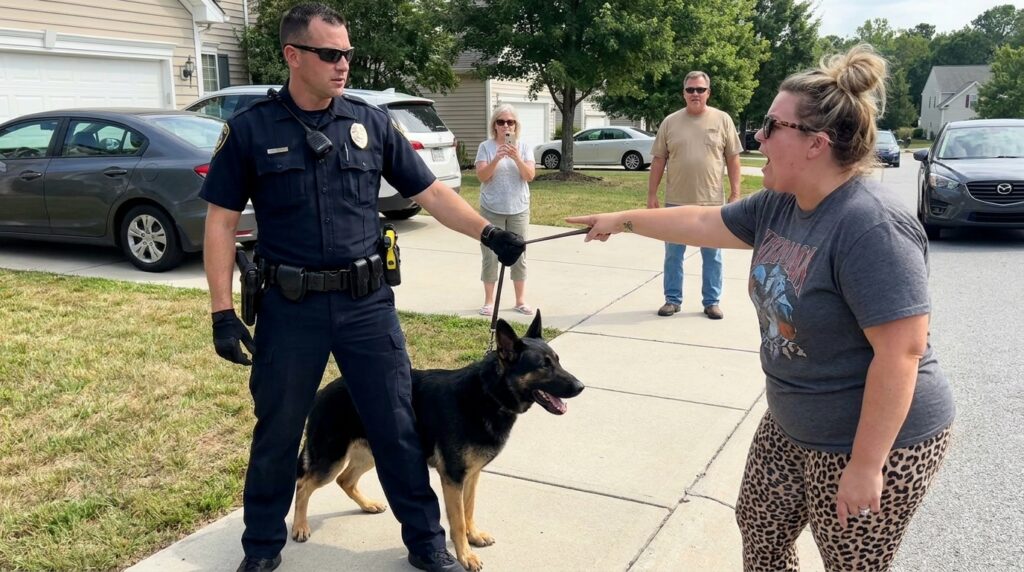
A figure was already kneeling at the property line. The woman—her frame unmistakable even in the deep indigo dark, her leopard-print leggings blending into the shadows of the bushes—was working with a jagged, sharpened piece of steel. She wasn’t just pulling the stakes; she was digging. Her hands moved with a rhythmic, frantic violence, tossing clods of dry earth over her shoulder, her breath coming in short, harsh rasps.
She wasn’t looking for the flags. She was reaching for something deeper.
David’s pulse hammered in his throat—a steady, rhythmic drum of pure, unadulterated friction. He stepped forward, his boots crushing a dried leaf, and the woman froze. She didn’t scream. She didn’t run. She turned her head slowly, the moonlight catching the hard, unyielding glass of her sunglasses, which she hadn’t bothered to remove even in the dead of night.
“You’re trespassing, Brenda,” David said. His voice was low, devoid of emotion, the voice of a man who had long since stopped trying to reason with the wind.
She stood up, holding a clump of dirt in one hand and the rusted metal cap—the same one David had spotted earlier—in the other. It was clearly marked with a faded, embossed year that didn’t match the modern zoning maps. She stood her ground, her back arched, her jaw set in a line of defensive iron.
“This isn’t your dirt,” she hissed, the words dripping with a manic, singular purpose. “This is the anchor. You pull this, and you pull the truth out with it. You don’t know what you’re doing, David. You don’t know what it cost to hold this line.”
“Put it down,” David said, moving into her personal space. He was a head taller, his posture solid, a wall of pragmatism against her fraying madness. “Whatever your husband did to secure this lane, it ends tonight. The sheriff is on speed-dial, and the county surveyor is coming back at eight in the morning with a radar sweep. There’s nowhere left to hide the variance.”
She laughed—a dry, hacking sound that had no humor in it. She threw the rusted cap at his feet. It landed with a dull, heavy thud in the soft dirt, the sound of dead metal against dead earth. “Radar? You think a machine can find a lie that’s been buried for thirty years?”
She stepped back, her silhouette shrinking into the darkness of the bushes, leaving him standing over the unearthed metal—the first physical piece of her “truth.” He reached down to grab it, his fingers brushing against the cold, scaling oxidation, when he felt the ground beneath the cap yield. It wasn’t solid. There was a void beneath the surface, a hollow resonance that didn’t belong in a suburban lawn.
He hadn’t found a boundary marker. He’d found a burial site for a secret that was never meant to be unearthed.
The air turned suddenly sharp, the smell of damp, ancient soil rising to meet him. Before he could call out to Sarah, a bright, sweeping beam of light cut through the dark—not from his own flashlights, but from a cruiser idling at the curb, its blue and red strobes kicking into life, casting long, violent shadows across the yard.
Brenda hadn’t just been waiting for the dark. She’d been waiting for the exact moment he touched the site, turning his defensive posture into an act of physical disturbance that the police were now arriving to witness.