
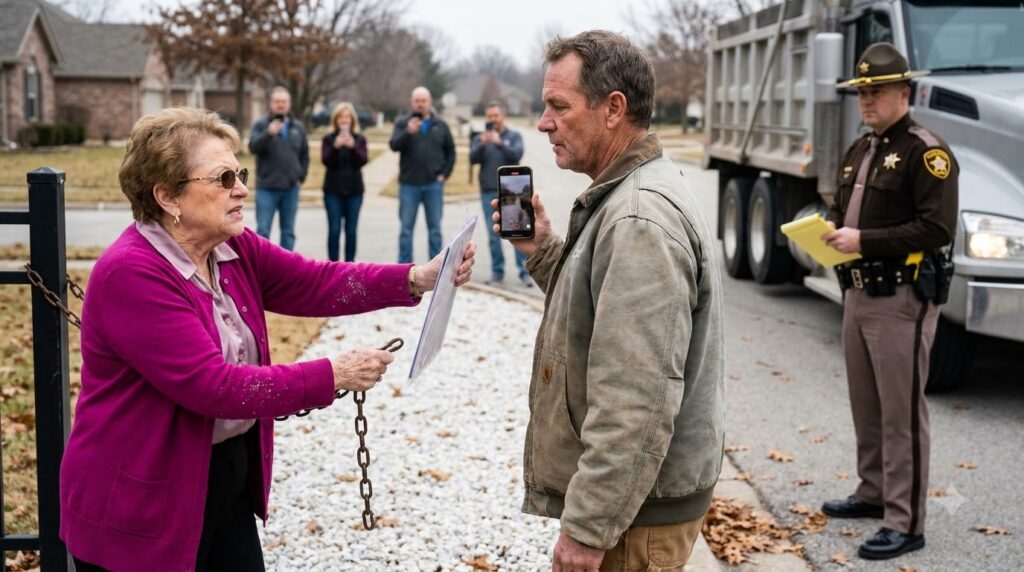
CHAPTER 5: THE UNBROKEN LINE
The rumble of the diesel engine faded entirely down St. Jude Lane, leaving behind the faint, lingering smell of unburnt exhaust and sun-baked limestone.
Julian stood at the foot of his gravel drive. In his right hand, he held the certified county survey map with its crisp red boundary lines; in his left, the crumpled, yellowed medical billing summary stamped UNCOLLECTIBLE.
Deputy Hayes’s cruiser remained idling at the curb, its amber lights clicking in steady, silent pulses. Hayes finished writing on his clipboard, tore off a yellow carbon copy, and walked across the asphalt toward Brenda’s porch.
Across the street, Brenda sat on her top wooden step, her pastel cardigan pulled tight around her waist, her knees drawn up against her chest. She didn’t look up when Hayes approached. She took the official trespass citation without a word, laying it face-down on the grass beside her overflowing leather folder.
Julian watched Hayes climb back into the cruiser and pull away, his tires crunching softly over the loose gravel at the corner of the cul-de-sac. One by one, the neighbors drifted back toward their front doors. Mr. Abernathy clicked off his lawnmower handle. Mrs. Gable lowered her phone and vanished behind her screen door. Within five minutes, St. Jude Lane returned to its usual mid-morning quiet—the suburban illusion restored, neat and undisturbed on the surface.
Julian didn’t go inside his house. He walked down the gravel path toward his rear barn, his work boots sinking into the white river stone his father had dumped and smoothed thirty years ago.
Inside the barn, the air was cool and smelled of old motor oil, dry sawdust, and rusted iron. Sunbeams streamed through the high wooden rafters, illuminating dust motes dancing in the stillness. Julian stopped at his father’s old workbench. Laid across the worn oak planking were Arthur Mercer’s hand tools: heavy steel wrenches, a handheld welding torch with a tarnished brass nozzle, and an unpolished iron latch pin meant to reinforce the gate fence.
Julian set the two papers side by side on the workbench: the forged easement with its fake notary seal, and the medical bill from St. Thomas.
He sat down on the wooden stool, the phantom ache in his left knee throbbing softly in the quiet.
He thought about August of twenty-twenty-two. He remembered sitting in the plastic chair in Room 412, listening to the monotonous, rhythmic beep of his father’s heart monitor while nurses rushed down the hallway outside. He remembered the suffocating terror of holding a power-of-attorney document, terrified that one wrong signature would forfeit his father’s house to pay the hospital system.
He had survived that room. His father hadn’t.
And three blocks away, in the very same month, Brenda Hollings had sat in a nearly identical room at St. Thomas, watching Harold’s monitors fade while the collection notices piled up in her mailbox. She had come home to an empty house, a son struggling to hold onto a failing van service, and an association board that demanded she maintain the polished, unyielding facade of suburban perfection.
She had chosen to forge the easement not out of cold, calculated malice, but out of the sheer, panicked instinct of a mother watching the last pillar of her life crumble into dust. It didn’t make the forgery right. It didn’t make the clipped gate lock legal. But it stripped away the monster Brenda had tried to project, leaving only the jagged, broken edges of a human being caught in the gears of a system that cared nothing for limestone or grief.
Julian picked up the medical bill, folded it neatly into thirds, and tucked it into his jacket pocket.
He walked out of the barn, down the two hundred feet of gravel, and stepped past the wrought-iron gate post onto the public asphalt of St. Jude Lane.
Brenda was still sitting on her porch step, her shoulders stooped, staring blankly at the white driveway across the street.
Julian crossed the road. His boots made no sound on the warm pavement. He stopped at the edge of her lawn, ten feet back, giving her space.
Brenda didn’t move. Her voice was barely a whisper, rasping and dry. “Are you calling the county prosecutor, Julian? Going to take the house too?”
Julian reached into his canvas jacket. He didn’t pull out his phone or a legal summons. He pulled out the laminated hospital bill from St. Thomas and laid it gently on the bottom step, beside her leather binder.
Brenda looked down at the yellowed paper. Her breath caught in her throat. Her hand trembled as she reached out, her fingers touching the plastic laminate like she was touching a scar.
“My dad was in bed four,” Julian said softly. He looked up at the quiet roofs lining St. Jude Lane, the warm morning sun turning the oak leaves to gold. “He didn’t want a monument, Brenda. He just wanted a fence that kept the wind off the barn.”
Brenda’s shoulders hitched. A single tear tracked through the dust on her cheek, but she stayed silent, holding the paper tight against her chest.
“The trespass warning stays with Hayes,” Julian continued, his voice calm, steady, anchored in the dirt beneath their feet. “And your son’s vans don’t park on my gravel. But I won’t file the civil suit for damages. And I won’t submit the forgery to the county attorney.”
Brenda looked up at him through her crooked, dark glasses, her lips parting in shock. “Why?”
Julian looked back toward his driveway—toward the heavy iron gate, the white limestone, and the quiet line his father had drawn in the earth thirty years ago.
“Because my dad always said a boundary isn’t built to keep people out,” Julian said, his voice carrying the deep, quiet weight of a man who had finally laid his ghosts to rest. “It’s built so you know where your home ends, and where you have to start helping your neighbor.”
He turned and walked back across St. Jude Lane, pulling his father’s gate closed behind him. The iron latch clicked shut—solid, unbroken, and permanent.








