
CHAPTER 3: The Fractured Public
“You aren’t clearing anyone out, Brenda.”
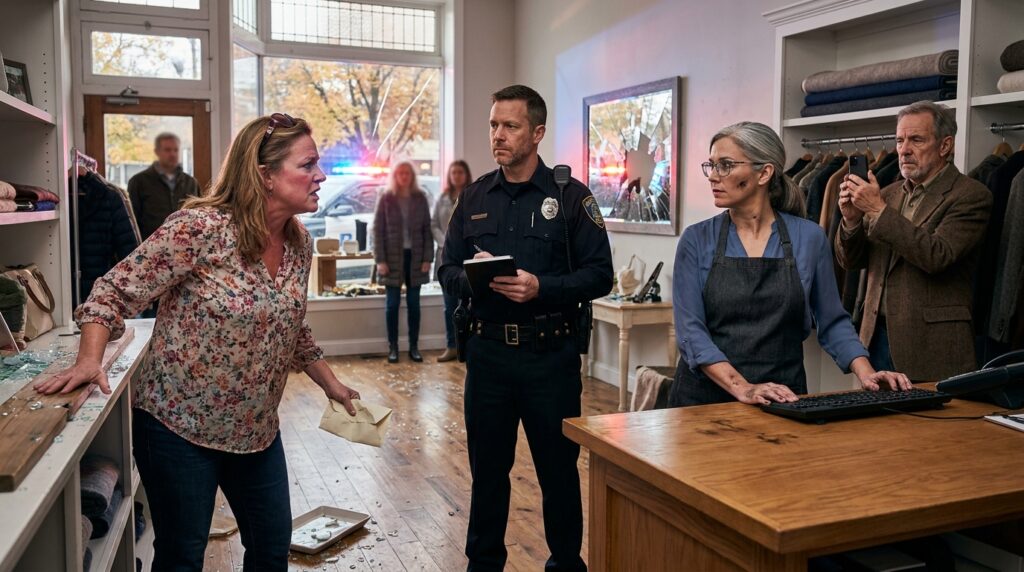
The rattle of the front door subsided into a low, metallic groan as the autumn draft died away, leaving the interior of the boutique suspended in a tight, breathless silence. Clara didn’t move from behind the cutting table. Her fingers maintained their firm, steady purchase on the edge of the polished oak, grounding herself against the rising tide of hostility.
Brenda recovered her footing instantly, her face mottling into an ugly, mottled flush. The brief flash of panic that had crossed her features when the door rattled vanished beneath a fresh layer of defensive fury. She took another sharp step forward, her designer heels biting into the floorboards with calculated malice.
“You think a polite tone and a sewing machine give you tenure on this block?” Brenda raised her voice, pitching it deliberately to carry toward the two customers standing frozen near the coat racks. “Listen to her, everyone. She’s sitting on community real estate while young people in this town starve for opportunities. She refuses to adapt, she refuses to sell, and she expects us all to bow down to her mediocrity.”
The two customers—longtime residents who usually exchanged pleasantries with Clara on Saturday mornings—shifted uncomfortably, avoiding eye contact. The psychological weight of a public shaming campaign was a heavy instrument, and Brenda wielded it like a blunt weapon.
Clara felt a cold spike of adrenaline sharpen her focus. She recognized the maneuver. It wasn’t about Maya; it never had been. It was about dominance, about rewriting the narrative of the street so that anyone who held a small, independent space was made to feel like an illegal squatter on land rightfully coveted by the loud and the connected.
“My lease is fully paid, my permits are current, and my doors are open to paying patrons—none of which includes you or your daughter,” Clara said, her voice cutting through the shop like a well-oiled blade. She didn’t shout; she didn’t need to. The quiet precision of her refusal exposed the theatrical hollowness of Brenda’s performance. “If you have grievances regarding commercial zoning, the municipal building is four blocks down on Main Street. Take your grievances there, or take them outside.”
Maya finally stirred, looking up from her phone with a vacant, miserable sigh. “Mom, can we just go? This is embarrassing.”
“Shut up, Maya,” Brenda snapped without looking back, her eyes locked onto Clara with venomous intensity. “You have no idea what’s coming, Clara. You think you’re untouchable because you survived ten years of small-town stagnation? I happen to know people on the redevelopment advisory committee. People who can make sure your inspections double, your utility lines get ‘reassessed,’ and your little boutique becomes entirely unviable by winter. Consider this a final, friendly warning before things get very expensive for you.”
As Brenda shifted her weight to deliver her final threat, her heavy leather handbag swung wide, catching the edge of a display stand. A small, cream-colored envelope slipped loose from the side pocket, tumbling silently onto the hardwood floor right at the base of the cutting table.
Clara’s eyes tracked the falling object with clinical detachment. The envelope landed face-up, revealing a bold, embossed header from the Commonwealth Trust & Savings Bank, stamped with a prominent NOTICE OF DEFAULT AND INTENT TO ACCELERATE.
Brenda’s face went completely bloodless. In a flash of panicked motion that completely belied her dignified posturing, she lunged forward, snatching the envelope off the floor before Clara could read another line, crushing the heavy paper furiously in her fist and shoving it deep into her coat pocket.
“Keep your eyes to yourself, you miserable seamstress,” Brenda hissed, her voice cracking slightly under the sudden weight of exposure.
Clara simply stared at her, the pieces clicking together with chilling clarity. The desperation, the unhinged demand for an immediate, turnkey business, the frantic projection of failure—it wasn’t about ambition. It was about survival. Brenda Miller was drowning in red ink, and she intended to use Clara’s life’s work as a lifeboat.








