
The Weight of an Inch: When Entitlement Meets the Unyielding Steel of Earned Labor

CHAPTER 1: The Cutting Table

The hum of the vintage sewing machine was a steady, rhythmic pulse that kept the world at bay. Clara Vance didn’t look up when the brass bell above the door chimed; she was in the final, delicate stage of turning a heavy wool hem, her ink-stained thumb pressing the fabric flat against the polished oak of her cutting table. For ten years, this small-town storefront had been her fortress of wool, chalk, and salt-air linen. It was a space carved out of endless early mornings and bruised fingertips.

Then came the sharp, deliberate clack of designer heels hitting the floorboards—a sound entirely too aggressive for a Tuesday afternoon.

Clara kept her eyes on the seam, guiding the needle with practiced precision. “Give me just a moment,” she said, her voice even, devoid of retail servility. “If you’re dropping off dry cleaning, the drop box is by the register.”

“I am not dropping anything off, Clara. And I suggest you put down those shears before you hurt yourself trying to look busy.”

The voice was lacquered, coated in the unmistakable varnish of someone who treated the entire county as her private drawing room. Clara slowly lifted her gaze over the rim of her silver-rimmed glasses.

Brenda Miller stood anchored directly in front of the cutting board, her floral-print blouse stiff with starch, oversized sunglasses shoved up onto a spray-tanned forehead. Behind her, scrolling mindlessly on a glowing smartphone screen, stood eighteen-year-old Maya, looking as though she had been dragged to the executioner’s block and found it intensely boring.

Clara didn’t flinch. She let the heavy steel shears rest against the wood, the cold metal catching the weak autumn light slanting through the storefront window. “Brenda. If you’re looking for custom alterations, my backlog is currently three weeks out.”

“We aren’t here for alterations,” Brenda said, stepping closer, invading the invisible perimeter Clara had spent a decade drawing around her workspace. She crossed her arms, her diamond-encrusted rings clicking against her sleeves. “Maya turned eighteen this weekend. She needs a proper start in life, something stable, and frankly, you’ve been rattling around this dusty shop long enough. We’ve decided it’s time for you to hand the lease and the inventory over to her.”

The silence that rushed into the room was absolute. Across the shop, two regular customers leafing through a rack of winter coats froze, their hands hovering over the hangers.

Clara stared at her, her mind refusing to translate the sentence into any language rooted in reality. She let out a slow, measured breath, feeling the pulse throb softly at her temple. “I’m sorry,” Clara said softly, her voice dropping an octave into dangerous calm. “I must have missed the part where my life’s work became a community handout.”

Brenda smiled, a tight, patronizing curl of the lips that didn’t reach her eyes. But as Clara leaned forward against the table, her eyes narrowing with a quiet, calculated sharpness, Brenda’s smile faltered for a fraction of a second, revealing a sudden, frantic twitch in her jawline that she masked instantly by raising her voice.


CHAPTER 2: The Stolen Lease

“You’re wasting your prime years here, so just sign the shop over to my daughter and let someone competent run it.”

The words hung in the narrow aisle between the cutting table and the winter coat rack like a thrown blade. Clara didn’t blink. Through the lenses of her silver-rimmed glasses, Brenda Miller’s face looked remarkably tight—the skin around her eyes drawn too thin, as if her entire expression was held together by expensive thread and sheer, unadulterated panic.

Clara shifted her weight, her hand resting flat against the cool grain of the oak table. She could feel the vibration of the antique sewing machine motor still humming softly beneath the floorboards, a steady heartbeat that contrasted sharply with the shrill, artificial cadence of the woman standing before her.

“Competent,” Clara repeated, the word tasting like dry ash. She let the silence stretch, watching Brenda’s manicured fingers twitch against the strap of her oversized leather handbag. A small detail caught Clara’s eye: peeking out from the suede pocket of Brenda’s bag was the corner of a heavy, cream-colored envelope bearing the distinct, dark-red stamp of a regional banking institution—not a boutique bill, but a notice of default. It vanished as Brenda abruptly jerked her arm away.

“People in this town are tired of stale shopfronts run by women who refuse to expand,” Brenda snapped, her voice rising to catch the attention of the two regular customers lingering near the front window. “Maya has modern ideas. She understands market flow. You’re squatting on commercial space that belongs to someone with actual vision.”

Behind her mother, Maya didn’t look up from her phone. Her thumb swiped endlessly across the glowing screen, a picture of absolute, rehearsed detachment. She had played this role in a hundred domestic dramas before—the prop utilized to legitimize an absurdity.

“If my space has such wonderful vision, Brenda, you are entirely free to rent a vacant storefront down on Fourth Street,” Clara said, her tone dropping into a low, measured register that forced Brenda to lean in slightly just to catch it. “Though I imagine the landlords down there require a credit check rather than a theatrical performance.”

Brenda’s chest heaved. The spray-tanned skin across her forehead flushed a dull, mottled crimson. For a second, the polished mask cracked entirely, revealing the frantic, trapped look of a predator who had cornered the wrong animal.

“You think you’re clever because you’ve spent ten years stitching hems for old ladies,” Brenda hissed, taking a sudden step forward, her shoe heel clicking sharply against the wood. “You have no idea what’s coming for this block. By next month, the zoning board is going to reevaluate every commercial lease on this strip. If you don’t hand it over voluntarily now while you have a shred of dignity left, you’ll walk away with nothing. Absolutely nothing.”

Clara didn’t back down an inch. She held her ground against the cutting table, her posture rigid, her mind calculating the exact distance between Brenda’s erratic movements and the glass display case behind her. “Then I suggest you take your daughter, your modern ideas, and your empty threats out through that front door before I save the zoning board the trouble of clearing you out.”

Brenda opened her mouth to retort, her breath catching in her throat as the front door rattled violently in its frame under a sudden gust of autumn wind. The sound startled Maya enough to finally drop her phone to her side, her eyes darting between her mother and the shattered reflection in the window glass.

CHAPTER 3: The Fractured Public

“You aren’t clearing anyone out, Brenda.”

The rattle of the front door subsided into a low, metallic groan as the autumn draft died away, leaving the interior of the boutique suspended in a tight, breathless silence. Clara didn’t move from behind the cutting table. Her fingers maintained their firm, steady purchase on the edge of the polished oak, grounding herself against the rising tide of hostility.

Brenda recovered her footing instantly, her face mottling into an ugly, mottled flush. The brief flash of panic that had crossed her features when the door rattled vanished beneath a fresh layer of defensive fury. She took another sharp step forward, her designer heels biting into the floorboards with calculated malice.

“You think a polite tone and a sewing machine give you tenure on this block?” Brenda raised her voice, pitching it deliberately to carry toward the two customers standing frozen near the coat racks. “Listen to her, everyone. She’s sitting on community real estate while young people in this town starve for opportunities. She refuses to adapt, she refuses to sell, and she expects us all to bow down to her mediocrity.”

The two customers—longtime residents who usually exchanged pleasantries with Clara on Saturday mornings—shifted uncomfortably, avoiding eye contact. The psychological weight of a public shaming campaign was a heavy instrument, and Brenda wielded it like a blunt weapon.

Clara felt a cold spike of adrenaline sharpen her focus. She recognized the maneuver. It wasn’t about Maya; it never had been. It was about dominance, about rewriting the narrative of the street so that anyone who held a small, independent space was made to feel like an illegal squatter on land rightfully coveted by the loud and the connected.

“My lease is fully paid, my permits are current, and my doors are open to paying patrons—none of which includes you or your daughter,” Clara said, her voice cutting through the shop like a well-oiled blade. She didn’t shout; she didn’t need to. The quiet precision of her refusal exposed the theatrical hollowness of Brenda’s performance. “If you have grievances regarding commercial zoning, the municipal building is four blocks down on Main Street. Take your grievances there, or take them outside.”

Maya finally stirred, looking up from her phone with a vacant, miserable sigh. “Mom, can we just go? This is embarrassing.”

“Shut up, Maya,” Brenda snapped without looking back, her eyes locked onto Clara with venomous intensity. “You have no idea what’s coming, Clara. You think you’re untouchable because you survived ten years of small-town stagnation? I happen to know people on the redevelopment advisory committee. People who can make sure your inspections double, your utility lines get ‘reassessed,’ and your little boutique becomes entirely unviable by winter. Consider this a final, friendly warning before things get very expensive for you.”

As Brenda shifted her weight to deliver her final threat, her heavy leather handbag swung wide, catching the edge of a display stand. A small, cream-colored envelope slipped loose from the side pocket, tumbling silently onto the hardwood floor right at the base of the cutting table.

Clara’s eyes tracked the falling object with clinical detachment. The envelope landed face-up, revealing a bold, embossed header from the Commonwealth Trust & Savings Bank, stamped with a prominent NOTICE OF DEFAULT AND INTENT TO ACCELERATE.

Brenda’s face went completely bloodless. In a flash of panicked motion that completely belied her dignified posturing, she lunged forward, snatching the envelope off the floor before Clara could read another line, crushing the heavy paper furiously in her fist and shoving it deep into her coat pocket.

“Keep your eyes to yourself, you miserable seamstress,” Brenda hissed, her voice cracking slightly under the sudden weight of exposure.

Clara simply stared at her, the pieces clicking together with chilling clarity. The desperation, the unhinged demand for an immediate, turnkey business, the frantic projection of failure—it wasn’t about ambition. It was about survival. Brenda Miller was drowning in red ink, and she intended to use Clara’s life’s work as a lifeboat.

CHAPTER 4: The Shattered Mirror

The silence that followed the glimpse of the bank’s default notice did not last. It cracked open with the sudden, violent velocity of a cornered animal realizing the trap had closed.

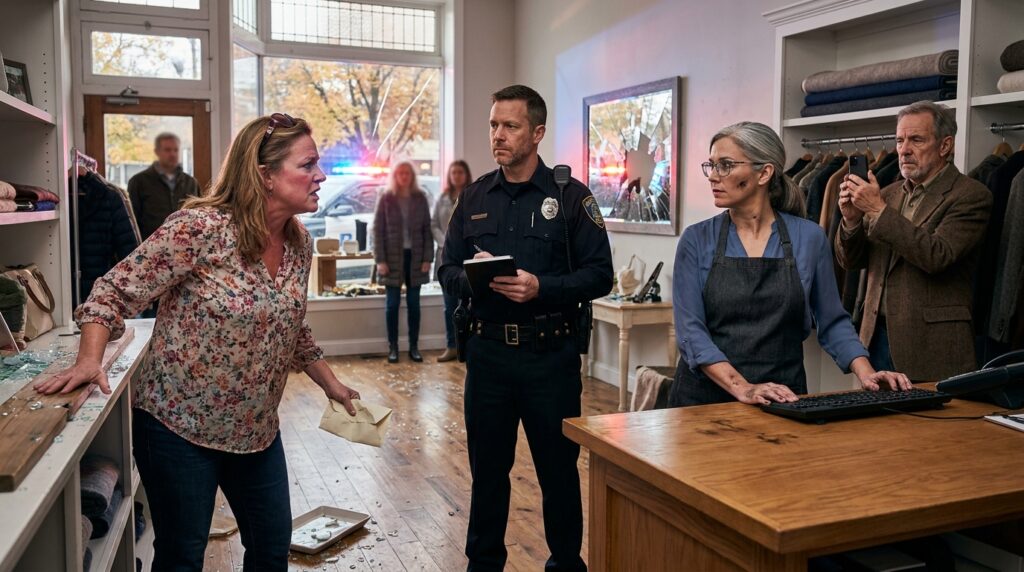
Brenda’s face twisted past mere anger into something raw and unrecognizable. The sight of Clara holding all the cards—knowing the pristine surface of her life was nothing more than a fresh coat of paint over rotting timber—shattered whatever fragile control she had left. Without a word of warning, her hand shot out, sweeping across the nearest display pedestal. A heavy, decorative ceramic tray laden with seasonal merchandise flew off the wood, spinning through the air before slamming directly into the antique French-plate mirror mounted on the wall.

The impact sounded like a gunshot.

The glass didn’t just crack; it exploded outward in a spiderweb of razor-sharp shards, raining down across the hardwood floor with a deafening clatter of splintered wood and glittering debris. Across the boutique, the remaining customers shrieked, scrambling backward into the clothing racks as fabric hangers rattled furiously against their metal rails. Maya let out a sharp, choked gasp, dropping her phone as she stared at her mother in sheer disbelief.

Clara didn’t flinch. Even as a stray sliver of glass pinged off the rim of her glasses, her posture remained locked to the cutting table. Her mind calculated the physics of the escalation with cold, surgical precision: property destruction, public endangerment, witnesses by the rack, and an aggressive refusal to vacate. The game Brenda thought she was playing had just crossed the threshold from theater into criminal reality.

“You absolute lunatic!” Clara’s voice cracked through the ringing space, hard and unforgiving as iron. She stepped out from behind the cutting table, her boots crunching over the fresh glass field. “You have completely lost your mind. Get out of my shop right now, or the next voice you hear will be a police dispatcher.”

Brenda stood chest-heaving amid the wreckage, her designer blouse dusted with fine white plaster and glass dust, her hair coming loose from its tight styling. Instead of shrinking back, she threw her head back with a manic, defensive laugh that sounded entirely unhinged.

“You think you can threaten me?” Brenda shrieked, pointing a trembling, manicured finger straight at Clara’s chest, her voice echoing off the high ceiling. “Look at this dump! You brought this on yourself by hoarding a business you don’t deserve. I’m going to make sure the town council revokes every permit you own before the week is out. You’re nothing! A low-rent tailor playing shopkeeper!”

“She’s not a shopkeeper, lady. She’s recording you right now, and so am I,” a sharp, gravelly voice cut through the chaos from near the doorway.

One of the regular customers—an older man who had been silently watching the entire exchange—held his phone high, the red recording light blinking steadily against the dim afternoon shadows. Next to him, another patron was already pressing the keypad to dial emergency services, her hands shaking slightly but her eyes locked firmly on Brenda.

Brenda spun around, her eyes widening as she realized the invisible boundary of her social immunity had just dissolved into a ring of hostile witnesses and active cameras. The realization that she was no longer the accuser, but the cornered subject of an unspooling public record, hit her with visible physical force. She stepped back, her heels catching on the shattered ceramic, nearly losing her footing before righting herself with a harsh, desperate gasp.

“This isn’t over,” Brenda choked out, her voice dropping an octave as she grabbed Maya by the forearm, yanking the dazed teenager toward the front door. “You haven’t seen the last of this, Clara. Not by a long shot.”

Clara watched them go, not moving an inch as Brenda shoved the front door open, the brass bell clattering wildly in a frantic, unharmonious rhythm before swinging shut against the frame. The heavy dust settled slowly over the shattered glass, leaving the boutique quiet once more, save for the heavy, collective breathing of the witnesses standing frozen in the aisles.

CHAPTER 5: The Weight of Evidence

The wail of a siren didn’t announce itself from blocks away; it tore through the damp autumn air and cut out abruptly right outside the storefront window. Red and blue emergency strobes painted the shattered remnants of the front mirror in frantic, alternating flashes, casting long, fractured shadows across the bolts of linen lining Clara’s shelves.

The door swung open with a heavy thud, and Officer Marcus Reed stepped across the threshold. His boots crunched immediately into the field of sparkling glass scattered across the oak floor. His hand rested lightly, instinctively, on the utility belt at his hip, his eyes sweeping the scene with the cold, practiced detachment of a man who spent his shifts sorting through adult tantrums disguised as civic emergencies.

“Dispatch received a report of property destruction and an active disturbance,” Reed said, his voice level, carrying the dull weight of absolute authority. He looked from the jagged hole in the mirror to the trembling customers huddled by the coat racks, and finally settled his gaze on Brenda, who was still standing near the threshold with her hand locked tight around her daughter’s arm.

Brenda moved first, throwing off her defensive posture with an astonishing pivot into theatrical victimhood. She smoothed the front of her starched floral blouse with a trembling hand, her voice pitching up into a reedy, practiced tremor.

“Officer, thank God you’re here,” Brenda cried, taking a hurried step forward before a sharp crunch of glass under her heel forced her to halt. “This woman—this unhinged shopkeeper—flew into a rage because my daughter and I simply asked a routine business question. She started screaming obscenities, threw merchandise, and shattered her own display case just to frame us. Look at us! She’s hostile, she’s unstable, and she’s clearly discriminating against us because we dared question her business practices.”

A collective murmur of absolute disbelief rippled through the witnesses standing by the racks. The older man who had recorded the exchange stepped forward immediately, his phone held out like a shield.

“That is an outright lie, Officer,” the man said, his voice gravelly and firm. “I filmed the whole thing. The woman in the floral blouse demanded Clara hand over her shop, and when she got rejected, she picked up a heavy ceramic tray and threw it straight into the glass.”

Brenda’s face drained of color for the second time that day. Her mouth opened, but no sound came out as her eyes darted frantically toward the officer, searching for the familiar deference she expected from local authorities.

Officer Reed didn’t blink. He turned his steady gaze away from Brenda and looked directly at Clara, who stood motionless behind her cutting table, her posture rigid and composed.

“Is that your security system overhead, Ms. Vance?” Reed asked, pointing upward toward the small, dark lens angled into the corner of the ceiling.

“It is,” Clara replied, her voice steady and low. “It records both audio and high-definition video across the entire front floor. It captured every word of the demand, the refusal, and the exact moment the display case was destroyed.”

Brenda let out a sharp, choked breath, her composure completely dissolving. “You don’t need to look at any camera,” she stammered, her voice losing its polished veneer entirely, replaced by the desperate rasp of a cornered debtor. “It was an accident! A slip of the hand! We can settle this privately, Officer, we don’t need to involve courts or—”

“Ma’am, step back from the door and keep your hands where I can see them,” Reed instructed, his tone dropping into a flat, professional command that brooked no argument. He unclipped his notepad while stepping past her to review the wreckage.

Clara walked calmly around the cutting table, reaching down to tap a few keys on her terminal to export the digital file directly to a secure drive. As the amber progress bar crept across her monitor, she looked up, watching the heavy reality of consequence finally catch up to a woman who had spent a lifetime believing rules applied only to everyone else.

CHAPTER 6: The Unraveling Seam

The police cruiser’s tailights bled a dull, bruised crimson through the fractured glass of the storefront window, fading down the street until even the thrum of the engine dissolved into the ordinary afternoon traffic of the town. Inside the boutique, the air smelled faintly of ozone, crushed ceramic, and old linen. Clara stood behind her cutting table, her fingers tracing the edge of the polished oak where the dust had settled in thin, even layers.

The security monitor flickered once before settling into its steady, continuous loop, displaying an empty sidewalk where moments earlier an empire of bluster and entitlement had collapsed under the weight of a single digital file.

By the following morning, the mechanics of small-town information flow had completed their silent work. In a place where reputations were currency, Brenda Miller’s sudden fall was not heralded by public declarations or dramatic town meetings; it arrived in the far more devastating form of absolute silence. When Brenda walked down Main Street later that week, shopkeepers found sudden, urgent tasks behind their counters; acquaintances who had once nodded politely found deep fascination in store window displays. The default notices stacking up on her doorstep were no longer a private secret hidden behind floral blouses and designer sunglasses; they were the anchor dragging down a ship that had already taken on too much water.

Clara did not gloat, nor did she watch the street for signs of her former tormentor. She simply unrolled a fresh bolt of heavy blue wool across the cutting table, the rough texture grounding her fingers in the physical reality of labor that could neither be faked nor demanded from another. The mirror would take a fortnight to replace, and the cost of the custom French plate glass would leave a temporary dent in her monthly ledger, but every snip of the shears felt lighter, cleaner, cutting through the residual static of a conflict that had burned itself out.

On Friday afternoon, the bell above the door chimed softly, announcing a regular customer holding a winter coat that needed a reinforced button. Clara looked up, her silver-rimmed glasses catching the warm autumn light, and offered a quiet, genuine smile. The storefront hummed its familiar, rhythmic song once more—a steady pulse of thread and steel, entirely secure in the knowledge that some worlds cannot be seized by force, because they are built out of hours that belong to no one else.

Similar Posts

Leave a Reply

Your email address will not be published. Required fields are marked *






